Isn’t it time we create a labor union in Grand Rapids for those who work for Non-Profits
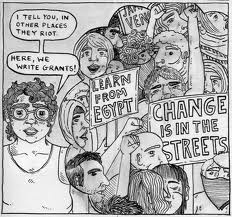 There are thousands of people in the Greater Grand Rapids area who work for a Non-Profit organization. Many of you who are reading this article work in the Non-Profit sector, and virtually everyone knows someone who works in that field.
I have worked for several different Non-profits organizations in my lifetime. I current work as a Direct Care worker for Hope Network. When there are issues or problems that those of us who are workers have to deal with, we have to either represent ourselves as individuals when speaking to management or we have to just grin and bear it.
I read a recent piece by someone who was fired by the Community Media Center here in Grand Rapids. The article provides a horrific account of what the author had to endure. The opening sentence of the article reads:
My own experience at the Wealthy Theatre, part of the Grand Rapids Community Media Center, shows how a lack of accountability for nonprofit leadership leaves open the door to ongoing abuses of power — and people.
The power that Non-Profit Directors have is similar to that of corporate CEOs, especially if the workers at said corporation don’t have a union. It’s even worse if you live in a Right to Work state, which we do here in Michigan.
However, the difference between working for a large corporation and working for a Non-Profit, is that people generally like the work and often embrace the mission of Non-Profits. In my case, I do work to provide basic daily needs to residents who have have serious injuries, plus I always try to make those I work with to feel like they are valued as a human being, even if much of the rest of the society doesn’t see them that way.
The thing that profits often do, is to take advantage of people’s good will and commitment to the mission. People go the extra mile, are willing to work long hours or put up with a dysfunctional work environment because, “at least I get to do work that makes a difference.” And while I understand this sentiment, it is deeply problematic. It is deeply problematic because it says that we are willing to accept exploitation while working for a Non-Profit.
Part of this is due to how we see and value our jobs, especially within a Capitalist system. We internalize the exploitation or we too often dismiss it as a marginal aspect of the work.
Within workplaces, we often think of labor unions as a potential benefit because they fight for better wages. This is true, but labor unions also have a history of fighting for working conditions and even a larger democratic environment. Creating a more democratic climate within Non-Profits seems like a non-brainer, but as anyone who has worked in non-profits will tell you democratic principles or horizontal organizing are rare. Non-Profits after operate like corporations, with a very top down framework, with a board of directors and often little room for those who do most of the work to have any input or say on daily tasks, on projects and on the matter of creating a work culture that is healthy and dynamic.
The experience of people working within the Non-Profit world, which has not been around all that long, has led people to refer to this field of work as the Non-Profit Industrial Complex. Part of this terminology is related to the relationship between foundations – often the primary funding sources for NPOs – and the de-politicization of work that used to be part of social movements. (See, The Revolution Will Not Be Funded: Beyond the Non-Profit Industrial Complex, a book put out by the group INCITE!)
However, I would argue that the exploitation and limited opportunities for workers to be able to defend themselves without retaliation within the Non-Profit world, is a central part of the concept of the Non-Profit Industrial Complex. The good news it, it doesn’t have to stay that way. We can create a union for Non-Profit workers.
The head of the Nonprofit Professional Employees Union (NPEU) said this in 2020:
During a two-week period in the month of April, as the coronavirus crisis raged, the economy buckled, and office workers fled to their homes, the NPEU announced seven successful union drives, boosting their number of shops by a full third. That record is likely unmatched anywhere in the union world. Blado says that the organizing at all of them had begun before the crisis, but was accelerated by the urgency of the moment. It doesn’t hurt that all of those workers now have a vehicle to participate in the conversation about when it is safe to reopen their offices. “This is exactly why people have chosen to have a union,” Blado says, “because of situations like this where management could [otherwise] make a unilateral decision.”
So, who wants to start a labor union for Non-Profit workers in Grand Rapids? Where do we start? Who can hold a meeting to convene those who labor within the Non-Profit Industrial Complex? In Grand Rapids if you want to start a business or if you want to be an entrepreneur, people will throw money at you, but the mention of organizing workers…..not so much.
Here is a link to the Nonprofit Professional Employees Union, https://npeu.org/, or we can create something new. Either way, let’s organize!!!!
What money is behind the politicians that are threatening Kent County Health Director Adam London
Last Tuesday, MLive posted a story about how Kent County Health Director Adam London has not only received verbal threats against his life, but that there was an attempt by someone to force him off the road while driving on US 131.
These kinds of threats seem to be more common, especially since the COVID pandemic began in March of 2020. The latest round of push back is coming from parents and groups like Moms for America once the new school year began.
There have been other threats against health department officials, like the threats made by State lawmakers against Adam London, in a letter that was sent to London on August 13th. The threat that four State Representatives used was framed as:
We in the Legislature are willing to use the Constitutional tools at our disposal – including the power of the purse – should a public health officer act outside the sphere of proper authority.
This letter was sign by 86th District Rep. Thomas Albert, 72nd District Rep. Steven Johnson, 74th District Rep. Mark Huizenga and 73rd District Rep. Bryan Posthumus. Now, various West Michigan news sources had reported on the letter sent to Adam London, but none of the news agencies thought to look at campaign finance records and see which individuals or which entities are the largest contributors to these four men. In other words, the “power of the purse” can work both ways.
What if the public was more aware of the money behind these elected officials? Transparency around campaign financing is a tool that popular social movements have used for decades, since it is not always enough to pressure politicians, but to pressure, expose or boycott the money that puts politicians in power. This is particularly relevant for politicians who hold local office, whether at the county or state level. Just look at the names of the organizations and individuals that have been the primary financial backers of these four State Representatives:
Rep. Thomas Albert has held office since 2015. According to Campaign Finance records, the number one contributor to Albert has been the CEO of Autocam John Kennedy, contributing $12,000. John Kennedy, has a long history of financing conservative politicians and far right policies. John Kennedy is a member of the Grand Rapids Power Structure, is deeply involved in groups like the West Michigan Policy Forum and has been one of the largest campaign contributors to State Senator Mike Shirkey, who sued Gov. Whitmer in May of 2020 over COVID mandates.
In the 2020 Election, Rep. Steven Johnson’s largest contributor was the Michigan Strategic Fund. The Michigan Strategic Fund is a Republican Political Action Committee and some of their largest contributors from West MI are the Meijer PAC ($6,000), Dan DeVos ($5,000) and Elsa Prince ($5,000) who is Betsy’s mother. The DeVos family has also been a direct campaign contributor to Steven Johnson, according to the Michigan Campaign Finance Network.
Rep. Bryan Posthumus is a relative newcomer to state office, being elected in 2020 to the 73rd District. Posthumus got in to office with money from groups like Michigan Association of Realtors, Blue Cross Blue Shield and Doug & Maria DeVos, Dan DeVos, Dick DeVos and JC Huizenga, all part of the Grand Rapids Power Structure.
In the 2020 Election, Rep. Mark Huizenga’s largest contributors were the Chatfield Majority Fund (Rep. Lee Chatfield also sued Gov. Whitmer over COVID mandates), several members of the Meijer family and several members of the DeVos family. Mark Huizenga is now running for State Senate this November and lots of big name West Michigan donors are contributing to his campaign, such as the Meijer family, virtually every member of the DeVos family, Michael Jandernoa, the Van Andel family and JC Huizenga……again, all members of the Grand Rapids Power Structure. It is also worth noting that the Great Lakes Education Project, created by Betsy DeVos, has formally endorsed Mark Huizenga for State Senate, because he, “is willing to put students and parents ahead of Michigan’s failed education bureaucracy.”
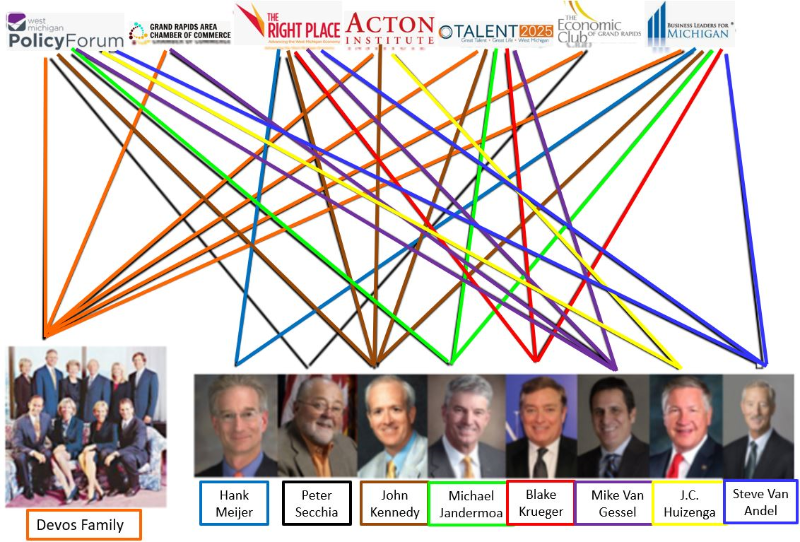
I do not want to minimize the verbal threats and road rage directed at Kent County Health Director Adam London, but the threat that comes from politicians is far greater than delusional parents. Politicians set policy, policies that have long lasting and structural impact on families and communities. However, these politicians don’t get to where they are without the funding they receive in the form of campaign contributions. When politicians make threats against public health officials, we should expose and pressure them, along with members of the West Michigan elite that endorse and condone the kind of harm that these politicians commit through public policy and public pronouncements.
The DeVos family, the Meijer family, the Van Andel family, John Kennedy, Michael Jandernoa, JC Huizenga and other member of the local power structure, need to be held accountable for their role in creating a political climate that tolerates and nurtures the kind of vitriol that has escalated in recent years.
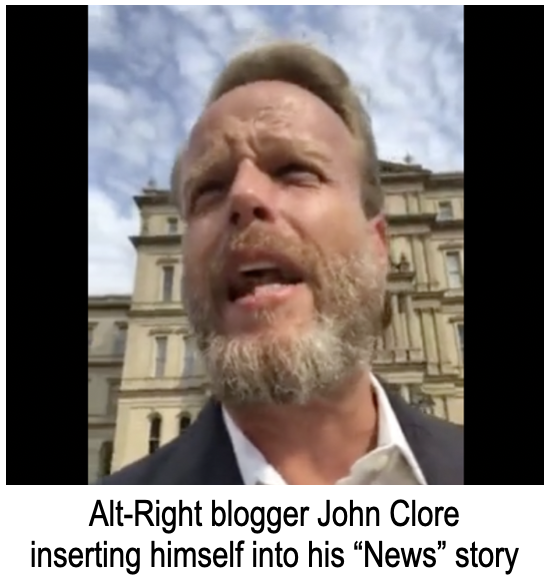
Alt-Right blogger creates a conflict at the Cosecha action in Lansing, then reports that a mob threatened him
 Last week, we reported on an action the Movimiento Cosecha organized in Lansing around their campaign to win Driver’s Licenses for All in Michigan.
There was a scheduled public hearing that day in Lansing, a hearing which was cancelled at the last minute. Despite the public hearing cancellation, Movimiento Cosecha still went inside the Capitol building to let lawmakers know they mean business.
However, before goin in the building, while still rallying outside in the plaza area in front of the Capitol, two people approached the gathering of about 150 Cosecha members and allies. The two people were talking amongst themselves and then each took out their smart phones and began video taping the Cosecha action.
I was doing crowd safety that day, so after the two unidentified people began filming the Cosecha activists, I approached one of them and asked what they were doing? The man kept filming and said he has a legal right to film. I kept asking him what he was doing and why he was there, but he started saying that there was an angry mob that was threatening him.
It turns out, the person who was filming and creating drama, was an Alt-Right blogger by the name of John Clore. His blog is called Us Against Media. The headline he created for the action in Lansing was, Attacked by Angry Mob in front of Lansing, Michigan State Capitol Building.
It turns out that Clore and his wife had also planned to attend the public hearing on granting driver’s licenses to undocumented immigrants, specifically to oppose the proposed bills. Clore then writes:
While walking towards the Anderson Building to check on Elections and Ethics committee, we came across an angry mob of migrants who started attacking us for simply asking questions.
You can watch the various videos Clore has posted, but the second video is the most instructive, in that Clore instructs his wife to walk right through the crowd. Clore at one points says, “they are not even speaking English.”
Those of us who were doing crowd safety, asked him to leave the rally, since we were trying to create a safe space for immigrants, plus we know that the Alt-Right has a history filming and doxxing activists.
Clore continued to claim that he was being threatened, then made comments about people wearing masks. At about 5:20 in the video he stated, “If you don’t like it here in the US, go back to Mexico.”
For the most part, Clore and his wife were manufacturing a news story, so much so that they made it about themselves in a rather narcissistic fashion. There was one person who flipped off Clore, but most people ignored him and his wife, since it was clear that their whole intent for being at the Capitol that day was to oppose proposed legislation that would allow undocumented immigrants a chance to obtain a driver’s license. Once Clore and his wife found out that the public hearing was cancelled, they decided to disrupt a non-violent Cosecha rally and then make claims about being threatened by a mob.
What some white people will do to get attention and create a narrative that fits their White Supremacist world.
Another manifestation of West Michigan Nice: Deconstructing the Inclusive Growth video
 Systems of power and oppression are always trying to reinvent themselves. One of the tactics that these systems use is to create a narrative or use rhetoric that makes those who are being oppressed believe that they care about you. Dylan Rodriquez, in his vitally important book, White Reconstruction: Domestic Warfare and the Logics of Genocide, provides us with a more precise articulation of this tactic that is used by systems of power and oppression:
Contemporary institutional articulations of multiculturalism, diversity, and inclusivity do not reflect the obsolescence of white supremacy, race, and/or racism. Rather, they indicate the historical continuities and discursive-political complexities of white supremacist social formations. These institutional re-articulations are foundational relations of anti-Blackness and racial-colonial power, and generally normalize those relations while narratively disavowing them.
This articulation sums up exactly how I felt after watching the recently created video by the Johnson Center at GVSU, a video entitled Inclusive Growth.
Included with the video is a definition of what inclusive growth means:
As both a process and outcome, inclusive growth is economic growth that prioritizes neighborhood-level needs, embraces the potential of local economies, and puts factors like health and education on par with job creation, all while closing widening income inequality (stagnating wages, lack of access to good jobs, and increasing costs of living).
On one level, what is being said in this video sounds nice, uses good buzzwords like opportunity and wealth creation, but it does exactly what Dylan Rodriquez is saying above.
There are numerous things about the video that are highly problematic, but let’s start with the problem of who was invited to be part of the video. We can begin by asking ourselves, who was involved with determining which people would be invited to participate. Then there is the question of “leaders.” Is this a self-designated term, a term based on what positions people hold or does it come from the broader community?
A second serious problem with this video is that there is no historical analysis that would back up the data used in the video. Black families have disproportionately less income than white families because of longstanding and ongoing structural racism. The longterm effects of Jim Crow policies and racial capitalism have determined the data that is used in the video. Now, maybe the creators of the video think the history of structural racism is well known, but that would be naive to think so. Kent County and Grand Rapids were founded on the theft of Indigenous land and the racial wealth gap is a result of systemic manifestations of White Supremacy.
Some of the people in the video do acknowledge the wealth gap, with one person saying that there is this intense concentration of wealth in this community. However, no one names the names. There are real people, with real names who have concentrated wealth, names like DeVos, Meijer, Kennedy, Jandernoa, Secchia and Van Andel. We all know this, so why are we not naming names? Now, I understand that maybe people did name names in the video process, but that information was included. I also recognize that there are people in the video who hold positions that rely on dollars coming from the DeVos family or other wealthy people in this community, thus self-censorship always comes into play. In fact, the only person who even talked about power was Beca from the Urban Core Collective. She made the important observation that those in power, the decision makers, don’t want to give up their power.
Speaking of concentrated wealth, the DeVos and Meijer families have a combined wealth that is roughly $20 Billion. In addition, their wealth has increased significantly during the COVID, which should tell you something about who benefits within the system of racial capitalism. But just imagine what $20 Billion could do for BIPOC communities that the video is wanting to center? Now, those who have concentrated wealth will not willingly give it up, so how do affected people get that wealth? This is a whole separate discussion, but historically, when oppressed people are organized, they tend to take back or reclaim what rightfully belongs to them.
A third issue I have with this video is the constant reference to the importance of providing opportunities. This is essentially Neo-Liberal language that says those in power will provide the “less fortunate” opportunities to achieve their goals. The notion of providing opportunities not only ignores the history of White Supremacy in Grand Rapids, it ignores the fact that those who have concentrated wealth, made their wealth on the backs of other people’s labor, resources and land.
There is also language around being invited to the table. I really hate this kind of language, especially since it usually means that those with power and privilege, the ones who have cause the rest of us harm, now want to invite us to their table, in their house, with their rules. In the video, the President of GRCC, Bill Pink, acknowledges that it is problematic to not invite those most affected, but this dynamic ignores history. Every example from history where there were oppressed groups, groups fighting for their liberation, always achieved liberation by challenging the power of those doing the oppressing, not by sitting down with them, especially if it was at the “master’s table.”
Lastly, the whole idea of inclusive growth is problematic. In fact, growth is an essential component of Capitalism. In this sense growth is not a good thing, since economic growth means the use of more resources. Growth, in an economic sense, is fundamentally extractive in nature. Just making sure that more BIPOC people gain wealth doesn’t come without consequences, consequences to other BIPOC people and to the natural world.
Instead of calling for inclusive growth, we should be demanding economic and racial justice. Now, these terms don’t sound as sexy, but they more honestly center the notion of justice, which means changing power dynamics and taking collective ownership for the harm that has been done by those with power and concentrated wealth.
I for one don’t think that those with political and economic power are going to give it up without a fight. I don’t trust most of the people in the video to fight with those most affected by the realities of racial capitalism and I don’t expect to see substantive change for the most people who are just struggling to survive. I do, however, believe that it is possible to achieve economic and racial justice, especially if such struggles are led by those most impacted and not by well intentioned people with privilege.
In the end, this video advocating for inclusive growth is just another manifestation of West Michigan Nice.
10th Anniversary of Occupy Wall Street and Occupy Grand Rapids
 It has been 10 years already since the radically wonderful action known as Occupy Wall Street took place in New York City.
There have been numerous left and left-leaning reflection on Occupy Wall Street (OWS), so we thought it would be important to talk with someone from Grand Rapids who went to New York back in 2011, get their thoughts on went it was like, and then provide some history of the Occupy Movement that started in Grand Rapids a few weeks after the New York City encampment.
Occupy Wall Street – New York City
Robby Fischer is local musician and an activist I have known since he was a student at GVSU. I spoke with Robby recently about his decision to go to New York City and be part of the first tens days of Occupy Wall Street (OWS).
Robby said he found out about the OWS from a flyer that a former professor had shared with him. The flyer was an image of the Wall Street bull, with a person standing on top of the bull, with text that said, Occupy Wall Street, September 17th. Bring tent. Robby said that was all he needed to know to get him to travel to New York City and take part in what would become, in many ways, a global movement.
The former GVSU student said he was at OWS for the first 10 days, and even during those 10 days the size of those participating in the action grew significantly. Robby said the gather was a few hundred on the first day, which did involve actually shutting down operations at Wall Street. From the actions grew, since more and more people were showing up to something that wasn’t just performative.
In some ways Robby said that OWS was concretely practicing a form of pre-figurative politics, where people were trying to practice creating the kind of world they wanted to live in. Besides people camping out, there were regular meals being shared, there were skill sharing session, workshops and actions that directly targeted centers of power in New York City.
After just a few days, the number of cops had increased, and along with that police repression. The repression by the cops only seemed to catalyze the movement, since more and more people were showing up to participate. There was one incident, which was captured on video, where a woman was forced up against a barricade and being pepper-sprayed by a cop.
Robby also talked about the use of consensus and the general assemblies that were taking place as a way to allow everyone to participate in the decision making process. Fischer said it was a bit unwieldy, partly because of the size of the gathering, but also because there were lots of people that this process was unfamiliar.
Fischer also said there were people from all sorts of political orientation, such as Socialists, Anarchists, Communists, people who were part of labor unions, environmental groups, feminist groups and anti-war efforts. Despite some of the ideological differences, Robby didn’t see at who lot of the cancel culture dynamic happening, mostly because despite their differences, people were sitting down and breaking bread together on a daily basis.
Another reasons that the group was able to maintain a delicate sense of unity, according to Fischer, was the clear message of the 99% vs the 1%. If anything Occupy Wall Street not only had a very clear class delineation, it was clear that the economic system of Capitalism was the enemy.
Occupy Wall Street – Grand Rapids
Robby Fischer did not start Occupy Wall Street in Grand Rapids, but someone created a flyer and call for an initial meeting to take place on Calder Plaza. There were 75 – 100 people initially who showed up, and once people found out the Robby had just come from Occupy Wall Street in NYC, they wanted him to share his experience.
Occupy Grand Rapids began on October 3rd, 2011 and lasted for less than a year. It was an experiment, like all social movements, but it did has had an impact on movement ecology ever since.
Those involved in that first day in October of 2011, decided to set up camp in Ah Nab Awen Park, partly because of its significance, but also because there was adequate green space for an encampment so close to downtown.
There were regular marches in the early days, marches that traveled through downtown, always past institutions that they were calling out – banks, government building, the police station and other powerful institutions.
Teresa Zbiciak has joined Occupy GR from the beginning and written a short reflective piece for the Rapidian on October 8th, which read in part:
Citizens in Grand Rapids have been developing demands specific to our community – though at this time a General Assembly to discuss these topics has not put them to review. Due concern and consideration is being given by the citizens of Grand Rapids to how best to assemble in an inclusive, peaceful way to raise awareness of the magnitude of the disparity of wealth, political injustice through corporate power over the government, and, in general, the message that the disenfranchised 99% will not sit idly by a moment longer.
True to its non-partisan position, Occupy GR had protested at a $500 a plate fundraiser being held by Vice President Joe Biden in a downtown restaurant. The goal was to bring their message of fighting with the 99% against the 1%.
After the GRPD had threaded to remove the encampment at Ah Nab Awen Park, participants decided that people were not ready for civil disobedience and were able to use space outside of Fountain Street Church to store supplies. The general assemblies were held in several different places, usually in parks in the downtown area, like the part that has the Civil War monument.
GRIID wrote a piece about Occupy GR at the beginning of the second week, mostly to critique the local news coverage of Occupy GR. GRIID identified 7 reasons why the local media doesn’t understand what the Occupy Movement is all about, nor will they challenge the 1% in this community, since they have no history of doing so. We also posted a short video from one of the early marches that Occupy Grand Rapids had organized.
The following month there was a coordinated effort by Occupy chapters all over the country to do an action against police repression, since many of the Occupy groups had been brutalized by the police over the first few months of the Occupy Movement. GRIID also posted a short video from that march.
In November, former Secretary of State Condoleeza Rice was speaking at the Grand Rapids Convention Center. People who had been organizing with Occupy GR, made a puppet of Rice and marched down to the convention center and joined others who were protesting Rice’s visit to Grand Rapids, mostly because of her role in committing war crimes in Iraq.
In December, Occupy GR had created their own zine, which provided text and images to communicate their ideas and what they had been doing during the first few months. In contrast, local members of the Capitalist Class, led by Tommy Brann, had organized an anti-Occupy event that was essentially a Pro-Capitalism event that last an hour. At the very end, one of the speakers made the statement, “we are here to occupy Grand Rapids for one hour and then get back to work, because that is what we do.”
Occupy Grand Rapids last for a few more months, but eventually fizzled out as a movement. Part of its demise was due to not having a more stable encampment space, plus the cold weather made it difficult for people to do ongoing actions, a reality for people who live in Michigan.
Another major criticism of Occupy GR was that is was too dominated by white people and too removed from the realities of BIPOC people, especially those facing eviction, food insecurity and joblessness. This criticism of the Occupy Movement was not just in Grand Rapids, it was nationwide.
However, Occupy Grand Rapids had some lasting impacts. First, this was the first time that numerous people had participated in general assemblies and used the consensus process or the purpose of taking stack. These more horizontally democratic processes have continued to be used in lots of different organizing capacities.
Occupy GR was also important because it challenged people to think about the function of Capitalism and how it benefits so few at the expense of the masses. The Occupy Movement was a direct result of the 2008 Wall Street Bailout, which demonstrated that both political parties had essentially worked to maintain the status quo with their defense of Capitalism. Exposing this was not only a revelation for many, it demonstrated produced a certain level of class consciousness in people that had largely been absent from recent movements for social change.
Doug DeVos’ faux populist rhetoric of celebrating “we the people” is deceptive, since he really means “we own the people”
 What do you call a West Michigan Billionaire who tries to use populist language? You call him a hypocrite.
This is exactly what Doug DeVos, the President of RDV Corporation, attempted to do in a recent article posted on the Grand Rapids Business Journal site, entitled, A Question for Constitution Day.
DeVos writes in the article, in reference to the US Constitution:
From the moment those words were written, it was obvious: America fell short. Our country has allowed terrible wrongs to exist, most notably slavery. Such injustices made “we the people” more hope than fact. They concentrated power in the hands of a few, despite the moral mandate to empower the many.
Doug DeVos then goes on to name three social movements, the Abolitionist Movement, the Women’s Suffrage Movement and the Civil Rights Movement, referring to them as a form of “American empowerment.”
Ok, so why does everyone with tremendous privilege hide behind the US Constitution? The history of the US has always been about concentrated power, both political and economic. Doug DeVos and his family have been part of the same power structure he identifies, since Doug’s father co-founded the pyramid scheme known as Amway.
However, once DeVos moves beyond is faux populist rhetoric, he reveals more about what he really values……often in a contradictory way. DeVos writes, “To start, our elected officials have asserted control over ever more of daily life.” While there is a grain of truth to this, Doug DeVos and his family have funded hundreds of politicians at the local, state and federal level, the very same politicians he is criticizing.
DeVos then advocates for, in a very round about way, states rights or what might be called local control. This strategy is what the far right has embraced for decades, from the Koch Brothers, to the American Legislative Exchange Council, to the State Policy Network and the Mackinac Center for Public Policy. This strategy has been pushed by the far right for the explicit purpose of undermining any positive federal policies, such as voting rights, LGBTQ equality, worker rights, environmental laws, etc.
Doug DeVos wants us to think that the is beyond a right/left dichotomy, when in fact he and his family have been deeply committed, for decades, to a far right agenda that seeks to undermine the same kinds of social justice movements he identifies in his article on the Grand Rapids Business Journal site.
To further explore why Doug’s rhetoric of faux populism is such bullshit, lets look at the track record of Doug DeVos and his family when it comes to embracing far right political and economic policies. It is also worth noting that these policies are often supported by his own theological framework, one that is rooted in a mixture of Calvinism and Christian Reconstructionism.
- In the 2020 US Election cycle, the DeVos family alone contributed $12.7 million to political candidates (primarily GOP), including Donald Trump. In 2018, Doug DeVos personally contributed thousands of dollars to a Senator from Mississippi, Cindy Hyde-Smith, who joked about going to a public hanging, saying she would be in the front row.
- Doug DeVos is a member of the West Michigan Policy Forum (WMPF), which crafts state policy and then lobbies elected officials in Lansing. The WMPF pushed for eliminating a business tax, helped get Michigan to become a Right to Work State, undermines labor unions, undermines public education and opposes Reproductive Justice and greater equality for the LGBTQ community. How again, does his money and lobbying role with the WMPF seek to thwart the control that politicians have over us???
- Based on a 2017 FOIA document, the Doug & Maria DeVos Foundation gave money to the Grand Rapids Public Schools, specifically to the district to have them get services from businesses, many of which are anti-Public Education.
- The DeVos family was an integral part of the One Kent Coalition, which was made up of wealthy and influential people from Kent County, who wanted to get rid of the current local government system and have just one governing body for all of Kent County. According to the One Kent Coalition documents, they were advocating for the government to act as a CEO. https://griid.org/2011/08/16/update-on-one-kent-local-government-consolidation-proposal/
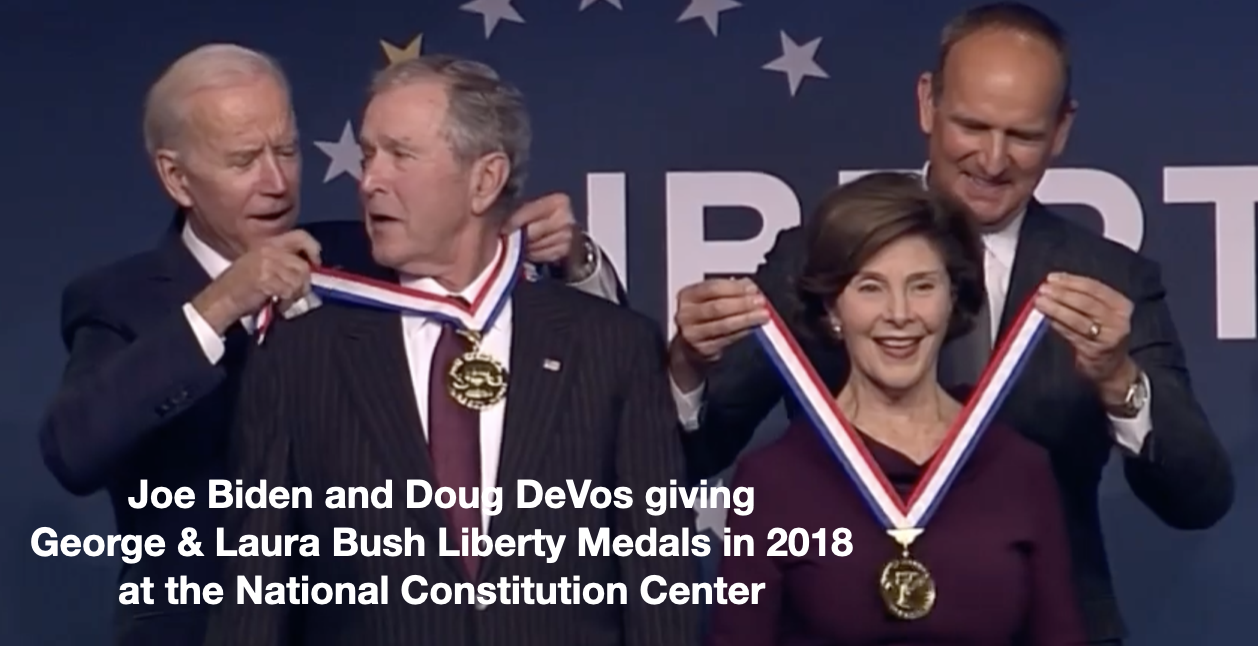
- In 2018, Doug DeVos, and then Senator Joe Biden, awarded Liberty Medals to George W. Bush and his wife at the annual National Constitution Center event. Awarding George W. Bush a Liberty Medal is like giving a member of the KKK a diversity award. (1:01:26 into the video)
- The Doug & Maria DeVos Foundation providing the funding for both the creation of AmplifyGR, but also to purchase dozens of properties in the southeast side of Grand Rapids before telling any of the predominantly Black residents of that area. Listen to the rhetoric from Doug DeVos in a video at this link, during an AmplifyGR town hall that received lots of pushback. In fact, the pushback was so great that DeVos and his minions decided to cancel move aways from town hall meetings and get people to buy into a framework for development that they were controlling from the very beginning.
Doug DeVos ends his article in the Grand Rapids Business Journal with the claim that he is all about the notion of “we the people.” If that were the case, why would he and his family spend millions every year to get people to buy into their worldview, whether they be politicians or non-profits. When people like Doug DeVos say “we the people”, they really mean, “we own the people.”
US Exceptionalism and the Legacy of the War on Terror – Part II: The realities of living in a Police State
 Last week, we posted Part I on the consequences of US Exceptionalism and the Legacy of the War on Terror, specifically as it relates to US Foreign Policy. In today’s post, we want to explore the same legacy of 9/11 on the domestic front.
In general, the consequences of the US War on Terror for people residing in this country have been increased government surveillance, increased collaboration with federal law enforcement and local law enforcement, the targeting of certain classes of people, Arab, Muslim and undocumented immigrants, along with greater government capacity to suppress dissent.
Of course, what we are primarily talking about was the bi-partisan passage of what is known as the USA Patriot Act, which was signed into law on October 26, 2001. The USA Patriot Act put into effect policies and procedures that means the government can:
- Search your home and not even tell you. (Section 213)
- Collect Information About what books you read, what you study, your purchases, your medical history and your personal finances. (Section 215)
- Label you as a “terrorist” if you belong to an activist group. (Sections 411 and 802)
- Monitor your E-mails and watch what internet sites you visit. (Section 216)
- Take away your property without a hearing. (Section 806)
- Spy on innocent Americans. (Sections 204 and 901)
- Put immigrants in jail indefinitely. (Section 412)
- Wiretap you under a warrant that doesn’t even have your name on it. (Section 216)
Now, a second version of the USA Patriot Act was passed years later, along with other amendments, along with some sunset provisions. In 2015, the USA Freedom Act was passed restored many of the provisions of the original USA Patriot Act, even though groups like the ACLU have been fighting these repressive policies all along.
When the USA Patriot Act was adopted, there were some groups that were more targeted than other. One group was anyone who was identified as Arab and/or a follower of Islam. There were thousands of Arabs/Muslims that were rounded up by the US government without being charged and held for long periods of time. We also know that those who were perceived as being Arab/Muslims were also experiencing an increase in discrimination, harassment and violence from the general public and from law enforcement. This dynamic is well documented in the recently updated version of the book by Deepa Kumar, Islamophobia and the Politics of Empire: 20 years after 9/11.
9/11 also led to the creation of the Department of Homeland Security, which created the repression entity known as Immigration and Customs Enforcement or ICE. ICE has terrorized immigrants, particularly undocumented immigrants since the agency was founded in 2003 by the Bush, Obama, Trump and now the Biden Administrations. In this instance, 9/11 has provided a justification for the repression of immigrants, Arabs, Muslims, Black and Brown communities, along with community dissidents and activists. The ACLU writes of this type of repression and surveillance:
The human toll of government surveillance is undeniable. It can have far-reaching consequences for people’s lives — particularly for communities of color, who are wrongly and disproportionately subject to surveillance. The people who feel the impact the most are Muslims, Black and Brown people, people of Asian descent, and others who have long been subject to wrongful profiling and discrimination in the name of national security. Routine surveillance is corrosive, making us feel like we are always being watched, and it chills the very kind of speech and association on which democracy depends. This spying is especially harmful because it is often feeds into a national security apparatus that puts people on watchlists, subjects them to unwarranted scrutiny by law enforcement, and allows the government to upend lives on the basis of vague, secret claims.
One other major consequence of the US War on Terror beginning after September 11, 2001, was how much public money went into the wars abroad, money which could have been spent here in the US, such as fully funding Medicare for All. According to a recent report put out by the National Priorities Project and the Institute for Policy Studies, the US spent $21 Trillion on foreign and domestic militarism over the past 20 years. Just imagine how $21 Trillion could have been used to give people a living wage, to create sustainable energy sources, to provide housing for all, end poverty, etc. We must always remember that creating equity isn’t about a lack of funds, its about how public money is prioritized. Over the past 20 years the US Government chose militarism over equity and justice at home.
This history is important for all of us to come to terms with. This is especially the case for people who were too young to remember 9/11 or for those born since 2001. The legacy of 9/11 domestically has been even greater government capacity to repress and monitor Black, Indigenous and other communities of color, gather intelligence on all of us, along with providing greater government powers to suppress public dissent of any kind. These dynamics make it clear that we live in a police state.
Ideological Bullshit: Banning housing evictions will actually hurt low-income renters, says the Acton Institute for the Study of Religion and Liberty
 It has been 3 weeks since the US Supreme Court ruled that the eviction moratorium is unfair to landlords and that it must come to an end soon.
To most reasonable people, people with their eyes open and a basic understanding of the current housing crisis, putting an end to the eviction moratorium is cruel and criminal, especially during a pandemic.
However, some people are ideologically driven, so no matter what kind of harm is being done to people, they will rationalize it away with their ideological perspective.
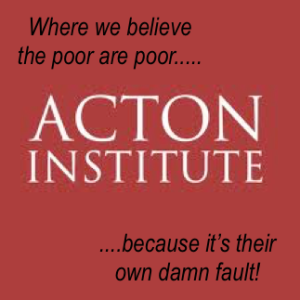
This is exactly what a writer and staff member of the Acton Institute has done. On August 9th, Acton writer Noah Gould posted an article entitled, Banning evictions poses harm for low-income renters.
This argument says in part:
The sentiment behind the ban is certainly admirable. An eviction ban, its proponents argue, would keep families off the streets during the pandemic. Unfortunately, the true impact of the ban will harm the very people it attempts to help. Perversely, the ban will result in higher prices for low-income housing and lower prices for luxury housing. This is because it disincentivizes landlords from investing in low-income housing. The eviction ban threatens the very mechanism for improving the housing supply and creatively adapting to people’s needs.
For Noah Gould and the Acton Institute, the market should dictate all things related to housing, since, as Gould says, “Landlords must sacrifice in the present and plan for the future. The risk they undertake is only worthwhile if they have a realistic chance of a return on investment. Instead of disrupting the market process, local and federal officials should look to other means for improving the housing situation for low-income Americans.”
The Acton writer doesn’t want the market to be interrupted, yet they want local and federal officials to “improve the housing situation for low-income Americans.” Not surprising that the Acton writer opposes any disruption to the market-driven system for housing that we have in the US, yet they don’t offer any clear proposal for how to improve housing for low-income people.
Another perspective on housing evictions comes from a recent article by Rev. Liz Theoharis, who is the co-chair of the national Poor People’s Campaign. Theoharis wrote an article on September 16, entitled, The Moral Case for Resisting Evictions Amid a Pandemic.
Rev. Theoharis writes:
The average household debt burden has only grown during the pandemic and no legislative action has been taken to relieve such a rent or housing crisis. The stimulus payments, unemployment insurance, and an expanded child tax credit were simply not enough. As a result, more than 10 million households are now estimated to be behind on their rent. Rather than bailing out renters and homeowners by canceling such debts or even efficiently distributing the $45 billion in rental assistance that has largely languished in a bureaucratic hell, Congress failed to extend the eviction moratorium, paving the way for disaster.
The co-chair of the Poor People’s Campaign also has an ideological framework, but her ideology puts people before profits. In addition, Rev. Theoharis presents some clear ideas about how to “improve housing for low-income people.” Actually, Rev. Theoharis is merely sharing some housing justice proposals that have been created by a larger national housing justice coalition. The national proposals include:
- Making evictions from any dwelling, including cars, tents, and encampments, illegal.
- Canceling the housing and rental debt that has been accumulated during the moratorium period.
- Ending predatory speculation that raises rents and makes housing unaffordable in every state in the country.
- Ensuring living wages and a guaranteed income so every American can afford a decent place to live.
- Protecting and expanding voting rights including for the poor, homeless, disabled, and elderly so people have the right to vote officials into office who will represent the interests of the unhoused, the temporarily housed, and those facing evictions.
- Ending the Senate filibuster that’s preventing the passage of bold and visionary policies, including the expansion of health care, the raising of wages, the introduction of new anti-poverty programs, and so much more.
It is unfortunate that we have the Acton Institute here in Grand Rapids, spewing their contempt for those who are not pulling themselves up by their bootstraps. However, it is fortunate that we do have the Grand Rapids Area Tenant Union, which embraces many of the same suggested by the national housing justice coalition.
For people who are facing eviction, please contact the Grand Rapids Area Tenant Union gratunion@gmail.com. For those who want to be in solidarity with those who are facing eviction and work with the tenant union to fight evictions, you should also contact them to ask about when their next Eviction Defense Training will take place. In the meantime, maybe we ought to organize an action in front of or inside the Acton Institute’s building located on E. Fulton and Sheldon, especially while all of the ArtPrize tourists will be wondering about past the apologists for Capitalism.
ArtPrize is Back and I still Hate it
 So, ArtPrize is back, and I still despise what it is and who primarily benefits from it.
Here at GRIID, I have been writing about the monied art spectacle that is run by the son of Dick & Betsy DeVos for the past 12 years. With that, here is a list of why I still hate ArtPrize.
- They exploits artists. ArtPrize gets artists to create art to be displayed in order to attract people to come and spend los of money on food, beer, parking and hotels. However, artists are not compensated in anyway. This year, ArtPrize has made some grant funding available to certain artists, but that still means the bulk of submissions will not be compensated for their time nor the supplies needed to create their art.
- ArtPrize gets public money from the City of Grand Rapids to promote the event. Why should any public money be given to an event that is run by a billionaire family, especially since the City already provides lots of other in kind services that costs taxpayers money, like the use of police during the monied spectacle.
- The local news media spends entirely too much time and energy on ArtPrize, essentially becoming a PR agent for an event that is run by a billionaire family. I mean, WOODTV8 even has a special studio inside the Grand Rapids Art Museum, created just to broadcast live about ArtPrize. In 2010, GRIID conducted a 56-day study of the Grand Rapids Press, to compare how much coverage there was on ArtPrize and elections in Michigan. The 2010 election include a Governor’s, Congressional races, State races, County races, candidates for the Michigan Supreme Court, and several statewide ballot initiatives. During the 56-day study period, we found there were 87 election articles, but 153 ArtPrize articles. For the full findings go to this link.
- Most of the sponsors of ArtPrize are either other members of the DeVos family or members of the Grand Rapids Power Structure. This group of people fund Republican candidates from the local level all the way up to the likes of Donald Trump. This would provide a perfect opportunity to boycott or disrupt the monied spectacle, yet liberals and progressives would rather attend ArtPrize that challenge their funding sources and the politics behind it.
- Early on in the ArtPrize experiment, one of the members of the Grand Rapids Power Structure, Sam Cummings, provided us with an honest reason why ArtPrize exists, when he said “Our long-term goal is really to import capital – intellectual capital, and ultimately real capital. And this (ArtPrize) is certainly an extraordinary tool.” ArtPrize has always been about bringing money to the downtown elites. We wrote The Political Economy of ArtPrize – Part I and The Political Economy of ArtPrize – Part II a few years back to make the point about who the primary beneficiaries of the money being spent during ArtPrize.
- ArtPrize is primarily about Whiteness. Sure, there are Black, Indigenous and other people of color that come to ArtPrize or submit their art. However, there are so many BIOPC people who have shared with me that they don’t feel safe during ArtPrize, nor do they feel like it is an event that centers their lived experience. We wrote about this dynamic is an article entitled, Grand Rapids, ArtPrize and Whiteness.
- In 2015, the State Policy Network (a far right policy network) was being hosted at the Amway Grand Plaza at the very same time that ArtPrize was being held. The founder of ArtPrize, Rick DeVos, presented at the far right conference, with a session entitled, ArtPrize: Unorthodox, Highly Disruptive, and Undeniably Intriguing. Here is a list of other session being offered at the same conference, which should tell you something about how Rick DeVos views ArtPrize:
- Get States to pass Right to Work Legislation
- Get States to adopt austerity measures that will hurt workers, the public sector and public services.
- Attack Public Education by redirecting more public funds to Charter Schools and other “Schools of Choice.”
- Privatize Higher Education.
- Promote more Ag-Gag laws, which attack community based efforts around food production and silences animal rights groups challenging the industrial animal industry.
- Attacks on Green Energy Legislation.
Lastly, one of the things that I hate most about monied spectacles like ArtPrize, is that they deceive us into a certain narrative about our lives, which is to say a Capitalist narrative. I want to live in a world where artists don’t have to worry about having their basic needs met and can create art that they don’t have to worry about people being offended by or censored. I want to live in a world where art is not a commodity. I want to live in a world where we all have plenty of leisure time to make art, to play, to learn another language or do whatever brings us joy. I don’t want to live in a world where the same people who exploit and oppress us are the same people that host art events that kill our souls, while they try to convince us it’s a fun.
Feeling deceived by Michigan Legislators, Cosecha organizers remain committed to campaign for driver’s licenses even after Public Hearing was cancelled
Yesterday, an estimated 150 people from across Michigan came to the Lansing State Capitol to demand Driver’s Licenses for All.
Cosecha Michigan, which has circles in numerous communities, showed up in Lansing to hold a rally before there was a public hearing on proposed legislation that would grant Driver’s Licenses to undocumented immigrants. There were people who came from Muskegon, Holland, Kalamazoo, Grand Rapids, Berrien Springs, Fennville, Ionia, Niles, Benton Harbor, Detroit and Ann Arbor. The same communities had participated in a tour in August, where each community organized an action to generate interest in the larger statewide campaign.
The rally on Tuesday mobilized Cosecha circles, which came to Lansing with great energy and enthusiasm, in order to demand driver’s licenses. The gathering yesterday felt more like a pep rally, with each Cosecha circle given the opportunity to speak and shout out their own chants.
Some local news media also showed up to capture the rally and do interviews with key organizers. There was a scheduled hearing on the proposed driver’s licenses legislation, HB 4835, which was then sent to the Committee on Rules and Competitiveness in May. The Committee on Rules and Competitiveness, which is chaired by Rep. Jim Lilly, had a public hearing scheduled for noon on September 14. However, just minutes before the noon hearing, it was cancelled.
Now, we still don’t know the reasons behind the last minute cancellation, but the coalition that makes up Drive Forward Michigan, contacted Cosecha organizers to tell them that the Michigan House Speaker, Rep. Jason Wentworth had cancelled the meeting. Beyond that information, there were no explanations provided to the public on why the hearing was cancelled.
Outraged, Cosecha organizers decided to enter the State Capitol and make some noise. Most of the 150 that had gathered outside the Capitol, went inside, chanting with bullhorns and other amplification systems. The 100 or so Cosecha activists walked up three flights of stairs, chanting and filling the rotunda at one point. Eventually, the Cosecha activists came down to the ground floor and held their own public hearing, inviting members from the numerous Cosecha circles to offer testimony on why having a driver’s licenses would radically improve their lives and the lives of their families. People expressed their anger, their indignation, their frustration and their feelings of being deceived by State Legislators for cancelling the public hearing on driver’s licenses.
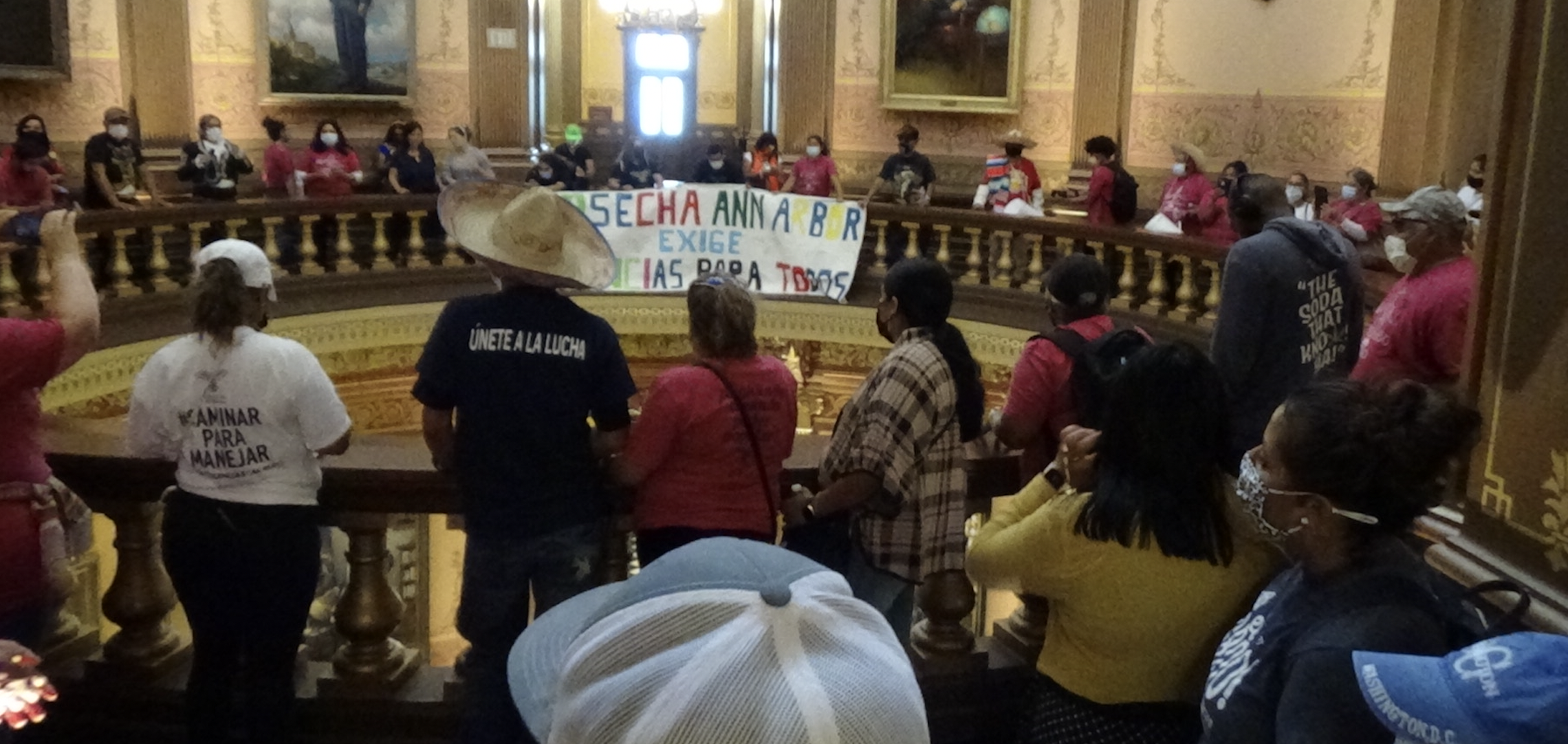
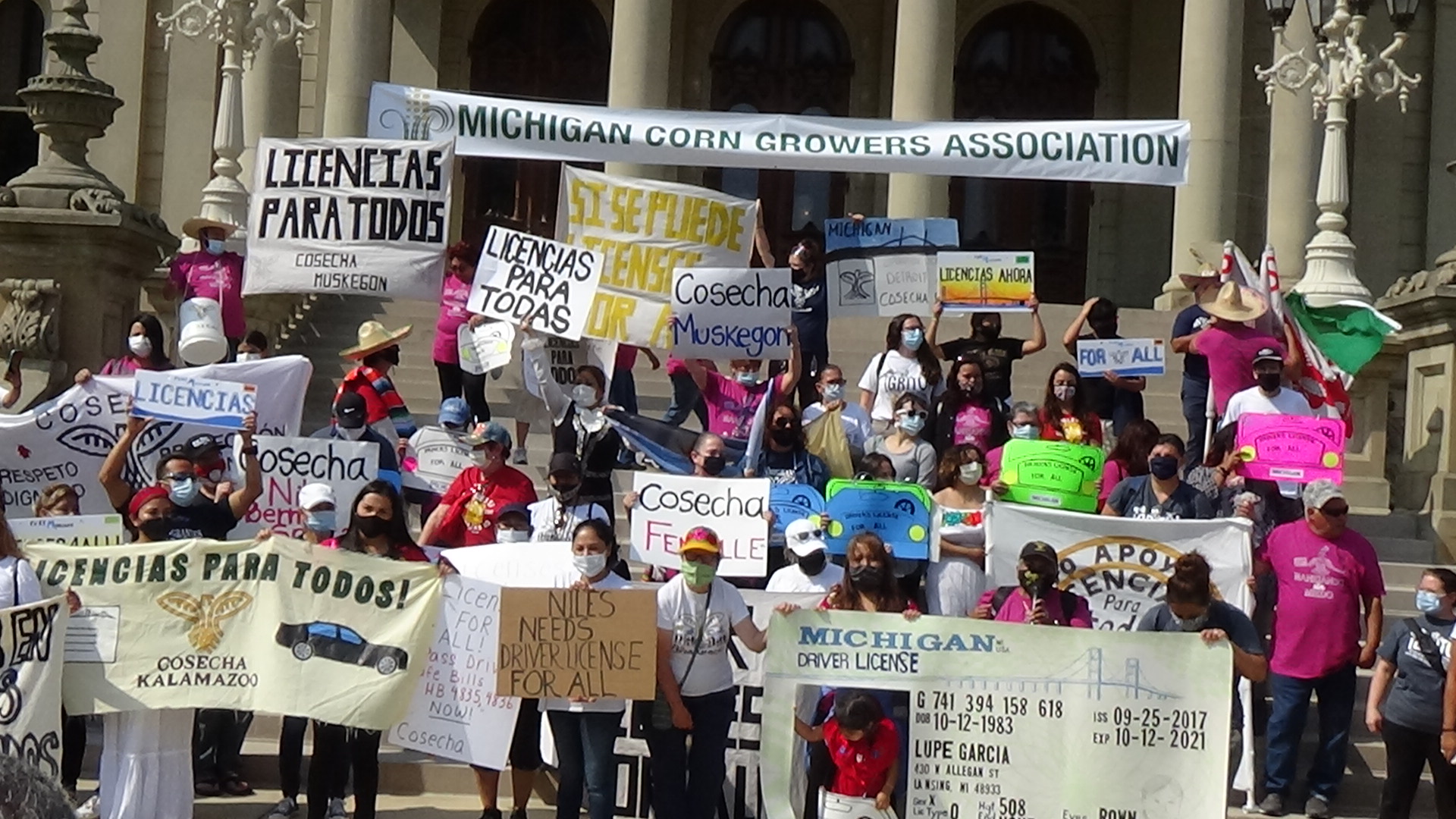
After about 45 minutes, people began to leave the Capitol building and regroup outside in front of the State Capitol. Ironically, there was a Michigan Corn Growers Association event that taking place on the lawn in front of the Capitol, with a large tent, filled with people, food and beverages. The Michigan Corn Growers Association also had hung a large banner the hung above the steps leading up to the front of the State Capitol. Taking advantage of the banner, Cosecha organizers got everyone to stand on the steps in from the banner and use that moment to say that the people who are part of the Cosecha circles that drove to Lansing from all across the state, that they were the ones who were the real agricultural growers and workers in Michigan. (Photo above) One person said, “Our people are the ones who pick the food that ends up on the tables of families all across Michigan and beyond. We are the one who do this work and make the harvest possible in Michigan.” Not lost on those in attendance, was the fact that the word Cosecha means harvest.
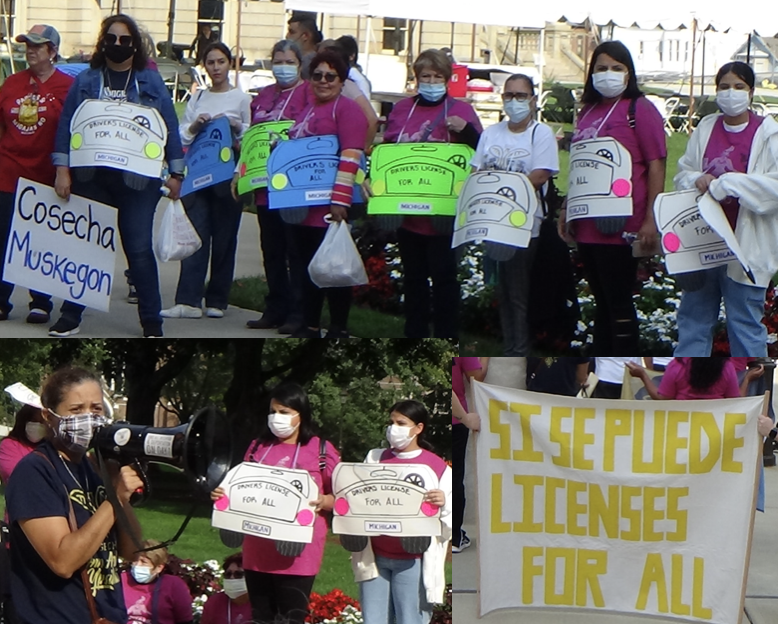 While many of the organizers and participants expressed a great deal of frustration over the cancellation of the public hearing, they also shared a deep commitment to continue to fight to win driver’s licenses in Michigan. Indeed, they are already talking about using this setback as yet another organizing opportunity, because that is what good organizers do.
If you want to support this campaign you can sign an online petition they have, along with contacting one of the Cosecha circles located near you. If you aren’t sure where there are Cosecha circles, you can contact Cosecha Michigan. Lastly, you an contact the Drive Forward Michigan, which is the inside game, by going to their website.

