In 1984, I spent 48 days in jail for refusing to sign a statement saying I would never do Civil Disobedience at a Nuclear Weapons factory in Michigan
 On December 2, 1984, there were 13 of us who were arrested at Williams International, a Michigan-based company that manufactures guidance systems for nuclear weapons.
It has been 38 years since I was arrested at Williams International, but in many ways it feels like yesterday. It was an unseasonably warm December day in Michigan, and just before the 1st Shift came into work, we blockaded the entrance to the factory, a factory where death was being manufactured.
After about 40 minutes, we were all arrested and taken to the local jail to be processed in, but ended up going in front of a District Court Judge and charged with trespass. When the judge got to me, he looked at my name and asked if I had been before him for the same charge. I said no, that would have been my brother. The judge joked that this seems to be a family affair and asked if anyone else from my family was involved. I said that my mother was in the courtroom that day, and pointed to where she was seated.
The judge then asked me if I had a problem with breaking the law. I responded by saying that December 2nd was the day that Rosa Parks refused to move to the back of the bus, thus breaking an unjust segregation law. I also stated that it was legal to manufacture, deploy and detonate nuclear weapons, which are weapons of mass death. Therefore, like Rosa Parks we were defiantly breaking a law that we believed to be unjust.
We were all sentenced to pay a $50 fine, which none of us ever ended up paying.
However, the 13 of us arrested at Williams International were also being charged in Circuit Court, since Williams International had created a court supported injunction, which barred anyone from doing civil disobedience at the company’s factory. So, we were back in court on December 3rd, but this time the judge gave us an indefinite sentence, meaning we would stay in jail until we signed statements saying that we would never go back to Williams International again. All 13 of us refused, so we were taken into custody and placed in the Wayne County Jail.
This was the first time I had gone to jail, so those in charge of the Wayne County Jail decided to separate those of us arrested. I was placed in a six-man cell with 5 African American guys. I had already planned to not eat once I got arrested, so when the meal time came around I told those in my cell that they could have my food. Offering them my food helped to break the ice between us. They asked why I was arrested. I told them for civil disobedience at a factory that manufacturers nuclear weapons and they said, “you are a crazy fucking white boy.”
From that moment on, all 5 of the other men in my cell were joking with me and sharing the reasons why they were there. None of them had any legal support, so I asked our legal support team to look into their cases and get people to visit them and write letters to the judge. Within 5 days, I was moved to the Shiawassee County Jail, near Flint, because the Wayne County Jail administrators did not want people to any kind of organizing or solidarity work inside that jail. I really wasn’t the catalyst for this, since the other men in my cell were simply asking for solidarity and support. In fact, they were the catalyst, and they were acting in a long tradition within the Black Freedom Movement, using jails/prisons as a means of doing organizing work, a reality so well documented in Dan Berger’s book, Captive Nation: Black Prison Organizing in the Civil Rights Era.
While at the Shiawassee County Jail, they put all of us into a six-man cell, utilizing cots and wanting to prevent us from “organizing other inmates.” Because the jail was so close to Flint, we were paid a visit by the editor of the Flint Voice, Michael Moore. This was before Moore had produced Roger & Me and wasn’t well known outside of the state.
We also grabbed the attention of the group Amnesty International (AI). AI was interested in our case, since we were not in jail for something we had done, but because we refused to say that we wouldn’t come back to Williams International again and engage in direct action. In legal terms, the judge was binding our conscience, since we refused to sign a statement. Amnesty International saw us as prisoners of conscience and decided to organize a campaign calling for our immediate release, since we were now officially political prisoners.
The attention our case received had now expanded and Williams International did not want all of this attention, which included increased news coverage. In addition, several of us had not eaten since we went into jail, so that was also getting lots of press. At the same time, the Shiawassee County Jail administrators were freaking out, since they did not want anyone dying from a hunger strike in their jail.
The combination of our collective refusal to eat and the Amnesty International campaign eventually resulted in our release from jail, some 48 days after we had been arrested.
I learned a great deal about how the jail system worked, how the court system worked, and how corporations wielded tremendous power as a result of my decision to engage in civil disobedience to resist nuclear war. All Power to the People!
Art by Shelby Lijewski
World AIDS Day: Remembering what Reagan AIDS Commission member Richard DeVos had to say about AIDS and the Gay Community
 By 1987, 40,000 had died from AIDS in the US and despite the growing epidemic the federal government did not take any formal action until later that year. Reagan did appoint the Presidential Commission on the Human Immunodeficiency Virus Epidemic in the summer of 1987; it was later renamed the Watkins Commission, after its chair.
With the appointment of this commission, Reagan was able to appease those who demanded a more sustained federal response to AIDS. He also answered the concerns of the New Right by appointing an AIDS commission that included few scientists who had participated in AIDS research and few physicians who had actually treated people with AIDS. In addition, the commission included outspoken opponents of AIDS education, such as New York Cardinal John O’Connor. O’Connor was not only opposed to AIDS education, he was openly hostile to the Gay community.
Religious Right leader Gary Bauer, who was in the Reagan administration in 1987, said of those appoint by the President:
…..the panel was designed to be ”a cross-section of thoughtful Americans” rather than another medical or scientific group that would duplicate dozens of previous efforts. ”We intentionally tried to get people from a wide variety of walks of life, and took the risk that there would be disagreements and fireworks,” Mr. Bauer said. He also called it ”a good group” to deal with such issues as insurance coverage and care for AIDS patients and said he doubted that quarantines, school policy or casual transmission would become a major focus.
The Religious Right was particularly incensed by the AIDS crisis and saw it as purely a result of immoral behavior, especially in the Gay community. Religious Right leaders at the time, such as Pat Robertson and Jerry Falwell, equated the deaths with the Gay community as retribution from God for their “sinful” lives. Falwell not only despised the Gay community, he despised the larger society which “tolerated” Gays. Falwell’s famous statement was:
“AIDS is not just God’s punishment for homosexuals, It is God’s punishment for a society that tolerates homosexuals.”
Rich DeVos and the AIDS Commission
One of the people appointed to the 13-member AIDS Commission was Amway co-founder Richard DeVos. DeVos was chosen in part because he was one of the largest financial supporters of the Republican Party, but also because of his role in the Religious Right.
In an interview with MLive a few years ago, DeVos made some pretty revealing comments about his attitudes towards the Gay community while sitting on the AIDS Commission.
When HIV first came out, President Reagan formed a commission and I was honored to be on that commission. I listened to 300 witnesses tell us that it was every body else’s fault but their own. Nothing to do with their conduct, just that the government didn’t fix this disease. At the end of that I put in the document, it was the conclusion document from the commission, that actions have consequences and you are responsible for yours. AIDS is a disease people gain because of their actions. It wasn’t like cancer. We all made the exceptions for how you got it, by accident, that was all solved a long time ago. That’s when they started hanging me in effigy because I wasn’t sympathetic to all their requests for special treatment. Because at that time it was always someone else’s fault. I said, you are responsible for your actions too, you know. Conduct yourself properly, which is a pretty solid Christian principle.
Not only does DeVos show his homophobic bias, his comments demonstrate his ignorance of the issues surrounding HIV/AIDS. It was within this climate of homophobia and inaction on the part of the federal government that AIDS activism would take a new direction in 1987, with the creation of the AIDS Coalition to Unleash Power (ACT UP). We encourage you to watch this powerful documentary film that chronicles the work of ACT UP, United in Anger.
West Michigan Foundation Watch: The Edgar & Elsa Prince Foundation – financing the far right
 West Michigan Foundations generally submit their 990 documents two years behind the current year. We just got done posting information on several West Michigan Foundations for their 2019 990 documents. However, one foundation, the Edgar & Elsa Prince Foundation, has already submitted their 990 documents for 2020.
The 990 documents are legally required to provide some transparency for foundation contributions, but it also provides us with a window into how the area’s largest foundations are spending their money to support far right causes that serve both an ideological and political function.
For those who don’t already know, Edgar and Elsa Prince are the parents of private mercenary profiteer Erik Prince and former Secretary of Education Betsy DeVos. Edgar Prince made his wealth in manufacturing and he and Elsa had been funding the far right for decades. We follow these families and their foundations because we believe it is important for people in West Michigan to know how much the far right is financially supported in West Michigan.
The Edgar & Elsa Prince Foundation 2019 990 documents can be found at GuideStar.org. According to Guide Star, the Edgar and Elsa Prince Foundation has a little over $11 million in assets. This Foundation is governed by Elsa Prince Broekhuizen, Erik Prince, Emilie Wierda, Eileen Ellens, Alan Hoekstra and Renselaer Broekhuizen.
What follows are some of the more prominent organizations that the Edgar & Elsa Prince Foundation contributed to in 2020. Their foundation contributed just under $3 million for 2020, to mostly conservative Christian entities. We include the name of the entity receiving foundation money, the amount and a brief description of each organization.
Haggai Institute – $600,000 – The Haggai Institute is a Christian evangelical entity that provides leadership training for people around the world to convert people. The Haggai Institute believes that only Jesus can bring joy to the world, not governments, education or any other spiritual tradition.
Family Research Council – $50,000 – The Family Research Council is a DC-based entity that was created in 1980 and has played an influential role with numerous administrations, beginning with the Reagan Administration. The Family Research Council advocates a theocracy, which means that religion should be the true ruling power.
Prison Fellowship Ministries – $100,000 – The Prison Fellowship Ministries was founded by former Nixon Administration staff Charles Colson, who was sentenced to jail for his role in the Watergate scandal. The Prison Fellowship Ministries practices far right Christianity and is part of the State Policy Network, which connects far right groups across the country to promote policy changes at the state level, changes which further the far right agenda.
Christian Leadership Institute – $25,000 – The CLI was co-founded by Richard DeVos Sr., to provide training to Christian leaders to spread a message of conservative Christianity in West Michigan, across the US and around the world.
Acton Institute – $30,000 – The Acton Institute is a far right think tank based in Grand Rapids that was founded in 1990 to promote the relationship between Christianity and Capitalism. Elsa Prince and Betsy DeVos have been former Board members with the Acton Institute.
Freedom Alliance – $30,000 – Freedom Alliance is an entity that was founded by convicted Iran Contra scandal participant Col. Oliver North. The Freedom Alliance promotes US militarism and encourages people to join the US military.
Media Research Center – $25,000 – The Media Research Center is a far right media watchdog, which seeks to counter the so-called leftist press in the United States.
Council for National Policy – $15,000 – The Council for National Policy (CNP) was founded in 1981, with board membership and funding from the Coors, Koch and DeVos families. The CNP is the subject of Anne Nelson’s book, Shadow Network: Media, Money, and the Secret Hub of the Radical Right, and has played a critical role in the anti-lockdown protests across the US since the COVID 19 pandemic began.
Mackinac Center for Public Policy – $10,000 – The Mackinac Center is a far right think tank based in Midland, Michigan, which has a long history of promoting far right stat policy. The Mackinac Center was instrumental in getting the Right to Work policy adopted in Michigan during the Synder administration and they have been active in the past year opposing COVID 19 policies in the state.
Alliance Defending Freedom – $100,000 – The Alliance for Defending Freedom is a Conservative Christian group of lawyers that defends religious groups around anti-LGBT policies and other religious right issues.
American Values – $30,000 – American Values is another conservative religious entity, which perpetuates the so-called values of the United States, but are rooted in far right principles. In a recent post they made the following comment:
In the aftermath of the Rittenhouse verdict, Marxists and revolutionaries took to the streets, using his exoneration as a match to try to set America ablaze. Make no mistake about it: They are Marxist and they are revolutionary. These radicals want a race war in America.
Gateways to Better Education – $100,000 – Gateways to Better Education was created to provide resources and strategies to Christians – teachers and students – who are in the public schools and want to insert their Christian beliefs into public school life. Their partner organizations is a who’s who of far right groups.
Center for Military Readiness – $15,000 – The CMR claims to be a group that supports US troops, but their website is filled with US military and foreign policy analysis and is run by mostly former high ranking US military officials.
Live Action – $25,000 – Live Action is an anti-abortion organization that claims to have the largest online pro-life presence. They use lots of the same scare tactics and misinformation to counter the pro-Choice movement.
Protect Life Michigan – $35,000 – PLM is an organization that attempts to develop anti-abortion leaders across the state at the high school and college level.
Moms for America – $5,000 – Moms for America is a women-centered far right group that mixes nationalism and Christianity. Moms for America has most recently been a central component in the anti-vaccination movement, particularly with K-12 schools.
West Michigan Far Right Watch: The Acton Institute still hates the Movement for Black Lives and Ryan Kelley loves Kyle Rittenhouse
 Welcome to the next installment of West Michigan Far Right Watch, where we keep tabs on the far right in this area and provide a summary of what they are up to and what kind of messages they are promoting in this community. As a matter of clarification, when we say the Far Right, we mean those in the streets who fight to defend White Supremacy, those who promote far right ideology, and those with political and economic power.
We have two examples this week. The first example comes to us from the Acton Institute for the Study of Religion and Liberty. Ever since the nation erupted in protest to the police murder of George Floyd, the Acton Institute has demonstrated over and over again their racist ideological tendencies and their contempt for the Movement for Black Lives.
In June of 2020, the Acton Institute essentially declared war on the Movement for Black Lives.
In April of 2021, the Acton Institute noted that Derek Chauvin was guilty, but the real problem was the riots in Minneapolis, along with Black Clergy and Black politicians.
On November 17th, on their radio show Acton Line, the Acton Institute once again demonstrated their hatred for the Movement for Black Lives. The guest for the Acton Line radio show was Kevin Schmiesing, director of research at the Freedom & Virtue Institute and coauthor and editor of the newly released Race and Justice in America. Schmiesing said that part of the problem in the US was that there was “too much of an emphasis on race.”
The Acton guest went on to say that the US is inherently not a racist country and that the system we have is fundamentally sound. The analysis in the new book he edited was that Black people want to blame the system instead of just wanting to work towards reforms or improvements on the system we have. Schmiesing referred to people as either personalists – those who want to take personal responsibility for their actions, and separationists – those who want to blame the system. The Acton Line guest then claimed that Dr. King was a personalist. This tells us a great deal, since there is no way that one can look at the whole life of Dr. King and NOT see that he was challenging systems of power.
Towards the end of the interview, when asked about what resources people should look to for solution to racism, Kevin Schmiesing suggested the far right Hillsdale College project, the 1776 Project, the Freedom & Virtue Institute, the US Constitution and Christianity.
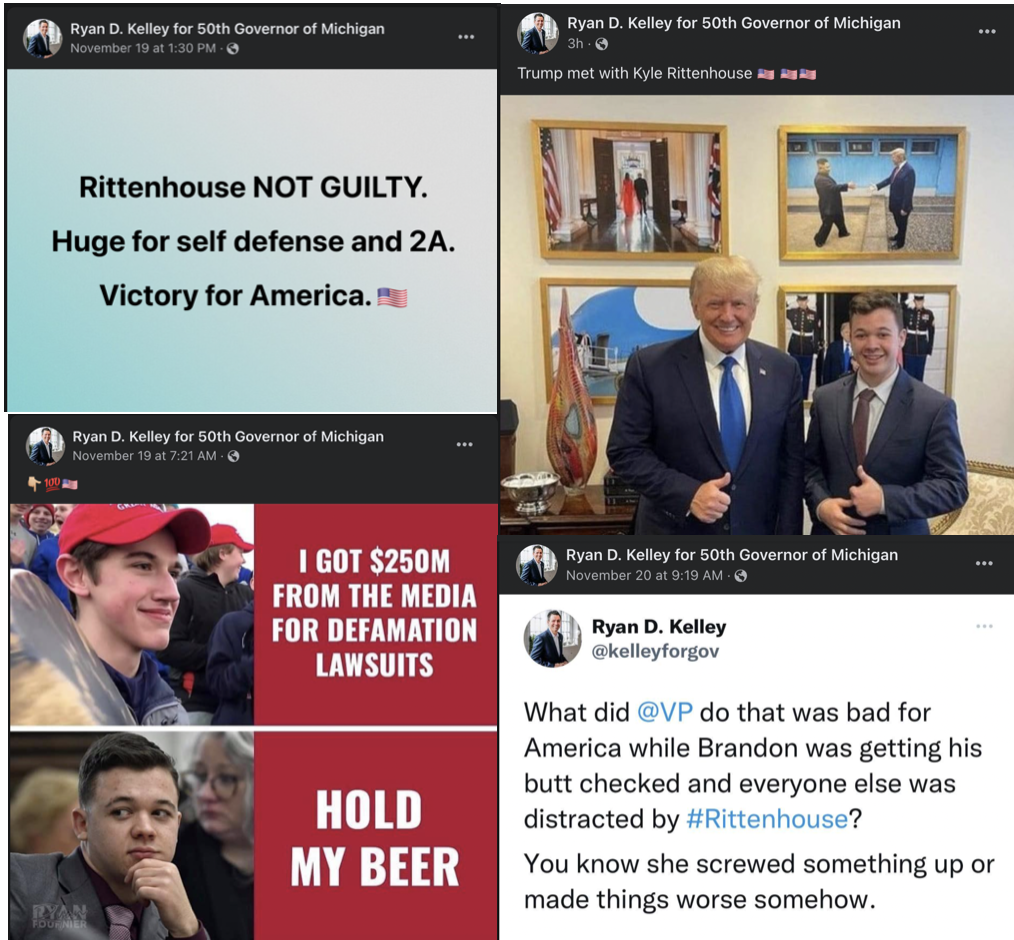
The second example comes to us from the Facebook page of Ryan Kelley, founder of the American Patriot Council and Republican candidate for Governor in Michigan.
Between November 19 and November 24, Ryan Kelley posted 4 different images/memes demonstrating that he supports and loves Kyle Rittenhouse. Here are those images.
Ryan Kelley claims to be a devout Catholic, while the Acton Institute was founded by a Catholic Priest. This is not the only thing they have in common. While the White Supremacy of Ryan Kelley is more visible, the White Supremacy of the Acton Institute is just as dangerous. In fact, one could argue that the ideological defense of White Supremacy that comes from the Acton Institute, lays the foundation for people like Ryan Kelley to be so brazenly racist in their words and their actions. We would all be wise to see how the Acton Institute and Ryan Kelley benefit from each other.

As the Holiday Season approaches, new report highlights how the US food system has become more monopolized during the first 18 months of the COVID pandemic
 A new issue brief from Food & Water Watch highlights an important aspect of the US food system, particularly since the beginning of the COVID 19 pandemic. The opening comments from the issue brief, The Economic Costs of Food monopolies: The Grocery Cartels, states:
While the COVID-19 pandemic dealt a blow to many parts of the economy, one sector saw record-breaking profits: the grocery industry. Many major supermarket chains reaped double-digit growth and surging stock values in 2020, as people locked down and ate more meals at home.
Americans, however, faced rising food costs and widespread shortages of some staples. And while the cost of meat shot up, prices paid to farmers actually declined, spurring a federal investigation. Most atrociously, frontline workers who stocked grocery shelves or worked in meat processing plants sickened and died from COVID-19. Yet many corporations limited hazard pay and instead invested in stock buybacks.The COVID-19 pandemic pulled back the curtain on the idea that the current food system offers abundance, efficiency and resilience.
The grocery cartels that the Food & Water Watch identify are Walmart, Kroger, Costco and Albertson’s Companies, which control roughly 70% of all grocery sales in the US.
There is a second tier of the grocery cartel, which includes Meijer Inc. As we have noted in previous postings, the wealth of Doug & Hank Meijer grew from $10.2 Billion since the pandemic began in March of 2020, to $16.9 Billion through October 2021. The owners of Meijer Inc. saw their wealth grow by $6.7 Billion during the first 18 months of the pandemic. Meijer Inc. was able to achieve these massive profits for the same reason as the four national grocery cartels – paying farmers less while raising prices and paying workers poverty-level wages during a time that more people were staying home to eat meals.
The report from Food & Water Watch does offer up some recommendations on how to combat the grocery cartels in the US, suggesting:
- Stop agribusiness and food chain mergers
- Enforce existing anti-trust legislation
- Create and expand more Grocery Cooperatives
- Create & support local food processors
One strategy that is missing from the recommendations is to support and promote more organizing amongst those who work in the field, in food processing, retail grocery stores and restaurant workers. We have seen in recent months the number of strikes and boycotts that are taking place, action which directly benefit food workers. In addition, this week is International Food Workers Week. The Food Chain Workers Alliance is behind this effort. “What started as an awareness campaign in 2012 by organized food and farmworkers leveraging end-of-year holidays around the need to raise the minimum wage and improve working conditions from farm to table, the campaign has become more relevant than ever in 2021.”
If we are serious about changing the current food system, then we not only need to create alternatives to the Agribusiness system, but by practicing food justice and food sovereignty. However, we must support food workers, at all levels, particularly now as they fight to win increased wages, the right to unionize and to improve working conditions. Ultimately, we have to support those who literally put food on our table.
The 2022 Kent County Budget: Funding the Prison Industrial Complex means funding harm against Black and Brown communities
 Last week, it was reported that the Kent County Commission passed the 2022 budget, at $526.9 million.
The MLive article cites one County Commissioner and provides some of the numbers for what the 2022 budget dollars are allocated for. Unfortunately, there is no link to the County’s 2022 budget, a link we provide here.
The County did hold one public hearing on the 2022 Budget, on November 4, but there was little promotion of that hearing by both the County government and by the local news media. After a presentation about the 2022 Budget at the November 4th meeting, not one person got up to speak about the proposed budget.
Like the Grand Rapids City Budget, the public has virtually no real input on how their tax dollars are being spent. Earlier this year, groups just Defund the GRPD pushed for more time to participate in crafting the annual budget, more user friendly budget proposals and for the city to adopt a participatory budgeting process, where the public could actively make decisions on how their tax dollars are being spent.
And like the Grand Rapids City Budget with the GRPD, the Kent County Budget also allocates a great deal of money for the Sheriff’s Department. In addition, the Kent County Budget provides significant funding for the Courts and the Kent County Jail. All of these budgeting priorities, the Courts, the Jail and the Sheriff’s Department, can be categorized as part of the Prison Industrial Complex – with law enforcement making arrests, with courts sentencing people and the jail detaining people.
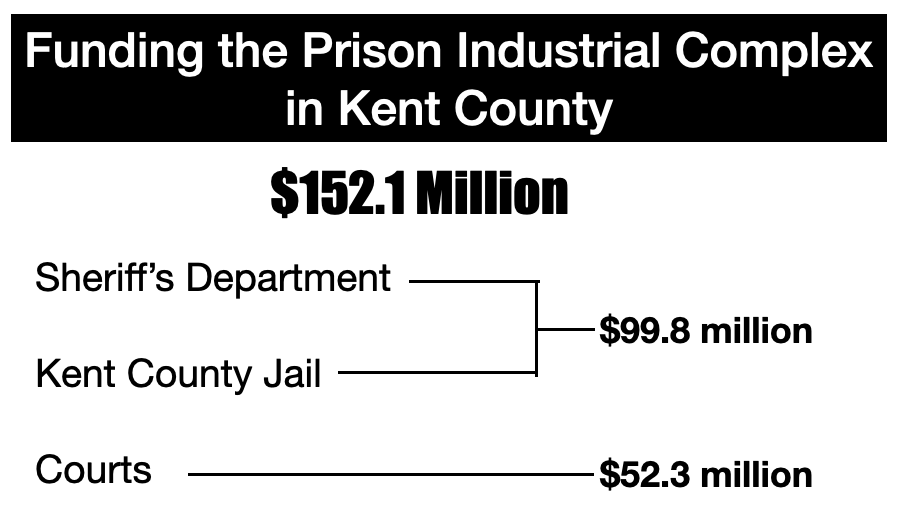
In looking at the 2022 Kent County Budget, there is $52.3 million allocated for the Courts and $99.8 million for the Sheriff’s Department, which includes the administration of the Kent County Jail. All total, the Prison Industrial Complex in Kent County, is costing the public $152.1 million. This means that about a third of the County’s budget is allocated for the arrest, sentencing and incarceration of people, what the County euphemistically refers to as “Public Safety.”
And just as groups like Defund the GRPD and Justice For Black Lives have been calling for the re-allocation of police money for things like housing, education, etc., imagine what the $152.1 million could fund for improve the lives of people in Kent County, rather than funding a system that primarily punished Black and Brown people. Maybe it is time that we scrutinize the county funding that disproportionately harms BIPOC people and protects systems of power in this community. The 19 member Kent County Commission seems to agree with this, since the budget was unanimously approved.
Justice For Black Lives Press Conference and the failure of local news agencies holding systems of power accountable
Earlier today, on Calder Plaza in downtown Grand Rapids, Justice For Black Lives held a Press Conference to address the actions of the GRPD during their Saturday evening protest in response to the Kyle Rittenhouse not guilty verdict.
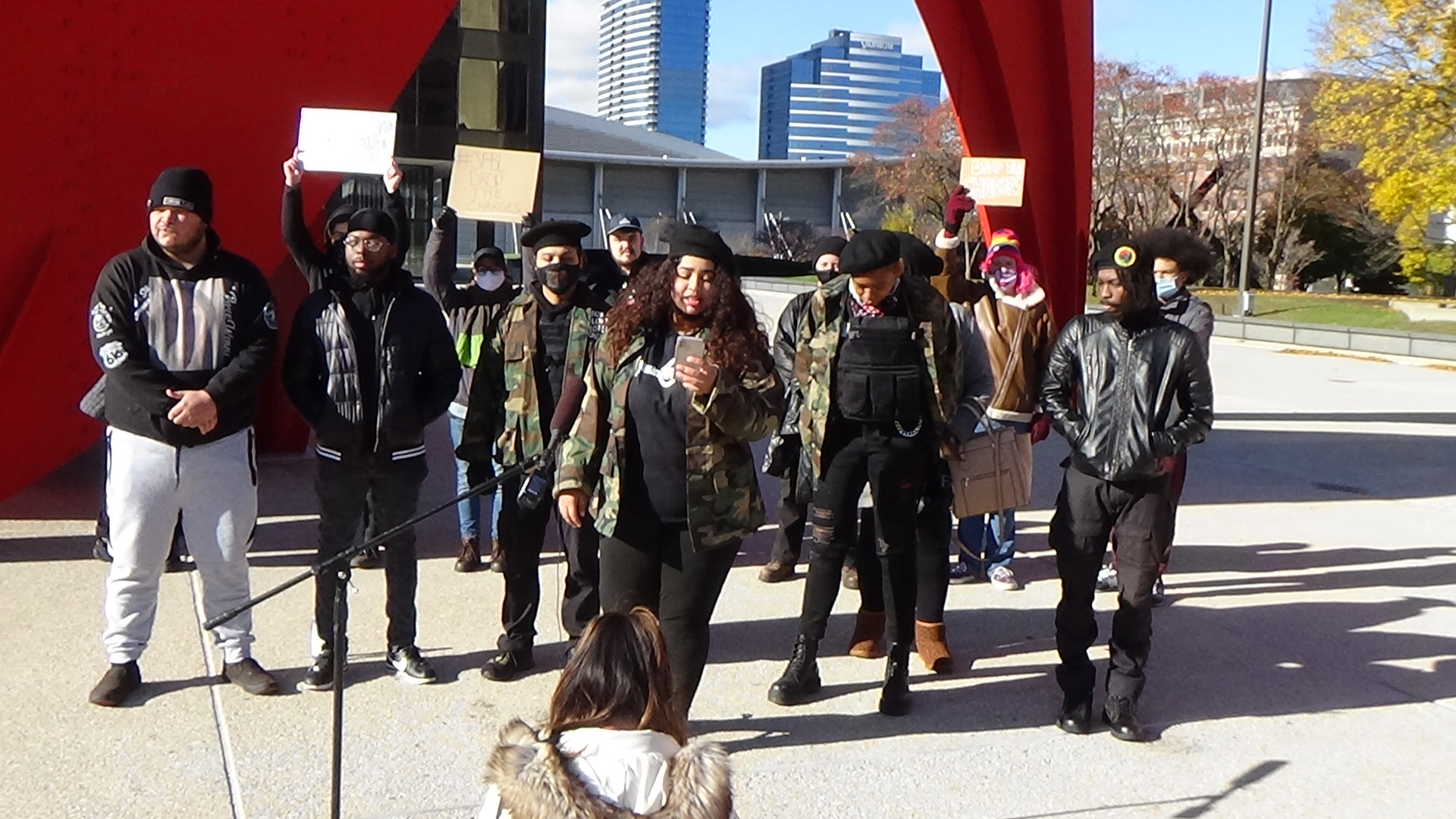
Several people spoke, including three of those that were either arrested or detained by the GRPD. In some cases, the GRPD stopped people with guns drawn on those that were protesting. Even those who were just detained, they were forced to get out of their car, at gunpoint, and then handcuffed before being released.
You can watch the entire Press Conference, which WXMI 17 recorded, at this link. There were two TV stations and one radio station present for the Press Conference. When it came time for Q & A, only the WXMI 17 reporter asked questions. You can’t hear him in the video very well, but the first question was, “It seems that you are all having to not only protest the issues you are confronting, but protesting the right to protest. Do you find this frustrating?”
The second question also centered on Justice For Black Lives, asking, “Where do you go from here? What will you do next?”
In both cases Justice For Black Lives graciously responded to the media questions. It is unfortunate that the WXMI 17 reporter, or the other two reporters, failed to ask questions about the GRPD, about the failure of Grand Rapids City Officials to respond or act on their demands, or the larger systemic problems related to how activists and organizers are met with repression in this city, especially those that do not engage in performative activism.
The news media would do well to explore these questions, which essentially means that they would have to confront systems of power in this city, something that they rarely have done in the 40 years that I have been involved in media accountability work. Let’s see if the local commercial news outlets will follow up with the GRPD, not to just get their take on the latest attempts to repress members of JFBL, but actually confront them on their tactics and their use of state violence against people demanding police accountability and police defunding. My guess is that they will chose to not confront systems of power, either the GRPD or Grand Rapids City Officials.
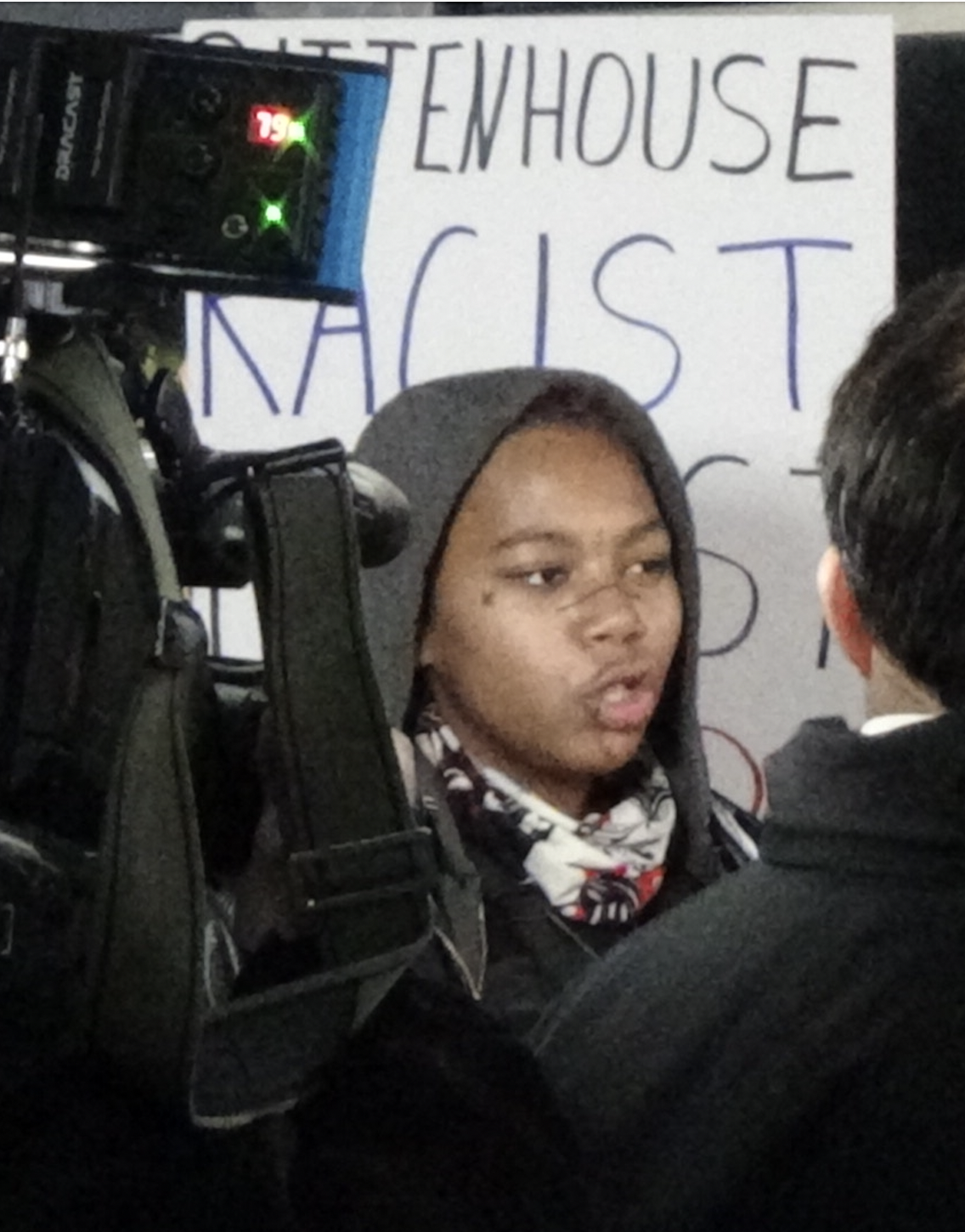 On Saturday night, about 50 people showed up to a protest organized by Justice For Black Lives (JFBL), a protest that was in response to the not guilty verdict in the Kyle Rittenhouse case.
The plan was to march around downtown Grand Rapids, to chant and to demonstrate our collective outrage that a white teenager can shoot and kill two people and not be convicted of murder.
Before the march began, JFBL organizers want to provide space to people to talk about how they felt after the Rittenhouse verdict. There were roughly a dozen people who spoke, addressing the double standard that exists for Black people and white people in the so-called criminal justice system. However, the loudest applause came when one of the JFBL organizers stated, “the justice system didn’t fail in Rittenhouse case, it was designed to do exactly what it has always done, to protect whiteness and property, but never Black and other BIPOC people.”
The march then woven through downtown Grand Rapids, with people chanting and disrupting business as usual – shopping and entertainment.
Both before and during the march, there were two commercial TV stations that came to report on the protest, channel 13 and 17. The WZZM 13 story was brief, but still centered white voices. In addition, the channel 13 story said that the people who came to the protest wanted to “change the system,” when in fact they wanted to get rid of the system. Lastly, the WZZM 13 news reader said that two people were arrested, but the arrests were unrelated to the protest, according to the GRPD.
The WXMI 17 coverage wasn’t much better, with the news reader also relying on the GRPD, along with centering several white voices over the one Black voice in the story. At one point that story states:
The protesters marched around a few blocks downtown, three of them carrying guns by their sides, but remained peaceful. “I don’t know who they are or what side they are on, but I don’t see any reason for them to be armed,” Whittington said.
It is interesting how they framed this part of the story, saying that people “remained peaceful”. What was worse is to follow that framing with a quote from a white woman who didn’t know which side those with guns were on and that there was no reason for them to be armed.
First, BIPOC have every reason to be armed and to protect themselves, since the police can do pretty much whatever they want in these situations.The people who were carrying weapons were there to provide security for the rest of us who were marching. Why is it that white people think they can dictate to BIPOC people about safety and security? The same conversation was had last year in Allendale, after some white protestors were upset because there were BIPOC people with guns.
When BIPOC groups like Justice for Black Lives organize an action, like the one on Saturday night, White people should generally never talk to the news media. As was the case with both channel 13 and 17, white voices were elevated over the one Black voice. White people should come to offer support and solidarity when BIPOC people organize these kinds of actions. If the news media wants to do an interview with you, before you talk to the media, you should check in with the event organizers first.
Lastly, it is deeply problematic for the local news media to uncritically rely on the GRPD as a news source. Just because the GRPD says people were arrested and then claimed it was unrelated to the protest, doesn’t mean it is true. At a minimum, the news media should have talked to someone from Justice For Black Lives or those who witnessed the arrests.
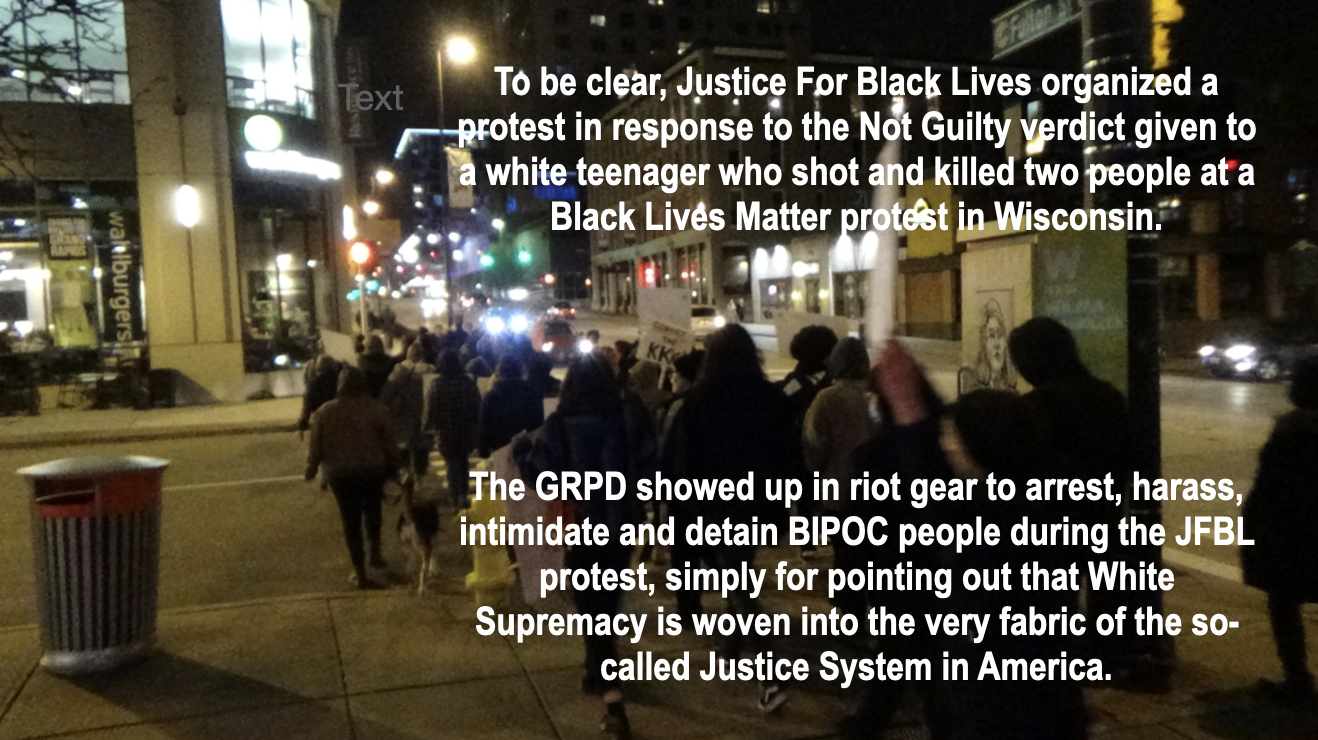
What is important to note about the arrests is that it happened after the protest disbanded. The GRPD showed up with an estimated 20 cops on bicycles, in riot gear, after the protest had taken place. We have seen this strategy used by the GRPD before, since people are often more vulnerable after an action has taken place.
In addition, there was a carload of JFBL organizers that were stopped, told to get out of the car, handcuffed and detained by the GRPD. They were eventually released, but this incident further demonstrates the ongoing harassment of JFBL organizers, supporters and anyone calling for the defunding of the GRPD.
There was video of people being detained and one person who had been arrested. One of those arrested was a Black man who had a firearm with him during the march, a firearm for which he had a permit. The other person arrested, was charged with “disturbing the peace,” which is just a vague charge generally applied to anyone the GRPD wants to arrest.
There were also White Supremacists who had been following the march in their car. Several witnesses believe they were not only filming those who participated in the march, but that they are the ones who called the GRPD.
One witness said:
After the police and most of the group had left the corner on Division & McConnell, the white supremacist couple drove around the block for nearly a half hour, still filming and staring at people who were waiting for rides or getting gas. The car was red, a smaller model, and had been seen multiple times following the march as well as on Division. They made several clear, violent threats towards our group and some individual protesters, which can be heard on some of the other streams from that night.
To be clear, Justice For Black Lives organized a protest in response to the Not Guilty verdict given to a white teenager who shot and killed two people at a Black Lives Matter protest in Wisconsin. The GRPD showed up in riot gear to arrest, harass, intimidate and detain BIPOC people during the JFBL protest, simply for pointing out that White Supremacy is woven into the very fabric of the so-called Justice System in America.
iCI Nation: Another Police Apologist group in the Grand Rapids area
 For the past several years, we have been writing about the pro-police group known as Voice For the Badge (VFB). VFB has been vocally opposed to immigrant justice demands to have the GRPD sever its ties with Immigration, Customs and Enforcement, and since the May 2020 uprising has been an unapologetic defender of the GRPD.
As we have also noted, the GRPD has had tremendous support from Grand Rapids City officials, both on budgetary matters and with a failure to hold them accountable in numerous cases involving GRPD abuse of Black people, along with the ongoing targeting of political activists.
In July, we wrote about a more recent GRPD program called Clergy on Patrol, where faith leaders are invited to participate in GRPD training sessions and ride-alongs. This program has also come under scrutiny by the Michigan Association of Civil Rights Activists, since it clearly violates Church and State separation.
Then in October, several clergy participated in a so-called Unity Walk with the GRPD. In the aftermath of that event, we discovered that there is another pro-police group in the Grand Rapids area, one that has been around longer than Voice For the Badge.
The group is known as iCI Nation, and the only reason we found out about them, was the fact that they produced a video about the so-called Unity Walk in October. iCI Nation claims that it’s mission is, “to provide a healthy environment for the Community to build trust with law enforcement.” Part of the reason why we have not heard about them until recently, has to do with the fact that they do not have leadership that seeks attention, unlike Johnny Brann Sr. (with VFB), plus they primarily do behind the scenes work.
The founder and leader of iCI Nation is Jennifer Franson, which according to her Linkedin page, she has been the leader since 2015. There have been a few articles about iCI Nation in the mainstream press, but these articles are less political in that the iCI Nation has primarily engaged in appreciation work with local law enforcement.
iCI Nation has four community partners listed on their website, Marge’s Doughnut Den, Urban Family Ministries, DLS Servicing Consultants LLC, and PeaceWalker. PeaceWalker is run by a guy who does self-defense training, but combines a strange sort of patriotism with his work. Urban Family Ministries has on its staff, Elijah Libbett, who has also had a very public relationship with VFB leader, Johnny Brann Sr. Libbett participated in Unity Rally in July of 2020, which was really an All Lives Matter rally. DLS Servicing Consultants LLC, is owned by Donna Schmidt, who also is the Treasurer for iCI Nation.
While iCI Nation is not as visible as Voice For the Badge, make no mistake about it, they are a committed to defending local cops, no matter how often the local police harass, intimidate and target Black and Brown communities, along with activists who are calling for defunding.
Far Right Michigan State Senator Tom Barrett announces he is running for Congress, while the news media fails to provide any real background on his voting record
 On Monday, Michigan State Senator Tom Barrett, announced that he is running for Congress in the 2022 Elections.
In standard commercial news media fashion, MLive reported on the Barrett announcement, choosing to use Barrett’s talking points, instead of providing the public with a history of Barrett’s tenure in Lansing.
The MLive article begins with Barrett’s video announcement, with a detailed narrative of the video, without any verification of the claims made in his video. From there, the MLive article pits Barrett as a staunch opponent of Gov. Whitmer’s COVID policies, from the lockdown in 2020 to vaccination issues.
While the stance that Tom Barrett has taken on the pandemic, vaccinations, mask mandates and fighting to give parents control over school curriculum is how the MLive reporter would like us to view Barrett, the article does not challenge Barrett’s views, nor does the reporter bother to explore the significance of these issues.
More importantly, the public would be better served with a more robust look at Barrett’s voting record as a member of the Michigan legislature, along with his numerous public pronouncements, which can be found at this link.
In 2019, as we reported, Barrett made the following statement about immigration activists demanding driver’s licenses, when he said:
“We have to respect the laws of our country, not encourage or reward people for being here illegally.”
Such pronouncement would not come as a surprise to those who have followed Barrett’s political career, on matters of immigration and race relations. In fact, in 2018, Barrett proposed legislation to make English the official language for the State of Michigan. While the MLive article presents Barrett as a Conservative, a more accurate reflection of what Tom Barrett really believes could best be described as someone who embraces a White Supremacists worldview.
In the final paragraphs, the MLive article then juxtaposes Barrett with his likely opponent in the 2022 Congressional race, Rep. Elissa Slotkin. Just as the MLive reporter gives us no real history on Barrett’s voting record, the same is the case with Slotkin. Providing the public with an accurate breakdown of Slotkin’s voting record would be easy, since this information is compiled at the online source known as Vote Smart. Here is a link to the chronological voting record of Elissa Slotkin.
Lastly, there is no information provided in the MLive article in regards to who financed Barrett’s run as a State Senator. This information would be beneficial for people to know, since in electoral politics it is always important to follow the money. Plus, the MLive reporter could have reached out to previous campaign contributors to see if they will financially back Barrett’s bid for Congress.

