For weeks now, there have been calls from the community for the Kent County Prosecutor, Chris Becker, to recuse himself from the case involving the GRPD killing of Patrick Lyoya.

The main issue surrounding the community’s demand that Becker recuse himself from this case has to do with the fact that he has directly received campaign contributions from the Grand Rapids Police Officer’s Association PAC, which is the union that represents the cops in the GRPD. The GRPD union contributed $1,000 to Becker’s campaign in 2016, according to the campaign finance records found online.
However, the GRPD police union is not the only law enforcement entity to contribute to Becker’s campaign over the years. Former Kent Count Sheriff Larry Stelma and current Kent County Sheriff Michelle LaJoye-Young have both made contributions. In addition, there was a $1000 contribution in 2016 from the Kent County Sheriff Law Enforcement (How it was listed on the campaign finance document), which I can only conclude is the Sheriff’s Department union.
Equally important are the contributions that Kent County Prosecutor Chris Becker has received from the legal system. Looking at the records for the past two election cycles, Becker has received campaign contributions from at least 30 different lawyers, with several of them connected to the Kent County Prosecutor’s office, along with 6 current or retired judges.
Then there are the contributions from member of the Grand Rapids Power Structure over the past two election cycles.
2016 Election
- J.C. Huizenga $500
- Peter Secchia $2,500
- Steven Van Andel $500
- Cheri DeVos $1,000
- Dan DeVos $1,000
- Pam DeVos $1,000
- Dick DeVos $1,000
- Betsy DeVos $1,000
- Richard DeVos $1,000
- Helen DeVos $1,000
- Doug DeVos $1,000
- Maria DeVos $1,000
2020 Election
- Cheri DeVos $4,000
- Dick DeVos $2,000
- Dan DeVos $2,000
- Doug & Maria DeVos $4,000
- Pam DeVos $2,000
The DeVos family alone contributed $23,000 to Becker, which is small change for them, but it still makes their family the single largest contributor to Becker’s campaign. There is one point about the contributions in 2020, which I believe to be relevant as well, as it speaks to the longterm interests of Billionaires like the DeVos family.
You can see that the amount of money given by each DeVos family member increased from 2016 to 2020. Richard & Helen did not contribute that year, since both of them had died before then. In looking at the contributions from the DeVos family in 2020, all of those contributions were made on July 10th, 2020. Why is that important? Well, it was only six weeks after the riot/uprising in Grand Rapids because of the police murder of George Floyd. It is my contention that Becker received an increase in campaign funds from the most power family in Grand Rapids, just weeks after the riot/uprising, since the DeVos family knew that Becker would be prosecuting people arrested during the riot/uprising.
The DeVos family has all of their foundation offices, their financial investment firm, RDV Corp, Windquest and the Reserve Bar and the slew of hotels they own, all of which are located in downtown Grand Rapids. The Capitalist Class has vested interests that must be protected by the state and Becker has not disappointed in the cases he presided over around property destruction during the riot/uprising of 2020.
Yes, it is deeply problematic at that the Kent County Prosecutor has not recused himself in the GRPD killing of Patrick Lyoya, especially since Becker received $1,000 from the Grand Rapids Police Officer’s Association PAC. This alone is a solid reason for Becker to recuse himself. However, it is equally troubling that Becker has relied on the DeVos family to get elected to the Prosecutor’s Office, and that their contributions increased after their investments were threatened by protestors in 2020. I can’t help but believe that the DeVos family continues to have conversations with Grand Rapids and Kent County Elected officials over the potential threat to their downtown interests in the aftermath of the GRPD murder of Patrick Lyoya. After all, this is how systems of power function.
It’s time for the annual Meijer sponsored LPGA Golf tournament, scheduled for June 16 – 19 at the Blythefield Country Club.
The Meijer corporation uses this event to promote their own charitable contributions, particularly their Simply Give campaign. Each year they have a different theme for the golf outing. Last year, the theme was “fighting hunger” and this year’s theme is “Let’s Beat Hunger.”
If Meijer or any other entity wanted to actually beat hunger, then raising money for food charity is nothing more than a false solution. Instead of beating hunger, Meijer food charity efforts, and any other food charity efforts, simply perpetuates the problem, since it doesn’t address the root causes of hunger. Here are 5 reasons why food charity does not beat hunger:
- Food Charity is not Food Justice. No amount of donated food will solve the problem, because the issue is not a lack of food but the absence of equity, If people were making a just and living wage, there would not be a need to food pantries or food charity, except maybe during a natural disaster. The problem is what researchers call the Food Charity Industrial Complex, with includes pantries, larger food charity entities like Feeding America and the corporations that donate to them. The Food Charity Industrial Complex doesn’t really want to end hunger, they want to only provide temporary relief for people who are not only food insecure, but who are experiencing poverty.
- If we were being honest, we would name the Meijer Corporation as a Food Cartel, which works with an Agribusiness system, within the larger economic system of Capitalism. (See our Food Justice Workshop for more details.) For example, Meijer has partners for this golf event, which interestingly enough includes other major corporations, specifically other Food Cartels, which benefit from contributing to the Food Industrial Complex as a tax write off, while making billions off of food trafficking, while millions in the US are food insecure.
- Meijer is running ads on TV and radio stations in this market about their charitable event and the local news media is playing right along, since they do not question the merits of the Simply Give event.
- This golfing event (and the Charity Industrial Complex as a whole) is normalizing the way in which society solves problems, which is through charitable efforts for the “less fortunate.” We are not allowed to ask the question, “why are so many people going hungry in our community.” We just have to accept that those who are “in need” are struggling because of some misfortune. We cannot be allowed to have any discussion that seeks to understand the root causes of hunger and the systemic forces that are the beneficiaries of hunger and poverty, like the Meijer Corporation. The normalization of food charity is particularly offensive during the COVID pandemic, which has seen a rise in people utilizing food charity services.
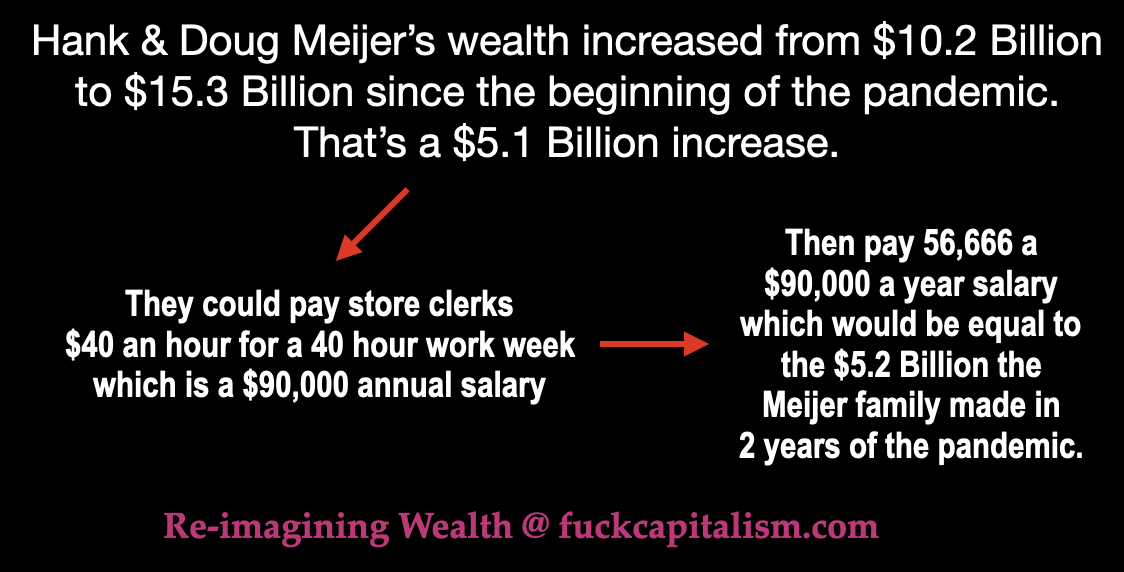
- According to the most recent data on the Forbes Billionaire list, Hank & Doug Meijer are worth $15.3 Billion, making them the 116th richest families in the world. This means that Hank & Doug Meijer’s wealth went from $10.2 Billion at the beginning of the pandemic to $15.3 Billion today. This also means that Hank & Doug Meijer’s wealth increased by $5.1 Billion in the past two years. The reality is that the Meijer family could redistribute equally the $5.1 billion to the people in West Michigan and effectively eliminate food insecurity for the thousands of individuals and families that are experiencing poverty. Hank & Doug Meijer could also pay their employees a living wage of $25 an hour, which would not only mean that their employees would be less likely to need food assistance, it would make the lives of their employee families less stressful. This would still leave Hank & Doug Meijer with $10.2 Billion, which should be more than enough to live on.
On Tuesday, MLive ran an article about Feeding America getting ready to move into a new facility, which would allow them to distribute more food for families “in need.”
 In that same MLive article it states that Feeding America West Michigan received a leading gift of $2 million from longtime supporter, Meijer. While this seems like a a very generous donation, $2 Million from a family that is worth $15.3 Billion is like you and I contributing $20 to something.
Not surprising, the MLive reporter doesn’t question the donation, the Meijer family wealth, the work of Feeding America or the fact that distributing more food to people will not address the root causes of hunger and food insecurity. The MLive reporter had no real incentive to ask these important questions, especially since the MLive article is essentially a re-wording of the Media Release sent out by the Meijer Corporation. Ultimately, the MLive article is not news, it is a Public Relations service they offered for the Meijer Corporation without charging them a cent.
Voice for the Badge finally breaks their silence over the GRPD murder of Patrick Lyoya with the One Bad Apple Theory
 After 43 days of silence, the founder of Voice for the Badge, Johnny Brann Sr., finally responded to the GRPD murder of Patrick Lyoya……..sort of.
On May 16th, this is what the police apologist group, Voice for the Badge posted on their FB page:
Such a tragic and sad situation occurred in our city in early April.
Prayers for all involved and may Patrick Lyoya rest in peace.
I do understand the anger held by many, but should the entire GRPD be treated like they are all bad officers?
No – they should not – but the cop haters –heck they hated our P.D. before and now their hatred has escalated even more.
I value our GRPD and if I thought for one second – our department was what has been said the department is-I would not support the GRPD but I do not believe this so my support for our GRPD remains.
Been said…disband, dissolve the VFB -not happening —No -we have many, many officers that bravely protect us all– as we see on far to many nights in our city.
Hate me if you like but I will never apologize for supporting the good officers of our GRPD-and why should I? The far majority of citizens value our P.D. in every section of our city.
Johnny Brann Sr.
In fact why are haters even on our page?
This is the sort of cowardly and unsubstantiated crap we have come to expect from Voice for the Badge. Here are my responses to such drivel.
- The GRPD murder of Patrick Lyoya wasn’t a “tragic and sad situation,” it was murder by Officer Schurr, who was following the standard protocol for cops.
- VFB offers up prayers, but no thoughts
- Then there is the One Bad Apple justification. As Catherine Caruso wrote after the trial of Derek Chauvin – “At this point, the bad apple theory is nothing but an illusion, a convenient way to brush off and ignore a much more deep-rooted and pervasive problem. It’s time to move past the bad apple theory. It will not end systemic racism or police brutality. It will only be used to continue to justify racist police violence and perpetuate a system of injustice.”
- Another commentator put it this way: The ‘bad apple analysis’ however simply obscures the reality that the criminal (in)justice system is not designed to provide safety to those marginalised and minoritised. It never has been. It’s in fact built on the criminalisation and disposability of black people, people of colour, poor people, trans people, disabled people and beyond, in service of those with wealth and power.
After using the one bad apple theory for the GRPD murder of Patrick Lyoya, Johnny Brann Sr. then rambles on about haters and how he doesn’t believe anything the haters have to say. Instead, Brann says that the cops are here to protect us, without offering up any data, analysis or commentary to substantiate such a claim. Sure the cops motto is to protect and to serve, but do they really protect the public? The GRPD rarely prevents crime, they show up after the fact. Ask Black people if the GRPD protect them. Ask undocumented immigrants if they feel protected by the police, or trans and queer people? What about the unhoused or those who are brutalized by the system of Capitalism, which society refers to as “the poor.” Do you think they feel safe and protected when cops are around?
Once more the founder of Voice for the Badge says that the majority of people value the GRPD, and once more he provides no evidence to substantiate such a claim.
Lastly, Brann signs off by asking the question, “why are haters even on our page?” Well Johnny, speaking for myself, I monitor the Voice for the Badge FB page because I consider your organization as a hate group, a group that perpetuates harm, and a group that is rooted in a White Supremacist ideology.
The Business of the Grand Rapids City Government is Business: The 2023 Budget Priorities
 US President Calvin Coolidge believed that the country’s well-being was best preserved by allowing business to create wealth. His most famous remark was in a speech that he delivered in 1925, in which he stated: “The business of America is business.”
Coolidge presided over a period when taxes and government spending were lowered. The President resisted appeals from Veterans for bonus payments. He vetoed the Soldiers’ Bonus and he was extremely antagonistic to the growing Labor Movement.
Based on the proposed 2023 Grand Rapids City Budget, it would seem that the Business of the Grand Rapids City Commission is business. According to a May 11th announcement from the City of Grand Rapids, the commissioners have already approved at total of $37,884,818 for several economic development committees, committees that are primarily stacked from members of the Business Class. (See Below) It should also be mentioned that these people are not elected, rather they are appointed by members of the Grand Rapids City Commission.
This $37,884,818 of public funding for business interests includes (see breakdown for each of the 12 areas)
- Business Development
- Business District Marketing
- Facade Improvement
- Business District Design
- Business Sponsorships
- Grand River Governance Planning – which is primarily designed to attract tourists and consumers
- Trade Shows
- Real estate development programs
- Infrastructure improvements – which primarily attracts tourists and consumers
- Major capital improvements to Downtown public spaces such as Lyon Square and the Van Andel Arena alley
These twelve groups, which are using nearly $39 million in public money, have a total of 96 current Board members. Of those 96 there are:
- 18 Current or former Government Officials
- 6 Non-Profit representatives
- 8 Educational Institutions
- 4 retired or without status
- 60 Business representatives
Now, if we are talking about how much the City of Grand Rapids has committed to things like Affordable Housing, Anti-Racism Work, or other critical social justice issues, the comparison to business interests is stark.
- We know that the City of Grand Rapids made a deposit of $957,365 for the Affordable Housing Fund in December of 2021.
- According to a document on Community Collaboration on Climate Change, this project is projecting to commit $900,000 over a three year period.
- Anti-Violence funding – the City of Grand Rapids is only a fiduciary for the Cure Violence Program, offering only resources and information.
- Last year, the City of Grand Rapids received $600,000 to advance racial equity in city operations
- Neighborhood Match Fund, which provides funding for neighborhood improvement, particularly around more progressive projects – estimate $100,000 per year
Even with these 5 critical issue areas, the City of Grand Rapids has committed no more than $2.7 Million, and some of that funding is for a three year period. Therefore, the City of Grand Rapids has committed roughly $2 Million for Affordable Housing, anti-racism work, Climate Change, anti-violence and resident-led Neighborhood projects, while the Business-led investment and development projects will be using nearly $39 Million of public money. Of course, this doesn’t even include the roughly $60 Million for policing, which demonstrates the issues that are prioritized by Grand Rapids City officials.
The proposed 2023 Budget for the Brownfield Development Authority is $15,507,194
BDA Board of Directors
Guillermo Cisneros – West Michigan Hispanic Chamber of Commerce
Lynn Rabaut – retired
Kristine Bersche – Natura Architectural Consulting LLC
Troy Butler – Thacker Sleight
Nathaniel Moody – City Commissioner
Dan Barcheski – Chairman of Axios HR
Kim McLaughlin – Wolverine Building Group
Micah Perkins – Retirement Services Officer US Army
John VanFossen – Meijer
Joshua Verhulst – Tech Defenders
The proposed 2023 Budget for the Downtown Development Authority DDA is $16,240,851
Board of Directors
Richard Winn – AHC Hospitality (DeVos-owned)
Mayor Rosalynn Bliss
Luis Avila – Varnum Law
Kayem Dunn – Consultant
Jermale Eddie – Malamiah Juice Bar
Greg McNeilly – Windquest Group (DeVos-owned)
Jim Talen – former Kent County Commissioner
Diana Sieger – Grand Rapids Community Foundation
Jen Schottke – ABC Western Michigan
The proposed 2023 Budget for the SmartZone Local Finance Development Authority is $2,374,546.
SmartZone LFDA Board of Directors
Hal Ostrow – Lawyer, Rhoades McKee
Al Vandeberg – Kent County Administrator
Keith Brophy – Emergent Holdings Inc.
Gerald Callahan – Van Andel Institute
Lisa Freiburger – GRCC
Kristian Grant – GRPS
John Helmholt – GRPS
Mark Washington – City Manager
Jerry Kooiman – MSU
Randy Thelen – The Right Place Inc
Fred Molnar – Michigan Economic Development Corporation
The proposed 2023 Budget for the Economic Development Corporation is $120,296.
Economic Development Corporation Board of Directors is the same as the Brownfield Development Authority.
Guillermo Cisneros – West Michigan Hispanic Chamber of Commerce
Lynn Rabaut – retired
Kristine Bersche – Natura Architectural Consulting LLC
Troy Butler – Thacker Sleight
Nathaniel Moody – City Commissioner
Kim McLaughlin – Wolverine Building Group
Micah Perkins – Retirement Services Officer US Army
John VanFossen – Meijer
Joshua Verhulst – Tech Defenders
The proposed 2023 Budget for the Southtown Corridor Improvement Authority is $647,858
Southtown CIA Board of Directors
Johnathan Farman – JF Consulting
Kristian Grant – GRPS
Helen Harp – Owner Joy Radio
Senita Lenear – City Commissioner
Eric Williams – United Methodist Community House
Nathaniel Moody – City Commissioner
Ruben Ramos – R&R MECHANICAL SERVICES LLC
Darel Ross – Start Garden and Owner Forty Acres Soul Kitchen
The proposed 2023 Budget for the Westside Corridor Improvement Authority is $290,000
Westside CIA Board of Directors
Brent Gibson – Construction Simplified
Johnny Brann Jr. – Brann’s Restaurant
Daniel Grinwis – Oasis of Hope Center
Lisa Haynes – GVSU
Aaron Jenks – Paradigm Design
Jon O’Connor – City Commissioner/Owner of Long Road Distillers
Dave Shaffer – CEO Interphase Interiors
The proposed 2023 Budget for the Uptown Corridor Improvement Authority is $133,505
Uptown CIA Board of Directors
Lynn Happel – owner of Veterinary Clinic
Stephanie Johnson – Urban Exchange LLC
Nathaniel Moody – City Commissioner
Matthew Smith – Open Systems Technologies Inc
Mark Stoddard
Tamara Sytsma – System Wealth Strategies
Peter Jacob – Kind Creative
Joana Hively – Owner Global Infusion
The proposed 2023 Budget for the Uptown Business Improvement District is $133,505
Uptown BID Board of Directors
Lynn Happel – Owner Eastown Veterinary Clinic
Stephanie Johnson – Urban Exchange LLC
Nathaniel Moody – City Commissioner
Matthew Smith – Open Systems Technologies Inc
Tamara Sytsma – System Wealth Strategies
Peter Vanderwier
Ted Lott – Lott3Metz Architecture
Jaye Van Lenten – Co-owner of Spirit Dreams
The proposed 2023 Budget for the Michigan Street Corridor Improvement Authority is $397,500
Michigan Street CIA Board of Directors
Max Benedict – Third Coast Development
Kevin Brant – Developer
Joe Jones – City Commissioner
Thomas Dann – Real Estate Agent
Alexander Lamkin
Jeff Lobdell – Restaurant Partners Inc.
Christopher Swank – GVSU
The proposed 2023 Budget for the South Division/Grandville Corridor Improvement Authority is $218,000.
South Division/Grandville CIA Board of Directors
Amy Brower – Roosevelt Park Neighborhood Association
Fran Dalton – Garfield Park Neighborhood Association
Mary Dengerink – Green Leaf Consulting
Synia Jordan – Real Estate Agent
Kurt Reppart – City Commissioner
Leonard Van Drunen – Calvin University
Angelica Velasquez – owner of La Casa de la Cobija
Marcel Price – Executive Director of The Diatribe
The proposed 2023 Budget for the North Quarter Corridor Improvement Authority is $106,467.
North Quarter CIA Board of Directors
Hannah Berry – Lions and Rabbits Center for the Arts
Kim Bode – Owner and founder of 8THIRTYFOUR
Duane Culver – Culver CPA Group
Brianna Forbes – Urban Massage
Alan Hartline – President Kingma’s Market
Milinda Ysasi – City Commissioner
The proposed 2023 Budget for the Monroe North Tax Incremental Finance Authority is $1,390,901
Monroe North Tax Incremental Finance Authority Board of Directors
Rosalynn Bliss – Mayor of Grand Rapids
James Baldwin – West Michigan Mechanical Contractors Association
Diedre Deering – Literacy Center of West Michigan
Jim Talen – former County Commissioner
Richard Winn – AHC Hospitality (DeVos-owned)
The local commercial news media has all reported that there has been “vandalism” committed at the homes of three Grand Rapids Elected Officials, Mayor Bliss, First Ward Commissioner Jon O’Connor and Third Ward Commissioner Nathaniel Moody.
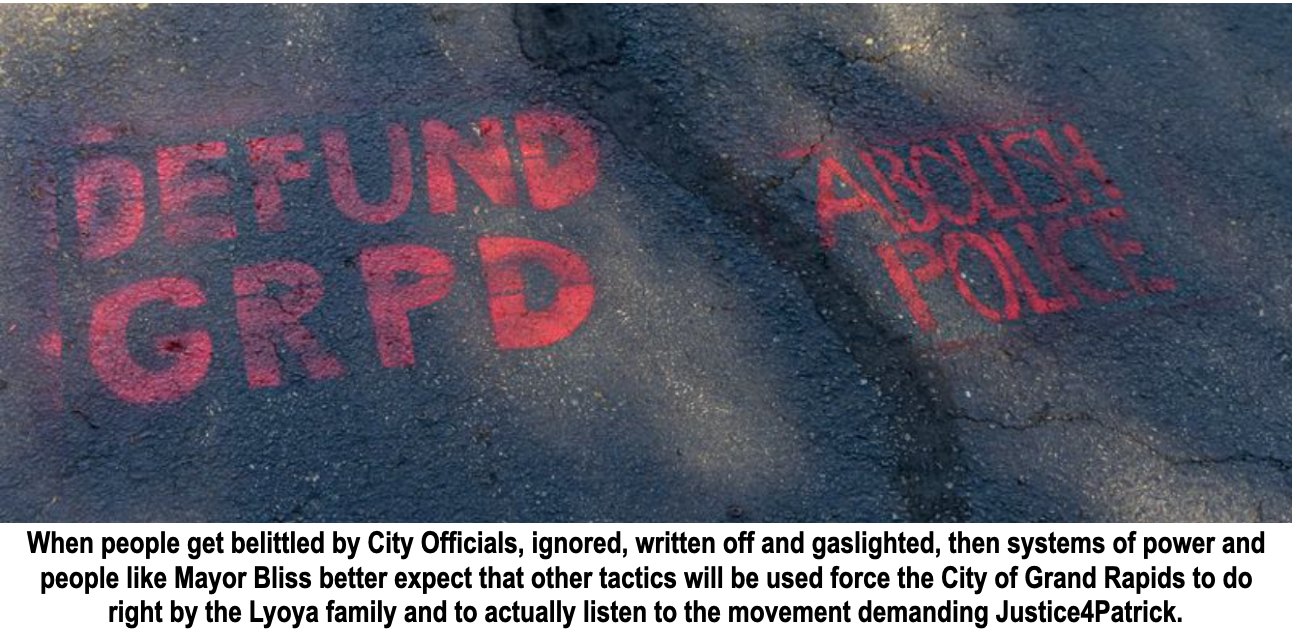
Now, there might be people who object to these kind of tactics, but it is important to point out that no one was hurt, no one was shot in the back of the head, and no property was destroyed.
However, this article is not about tactics, it is about how the local commercial news agencies reported on these incidents, which ultimately reflects how they practice so-called journalism in general.
First, there was a brief quote from the GRPD, where they acknowledged what had happened. More importantly, there is a statement that all of the four major daily local commercial news agencies included, which was a statement from Mayor Bliss, which said:
“While I understand people’s frustration and anger, acts of violence and vandalism doesn’t get us to just outcomes. I’m disappointed in these most recent incidents of vandalism. Social activism is a valuable part of our democracy – but targeted vandalism designed to intimidate is not. The challenges confronting our city require respectful engagement so that we can reach thoughtful solutions. Intentional vandalism is an empty response to the important issues we face.”
None of the news agencies questioned this statement, nor did they report that they sought out any sort of response from the various groups fighting for Justice for Patrick Lyoya. How can the local news media not question the Mayor, when she says, “The challenges confronting our city require respectful engagement so that we can reach thoughtful solutions.” What kind of engagement is the Mayor referring to? People have been coming to the City Commission meetings, which are not authentic engagement. There is no dialogue, because that is how the Commission meetings are designed. Despite the inauthenticity of the Commission meetings, there have been hundreds of people who have stepped up to the mic during public comment and have made demands from this elected body, none of which have been met. In addition, there have been over 130,000 messages sent to these seven elected Grand Rapids officials, along with City Manager Mark Washington, which have included the same kind of demands, yet that information has been ignored by the elected officials and unreported on by the local news media. When people get belittled by City Officials, ignored, written off and gaslighted, then systems of power and people like Mayor Bliss better expect that other tactics will be used force the City of Grand Rapids to do right by the Lyoya family and to actually listen to the movement demanding Justice4Patrick.
Second, all of the news agencies presented a narrative about what happened when a GRPD officer shot Patrick Lyoya in the back of the head. In fact, the local commercial news agencies spent as much time, if not more, on the biased narrative than they did on the graffiti at Commissioner’s homes. Perpetuating this kind of a narrative is not only poor journalism, it feeds into the systemic racism that permeates Grand Rapids, whereby it blames Patrick Lyoya for his own death and makes those who are demanding Justice4Patrick out to be an unruly mob. What if it was reported on how much the FOIA’d documents on the GRPD killing of Patrick Lyoya were redacted? How would that change public perception?
Lastly, for those who think that the tactics used at the City Commissioner’s home violates “peaceful protest” protocols, I would say two things. First, those who disagree are people with tremendous privilege, specifically white privilege and class privilege. Secondly, the history of social movements/resistance movements in the United States have never been exclusively non-violent. The Abolitionist Movement wasn’t non-violent when those who were enslaved rose up against the plantation owners, sometimes killing them and burning down the plantation. Hell, even during the Black Freedom Struggle from the 1950s through the 1970’s, there were lots of examples of disruption and even armed self defense. It wasn’t all Kumbaya.
Links to the four local commercial news agency stories:
 There was a recent article at the online independent news site, The Intercept, entitled, A “WOODSTOCK” FOR RIGHT-WING LEGAL ACTIVISTS KICKED OFF THE 40-YEAR PLOT TO UNDO ROE V. WADE.
This article provides an excellent overview of the origins of the anti-abortion movement in the United States, a movement that is rooted in religious fanaticism. The author of the article is Ilyse Hogue, who also wrote the book, The Lie That Binds, from which the article was taken. The article looks at the group the Federalist Society and a more recent organization, the Alliance Defending Freedom, which is mostly a group of lawyers who claim to defend individuals and entities on religious grounds, when in fact they are really committed to imposing Far Right Christian values on the rest of society.
Since the “leaked” Supreme Court document, I have been thinking about the West Michigan version of the 40-year war against abortion and who are the major players in the Greater Grand Rapids area, institutions and individuals that have played a major role in attempting to undo the legal framework of Roe v. Wade.
Churches and other Religious Institutions
Beginning in the late 1980s, the antiabortion attacks certainly escalated in Grand Rapids. Operation Rescue, the anti-Abortion group led by Randall Terry, came to Grand Rapids on several occasions beginning in the late 1980s. Protests and efforts to stop women from choosing to have an abortion were intense and often confrontational, as you can see from this Grand Rapids Press article above.
There are literally hundreds of churches in West Michigan that embrace an anti-abortion stance, some evangelical, some Christian Reformed, along with the Catholic Church. Many of these churches would include information about protests and other so-called Pro-Life actions happening in Grand Rapids, Lansing or in Washington, DC.
As a more centralized entity, the Catholic Church has been firm on its stance against abortion. The Catholic Bishops in Grand Rapids since Roe v. Wade became law, have been consistently conservative on social issues, particularly on abortion. This means that there is entrenched opposition to abortion, with a structural mechanism to disseminate information around the issue of abortion and how people can become actively involved in opposing it. Catholic Church bulletins regularly include information about Right to Life rallies or action alerts on upcoming votes at the state and federal level as it relates to the issue of abortion.
There is also the Christian Reformed Church and while it is less centralized than the Catholic Church, their position on abortion has also been consistent in their opposition since 1972.
Then there are the numerous Evangelical Churches and independent churches, which are part of the larger Religious Right Movement in West Michigan. These churches have also consistently opposed abortion and have taken part in rallies and action to oppose reproductive choice. One example is The Ridge Covenant Church, where the pastor does regular video, such as this one, where he condemns abortion.
In addition to churches, there are other religious institutions that have also been part of the anti-Abortion movement. The Acton Institute for the Study of Religion and Liberty has not only been opposed to abortion since their founding in 1990, they regularly provide analysis and information on their website that condemns abortion and endorses legal action, like their support of the Alliance Defending Freedom. The Acton Institute led the charge to endorse Trump’s Supreme Court nominee, Amy Cone Barrett, who has been part of the Catholic group known as People of Praise, which believes that women should be subordinate to men.
Other religious entities that have provided support for the anti-abortion position is the Catholic Radio station, Holy Family Radio, which is 1140 AM and 98.3 FM in Grand Rapids. This radio station amplifies the anti-abortion positions on a regular basis and includes as one of its underwriter, Right to Life.
Funding the anti-Abortion Movement
Additionally, there are thousands of religious people in West Michigan that make regular contributions to Michigan Right to Life. More importantly, there are several members of the West Michigan elite that have collectively contributed millions of dollars to anti-abortion groups and other “family-values” organization that want to keep women in a subordinate role in society, which also means they do not want women to have bodily autonomy. In Russ Bellant’s book, The Religious Right in Michigan Politics, he cites the DeVos family, Peter Cook, the Prince family, the Van Andel family and the DeWitt family as major funders of the anti-abortion movement. Many of these same families continue to make significant financial contributions to anti-abortions groups like Right to Life.
These families fund anti-abortion efforts in two ways. First, they collectively have provided millions of dollars to political candidates and to the Republican Party, which has consistently opposed abortion and have weakened women’s access to abortion at the state level for the past four decades. The DeVos and Prince families have consistently funded Pro-Life candidates, candidates who have become members of Congress, along with State legislators, thus consistently pushing for policy that weakens access to abortions. According to the Michigan Campaign Finance Network, between 1999 and 2016, the DeVos family contributed $81 Million to the Republican Party.
The Second way that these families fund the anti-abortion movement, is through their foundations. Again, the DeVos family has been consistently the largest funder of the anti-abortion movement from West Michigan, which not only has included funding to groups like Right to Life, it means funding “pregnancy resource centers,” and other groups like Focus on the Family, the Family Research Council, the Acton Institute, the Alliance Defending Freedom, the Council for National Policy, the Federalist Society, Hiilsdale College, and many other groups that include opposition to abortion as part of their work/mission.
We have been tracking the various DeVos Family Foundations since 2013, where they have collectively contributed millions to organizations that oppose abortion.
If the reproductive justice movement is serious about keeping abortion legal and safe in the US, then they need to come to terms with the groups organizing against and bankrolling the anti-abortion movement. Recent rallies have been primarily held at Calder Plaza, but it might make sense for them to hold rallies outside the DeVos family headquarters in downtown Grand Rapids (200 Monroe NW) or the Catholic Diocese/Cathedral location on South Division, just north of Wealthy St. This would not only provide an opportunity to educate people about the Anti-Abortion Cartel in West Michigan, it would force these groups to have to respond to their role in funding hate and harm.
In addition, of the few rallies that have been held in Grand Rapids in recent weeks, there have been numerous Democratic Party politicians and/or candidates who have spoken and advocated for people to vote Democratic if they want to save Roe V. Wade or minimize the harm being done at the state level. However, advocating for the electoral strategy has not been terribly effective since Roe v. Wade was adopted. Too often we forget that Roe v. Wade was adopted during the Nixon Administration, primarily because of a strong women’s social movement.
Likewise, the electoral strategy doesn’t always measure up, especially when Speaker of the House, Nancy Pelosi, who is backing the anti-Choice incumbent Henry Cuellar in Texas, over the more progressive primary challenger Jessica Cisneros. More importantly, as Margaret Kimberly writes on Black Agenda Report, the Democrats have had numerous opportunities to codify abortion rights into federal law, by passing legislation like the Freedom of Choice Act, which the Obama Administration promised to do, but never did.
I will conclude with some insightful analysis by Natasha Lennard, writing for The Intercepted, who says:
Democrats in Congress should have long ago codified the right to abortion access, as the party’s left flank has urged, but they didn’t. If they don’t act now to end the filibuster and pass abortion protection laws, they will deserve something approaching the same level of blame directed at anti-abortion Republicans.
After Texas passed an effective abortion ban last year, which was ruled unconstitutional by a state judge in December, President Joe Biden vowed to “launch a whole-of-government effort” to protect the right to abortion in the state. We are yet to see any such effort, even though, as I wrote at the time, there are a number of steps his administration could immediately take.
 If — and this really is an if — the fear of a nationwide abortion ban and the shock of Roe’s undoing galvanizes Democratic voters in November, these will once again be votes against a greater evil, rather than votes the Democrats have earned. Just as today’s Democratic Party has refused to take the lead on this issue even as abortion access has fallen apart in so many places, they will not take the lead now. Instead, it is up to us — it always has been.
Since we cannot rely on Democratic leaders, we must — following the example of organizers on the front lines of this struggle — work around the law, exploiting the coming interstate jurisdictional chaos around abortion law that the end of Roe will bring into even sharper relief. The fight for free and accessible abortions has always required solidarity, risk, and cunning. To keep reproductive justice alive, we must fight on terrain beyond the law, in contravention of certain laws, or in post-Roe legal gray areas.
One such group that is operating outside of the establishment framework is Rise up 4 Abortion Rights.
Sources used for this article:
- The Religious Right in Michigan Politics, by Russ Bellant
- Dark Money: The Hidden History of the Billionaires Behind the Rise of the Radical Right, by Jane Mayer
- Shadow Network: Media, Money, and the Secret hub of the Radical Right, by Anne Nelson
- Spiritual Warfare, by Sara Diamond
- The Lie That Binds, by Ilyse Hogue
- Without Apology: The Abortion Struggle Now, by Jenny Brown
GRIID Interview with Indigenous Activists on MMIP Rally in Grand Rapids and Performative Politics
 GRIID was able to sit down recently with two local Indigenous activists to talk about the recent Mission & Murdered Indigenous People rally that was held in Grand Rapids.
We spoke with Joe (Banashee) Cadreau, Co founder of Bimose Ode and the executive secretary of The Native Circle of Newaygo County, and Jade (Giddigongoons-kwe) Green, Co-founder of Bimose Ode and Youth Council Chair at Native Circle of Newaygo County.
Here are the questions that we asked both of them:
- Can someone briefly talk about what the Indigenous Rally was for last week and who organized it?
- Did the organizers invite City Commissioner Joe Jones? If so, for what reason?
- What are your main critiques for objecting to have Joe Jones speak at an Indigenous event/rally?
- We talked about this just before the interview, what was the difference between this rally and the one that was organized last year?
- For people who will be watching this video, what message(s) would you like them to think about?
The interview is 13 minutes long.
Yesterday, MLive posted an article entitled, Grand Rapids leaders may make changes to public meetings following disruptions.
The article centers around the fact that since those protesting the GRPD murder of Patrick Lyoya have not practiced West MI Nice during the past two City Commission meetings, the Mayor of Grand Rapids decided to end those meetings. Earlier on in the MLive article, Mayor Bliss said:
“I’ll be meeting with our city attorney and city clerk and we’ll be looking at what options we have under not just the Open Meetings Act but our standing rules and potentially making changes to those.”
Bliss doesn’t provide any additional information or thoughts on what sort of changes or options there are regarding City Commission meeting rules, but it would be safe at this point to assume that those changes would be punitive, restrictive and essentially anti-democratic.
The MLive article then goes on to cite Mayor Bliss at length, who was expressing her dismay at how disrespectful people are and how they do not follow City Commission meeting rules. The article also mentions that there have been other instances during Mayor Bliss’s tenure that meetings have been disrupted, along with citing an example of when County Commission meetings were disrupted in 2018 and 2019 over the issue of the County’s contract with Immigration and Customs Enforcement (ICE).
Recent City and County Commission meeting disruptions
In late 2018, Captain Kurt VanderKooi, the GRPD’s liaison with ICE, while watching a local TV news story, contacted ICE to look into Jilmar Ramos-Gomez. The thing that VanderKooi didn’t know was that Ramos-Gomez was a US citizen and a former US Marine. After VanderKooi’s call to ICE, they detained Ramos-Gomez for several days, until it became public that he was a US citizen and former Marine. Grand Rapids City officials did not suspend VanderKooi, nor did they fire him, even though he also used racist language when talking about Ramos-Gomez to ICE.

In late February of 2019, members of Movimiento Cosecha GR and GR Rapid Response to ICE planned to disrupt the City Commission meeting, by standing in front of the Commissioners and holding signs while the Commission meeting was still in progress. Mayor Bliss adjourned the meeting.
Mayor Bliss was no doubt mimicking what the Kent County Commission had done in June of 2018, when Movimiento Cosecha GR and GR Rapid Response to ICE organized an action during their June 28th meeting. There were over 200 people who packed the County Commission chambers, with many holding signs. When public comment began, several activist moved into the area where the commissioners are seated and held up a banner and began to chant. The County Commission Chair adjourned the meetings shortly after that. Seeing that most of the Commissioners had left, people still got up and shared stories of ICE violence and how they live in constant fear of arrest, detention and deportation.
After that meeting, the County Commission then put up a barrier to deter people from coming near to where the commissioners were seated, so at the next meeting, activist sat down in front of the barrier and again began chanting for an end to the ICE contract. Once again, people brought signs and held them up during the meeting.
In late August, the same activists came to another Kent County Commission meeting after it was announced days before that people could no longer bring signs to the meetings. As a response, activist pinned large patches on their back and then stood up, with their backs facing the County Commissioners during the entire meeting.
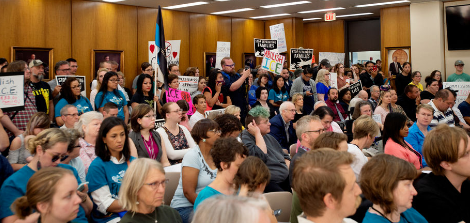
In September, Movimiento Cosecha GR and GR Rapid Response to ICE activists again disrupted the Kent County Commission meeting, by holding their own People’s Commission, in an attempt to model the kind of meeting process that the public might actually benefit from. The Kent County Commission Chair once again adjourned the meeting shortly after the People’s Commission meeting had begun.
Over the next several meetings, the County Commission decided to have a closed meeting and only allow people to watch the proceedings on a TV monitor in a different room.
All of this is to say that it is possible that the Grand Rapids City Commission might follow the actions of the Kent County Commission. Mayor Bliss has already stated that to disrupt the meeting was a misdemeanor and people could be arrested. Whatever actions Grand Rapids City officials take, it will only embolden activists who are demanding Justice for Patrick Lyoya. The more that Mayor Bliss decides to adjourn meetings and not meet the demands of this movement, the more the resistance will continue.
Last night, Grand Rapids Mayor Rosalynn Bliss decided to stop the City Commission meeting because those who came out to protest for Patrick Lyoya would not play by the rules of commission meetings.

Many people addressed the City Commission last night, some more than once. During the first Public Comment portion, where people could speak on agenda items, several people got up to address the issue of the proposed 2023 City Budget. Virtually everyone who spoke at this point shared their disgust and outrage over the fact that the GRPD Budget would not be reduced and that the City was considering purchasing new vehicles for the Police Department. Several of those who spoke made it clear that they wanted the GRPD Budget reduced to the City Charter mandated 32% of the budget, which would be a significant reduction.
What is instructive is the fact that none of the local news agencies – MLive, WOODTV8, WZZM 13 or WXMI 17 – mentioned the demand that the GRPD be defunded to the City Charter mandated 32%. There was some mention in a few of the stories around police funding, but all four of the local news agencies failed to include he clear demand about defunding the GRPD, which has been one of the most consist demands since June of 2020.
Instead, the focus of the coverage was centered around people swearing during the public comment period, where people became “unruly” or didn’t “respect the space” or allow the City to “conduct City business.” Mayor Bliss was repeatedly quoted by the local news agencies and WOODTV8 even did a story they ran before the 7pm City Commission meeting, where Mayor Bliss and Chief Winstrom were provided a platform to verbalize their talking points, even though the Justice4Patrick movement was not afforded the same opportunity to share their thoughts.
Once the Mayor decided to end the meeting, the rest of the coverage focused on but of video footage of protestors in the Commission Chambers, then outside of City Hall, since the GRPD – which had several dozen officers present – threatened people with arrest if they didn’t leave the building.
Several of the news agencies did report that one of the those protesting the GRPD murder of Patrick Lyoya was arrested, but the only source to confirm this was the GRPD. Once again, those with the Justice4Patrick Movement were not asked to provide any comments about the arrest.
The continued reliance by the local commercial news media on official sources – people with political and economic power – is not just a reflection of how journalism is produced in this city, it demonstrates that the local commercial news media doesn’t have a functional relationship with grassroots community organizers. This lack of relationship with grassroots community organizers stems from the fact that the community doesn’t trust the local commercial news agencies, since they often present biased coverage on policing in this city, which is also due to the fact that the local commercial news agencies have internalized the same values of the very systems of power that they are supposed to hold accountable. #Justice4Patrick#
West MI Foundation Watch: Peter & Joan Secchia Foundation – contributions to fit their political agenda
 Even though Peter Secchia, a member of the Grand Rapids Power Structure, died in 2020, his foundation continues to promote the myth that rich white guys really want to make a difference in the world.
For more than 5 decades, Peter Secchia contributed money to the Republican Party, which means that he funded the hateful rhetoric and the harmful policies of the Republican Party, from Ronald Reagan all the way through the neo-fascist Trump Administration.
The Secchia Foundation was created, like all foundations of the Capitalist Class, as a way hide some of their money from being taxed and to generate a positive PR buzz about how generous they are with the money they made off the backs of the workers they exploited.
GRIID just downloaded the 990 documents for the Secchia Foundation for 2020, which is the most recent year to access from GuideStar.
The Peter and Joan Secchia Foundation, like most foundations started by members of the Capitalist Class, contributes some of their money to charitable organizations, organizations which do not challenge structural inequalities nor the families that the foundations are named after. Some of the local charitable organizations that the Secchia Foundation contributed to are:
- Baxter Community Center
- Steepletown Neighborhood Services
- YMCA of Grand Rapids
Secchia was also a member of the Catholic Church, so there are also several contributions to Catholic organizations, like St. Thomas Church and the St. Andrews Cathedral.
Then there are the education institutions that Secchia has contributed to, in the case much larger contributions than the charity groups, such as:
- Davenport University Foundation – $50,000
- GR Community College Foundation – $84,333
- GVSU – $12,500
- West Michigan Aviation Academy (Dick DeVos) – $5,000
Lastly, there are organizations that have an Capitalist Agenda, that the Secchia Foundation has contributed to, such as:
- Downtown Market Ed Fund – $11,000
- Experience Grand Rapids – $12,030
- Grand Rapids Community Legends – $117,392
- Russell Kirk Center – $25,000
The Grand Rapids Community Legends is particularly problematic, as they are the one responsible for most of the statues that have been erected in downtown Grand Rapids, centering around “great leaders,” most of whom are white. The Grand Rapids People’s History Project has written about many of them, including:
As we mentioned in the beginning of this post, the Secchia family has contributed a great deal more money to the Republican Party, but that reality tends to be less of any interesting story to the local news media. The foundation contributions are often what solidify the legacy of Capitalists like Peter Secchia, thus hiding how they made their wealth and how they used it to further their own agenda.

