Boycott Campaign targets downtown businesses over GR Chamber of Commerce proposed ordinance to criminal the unhoused
 In early December, when we began reporting on the Grand Rapids Chamber of Commerce’s proposed ordinance, which they sent in a letter to the City Commission on January 6th. You can read the proposed ordinance from the GR Chamber of Commerce here.
One week later, 120 business people, many of who are members of the Grand Rapids Power Structure, sent another letter to the Grand Rapids City Commission, which they all signed. You can read that letter, with all 120 signatures at this link.
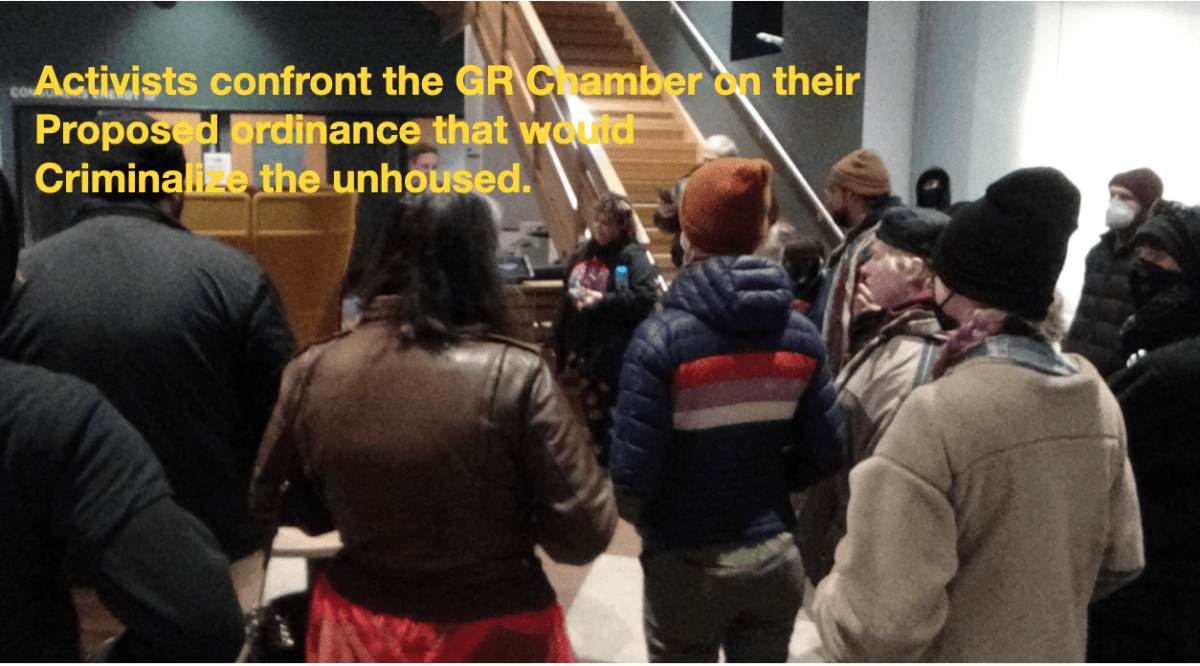
Shortly after the GR Chamber announced their proposed ordinance, the Grand Rapids Area Tenant Union, along with a coalition of groups and individuals called for a boycott of all downtown businesses until the GR Chamber retracts their proposed ordinance and makes a public apology for proposing a policy that would criminalize the unhoused. On December 12, about 25 activists went to the GR Chamber’s downtown office to protest the ordinance proposal and to make their demands known. The GR Chamber of Commerce responded by calling the GRPD.
The following week activists went to make similar demands at Mel Trotter Ministries, which was one of the signatories to the letter that endorsed the GR Chamber’s ordinance proposal. At the same time, this group, working through the Grand Rapids Area Tenant union, created an electronic letter campaign, which as of today generated nearly 13,000 letters to Grand Rapids City officials and the GR Chamber of Commerce.
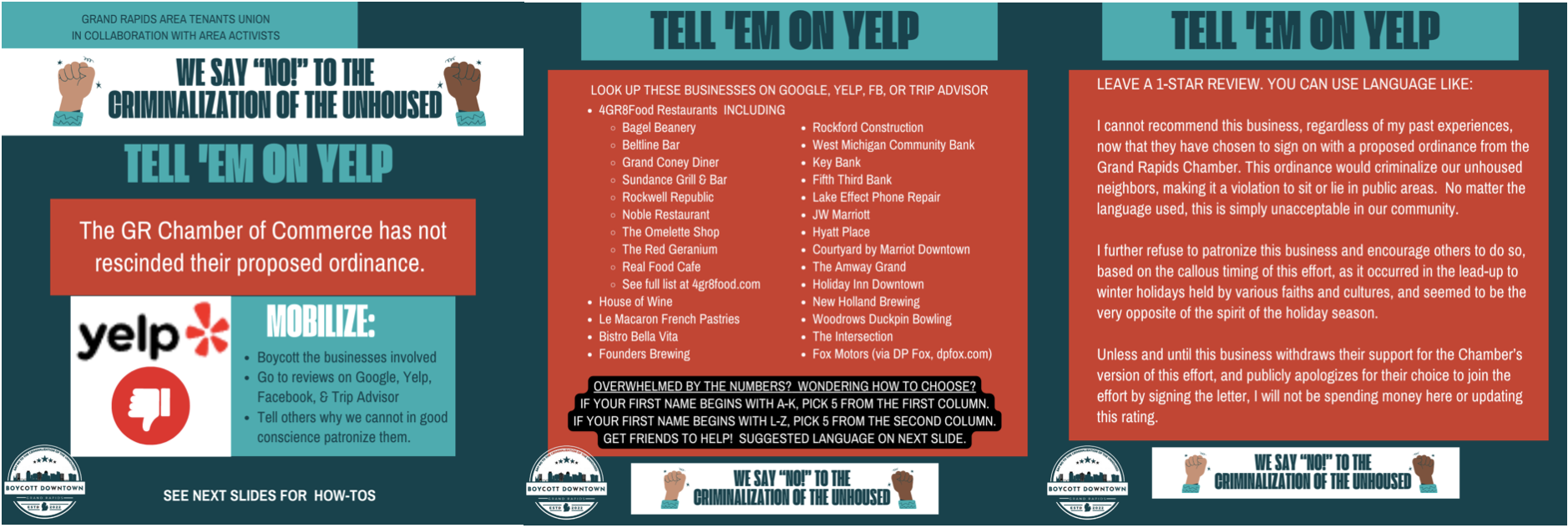
This boycott campaign also has created a toolkit of sorts, providing people with a list of downtown Grand Rapids business to boycott, along with the idea that people can go to reviews on Google, Yelp, Facebook, & Trip Advisor and tell others why we cannot in good conscience patronize them. All of this information is on the Grand Rapids Area Tenant Union Facebook page.
Just yesterday, so people involved in the boycott made a short video, using caution tape, to demonstrate how the ordinance would criminal the unhoused and severely limit their ability to even have a presence in downtown Grand Rapids.
Lastly, as with all boycott, in order for them to be effective, the campaign will need to grow and get more people involved in doing the necessary work to inform the public as well as to resist the repressive ordinance proposal from the GR Chamber of Commerce. If you want to be involved in the campaign, you can leave the Grand Rapids Area Tenant Union a message on their Facebook page or you can send them an e-mail gratunion@gmail.com.
 Rachel Ferguson, a professor and contributing writer for the Grand Rapids Far Right Think Tank, the Acton Institute for the Study of Religion and Liberty, believes that Christian Landlords would make the best kind of landlords.
Her article from January 4th, Why Christians Should Be (the Best) Landlords, is based upon a social media argument she had with Kevin Nye, who is a Housing Director at an organization addressing youth homelessness in Minnesota.
In the typically condescending language that Acton writers engage in, Rachel Ferguson demonstrates her own by writing:
I have a real soft spot for people who put their money where their mouth is and do the hard work of helping people whose issues can be incredibly hard to face. At the same time, sincerity and effort don’t make up for ignorance. In fact, as we’ve seen in cases like Prohibition, sincere, God-fearing, hardworking people who believe in radical action for the marginalized can create outcomes that are far, far worse than if they’d done nothing at all. So, with real respect to Mr. Nye for his personal intervention in the lives of the homeless, we’ve got to review what’s wrong with his views on landlords, rent, and eviction—not to “own the libs” but for the sake of the homeless themselves.
Now, it is important to note that Professor Ferguson has no direct experience with the issues surrounding tenants, tenant rights, eviction, predatory landlords and property management companies. Her opinion and her knowledge background is in the area of her own theological interpretation of Christianity and her deep commitment to free market Capitalism.
I’m not really interested in for or against arguments about whether or not Christians should be landlords or would be the best landlords, but the arguments that Professor Ferguson uses are weak and rather misleading. This was the case the last time an Acton writer addresses tenant evictions in an article from September of 2021. Another Acton writer, Noah Gould, in an article entitled, Banning evictions poses harm for low-income renters, argues that the eviction ban was bad because it was some liberal scheme. Gould cites President Biden’s decision to extend the eviction moratorium, but fails to mention that it began under President Trump, because the CDC decided it was cruel and inhuman to evict people in the middle of a pandemic.
I agree, that evicting renters in the middle of a pandemic is a brutally cruel practice. The Acton writer in the 2021 article opposing a moratorium on evictions also fails to mentions that lots of property management companies and landlords received federal funding in the form of PPP loans, in which most did not have to pay it back. One Property Management Company that the Grand Rapids Area Tenant Union is currently dealing with is KMG Prestige. KMG Prestige owns numerous rental properties in this area and in other communities. Interestingly enough, KMG Prestige applied for a PPP loan during the COVID pandemic and was given $7,845,514, which was forgiven. So, the idea that landlords weren’t making any money during the pandemic, is simply false.
Radical Hospitality
As a counter to the narrative from the Acton Institute about tenant evictions and Christian landlords, I think it is important to talk about a long practiced tradition within religious and non-religious traditions, where Radical Hospitality is practiced.
When I was younger and studying to be a Catholic Priest, I learned about Dorothy Day and the Catholic Worker Movement. Day, who was a young adult during the Great Depression, co-founded the first Catholic Worker houses with Peter Maurin. Catholic Worker Houses were houses of hospitality, that provided a safe place for people to sleep, meals and a case by case time frame for people to get back on their feet economically to get their own apartment of house. In addition, Catholic Worker houses practices simple living and were actively involved in opposing US involvement in war and the amount of money the US government spent on the annual military budget. The Catholic Worker Movement argued that money that is being spent on militarism should be spent on housing and other basic necessities for the millions who are housing insecure.
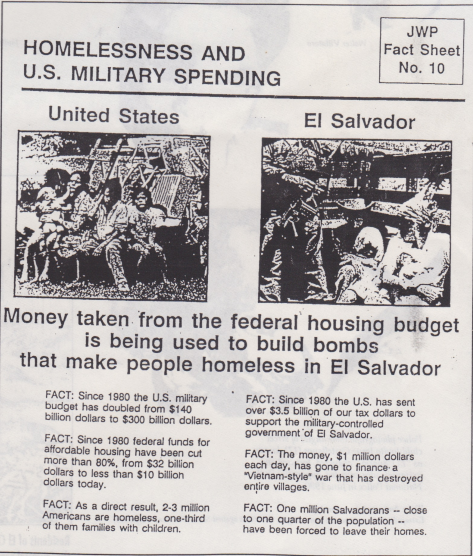
 In Grand Rapids, the first Catholic Worker Houses began in the 1970s. The first was the Grimke House, named after the abolitionist Grimke sisters. Then in 1984, I was part of creating a place called the Koinonia House, which was modeled on the Catholic Worker. We provided hospitality to over 300 individuals and families during a 20 year period. Koinonia house was our home and we treated those who were housing insecure as our guests for however long they needed. We also opposed war, US military intervention and US military spending. In the summer of 1990, many of us were involved in a Homes Not Bombs campaign (pictured here), where we built shanties in front of the US Federal Building in Downtown Grand Rapids to make a point about the disparities in spending on weapons of mass death versus spending on housing for people in our communities. We even created fact sheets to distribute to people, showing the huge disparity between money for bombs as opposed to money for housing. (See below)
For Acton Institute writers, like Rachel Ferguson, who want to spend their energy arguing that Christians make the best landlords, we think it is more effective and more important to talk about housing justice and why it is important to think about and create housing justice outside of the For Profit framework.
What the commercial news media isn’t telling us about the group behind the firing of several Ottawa County officials
 On Tuesday, the Ottawa County Board of Commissioners fired the County Administrator and replaced him with John Gibbs, a candidate who ran for the 3rd Congressional District in last years election, but was defeated by Hillary Scholten.
This news, which has been reported by most of the West Michigan commercial news media, is presented as shocking news. And while I agree that the Ottawa County Board of Commissioners decision was abrupt, none of what happened is in any way shocking or a surprise. Look, within the past 2 years, we have seen millions of people denying the election results from the 2020 Presidential Election. In January of 2021, there was an attempted insurrection at the nation’s capitol, where only a few people have suffered any real consequences for their actions. In the 2022 Elections, there were hundreds of candidates running for local, state and federal positions, all of which were election deniers, with many of them winning their races. (Check out this new resource by the Center for Media & Democracy, Insurrection Exposed.)
With this recent history, we should not be shocked or surprised that people in Ottawa County embrace the same ideological positions that those who participated in the failed insurrection. What I find most instructive about the local news coverage, especially the articles coming from MLive (there have been 3 articles, listed below), which mentioned the group Ottawa Impact, is that none of the articles or the other coverage has bother to link to or explore their ideological and political beliefs. The rest of this article will explore their political ideology.
The Ottawa Impact group is a 501c4 group, which means they can endorse candidates, plus they have their own Political Action Committee. Their PAC is registered with the State of Michigan, but they have yet to file any fundraising data from 2022, according to the Michigan Secretary of State.
Their mission statement reads:
We are committed to defending the constitutionally protected rights of parents to make health and education decisions for their own children. We desire to preserve and pass on the blessings and heritage of Ottawa County to future generations.
We recognize our nation’s Judeo-Christian heritage and celebrate America as an exceptional nation blessed by God. We oppose indoctrination of our county’s youth and the politicization of public schools.
We believe civic engagement, ground up, is critical to preserve a healthy, moral society. We seek to educate, encourage, and support local leaders who fight to preserve Ottawa’s values and work to eliminate policies which oppose them.
The last sentence makes clear that the firing of the of the current Ottawa County Administrator, shows exactly what they will do when anyone opposes them.
The Ottawa Impact group has a contract for those running for County Commission and for the Ottawa County School Board. The contract for the County Commission is 8 pages and the one for the School Board is 9 pages. People should read them and not just dismiss them as lunacy, since these contracts will do very real forms of harm to people.
These documents were created in March of 2022, and their policy agendas are very clear. For example, the fact that the Ottawa County Board of Commissioners announced that they were doing away with the Diversity, Equity and Inclusion office is because they say very clearly in the contract, “I will support removing Ottawa County from the Government Alliance on Race and Equity (“GARE”) membership, and discontinuing Ottawa County’s promotion of divisive teachings aligned with Critical Race Theory such as; racial equity, privilege vs oppression based on skin color, intersectionality, implicit bias, systemic racism, and revisionist history.”
In addition, the contract for Ottawa County Commissioners running as Ottawa Impact candidates also must be committed to removing any and all Planned Parenthood-aligned resources, view civil liberties as rights the government takes away – such as during COVID restrictions – but not civil liberties as in right for BIPOC, queer, immigrants or other marginalized groups, and parental rights, specifically as it relates to education curriculum.
With the candidates who run for Ottawa County School Board, they must commit to opposing curriculum that is seen as applying Critical Race Theory, protect religious freedom, promote teaching “America’s True History”, oppose controversial materials, which they define as “containing controversial sexuality and racial teachings.” This contract also includes a commitment to support censorship of materials, like library books, plus they must take a hard anti-trans stance, which denies trans students from using bathrooms that are gender specific. The anti-trans commitment is framed as protecting women and children.
Under the Documents section of the Ottawa Impact page there are numerous links, with the first being one that is used to vet candidates. This document has some of the same language as the other contracts, but also includes language about protecting the 1st and 2nd Amendments, being Pro-Life, in support of the freedom of businesses, churches and individuals to not be subjected to what they call Health Freedom, which is basically to oppose any further government restrictions like what has happened under COVID. Then there is language under law and order stating that candidates must oppose defunding of the police and must support an America First ideology, of closed borders, undocumented immigrants, “as well as refugee influx from areas/countries hostile to America.” Lastly, candidates must oppose labor unions of any kind. Some of the other documents under this section, have more details on the contract commitments that candidates must take.
There is also a News section on the website banner, which has only about a dozen since this group was founded. Speaking of founders, Ottawa Impact was founded by Joe Moss and Sylvia Rhodea, which you can follow on Facebook. Ottawa Impact also has a Facebook page.
None of this information was presented by the local commercial news, which it seems to me is vitally important if we are to understand what Ottawa Impact stands for, what they believe and how to organize to reduce the harm they clearly want to do.
Business Press interview with Whitmer/Gilchrist reads like Business as usual when it comes to politics in Michigan
Just before the holiday break, MiBiz did an interview with Michigan Governor Gretchen Whitmer and Lt. Governor Garlin Gilchrist about their party’s plans in the New Year, no that the democrats control the Governor’s office and the State Legislature. This Democratic control of Michigan politics is the first time that the Democrats have had this kind of control in 40 years, yet the headline read, ‘WE’RE PRAGMATISTS’: Whitmer, Gilchrist outline 2023 policy goals.
We thought this would be a good opportunity to dissect the policy agenda of the Democrats for at least the next two years, while they have control of the State. We are going to go through this interview, question by question, to critique the policy vision, along with the language and framing used by both Whitmer and Gilchrist.
MIBiz – What are your top policy priorities heading into 2023?
Whitmer: We’re really excited about the opportunity to continue the work that we got started in the first term. We are working very closely with Speaker-elect Joe Tate and Senate Majority Leader-elect Winnie Brinks. I think some of the first things we want to accomplish is help people keep more money in their pockets. Whether it’s a working family tax credit or repealing the retirement pension tax, these are ways we could help people who are struggling right now with the high cost of everything.
GRIID – In response to the question about top policy priorities, Whitmer only lists two specific policies, the family tax credit or repealing the retirement pension tax. Both of these would certainly be a good start to keeping money money into the pockets of working class people/families, but it doesn’t address the massive wealth gap that exists in Michigan. There is no discussion about raising the minimum wage to a level that would allow people to afford the basic necessities, such as housing, health care, transportation, groceries, etc. On January 1st, 2023, Michigan’s minimum wage went from $9.87 to $10.10, which is only a 23 cent increase. $10.10 an hour is a poverty wage and is unacceptable for individuals and those raising a family.
MiBiz – As Democrats secured a trifecta in state government, some have suggested that the party should avoid veering too far left on policies to retain its majorities. What’s your view on that analysis?
Whitmer: We’re pragmatists. We’re Michiganders through and through, we just want to get things done that are going to make a difference in people’s lives right now. We’ve got a slim, two-seat majority in the House and Senate. We will continue to make a seat at the table for the minority leaders because we share constituencies and the people of Michigan deserve a governor and a lieutenant governor who stay focused on solving problems. We are here to serve and to govern for all people of Michigan.
Gilchrist: I think the results of this election are reflective of the support for the approaches we have taken. The governor and I have always put solutions ahead of everything because we know that’s what the people of Michigan need to have an improved quality of life. So this is certainly the way we’re going to continue to approach this. And I think the legislators will have that same posture.
GRIID – With this second question, the MiBiz reporter is setting up both Whitmer and Gilchrist, even baiting them to see if they will veer going “too far left.” Whitmer’s response is instructive. First, she says, “We’re pragmatists.” This statement speaks volumes and is followed up by not speaking to what kind of policies they will push for, but that they want to work with the GOP and solve problems. It’s a tepid response that doesn’t suggest that people who are being exploited, those experiencing structural racism, those demanding right and those wanting to live in a world that run by money and power should not hope that much will change with the Democratic majority. The response from Gilchrist isn’t much better, where he uses vague language and completely avoids concrete policy proposals.
MiBiz – Do you support repealing Michigan’s right to work law? And what’s your response to business advocates who say doing so would send a bad message to companies considering investing here?
Whitmer: I can tell you this: I was in the Legislature when the Republicans changed the law. No one’s going to be surprised to know what my position is on this issue. I can also tell you this: We have seen tough times here in Michigan and right now one of the greatest strengths we have is our mobility sector. It’s growing. We’ve added jobs and it’s because of a great partnership with the U.A.W. and General Motors, Ford and Stellantis. I think there were a lot of promises made 10 years ago when the law changed, a lot of threats were made. Very little of it came to fruition. We’re going to stay focused on building a future economy where all people can have a say in the terms of their employment and all businesses can thrive. It’s not one or the other, it’s got to be both.
GRIID – Again, Whitmer doesn’t really answer the question with an emphatic, “yes, we will repeal the Right to Work law.” Instead, Whitmer talks about partner ships with the auto industry and the UAW, but then ends her comments by saying she wants all businesses to thrive. Repealing Right to Work would send an important message, particularly a message to working class people, so why does the Governor not just say she will repeal it?
MiBiz – While campaigning this election season, what were you both hearing as the top concerns or needs of business owners?
Whitmer: Businesses everywhere, not just Michigan but across the country, are looking for employees. Growing our population and making sure people know: If you want to live a high quality of life with a low cost of living, Michigan’s the place to move to or build your business in. There are a lot of pieces that go into making Michigan competitive, but we’ve seen record small business growth, which tells me the entrepreneurial spirit is strong.
Gilchrist: First of all, (business owners) care a lot about the people working on their teams. So (we heard about) things like making sure there is adequate housing available for people so they could live and work close to one another. Making sure they have child care and people could trust where their kids were and they were safe and learning so they could be productive while working. These are things that we prioritized for the last four years because we heard business owners talk about these issues and how important they were for their quality of life. We want to build on the progress we’ve made in those areas.
GRIID – This question is expected, since MiBiz is a news source with a primary readership being business owners. When Governor Whitmer makes the statement, “f you want to live a high quality of life with a low cost of living, Michigan’s the place to move to or build your business in.” All I could think when I read this statement was – 1) Michigan does not have a low cost of living, not for hundreds of thousands of families that are living in poverty. Hell, even that State of Michigan acknowledges that, “1.5 million Michiganders struggle to afford the basic necessities of housing, child care, food, technology, health care and transportation.” The response from Gilchrist is even more outlandish, when he says, “business owners care a lot about the people working on their teams.” Does he actually believe this to be true, and if so, what evidence does he have to support it?
MiBiz – What do you see as the best strategy for getting to the heart of the housing issue, which is creating more units?
Gilchrist: Our first ever statewide housing plan showed we need to have housing that works in every market: Housing for workforce or seasonal employees, single-family, multifamily, rehabbing, new construction. And that plan is pretty comprehensive in terms of how it addresses all of those things. As we work, we’ll also see a lot of new interest in smaller developers to meet the needs of local communities. An affordable, safe place to live is the starting point for people’s participation in the economy and civic life.
GRIID – The last sentence from Gilchrist is somewhat agreeable, but he avoids talking about or at least directing people to what the actual statewide housing plan is, which you can find here. https://www.michigan.gov/mshda/developers/statewide-housing-plan
MiBiz – Can you discuss this administration’s focus on outdoor recreation as an economic engine, and your outlook for the industry’s growth potential?
Whitmer: Michigan is so unique. We have 20 percent of the world’s freshwater in and around our borders. We have four seasons and some phenomenal outfitters like Carhartt and Stormy Kromer, for instance. This is a national strength of ours that I don’t know we’ve ever really harnessed as well as we could. We put a lot of emphasis on it. We’ve made a record investment in our state parks, and I think this is really an opportunity for us. This is a way that we can build an industry, grow it here in Michigan, and capitalize on all the national strengths we have as a state.
GRIID – Why do things like outdoor recreation have to be framed in terms of generating profits? Why can’t we support families living in Michigan, by paying them a livable wage, so they actually have the time and resources to enjoy camping, hiking or other outdoor activities? Why the hell does the Governor even highlight companies like Carhartt and Stormy Kromer? Stop commodifying nature!
MiBiz – You also released a statewide climate action plan this year that calls for net-zero carbon emissions by 2050. Do you anticipate legislative efforts to codify that through a stronger renewable energy standard or a vehicle emissions standard?
Whitmer: We know setting goals is one thing, but achieving them is another. We have to have industry really committed to the same goals we’ve laid out. We’re making progress. I think with this new makeup in the Legislature there will be an opportunity to do even more to codify a lot of pieces of the climate plan, and that’s something I’m very eager to get started.
GRIID – Achieving Climate Justice should be a high priority, but the Governor’s language is vague enough to avoid concrete policy stances. Hell, Enbridge is still operating Line 5, despite the promise from Governor Whitmer to shut it down. How can Michigan achieve Climate Justice when Climate fanatics like Enbridge are allowed to continue to put our future at risk?
MiBiz – What can you say about the state’s pipeline of additional large battery manufacturing projects?
Whitmer: We’ve made some really amazing announcements in just this last year. And we worked across the aisle to sharpen our economic development tools. We moved fast, we were bipartisan, and we got it done. If we don’t win this decade, we could get left behind for a generation. We can’t just assume that because General Motors has a strong history in Michigan that they’re always going to be here. We had to compete, and we won — $7 billion investments in batteries in Lake Orion and Lansing. This has huge implications across our economy. We’ve got to put our foot on the accelerator. We’ve landed a lot of battery plants and EV production, but we can’t rest on our laurels. We’ve got to stay at it.
GRIID – I know we are all supposed to be excited about the announcement in early 2022, that Michigan will begin major EV auto production, but this is NOT a sustainable solution, which we wrote about last year.
The week after the 2022 Elections, GRIID wrote a 3 part series, What Kind of Change Do We really want to see in Michigan. In that 3 part series we suggested policies changes that would primarily benefit working class people, BIPOC communities and others who are oppressed under the current business as usual policy framework for Michigan. The MiBiz interview with Whitmer and Gilchrist doesn’t suggest any real deviation from business as usual, which is why I believe that social movements will have to pressure the State government if they want to win their demands. Just ask yourself, if Michigan politicians really wanted to work for the people, would they first ask real people to prioritize what kinds of policy they want to see and then invite them to be part of a participatory budgeting process to have a real say in how their tax dollars are spent?
GRIID Year in Review Part V – Documenting the work of Social Movements in Grand Rapids
In Part I of our Year in Review for 2022, we looked at how the local news media (mis)reported on critical issues in Grand Rapids. In Part II, we looked back at what the Far Right in West Michigan was doing over the past year. With Part III, we looked back at the activity of the Grand Rapids Power Structure, how they expanded their wealth, how they influenced electoral outcome and how they colluded with local government. In Part IV, we looked back at the most reported issue in Grand Rapids for 2022, the GRPD murder of Patrick Lyoya. In today’s post, Part V, we want to look back at our documentation of social movements in Grand Rapids.

Some social movements continued to do the important work of fighting for justice and collective liberation. However, 2022 was an election year, so social movement work always struggles, since too many people divert money and time to voting. There were movements that have been around for several years, such as the immigrant justice movement, which is best reflected in the work of Movimiento Cosecha, the housing justice movement, lots of Mutual Aid work, the Defund the GRPD effort and the Justice4Patrick movement, which was born out of the GRPD murder of Patrick Lyoya on April 4, 2022.
Immigrant Justice
Movimiento Cosecha continued to organize around Driver’s Licenses for All, in Grand Rapids and across the state. The undocumented immigrant movements continued to do education around the importance of driver’s licenses, along with building capacity for the campaign, which meant working with immigrants and allies across the state. Much of this organizing is through meetings, zoom calls and preparation for actions, which most of us never see.
In late April of 2022, we wrote about how Movimiento Cosecha has been organizing May Day actions for the previous 5 years, with an invitation to participate in the 2022 May Day action. One thing that happened this past May, was that they were finally able to shut down US 131 for nearly 30 minutes, backing up traffic, getting commercial news media coverage and documenting the action on social media, always with the theme, “We will stop disrupting your lives when you stop disrupting our lives.”
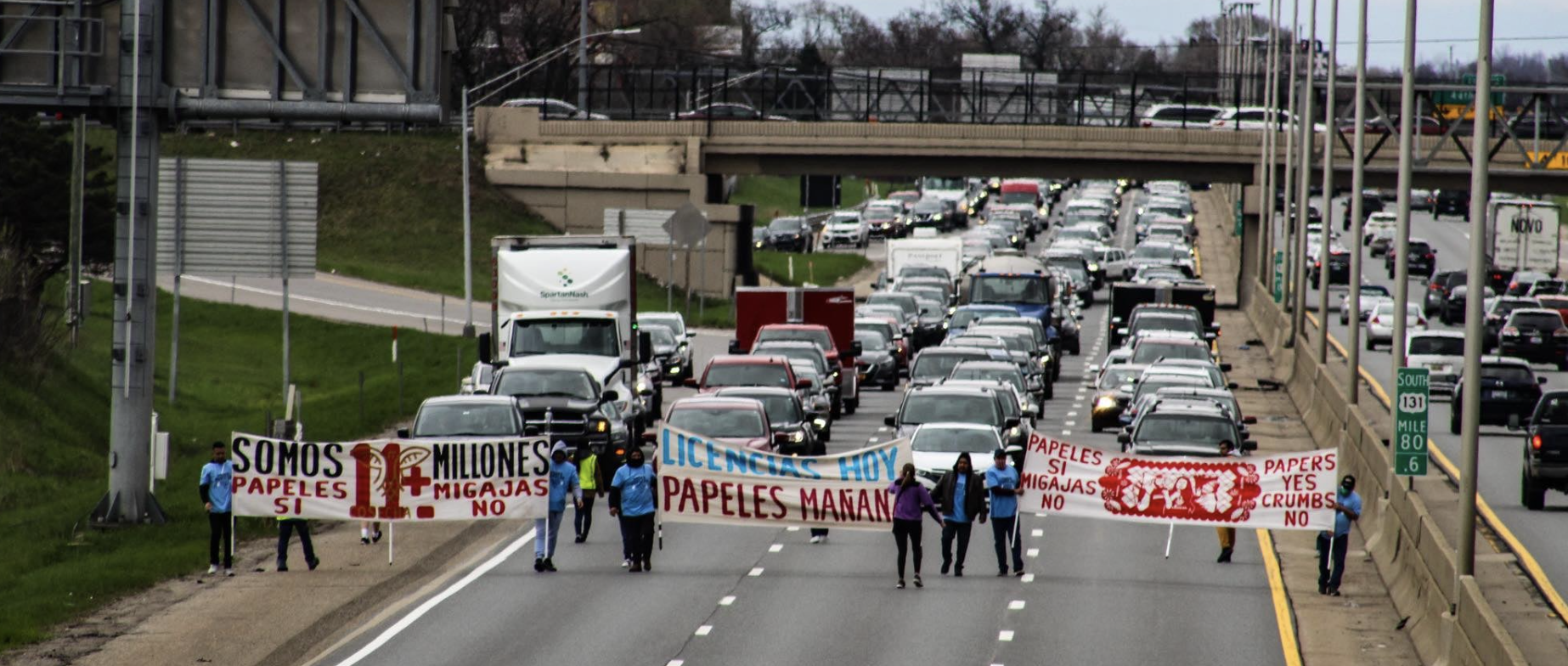
Another major action was a 3 day encampment in Lansing, where Movimiento Cosecha continued to pressure lawmakers to hold a public hearing on Driver’s Licenses, then get it passed, so that undocumented immigrants can go to work and raise their families in safety, without fear that being stopped by local police will result in them being detained or deported. We participated in the first two days of the encampment, waiting about Day 1 and Day 2. Lastly, Movimiento Cosecha organized an action at the home of the GOP speaker of the House, Rep. Wentworth, who had cancelled the public hearing on Driver’s Licenses back in 2021, which put the lives of undocumented immigrants at risk by delaying a public hearing, which will likely not be held until sometime in 2023.

Union organizing
Labor organizing across the US surged in 2022, at places like Amazon and Starbucks. Grand Rapids Starbuck workers began an organizing campaign in late Spring of 2022, which we wrote about, also noting that Starbucks workers had attempted to organized way back in 2008/2009.
The Grand Rapids Area Tenant Union also continued to provide support for tenants, which often translated into being involved in pressure campaigns against landlords and property management companies, which we wrote about in September. Towards the end of the year, the Grand Rapids Area Chamber of Commerce proposed an ordinance that would essentially criminalize the unhoused. The GR Tenant Union, along with a coalition of groups and individuals, rallied to take action, first at the GR Chamber’s headquarters in downtown Grand Rapids and again at Mel Trotter Ministries, which has publicly supported the Chamber’s proposed ordinance. This campaign has also called for a boycott of businesses in the downtown area, which often includes business in other parts of the city, since several of the downtown business own multiple entities across the city. For ways to become involved in the boycott campaign, go to the Grand Rapids Area Tenant Union FB page.
Justice4Patrick Movement
The other major social movement that was active also included a coalition of groups, such as Defund the GRPD, Together We Are Safe, the Grand Rapids Area Mutual Aid Network, GR Rapid Response to ICE and people who were previously affiliated with Justice for Black Lives. This coalition was the result of the GRPD murdering Patrick Lyoya, a Black Congolese man, on April 4th in Grand Rapids.
A few days after Lyoya was murdered by the GRPD, we wrote about the numerous ways that people could support Patrick’s family and take action to demand justice.
There were marches that were organized starting from the site where Patrick was murdered, but most of the marches were in downtown Grand Rapids and many of those marches ended up at City Hall, where the community could pressure City officials to meet their demands. Many of the City Commission meetings saw dozens of people speaking during the public comments period, often demonstrating anger at what had happened and how the City was not taking this murder seriously. The public was so angered that they often used what City officials referred to as “profanity,” plus they chanted and shouted during meetings, often resulting in City officials shutting down the meeting.
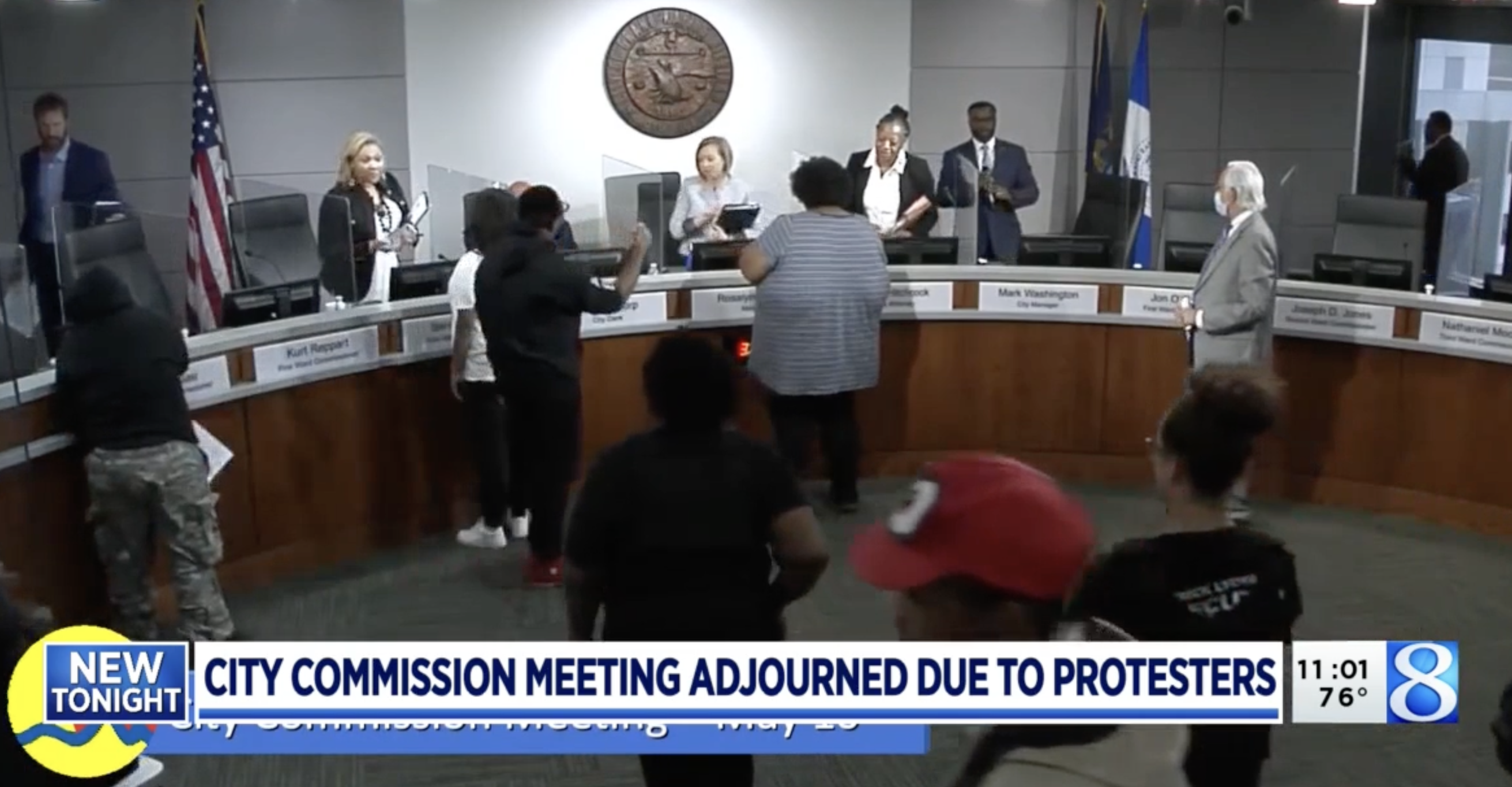
In addition, as was the case in the previous two years, certain activists were targeted by the GRPD, often being arrested as they were leaving the building and going to their cars or at times after they had left in cars and were pulled over by the GRPD, then arrested. The GRPD, with City official approval, repeatedly took this kind of action, no doubt as an attempt to instill fear in those who were speaking out about the GRPD murder of Patrick Lyoya.
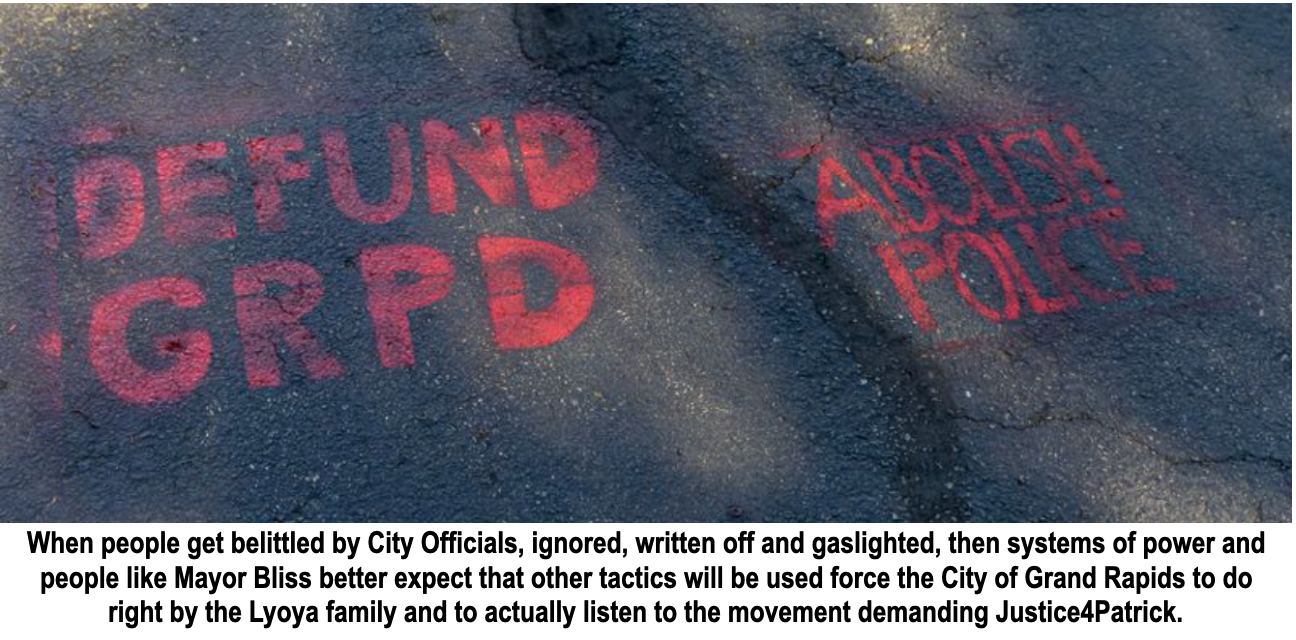
In late May, there were actions taken at the homes of several Grand Rapids City officials, which involved primarily graffiti. The local news media demonstrated once again a very clear bias in support of local government, completely misrepresenting grassroots organizing.
In June, the Kent County Prosecutor finally charged, Christopher Schurr, the ex-GRPD cop who shot Patrick Lyoya in the back of the head, with second degree murder. GRIID wrote a piece documenting how those in power responded to the charges.
As is always the case with the judicial process, there were delays involved in moving forward against Christopher Schurr, with one court hearing in September and another one in October, where activists were present to monitor the case, along with holding protests outside. The trial for the ex-cop who killed Patrick Lyoya is expected to begin in March of 2023.
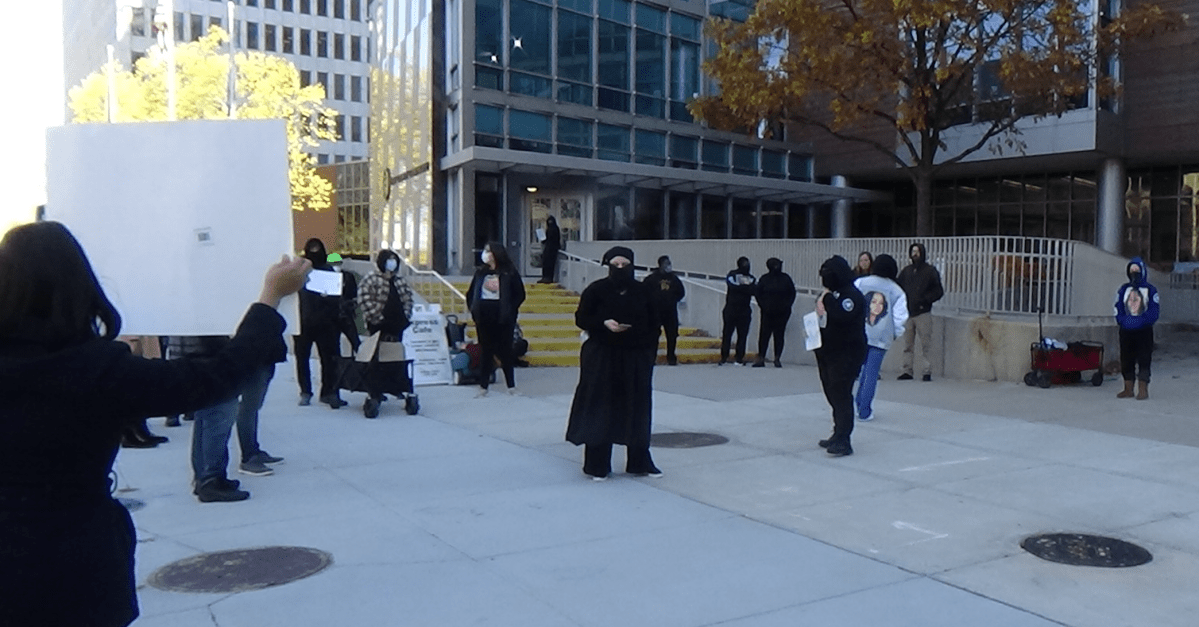
There were certainly other forms of important organizing being done, mostly behind the scenes, but the above movements were the most active in 2022.
For me, the New Year is always about collective liberation: My experience with the Zapatistas in Mexico
During four different trips to Mexico, I had the opportunity to do accompaniment work with the Ejercito Zapatista de Liberacion Nacional (EZLN), also known as the Zapatistas.
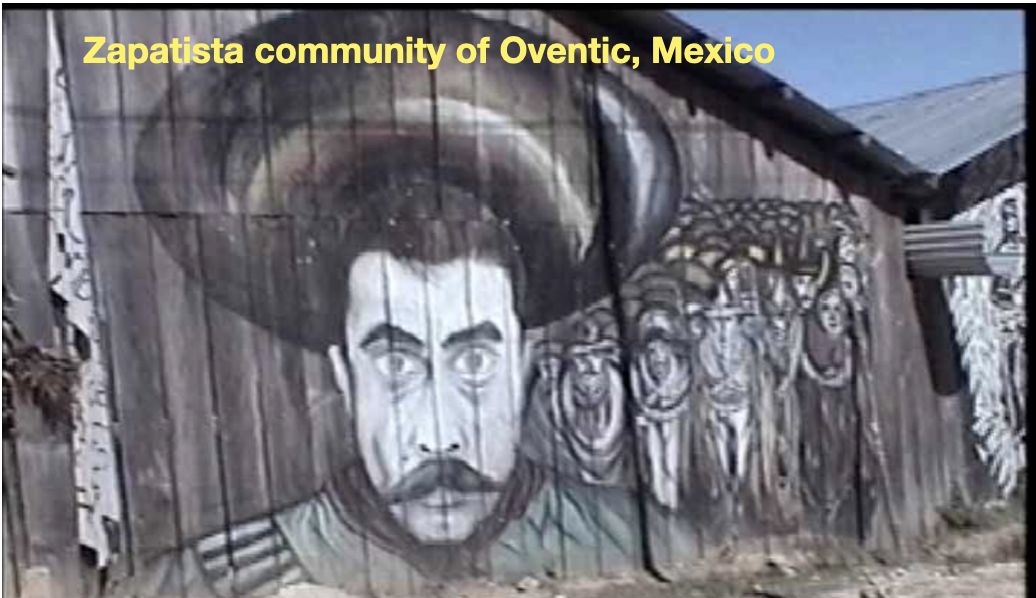
The EZLN began organizing in response to Neo-Liberal Globalization in the early 1990s, which was disproportionately impacting Indigenous communities in Mexico. The North American Free Trade Agreement (NAFTA), a trade agreement made between the governments of Canada, Mexico and the USA, would escalate the Neo-Liberal war against Indigenous communities, so the Zapatistas made the day that NAFTA went into affect – January 1st, 1994 – the day they went public with their uprising.
The Zapatista uprising is documented well in John Ross’s book, Rebellion from the Roots: Indian Uprising in Chiapas. Ross and other chroniclers of the EZLN uprising all recount how the Zapatistas targeted the colonial city of San Cristobal. They particularly targeted the government buildings and destroyed many government documents, specifically land title documents, which the EZLN believed were bogus documents because they legalize the theft of Indigenous land. San Cristobal was also a popular tourist destination, so there were numerous European and US tourists in San Cristobal on New Year’s eve that day. The EZLN uprising disrupted the tourists’ plans and it is said that at one point some of the tourists who were looking down onto the central park from their hotels were complaining about the EZLN rebellion. In response, Sub Commandente Marcos replied, “Sorry for the inconvenience, but this is a revolution.”
The first time I did accompaniment in one of the Zapatista communities was in 1997, the in community of La Realidad. Our work was two-fold. We were to have a presence to deter Mexican military violence against the Indigenous communities, and we were there to document what the Mexican military was doing, which included collecting data on the number of soldiers, weapons, communications systems and how often US supplied army helicopter flew above the community.
I went to Chiapas the following year, also to do accompaniment work, this time in the community known as Oventic. I returned to Oventic again in 2000 and 2005, always doing accompaniment work and always at the invitation of the EZLN. You can read about my time in Chiapas, Mexico and Guatemala, in the book, Sembramos, Comemos, Sembramos: Learning Solidarity on Mayan Time.
The 6 minute video here is an excerpt from my documentary called, Reversing the Missionary Position: Learning Solidarity on Mayan Time.
One bullshit response I received from a business owner that signed on to the GR Chamber of Commerce ordinance proposal that would further punish the unhoused
 For those who read this blog or follow the Grand Rapids Area Tenant Union on Facebook, you are aware that there has been an organized campaign to pressure business in downtown Grand Rapids for signing on the GR Chamber of Commerce ordinance proposal.
The proposed ordinance from the GR Chamber of Commerce would further criminalized the unhoused, those struggling with mental health issues and those that don’t make a living wage. We wrote about the GR Chamber’s ordinance proposal, which even has some of the following details:
However, despite the Chamber’s claim that this will not criminalize homelessness, beginning on page 45 of the Agenda Packet there is a section with the heading, “Aggressive solicitation and harassment.” Under that section it makes clear that this type of ordinance would punish those who solicit people for money. What is instructive about this section is that it is prohibiting people (those who solicit) from being within 15 feet of a public toilet entrance, an automated teller machine, any bus stop, taxi stand or rapid transit stop, the entrance or exit from a building, public or private, or within 20 feet of any parking lot, parking garage, parking meter or parking pay station, from any entrance or exit of commercially zoned property, or within 150 feet of any signalized intersection. Lastly, the ordinance that the GR Chamber of Commerce is proposing would prohibit those soliciting -which is code for the unhoused and those that are financially struggling – from, “At any lawfully permitted outdoor dining area, amphitheater seating area, playground or lawfully permitted outdoor merchandise area.”
The organized campaign against this proposal has included over 12,700 electronic letters being sent to GR City officials and businesses that signed on the the ordinance proposal. There have also been actions done at the GR Chamber of Commerce office and a visit was paid to Mel Trotter Ministries.
I signed the electronic letter early on, so those who have received it have had almost three weeks to respond. Yesterday, I finally received the first response. The response came from the owner of Restaurant Partners, Jeff Lobdell, who was one of the 120 people to endorse the GR Chamber’s ordinance proposal. What follows is what Lobdell had to say, followed by my response.
Thank you for reaching out and taking the time to express your concern and care. Our apologies for the delay in getting back to you – this email was filtered to our spam folder. Please be assured, as a locally owned and operated company we share the same concern and deep care for our community as well as for our employees and our guests.
We care about the community and its residents, whether housed or unhoused. We work closely with the Homeless Outreach Team to help find people assistance who have fallen on hard times. We also show our care and offer our support to the local shelters and food banks in hopes that our contributions will help work toward a solution. We will continue to support these shelters and stand beside places like Mel Trotter, Dégagé Ministries, Guiding Light, Kid’s Food Basket, Family Promise of Grand Rapids, Feeding America West Michigan, Meals on Wheels, and the YWCA.
We also care greatly about our employees and our guests. The safety and well-being of everyone in the community is our number one priority. While some may believe the new legislation proposed to the Grand Rapids City Commission is unacceptable, we believe the status quo is not working. Our employees and our guests are forced to endure harassment, witness public defecation, fear verbal and physical assault, remove dangerous drug paraphernalia from our properties, as well as deal with other disruptive and disturbing behavior on a regular basis. We take pride in our businesses operating as safe gathering places around Grand Rapids and we care deeply for our employees who come to work every day to provide for their families and serve our great community.
Although proposing a new ordinance may not solve all of the current problems, we agree with Dennis Van Kampen’s article in the Grand Rapids Business Journal that neither is the status quo. We invite you to read the article here, “Homelessness won’t be solved by status quo.” We appreciate the Chamber of Commerce for getting the conversation started and look forward to working together as a community to come up with a solution that works for everyone’s health and safety.
Best Regards,
Jeff Lobdell Owner
Restaurant Partners Management
Wow, Mr. Lobdell engaged in some pretty ridiculous gaslighting here, using all sorts of double speak, making sure to present himself as a responsible business owner and NEVER taking ownership for endorsing the GR Chamber’s ordinance proposal.
First, the owner of Restaurant Partners makes the claim that he care about the unhoused, because his business works with the City’s Homeless Outreach Team. He then goes on to list several non-profit groups that his business “stands beside,” even though he never says what it is exactly they do with these groups. More importantly, the list of groups he cites are not interested in ending “homelessness,” they only want to manage those who are unhoused or hungry, since none of these groups are willing to address the root causes of hunger or those without a place to live.
Second, Mr. Lobdell then spend a great deal of time talking about how his business cares about their employees and their safety. Just to be clear, Mr. Lobdell owns numerous restaurants, which means cooks, dish washers, people who bus tables, along with wait staff. Employees who do this kind of work don’t usually get paid very well, which means that it is very likely that most of his employees do not earn the minimum amount of money to afford paying rent in this market. According to the National Low Income Housing Coalition, people need to earn $20.02 an hour to afford the average cost of rent in Grand Rapids, as is shown in the graphic below. Keep employees safe also means that you pay them enough to afford basic necessities, like housing in this city.

Third, Mr. Lobdell says that he appreciates that the GR Chamber of Commerce was “getting the conversation started” around addressing issues of health and safety. The GR Chamber’s proposed ordinance was not a conversation starter, especially since it had very specific points that would criminalize those who are unhoused, as we noted above. Even in the letter that Lobdell signed on to, the only text that was in bold states, “We request that you adopt an ordinance to regulate appropriate access and use of the public right of way and solicitation.” Such a statement does not reflect a conversation starter, rather it says that they want the City of Grand Rapids to use whatever means they chose to stop people from asking people for money in downtown Grand Rapids.
Lastly, Mr. Lobdell references a letter published in the Grand Rapids Business Journal by the CEO of Mel Trotter Ministries, Dennis Van Kampen. Van Kampen’s article does mention systemic issues that are at the root of why people are living on the street, etc, yet the agencies he works for doesn’t have a plan to address these systemic issues. What Van Kampen, Mr. Lobdell, and all of the other business people who signed on in support of the GR Chamber’s ordinance proposal don’t want to talk about, in fact are deathly afraid to talk about, is the massive wealth gap in Grand Rapids.
Most of the 120 people who signed the letter saying they support the GR Chamber’s ordinance proposal are people who are part fo the Capitalist Class and obtained their wealth by exploiting workers, by influencing public policy with campaign contributions and ongoing lobby work conducted by the GR Chamber of Commerce and the West Michigan Policy Forum. If anyone is seriously interested in talking about the health and safety of people in downtown, then there is no way they will ever find a solution without talking about system of power and privilege, which the GR Chamber and the 120 signatories are part of, and the massive wealth gap that exists between the these so-called business leaders and the rest of us.
GRIID Year in Review Part IV – The GRPD murder of Patrick Lyoya
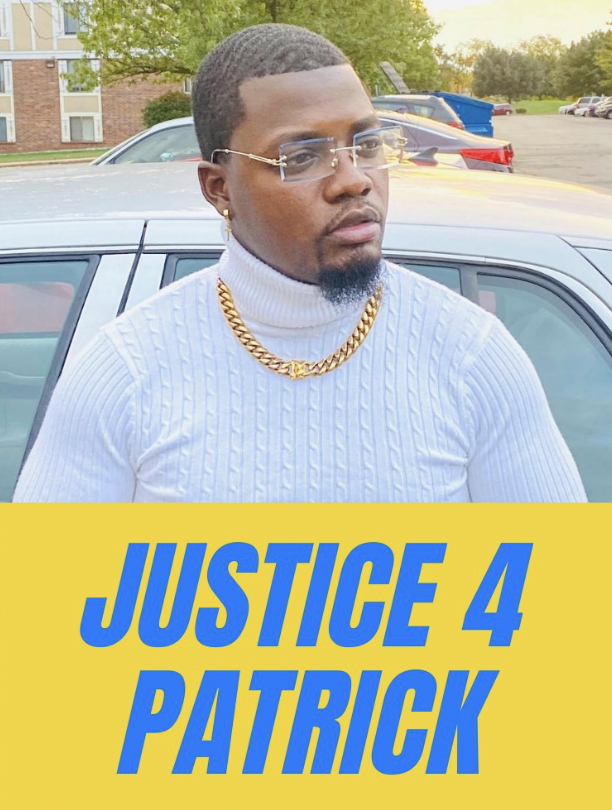 In Part I of our Year in Review for 2022, we looked at how the local news media (mis)reported on critical issues in Grand Rapids. In Part II, we looked back at what the Far Right in West Michigan was doing over the past year. With Part III, we looked back at the activity of the Grand Rapids Power Structure, how they expanded their wealth, how they influenced electoral outcome and how they colluded with local government. Today, we want to look back at the most reported issue in Grand Rapids for 2022, the GRPD murder of Patrick Lyoya.
As we mention in Part I, GRIID responded with 14 posts to local news media coverage on the police killing of Patrick Lyoya. We also made numerous posts about activist organizing as a result of the GRPD murder of Patrick, but we will discuss that aspect in Pat V, which will cover social movements in Grand Rapids.
When it comes to articles about what happened to Patrick Lyoya, the City of Grand Rapids and the GRPD response, or the legal aspect of this case, GRIID posted a total of 31 articles. Our first post, from April 5, was entitled, GRPD shoots and kills 26 year old Black man: Deconstructing the PR Spin, also known as a Press Conference. Here is part of what we wrote:
In effect, the Press Conference was designed to primarily divert attention away from the police shooting of a Black man, both through the rhetoric they used and the fact that they are holding the facts close to their chest until the investigation is complete and the video is released, allowing them time to devise a Public Relations/communications plan.
A few days later, GRIID posted something that no other news sources were discussing, which was an overview of US policy in the Congo since that country began resisting colonialism, how US policy supported political repression, which was the very reason that the Lyoya family chose to come to the US in the first place.
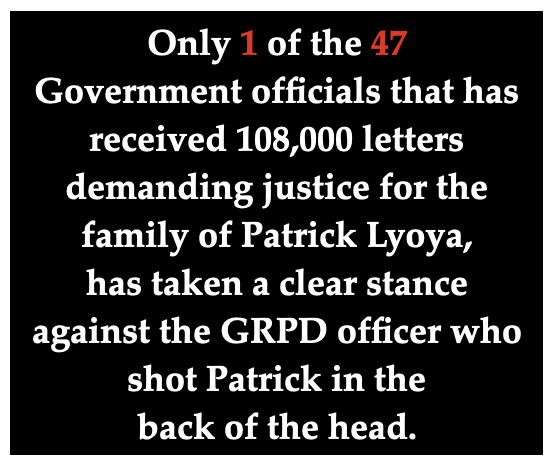 One week after the GRPD had murdered Patrick Lyoya, the Justice for Patrick had generated 108,000 letters to 47 different government officials, but only one had even bothered to respond. Then on April 14, Grand Rapids City officials released video of the GRPD murder of Patrick Lyoya, but used another Press Conference as an attempt to control the narrative.
Once people in positions of power felt comfortable addressing the death of Patrick Lyoya, there were several local government officials that addressed the GRPD murder of Patrick, although none of them called it that. Maybe the most egregious public statement had come from then Kent County commissioner Skaggs, who was running for state office at the time. Here is a summary of the GRIID response to the statement from Skaggs:
Lastly, towards the end of the statement, Skaggs says, “Throughout American history, change only happens when we elect government officials who are work toward justice and when people peacefully take action to show leaders the changes they want to see implemented.” This is a very White interpretation of US history. Elected officials have overwhelmingly only ever done the will of the people when they are forced to. In addition, to suggest that change only came about through peaceful means in just a god damn lie. People who were enslaved often freed themselves by killing those who enslaved them and burned the fucking plantation. In fact, the Black Freedom Struggle has always had an armed wing throughout history, that often work in concert with the more non-violent branch of that centuries long movement. See the books Force and Freedom: Black Abolitionists and the Politics of Violence, by Kellie Carter Jackson, and, This Nonviolent Stuff’ll Get You Killed: How Guns Made the Civil Rights Movement Possible, by Charles Cobb Jr.
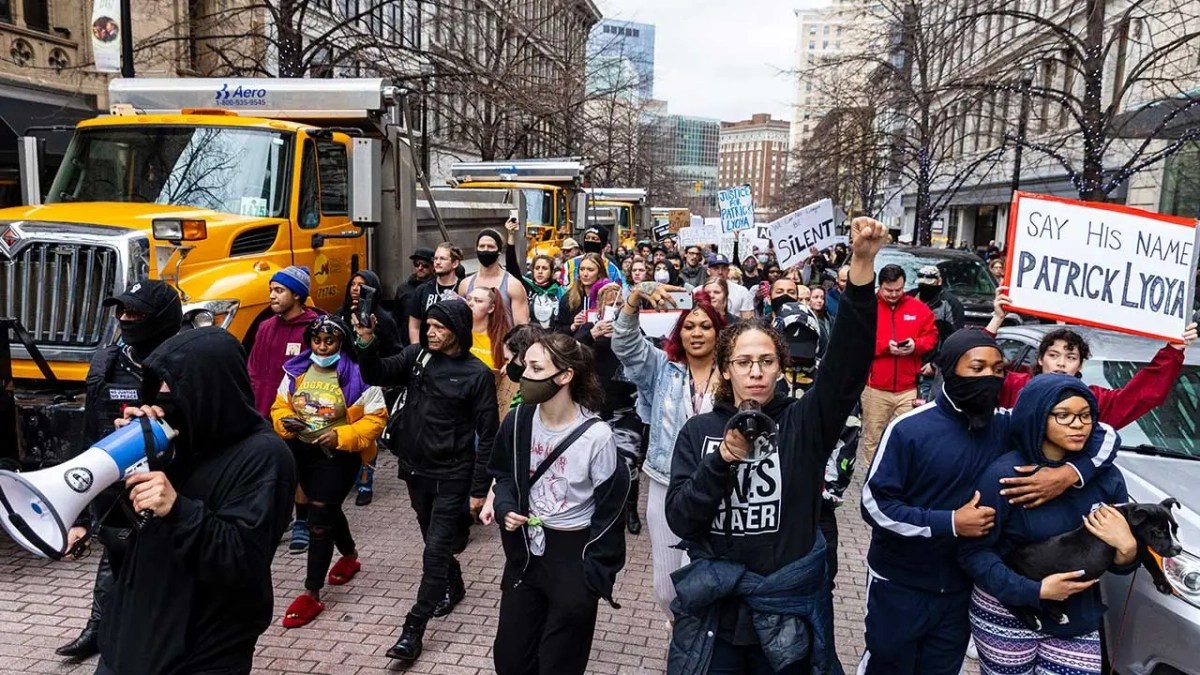
There were also constant attempts by GR City officials to dictate how the community should resist the GRPD murder of Patrick Lyoya. GR City officials were constantly demanding that the community act peacefully, all the while the GRPD was preparing to target activists who were part of the movement. On April 18, we wrote:
For those of us who have participated in the protests over the past week, we have also seen undercover officers in the crowd, cops in buildings overlooking the usual protest areas and cops on rooftops. Such tactics are designed to intimidate people, but their primary interest is to engage in surveillance, with the intent of identify certain people and to have documented footage to use against organizers and protesters in general.
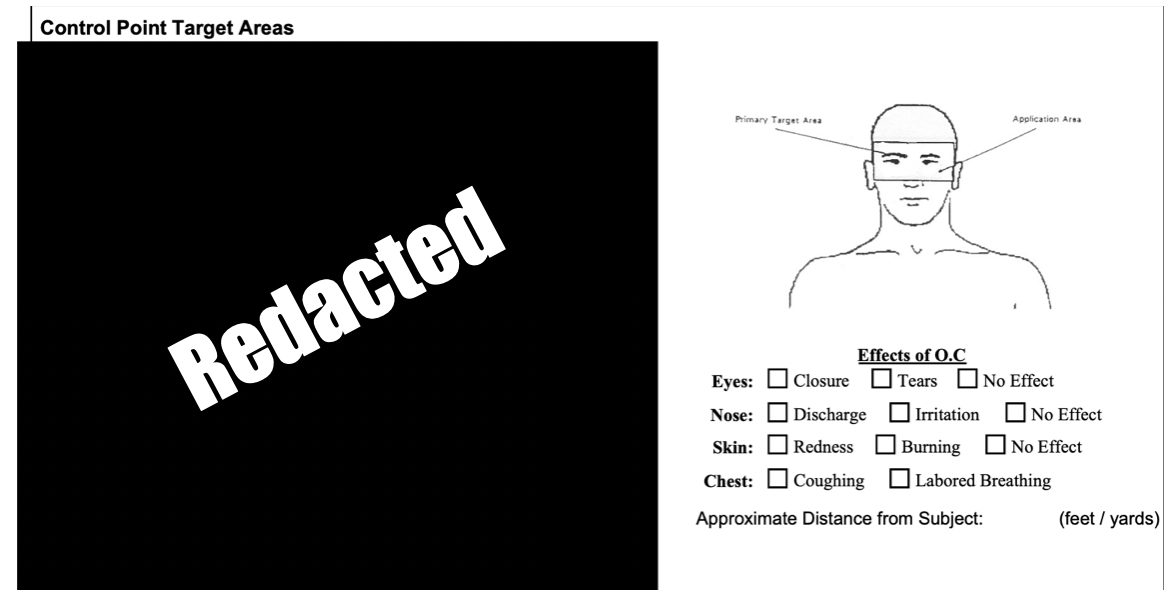
In early May, we wrote about FOIA documents that had been released, but was largely ignored or downplayed by local news and GR City officials. Not surprising, was the fact that most of the requested documents were heavily redacted.
Six weeks after the GRPD murdered Patrick Lyoya, groups like Voice for the Badge decided to respond. Their statement used the same tired arguments, along with unsubstantiated claims.
On June 10th, the Kent County prosecutor charged the cop who shot Patrick Lyoya in the back of the head with second degree murder. GRIID put together a list of responses from GR City officials and so-called community leaders. A few days later, the lawyers representing the cop that killed Patrick Lyoya, went of the offensive to push their own narrative about what happened on April 4, stating:
We were disappointed to learn that Officer Schurr has been charged with murder by the Kent County Prosecutor. Officer Schurr is a decorated member of law enforcement who has dedicated his career to helping others and protecting the citizens of Grand Rapids. The evidence in this case will show that the death of Patrick Lyoya was not murder but an unfortunate tragedy, resulting from a highly volatile situation. Mr. Lyoya continually refused to obey lawful commands and ultimately disarmed a police officer. Mr. Lyoya gained full control of a police officer’s weapon while resisting arrest, placing Officer Schurr in fear of great bodily harm or death. We are confident that after a jury hears all of the evidence, Officer Schurr will be exonerated.
We respond by writing, “This narrative about Christopher Schurr was very strategic on the part of his lawyers. First, they want to present Schurr in a positive light, since he apparently, “has dedicated his career to helping others and protecting the citizens of Grand Rapids.” Neither of these claims are substantiated by the lawyers, but they will no doubt be using this narrative as a central part of their case when it goes to trial. This narrative about Schurr is also a narrative that has been perpetuated by the commercial news media, like a recent MLive article from late May that GRIID deconstructs.”
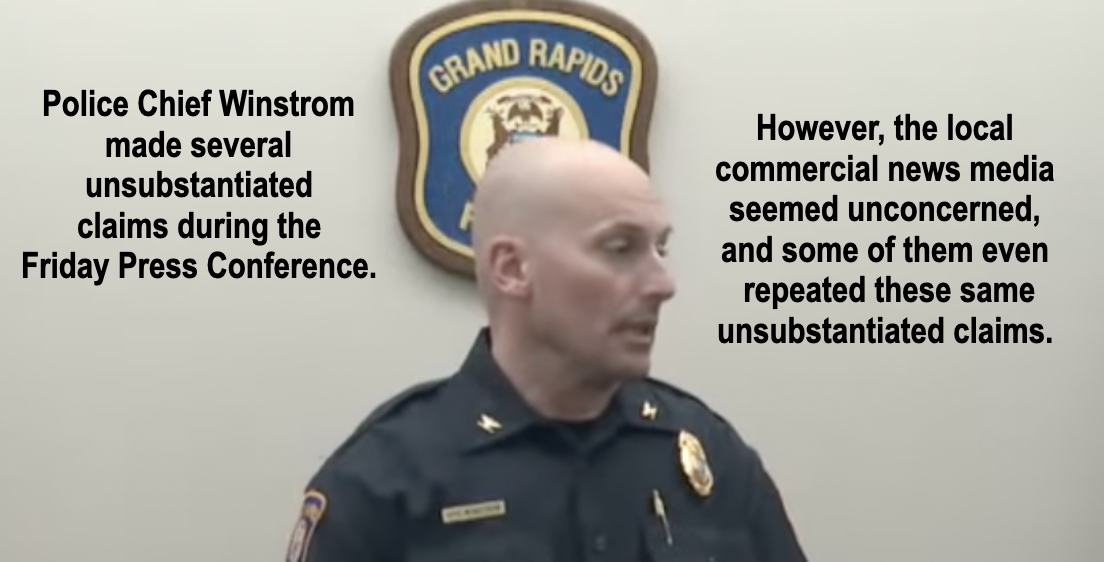
As time passed, GR City officials felt like they could continue to control the narrative and hope that the resistance would fade away. In late June, the GRPD held another Press Conference, and GRIID responded with an article entitled, The Ferguson Effect, handling protesters and other fallacies at the GRPD Press Conference on Friday.
Much of the local news coverage had died down and the only stories presented by the local news media, were specifically about the legal proceedings, like they did in late September and October, often ignoring or dismissing those who continued to protest the GRPD murder of Patrick Lyoya.
In Part V, we will look back at our reporting on the various social movements in Grand Rapids and their important work.
In Part I of our Year in Review for 2022, we looked at how the local news media (mis)reported on critical issues in Grand Rapids. In Part II, we looked back at what the Far Right in West Michigan was doing over the past year. Today, we want to look back at the actions and influence of the Grand Rapids Power Structure in 2022.
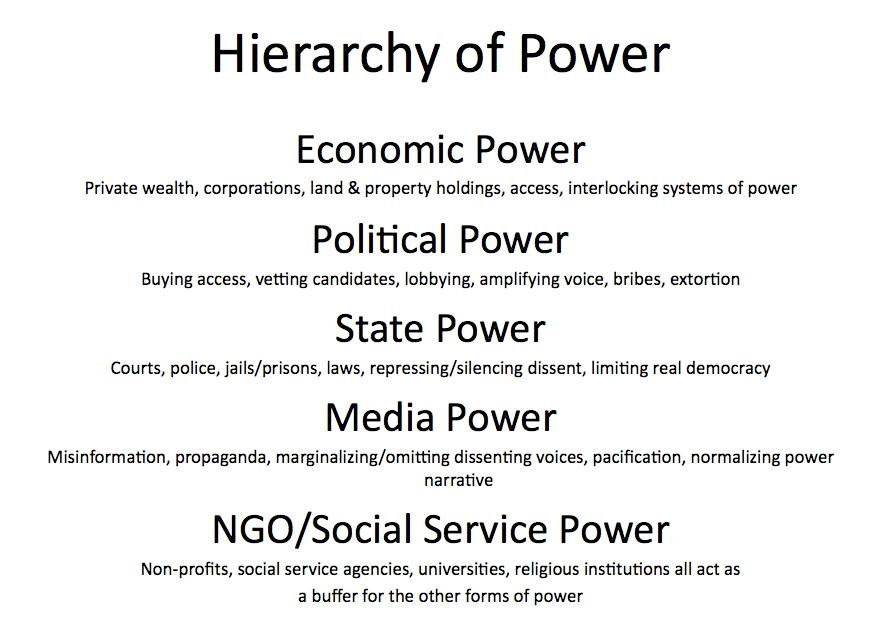
The Grand Rapids Power Structure can best be defined in the graphic above, but for our purposes today, we are going to focus on economic power, political power and state power.
Economic Power in Grand Rapids
Over the past year, those with tremendous wealth have continued to exert their influence over the general public. We know the names of these families and entities, what we often don’t know the details of how they function, primarily because they are not committed to transparency.
Part of our look at economic power dynamics when it comes to members of the Grand Rapids Power Structure, always includes how they defend their own economic interests, while at the same time taking credit for “innovative projects.” In March of 2022, we saw a great example of how wealthy elites engaged in a bit of deception around a housing program they are backing. The GR Chamber of Commerce announced a new workforce housing plan, which GRIID responded to, writing:
The language from the announcement is instructive, in that it states that the goal, “was to create workforce housing for individuals and families employed in Ottawa County who were unable to afford to live there.” Now, any reasonable person would ask themselves why can’t workers afford to live in the communities that they work in? The simple answer is because these individuals and families don’t make enough to afford the cost of housing in the communities that they work in.
Another major economic-driven project GRIID has been following for a few years, is the proposed downtown outdoor amphitheater project. In late March, the City of Grand Rapids unanimously approved a land sale worth $116 Million, paving the way for the proposed amphitheater project. Then in June, it was announced that the State of Michigan would likely be providing $30 Million in public funds for the downtown amphitheater project, despite the fact that the public had no say in this. Finally, in November it was announced that the downtown amphitheater project would be run by the Kent County Convention Arena Authority, an entity which is essentially run by the GR Power Structure.
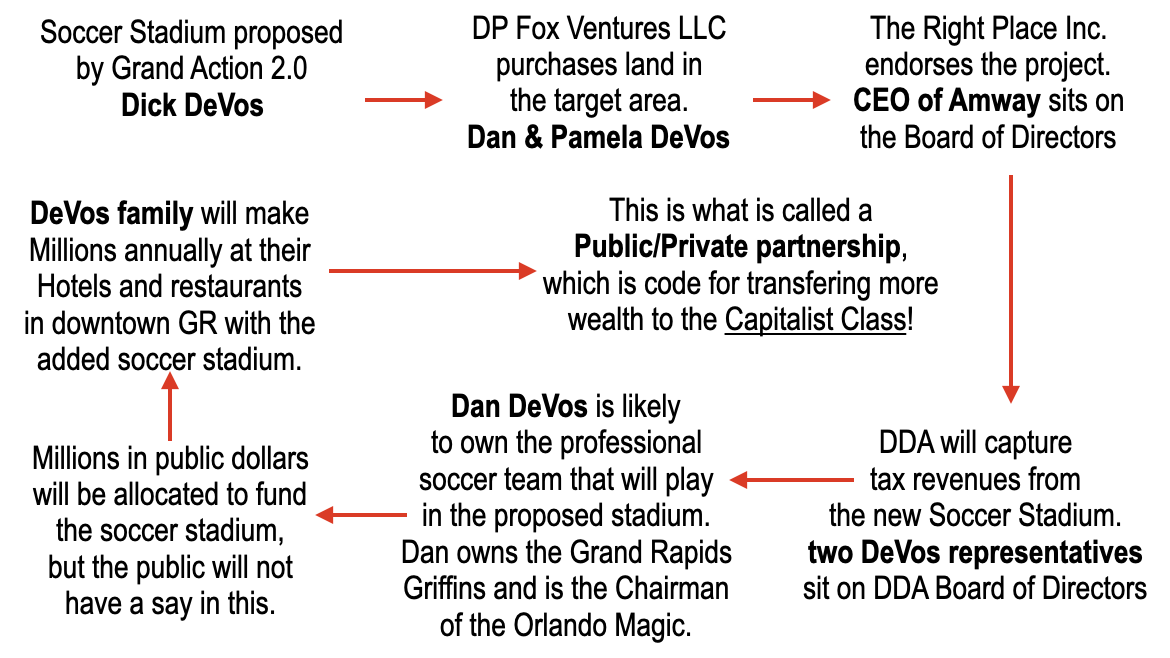
There were also a few land deals involving the DeVos family. In September, local news agencies reported that there was a new proposal to build a soccer stadium in downtown Grand Rapids, one that had a DeVos connection. GRIID did more digging and connected the dots on this project. Then in November, GRIID reported on a new land purchase by the DeVos family in the city’s 2nd Ward. What we discovered is that the land was purchased by a DeVos family member and that the developer involved int he project is also connected to the DeVos family.
GRIID also critiqued the annual 200 most powerful business leaders edition of the Grand Rapids Business Journal.
However, one of the biggest stories of 2022, was the Grand Rapids Chamber of Commerce push to criminalize the unhoused. In early September, the GR Chamber sent a letter to Grand Rapids City officials, complaining about how downtown businesses were being negatively impacted by the unhoused, plus their demand to increased GRPD presence. This initial letter was followed up by a second letter in early December, where the GR Chamber included a proposed ordinance that would punish the unhoused. Lastly, 120 so-called leaders, signed on to the GR Chamber’s proposed ordinance, primarily because of their economic interests.
Political Power/Influence by the GR Power Structure
 2022 was an election year in Michigan, so the Grand Rapids Power Structure certainly used their economic power to influence election races. GRIID reported on campaign finance dynamics involving the GR Power Structure in February, April, and just before the August primary, which also included how much money the DeVos family contributed to the GOP Gubernatorial candidate Tudor Dixon.
However, even larger amounts of campaign contributions came just before the November 8th election, specifically with State Representative and State Senate races. However, the major political intrigued was all the money that was injected into Grand Rapids City Commission races, particularly money coming from the Grand Rapids Police Union and the GR Chamber of Commerce. There was also a tremendous amount of money coming from members of the Grand Rapids Power Structure, particularly in the 1st and 3rd Ward City Commission races.
Grand Rapids City government power, often in service to economic power
One last area of how systems of power work together, was how the City of Grand Rapids used its own power, which is often in service to the Grand Rapids Power Structure.
For instance, in January, the process the City of Grand Rapids used during their search for a new Chief of Police, the city held public forums, despite the fact that the City Manager ultimately made the decision. In March, it was announced that the outgoing Chief of Police, Eric Payne, was stepping down. Unfortunately, the local news just used the narrative created by the City of Grand Rapids, a manufactured narrative that the local news ran with.
In April, GRIID wrote about all of the tax money the City of Grand Rapids was getting from cannabis sales. We proposed that all of that money go towards reparations for those most impacted by the War on Drugs. GRIID also wrote about the Downtown Development Authority’s decision to expand their geographical area, which means more tax dollars would be captured, specifically for the purpose of benefiting downtown businesses.
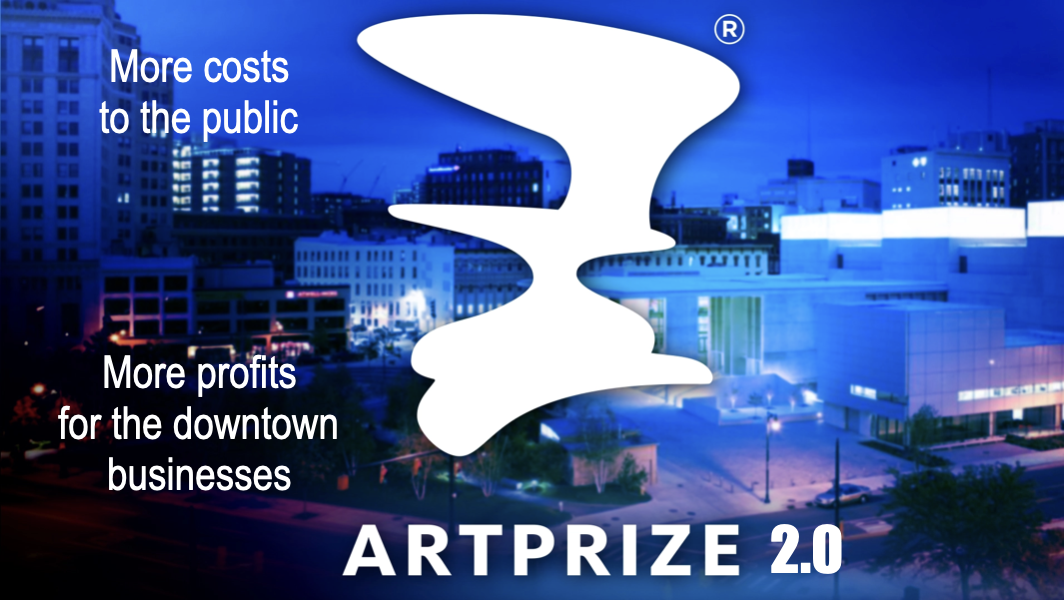
Lastly, it was announced that the DeVos family would no longer be running ArtPrize. However, the City of Grand Rapids agreed to step in and create another public/private partnership that would not only mean more public money and city staff time would be used for ArtPrize, those who have been economically benefiting from the annual art spectacle, would continue to reap the monetary rewards, without having to front the money to run the annual art event. GRIID wrote about what the City of Grand Rapids is calling ArtPrize 2.0, both in November and December.
In Part IV, we will look at the GRPD murder of Patrick Lyoya and how the City of Grand Rapids has responded to this injustice.
Unlike social spending, US Congress has no problem passing the largest US Military budget in history
A nation that continues year after year to spend more money on military defense than on programs of social uplift is approaching spiritual doom. Dr. Martin Luther King Jr.
Just two days before Christmas, the US Congress passed that largest US military budget in history, The $858 Billion budget for the Pentagon/US Military was almost unanimously passed by Congress, thus continuing the long standing history of Bi-partisan support for US militarism.
According to the Director of the National Priorities Project:
This deal gives the military its highest budget since the height of the post-9/11 wars, and more than $100 billion more than the last budget under President Trump — an increase big enough to fund most of the still-unfunded priorities under President Biden’s Build Back Better plan. In a typical year, half or more of the Pentagon budget goes to corporate contractors, who have seen their stock prices soar since Russia’s invasion of Ukraine. The Pentagon recently failed its fifth audit in a row, the only major government agency unable to account for how it spends taxpayer dollars.
Co-founder of The Intercepted, Jeremy Scahill, also wrote about the FY 2023 US Military budget, stating:
Included in the National Defense Authorization Act of 2023, finalized on December 6, is the establishment of a multiyear no-bid contract system through which Lockheed Martin, Raytheon, Boeing, and other weapons manufacturers are being empowered to expand their “industrial base” and business. Lawmakers determined that “providing multi-year procurement authority for certain munitions programs is essential,” in part because it will “provide the defense industrial base with predictable production opportunities and firm contractual commitments” to “increase and expand defense industrial capacity.”
The power of the US Military Industrial Complex cannot be understated. According to data from OpenSecrets.org, military contractors have contributed over $293 Million to Congressional candidates since 1990, when the data began to be collected. The military industry also has over 700 lobbyists, who are paid a ton of money to constantly pressure members of the US Congress to adopt military budgets, which will be good for their clients. In 2022, Military contractors spent over $92 Million in order to lobby the US Congress.
Senate Armed Serves Committee member and Michigan Senator, Gary Peters, released his own Press Release on December 23rd, touting how well he didi to secure funding for US military installations in Michigan and Michigan-based military contractors.
What Senator Peters and other members of the US Congress fail to mention are the following important contextual realities about the US Military Budget:
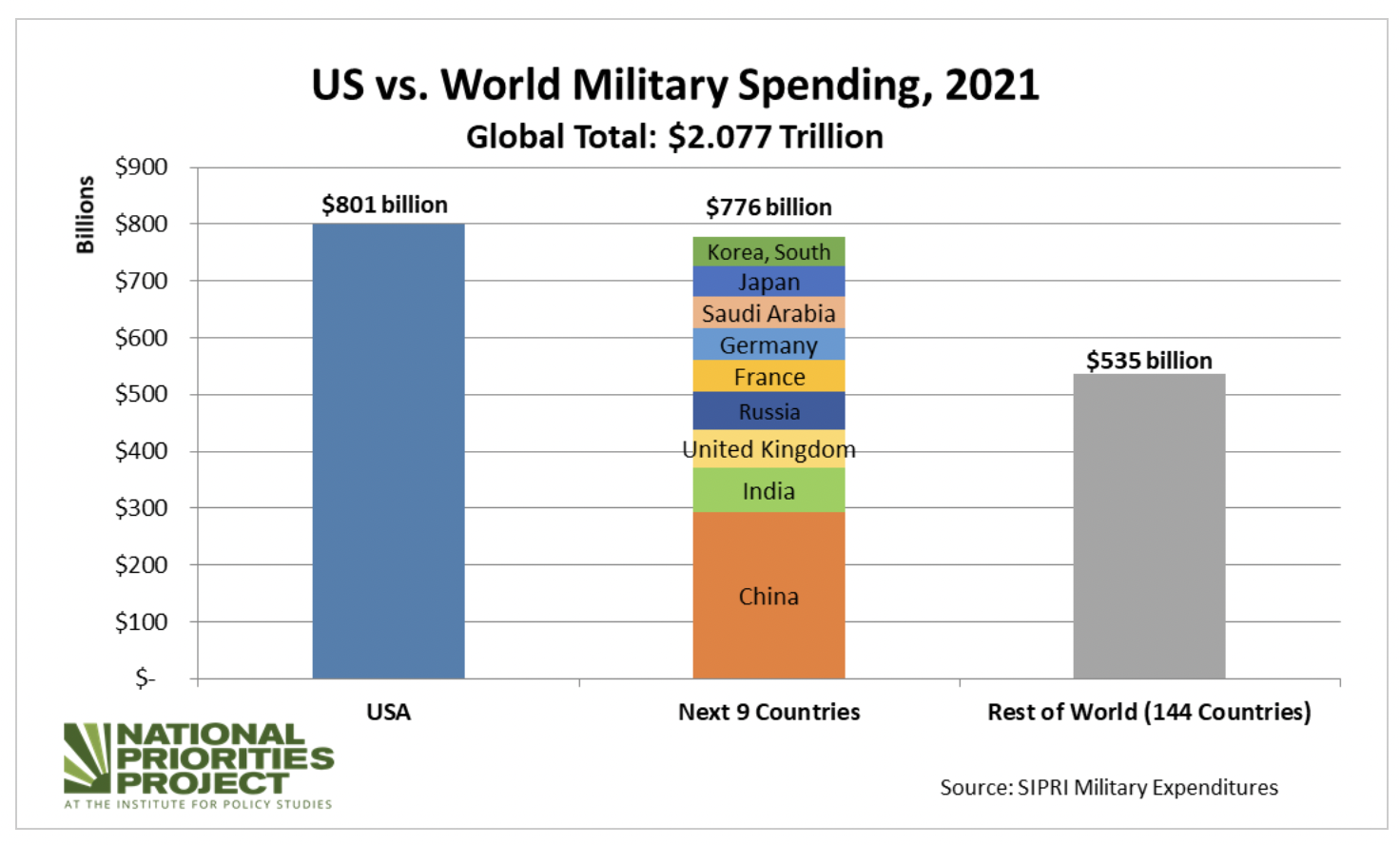
The US has the largest military budget in the world. In fact, the US military budget is larger than the next 9 largest military budgets in the world, combined. (See graph above, from the National Priorities Project)
The US has 750 Military bases around the world, in 80 different countries, according to data from 2021 from World Beyond War.
The US military is currently involved in numerous wars/military conflicts around the world, which includes direct military involvement, US military advisors, covert operations, training for foreign troops, US Military aid to countries and US weapons sales abroad. In fact, the US is the largest weapons dealer on the planet.
Did you know if the Pentagon were a country, its fuel use alone would make it the 47th largest greenhouse gas emitter in the world? If we’re going to address the climate crisis, we need to #DivestFromWar NOW!
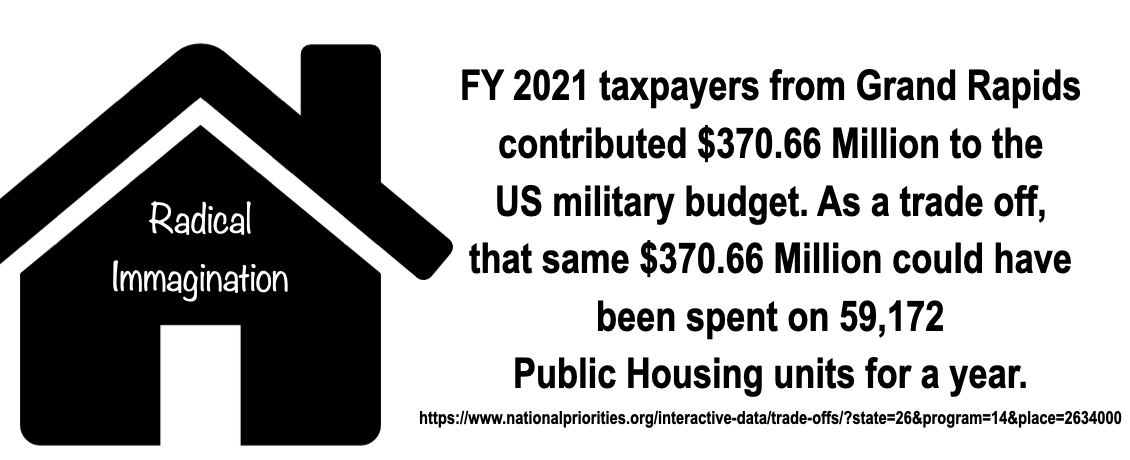
 According to the excellent data provided by the National Priorities Project, for FY 2021 taxpayers from Grand Rapids contributed $370.66 Million to the US military budget. As a trade off, that same $370.66 Million could have been spent on 59,172 Public Housing units for a year. Imagine if that amount of money stayed in Grand Rapids and was used for critical issues like housing, education, health care etc. It’s never a question of there not being enough money, rather it is always a question of priorities.
Just last week, over 1,000 US faith leaders called for a negotiated settlement between Russia and Ukraine, a settle that the US could be involved in if they were truly committed to disarmament and lasting peace.
The very fact that there is no real anti-imperialist/anti-war movement in the US right now, is indicative of the fact that too many people are either disinterested in fighting US imperialism or too many people, including progressives who contrite to support US militarism and the US Military Industrial Complex. Until such a movement exists in the US, the US Military Budget will continue to grow and be adopted by both Republicans and Democrats alike.

