Taking a break from posting, be back next week!
Still saying NO to the Criminalization of the unhoused: Paying a visit to Mel Trotter Ministries
 Last week, we reported on a group of activists that went to the Grand Rapids Area Chamber of Commerce to demand that they retract their proposed ordinance for downtown Grand Rapids and make a public apology for even suggesting such an oppressive policy be adopted by the city.
Last night, another group of activists did the very same thing, by going to one of the entities that endorsed the GR Chamber’s ordinance proposal, Mel Trotter Ministries. This time there were no chants or signs being held by activists, so as not to alarm or cause any unnecessary stress to the people who utilize the services of Mel Trotter’s, primarily the unhoused.
One can’t enter Mel Trotter by just opening a door, instead every door has a security camera and a buzzer you have to push in order to gain access. Once inside, people approached a reception area, where staff were sitting behind plexiglass. Activists asked to see the CEO of Mel Trotter’s, Dennis Vankampen. However, when the help desk staff called back, they were told that the CEO was not there. Instead, the Vice President of Operations, Jeff Dashner, was sent out to greet the group of activists.
Once a representative of Mel Trotter was present, activists communicated the same thing they did last Monday to the GR Chamber, they demanded that they retract their support of the proposed ordinance for downtown Grand Rapids and make a public apology for supporting said ordinance proposal. They also demanded a response by this Friday.
Jeff Dashner said that he sent an e-mail to both Vankampen and another person who is part of the Executive Team. While making the demands it appeared to several of the activists present, that the Mel Trotter staff person seemed disinterested in what was being said. One activist, who does weekly work with the unhoused – mutual aid, harm reduction, etc. – spoke up and said, “We are not just observers, we work with the unhoused and are well aware of the precarious situation they are in, which is exactly why we are appalled by your organization’s support for the ordinance proposed by the GR Chamber of Commerce. Several other activists who were present, affirmed this point and made other comments, which were acknowledged. Another activists made it clear that as of Sunday, those involved in organizing against the Chamber’s proposed ordinance, had over 12,000 people send messages to Grand Rapids City officials making it clear that there was widespread popular opposition.
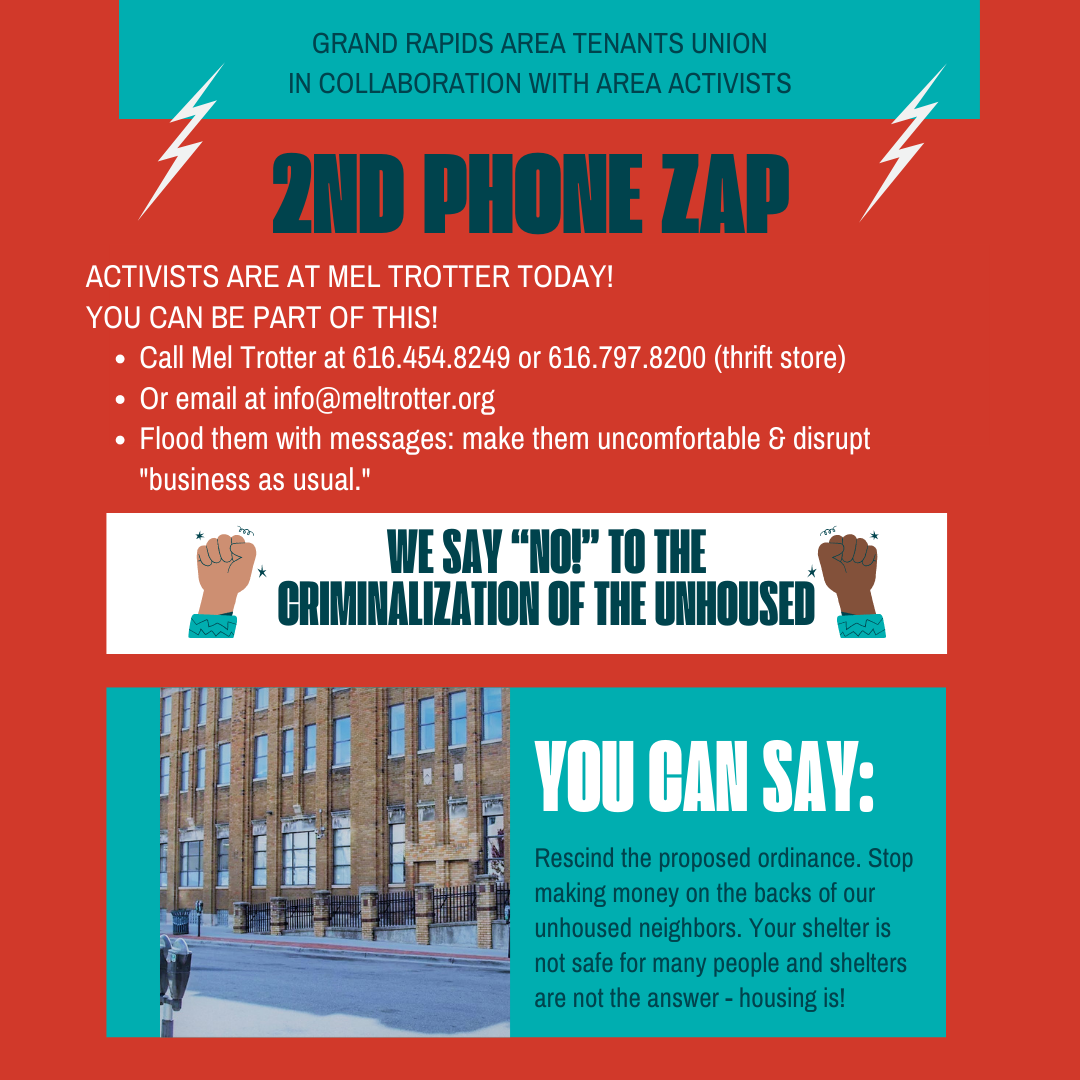
For those who were unable to attend in person, the Grand Rapids Area Tenant Union, which is collaborating with other area activists, are encouraging people to contact Mel Trotter Ministries to demand they pull their support for the proposed ordinance from the GR Chamber of Commerce. Call Mel Trotter at 616.454.8249 or 616.797.8200 (thrift store), or email at info@meltrotter.org. Please share the graphic included in this article so we can get as many people to pressure Mel Trotter Ministries to do the right thing.
GRIID Year in Review Part II – Monitoring the Far Right in West Michigan
Yesterday, we began our annual year in review series with a look at our work with monitoring local news coverage of critical issues, which was Part I in this series. Today, we will take a look at our coverage of the Far Right in West Michigan in 2022.
When we use the term Far Right, we are not simply referring to extremist groups like the Proud Boys (although they would fall under this category), we are referring to organizations and institutions that embrace and perpetuate policies and practices that push the envelope on issues like White Supremacy, heterosexism, transphobia, patriarchy, and xenophobia. Granted, some of the stories we look at below, could fall under multiple categories, but for our purposes today we are identifying them as Far Right.

Within the past year it is hard to go a week without the dominant news media reporting on the January 6th attempted insurrection. However, local news agencies haven’t reported much on that issues, except for some coverage around the 1st anniversary of January 6th.
On January 4th, GRIID posted a piece that discussed the importance of having a critical lens when it came to the one year anniversary of the attempted insurrection, which also included a critique of a Catholic TV show that interviewed Fr. Robert Sirico, founder of the Grand Rapids-based Action Institute, where he was discussing the January 6th insurrection. A few days later we wrote a piece about the PBS documentary on the January 6th attempted insurrection, which left out any critical information about the West Michigan connection to that insurrection. Lastly, this issue was reported on briefly in June, after Michigan Gubernatorial candidate Ryan Kelley (from Allendale) was arrested by the FBI for his role in the January 6th attack on the US Capitol.
There were also some article we posted that continued our two-decade critique of the Far Right Think Tank, the Acton Institute, based here in Grand Rapids. In January, they posted an article that once again demonized the national movement of Black Lives Matter. Then in March, the Acton Institute continued its assault against people who identify as trans, which they have consistently done for years.
There were also a couple of stand alone piece that GRIID wrote during the year, having to do with the Far Right in this area. One article had to do with the major contributions from the Van Andel family to the Far Right school in Michigan, Hillsdale College. Another article was about a church just north of Grand Rapids, which bragged about building their own armory back in April. The other stand alone article was just after the shooting in Colorado in November, where a gunman shot and killed several people, along with wounding others who were part of the LGBTQ community. One queer group spray painted a message at the compound of the group Focus on the Family, which has received millions of dollars of funding from the DeVos family and has created an anti-LGBTQ climate across the country.
However, the big far right story of the year was the US Supreme Court’s decision to reverse Roe v Wade. GRIID wrote a piece about the history of the reproductive justice movement in Grand Rapids, then followed it with a piece looking at what we called the anti-abortion cartel in West Michigan in May. After that we posted several stories focusing on people or organizations in West Michigan that have contributed to the criminalization of abortion, some for more than forty years. Each of these stories came with a Wanted Poster for the family or organization that funded and supported the criminalization of abortion, with links to each of those postings/Wanted posters below.
In Part III, we will take a look at article we did in 2022 that shinned the light on the Grand Rapids Power Structure.
https://griid.org/2022/07/07/wanted-for-funding-the-criminalization-of-abortion-the-devos-family/
https://griid.org/2022/07/21/wanted-for-funding-the-criminalization-of-abortion-the-cook-family/
https://griid.org/2022/08/18/wanted-for-funding-the-criminalization-of-abortion-the-prince-family/
https://griid.org/2022/08/26/wanted-for-funding-the-criminalization-of-abortion-john-nancy-kennedy/
It’s that time of the year again, where we offer up a review and revisit some of the most relevant posts from GRIID. We will be looking back at stories that focus on the Grand Rapids Power Structure, Social Movements in Grand Rapids, Monitoring the Far Right in West Michigan and a reposting of GRIID constructed memes. However, we kick off the year in review by looking at our ongoing critique of local news coverage.

There were a total of 42 times that we posted under the section Dissecting Local News for 2022. Not surprising, 14 of our posts were dedicated to critiquing how the local news reported on the GRPD, particularly the police murder of Patrick Lyoya.
One of the things that we noticed in the reporting on the GRPD’s murder of Patrick Lyoya have to do with how favorable the coverage has been to the now ex-cop Christopher Schurr, with the example of a May article by MLive that presented Schurr as someone devoted to serving others. Our response to that story, was entitled, MLive article on Officer Christopher Schurr normalizes White Supremacy and White Saviorism. Another issue has been how the local news has framed the police murder of Lyoya once the court process had begun, as is evidenced in our post in late September, The ongoing court case and Grand Rapids news media coverage of the ex-cop who murdered Patrick Lyoya.
There have also been stories about the GRPD, that continue to show the local news media’s bias towards the GRPD. Two separate posts that we did are worth noting here. The first was a post in early January, where were documented how the local news essentially just regurgitated the City”s Press Release about a forum for the next Police Chief, When Press Releases become news stories: City of Grand Rapids sends Press Release on forum about new GRPD Chief, local TV stations regurgitate Press Release as news.
The second example of what could be called Copaganda, comes from an April story done by WZZM 13, about the group iCI Nation. iCI Nation is essentially a pro-police organization that has been active in recent years specifically because the public has been demanding greater scrutiny of how policing is done in the US and in Grand Rapids. The GRIID post was actually an Action Alert, since the WZZM 13 story provided no context or critical backdrop on the iCI Nation group.
News Coverage regarding those with power in Grand Rapids
One of the most important roles that news agencies can play is to hold systems of power in check, whether those systems are government or private power. There were numerous postings that GRIID crafted in response to how much of a free pass the local news media gave for those in power. One example was how the local news reports on those with power was from January. The wife of Fred Meijer, Lena, passed away in January, and the local news coverage made her out to be a saint, with MLive referring to her as having “a wonderful heart.” Our response was written to reflect the fact that the Meijer family is one of the wealthiest families in the area, which the local news coverage didn’t really address. A second example looks at how MLive reported uncritically on the DeVos Family Foundation hurricane relief donation in October.
When local reporting is PR for developers
New development projects are always being announced in Grand Rapids, but unfortunately the coverage does not challenge, question or provide amble contextual information for the public. There were six times that GRIID wrote critiques of how development project were covered by the local news media.
 One example GRIID looked at was an MLive story that was essentially based on a Press Release from the Right Place Inc, having to do with what they referred to as 12 Transformational projects. A second example, which is related to the 12 Transformational projects, has been coverage of the proposed soccer stadium, where the local news coverage fails to provide relevant context and issues around conflict of interest. A third example, looks at how public funds continue to be prioritized for tourism and private sector interests, over affordable housing and other urgent needs for thousands of families in Grand Rapids. Our post was entitled, It’s never a question of funding, rather priorities: Making the area around the Van Andel Arena more appealing or providing housing relief for marginalized families?
There were other issues, like the 2022 election coverage, but we will provide more on that in another part in the series. In tomorrow’s post we will look at articles we posted looking at the far right in West Michigan.
Grand Rapids is considering spending between $3 and $15 Million on an indoor golf driving range
“I’ve got just the place for low-cost housing. I have solved this problem. I know where we can build housing for the homeless: golf courses! It’s perfect! Just what we need. Plenty of good land, in nice neighborhoods, land that is currently being wasted on a meaningless, mindless activity engaged in primarily by white, well-to-do male businessmen who use the game to get together to make deals to carve this country up a little finer amongst themselves.” George Carlin

Grand Rapids City officials never cease to amaze me when it comes to how they spend money. On Tuesday, only a few local news agencies reported that the City of Grand Rapids is considering spending between $3 and $15 million on an indoor driving range, according to a story on WOODTV8.
The source for this news is David Marquardt, the director of Grand Rapids Parks and Recreation. Marquardt is quoted as saying:
“Topgolf is the one brand that comes to people’s mind. It is in most of the major cities across the country, like Chicago, Detroit and Minneapolis. That company looks for a big population base and other things that attract people to their cities like major league football. Grand Rapids does not have that.”
Again, it’s all about entertainment stuff when it comes to attracting people to live or visit here. How about instead of making the City of Grand Rapids primarily a destination for tourism or attracting “talent”, how about we attract people based on the notion the principle that every person who lives in the city is valued? And when I say valued, I mean that everyone has all of their basic needs met – earning a living wage ($25 an hour minimum), health care, good public education, great sustainable transportation, and yes, truly affordable housing.
The director of Grand Rapids Parks and Recreation says that Topgolf is probably not in the cards, but a smaller version of what they do. The discussion so far is to build an indoor golf driving range using land at the City operated Indian Trails golf course. (Of course this is what the City would call a golf course.)
Marquardt then goes on to say:
“The Indian Trails golf course is what we call an ‘enterprise fund’. And so essentially it needs to be self-sustaining like any business. It would not necessarily be taxpayer funded, but rather funded by user participation. We would be looking at some partner funding from other sources. I don’t know how many or whom.”
Do other people find it curious (and enraging) that this is even a conversation happening in city government circles? The timing is also pretty incredible, especially considering we are only beginning to come out of a major pandemic, with massive inflation, making thing even more economically stressful for thousands of families in Grand Rapids, along with increased pressure from residents to re-direct funding away from policing and into housing, health care and other basic needs.
In addition, I have no doubt that Grand Rapids City officials will be able to find partners – ie rich people – who will contribute to the cost. However, as we continue to see with other public/private partnerships, more often than not the public pays (with little or no input), while the private sector makes money and lobbies to use federal, state and local public dollars, all in the name of attracting people to Grand Rapids.
Missed opportunity by the Grand Rapids City Commission to reject the GR Chamber’s ordinance proposal to criminalize the unhoused
Ever since the Grand Rapids Chamber of Commerce went public with their proposal for the City of Grand Rapids, a proposal that would criminalize the unhoused, it has become the main local news topic.
GRIID wrote a response to the GR Chamber’s unjust and insensitive ordinance proposal on December 6th. That same night, during last week’s City Commission meeting, numerous downtown business owners and members of the Grand Rapids Power Structure showed up to show support for the Chamber’s ordinance proposal.
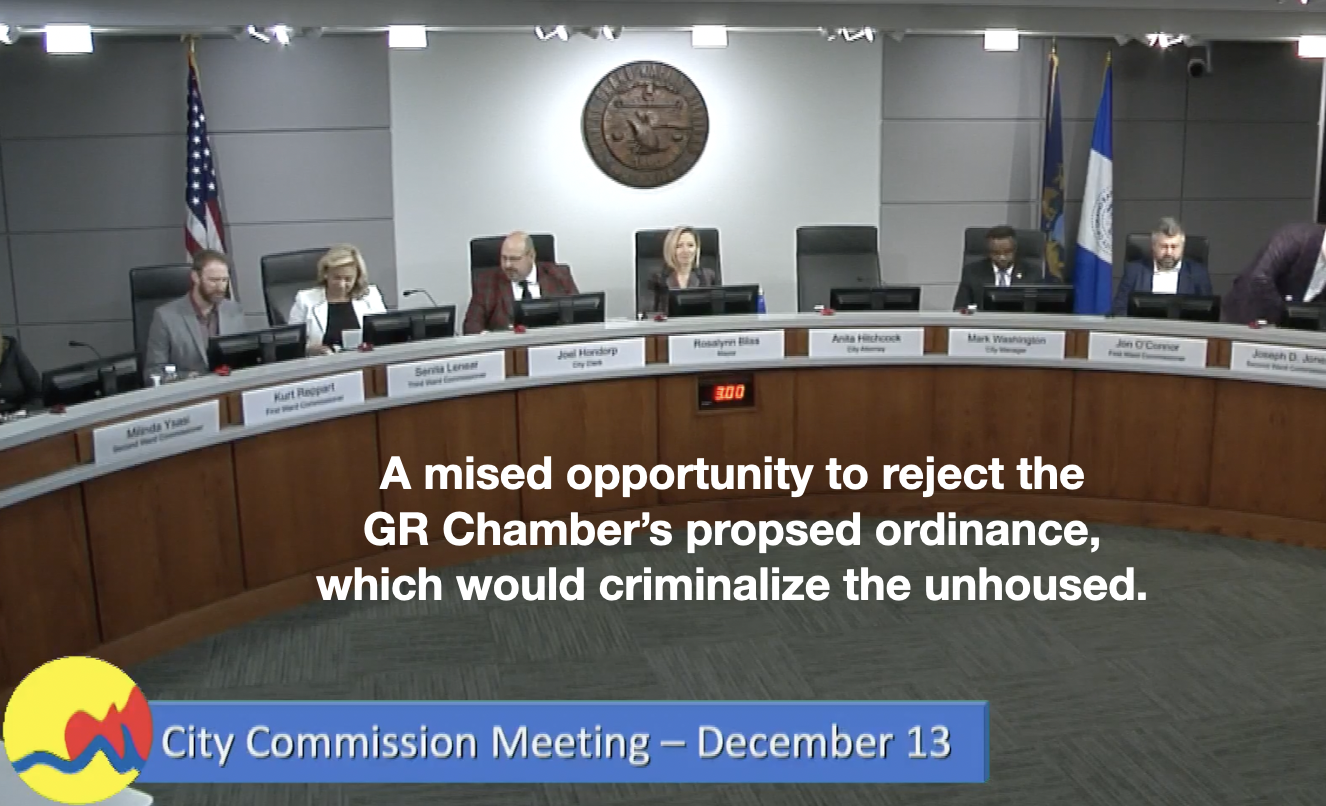
We then followed up with a post that critiqued the local news coverage of the Chamber’s proposal, making it clear that the coverage primarily centered the voices of the business community.
On Monday, we posted an article that took a critical look at another letter send to the Grand Rapids City Commission, this time from 120 business people, which included several members of the most powerful families in the city. In that post we made the point that many of those who signed the letter have financed politicians and pushed economic policies that have in many ways created the housing crisis we are currently facing in Grand Rapids. This dynamic is also true of the Grand Rapids Chamber of Commerce, which has a long track record of lobbying on behalf of the richest people in the community, while pushing policies that impacted thousands of individuals and families that are one paycheck away from being unhoused.
Several local organizers and autonomous groups have resounded to the outlandish GR Chamber proposal. On Monday, about 25 people showed up at the GR Chamber office, demanding that they rescind the letter and make a public apology for putting forth said ordinance proposal. In addition to the protest, people have been calling the Chamber CEO, along with several members of the business community that signed on to the Chamber’s proposal to let them know that if the Chamber doesn’t meet the demands presented to them on Monday, that there would be a call for a boycott of all downtown businesses. Lastly, those involved in resisting the Chamber’s ordinance proposal, created an online letter that is being sent to Grand Rapids City officials, which has been signed by over 10,000 people. I know that most of the 10,000 are not self-designated “community leaders”, but 120 compared to 10,000 should tell you something.
Just a few days ago, Grand Rapids City officials held their usual meetings, but there were two that were of particular interest as it relates to the GR Chamber’s proposed ordinance.
On Tuesday afternoon, the Public Safety Committee met, with the Chief of Police and other GRPD staff presenting all of the things that they are doing to address “safety issues” in downtown Grand Rapids. You can watch this meeting, but what seemed clear was that the GRPD was using both the Chamber’s call that the City do more around public safety and their own list of responses, as an opportunity to push for an increase in cops and an increase in funding for the GRPD.
Writer and activist Naomi Murakaw identifies this tactic as one of the three traps of police reform. In this case, the GRPD wants to make themselves relevant through programs like the HOT Team, in order to justify ongoing or increased funding. The ongoing push by police to justify their existence almost always happens when there is significant push back from the community.( See Elizabeth Hinton’s book, America on Fire: The Untold History of Police Violence and Black Rebellion Since the 1960s) Ever since the May 2020 uprising, the GRPD has been working hard to control the narrative and to push city officials to increase their budget and add more cops to the department. During Tuesday’s Public Safety Committee meeting, Chief Winstrom continued that narrative.
Towards the end of the Public Safety Committee meeting, one of the committee members, Ed Kettle, who has been a longtime support and apologist for the GRPD, offered to run another millage campaign to increase funding tor the GRPD. It should be noted that Kettle was involved in the campaign in 1995 to change the City Charter to institutionalize the no less than 32% of the budget going to the GRPD and to add more cops to the force.
On Tuesday evening, during the Grand Rapids City Commission meeting, there were more than a dozen people who spoke on the GR Chamber of Commerce proposed ordinance and all of them were in opposition to it. In addition to the public comment opposition, there were already over 10,000 letters from the public condemning the Chamber ordinance proposal that Commissioners would have seen, but despite all of this opposition, the City Commissioners failed to address or reject what the Chamber of Commerce had submitted. In my mind, this was a missed opportunity to demonstrate to the public that City officials don’t give in to the Grand Rapids business class.
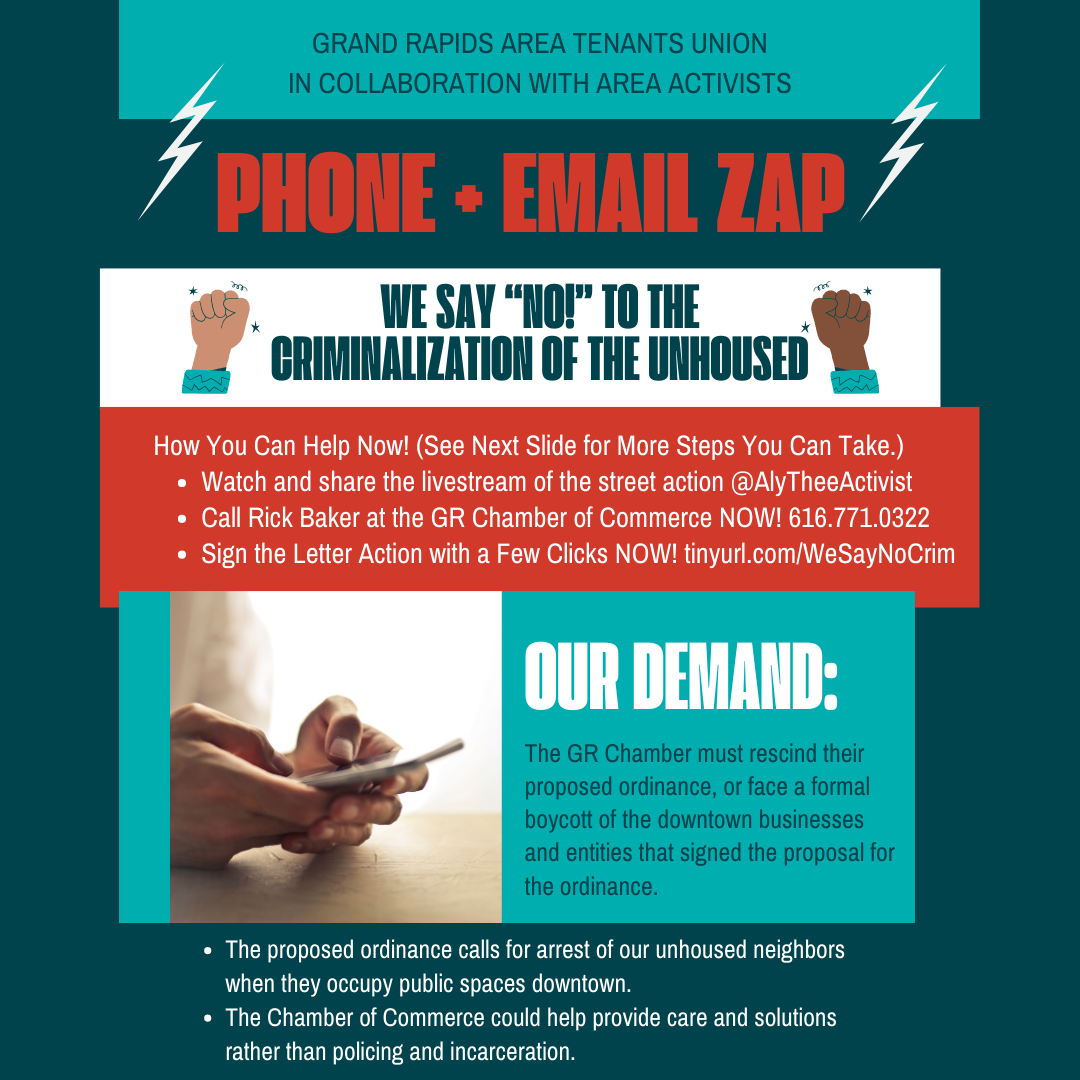 Not only did the City Commissioners miss an opportunity to say no to the criminalization of the unhoused, they spent the last hour of their meeting congratulating each other, since three Commissioners were leaving due to being term limited or voted out. While I can appreciate the comments that many of them made, they could have done that in a more private setting with each other, instead of using the public’s time. This was the last City Commission meeting of 2022 and who knows how long it will be before the GR Chamber’s proposed ordinance will get voted on by the commission. We do know that one of the new Commissioners, Drew Robbins, was endorsed by the police union and bankrolled by the Chamber of Commerce, which means he will likely support their ordinance proposal. The other two commissioners come from the non-profit world and are often seen as progressives, but without either of them holding political office it would be naive to assume that they would reject the Chamber’s proposal.
ArtPrize 2.0: More public money to be used means more profits for downtown Grand Rapids businesses
More information has come out regarding the future of ArtPrize in Grand Rapids.
As we noted in a November 20th post, where Mayor Bliss was interviewed by WOODTV8, the future of ArtPrize will be a partnership between the City of Grand Rapids, Kendall College of Art & Design, and Downtown Grand Rapids Inc.
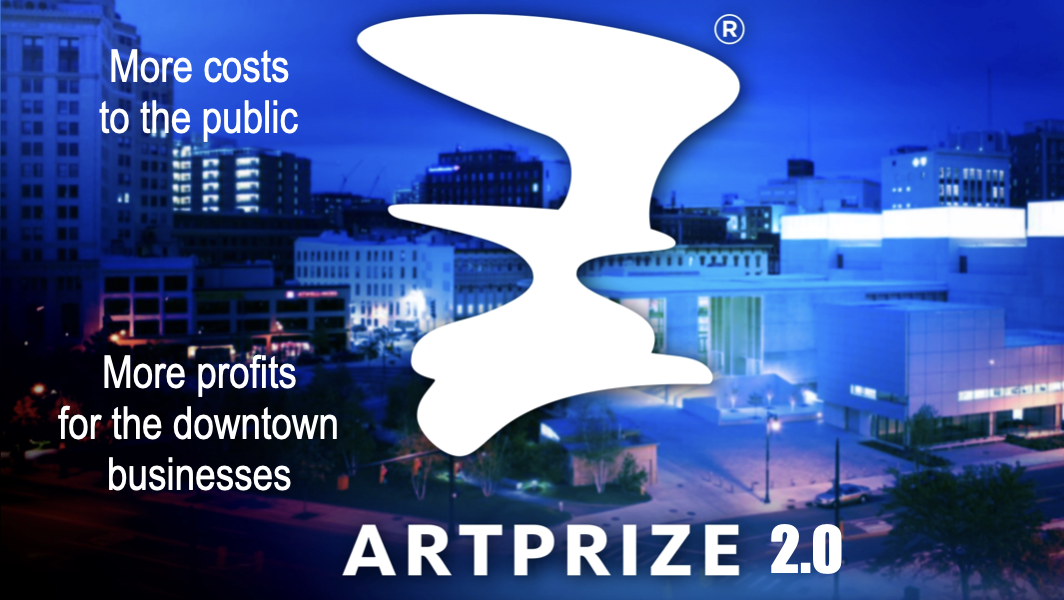
In the Agenda Packet (pages 2 – 4) for the Grand Rapids Committee of the Whole for December 6th, we now have a memorandum of understanding (MOU) on the future of ArtPrize. Grand Rapids City officials adopted the proposed resolution regarding the future of ArtPrize, stating:
ArtPrize has had an immense impact on our community. It has created a unique conversation about arts, culture, and self-expression. This distinctively Grand Rapids approach to innovation captured the imagination of the arts world. The past work of the founders, sponsors, artists, and donors has built a strong foundation that provides a tremendous opportunity for the future of this next phase of ArtPrize.
Such commentary seems a little self-congratulatory, which is consistent with how those who run this city often responds. Besides adopting the resolution, we now have a partial list of the nine-member Leadership Board of Directors for ArtPrize:
- Tara McCrackin – President of Kendall College
- Richard Winn – AHC Hospitality (DeVos owned)
- Natalie Stewart – Switch (https://www.switch.com/about/)
- Mark Washington – City Manager Grand Rapids
- Mayor Bliss – Mayor Grand Rapids
According to the December 6th document, the Leadership Board will be responsible for selecting the remaining members of the board. Can’t wait to see who else gets selected to manage/control the future of the art spectacle.
Yesterday, included in the Grand Rapids City Commission Fiscal Committee Agenda Packet (pages 11 – 13), we now know that City officials want to use public funds to continue to subsidize ArtPrize. I say continue to subsidize, since Grand Rapids has been using public money to support ArtPrize, such as the $50,000 they approve in August for the the 2022 integration of the monied spectacle. However, the amount that the City of Grand Rapids approved yesterday is definitely an increase from previous years. The Fiscal Committee document states:
Your Committee of the Whole recommends adoption of a $50,000 Mobile GR sponsorship and $100,000 Special Events sponsorship and $50,000 of in-kind services from Mobile GR for the ArtPrize 2023 event.
This means that a $200,000 value of public money will be used to subsidize ArtPrize for 2023. Do you think that the City will finally decide to pay artists for their time/labor for participating in ArtPrize? I’m not holding my breathe.
In the end, the only real difference that I can see with Rick DeVos no longer running ArtPrize, is that he got the City of Grand Rapids to take it over. Ultimately, this means City funds, City resources and City staff time will be spent on an event that will primarily benefit the private sector. It’s sort of like a reverse austerity measure, where instead of privatizing a public service, the private sector gets the public sector to underwrite and promote ArtPrize, yet the private sector is the primary beneficiary of the monied art spectacle. Another example of the economic shell game that Capitalism plays on the public.
We say NO to the criminalization of the unhoused protest confronts GR Chamber of Commerce staff with demands
Last night, roughly 25 activists gathered in front of 250 Monroe NW, the building that is home to the Grand Rapids Chamber of Commerce. The gathering was from a call by the Grand Rapids Area Tenant Union, working with a coalition of autonomous groups, to protest the GR Chamber’s proposed ordinance that would criminalize those who are unhoused, those who are subjected to poverty, and those who are struggling with mental health issues.
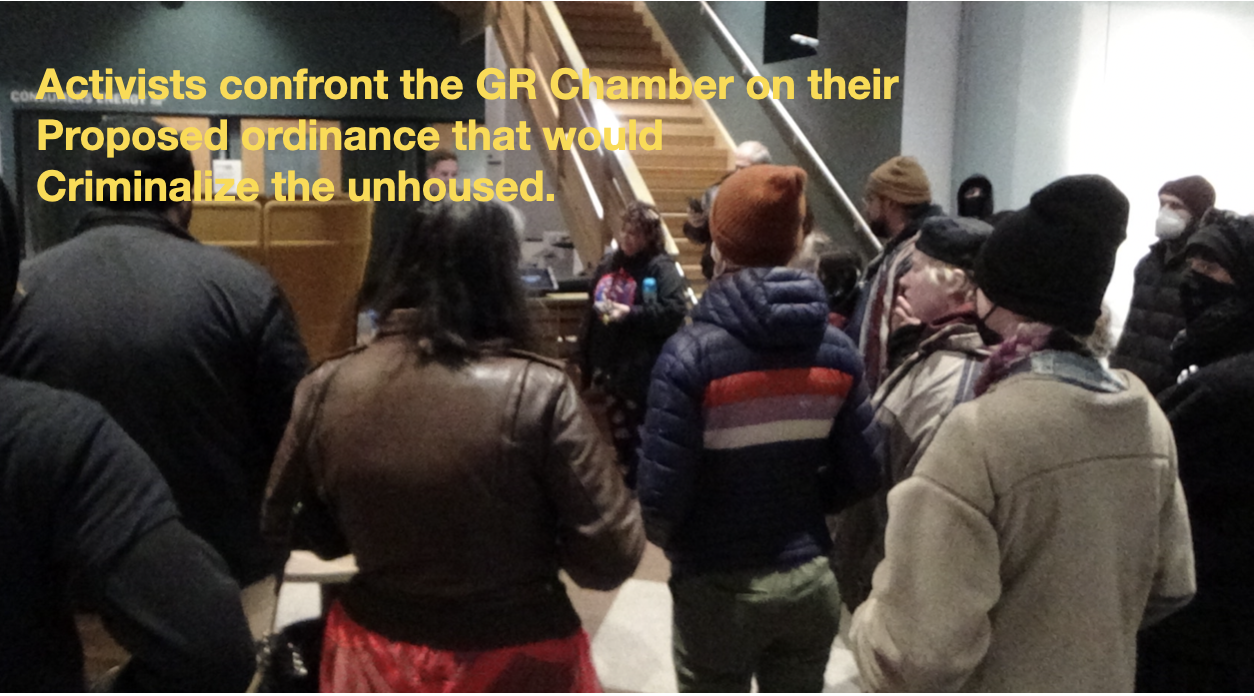
After a brief gathering outside, the group decided to go inside the building and directly confront members of the Grand Rapids Area Chamber of Commerce. This is the first time this writer had been in the new office space, which is way more upscale than their office was when it was housed on Pearl St. in downtown Grand Rapids.
Upon entering the glass doors of the GR Chamber office, one staff member pleaded with the group to leave, since the office was “private property.” While we understand that the GR Chamber and other members of the Capitalist Class view private property as sacrosanct, those who came to communicate their anger over the proposed ordinance were in no way intimidated by the hollow plea to vacate the Chamber’s office.
A clear demand was presented by someone, which included that the Grand Rapids Area Chamber of Commerce rescind their letter proposing the criminalization of the unhoused and make a public apology for doing so. From that point on, several other activists verbalized their rage over the proposed ordinance, with some asking the Chamber staff directly if they “hated” those who were unhoused. By this time a second GR Chamber staff member had appeared and was clearly on the phone to the GRPD. The other GR Chamber staff member tried to speak softly to the person who made the demands, asking them if they would get people to leave. Clearly, the GR Chamber staff isn’t familiar with the fact that groups like this organize horizontally, therefore individuals are not “in charge” and everyone participating is allowed to make up their own damn minds.
 Eventually, the group left GR Chamber office, only to gather just outside the door, where they continued to chant and direct comments towards the staff still inside. The confrontation seemed to energize people, and their chants echoed throughout the building, so much so that people from other offices poked their heads out to see what all the ruckus was.
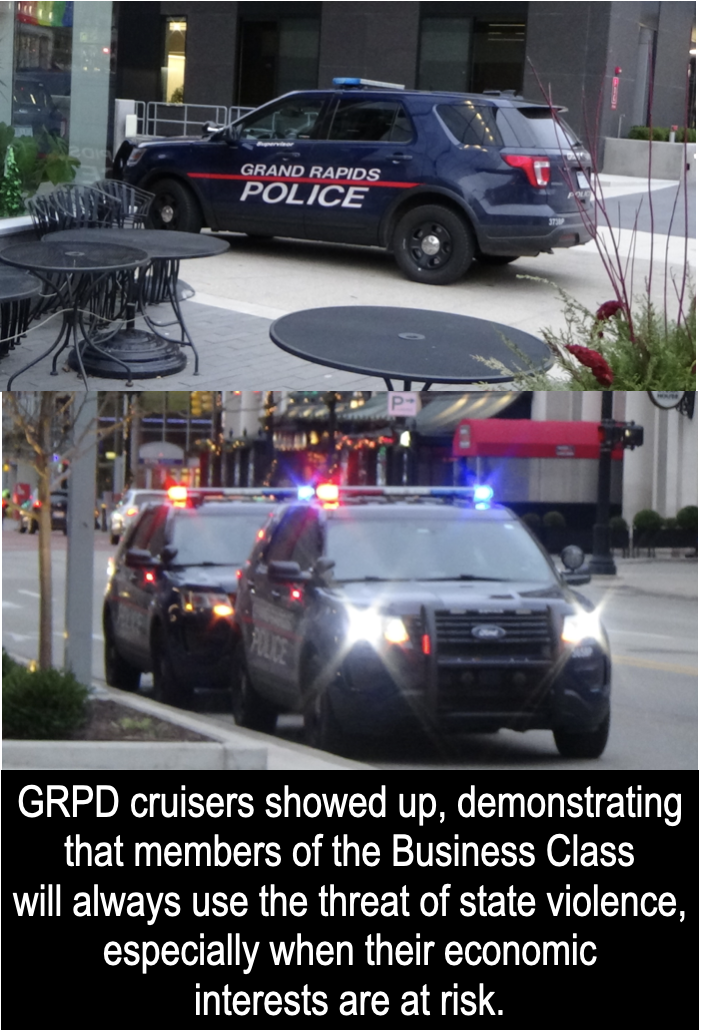
By this time, there were four separate GRPD cruisers that had arrived, so most members of the group exited out the Ottawa-side of the building, with a few people going out to see what the GRPD were up to. The cops saw that some people were exiting out the Monroe-side of the building, so they waited until people came out. The cops said nothing to the activists who came out, and immediately went inside the building to assure the GR Chamber staff that their “private property” was safe.
It is rather instructive that the GR Chamber of Commerce staff called the GRPD on those who were there to make demands that the organization rescind the letter and make a public apology. The irony is that if the GR Chamber proposed ordinance is adopted by the City of Grand Rapids, it will result in the Chamber, or any of their business members, casually calling the GRPD to remove or arrest those who are unhoused, those who are subjected to poverty, and those who are struggling with mental health issues. The fact that the GRPD were called, fully demonstrates that members of the Business Class will always resort to using state-sponsored intimidation and violence, especially when their financial interests are being threatened.
The group eventually went back outside and marched around downtown Grand Rapids for about 30 minutes, letting other businesses and residents know that some people will not tolerate the actions of organizations like the Grand Rapids Chamber of Commerce, especially when they prioritize profits over people.
Below are other actions that people can take if they object to the criminalization of the unhoused.

Members of the Grand Rapids Power Structure and their associates sign on to letter endorsing the ordinance proposal that would criminalize the unhoused
Another letter from “community leaders” is asking Grand Rapids City officials to adopt the proposed ordinance put forth by the GR Chamber of Commerce, which was presented to the GR City Commission last Tuesday, which GRIID wrote about.

This week there is a new letter included in the City Commission Agenda Packet (pages 44 – 50), a letter that is signed by 120 people. Half way through the letter, the only bolded text reads:
We request that you adopt an ordinance to regulate appropriate access and use of the public right of way and solicitation.
This new letter clearly endorses and demonstrates that those with considerable political and economic power are behind the GR Chamber’s ordinance proposal.
However, the letter does include language similar to the Chamber’s communication to the city, suggesting they do not want to criminalize the unhoused. As we wrote previously about the language of the GR Chamber’s letter, the proposed ordinance would limit the mobility of people, where they will NOT be allowed to go, plus it will result in fines and/or likely jail times, as most people this ordinance will impact will not be able to afford the cost of the fines.
List of those who signed
As mentioned earlier, there were 120 people who signed on to the most recent letter, which is part of the City Commission’s Agenda Packet for Tuesday, December 13. However, a closer look reveals that the majority of the people who signed are either members of the Grand Rapids Power Structure, are associates of the GR Power Structure, or they have an organization affiliation with the most powerful people in this city.
For instance, there are only 3 DeVos family members who have signed on to the letter, but 13 other people who run one of the entities that the DeVos directly controls. Then there are at least 18 other people who have a direct connection to the DeVos family, primarily through groups like the GR Chamber of Commerce, the West Michigan Policy Forum and the Right Place Inc, which are all part of the GR Power Structure.
The bulk of the rest of the signatories are people who either own businesses or property in downtown Grand Rapids, along with a handful of people who actually live downtown.
As we wrote last week, “This new letter from the GR Chamber of Commerce demonstrates once again that their primary goal is to protect the interests of members of the Capitalist Class – making downtown safe for commerce and tourists, which always results in punishing those who threaten those interests.” In addition, it should be noted that many of the people who are signatories to the newest letter are people who make significant contributions to the Republican Party, which zealously supports the interests of the Capitalist Class. In addition, many of these same signatories are also connected to the GR Chamber of Commerce and the West Michigan Policy Forum, which have actively opposed raising the minimum wage, have worked to get business taxes and taxation of the rich reduced, actively work to undermine worker associations and labor unions, plus many of them supported Michigan becoming a Right to Work state in 2012. In short, this class of people has aggressively worked to create a wealth gap, to perpetuate poverty and to create market dynamics in Grand Rapids that has made the cost of living impossible for thousands.
10 years of Michigan being a Right to Work state: Why we could have prevented it if we used our collective power
 This week marks the 10th anniversary of when a Right to Work policy was adopted by the GOP controlled Michigan legislature and then signed into law by former Governor Rick Snyder.
West Michigan’s role in pushing Right to Work for Michigan
Members of the Grand Rapids Power Structure played a significant role in helping to make Michigan a Right to Work state, something we should never forget. The West Michigan Policy Forum made Right to Work a priority since 2008, when the group grew out of the Grand Rapids Chamber of Commerce.
At their bi-annual Conference in 2012, the West Michigan Policy Forum ramped up their commitment to making Michigan a Right to Work state, with presenters from the Mackinac Center for Public Policy addressing the issue on September 11 of 2012, which GRIID wrote about. A few days later, at that same conference, the West Michigan Policy Forum had Rick Berman do a session on how to undermine labor unions. Berman is notorious for settling up anti-labor front groups as a strategy to not only undermine labor organizing efforts, but also function as a mechanism to win over public support for Right to Work policies.
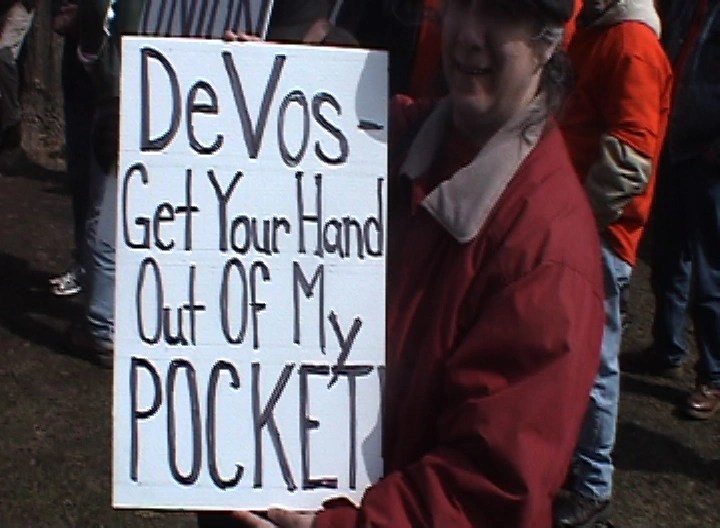 When Michigan became a Right to Work state in early December of 2012, GRIID also wrote about the role that the DeVos family played in making Right to Work a reality in Michigan. We pointed out that the DeVos family not only has had members sitting on the Board of Directors of the Mackinac Center for Public Policy (they were the main organization that had crafted the language Michigan used), they contributed millions to Mackinac, along with helping to found the West Michigan Policy Forum and making Right to Work a policy priority in the early years. MLive eventually acknowledged the role that the DeVos family played in an editorial they published 10 days after the GRIID article, but they gave the DeVos family spokesperson a great deal of space to defend the reasons why West Michigan’s most powerful family made Right to Work a priority.
A Missed opportunity to stop Right to Work in Michigan
As expected, organized labor and other civil society groups became mobilized against Right to Work being imposed on workers in Michigan. On December 10th, about 100 people protested in the streets of Grand Rapids, making a stop in front of the Amway Grand Plaza, since workers were well aware of the role that the DeVos family played in forcing a Right to Work policy in Michigan. This march, however, was just a prelude to the march that would take place the very next day in Lansing.
It was estimated that some 10,000 people, mostly workers, converged on the State Capitol in Lansing to protest the Right to Work policy that had been adopted. People began arriving as early as 6am, but by 9am there were thousands. Here is an excerpt of what GRIID wrote at that time:

By 9:00am there was an estimated 10,000 people in and around the state capitol demanding that Governor Snyder veto legislation that was voted on today, making anti-union Right to Work the official policy of the state.
Most of those attended the protest were union members, as was expected, with representation from the UAW, SEIU, electrical workers, steel workers, the MEA, the nurses union, public sector unions and the IWW.
Many roads were blocked off by the police, who were trying to make it difficult for folks to navigate downtown Lansing, but many unions bused in their members and took over the capitol lawn and the road out front with members holdings signs and inflated rats with Governor Snyder’s name on one and Dick DeVos’ name on another.
There were also over a thousand people inside the capitol, which had a large police presence, some in full riot gear, carry pepper spray and concussion grenades.
Unfortunately, most of the 10,000 people who came to demand that Snyder veto the Right to Work legislation, stayed outside listening to a selection of hand-picked speakers who emphasized the need to get a Democratic Party candidate elected in 2014. Michigan workers could have followed what Wisconsin workers did earlier that year, by occupying the Capitol to press their demands, even if it meant risking arrested. There were a few hundred people inside who had come to do just that and I was there with a contingent from Grand Rapids who were prepared to stay inside until the cops arrested us. Here again is what I wrote on GRIID about those of us who were inside the State Capitol:
Those of us who sat down, then began to invite others who were inside the capitol as part of the protest. Our numbers grew and we moved out from the center to take over more space. At about 11:30am, we were all greeted by Rev. Jesse Jackson, Lansing Mayor Virg Bernero and Rep. Gretchen Whitmer.
Jackson made some very moving comments about the importance of this action and how so many working families have already gone over the “fiscal cliff.” After speaking Jackson sat down with the rest of us, along with Bernero and Whitmar, which brought even more excitement to the action.
However, in less than a minute, Jackson and the local politicians got up and wished us well. Many people took this as an insult and felt that if they really supported this action they would have stayed, considering we live in a society where having people like Jackson and elected officials will generally guarantee more media attention.
The occupation lasted for another hour or so, but it became apparent that not everyone was going to stay, even if it meant risking arrest. We also could not get more people to join us and the police presence continued to grow inside.
Some people who were wearing reflective vests and directing people inside all day, were members of unions, but more often than not acted as an extension of the cops, by constantly telling people to cooperate and getting into arguments with people who were doing civil disobedience.
Sadly, the State Capitol occupation numbers dwindled and eventually ended. People went back outside to listed to more speakers and embrace the electoral strategy, which might finally be able to reverse the Right to Work policy, but more than a decade later.
The failure to get enough people to engage in Direct Action that day was clearly a missed opportunity to actually prevent Right to Work becoming a policy in Michigan. It was also a missed opportunity to demonstrate the power of Direct Action and collective organizing that likely would have shown people the real power that workers have if they engaged in Direct Action.
A few days later, GRIID posted the first of a two part article entitled, Fighting Back in Michigan Part I: A Statewide Strategy. Part of that article read:
For decades the labor movement has been pumping millions of dollars into electoral politics instead of organizing in the workplace and building capacity amongst workers to have the skills to do radical politics.
Think about the $21.9 million dollars that was raised this year to push for Proposal 2. What if that amount of money was spent on paying people to become organizers, to provide resources to those doing organizing campaigns wherever workers wanted to organize? Workplace democracy is one of the strongest forms of democracy and can trump Right to Work laws. If businesses do not have compliant workers, they can’t make money.
Beyond spending the money on organizing, that kind of money could be used for mutual aid, providing resources like food, health care and housing to fellow workers and their families who are struggling to make it in this capitalist economy. Engaging in mutual aid will build solidarity, by demonstrating to people that we care about our working class brothers and sisters.
Now, detractors might suggest that the electoral strategy won this year, but such strategies on really win if they result is massive structural changes to policies that prioritize people above profits.
It should be easy for the Democrats to get rid of the Right to Work policy in Michigan, but they is very low hanging fruit. Getting rid of Right to Work should be followed by making the minimum wage in Michigan $25 an hour, which would be more of a livable wage, along with taxing the hell out of the rich to fund housing, education, health care and climate justice work that we can’t wait another decade for. We need to demand these things now, as I wrote in a 3 part series right after it was announced that the Democrats would control the State Legislature beginning in 2023. Another World is Possible!!!


