Resisting the narratives about Grand Rapids from the DeVos dominated GR A250 committee
We are now less than two weeks from the 250th anniversary of the creation of the United States of America.
For the past nine months GRIID has been writing about and monitoring the group GR A250, the local entity created to get the rest of us to fall in line with the dishonest history of the US that was shoved down our throats since we first started saying the Pledge of Allegiance in Grade School – well since those of us who are older did that.
The GR A250 group has been crafting narrative about the founding of the US and Grand Rapids since they started and GRIID has provided a critique of those narratives, along with counter-narratives. The most recent post on their Facebook page focuses exclusively on creating a narrative about Grand Rapids. Here is what they wrote:
Before we officially reach this year’s historic milestone, we’re taking a look back at historic moments that capture the spirit of community in Grand Rapids across generations. Swipe through to see the evolution of Grand Rapids over the years.
The swiping that GR A250 is referring to is a series of images (in chronological order) with a short “description.” What is instructive about their evolution of Grand Rapids is what these images mean and what they exclude. There are 17 separate images/narratives, thus I will provide 17 separate counter-narrative.
The first image is a plaque of Ottawa Indians that located along the Grand River in 1825, according to the plaque. The caption reads: 1700 – Citing economic opportunities, the Odawa established permanent villages along the Grand River. This plaque is contradictory, filled with misinformation and is presented from a Settler Colonial perspective, not an Odawa perspective.
#2 – 1852, with a caption that reads: This 1852 image is the first known image of Grand Rapids, depicting what was called Grabs Corners at the center of the city, near where Rosa Parks Circle is today. While quaint, this image provides a convenient way of skipping over how Settler Colonialists took Indigenous land and used treaties (legal manipulation with an unbalanced power dynamic) to create the city of Grand Rapids by white settlers. See this article from the Grand Rapids People’s History Project.
#3 – 1874, with a caption that reads: Built in 1874, Comstock Row was tenement housing for employees in Charles Comstock’s pail factory and was located south of Leonard Street on Monroe Ave. NW. This picture depicts several men, women and children outside the building. The caption completely omits the fact that Charles Comstock was one of the early Robber Barons in Grand Rapids, along with the fact that men, women and children were exploited in factories like this one and living in substandard housing that reflected the early massive wealth gap between members of the capitalist class and the working class.
#4 – 1885, with a caption that reads: Construction of the Grand Rapids City Hall. Of course there would be a picture of city hall, but no evidence of construction workers who built it. They GR A250 committee could have shown an image from 1886, where workers organized the first May Day parade, which was organized by the Furniture Workers Protective Association. See chapter 3 of my book, A People’s History of Grand Rapids.
#5 – 1909, with a caption that reads: Frank Lloyd Wright built the Meyer May House in 1909. This is the earliest known photo of the family in front of the home in 1919. Again, the GR A250 groups wants to center members of the capitalist class, when they easily could have inserted a photo and caption of the 1911 furniture workers strike, which impact thousands in Grand Rapids. See Jeffrey Kleiman’s book, Strike!: How the Furniture Workers Strike of 1911 Changed Grand Rapids.
#6 – 1919, with a caption that reads: In 1919, the 19th Amendment to the US Constitution, which granted women the right to vote, was passed by Congress. The photo depicts three members of the League of Women Voters and they prepare their car for an election parade. The 19th Amendment to the US Constitution only allowed white women the right to vote, since Black men and women were prevented from voting because of Jim Crow laws and other repressive legal mechanisms. This is why the there are only white women in this photo, specifically economically privilege white women that could afford a car. For more information on the Suffrage Movement go to this link.
#7 – 1928, with a caption that reads: In 1928, Division Avenue was widened to allow bus and automobiles more room on the road. Again, the photo is misleading, since there were also electric street cars in Grand Rapids in 1928, but because of the national push to use cars and the corporate conspiracy to purchase street car and bus companies (see the documentary Taken for a Ride) car transportation would dominate in Grand Rapids, which meant cars use would dominate land use.
#8 – 1932, with a caption that reads: Richmond Park Pool and Bath House officially opened on July 13, 1932. Around 6,000 west-siders attended the opening ceremonies which began with swimming and diving competitions and was complete with a high school band “perched on top of the flirtation plant.” While it is nice that we can see working class families enjoying themselves, the context of this photo is misleading. In 1932 the US and Grand Rapids were in the midst of a depression, where working class families were struggling to survive. The GR A250 committee could have informed people about the New Deal-like program that the City of Grand Rapids created, a public works program, which provided ways for thousands of families to earn a living.
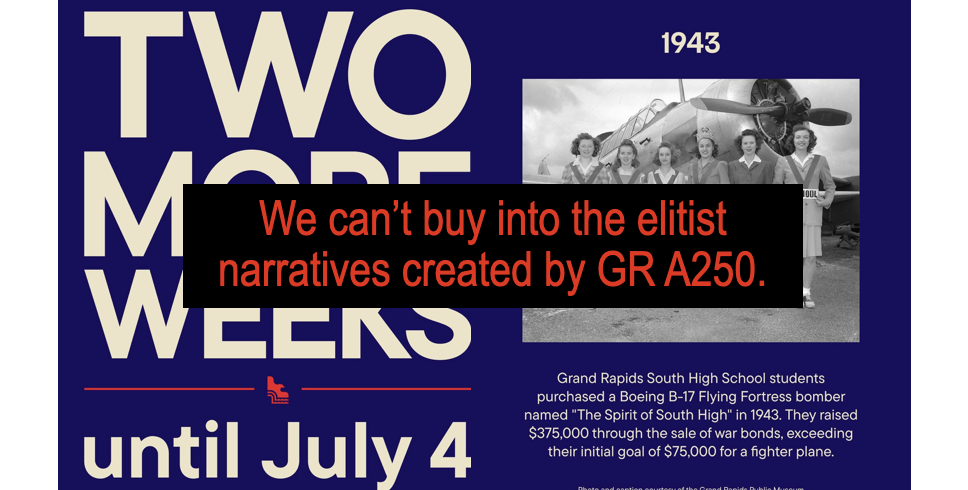
#9 – 1943, with a caption that reads: Grand Rapids South High School Students purchased a Boeing 17 Flying Fortress bomber named “The Spirit of South High” in 1943. They raised $375,000 through the sale of war bonds, exceeding their original goal of $75,000 for a fighter plane. Once again a picture of white people. For 1940s, the GR A250 committee could have talked about the realities that Black people in Grand Rapids were facing, like the red lining policies of housing discrimination, employment rates for Black people or the cost of rent.
#10 – 1958, with a caption that reads: The US-131 S-Curve was announced in 1958. While it is true that the S-Curve construction was announced in 1958, this image and narrative completely omits the roughly 4,000 people that were displaced from their homes to make way for the highway.
#11 – 1969, with a caption that reads: Alexander Calder’s La Grand Vitesse sculpture was dedicated in 1969. While it is true that the Calder sculpture is often the symbol of grand Rapids, the only image from the GR A250 committee for the 1960s is of this sculpture. Why is the Black Freedom Struggle omitted, especially since there was significant Black participation in the 1963 March on Washington, or Black youth organizing at South High, the reason for the 1967 riot or the fact that the Mayor of Grand Rapids would not allow Black people to march after Dr. King was assassinated?
#12 – 1976, with a caption that reads: Yesterdog was founded in 1976 by Bill Lewis. The restaurant gain recognition for its role in the 1999 film American Pie and continues to be a popular Grand Rapids hot dog spot. Really, this is the only thing they could focus on from the 1970s? As a counter-narrative I want to direct you to this interview I did with Delia Fernandez-Jones, Professor of history at MSU and author of the book, Making the MexiRican City: Migration, Placemaking, and Activism in Grand Rapids, Michigan. The Latino/Latinx population was engaged in important organizing work, especially around civil rights and education in the 1970s.
#13 – 1981, with a caption that reads: This photo depicts that 1981 the Gerald R. Ford Museum dedication taken by White House photographer Karl Schumaker. This is the only image from the 1980s, despite the fact that there were incredible things that were happening in the 1980s that impacted a lot more people. The anti-Apartheid movement got the City of Grand Rapids, the Grand Rapids Public Schools and Calvin College to divest from South African in the 1980s. Grand Rapids was home to one of three sanctuaries for Central American political refugees in the 1980s. The first Pride Celebration was held in 1988 in Grand Rapids, just to name a few of the important moments in Grand Rapids history in the 1980s.
#14 – 1994, with a caption that reads: West Michigan Whitecaps players tip their hats to the cheering crowd as they leave the field victorious following their first game in 1994. Again, the image is focus on entertainment and not civic engagement of history from the perspective of those who were part of social movements. The 1990s saw the passing of NAFTA, which were devastating for workers in the manufacturing sector in the 1990s. In the early 1990s there was a campaign an LGBT-inclusive ordinance passed in Grand Rapids. It eventually passed in 1994, after lots of grassroots organizing the the LGBTQ community. See the section on the ordinance (at 16:10 into the video) of the film, A People’s History of the LGBTQ Community in Grand Rapids.
#15 – 2009, with a caption that reads: ArtPrise, the world’s largest art competition, opened to huge crowds in 2009. Artists from all over the world came to Grand Rapids to exhibit their art and the public voted for their favorites. This narrative completely omits that ArtPrize was started by a member of the DeVos family, with tons of funding from the DeVos family, with devastating affects on local artists and art associations. Check out these links:
https://griid.org/2021/09/15/artprize-is-back-and-i-still-hate-it/
#16 – 2018, with a caption that reads: The Love sculpture by Robert Indiana was installed in downtown Grand Rapids 2018. As a counter narrative I would say that an important event in Grand Rapids was the creation of a campaign to get Kent County to end it’s contract with ICE, a campaign that was successful 14 months later.
#17 – 2024, with a caption that reads: The Rise are a professional women’s vollyball team in the Pro Volleyball Federation. The team played their inaugural match at a sold-out Van Andel Arena in 2024. How convenient for the GR A250 committee to omit the fact that the DeVos family owns The Rise, the Grand Rapids Griffins hockey team and the yet to be created soccer team. This narrative is a fitting conclusion in their narrative timeline, since Doug DeVos is the most visible member of the GR A250 committee and the DeVos family is the most powerful in Grand Rapids, politically, economically and socially. See my DeVos Family Reader.
This is why it is so vitally important to create counter-narratives, especially when the narratives of those in power center people in power, entertainment and frivolous dates in history that perpetuate a Bread & Circuses environment in Grand Rapids.


Trackbacks
Comments are closed.