Media Bites – Exxon/Mobil
In this week’s Media Bites we look at a recent Exxon/Mobil commercial, where the oil giant tries to present itself as an environmentally responsible company. After deconstructing the ad we address issues like Exxon/Mobil’s funding of junk science, the human and environmental costs of oil production and the political influence the company has in Washington.
The GR Press and End of the Year Journalism
Yesterday’s Grand Rapids Press even outdid its usual weak journalism by filling its pages with end of the year and the decade in review articles.
The Press has downsized its Sunday edition over the past year due in part to the decline in ad revenues, according to comments given by the new Press editor at a public forum several weeks ago. However, economics cannot be the only factor that determines content. Here is a breakdown of Section A of Sunday’s edition of the Grand Rapids Press.

Section A had a total of 16 pages. Three of those pages were made up of editorials and public comment. Another seven and one half pages were taken up by advertisements, leaving five and one half pages of articles.
Three pages of the news content that was taken up by wire stories. On page 3 there was a near full page devoted to what was headlined as Disaster and Triumph. This wasn’t really a story but a series of pictures with captions looking at everything from 9/11 to Katrina, the economic meltdown and the election of Barack Obama.
Then there were the standard World/Nation in Brief snippets, where we get a print version of what CNN popularized as your world in 30 seconds. The Press has also begun adding its own version of snap shot stories that look at what is happening in Michigan. These “briefs” took up another page of content.
There were four other wire stories throughout Section A. On page six there was an AP story on the top 10 stories of 2009. On page 8 there was an AP story about a two-legged dog working with someone with disabilities. Page 9 brought more in depth journalism with a story about the Top 10 video games of 2009, just in case you wanted to add to your gaming collection.
Then on page 11 there was another Decade in Review piece from the Washington Post entitled, “Bad ideas couldn’t have come at a worse time.” Here the story identifies five bad ideas of the decade; Giving up on bin Laden, Compassionate Conservatism, The Sarbanes-Oxley Act, The Blackberry and Housing prices. Each bad idea is given less little space for explanation, but they layout breaks up the page well.
As for local stories in Section A, there were a total of four. One story was about reactions from Congressmen Ehlers and Hoekstra on the “failed” Detroit airport terrorist attack. Another story focused on what “local leaders” (meaning CEOs, politicians and University Presidents) think about the future economic outlook for West Michigan.
The rest of the local stories were part of what the Press called part of a series where they will explore recent immigrants who have started their own businesses. Interesting, but why not write a series on other achievements of recent immigrants or ways they contribute to the West Michigan community? This series could be followed by the difficulties that recent immigrants face, particularly cultural, social and institutional discrimination? However, it wouldn’t be wise to hold your breath waiting for these kinds of stories.
Movie Review: Avatar and Real World Struggles
Sometimes popular culture can provide us with a critique of the way the world really is. That’s not to say that it is perfect or even a great critique, but it can provide a forum to engage people in how to learn of the world.

I just saw the holiday-hyped movie Avatar and despite all of the flaws of Hollywood, this film does provide an interesting and timely critique of what I would identify as ecological and cultural Imperialism.
Once we can get past the fact that this film has come with lots of product tie-ins, that it will make tons of money for News Corp (which owns 20th Century Fox), and McDonalds is using it as a major marketing tool, we might be able to discuss how Avatar is a useful critique of contemporary forms of imperialism.
The film in many ways is retelling an old story – a genocidal policy based on the desire to dominate another culture for the basic purpose of stealing the natural resources from that cultures land base. To do this the predatory culture uses a variety of means to achieve it’s end.
First, the dominant culture tries to win over the “natives” by using a cross between anthropologists and missionaries. The do-gooders provide a school for the children and even learn their language. However, like all anthropological endeavors, the intent is to study their subjects for the benefit of the dominant culture.

Another tactic that is employed in the story-line is to create avatars as a way to infiltrate the native population. Members of the dominant culture try to become natives by creating avatars that are nearly identical to the genetic make up of the Native population. The intent here is to convince the Natives to flee their lands so that the dominant culture can extract the mineral resources.
However, it becomes clear early on in the film that the primary method that the dominant culture uses is military force. It is particularly interesting that in this movie the military personnel that are used are a privatized military, much like Blackwater and Dyn-Corp.
The problem is that one of the private soldiers decides to “turn native,” much like Kevin Kostners character in Dances With Wolves. The marine/avatar is converted by the Native culture, which is rooted in the idea that all creation is sacred. I thought the most profound comment made in the film was when one of the Native females said “we all are just borrowing energy, which eventually we must give back.”
Unfortunately, I fear that audiences in this culture, the current dominant culture, will be too distracted by the special effects, other world creatures and battle scenes that they will not see the larger picture.
Any good historian could say that the human-like species in this film are fantasy representations of Native Americans, cultures that suffered the genocidal policies of Euro-Americans. However, anyone familiar with global politics could easy use the film to make comparisons to current US foreign policy.

The mineral extraction that justifies genocide in the film could easily be compared to what US backed corporations are doing all over the world. The film is a depiction of what is happening in places like Guatemala, where serious human rights abuses are happening because of resistance to gold mining. You could also look at the case of what Shell Oil has been doing in Nigeria for decades, polluting the native lands and killing those who resist the company’s plans.
Another good example is what Chevron is doing in the Amazonian part of Ecuador. Here the petroleum company is killing indigenous communities through contamination and brute force. Joe Berlinger’s, Crude: The Real Price of Oil, captures this reality in a powerful new documentary, which will unfortunately not be seen by a majority of Avatar’s target audience.
In fact, one could go to a website like Mining Watch or read books like Al Gedick’s The New Resource Wars: Native and Environmental Struggles Against Multinational Corporations to see that the plot of Avatar is being played out all across the globe.
For anyone who was moved by the plight of the Na’vi in Avatar, we would encourage you to become familiar with the struggles against imperialism and genocide happening in the world today and take action to affect change.
Gaza: One Year Later
It was one year ago when the Israeli military began a 22-day assault on the people of Gaza, killing 1,400 Palestinians, injuring thousands more, and causing billions of dollars in damage to Palestinian civilian infrastructure.
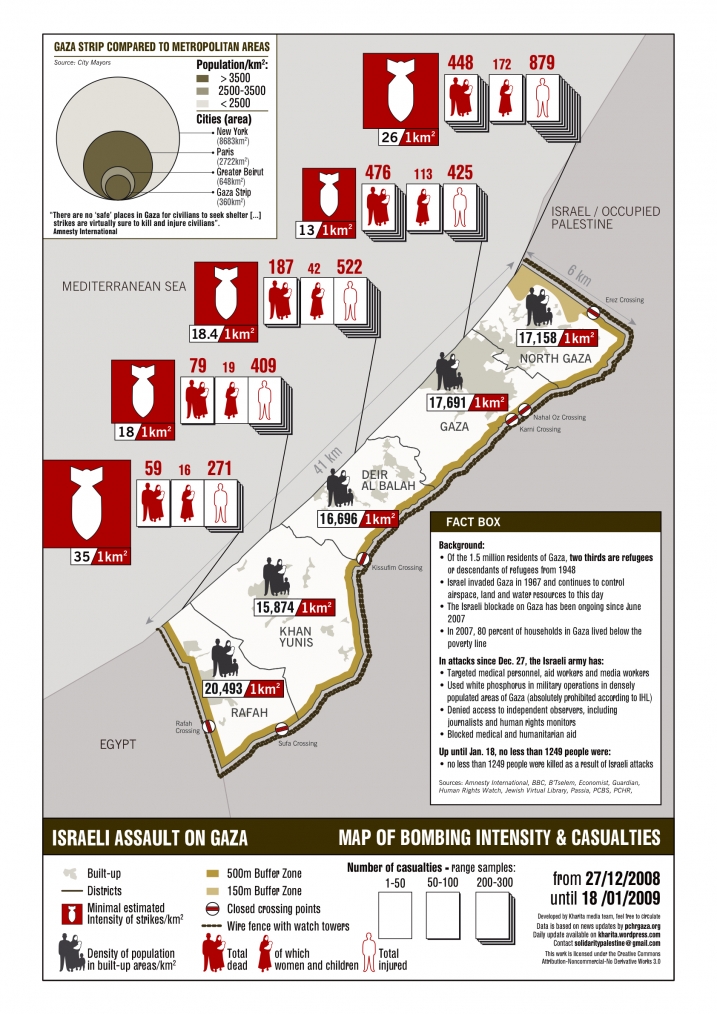
The situation today remains dire as Israel’s blockade of the Gaza Strip remains in place–a recent report from Gisha, the Israeli Legal Center for Freedom of Movement, shows the drastic contrast between the amount of aid that is allowed in monthly versus the amount that is needed. In addition, Agence France Presse reported today that a new Israeli assault has resulted in the deaths of six more Palestinians.
One important question to ask through all of this is what has been the response of the Obama administration? The new administration has responded much like previous ones……it maintains full support of Israel.
The Obama administration has rhetorically challenged the Israeli government to stop building new settlements on Palestinian land. Israel has ignored the US and continued since the Obama administration has done nothing concretely to pressure Israel into changing its position.
The US continues to provide billions of dollars in military equipment and aid, maintained all diplomatic support for Israel’s illegal occupation and ignored the Goldstone Report, which roundly condemned the Israeli military actions in Gaza. In fact, the US not only ignored the Goldstone Report, Congress voted overwhelmingly in November to condemn the report.

However, not everyone is responding to the Israeli brutality against Gaza with silence or complicity. People from around the world are participating in a march with Palestinians to commemorate the 1 Year Anniversary of the Israeli attacks and demand an end to the occupation.
The Gaza Freedom March will have an estimated 1,400 participants from 43 different countries and will march from Gaza to the Israeli border. Israeli activists will march from Israel and meet the other marchers at the border in this historic action.
In response to this courageous action there are several other marches taking place around the world in solidarity with those marching in Gaza to end the occupation. In addition, the US-based End the Occupation Campaign has a list of other actions people can take to be in solidarity with the people of Gaza.
Beer Lobbyists in Michigan
According to a new report from the Michigan Campaign Finance Network (CCFN), Michigan legislators have decided to not increase the state’s sales tax on beer. In a media release from last week, MCFN director Rich Robinson writes, “The (MI) beer tax, which was last increased in 1962 to 46 cents per case, is wholly inadequate for the purpose it should serve.”

The media release goes on to say:
The National Center for Addiction and Substance Abuse reported earlier this year that the states generally spend nine dollars for every dollar they collect in alcohol taxes: For everything from health care costs related to obesity, diabetes, STDs, addiction and car crashes; to social service costs for domestic violence, failure in education and child protective services; to criminal justice costs for police, courts and incarceration. There is a world of social wreckage in the wake of alcohol abuse.
Michigan’s beer tax hasn’t kept pace with the escalating costs of the clean-up. When my dad bought a six-pack of Bosch in 1962, the beer tax amounted to 12 percent. Today when I buy a six-pack of my favorite craft brew, the beer tax is barely one percent. Fellow beer drinkers, we’re just not pulling our fair share of the load.
The conclusion that Robinson comes to for this disparity in how Michigan taxes beer is the influence of the lobbyists. MCFN has documented that the Michigan Beer and Wine Wholesalers political action committee has provided $1.5 million in recent years to the members of the 95th Legislature and the various PACs that they control.
West Michigan legislators have been recipients of this PAC money – Dave Agema $10,128, Robert Dean $2,830, Dave Hildenbrand $31,289, and Roy Schmidt $5,850 in the State House; Bill Hardiman $3,000 in the State Senate. You can search information on your State Senators and State Representatives in terms of how much money they have received from beer lobbyists.
The 2009 P.U.-Litzer Awards
This posting is taken from the national media watchdog group Fairness & Accuracy in Reporting (FAIR)
For 17 years our colleagues Jeff Cohen and Norman Solomon have worked with FAIR to present the P.U.-Litzers, a year-end review of some of the stinkiest examples of corporate media malfeasance, spin and just plain outrageousness.

Starting this year, FAIR has the somewhat dubious honor of reviewing the nominees and selecting the winners. It’s a dirty job, but someone has to do it. So, without further ado, we present the 2009 P.U.-Litzers.
–The Remembering Reagan Award WINNER: Joe Klein, Time
Time columnist Joe Klein (12/3/09), not altogether impressed by Obama’s announcement of a troop escalation in Afghanistan, wrote that a president “must lead the charge–passionately and, yes, with a touch of anger.”
He described the better way to do this:
Ronald Reagan would have done it differently. He would have told a story. It might not have been a true story, but it would have had resonance. He might have found, or created, a grieving spouse–a young investment banker whose wife had died in the World Trade Center–who enlisted immediately after the attacks…and then gave his life, heroically, defending a school for girls in Kandahar. Reagan would have inspired tears, outrage, passion, a rush to recruiting centers across the nation.
Ah, Reagan–now there was a president who could inspire people to fight and die based on lies.
–The Cheney 2012 Award WINNER: Jon Meacham, Newsweek
Newsweek editor Jon Meacham declared (12/7/09) that Dick Cheney running for president in 2012 would be “good for the Republicans and good for the country.” He explained that “Cheney is a man of conviction, has a record on which he can be judged, and whatever the result, there could be no ambiguity about the will of the people…. A campaign would also give us an occasion that history denied us in 2008: an opportunity to adjudicate the George W. Bush years in a direct way.”
While the 2008 election might have seemed a sufficient judgment of the Bush years, it’s worth pointing out that at beginning of the year (1/19/09), Meacham was adamantly opposed to re-hashing Cheney’s record, calling it “the rough equivalent of pornography–briefly engaging, perhaps, but utterly predictable and finally repetitive.” The difference? That was in response to the idea that Cheney should be held accountable for lawbreaking. Apparently a few months later, the same record is grounds for a White House run.
–The Them Not Us Award WINNER: Martin Fackler, New York Times
The New York Times (11/21/09) describes the severe problems with Japan’s elite media–a horror show where “reporters from major news media outlets are stationed inside government offices and enjoy close, constant access to officials. The system has long been criticized as antidemocratic by both foreign and Japanese analysts, who charge that it has produced a relatively spineless press that feels more accountable to its official sources than to the public. In their apparent reluctance to criticize the government, the critics say, the news media fail to serve as an effective check on authority.”
The mind reels.
–Thin-Skinned Pundits Award WINNER: Dana Milbank, Washington Post
Washington Post reporters Dana Milbank and Chris Cilizza got into trouble when, in an episode of their “Mouthpiece Theater” web video series, they suggested brands of beer that would be appropriate for various politicians. What would Hillary Clinton drink? Apparently something called “Mad Bitch.” The video, unsurprisingly, was roundly criticized, and was pulled from the Post site. So what lesson was learned? Milbank complained (8/6/09) that “it’s a brutal world out there in the blogosphere…. I’m often surprised by the ferocity out there, but I probably shouldn’t be.”
Yes, the problem with calling someone a “bitch” is the “ferocity” of your critics.
–The Sheer O’Reillyness Award WINNER: Bill O’Reilly, Fox News Channel–TWICE!
1) Asked by a Canadian viewer, “Has anyone noticed that life expectancy in Canada under our health system is higher than the USA?,” Fox‘s O’Reilly (7/27/09) responded: “Well, that’s to be expected, Peter, because we have 10 times as many people as you do. That translates to 10 times as many accidents, crimes, down the line.”
2) Drumming up fear of Democrats’ tax plans: “Nancy Pelosi and her far-left crew want to raise the top federal tax rate to 45 percent. That’s not capitalism. That’s Fidel Castro stuff, confiscating wages that people honestly earn.”
Perhaps Castro was president of the United States in 1982-86, when the top rate was 50 percent. Or maybe all of the 1970s, when it was 70 percent. Or from 1950-63, when it was 91 percent.
–The Less Talk, More Bombs Award WINNER: David Broder, Washington Post
Post columnist Broder expressed the conventional wisdom on Barack Obama’s deliberations on the Afghanistan War, writing under the headline “Enough Afghan Debate” (11/15/09):
It is evident from the length of this deliberative process and from the flood of leaks that have emerged from Kabul and Washington that the perfect course of action does not exist. Given that reality, the urgent necessity is to make a decision–whether or not it is right.
–The Racism Is Dead Award WINNER: Richard Cohen, Washington Post
Post columnist Richard Cohen wrote (5/5/09): “The justification for affirmative action gets weaker and weaker. Maybe once it was possible to argue that some innocent people had to suffer in the name of progress, but a glance at the White House strongly suggests that things have changed. For most Americans, race has become supremely irrelevant. Everyone knows this. Every poll shows this.”
For the record, “every poll” does not actually show this; the vast majority of Americans continues to recognize that racism is still a problem. Cohen went on to write months later–still presumably living in his racism-free world–that he did not believe Iran’s claims about its nuclear program, because “these Persians lie like a rug.”
–The When in Doubt, Talk to the Boss Award WINNER: Matt Lauer, NBC News
Today show host Lauer announced a special guest on April 15: “If you really want to know how the economy is affecting the average American, he’s the guy to talk to.” Who was Lauer talking about? Wal-Mart CEO Mike Duke. The ensuing interview touched on the Employee Free Choice Act, which Lauer noted was supported by many unions but opposed by some large corporations–leading him to ask Duke, “What’s the truth?” Yes, look for “the truth” about a proposed pro-labor bill from the new CEO of an adamantly anti-labor corporation.
–The Socialist Menace Award WINNER: Michael Freedman, Newsweek
Newsweek‘s “We Are All Socialists Now” cover (2/16/09) certainly turned heads, but one of the stories inside explained in more detail the real threat. As senior editor Michael Freedman asked: “Have you noticed that Barack Obama sounds more like the president of France every day?”
The real problem, though, is what that’s going to do to us Americans, says Freedman: “If job numbers continue to look dismal, or get even worse, an ever-greater number of people will start looking to the government for support…. It’s very easy to imagine a chorus of former American individualists demanding cushy French-style pensions and free British-style healthcare if their private stock funds fail to recover and unemployment inches upward toward 10 percent and remains there.”
Pensions and healthcare for all–this is worse than we thought!
–The Iraq All Over Again Award WINNER: Too Many to Name
After the invasion of Iraq, countless journalists who had treated allegations about Iraq’s weapons of mass destruction as facts were embarrassed when there were no such weapons to be found. So you’d think they’d be more careful about thinly sourced claims that Iran is seeking nuclear weapons. But in 2009, many journalists are still willing to treat such allegations as facts. –NBC‘s Chris Matthews (10/4/09): “As if Afghanistan were not enough, now there’s Iran’s move to get nuclear weapons.” –NBC‘s David Gregory (10/4/09). “Iran–will talks push that country to give up its nuclear weapons program?”
–Fox News Channel‘s Bill O’Reilly (9/25/09): “All hell breaking loose as a new nuclear weapons facility is discovered in Iran, proving the mullahs have been lying for years…. Iran’s nuclear weapons program has now reached critical mass. And worldwide conflict is very possible. Friday, President Obama, British Prime Minister Brown and French President Sarkozy revealed a secret nuclear weapons facility located inside Iran.”
Some even went further, turning allegations of a nuclear weapons program into the discovery of actual nuclear weapons:
–ABC‘s Good Morning America host Bill Weir (9/26/09): “President Obama and a united front of world leaders charge Iran with secretly building nuclear weapons.”
–The Talking Like a Terrorist Award WINNER: Thomas Friedman, New York Times
In a January 14 column, New York Times superstar pundit Tom Friedman explained Israel’s war on Lebanon as an attempt to “educate” the enemy by killing civilians: The Israeli strategy was to “inflict substantial property damage and collateral casualties on Lebanon at large. It was not pretty, but it was logical.” Friedman added, “The only long-term source of deterrence was to exact enough pain on the civilians–the families and employers of the militants–to restrain Hezbollah in the future.” That strategy of targeting civilians to advance a political agenda is usually known as terrorism; Osama bin Laden couldn’t have explained it much better.
–The It Only Bothers Us Now Award WINNER: Wall Street Journal editorial page
When Barack Obama only called on journalists from a list during a press conference, the Wall Street Journal did not like the new protocol (2/12/09):”We doubt that President Bush, who was notorious for being parsimonious with follow-ups, would have gotten away with prescreening his interlocutors.”
Actually, Bush was famous for calling only on reporters on an approved list; as he joked at a press conference on the eve of the Iraq War (3/6/03), “This is scripted.”
–The No Comment Award WINNERS: MSNBC’s Mika Brzezinski and Rush Limbaugh
When asked by Politico (10/16/09) to name her favorite guest, MSNBC host Mika Brzezinski named arch-conservative Pat Buchanan “because he says what we are all thinking.”
Rush Limbaugh on Obama (Fox News Channel, 1/21/09): “We are being told that we have to hope he succeeds, that we have to bend over, grab the ankles…because his father was black.”
Media Bites: The Gap “Cheer Factory”
This week’s Media Bites takes a look at a series of holiday commercials from The Gap. Set in The Gap’s “Cheer Factory,” each commercial features a trendy cheer team that encourages viewers to celebrate their diversity and rebel spirit by wearing practically identical outfits from this one retail giant. A second look at the messages of the ads and the business practices of the Gap is actually quite disturbing.
To access the resources mentioned, visit TRUCE for the toy guide or the Coalition for a Commercial Free Childhood for the Guide to a Commercial Free Holiday.
Fundraiser for workers a success
(Stelle Slootmaker contributed to this story.)
A year ago this December, workers at the Republic Windows and Doors Factory in Chicago, Illinois were informed by management that the factory would be closing in three days and they would receive no severance or vacation pay. Rather than just accept this illegal action, the workers with the help of their union, the United Electrical Radio and Machine Workers, decided to occupy the factory. After six days of negotiations with the company’s creditors, the workers won their pay.
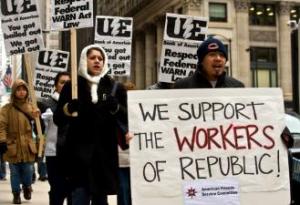
On Saturday night here in Grand Rapids, The Bloom Collective and the Grand Rapids chapter of the Industrial Workers of the World sponsored a benefit at the Kent Ionia Labor Hall to raise money for the workers and the UE union who are currently engaged in organizing similar actions.
A documentary on the factory occupation was shown and UE organizer Abe Mwaura held a question and answer session from Chicago via Skype.
Event and local IWW organizer Cole Dorsey was also on hand. Dorsey said this is an important issue because “Workers can take an example from the sit-downers because workers hands are tied when they rely solely on legal means.”
Following the question and answer session, local band Chance Jones performed for close to an hour. Lead singer Josh Burge said, “We [Chance Jones] support working people. That’s who we are.”
According to the IWW Facebook page, the event raised over $440 for the workers.
Dorsey and various audience members put the following questions to Abe Mwaura.
Q. Prior to getting national publicity, did Republic Window and Doors or local police use any scare tactics to dissuade workers from taking action?
A. Mwaura explained that because the workers had already communicated to their local Chicago alderman that the action would be nonviolent, the police knew what was going on and did not respond on behalf of management. “Management was scared by what we did. We took power away from them. It was our factory for six days. It was clear that we controlled the place.”
Q. Republic Windows and Doors claimed that the reason they were closing was because Bank of America would not extend them a line of credit. Was this the truth?
A. Mwaura explained that this was a lie. The company owner had actually bought a shadow company in Iowa, a Right to Work state where the UE would have less power to organize workers. Having noticed equipment being taken out of their plant, the local in Chicago set up surveillance that confirmed suspicions of an imminent plant closing. Management also stole money to set up the new plant. “Bank of America had been calling these shots since August. They were actually moving the factory. We knew we had to do some fairly radical action to win justice.”
Q. Did you have any other actions planned?
A. “There was no plan B,” Mwaura said. “The national union suggested it (the occupation). Armando, brought the idea back. The executive comittee asked for volunteers. The first workers to volunteer to occupy the plant were women. Nine or ten women offered first. Eventually 30 folks volunteered. When it came down to it. It was unanimous. All 260 folks were going to stay in the factory. They knew they were going to be part of something big.”
Q. What did you do for six days?
A. The six-day occupation was not six days of passing time. Committees worked hard carrying out the extensive tasks of negotiations, security, clean-up, and media relations, to name a few. “There was a real sense of what our leverage was—those windows, doors and machines were our leverage and the bank knew it.” On the weekends, the workers did play a little cards; many of the workers’ children came during evenings and on the weekend. “The probably got a better education that they ever got in school,” Mwaura said.
Q. What was the biggest lesson that the Republic workers taught the labor movement?
A. “It’s possible to take radical steps and win.”
Q. Republic workers had good publicity and political support. How possible would their success have been without that support?
A. “It would have been hard, but we weren’t relying on that support. Our leverage was the stuff in the factory. When you’re out of a job, you don’t have your leverage. Our labor was they millions of windows and doors in that factory,” Mwaura said. “If the tactic is to be used, you have to build alliances before you can do that type of action.”
Q. What are you working on now?
A. UE is mounting a movement to organize warehouse workers in the Chicago area. Armando is now president of the new local, “Warehouse Workers for Justice.” “This is a sector of the economy where we could build power,” Mwaura said.
Many warehouse workers in the Chicago are, which is the third largest container port in the world, work in dangerous sweatshop conditions for as little as $2 an hour. Others are not paid for hours worked or are paid in split paychecks that avoid payment of overtime rates. Racial and gender discrimination runs rampant, especially against pregnant workers.
Mwaura used an analogy of a huge elephant obediently tethered by a weak chain. The chain has been there so long that the elephant does not realize it can break it and run free. “We need to take that psychological chain off from our minds and see the power that we really have. UE believes in leadership development through struggle. A year after the occupation, that’s the piece that’ s missing—organizing that helps workers break that chain.”
Levin Speaks to Think Tank on Afghanistan
A few weeks after President Barack Obama announced his intent to send an additional 30,000 US combat troops to Afghanistan, Michigan Senator Carl Levin spoke to the right-wing think tank, the Brookings Institute.

In his talk to the Brookings Institute, Levin reiterated many of the same points made by President Obama in his December 1st address to the nation. The main points that Levin addressed were the need to deny Al Qaeda a “sanctuary” to commit more acts of terror and to prevent the Taliban from “destabilizing” Afghanistan.
However, Levin does say he has some concerns about the additional US troops being deployed to Afghanistan. “I am concerned that the large new commitment of U.S. combat forces included in the plan may undermine the over-arching goal of preparing the Afghans to secure their own success.” This concern seems to be quite reasonable, but it raises questions about how the Afghans will secure their own future and with what kind of government.
In terms of how to make sure that turning Afghanistan over to Afghanis the only enforcement mechanism that Senator Levin provides is that he “will continue to urge the administration to focus intently on the training aspect of our mission.” A question for all of us at this point might be how relevant is it to “urge” the President to do something when Senator Levin votes to fund the war in Afghanistan?
Later in his talk Levin admits that there are reports that the Afghan military is unwilling to fight when called upon by the US. He also said that while meeting with a village council in Afghanistan he asked how long the US should have their troops in their country. One man answered and said, “Until the moment we make Afghanistan’s security forces self-sufficient. Then, he said, we should go.”
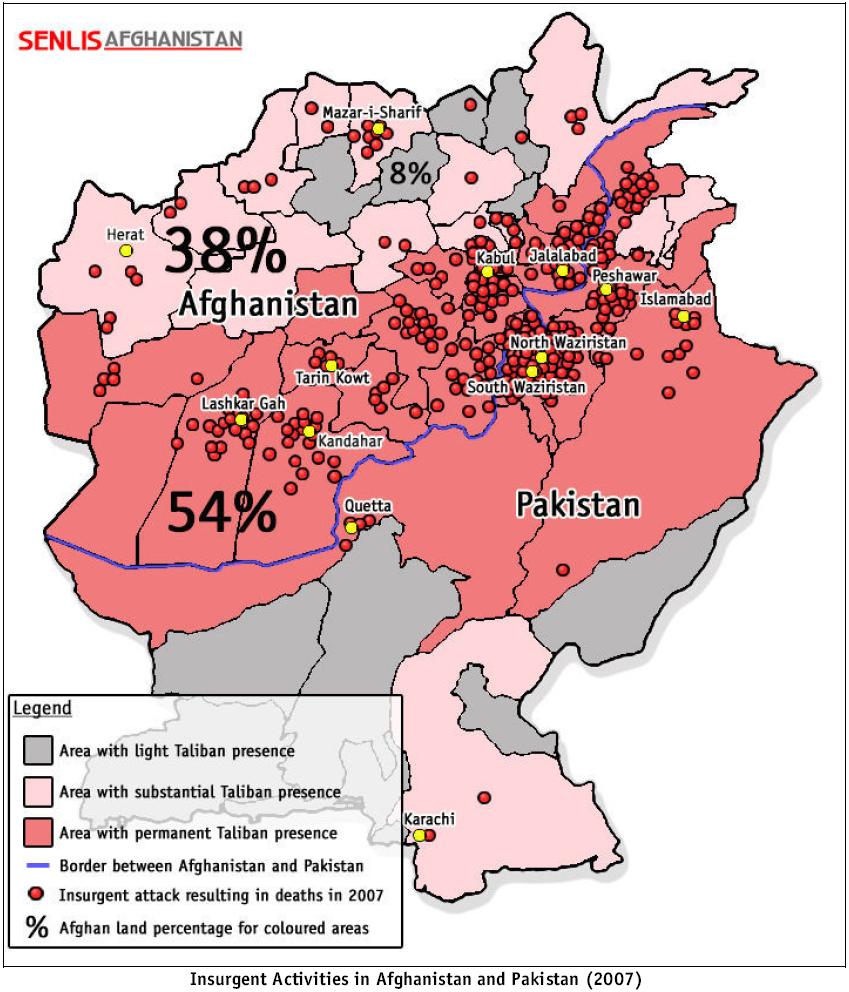
Levin then says something quite interesting in his presentation to the Brookings Institute. “Our commanders should wake up every morning thinking, what can I do today to prepare the Afghans to secure their own nation? That should be our principal mission. Yet General McChrystal acknowledged yesterday that the additional troops we will send to Afghanistan will not speed up an increase in the size of the Afghan security forces.”
Again, the question should be asked, if it is clear that the increase in US troops will not lead to Afghanis being responsible to their own nation’s security, why does Senator Levin vote to fund this war and support the President’s decision?
The only other point that Levin raises in his talk worth discussing is his claim that the Taliban are engaged in a propaganda campaign calling the US presence in Afghanistan as an occupation. What Levin fails to acknowledge is that the Taliban are not the only ones who believe that the US presence in Afghanistan is an occupation. Groups like RAWA and the Afghan Women’s Mission both call the US military presence in their country as an occupation and over the past few months Malalai Joya, a member of the Afghan Parliament who has been touring the US for the past 3 months, has repeatedly referred to the US presence as an occupation.
Levin & Stabenow Vote for more War Funding
Today, the US Senate voted to pass a defense appropriations bill in the amount of $636 Billion. Michigan Senators Carl Levin and Debbie Stabenow voted for the additional military spending, with Wisconsin Senator Russ Feingold as the only Democrat voting against the measure.

After voting for more military spending Senator Levin and Stabenow released a joint statement providing some reasons for supporting the bill. Levin said, “During this time of two wars, supporting the military’s ongoing operations is among our highest duties as legislators. I will do all I can to support our troops by making sure they are properly equipped and have the equipment they need in the field. This bill ensures that Michigan’s factories and research centers will continue their cutting-edge work that has helped make our military the strongest the world has ever seen.”
Senator Stabenow also chimed in on why she voted for the $636 Billion for war. “I am very pleased that this legislation not only provides critical funding to support our troops, including a 3.4% increase in military pay, but also invests in my priorities for alternative energy research and more energy-efficient combat vehicle technology. These investments will create jobs in Michigan and further advance our state’s leadership in clean energy. This bill also includes another high priority of mine by addressing the unique health care needs of our men and women in uniform.”
So it seems that funding US military occupations abroad, occupations that result in the deaths of Iraq & Afghan civilians, plus US soldiers is ok as long as it creates jobs in Michigan. Economically this doesn’t make sense, since as the National Priorities Project has documented, the Iraq and Afghan wars have cost the state of Michigan over $25 Billion in tax dollars since 2001.

