Local Media Fails in Climate Summit Coverage
Right now 192 global delegates at the Climate Summit in Copenhagen are deciding the future of our world. But what is West Michigan saying about this? Not much.

As previously reported the local coverage of the massive Summit is paltry at best and leaves much unreported.
Only one article about the Climate Summit was written by a local journalist, while the rest of the coverage in the Grand Rapids Press, on WOOD-TV, and FOX-17 was from the Associated Press. On WZZM-13 only one short AP article was found, and over on WMMT-CBS there was nothing about the Climate Summit.
The AP articles used present the basic framework of the situation happening now in Denmark:
Any major environmental commitment hinges on the determination of developed nations, in particular the United States. A draft of a global climate treaty is being debated endlessly, as developing nations say they will be the ones hit hardest by the damage caused by global warming. Developing nations are demanding the major developed nations help pay for the climate damage caused mainly by their greenhouse gas emissions.
Out of the vast array of articles, local media chose only AP articles that convey part of what is going on in Copenhagen right now, leaving the rest of the debate unreported for West Michigan citizens.
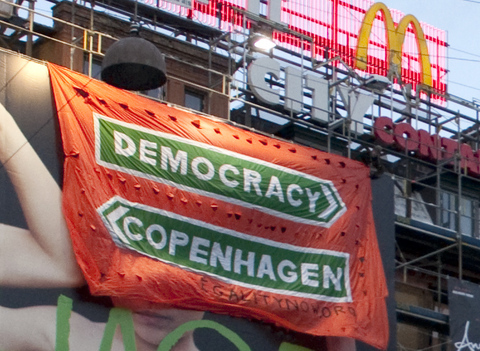
No articles speak of the massive demonstrations that have been taking place since the Summit began, including the demonstrations on the weekend of December 12th & 13th that saw 100,000 people take to the streets demanding action.
No articles speak of how many environmental organizations have now been banned from entering the Bella Conference Center where delegates and world leaders are meeting.
No articles speak of the mass arrests of protesters, often for less than credible reasons.
No articles speak of the debates surrounding cap and trade carbon agreements.
Even if local media did not want to post stories from alternative media such as Democracy Now! or IndyMedia Denmark, there were plenty of AP articles for West Michigan media to choose from, including this one about the protests and arrests, about environmental groups being banned, or even the plight of island nations in the face of global warming.
Why is West Michigan’s media failing to pick up on these stories? Why do they deem them un-newsworthy? Whose interests are served by ignoring the real debate raging on the streets in Copenhagen?
More Drones, Less Diplomacy
According to a recent news story, the Obama administration has decided to increase its use of military drones and video surveillance in Afghanistan/Pakistan.

“According to US Air Force General David Deptula, the drones will meet the needs of 30,000 more troops set to be sent to the country next year.”
The Obama administration continues to claim that the drones are being used to attack both Taliban and Al Qaeda insurgents. However, some news reports have said that as many as 600 civilians in Pakistan alone have been killed in the past year in some 70 drone bombings. In addition, a United Nations official who deals with Extrajudicial Executions is also questioning whether or not the use of drones by the US is in violation of International Law.
At the same time most major news agencies have ignored recent reports that the Taliban made an offer to the Obama administration that it will not meddle “in the internal affairs of other countries and is ready to give legal guarantees if foreign forces withdraw from Afghanistan.”
Independent journalist Gareth Porter says that it is not sure whether or not this will mean that the Taliban has renounced any and all ties with the Al Qaeda, but it is clear that the Taliban is responding to the Obama administration’s recent announcement to escalate the war by sending 30,000 more combat troops.
The only mainstream US news source to report on the Taliban’s willingness to negotiate was the Wall Street Journal. WSJ reporter Anand Gopal, who has been reporting from Afghanistan for years, wrote the story on December 7th.
Porter points out that those who have suggested that the Taliban are willing to negotiate are being portrayed by the Obama administration as trying to deliberately deceiving the West.
Lastly, Porter mentions in his article that Afghani President Hamid Karzai, in a recent interview with CNN, stated “there is an urgent need for negotiations with the Taliban, and made it clear that the Obama administration had opposed such talks.”
My Dance with the Economic Club of Grand Rapids
(This article was submitted by Kate Wheeler)
After having read a GRIID report of Marcus Luttrell’s speech to the Economic Club of Grand Rapids, I wanted to know who exactly had chosen him as a speaker. I also wanted to find out what connection he had to any economic concerns or interests that club members might have. This proved a more Byzantine task than I first thought.
The only members of the Program Committee listed on the club’s Web site were for 2007 and 2008. So I had to call the Economic Club for the current list. A nervous administrative person did not want to tell me. I finally convinced her that since a list of past members was already posted, it didn’t seem like confidential information. Once I had the members’ names, it was easy to find their corporate affiliations using Google.
I wrote to the members, asking about their choice of Luttrell as a speaker. My e-mail in part asked if there was some economic information to be had from the speaker: “Were you suggesting through this speaker that Grand Rapids should grab a larger share of war profits? After all, the occupation of Afghanistan is costing us $3.6 billion a month…and the addition of 30,000 troops is going to add at least another $30 billion to the overall total, according to White House Press Secretary Robert Gibbs. There’s obviously a lot of money to be made. Perhaps the members of the club were anxious to discuss this?” I also asked if the choice represented a particular political viewpoint that appealed to members.
This caused more concern than I thought it would, and a lot faster, too. Later that same day, I got an e-mail from Lorna Schultz, the executive director of the club, who said a number of committee members had forwarded my e-mail to her. She asked that I call her to discuss “the objectives of our organization and the consideration given to [Luttrell’s] invitation to speak.”
I finally connected with Ms. Schultz on December 14. I do want to say up front that I was impressed by how time she gave me. She started out by stating that the Economic Club invited a “diverse array of speakers on government, economic, and social issues.” I asked, “So which is Marcus Luttrell? Is he speaking on behalf of the government, the economy, or a particular social issue?”
Apparently, none of the above. Ms. Schultz told me that in December, the club often invited a speaker who would “inspire, offer a show of patriotism, or who was a celebrity of some kind.” She noted that Mr. Luttrell had written a best-selling book that was “a story of teamwork, camaraderie, and sacrifice.”
Ms. Schultz’s biggest concern with me seemed to be that I was a mainstream media journalist. I told her I wasn’t. But often after our opening steps in this dance, she would say something like, “Now you’re sounding like a journalist!”
So we embarked on a lengthy back-and-forth two-step, where I tried to find out if she’d actually been involved in the selection of Marcus Luttrell as a speaker and she tried to figure out why I was interested.
Finally I extracted a few shreds of information. Ms. Schultz said that she had in fact been at the meeting in which Marcus Luttrell’s speaker potential had been vetted. “Why did people think Mr. Luttrell would be a good choice?” I asked.
“He had a story of teamwork and camaraderie and sacrifice,” she said again. “It’s a commentary on the difficult time our armed forces have in Afghanistan.”
“OK,” I said. “How was his story presented at the meeting?” I was trying to find out if anyone on the committee had offered a less glowing version or opinion. After all, Luttrell had nearly violated the Uniform Code of Military Justice in his “big moment” in Afghanistan. After capturing three unarmed civilians, he and his squad had to decide if they should shoot them or release them, knowing that they would probably go to the Taliban and report having seen the squad on the ground.
Luttrell, in fact, had no real decision to make—it was his military duty to let the men go regardless of what might happen later. But instead, he and his squad voted, as if they felt they had the right to modify the Uniform Code on the spot. This, I feel, is a strong indication of how the US government’s unspeakable decisions to occupy Afghanistan and to allow torture in violation of the Geneva Convention are causing any safeguards in military behavior to completely fall apart.
And now Marcus Luttrell is making a lot of money touting this event as a spiritually powerful, inspiring act of heroism.
Ms. Schultz said that some committee members had read Luttrell’s book and “everyone had information about the book.” It emerged that the information that they had was PR copy taken directly off Luttrell’s Web site. I asked if anyone was concerned that Luttrell might be a controversial choice. She said, “Oh, no. We invite controversy.”
Ms. Schultz then explained that after names were approved by the committee, invitations were sent out. Any speakers who agreed to come were reviewed and final choices were made. She absolutely refused to tell me who made that final decision. When I asked her point-blank for the name of the person, she employed the Alberto Gonzales defense and said, “I don’t recall.”
“You said that you invite controversy in your choice of speakers,” I added, looking at the list on the Economic Club speakers from past years. “I’m not sure many of your members would find these speakers controversial. Most of these names seem to me to come from the political right.”
“That’s not true,” she said. “We have a variety of members and choose a variety of speakers to address that.”
“Have you ever had a left-wing speaker at the Economic Club?” I asked.
“Oh, yes,” she answered triumphantly. “Bill Clinton.”
And so, although I didn’t wind up with answers to all of my questions, I did learn a few things:
One is that committee members at the Economic Club don’t appear to like the idea that their decisions might be dragged out into the bright light.
One was a realization of just how far to the right this group is, despite numerous claims about its “diversity.”
And one is that, although the gates to capitalism are firmly shut and carefully guarded, what’s going on in there seems to be pretty much exactly what we think is going on.
Climate Change vs. Global Warming
 Climate Change = Global Warming, right? In the world of politics and corporate media, the equation is never that simple. In reality it looks more like this: (Global Warming – Blame) x Corporate Control = Climate Change.
The phrase “climate change” is just another example of euphemistic language used to cover up the reality hidden just beneath the surface. Of course, this is nothing new. Think how often the word “abuse” was used instead of “torture” when news of Abu Ghraib broke. Or how about “collateral damage” instead of civilian deaths when the destruction from US bombs in Afghanistan is mentioned?
The mainstream press more often than not choses to use the phrase “climate change” rather than “global warming.” Just look at the news coming out of Copenhagen.
But what is the reasoning behind this?
To start out with, the mental image conjured up when thinking about “global warming” (a sweltering Earth) sounds horrifying, whereas ‘climate change’ sounds much more pleasant, like going from this frigid Michigan winter down to the tropic warmth of Key West. It almost seems like a natural occurrence when saying “climate change,” which the majority of scientists claim it is not.
While NASA scientists argue that “global warming refers to surface temperature increases, while climate change includes global warming and everything else that increasing greenhouse gas amounts will affect,” I don’t think this is the only reasoning behind the use of “climate change.”
Author and journalist Steven Poole points out in his book Unspeak: How Words Become Weapons that:
“it is clear that in the phrase ‘global warming’, after all, the word ‘warming’ implies an agent doing the warming. And once you accept that human beings might be the cause of the problem, again you will eye skeptically those with an interest in burning coal, oil, and gas. Thus the preference for the term that seems to assign no blame, ‘climate change’…”
And that hits on a key point. The assignment of blame to those in the coal, oil, and gas industries. It should come as no surprise that these big three industries have meddled with the framing of important issues like global warming, in particular oil industry giant Exxon Mobil. But these industries didn’t stop there. They went on to attack the very words themselves, as Poole says, “States with oil interests, including Saudi Arabia and the US. . .specifically lobbied for the elimination of the phrase ‘global warming’ in agreements.”
With the politically tepid “climate change” in mainstream use, the urgency of the situation is lost. And our nation’s industries that are the chief producers of greenhouse emissions are more easily let off the hook.
Perhaps this seems trivial to some, but words carry within them so much meaning. How can we understand something if we do not correctly label it? How can we get to the root of the problem if it is not known in its entirety? In order to understand this issue facing our country and our world, we need first to call this impending environmental catastrophe by its true name and come to grips with our nation’s culpability in it.
Independent Media Climate Conference Updates
Thousands of protesters continue to take to the streets of Copenhagen, demanding action be taken to halt climate change.
 From KlimaForum 09
A succesful demonstration and a promising “alterglobalist” movement!
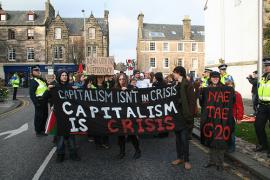
“The international demonstration of December 12 was a success. More than 100,000 people from all over the world joined this unitary mobilisation action. Altogether, 538 organisations from 67 countries answered the call. Under an enjoyable (a welcoming) sun, the colourful procession and its bicycles (as it is the custom in Denmark) went to the Bella Center, where the official negotiations are taking place. Many radical catchphrases could be read on banners and placards, around the following idea: “Climate Justice means System Change not Climate Change”.
 People not Politicians can save the Climate, says the President of the Maldives
“The President of the Maldives, Mohamed Nasheed, stressed the power of people to take action on climate change, when he spoke to a packed audience at Klimaforum09, the alternative climate summit in Copenhagen, Monday evening. ‘The social movements have the power to save the planet from the effects of climate change. My message to you is to continue the process of movement building after the conference,’ the President said.
Mohamed Nasheed used his own personal story to illustrate the point. A few years ago he was in prison because of his work as a human rights activists, but upon his release he became the first democratic elected president of the island nation acutely threatened by the rising sea levels.”
From IndyMedia Climate
On Tuesday in Copenhagen, The Resistance is Ripe Agriculture protest started at noon, with protesters marching through the center of town under a banner that read, “Food Climate Justice, not Climate Change.” Hundreds of people stopped outside the Netto supermarket for speeches about the importance of food sovereignty and the links between climate change, agriculture and exploitation of people. Naomi Klein delivered this speech.
For more breaking news on the Copenhagen Conference, check on Amy Goodman’s live broadcasts at Democracy Now!
Do you want to take action in solidarity with the protesters at Copenhagen?
Sign the petition at the Avaaz.org World in Action Website. The site states, “Copenhagen’s last-ditch summit to stop catastrophic global warming is failing; only massive public pressure can save it. Tomorrow (Dec. 16), the world’s leaders arrive for an unprecedented 60 hours of direct negotiations. Experts agree that without a tidal wave of public pressure for a deal, the summit will not stop catastrophic global warming of 2 degrees.”
 Where: Kent/Ionia Labor Hall, 918 Benjamin SE, GR
When: Saturday Dec. 19
- 7 p.m. Film & Discussion
- 9 p.m. Chance Jones
Tickets at the door: $5 or $10. All proceeds go to sit-downers.
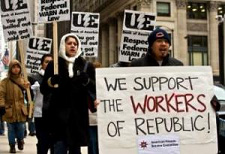
This Saturday Dec. 19, the Grand Rapids IWW and The Bloom Collective host a benefit for the former workers of Republic Windows & Doors at the Kent/Ionia Labor Hall. The evening will start off with the film Hasta La Victoria, which shares how, in December of 2008, 270 workers occupied their plant for six days and successfully negotiated their demands.
UE members and workers who participated in the Republic Windows and Doors occupation will discuss what happened during the occupation and the goals they have for organizing the 100,000+ warehouse workers toiling in sweatshop conditions in the Chicago area
 Following the discussion, guests will enjoy live music by popular Grand Rapids band, Chance Jones, and have opportunity to stand in solidarity with workers here, in Chicago and around the globe. “We decided that we wanted to do this benefit because we support the working class,” says band member, Mike Saunders. “It’s as simple as that, we all have jobs outside of playing music and we see it as effecting us when our fellow workers are being exploited.”
Media Bites – Holiday Consumption
This week’s Media Bites takes a look at several holiday commercials from Overstock.com, Target and Toyota. In each commercial viewers are lured by traditional holiday music and scenery. We are even seduced by childhood memories of what it was like to open presents on Christmas morning. Ultimately these commercials want us to believe that consumption equals happiness. A good resource that critiques this myth is the documentary, The Overspent American: Why We Want What We Don’t Need.
Art Exhibit Explores Activism Through Printmaking
On Friday, the Urban Institute for Contemporary Arts kicked off the opening of a new exhibit entitled, “(S)edition: Prints as Activism.” The show features 70 different pieces from 54 different artists. I spoke with Brett Colley, the exhibit’s lead curator, on Friday night to find out a bit about the show and its theme.

First, I asked Brett why this theme and why now? He said that individual artists have submitted similar proposals over the past eight years, but most were not strong enough alone. “The Bush years provided lots of creative material. Throughout his administration we saw many of the same themes now evident in this exhibit.” Brett also said that printmaking has its own history as an instrument of medium democracy. “This exhibit is foremost an educational forum, which is somewhat different than exhibits one might normally see at the UICA.”
When asked about the themes that were explored in this show Brett felt that there were three major themes; militarism & conflict, national identity and environmentalism. He said he was somewhat surprised that there wasn’t more seditious works that were submitted. Colley thought that there might be more submissions that would deal with themes like daily repression and government repression. He was also surprised that there were not more pieces that dealt with the daily resistance to these types of repression, even something as simple as “riding a bike.”

In addition Colley, a volunteer member of the UICA’s visual arts committee, noted that the vast majority of prints were presented in a traditional art format, framed and hung on a wall. “Even though many pieces deal with social and political themes, they are still presented as a commodity.” There were a few submissions that were unconventional, where the public could take items that were created or in one case people were encouraged to use the materials in the submitted piece to make their own art.
I asked Brett if he thought that there would be a change in how political art would be produced in the US during the transition from the Bush years to the Obama years. He felt that some themes like military conflict are never ending, but what is different is that the rhetoric during the Bush years was very direct, whereas so far on the Obama administration it is “harder to reconcile rhetoric and action.”
 During the opening night there was an opportunity for people to hear from a few of the artists about their work. Eric Garcia, an artist from Chicago, submitted a piece called Collision. Garcia said his piece dealt with how things can collide historically, politically and culturally. He said, “the symbol of an eagle has been used by many empires,” but he also felt that his piece grapples with how cultural icons collide, especially in the age of globalization.
The other artist who spoke about her work was Alynn Guerra. Guerra first spoke about why printmaking as a medium was important to her. “I can give them away easily or sell them for very little. Printmaking gives me lots of options of how to express myself.” Her submission for this exhibit was prints that were all over the floor throughout the space. The prints were representations of landmines that are all over the world where ever military conflicts have occurred in the past century. Guerra said this submission was originally part of an early exhibit that dealt with the US war in Iraq, but it is a theme that continues even six years after the beginning of that war.
“People can pick up these prints and think about what happens to real people when they come in contact with landmines. People might lose a limb or their lives.” Guerra also said that whatever donations she gets from this prints she will donate to a local group called Healing Children of Conflict, a group that will assist children who have been wounded in military conflicts that the US is directly involved in.
“(S)edition: Prints as Activism” is running at the UICA from now until March 5.
House Passes a Limited Wall Street Reform Bill
On Friday, the US House of Representatives passed the Wall Street Reform and Consumer Protection Act of 2009 by a vote of 223 – 202. Not one Republican voted for the bill and 27 Democrats voted against it.
The Grand Rapids Press ran an Associated Press article on Saturday about the House vote. The article began by saying that it was the, “most ambitious restructuring of federal financial regulations since the New Deal.”
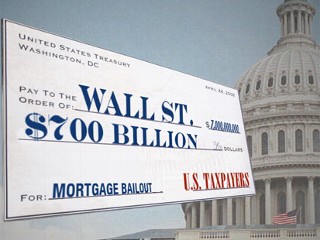
The AP story cited President Obama, as well as Republican & Democratic lawmakers. In many ways the story is framed along partisan lines and at one point quotes White House Chief of Staff Rahm Emanuel as saying, “I didn’t expect them (GOP) to help after a meeting with 100 lobbyists for the financial industry.”
While it is true that Republican lawmakers received more money from Wall Street lobbyist this year, the Democrats were not far behind. According to the Center for Responsive Politics, those who loved against the bill have received an average of $849,000 from Wall Street over their career compared to $694,000 on average for those who supported it.
The AP article does not provide much in the way of details from the bill but does mention the creation of a Financial Services Oversight Council, which will be made up of the Treasury secretary, the Federal Reserve Chairman and heads of regulatory agencies.
Robert Weissman, the President of Public Citizen, said the bill “does not do nearly enough to rein in the Wall Street banksters. It is wholly incommensurate with the devastation Wall Street has wreaked across the land and planet.” In an article posted on Common Dreams, Weissman lists some of the major shortcomings of the House bill.
- The bill does very little to address industry structure. Wall Street and the big banks engaged in reckless betting under the belief that they were too big to fail — that they were protected by a federal backstop. The biggest banks are now even bigger than they were before the crisis. The solution to the too-big-to-fail problem is to break up the big banks, so that the system can absorb their failure. The bill fails to impose limits on bank size.
- A related problem is the intermixing of commercial and investment banking in single firms and resultant excessive risk taking by federal insurance-backed commercial banks. The bill fails to separate commercial and investment banking, as the Glass Steagall law did before repeal in 1999, or otherwise address this problem.
- Financial derivatives and other exotic instruments — labeled by Warren Buffett as weapons of financial mass destruction — fueled the crisis. The bill contains very modest regulations over financial derivatives but leaves more than a quarter of the market free from regulation and contains loopholes to enable another substantial chunk to escape regulatory control. Even for derivatives covered by the bill, the new rules are very limited. The bill does not establish a regulated exchange for derivatives trades. It does not ban financial instruments that do little more than enable high-stakes gambling. And it does not require the purveyors of derivative instruments to prove that the benefits of their new products outweigh the costs and risks to the financial system.
- The bill also fails to tackle seriously the problem of executive and high-level pay. Wall Street mocks the Congress — and the American people — by preparing to pay tens of billions of dollars in bonuses, in the shadow of a vote on financial regulation and while the financial sector continues to benefit from trillions of dollars of public supports.
One thing to keep in mind through this whole process has been the relationship of Obama and his economic advisors to the financial sector. Matt Taibbi has written an excellent piece in the most recent issue of Rolling Stone Magazine entitled, “Obama’s Big Sellout.” In this piece Taibbi takes a close look at how the Obama administration ditched his economic advisors from the election campaign and whom he brought in once he was in the White House.

