Media Bites – Holiday Consumption
This week’s Media Bites takes a look at several holiday commercials from Overstock.com, Target and Toyota. In each commercial viewers are lured by traditional holiday music and scenery. We are even seduced by childhood memories of what it was like to open presents on Christmas morning. Ultimately these commercials want us to believe that consumption equals happiness. A good resource that critiques this myth is the documentary, The Overspent American: Why We Want What We Don’t Need.
Art Exhibit Explores Activism Through Printmaking
On Friday, the Urban Institute for Contemporary Arts kicked off the opening of a new exhibit entitled, “(S)edition: Prints as Activism.” The show features 70 different pieces from 54 different artists. I spoke with Brett Colley, the exhibit’s lead curator, on Friday night to find out a bit about the show and its theme.

First, I asked Brett why this theme and why now? He said that individual artists have submitted similar proposals over the past eight years, but most were not strong enough alone. “The Bush years provided lots of creative material. Throughout his administration we saw many of the same themes now evident in this exhibit.” Brett also said that printmaking has its own history as an instrument of medium democracy. “This exhibit is foremost an educational forum, which is somewhat different than exhibits one might normally see at the UICA.”
When asked about the themes that were explored in this show Brett felt that there were three major themes; militarism & conflict, national identity and environmentalism. He said he was somewhat surprised that there wasn’t more seditious works that were submitted. Colley thought that there might be more submissions that would deal with themes like daily repression and government repression. He was also surprised that there were not more pieces that dealt with the daily resistance to these types of repression, even something as simple as “riding a bike.”

In addition Colley, a volunteer member of the UICA’s visual arts committee, noted that the vast majority of prints were presented in a traditional art format, framed and hung on a wall. “Even though many pieces deal with social and political themes, they are still presented as a commodity.” There were a few submissions that were unconventional, where the public could take items that were created or in one case people were encouraged to use the materials in the submitted piece to make their own art.
I asked Brett if he thought that there would be a change in how political art would be produced in the US during the transition from the Bush years to the Obama years. He felt that some themes like military conflict are never ending, but what is different is that the rhetoric during the Bush years was very direct, whereas so far on the Obama administration it is “harder to reconcile rhetoric and action.”
 During the opening night there was an opportunity for people to hear from a few of the artists about their work. Eric Garcia, an artist from Chicago, submitted a piece called Collision. Garcia said his piece dealt with how things can collide historically, politically and culturally. He said, “the symbol of an eagle has been used by many empires,” but he also felt that his piece grapples with how cultural icons collide, especially in the age of globalization.
The other artist who spoke about her work was Alynn Guerra. Guerra first spoke about why printmaking as a medium was important to her. “I can give them away easily or sell them for very little. Printmaking gives me lots of options of how to express myself.” Her submission for this exhibit was prints that were all over the floor throughout the space. The prints were representations of landmines that are all over the world where ever military conflicts have occurred in the past century. Guerra said this submission was originally part of an early exhibit that dealt with the US war in Iraq, but it is a theme that continues even six years after the beginning of that war.
“People can pick up these prints and think about what happens to real people when they come in contact with landmines. People might lose a limb or their lives.” Guerra also said that whatever donations she gets from this prints she will donate to a local group called Healing Children of Conflict, a group that will assist children who have been wounded in military conflicts that the US is directly involved in.
“(S)edition: Prints as Activism” is running at the UICA from now until March 5.
House Passes a Limited Wall Street Reform Bill
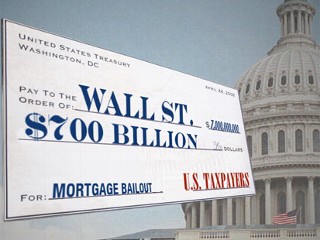
On Friday, the US House of Representatives passed the Wall Street Reform and Consumer Protection Act of 2009 by a vote of 223 – 202. Not one Republican voted for the bill and 27 Democrats voted against it.
The Grand Rapids Press ran an Associated Press article on Saturday about the House vote. The article began by saying that it was the, “most ambitious restructuring of federal financial regulations since the New Deal.”
The AP story cited President Obama, as well as Republican & Democratic lawmakers. In many ways the story is framed along partisan lines and at one point quotes White House Chief of Staff Rahm Emanuel as saying, “I didn’t expect them (GOP) to help after a meeting with 100 lobbyists for the financial industry.”
While it is true that Republican lawmakers received more money from Wall Street lobbyist this year, the Democrats were not far behind. According to the Center for Responsive Politics, those who loved against the bill have received an average of $849,000 from Wall Street over their career compared to $694,000 on average for those who supported it.
The AP article does not provide much in the way of details from the bill but does mention the creation of a Financial Services Oversight Council, which will be made up of the Treasury secretary, the Federal Reserve Chairman and heads of regulatory agencies.
Robert Weissman, the President of Public Citizen, said the bill “does not do nearly enough to rein in the Wall Street banksters. It is wholly incommensurate with the devastation Wall Street has wreaked across the land and planet.” In an article posted on Common Dreams, Weissman lists some of the major shortcomings of the House bill.
- The bill does very little to address industry structure. Wall Street and the big banks engaged in reckless betting under the belief that they were too big to fail — that they were protected by a federal backstop. The biggest banks are now even bigger than they were before the crisis. The solution to the too-big-to-fail problem is to break up the big banks, so that the system can absorb their failure. The bill fails to impose limits on bank size.
- A related problem is the intermixing of commercial and investment banking in single firms and resultant excessive risk taking by federal insurance-backed commercial banks. The bill fails to separate commercial and investment banking, as the Glass Steagall law did before repeal in 1999, or otherwise address this problem.
- Financial derivatives and other exotic instruments — labeled by Warren Buffett as weapons of financial mass destruction — fueled the crisis. The bill contains very modest regulations over financial derivatives but leaves more than a quarter of the market free from regulation and contains loopholes to enable another substantial chunk to escape regulatory control. Even for derivatives covered by the bill, the new rules are very limited. The bill does not establish a regulated exchange for derivatives trades. It does not ban financial instruments that do little more than enable high-stakes gambling. And it does not require the purveyors of derivative instruments to prove that the benefits of their new products outweigh the costs and risks to the financial system.
- The bill also fails to tackle seriously the problem of executive and high-level pay. Wall Street mocks the Congress — and the American people — by preparing to pay tens of billions of dollars in bonuses, in the shadow of a vote on financial regulation and while the financial sector continues to benefit from trillions of dollars of public supports.
One thing to keep in mind through this whole process has been the relationship of Obama and his economic advisors to the financial sector. Matt Taibbi has written an excellent piece in the most recent issue of Rolling Stone Magazine entitled, “Obama’s Big Sellout.” In this piece Taibbi takes a close look at how the Obama administration ditched his economic advisors from the election campaign and whom he brought in once he was in the White House.
West Michigan Media Mostly Ignores International Climate Summit
 The world’s leaders and tens of thousands of activists have come to Copenhagen, Denmark for the UN Climate Summit. Many commentators are calling this a critical gathering, one that could determine the future of humanity. With so much at stake you would think that the news media might make it a priority to let people know what is happening, both with the formal negotiations and with the demands and actions of civil society in the streets.
When looking at the news media in West Michigan you find that other issues are more important. Granted, local news outlets should make local issues a priority, but that does not mean that anything local is news.
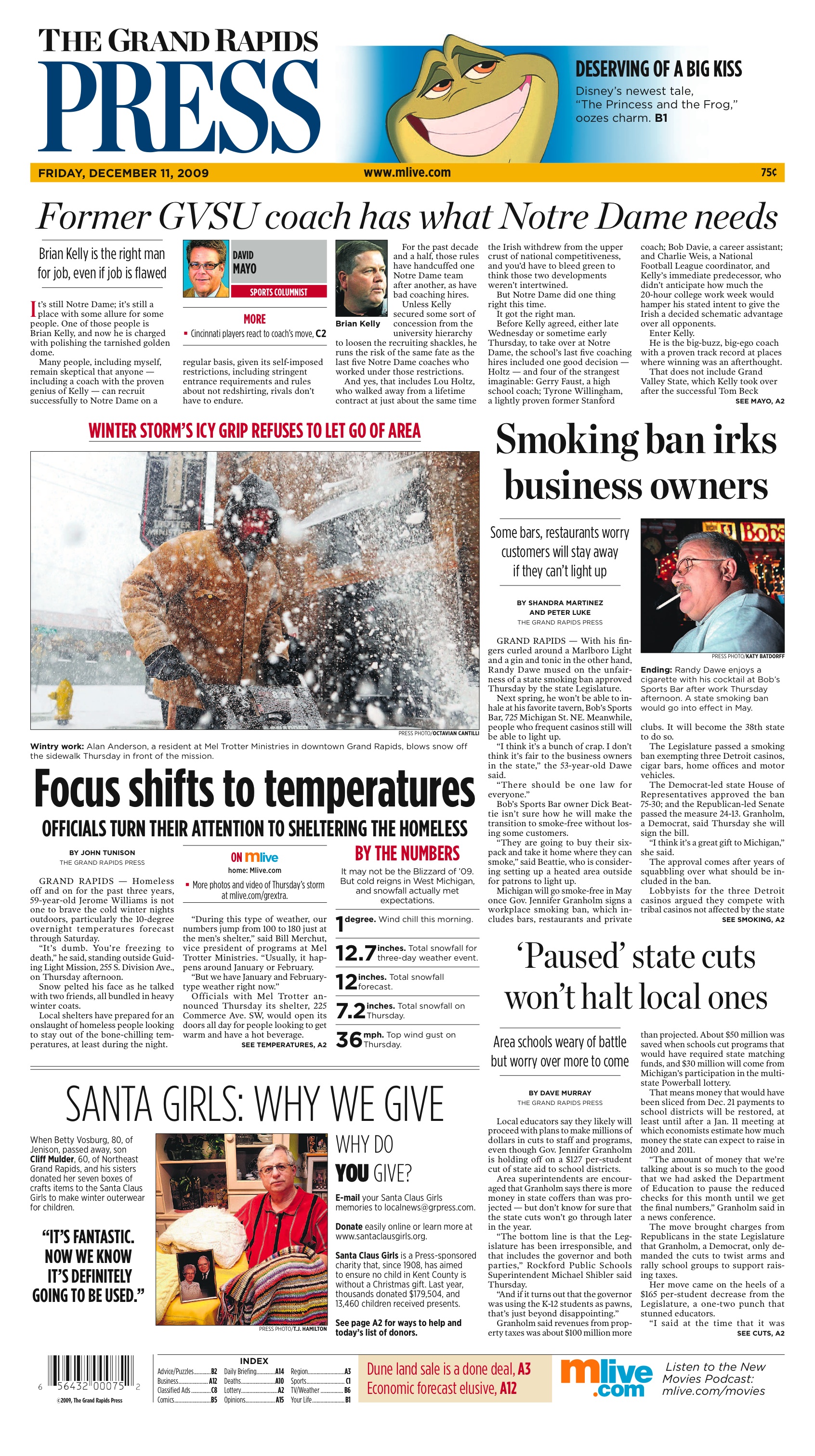
Take for instance a story that has received significant coverage in the past 24 hours in the local news media about a former GVSU football coach who has been at the University of Cincinnati was hired as the new Notre Dame football coach. All of the local TV stations have made this news and the Grand Rapids Press made it the main headline in Friday’s paper. So the question should be asked, how does this story impact our lives?
Comparatively, the Press has not run any local stories in their print publication this week and the only online story I came across that was written by Press staff was about the 56 newspapers around the world that ran a joint editorial calling on the world’s leaders to take strong action to reduce carbon emissions. The Press writer, Troy Reimink, fails to mention that most of the newspapers involved were not from the US and certainly none of them were papers owned by Advanced Publications, one of which is the Grand Rapids Press.
The only local daily news source that has reported on the Climate Summit on Copenhagen was WOOD Radio. On Friday, WOOD Radio ran a short story about a GVSU student who is a youth delegate at the UN Climate Summit. The story quotes Danielle Ostafinsk, but provides no information about the Summit or what she has participated in directly. The Clear Channel owned station also didn’t mention that Danielle was one of the organizers of a Climate Justice Day in Grand Rapids this past October.
This lack of coverage in the West Michigan news market on what is possibly the most critical issue of this generation is quite staggering and it speaks to the growing need for independent journalism.
Afghan War Vets Speak Out on US Escalation
Robert Greenwald and Brave New Films have just released a new short video to add to the growing collection of online films at Rethink Afghanistan. The video includes the comments and experiences of several US veterans who served in Afghanistan and paints a much different picture of what the American public has been presented through the corporate media.
Obama accepts Nobel Peace Prize while escalating war

US President Barack Obama accepted the Nobel Peace Prize in Oslo Norway today. His speech there was longer than his inaugural address and he had the audacity to cite Dr. Martin Luther King and Mohandas Gandhi.
In his acceptance speech Obama continued some of the same rhetoric he used when announcing the escalation of the US occupation of Afghanistan with claims that the US, “has helped underwrite global security for more than six decades.” In addition, the US President said, “the instruments of war do have a role to play in preserving the peace.”
Democracy Now! reported, “In a possible attempt to avoid questions about the Afghan war, the White House has canceled the traditional press conference held by Nobel Peace Prize winners. In addition, the White House has canceled other events held every year, including a dinner with the Norwegian Nobel Committee, a television interview, appearances at a children’s event promoting peace, as well as a visit to an exhibition in his honor at the Nobel Peace Center.”
Obama’s Orwellian comments did not fool everyone, particularly some Afghanis who share their views on his acceptance of the Nobel Peace Prize in this video provide by Al Jazeera News.
The Senate Health Care Bill and the Public Option
On Tuesday, about 10 MoveOn.org members participated in one of the numerous “Cost of Delay” vigils organized across the country. The main focus of those at the rally in downtown Grand Rapids was to send a message to Michigan Senators Debbie Stabenow and Carl Levin to support the “public option” in the Senate version of the health care reform bill, known as the Patient Protection and Affordable Care Act.
Everyone GRIID spoke with was in favor of a public option, even if it was a weak option. Sean Kenney felt that even though it was a weak option that it might be the beginning of more progressive reforms.
Robert DeMaagd also felt that if the weak public option version of the Senate bill passed that it would be a first step to what he would rather see, a Single-Payer health system. However, DeMaagd expressed concern that the Senate version did not include the anti-abortion position that the House bill adopted. He said, “If the Senate version of the bill did not include a woman’s right to choose then it shouldn’t be called Health Care Reform.”
Yesterday it was announced that the Senate did reach an agreement, but that agreement did not include a public option. According to Washington correspondent for the Nation, John Nichols, the Senate has a tentative agreement, which does not include a public option. Instead, the federal Office of Personnel Management would hire the insurance companies to run the health plans.
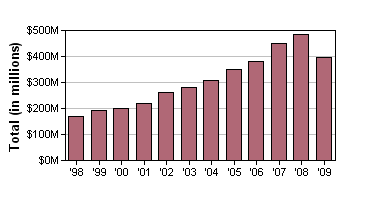
The defeat of a public option should come as no surprise considering that the corporate health sectors had spent $400 million to lobby Congress and that amount doesn’t include the last quarter of the year.
Groups like MoveOn are blaming Republicans and a few conservative Democrats, but as independent reporter James Ridgeway points out, the plan that the Senate will likely adopt is more a result of compromises within the Democratic Party.
The Senate is not expected to vote on this bill until the Congressional Budget office analyzes the costs.
Former Navy Seal Speaks to Econ Club
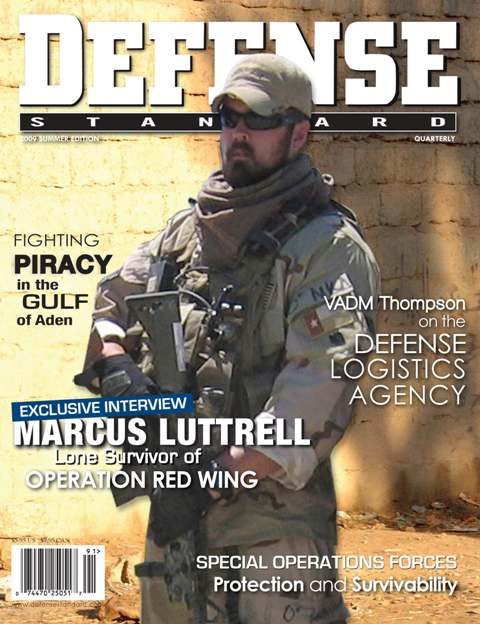
On Monday, Marcus Luttrell, a former US Navy Seal and author of the book The Lone Survivor: The Eyewitness Account of Operation Redwing & Lost Heroes of Seal Team 10, spoke to an estimated 700 people at a luncheon hosted by the Economics Club of Grand Rapids.
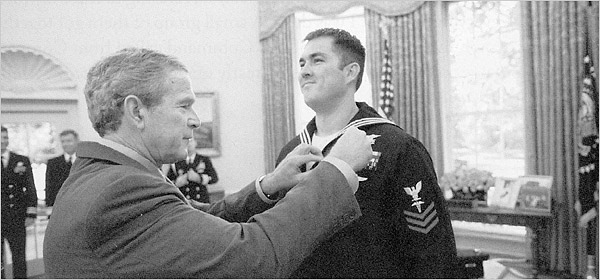
Luttrell, who served in Afghanistan & Iraq, spent the first 20 minutes talking about growing up in a military family and how he wanted to be a Navy Seal ever since he was a teenager. The former soldier also said that his father used “to beat me even if I didn’t do anything.”
This comment summed up a great deal of Luttrell’s attitude and reflected a hyper-masculinity that anti-violence advocate Jackson Katz addresses in his documentary Tough Guise and what former Army Ranger Stan Goff address in his book Sex & War. Luttrell kept emphasizing the toughness that was needed to be a Navy Seal and that it was his training that kept him alive in Afghanistan.
There is no doubt after listening to the speaker that one would have a certain level of respect for what Luttrell endured. He was shot numerous times, had broken bones, a broken back and a disfigured face after being caught in an ambush by Taliban fighters in Afghanistan. However, once you got past the super-patriotism of his comments there was a different message that came through.
Luttrell talked often about his role of being undercover in the mountains of Afghanistan, where he would collect intelligence on the enemy and then “kill people if given the green light.” He told the audience that he would often tell people before being deployed “after 9/11 that when I was in Afghanistan I was gonna get another one for you.” Every time he spoke of killing Afghanis he would use the word dispatch, as in “I threw a grenade and dispatched some more of them.”
Luttrell said that after he escaped the ambush there were some Afghan civilians who found him and took him to their village. A few days later while recovering the Taliban showed up. Luttrell said, “You can always identify a Taliban because their beard is well kept, they have nice teeth, spoke good English and were educated at places like Yale.” This is certainly not the picture you get from reading Ahmed Rashid’s book Taliban, or the investigative journalism of Anand Gopal.
Luttrell then said he was eventually rescued by US Army Rangers and spent months in the hospital having reconstructive surgery. He did some time in Iraq after he recovered by eventually received an honorable discharge.
At the end of his talk David VanAndel, current President of the Econ Club, said, “thank you for being in Afghanistan on our behalf.” With that Luttrell received a standing ovation.
As I walked through the crowd I noticed CEOs, university presidents, leaders in the Chamber of Commerce, lawyers, and other representatives of the City’s economic elite. Since there was no Q&A I could only wonder what those in attendance really thought about the speaker or why the Econ Club would have Marcus Luttrell address an economic minded crowd.
I had hoped there would be a link between President Obama’s recent decision to escalate the US occupation in Afghanistan and the speaker, but that never came to pass. However, based on the standing ovations Luttrell received it might be an indication of what the City’s economic elite think about the US occupation of Afghanistan, now in its ninth year.
Indy News Coverage of the International Climate Summit
Yesterday the International Summit on Climate Change began in Copenhagen, Denmark. We know from previous independent news coverage that the heads of state have already acknowledged that there will be no major agreements made at the summit.
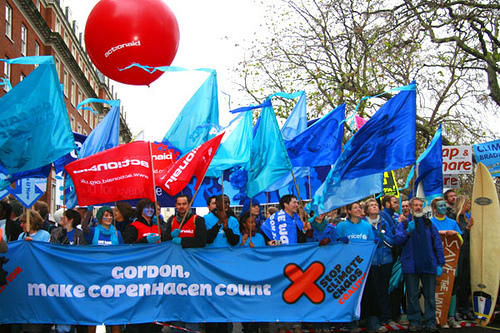
We have already written about the impact of the Climate denial groups, Climate lobbyists in the US, and a bit about what groups in Third World nations are demanding from the rich countries, which have been the primary polluters around the world. What we will write about in the next two weeks are what grassroots groups are doing on the streets in Copenhagen and around the world to draw attention to Global Warming.
Democracy Now! began its two-week coverage of the Copenhagen Climate Summit and even did a story about the protests that took place all across Europe leading up to this week.
Other independent news coverage of the summit in Copenhagen is coming from the Climate Indy Media Center, which is reporting on what is happening in Denmark and around the world in conjunction with the Climate Summit.
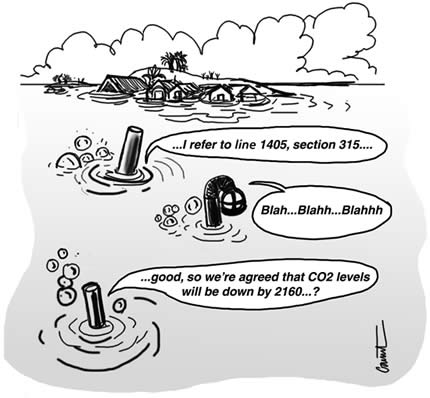
The British newspaper The Guardian has a live blog reporting from Copenhagen, which included a story on a talk given by Naomi Klein at the People’s Summit.
Then there are several grassroots groups, which have good analysis and provide activist and movement information as it relates to Climate Justice and the Copenhagen Summit. Some of those sites are Climate Justice Action, Camp for Climate Action, and the Radical Left Network called Never trust a Cop.
In addition there are some international organization, which have a significant presence in Copenhagen such as Via Campesina and the Indian Social Action Forum.
In the US there some groups that are engaging in Direct Action that is coinciding with the International Climate Summit. Yesterday, hundreds of activists in West Virginia demonstrated outside the EPA offices against Mountaintop removal coal mining. On Sunday, two activists did a lockdown to a drilling rig in West Virginia, also to protest Mountaintop removal coal mining.

We plan to continue to provide some independent news updates during the two-week period of the International Climate Summit in Copenhagen, as well as some analysis of corporate news if they even bother to report on the summit.
 Grand Rapids Institute for Information Democracy