Media Bites: The Gap “Cheer Factory”
This week’s Media Bites takes a look at a series of holiday commercials from The Gap. Set in The Gap’s “Cheer Factory,” each commercial features a trendy cheer team that encourages viewers to celebrate their diversity and rebel spirit by wearing practically identical outfits from this one retail giant. A second look at the messages of the ads and the business practices of the Gap is actually quite disturbing.
To access the resources mentioned, visit TRUCE for the toy guide or the Coalition for a Commercial Free Childhood for the Guide to a Commercial Free Holiday.
Fundraiser for workers a success
(Stelle Slootmaker contributed to this story.)
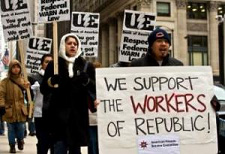
A year ago this December, workers at the Republic Windows and Doors Factory in Chicago, Illinois were informed by management that the factory would be closing in three days and they would receive no severance or vacation pay. Rather than just accept this illegal action, the workers with the help of their union, the United Electrical Radio and Machine Workers, decided to occupy the factory. After six days of negotiations with the company’s creditors, the workers won their pay.
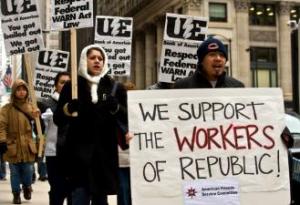
On Saturday night here in Grand Rapids, The Bloom Collective and the Grand Rapids chapter of the Industrial Workers of the World sponsored a benefit at the Kent Ionia Labor Hall to raise money for the workers and the UE union who are currently engaged in organizing similar actions.
A documentary on the factory occupation was shown and UE organizer Abe Mwaura held a question and answer session from Chicago via Skype.
Event and local IWW organizer Cole Dorsey was also on hand. Dorsey said this is an important issue because “Workers can take an example from the sit-downers because workers hands are tied when they rely solely on legal means.”
Following the question and answer session, local band Chance Jones performed for close to an hour. Lead singer Josh Burge said, “We [Chance Jones] support working people. That’s who we are.”
According to the IWW Facebook page, the event raised over $440 for the workers.
Dorsey and various audience members put the following questions to Abe Mwaura.
Q. Prior to getting national publicity, did Republic Window and Doors or local police use any scare tactics to dissuade workers from taking action?
A. Mwaura explained that because the workers had already communicated to their local Chicago alderman that the action would be nonviolent, the police knew what was going on and did not respond on behalf of management. “Management was scared by what we did. We took power away from them. It was our factory for six days. It was clear that we controlled the place.”
Q. Republic Windows and Doors claimed that the reason they were closing was because Bank of America would not extend them a line of credit. Was this the truth?
A. Mwaura explained that this was a lie. The company owner had actually bought a shadow company in Iowa, a Right to Work state where the UE would have less power to organize workers. Having noticed equipment being taken out of their plant, the local in Chicago set up surveillance that confirmed suspicions of an imminent plant closing. Management also stole money to set up the new plant. “Bank of America had been calling these shots since August. They were actually moving the factory. We knew we had to do some fairly radical action to win justice.”
Q. Did you have any other actions planned?
A. “There was no plan B,” Mwaura said. “The national union suggested it (the occupation). Armando, brought the idea back. The executive comittee asked for volunteers. The first workers to volunteer to occupy the plant were women. Nine or ten women offered first. Eventually 30 folks volunteered. When it came down to it. It was unanimous. All 260 folks were going to stay in the factory. They knew they were going to be part of something big.”
Q. What did you do for six days?
A. The six-day occupation was not six days of passing time. Committees worked hard carrying out the extensive tasks of negotiations, security, clean-up, and media relations, to name a few. “There was a real sense of what our leverage was—those windows, doors and machines were our leverage and the bank knew it.” On the weekends, the workers did play a little cards; many of the workers’ children came during evenings and on the weekend. “The probably got a better education that they ever got in school,” Mwaura said.
Q. What was the biggest lesson that the Republic workers taught the labor movement?
A. “It’s possible to take radical steps and win.”
Q. Republic workers had good publicity and political support. How possible would their success have been without that support?
A. “It would have been hard, but we weren’t relying on that support. Our leverage was the stuff in the factory. When you’re out of a job, you don’t have your leverage. Our labor was they millions of windows and doors in that factory,” Mwaura said. “If the tactic is to be used, you have to build alliances before you can do that type of action.”
Q. What are you working on now?
A. UE is mounting a movement to organize warehouse workers in the Chicago area. Armando is now president of the new local, “Warehouse Workers for Justice.” “This is a sector of the economy where we could build power,” Mwaura said.
Many warehouse workers in the Chicago are, which is the third largest container port in the world, work in dangerous sweatshop conditions for as little as $2 an hour. Others are not paid for hours worked or are paid in split paychecks that avoid payment of overtime rates. Racial and gender discrimination runs rampant, especially against pregnant workers.
Mwaura used an analogy of a huge elephant obediently tethered by a weak chain. The chain has been there so long that the elephant does not realize it can break it and run free. “We need to take that psychological chain off from our minds and see the power that we really have. UE believes in leadership development through struggle. A year after the occupation, that’s the piece that’ s missing—organizing that helps workers break that chain.”
Levin Speaks to Think Tank on Afghanistan
A few weeks after President Barack Obama announced his intent to send an additional 30,000 US combat troops to Afghanistan, Michigan Senator Carl Levin spoke to the right-wing think tank, the Brookings Institute.

In his talk to the Brookings Institute, Levin reiterated many of the same points made by President Obama in his December 1st address to the nation. The main points that Levin addressed were the need to deny Al Qaeda a “sanctuary” to commit more acts of terror and to prevent the Taliban from “destabilizing” Afghanistan.
However, Levin does say he has some concerns about the additional US troops being deployed to Afghanistan. “I am concerned that the large new commitment of U.S. combat forces included in the plan may undermine the over-arching goal of preparing the Afghans to secure their own success.” This concern seems to be quite reasonable, but it raises questions about how the Afghans will secure their own future and with what kind of government.
In terms of how to make sure that turning Afghanistan over to Afghanis the only enforcement mechanism that Senator Levin provides is that he “will continue to urge the administration to focus intently on the training aspect of our mission.” A question for all of us at this point might be how relevant is it to “urge” the President to do something when Senator Levin votes to fund the war in Afghanistan?
Later in his talk Levin admits that there are reports that the Afghan military is unwilling to fight when called upon by the US. He also said that while meeting with a village council in Afghanistan he asked how long the US should have their troops in their country. One man answered and said, “Until the moment we make Afghanistan’s security forces self-sufficient. Then, he said, we should go.”
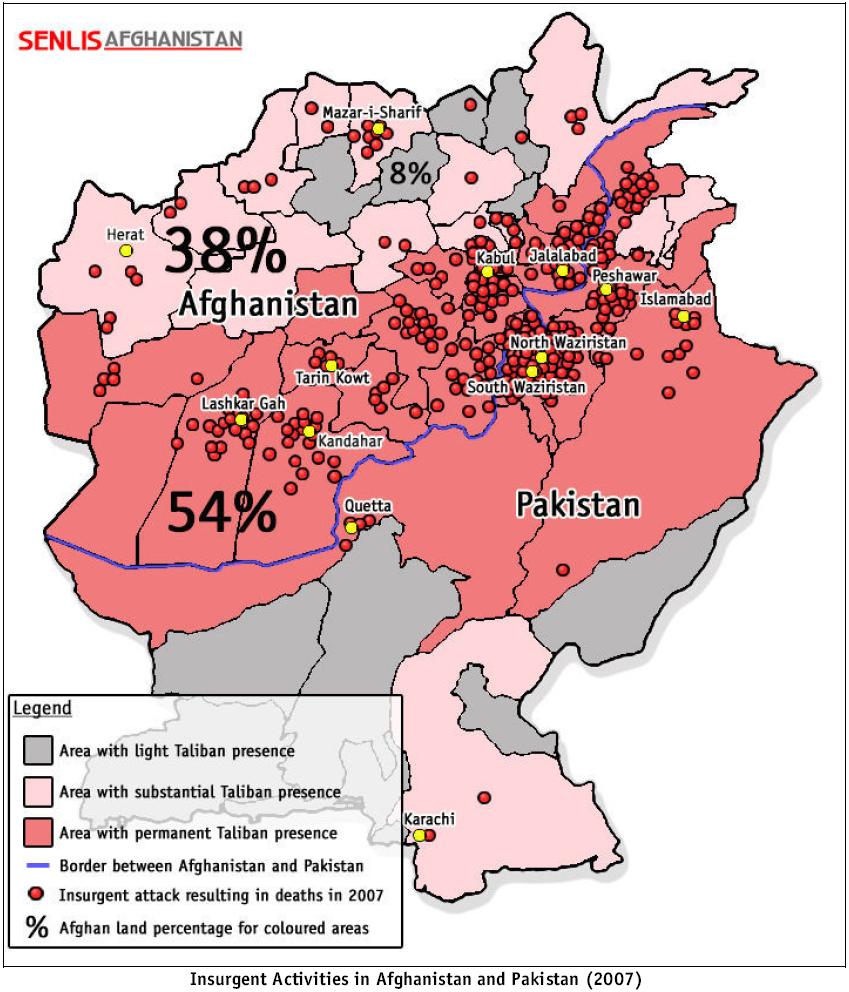
Levin then says something quite interesting in his presentation to the Brookings Institute. “Our commanders should wake up every morning thinking, what can I do today to prepare the Afghans to secure their own nation? That should be our principal mission. Yet General McChrystal acknowledged yesterday that the additional troops we will send to Afghanistan will not speed up an increase in the size of the Afghan security forces.”
Again, the question should be asked, if it is clear that the increase in US troops will not lead to Afghanis being responsible to their own nation’s security, why does Senator Levin vote to fund this war and support the President’s decision?
The only other point that Levin raises in his talk worth discussing is his claim that the Taliban are engaged in a propaganda campaign calling the US presence in Afghanistan as an occupation. What Levin fails to acknowledge is that the Taliban are not the only ones who believe that the US presence in Afghanistan is an occupation. Groups like RAWA and the Afghan Women’s Mission both call the US military presence in their country as an occupation and over the past few months Malalai Joya, a member of the Afghan Parliament who has been touring the US for the past 3 months, has repeatedly referred to the US presence as an occupation.
Levin & Stabenow Vote for more War Funding
Today, the US Senate voted to pass a defense appropriations bill in the amount of $636 Billion. Michigan Senators Carl Levin and Debbie Stabenow voted for the additional military spending, with Wisconsin Senator Russ Feingold as the only Democrat voting against the measure.

After voting for more military spending Senator Levin and Stabenow released a joint statement providing some reasons for supporting the bill. Levin said, “During this time of two wars, supporting the military’s ongoing operations is among our highest duties as legislators. I will do all I can to support our troops by making sure they are properly equipped and have the equipment they need in the field. This bill ensures that Michigan’s factories and research centers will continue their cutting-edge work that has helped make our military the strongest the world has ever seen.”
Senator Stabenow also chimed in on why she voted for the $636 Billion for war. “I am very pleased that this legislation not only provides critical funding to support our troops, including a 3.4% increase in military pay, but also invests in my priorities for alternative energy research and more energy-efficient combat vehicle technology. These investments will create jobs in Michigan and further advance our state’s leadership in clean energy. This bill also includes another high priority of mine by addressing the unique health care needs of our men and women in uniform.”
So it seems that funding US military occupations abroad, occupations that result in the deaths of Iraq & Afghan civilians, plus US soldiers is ok as long as it creates jobs in Michigan. Economically this doesn’t make sense, since as the National Priorities Project has documented, the Iraq and Afghan wars have cost the state of Michigan over $25 Billion in tax dollars since 2001.
Local Media Fails in Climate Summit Coverage
Right now 192 global delegates at the Climate Summit in Copenhagen are deciding the future of our world. But what is West Michigan saying about this? Not much.

As previously reported the local coverage of the massive Summit is paltry at best and leaves much unreported.
Only one article about the Climate Summit was written by a local journalist, while the rest of the coverage in the Grand Rapids Press, on WOOD-TV, and FOX-17 was from the Associated Press. On WZZM-13 only one short AP article was found, and over on WMMT-CBS there was nothing about the Climate Summit.
The AP articles used present the basic framework of the situation happening now in Denmark:
Any major environmental commitment hinges on the determination of developed nations, in particular the United States. A draft of a global climate treaty is being debated endlessly, as developing nations say they will be the ones hit hardest by the damage caused by global warming. Developing nations are demanding the major developed nations help pay for the climate damage caused mainly by their greenhouse gas emissions.
Out of the vast array of articles, local media chose only AP articles that convey part of what is going on in Copenhagen right now, leaving the rest of the debate unreported for West Michigan citizens.
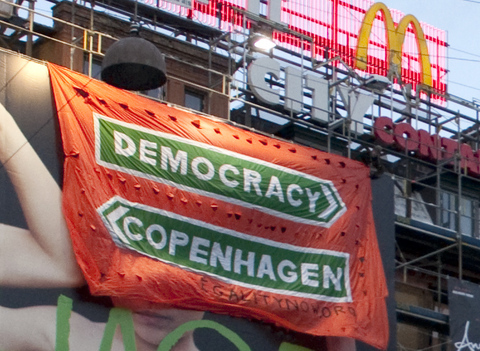
No articles speak of the massive demonstrations that have been taking place since the Summit began, including the demonstrations on the weekend of December 12th & 13th that saw 100,000 people take to the streets demanding action.
No articles speak of how many environmental organizations have now been banned from entering the Bella Conference Center where delegates and world leaders are meeting.
No articles speak of the mass arrests of protesters, often for less than credible reasons.
No articles speak of the debates surrounding cap and trade carbon agreements.
Even if local media did not want to post stories from alternative media such as Democracy Now! or IndyMedia Denmark, there were plenty of AP articles for West Michigan media to choose from, including this one about the protests and arrests, about environmental groups being banned, or even the plight of island nations in the face of global warming.
Why is West Michigan’s media failing to pick up on these stories? Why do they deem them un-newsworthy? Whose interests are served by ignoring the real debate raging on the streets in Copenhagen?
More Drones, Less Diplomacy
According to a recent news story, the Obama administration has decided to increase its use of military drones and video surveillance in Afghanistan/Pakistan.

“According to US Air Force General David Deptula, the drones will meet the needs of 30,000 more troops set to be sent to the country next year.”
The Obama administration continues to claim that the drones are being used to attack both Taliban and Al Qaeda insurgents. However, some news reports have said that as many as 600 civilians in Pakistan alone have been killed in the past year in some 70 drone bombings. In addition, a United Nations official who deals with Extrajudicial Executions is also questioning whether or not the use of drones by the US is in violation of International Law.
At the same time most major news agencies have ignored recent reports that the Taliban made an offer to the Obama administration that it will not meddle “in the internal affairs of other countries and is ready to give legal guarantees if foreign forces withdraw from Afghanistan.”
Independent journalist Gareth Porter says that it is not sure whether or not this will mean that the Taliban has renounced any and all ties with the Al Qaeda, but it is clear that the Taliban is responding to the Obama administration’s recent announcement to escalate the war by sending 30,000 more combat troops.
The only mainstream US news source to report on the Taliban’s willingness to negotiate was the Wall Street Journal. WSJ reporter Anand Gopal, who has been reporting from Afghanistan for years, wrote the story on December 7th.
Porter points out that those who have suggested that the Taliban are willing to negotiate are being portrayed by the Obama administration as trying to deliberately deceiving the West.
Lastly, Porter mentions in his article that Afghani President Hamid Karzai, in a recent interview with CNN, stated “there is an urgent need for negotiations with the Taliban, and made it clear that the Obama administration had opposed such talks.”
My Dance with the Economic Club of Grand Rapids
(This article was submitted by Kate Wheeler)
After having read a GRIID report of Marcus Luttrell’s speech to the Economic Club of Grand Rapids, I wanted to know who exactly had chosen him as a speaker. I also wanted to find out what connection he had to any economic concerns or interests that club members might have. This proved a more Byzantine task than I first thought.
The only members of the Program Committee listed on the club’s Web site were for 2007 and 2008. So I had to call the Economic Club for the current list. A nervous administrative person did not want to tell me. I finally convinced her that since a list of past members was already posted, it didn’t seem like confidential information. Once I had the members’ names, it was easy to find their corporate affiliations using Google.
I wrote to the members, asking about their choice of Luttrell as a speaker. My e-mail in part asked if there was some economic information to be had from the speaker: “Were you suggesting through this speaker that Grand Rapids should grab a larger share of war profits? After all, the occupation of Afghanistan is costing us $3.6 billion a month…and the addition of 30,000 troops is going to add at least another $30 billion to the overall total, according to White House Press Secretary Robert Gibbs. There’s obviously a lot of money to be made. Perhaps the members of the club were anxious to discuss this?” I also asked if the choice represented a particular political viewpoint that appealed to members.
This caused more concern than I thought it would, and a lot faster, too. Later that same day, I got an e-mail from Lorna Schultz, the executive director of the club, who said a number of committee members had forwarded my e-mail to her. She asked that I call her to discuss “the objectives of our organization and the consideration given to [Luttrell’s] invitation to speak.”
I finally connected with Ms. Schultz on December 14. I do want to say up front that I was impressed by how time she gave me. She started out by stating that the Economic Club invited a “diverse array of speakers on government, economic, and social issues.” I asked, “So which is Marcus Luttrell? Is he speaking on behalf of the government, the economy, or a particular social issue?”
Apparently, none of the above. Ms. Schultz told me that in December, the club often invited a speaker who would “inspire, offer a show of patriotism, or who was a celebrity of some kind.” She noted that Mr. Luttrell had written a best-selling book that was “a story of teamwork, camaraderie, and sacrifice.”
Ms. Schultz’s biggest concern with me seemed to be that I was a mainstream media journalist. I told her I wasn’t. But often after our opening steps in this dance, she would say something like, “Now you’re sounding like a journalist!”
So we embarked on a lengthy back-and-forth two-step, where I tried to find out if she’d actually been involved in the selection of Marcus Luttrell as a speaker and she tried to figure out why I was interested.
Finally I extracted a few shreds of information. Ms. Schultz said that she had in fact been at the meeting in which Marcus Luttrell’s speaker potential had been vetted. “Why did people think Mr. Luttrell would be a good choice?” I asked.
“He had a story of teamwork and camaraderie and sacrifice,” she said again. “It’s a commentary on the difficult time our armed forces have in Afghanistan.”
“OK,” I said. “How was his story presented at the meeting?” I was trying to find out if anyone on the committee had offered a less glowing version or opinion. After all, Luttrell had nearly violated the Uniform Code of Military Justice in his “big moment” in Afghanistan. After capturing three unarmed civilians, he and his squad had to decide if they should shoot them or release them, knowing that they would probably go to the Taliban and report having seen the squad on the ground.
Luttrell, in fact, had no real decision to make—it was his military duty to let the men go regardless of what might happen later. But instead, he and his squad voted, as if they felt they had the right to modify the Uniform Code on the spot. This, I feel, is a strong indication of how the US government’s unspeakable decisions to occupy Afghanistan and to allow torture in violation of the Geneva Convention are causing any safeguards in military behavior to completely fall apart.
And now Marcus Luttrell is making a lot of money touting this event as a spiritually powerful, inspiring act of heroism.
Ms. Schultz said that some committee members had read Luttrell’s book and “everyone had information about the book.” It emerged that the information that they had was PR copy taken directly off Luttrell’s Web site. I asked if anyone was concerned that Luttrell might be a controversial choice. She said, “Oh, no. We invite controversy.”
Ms. Schultz then explained that after names were approved by the committee, invitations were sent out. Any speakers who agreed to come were reviewed and final choices were made. She absolutely refused to tell me who made that final decision. When I asked her point-blank for the name of the person, she employed the Alberto Gonzales defense and said, “I don’t recall.”
“You said that you invite controversy in your choice of speakers,” I added, looking at the list on the Economic Club speakers from past years. “I’m not sure many of your members would find these speakers controversial. Most of these names seem to me to come from the political right.”
“That’s not true,” she said. “We have a variety of members and choose a variety of speakers to address that.”
“Have you ever had a left-wing speaker at the Economic Club?” I asked.
“Oh, yes,” she answered triumphantly. “Bill Clinton.”
And so, although I didn’t wind up with answers to all of my questions, I did learn a few things:
One is that committee members at the Economic Club don’t appear to like the idea that their decisions might be dragged out into the bright light.
One was a realization of just how far to the right this group is, despite numerous claims about its “diversity.”
And one is that, although the gates to capitalism are firmly shut and carefully guarded, what’s going on in there seems to be pretty much exactly what we think is going on.
Climate Change vs. Global Warming
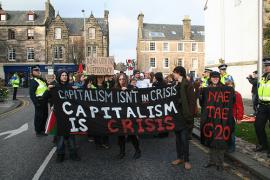 Climate Change = Global Warming, right? In the world of politics and corporate media, the equation is never that simple. In reality it looks more like this: (Global Warming – Blame) x Corporate Control = Climate Change.
The phrase “climate change” is just another example of euphemistic language used to cover up the reality hidden just beneath the surface. Of course, this is nothing new. Think how often the word “abuse” was used instead of “torture” when news of Abu Ghraib broke. Or how about “collateral damage” instead of civilian deaths when the destruction from US bombs in Afghanistan is mentioned?
The mainstream press more often than not choses to use the phrase “climate change” rather than “global warming.” Just look at the news coming out of Copenhagen.
But what is the reasoning behind this?
To start out with, the mental image conjured up when thinking about “global warming” (a sweltering Earth) sounds horrifying, whereas ‘climate change’ sounds much more pleasant, like going from this frigid Michigan winter down to the tropic warmth of Key West. It almost seems like a natural occurrence when saying “climate change,” which the majority of scientists claim it is not.
While NASA scientists argue that “global warming refers to surface temperature increases, while climate change includes global warming and everything else that increasing greenhouse gas amounts will affect,” I don’t think this is the only reasoning behind the use of “climate change.”
Author and journalist Steven Poole points out in his book Unspeak: How Words Become Weapons that:
“it is clear that in the phrase ‘global warming’, after all, the word ‘warming’ implies an agent doing the warming. And once you accept that human beings might be the cause of the problem, again you will eye skeptically those with an interest in burning coal, oil, and gas. Thus the preference for the term that seems to assign no blame, ‘climate change’…”
And that hits on a key point. The assignment of blame to those in the coal, oil, and gas industries. It should come as no surprise that these big three industries have meddled with the framing of important issues like global warming, in particular oil industry giant Exxon Mobil. But these industries didn’t stop there. They went on to attack the very words themselves, as Poole says, “States with oil interests, including Saudi Arabia and the US. . .specifically lobbied for the elimination of the phrase ‘global warming’ in agreements.”
With the politically tepid “climate change” in mainstream use, the urgency of the situation is lost. And our nation’s industries that are the chief producers of greenhouse emissions are more easily let off the hook.
Perhaps this seems trivial to some, but words carry within them so much meaning. How can we understand something if we do not correctly label it? How can we get to the root of the problem if it is not known in its entirety? In order to understand this issue facing our country and our world, we need first to call this impending environmental catastrophe by its true name and come to grips with our nation’s culpability in it.
Independent Media Climate Conference Updates
Thousands of protesters continue to take to the streets of Copenhagen, demanding action be taken to halt climate change.
 From KlimaForum 09
A succesful demonstration and a promising “alterglobalist” movement!
“The international demonstration of December 12 was a success. More than 100,000 people from all over the world joined this unitary mobilisation action. Altogether, 538 organisations from 67 countries answered the call. Under an enjoyable (a welcoming) sun, the colourful procession and its bicycles (as it is the custom in Denmark) went to the Bella Center, where the official negotiations are taking place. Many radical catchphrases could be read on banners and placards, around the following idea: “Climate Justice means System Change not Climate Change”.
 People not Politicians can save the Climate, says the President of the Maldives
“The President of the Maldives, Mohamed Nasheed, stressed the power of people to take action on climate change, when he spoke to a packed audience at Klimaforum09, the alternative climate summit in Copenhagen, Monday evening. ‘The social movements have the power to save the planet from the effects of climate change. My message to you is to continue the process of movement building after the conference,’ the President said.
Mohamed Nasheed used his own personal story to illustrate the point. A few years ago he was in prison because of his work as a human rights activists, but upon his release he became the first democratic elected president of the island nation acutely threatened by the rising sea levels.”
From IndyMedia Climate
On Tuesday in Copenhagen, The Resistance is Ripe Agriculture protest started at noon, with protesters marching through the center of town under a banner that read, “Food Climate Justice, not Climate Change.” Hundreds of people stopped outside the Netto supermarket for speeches about the importance of food sovereignty and the links between climate change, agriculture and exploitation of people. Naomi Klein delivered this speech.
For more breaking news on the Copenhagen Conference, check on Amy Goodman’s live broadcasts at Democracy Now!
Do you want to take action in solidarity with the protesters at Copenhagen?
Sign the petition at the Avaaz.org World in Action Website. The site states, “Copenhagen’s last-ditch summit to stop catastrophic global warming is failing; only massive public pressure can save it. Tomorrow (Dec. 16), the world’s leaders arrive for an unprecedented 60 hours of direct negotiations. Experts agree that without a tidal wave of public pressure for a deal, the summit will not stop catastrophic global warming of 2 degrees.”
 Where: Kent/Ionia Labor Hall, 918 Benjamin SE, GR
When: Saturday Dec. 19
- 7 p.m. Film & Discussion
- 9 p.m. Chance Jones
Tickets at the door: $5 or $10. All proceeds go to sit-downers.
This Saturday Dec. 19, the Grand Rapids IWW and The Bloom Collective host a benefit for the former workers of Republic Windows & Doors at the Kent/Ionia Labor Hall. The evening will start off with the film Hasta La Victoria, which shares how, in December of 2008, 270 workers occupied their plant for six days and successfully negotiated their demands.
UE members and workers who participated in the Republic Windows and Doors occupation will discuss what happened during the occupation and the goals they have for organizing the 100,000+ warehouse workers toiling in sweatshop conditions in the Chicago area
 Following the discussion, guests will enjoy live music by popular Grand Rapids band, Chance Jones, and have opportunity to stand in solidarity with workers here, in Chicago and around the globe. “We decided that we wanted to do this benefit because we support the working class,” says band member, Mike Saunders. “It’s as simple as that, we all have jobs outside of playing music and we see it as effecting us when our fellow workers are being exploited.”
 Grand Rapids Institute for Information Democracy