Hoekstra votes for more Afghan war funding

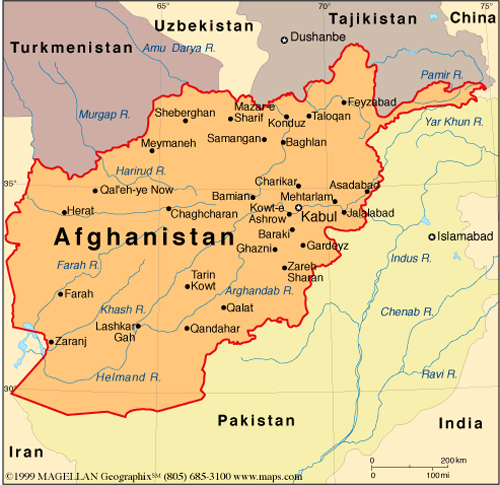
Late Tuesday, the US House of Representatives voted 308 – 114 in favor of President Obama’s war surge in Afghanistan. This means the President got the additional $33.5 billion to go towards the additional 30,000 US troops now deployed in Afghanistan.
Twelve Republicans and 102 Democrats voted against the war-funding bill. Amongst those who opposed sending billions more for a failed war in Afghanistan was West Michigan Congressman Vern Ehlers, although since Ehlers has announced his retirement this vote doesn’t seem to have much significance.
Voting for additional war funding was 2nd Congressional District Representative Pete Hoekstra. Hoekstra, a GOP candidate for Governor in Michigan, is also now a leading member in the Tea Party Caucus. Joining Hoekstra in voting for the President’s war funding bill were 148 Democrats and 160 Republicans.
According to an Associated Press article the President urged passage of the war-funding bill, saying in a Rose Garden statement that it was needed “to ensure that our troops have the resources they need and that we’re able to do what’s necessary for our national security.” Like Bush before him, President Obama doesn’t clarify how a nearly 9-year occupation of Afghanistan is necessary for national security.
(This video interview is re-posted from Common Dreams.)
The Pentagon’s hunting for the sources behind the biggest leak in U.S. military history. The whistle-blowing website Wikileaks published some ninety thousand classified documents exposing cover-ups over the war in Afghanistan. Phyllis Bennis from the Washington Institute for Policy Studies provides her perspective on the latest Pentagon scandal and its consequences.
Immigration Rights Alert for Grand Rapids
Since the Grand Rapids Press posted a story about today’s planned prayer vigil in support of immigrant rights, there have been a large number of comments left on Mlive.

Most of the comments are critical of the planned vigil for this afternoon at Ah Nab Awen Park (5:30pm). However, there are also several comments from those who favor the new Arizona law to come today and protest the prayer vigil.
We encourage as many people who are able to come to stand in solidarity with people who are vulnerable to these laws and the racialized hatred that comes with it. Those of us who are privileged need to be willing to stand with people who are the targets of this hateful anti-immigration sentiment that exists in West Michigan.
Whether or not you are a person of faith, it is important for people to come today to send a message to people who think that immigrants threaten their way of life. More importantly, join us today to send a message to those at risk of racial profiling, police harassment, detention and deportation that we will not stand for these kinds of policies. Come stand in solidarity with all immigrants!
5:30 – 6:30pm
Ah nab Awen Park
What does it mean when candidates shift to the right?
Yesterday, the Grand Rapid Press published a story about how several Republican candidates for Governor in Michigan were moving to the right just before the August 3rd Primary. The print version of the Press was headlined, “Candidates sharpen focus,” with a subheading of “A week before primary, GOP governor hopefuls appeal to party base.”

The MLive version of the story had a much different headline, which read, “Several Republican candidates for governor move to the right in primary campaign, but not Snyder.” Interesting that there is such a clear difference in what is emphasized and how the different headlines frame the story.
Beyond the headlines the article provides readers with two example of this “move to the right” or “appeal to the party base.” The first example involves an endorsement from Arizona Sheriff Joe Arpaio of gubernatorial candidate Mike Bouchard. The Press reporter refers to Arpaio as “the Republican sheriff who has gained national attention for setting up “Tent City” outside of his county jail, and has been featured as a strong proponent of the new Arizona immigration law set to take effect this week.”
Using the terms “Tent City” and “a strong proponent of the new Arizona immigration law” hardly reflect the realities of the tactics and policies that Sheriff Arpaio uses to enforce his brand of the law. The Phoenix New Times refers to the lawman’s policies as a “Reign of Terror” and the San Diego Immigrant Rights Consortium has a long list of documented human rights violations and abuses under Sheriff Arpaio.
Besides being under investigation by the US Justice Department and the FBI, the conditions in Arpaio’s jail are unconstitutional, he threatens lawyers who challenge him, has roughly 2,700 lawsuits against him, conducts “crime suppression sweeps” in Latino communities and in 2009 forced a mother to give birth while handcuffed to her jail bed. Unfortunately these realities are not conveyed in the Press article about Arpaio’s endorsement of Bouchard.
The other example of candidates moving to the right is the announcement that Pete Hoekstra is now part of the newly formed Tea Party Caucus. However, the Press article does not explore the significance of this announcement, both at the local and national level, especially considering the Tea Party’s far right leanings on race, immigration, war and the economy.
Instead, our local daily monopoly paper decided it was more important to quote “political analyst” Craig Ruff from Public Sector Consultants who speculates why candidates move to the left or right before primaries. Once again, the Press fails to adequately explore the implication of far right policies and politicians for those living in West Michigan.
In this week’s Media Bites we look at one of the new ads for Axe body spray. Like previous Axe commercials this one also equates the use of their product by men as a way of making them more desirable to women. The absurdity of this ad is accentuated by the punch line, which says, “women get bored easy.” In addition, the commercial continues the main advertising mantra, which says that we are happier and more human when we consume products.
Afghan War Leaks Expose Costly, Deceitful March of Folly
(This article by Ray McGovern is re-posted from Common Dreams.)
The brutality and fecklessness of the U.S.-led war in Afghanistan have been laid bare in an indisputable way just days before the House of Representatives is scheduled to vote on whether to throw $33.5 billion more into the Afghan quagmire, when that money is badly needed at home.

On Sunday, the Web site Wikileaks posted 75,000 reports written mostly by U.S. forces in Afghanistan during a six-year period from January 2004 to December 2009. The authenticity of the material – published under the title “Afghan War Diaries” – is not in doubt.
The New York Times, which received an embargoed version of the documents from Wikileaks, devoted six pages of its Monday editions to several articles on the disclosures, which reveal how the Afghan War slid into its current morass while the Bush administration concentrated U.S. military efforts on Iraq.
Wikileaks also gave advanced copies to the British newspaper, The Guardian, and the German newsmagazine, Der Spiegel, thus guaranteeing that the U.S. Fawning Corporate Media could not ignore these classified cables the way it did five years ago with the “Downing Street Memo,” a leaked British document which described how intelligence was “fixed” around President George W. Bush’s determination to invade Iraq.
The Washington Post also led its Monday editions with a lengthy article about the Wikileaks’ disclosure of the Afghan War reports.
Still, it remains to be seen whether the new evidence of a foundering war in Afghanistan will lead to a public groundswell of opposition to expending more billions of dollars there when the money is so critically needed to help people to keep their jobs, their homes and their personal dignity in the United States.
But there may be new hope that the House of Representatives will find the collective courage to deny further funding for feckless bloodshed in Afghanistan that seems more designed to protect political flanks in Washington than the military perimeters of U.S. bases over there.
Assange on Pentagon Papers
Wikileaks leader Julian Assange compared the release of “The Afghan War Diaries” to Daniel Ellsberg’s release in 1971 of the Pentagon Papers. Those classified documents revealed the duplicitous arguments used to justify the Vietnam War and played an important role in eventually getting Congress to cut off funding.
Ellsberg’s courageous act was the subject of a recent Oscar-nominated documentary, entitled “The Most Dangerous Man in America,” named after one of the less profane sobriquets thrown Ellsberg’s way by then-national security adviser Henry Kissinger.
I imagine Dan is happy at this point to cede that particular honorific to the Wikileaks’ leaker, who is suspected of being Pfc. Bradley Manning, a young intelligence specialist in Iraq who was recently detained and charged with leaking classified material to Wikileaks.
An earlier Wikileaks’ disclosure – also reportedly from Manning – revealed video of a U.S. helicopter crew cavalierly gunning down about a dozen Iraqi men, including two Reuters journalists, as they walked along a Baghdad street.
Wikileaks declined to say whether Manning was the source of the material. However, possibly to counter accusations that the leaker (allegedly Manning) acted recklessly in releasing thousands of secret military records, Wikileaks said it was still withholding 15,000 reports “as part of a harm minimization process demanded by our source.”
After Ellsberg was identified as the Pentagon Papers leaker in 1971, he was indicted and faced a long prison sentence if convicted. However, a federal judge threw out the charges following disclosures of the Nixon administration’s own abuses, such as a break-in at the office of Ellsberg’s psychiatrist.
In public speeches over the past several years, Ellsberg has been vigorously pressing for someone to do what he did, this time on the misbegotten wars in Iraq and Afghanistan. Ellsberg also has praised Assange for providing a means for the documents to reach the public.
Ellsberg and other members of The Truth Telling Coalition established on Sept. 9, 2004, have been appealing to government officials who encounter “deception and cover-up” on vital issues to opt for “unauthorized truth telling.” [At the end of this story, see full text of the group’s letter, which I signed.]
Emphasizing that “citizens cannot make informed choices if they do not have the facts,” the Truth Telling Coalition challenged officials to give primary allegiance to the Constitution, and noted the readiness of groups like the ACLU and The Project on Government Oversight (POGO) to offer advice and support.
What’s New?
In a taped interview, Assange noted in his understated way that, with the Internet, the “situation is markedly different” from Pentagon Papers days. “More material can be pushed to bigger audiences, and much sooner.”
Also, the flow of information can evade the obstructions of traditional news gatekeepers who failed so miserably to inform the American people about the Bush administration’s deceptions before the Iraq War.
People all over the world can get “the whole wad at once” and put the various reports into context, which “is not something that has previously occurred; that is something that can only be brought about as a result of the Internet,” Assange said.
However, Assange also recognized the value of involving the traditional news media to ensure that the reports got maximum attention. So, he took a page from Ellsberg’s experience by creating some competitive pressure among major news outlets, giving the 75,000 reports to the New York Times, the Guardian and Der Spiegel. Beginning Sunday afternoon, all three posted articles about the huge dump of information.
Assange noted that the classified material includes many heart-rending incidents that fit into the mosaic of a larger human catastrophe. These include one depicted in Der Spiegel’s reportage of accidental killings on June 17, 2007, when U.S. Special Forces fired five rockets at a Koran school in which a prominent al-Qaeda functionary was believed to be hiding.
When the smoke cleared, the Special Forces found no terrorist, but rather six dead children in the rubble of the school and another who died shortly after.
Role of Pakistan
Perhaps the most explosive revelations disclose the double game being played by the Pakistani Directorate for Inter-Service Intelligence (ISI). Der Spiegel reported: “The documents clearly show that this Pakistani intelligence agency is the most important accomplice the Taliban has outside of Afghanistan.”
The documents also show ISI envoys not only are present when insurgent commanders hold war councils, but also give specific orders to carry out assassinations – including, according to one report, an attempt on the life of Afghan President Hamid Karzai in August 2008.
Former Pakistani intelligence chief, Gen. Hamid Gul, is depicted as an important source of aid to the Taliban, and even, in another report, as a “leader” of the insurgents. The reports show Gul ordering suicide attacks, and describe him as one of the most important suppliers of weaponry to the Talban.
Though the Pakistani government has angrily denied U.S. government complaints about Gul and the ISI regarding secret ties to the Taliban and even to al-Qaeda, the new evidence must raise questions about what the Pakistanis have been doing with the billions of dollars that Washington has given them.
Two Ex-Generals Got It Right
We have another patriotic truth-teller to thank for leaking the texts of cables that Ambassador (and former Lt. Gen.) Karl Eikenberry sent to Washington on Nov. 6 and 9, 2009, several weeks before President Barack Obama made his fateful decision to send 30,000 more troops to Afghanistan.
In a somewhat condescending tone, Eikenberry described the request from Gen. Stanley McChrystal, then commander of allied forces in Afghanistan, for more troops as “logical and compelling within his narrow mandate to define the needs” of the military campaign.
But then Eikenberry warned repeatedly about “unaddressed variables” like militants’ “sanctuaries” in Pakistan. For example, the ambassador wrote:
“More troops won’t end the insurgency as long as Pakistan sanctuaries remain … and Pakistan views its strategic interests as best served by a weak neighbor.”
In Eikenberry’s final try at informing the White House discussion (in his cable of Nov. 9), the ambassador warned pointedly of the risk that “we will become more deeply engaged here with no way to extricate ourselves.”
At the time, it seemed that Eikenberry’s message was getting through to the White House. On Nov. 7, Der Spiegel published an interview with National Security Adviser (former Marine General) James Jones, who was asked whether he agreed with Gen. McChrystal that a substantial troop increase was needed. Jones replied:
“Generals always ask for more troops; I believe we will not solve the problem with more troops alone. You can keep on putting troops in, and you could have 200,000 troops there and Afghanistan will swallow them up as it has done in the past.”
However, McChrystal and his boss, then-Central Command chief Gen. David Petraeus pressed the case for more troops, a position that had strong support from Defense Secretary Robert Gates, former Vice President Dick Cheney, key hawks in Congress and Washington’s neoconservative-dominated opinion circles.
After months of internal debate, President Obama finally caved in and gave McChrystal nearly all the troops that he had requested. (McChrystal has since been replaced by Petraeus as commander of forces in Afghanistan.)
Despite the fact that the Wikileaks disclosures offer fresh support for the doubters on the Afghan War escalation, Jones acted as the good soldier on Sunday, decrying the unauthorized release of classified information, calling Wikileaks “irresponsible.”
Jones also lectured the Pakistanis:
“Pakistan’s military and intelligence services must continue their strategic shift against insurgent groups. The balance must shift decisively against al-Qaeda and its extremist allies. U.S. support for Pakistan will continue to be focused on building Pakistani capacity to root out violent extremist groups.”
[Note: Okay; he’s a general. But the grammatical mood is just a shade short of imperative. And the tone is imperial/colonial through and through. I’ll bet the Pakistanis are as much swayed by that approach as they have been by Secretary of State Hillary Clinton’s admonitions not to be concerned about India – just terrorists.]
And regarding “progress” in Afghanistan? Jones added that “the U.S. and its allies have scored several significant blows against the insurgency.”
However, that’s not the positive spin that Joint Chiefs Chairman Adm. Mike Mullen was offering just four weeks ago. On his way to Kabul, again, Mullen spoke of “recent setbacks in the Afghan campaign.”
“We underestimated some of the challenges” in Marja, the rural area of Helmand province that was cleared in March by U.S. Marines, only to have Taliban fighters return. “They’re coming back at night; the intimidation is still there,” Mullen said.
Of the much more ambitious (and repeatedly delayed) campaign to stabilize the Taliban stronghold of Kandahar, Mullen said: “It’s going to take until the end of the year to know where we are there.”
Would you say yes to an additional $33.5 billion for this fool’s errand?
Notice all the letters about “illegal immigrants” in the Grand Rapids Press lately? Inevitably, the writers comment that SB 1070—the new, racist Arizona immigration law—is a just and equitable solution to dealing with the “problem” of undocumented workers in the U.S. “If they’re breaking the law, why not catch and deport them?” the letters demand. “These people come here to take advantage of us. They are taking our jobs, enjoying the rights of citizens, and are here illegally! It’s about time the government did something.”

Well, the United States is doing something. In fact, the United States created this so-called “problem”—and did so with what seems to be deliberate intent. Here are a few facts:
1. Ever hear of an attractive nuisance? That’s the swimming pool that someone builds but doesn’t put a fence around. Neighborhood kids are drawn to it. And they drown.
Think of the United States as an attractive nuisance. For decades, we’ve openly promised that everyone who comes here will prosper. At the same time, we spend more on our military than any other country in the world—yet, we seem completely unable to do what every piddling Eastern European country can do: secure its borders. Ever wonder why?
Answer: Because the government doesn’t want to. Because the capitalist system thrives on the backs of undocumented workers. Here is a labor force that can be exploited in every way imaginable. They can’t demand minimum wage for their work. They can’t complain about unsafe working conditions and unfair treatment. And sometimes, they can’t even leave a job if they want to: they are threatened with reporting, deportation, and separation from their families if they do.
When costs for labor are lower, profits are higher. It’s the American way, right?
And it’s not only unnamed sweatshops in back alleys that are profiting hugely from this captive labor force. In 2005, Wal-Mart was fined $11 million for violations in hiring undocumented workers to clean its stores. A mere drop in the bucket for a retail giant that cleared $285 billion that same year. The fine went down on the Wal-Mart books as a type of accounting error.
2. The business capitalists are not the only ones feasting on profits from undocumented workers. The U.S. government is, too—to the tune of about $7 billion a year. How? Through money taken from paychecks for Social Security.
This is pure cream for the government. These workers can never collect Social Security, and yet they are paying into the system. And, as we all know, Uncle Sam uses the Social Security “trust fund” as a private bank account. The current budget, formulated under the Bush Administration, allows the government to borrow $2 trillion in Social Security funds over the next ten years.
That extra $7 billion from exploiting “illegal immigrants” is going to come in very handy. Why turn off the tap?

3. Next, let’s roll the dice and play the poverty game. Take a country that is largely agricultural, but has a system in place that has worked in precarious balance for centuries. How do you decimate that culture and economy in less than a decade?
With NAFTA and its evil twin, CAFTA: Two initiatives that allowed major U.S. corporations to invade places like Mexico and the Central American countries and take over—literally—with devastating consequences. For example, the 1994 economic crisis in Mexico was triggered by the start of NAFTA, devaluating the peso dramatically relative to the U.S. dollar. Today, thanks in large part to U.S. policies, 53 percent of Mexicans live on less than $2 a day, and the unemployment rate is currently over 40 percent. And some Central American countries have suffered even more.
But by removing trade barriers and dropping tariffs, U.S. companies have made fistfuls of dollars on these agreements. Industrialized farm operations, for example, have crushed the small-farm systems that existed in these countries. It became impossible for most Mexican and Central American farmers to make a living any longer. And it happened almost overnight.
So where could these people go in order to work, to feed and clothe their families? El Norte, of course. Where they supply unlimited cheap labor, Social Security padding, and even more profit for money-hungry corporations.
4. And that brings us back around to jobs—those jobs that are supposedly being stolen from the rest of us. In the last great Depression, there was similar outrage about how Latinos were stealing bread from the mouths of “real Americans”—and it led to the illegal deportation of hundreds of thousands of people from Texas and other border states. They were forced into Mexico—even if they didn’t come from there. And many of these people were actually American citizens. To date, the U.S. government has never even admitted any wrongdoing in this travesty.
Read the letters in the Grand Rapids Press, and you’ll see the same kind of mounting hysteria. Yes, there aren’t enough jobs to go around. Yes, the unemployment rate is rising. But you’d be hard pressed to find some well-fed Dutch American who’d be willing to take an undocumented immigrant’s job.
Most undocumented workers in this country live lives that are either slave-like or close to it. They are working double shifts in factories or at restaurants. They are plucking chickens and slaughtering beef in unregulated facilities. They are working fourteen-hour days as migrant farmers. They are sex slaves in prostitution rings.
I’d be unable to put it better than Dr. Daniel Groody, who wrote in his essay “Dying to Live”: “Immigrants die cutting North Carolina tobacco and Nebraska beef, chopping down trees in Colorado, welding a balcony in Florida, trimming grass at a Las Vegas golf course, and falling from scaffolding in Georgia….With an economic gun at their backs, they leave their homes because hunger and poverty pushes them across the border.”
So go ahead, Grand Rapids. Assert your rights! Pick any job that sounds good to you. I dare you.
But before you write another sanctimonious letter to the Press, think about the responsibility that each of us has for a situation that was created by our own country, is perpetuated by it, and profits from it every day.
Six Facts No War Supporter Knows
(This article by David Swanson is re-posted from ZNet.)
This coming week, the House of Representatives is expected to vote on $33 billion for war. A majority of Americans opposes this, but a sizable minority of Americans supports it. No one who supports it can be aware of any of the following six facts.
1. For many months, probably years, at least the second largest and probably the largest source of revenue for the Taliban has been U.S. taxpayers. We are giving the Taliban our money instead of investing it in useful things at home or abroad. “WARLORD, INC.: Extortion and Corruption Along the U.S. Supply Chain in Afghanistan,” is a report from the Majority Staff of the Subcommittee on National Security and Foreign Affairs in the U.S. House of Representatives. The report documents payoffs to the Taliban for safe passage of U.S. goods, payoffs very likely greater than the Taliban’s profits from opium, its other big money maker. And this is neither new nor unknown to top U.S. officials. But it must be unknown to Americans supporting the war. You can’t support a war where you’re funding both sides unless you want both sides to lose. We lock people away for giving a pair of socks to the enemy, while our own government serves as chief financial sponsor.
2. Our top consumer of oil is the U.S. military. We don’t just fight wars in areas of the globe that are coincidentally rich in oil, but fighting those wars is the single biggest way in which we burn oil. We pollute the air in the process of poisoning the earth with all variety of weaponry. According to the 2007 CIA World Fact Book, when oil consumption is broken down per capita, the U.S. military ranks fourth in the world, behind just three actual nations. There’s no way to care about the environment while allowing the money that could create renewable energy to be spent instead on an operation whose destructiveness is rivaled only by BP. We could have 20 green energy jobs at $50 K each for what it costs to send one soldier to Afghanistan. We’re fighting wars for the fuel to fight wars, even though the process is eating up the funds we could use to try to survive its side-effects.

3. Over half of every U.S. tax dollar is spent on wars, the military, and payments on debt for past wars and military spending. Here’s a pie chart that breaks it down for you. If you’re concerned about government spending, you can’t just be concerned with the minority of it that is carefully funded with taxes and off-setting cuts elsewhere. You have to also consider the single biggest item, the one that takes up a majority of the budget, large chunks of which are routinely funded off the books, borrowed from China, and passed with so-called “emergency supplemental” bills of the sort now before the House of Representatives, the sole purpose of which is to keep the money outside the budget. Numerous economic studies have shown that investing in the military, even at home, does less for the economy than tax cuts, which do less for the economy than investing in education, energy, infrastructure, and other areas. Its wars or jobs, we can’t have both. The labor movement has mostly (with some good exceptions) been silent on war spending, in part because jobs spending has been packaged into the same bill. Now it’s not. Now the House is confronted with a bill that spends on war the money that is needed for jobs, for housing, for schools, for green energy, for retirement. Will advocates of these raise their voices this week?
4. A leading, and probably the leading, cause of death in the U.S. military is suicide. U.S. troops are killing themselves in record numbers. One central reason for this is likely that these troops have no idea what it is they are risking their lives, and taking others’ lives, for. Can we expect them to know, when top officials in Washington don’t? When the President’s special representative to Afghanistan testified in the Senate recently, senators from both parties asked him repeatedly what the goal was, what success would look like, for what purpose the war went on. Richard Holbrooke had no answers. Senator Bob Corker (R-Tenn.) told the Los Angeles Times: “A lot of folks on both sides of the aisle think this effort is adrift. A lot of folks you’d consider the strongest hawks in the country are scratching their heads in concern.” Corker complained that after listening for 90 minutes to Holbrooke he had “no earthly idea what our objectives are on the civilian front. So far, this has been an incredible waste of time.”
5. The $33 billion about to be voted on cannot possibly be needed to continue the war in Afghanistan, because it is exclusively to be used for escalating that war. The President was publicly pressured by his generals several months ago to begin an escalation, but Congress has yet to fund it. To the extent that it has been begun unfunded, it can be undone. CNN reports: “Defense Secretary Robert Gates warned senators in June that military operations will need to be reduced for the rest of the year unless Congress approves additional funding for the wars in Iraq and Afghanistan.” This is nonsense. If this escalation funding were blocked, the war would remain at the level it was at before. And that’s if the Pentagon respects the authority of the Congress. The other alternative, openly indicated by Gates, is that the Pentagon will fund the escalation out of its standard budget. Congressman Alan Grayson has a bill called “The War Is Making You Poor Act” which would require that wars be funded out of the military budget, which would eliminate federal taxes on the first $35,000 anyone earned and reduce the national debt. How horrible would that be?
6. War would be the greatest evil on earth even if it were free. Watch this new video of a man whose father was shot and killed while sleeping in bed. More of our tax dollars at work. How many of these stories of what our military does can we write off? Our drones kill both civilians and “insurgents,” as do our night raids and check points. Or, maybe not the check points. General Stanley McChrystal said that of the amazing number of people we’ve killed at check points, none of them have been any threat. And the damage lasts in the places we destroy. Look at this new report on the damage done to the children of Fallujah. This is not because U.S. soldiers aren’t brave or their parents didn’t raise them well. It’s because these wars don’t involve pairs of armies on battlefields. We’re occupying countries where the enemies look like everyone except us.
Well, maybe our representatives know all of this and still fund wars because people who fund them tell them to. But what can we do about it? We vote whenever there’s an election, or at least some of us do. Isn’t that our role? What does this have to do with elections? It should have everything to do with them. When we call our congress members this week we should not just ask them to vote No on war money, we should demand it, and we should let them know that we will work to unelect them, even replacing them with someone worse (since you can’t get much worse), if they vote for this money. And we should spend August rewarding and punishing accordingly. Here are 88 candidates for Congress this year who have committed to not voting a dime for these wars. They are from every party and political inclination. They should be supported.
If this war funding can be blocked for another week it will be blocked until mid-September and perhaps for good. If we can get closer to doing that than we have before, we will have something to build on. Just holding a straightforward vote in which war opponents vote No and war supporters vote Yes, no matter how close or far we are from winning, will identify who needs to keep their job and who doesn’t. If most of the Yes votes are Republican, we will be able to confront the President with the opposition of his own party. We’re moving toward peace.
Get resources from http://defundwar.org
(The Christian Reformed Church Office of Social Justice sent out a Media Release for this event and we are re-posting it in full.)

Local organizers of an upcoming prayer vigil on the eve of the enactment of Arizona’s SB 1070 law say that the immigration system in the U.S. is broken and needs to be fixed — but Arizona’s law is not the solution. The event, hosted by three local faith groups fighting for immigration reform, will be held on Wednesday, July 28 at Ah Nab Awen Park: from 5:30pm – 6:30pm, overlooking the Gerald R Ford Museum where immigrants gather for naturalization ceremonies.
“We are speaking out against ‘enforcement only’ laws and praying for a more sensible, humane immigration law — one that creates paths to citizenship that keeps families and communities whole,” said event organizer Laura Rampersad, Regional Coordinator Justice for Our Neighbors-West Michigan, a program of United Methodist Committee on Relief (UMCOR) and the United Methodist Church that provides immigration legal assistance to the community. JFON is helping to sponsor the event. “We would like to gather to pray for the millions who have been excluded and cast aside by our country’s current immigration laws, and for whom there simply is no way to become a citizen.”
The prayer vigil is part of a nation-wide series of vigils for immigration reform called Isaiah 58, organized by the Interfaith Immigration Coalition. Isaiah 58 events, which have taken place across regions of the country for weeks, will culminate on July 29 when Arizona’s law is to go into effect.
Wednesday evening’s event, which is also sponsored by the Michigan Organizing Project and the Christian Reformed Church’s Office of Social Justice, will include prayers from many faith groups as well as an interactive prayer path — participants will be invited to create a footprint on a large cloth “path” that will symbolize their prayer for an undocumented immigrants. The path will then be delivered to Michigan lawmakers to show voters’ opposition to an Arizona-style bill that is being considered in the legislature.
“Immigrants, like all people, are made in the image of God,” says Kate Kooyman, a local representative from the Christian Reformed Church. “Michigan is a place that welcomes immigrants.”
Retrieving the belongings of those arrested for occupying Eagle Rock.
This is the first of a three-part series . Look for Part 2 on August 2.
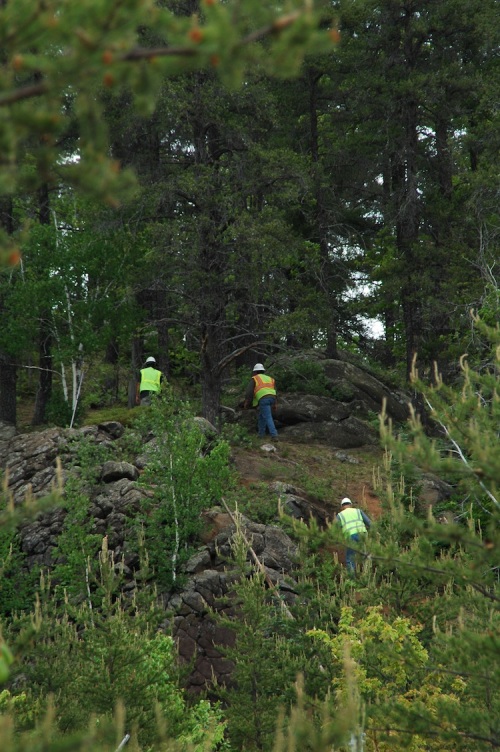
Corporate greed, government corruption, the promise of new jobs . . . this familiar formula for destruction and injustice is yielding the predictable results right here, right now in Michigan’s Upper Peninsula. Rio Tinto/Kennecott Minerals has begun its destruction of Yellow Dog prairie’s pristine public lands and Eagle Rock, a sacred Ojibwa site, in Marquette County.
The destruction here means more than the loss of a beautiful view. The mine will irreversibly pollute the entire Yellow Dog Water Shed, which feeds into Lake Superior. The waters that have sustained fish, turtles, birds and human beings for thousands of years will become a toxic dump site within the next decade. Why? So Rio Tinto, a British company with an extensive history of destructive mining practices, human rights violations and labor abuses, can produce profits for its shareholders.
“The two hallmarks of Rio Tinto are, one, they violate indigenous rights more than any other mining company, and two, they violate workers’ rights, in Australia, Canada and Utah,” says Gabriel Caplett, a local resident who has worked hard to stop the mine. “They do not like unions and they like contracting the work out so they don’t have to pay benefits or deal with organizers.”
A bulldozer operator who was clearing the site complained he wasn’t given enough of a gas stipend to get to the job site without using his own money. He was also concerned that his wages for the work were going to get cut—Kennecott is proposing new wage cuts for the contractor’s currently working for them. Many of the other workers that Kennecott refers to as having “Marquette County addresses” we’re brought in from other states. While 200 to 300 contractors may be kept busy during the pre-construction phase, specialists from Canada and South Africa will be brought in to do the actual construction of the mine. If Kennecott follows the common practice of the industry, the promised 200 permanent jobs created for locals will dwindle by half.
Sadly, locals are divided on the issue. While many are active, vocal opponents, others need work and find it easy to dismiss the ruin of their own habitat. “There’s a nostalgia for the past here, when a mine would employ hundreds and hundreds of people for years and years,” Caplett says. “This mine will probably only be open for five to six years. The mining companies like to come in and get out quickly. They make more money that way. Today’s mines don’t employ a lot of people and, don’t pay a lot of taxes.”

The promise of employment is just one of the tactics Rio Tinto used to access the mining site. To get the legal ball rolling, they used a strategy they found successful in other states. They crafted new state law, HB 6432 section 632, under the ruse of involving environmental groups to create more protections. In essence, the new law permits mining companies to mine on any site, be it a protected wetland, forest, sacred site or vital water source. While the first pages of the legislation seem to offer environmental protections, exceptions added later on give mining companies free reign to ravage Michigan’s natural resources.
Even with the law changed in its favor, Rio Tinto feared public outcry. In 2008, the firm hired Matt Johnsonaway from his job in Governor Granholm’s office. From 2003 to 2008, as director of the Governor’s Office for the Upper Peninsula, Johnson was the Governor’s contact and communications point person on metallic sulfide mining.
“He was the one that citizens spoke to (about the mine) up until 2008. He could have used the information to his advantage. He could have influenced Granholm on it,” Caplett says. ”Now he works for the company. It’s another one of those revolving door stories.”
Similarly disturbing, a 2009 ballot proposal campaign that sought to better regulate mining throughout all of Michigan fizzled amid squandered funds and questionable leadership. “A ballot initiative could be a useful democratic tool for protecting our water, public land and economy if it weren’t too costly for the regular citizen to pull off in Michigan,” Caplett says.
Then there’s geologist Joe Maki, from the DEQ’s Office of Geological Survey. According to Headwaters, “In court proceedings regarding the DEQ’s approval, Maki admitted under oath that neither he nor his review team applied a central tenet of Michigan’s new metallic mining law in approving Kennecott’s application.”

Maki also purported that he had lost a report that analyzed the mine’s proposed design as dangerous. Most disturbing of all, Maki remains the person responsible for inspecting the Kennecott mine and others in the UP.
“There has never been a mine of this type in a water-rich area that has not polluted the environment. The water here is very clean. This is one of the cleanest and most sensitive aquifers in the lower 48,” Caplett says. “A (proposed) hydrology study by the US geological service never happened. There’s no baseline data. Impact will not be able to be measured. It’s really a shame. The Yellow Dog Plains are really quiet, still really gorgeous. There are blueberries, clean rivers. It is a unique place. It will not be that way much longer.”
For more information, visit Stand for the Land and Lake Superior Mining News. Or, attend the 3rd Annual Protect the Earth Gre

