Candidate Profiles for the 3rd Congressional District
(This article was submitted by Josh Sadowski)

As congressperson Vern Ehlers has publicly announced his retirement, the seat for Michigan’s 3rd Congressional district has been left open for the November 2010 election season. There are seven candidates running for the office in the fall (five Republicans and two Democrats), however little is known about them.
The debates that have been held scantily covered by the local media and focused primarily on the Republican candidates (the district is considered “safely Republican” by most observers and with disorganized participation by the Democrats, it’s easy to see why). Many potential voters may be wondering where the candidates fall on a variety of issues and where they get their funding from.
Justin Amash is, by many estimates, the front-runner for the Republican Party and thus the front-runner in the race to fill Ehlers seat. Amash announced his intention to run prior to Ehlers announcement to retire, and received early support from Dick and Betsy DeVos. Amash’s early announcement may serve as an indication that he is aiming right of the current political establishment, looking to fill Ehlers seat with a more conservative voice.
By and large, what most distinguishes Amash from his opponents is his vehement support of the free market and criticism of government intervention, regulation, and social programs in all areas of the economy.
Amash’s voting record is particularly reactionary, leaving him sometimes standing alone as the only dissenting vote. Amash has gone as far as to vote “No” against subsidized healthcare for Autism, a ban on texting while driving, and Hire Michigan First legislations in Michigan.
Amash is considered a “tea party” candidate, as his stance on most issues is framed as anti-big-government and pro-free-market. However, in step with traditional right wing values, this philosophy is not extended to abortion or national defense, where Amash is pro-life and pro-military. Amash makes a point on his website to criticize government spending on healthcare, environment, and education, but not on the defense budget, (which accounts for nearly half of all federal discretionary spending).
With such a shift in public perception on the environment in recent years, all candidates at least attempt to appear “green”, and Justin Amash is no exception. On his website, he states that “government should punish businesses and individuals that pollute the land, water, or air of their neighbors”. However, Amash is one of the few members of the Michigan House to receive a 0% on Michigan League of Conservation Voters annual scorecard (43 Michigan congressmen and women were able to obtain a 100% rating).
Amash occasionally tries to appear in favor of popular government programs, however his record and contributions illustrate he is more in favor of big businesses running society. In Amash’s run for the Michigan House, he received contributions from the DeVos and Van Andel families, with much of his money (over $70,000) coming from his family’s own Michigan Industrial Tools. In this race thus far, Amash has received $25,000 from Michigan Industrial tools, nearly $20,000 from various health care providers, and a thousand each from Amway and AT&T.
Steve Heacock is a former Kent County Commissioner and a leader in the Van Andel Institute. To date, little is known about Heacock given his lack of voting record or political presence in the area. Given his previous rolls, it can be assumed that Heacock believes in a partnership between the public and private sectors. He was the chairman of the Convention and Arena Authority in Grand Rapids and has helped to bring the Van Andel arena, the DeVos place, and MSU’s college of human medicine to the downtown area.
Heacock has received campaign dollars from the Van Andel institute, as well as the law firm Warner, Norcross & Judd, who’s contributed over $40,000, making them the largest single contributor to any candidate, dwarfing the $25,000 Amash has received from his own Michigan Industrial Tools. Warner, Nocross & Judd is one of the largest law firms in Michigan.
Heacock’s stated views (per his website: http://heacockforcongress.com/the-issues/) do little to distinguish him from a run of the mill Republican. He does occasionally try to tap into populist attitudes by listing jobs and health insurance reform (or the repeal of) among his top priorities, but these stances are repeated by the other candidates and contradicted by Heacock’s positions on other issues.
For example, Heacock has proposed an “Eight Step Plan” to fix Michigan’s failing economy. The plan includes extending the “Bush Tax Cuts”, removing regulations on businesses, and passing any pending Free Trade Agreements to open up trade with any foreign nations we have neglected up to now, all of which have proven to be detrimental to Michigan workers by accelerating (or even causing) the collapse of the financial sector, concentrating wealth in corporate pockets, and exporting jobs to other nations with less labor regulations and lower costs to the business.
Ultimately, Heacock is will be seeking to define himself more fully in the debates and campaign ads that are sure to come. With little record to stand on, it can be expected that Heacock will follow the current republican talking points, which encourage Bush era deregulation and hawkish foreign policy.
“Hi, I’m Bob Overbeek and I’m not for sale.” If you’ve heard Bob Overbeek speak once since May, you’ve heard him say those words. Overbeek claims to be on the side of working class Americans and the working poor, and thus will not be accepting more than one dollar from any contributor. By this logic, as of March 31st, 478 people had contributed to Overbeek’s campaign, which is the dollar amount he has purportedly raised from outside investors. The remaining $2,071 in his war chest was self-contributed (this compared to $116,063 raised by Justin Amash and $88,187 by Steve Heacock).
While Overbeek claims to be in support of market solutions to societal issues (such as healthcare), he is by no means a tea party candidate. His website proclaims he is opposed to “continued action in Afghanistan with the deployment of US ground troops en masse”. He is the only candidate to mention either Iraq or Afghanistan so far in the campaign.
Overbeek also supports “card check”, which is largely considered a pro-union measure supported by some democrats (including Barrack Obama and Paul Krugman) and opposed by big business advocates such as the U.S. Chamber of Commerce and the National Restaurant Association.
Overbeek gained some media attention during the first public debate between candidates for the Third Congressional District when he pulled out a pair of vice-grips made by Justin Amash’s Michigan Industrial Tools, which were made in China. Overbeek criticized his opponent for supporting China as a Most Favored Nation in free trade. Amash failed to respond.
While Overbeek remains conservative on many issues (marriage, abortion, immigration, markets, guns) he is the most progressive of the Republican candidates in the race, giving the working poor the most to grasp onto. This is sure to be a target of his opponents, who are likely vying for the tea party vote. Considering Overbeek was the first to submit the required signatures to run in the election, he may have more support than his bank account suggests.
Bill Hardiman is a Michigan state senator and a former mayor of Kentwood Township. He is the only non-white candidate on the Republican side. Hardiman’s website features a picture of the senator posing with Sean Hannity, however the conservative pundit might be disappointed with mixed voting record.
According votesmart.org, Hardiman has supported such “liberal” and “big-government” legislation as Prohibiting Text Messaging While Driving (HB 4394), Renewable Electricity Standards (SB 213), and Tuition Assistance for Students in High Poverty Areas (SB 861), among others.
Hardiman’s voting record suggests most of all that he likes to be on the winning team, whether that be Democrats or Republicans. He has rarely supported a losing bill (and vice versa), voting with Democrats only when there were enough other republicans doing so to pass the legislation at hand (Hardiman works in the republican led Michigan senate). Hardiman is a populist among other senators, going along with whatever is popular at the time. There is little to suggest that his behavior in Washington will be different than it has been in Lansing.
In Hardiman’s campaign for state senator, he received contributions most often from Blue Cross Blue Shield, and often from DeVos family members, Realtor groups, and the Comcast Cable Company.
Ultimately, with Amash and Louise Johnson vying for the ultra-right wing, anti-government vote, Heacock coming from outside the political establishment, and Overbeek playing populist, Hardiman is going to be hard pressed to distinguish himself as a strong Republican people can trust in Washington.
Polls show people are frustrated with incumbents and America’s institutions in general. Hardiman, having allied with big businesses and worked to put Michigan where it is economically, may have his work cut out for him.
Louise Johnson is the only female in the race and she seems to be taking a far right, political outsider approach. However, this is difficult to discern considering an extreme lack of available information on the candidate. Her website suggests she is pro-life, pro-gun, and anti-government (she describes government as a “cancer” on her homepage, which begs the question, why try to work in government?).
Johnson is a member of the West Michigan Tea Party and a local lawyer at a law firm that specializes in criminal defense. She was characterized as a tea party candidate by the local press after the recent debate. However, considering the diverse range of views the tea party can attract, this information does little to inform voters of Johnson’s stance on any issues (other than perhaps taxes and the size of government, but that’s even arguable).
If Johnson is going to be a serious contender in the August primary she has some serious footwork in the coming months. As of March 31st, she had not yet reported any campaign financing information. Currently, Johnson is struggling to inform even interested voters of her positions on any of the issues facing West Michigan. Johnson’s lack of preparedness is eclipsed only by that of the Democratic contenders for the 3rd Congressional district.
Patrick Miles is the first of two Democrats registered for the August primary election. He is a Harvard Law School graduate (a class mate of President Obama) with no political record to speak of. Mile’s fundraising efforts are second only to Amash, and he has received contributions mostly from lawyers and law firms, the food and beverage industry, and non-profits. Other than these points, little is available on Miles.
Miles was the only candidate not to participate in a recent debate between those seeking Ehlers seat, and his website, though neat and sleek, does not give a basic rundown on his positions. It does feature a section called “Vision”, which is a sort of political abstract of the candidate. However, the section does little more than define Miles as a democrat who believes in vague ideas such as “job growth” and “investment in clean energy”.
Miles’ vision is also a bipartisan one, because according to his website “partisanship rules the day and things are not getting done right… we must work together to get results”. This suggests Miles is really a moderate who believes in compromising with the right, but it’s hard to tell.
According to opensecrets.org Miles has spent almost none of his $107,230 in campaign contributions. It seems as if the cannon is loaded and Miles, for reasons unknown, is waiting to fire.
Paul Mayhue is Miles’ only other Democratic contender and is a former Kent County Commissioner. As of March 31st, Mayhue had reported no campaign contributions and, as of June, has done very little to establish himself as a viable candidate. Mayhue’s website is difficult to find on the web (www.mayhue4u.com) and contains little content about what the former commissioner is proposing.
Mayhue’s website contains his positions on four issues: healthcare, education, jobs, and senior issues. Each section contains one or two sentences on the given issue, not giving the candidate much room to elaborate on anything other than the general importance of the issue at hand. Mayhue did come out in favor of universal healthcare early in the debate, but has since vowed to “inform our nation of the benefits of the recently passed legislation.” If Mayhue is willing to compromise on such an issue before even getting into office, this suggests that while he may have leftist ideals, he is more than willing to compromise and move right with the whole of the Democratic party. Again, with voters disliking the current political establishment, this move comes off as particularly weak and ineffectual.
Mayhue did participate in a recent debate with the five republican candidates. There he stated that he believed corporations such as BP should be criminally punished as citizens since they are treated as people under the law. Mostly however, Miles’ lack of participation in the debate left Mayhue to be outnumbered and outgunned by the Republicans, adding evidence to the perception that Democrats in the district are truly outmatched, in every sense, by Republicans.
Ultimately, the efforts of both Democratic candidates combined hardly compare to the work done by either Amash or Heacock separately. Thus far, Miles and Mayhue’s efforts are resembling those of the Democrats who have failed for the past 35 years to capture the 3rd district: insufficient, unorganized, and late from the starting gate. One has to wonder if the Democrats running in the 3rd district even believe they can win the seat.
Obama carried Kent County in 2008, which demonstrates some local willingness to vote Democrat. However, local candidates have failed to give West Michigan what Obama did – an inspiring and well organized candidate who believes he can beat Republicans in even the most conservative areas.
It is well known that the personality and presence of a candidate is as much or more important than their stance on the issues. Candidates who are timid and doubtful from the start are unlikely to garner any real support. Obama was a confident candidate who aspired to progressive ideals during the campaign, and he won over this “safely Republican” district. This makes the lack of a strong leftist candidate in this election seem like a missed opportunity for the left, especially for those disappointed with Obama’s retreat to the right while in office.
All things considered, with no sign of a confident candidate even left of center, November is shaping up to be a winning month for the far right in the 3rd district once again.

The US Social Forum got underway Tuesday with a jubilant march through the streets of Detroit. Thousands of people joined the march, which started at Warren and Woodward and ended at Cobo Hall, where an expected 20,000 people are gathering for workshops, plenaries, parties and cultural activities focused on social justice and systemic transformation.
The march united black, white, Latino, and indigenous peoples– as well as anarchists, socialists, union locals and activist mothers, youth and immigrants and dozens of affinity groups. One theme ignited the hopes of all, “Another world is possible!”
(Jeff Smith produced the video)
Reporting from the US Social Forum

Some of us who write for GRIID arrived today at the US Social Forum along with an estimated 12 – 15,000 people. There is a march at 3pm today, followed by an opening ceremony, which we plan to report on.
We will write about what we can, conduct interviews and write pieces based on the sessions we attend. GRIID will be reporting from the US Social Forum until Friday night.
Another World Is Possible! Another US Is Necessary!
It’s cool, if you’re White

This morning on MLive.com, the Grand Rapids Press posted a story that will be in today’s paper entitled, “Grand Rapids’ Uptown neighborhood held up as model of urban revival.”
The article is a follow up to stories that appeared Sunday on what young people think about Grand Rapids and the State’s Cool Cities initiative. From the very first sentence, the reporter equates being cool with being in certain neighborhoods and going to certain businesses.
In fact, the whole article (apart from the State’s Cool Cities manager) cites people who own businesses or are purchasing something at a business. This emphasis on the commercial element can lead one to conclude that being cool is equated with making money in a neighborhood district.
The article also cites Guy Bazzani, a local businessman who has done well financially constructing LEED-certified buildings throughout the city. At one point Bazzani, who is talking about public perception of crime in the Uptown area, says, “people that embrace diversity are very comfortable here.”
This is an interesting comment from Bazzani considering that everyone cited in this story is White. So, how is it that the Press reporter did not talk about what is cool in the Uptown area with anyone who is not White? Was this intentional or just a coincidence? Either way it doesn’t really matter, because readers will not know the intent of the reporter. The important point to make here is that everyone cited is White and that is how people could read the story. Some people may not notice this and that most likely has more to do with lack of awareness and privilege.

The last point that is worth noting which intersects with the other two points about the business focus and the racial representation, which is something that is missing in this story. The article paints a happy picture of a thriving area of the city, but omits any of the negative consequences of what all this commercial development has created.
Property values have gone up as a result of all of this development, particularly along the Wealthy Street corridor. Increased property values means higher taxes and increased rental costs, which has inevitably led some people to leave the neighborhood.
Another consequence to this gentrification has meant that many minority residents have felt alienated by all of the new businesses, most of which are owned by White people. Many African American people I have spoken with have felt added pressure both economically and culturally because of the commercial development projects.
Another omission in the Press article is the numerous minority owned businesses in the Uptown area. The reporter did not talk to the owners of Sandmans, the Guatemalan store on Wealthy or former gallery owner George Bayard who left Wealthy Street because of increased rent costs. Journalists cannot claim ignorance on such important matters, even if their “angle” is to write about “cool neighborhoods.” If the Press is going to address diversity and neighborhood changes they need to identify both the positive and negative consequences to these kinds of developments.
Fault Lines TV investigates BP Oil Disaster
In the two months since the Deepwater Horizon explosion, millions of litres of oil have gushed out of BP’s well into the water each day, slowly encroaching on the coastline. Fault Lines’ Avi Lewis travels to the drill zone, and learns about the erosion in the wetlands from industry canals and pipelines, the health problems blamed on contaminated air and water from petrochemical refineries.
(This article by Jeremy Scahill is re-posted from The Nation.)

Blackwater is up for sale and its shadowy owner, Erik Prince, is rumored to be planning to move to the United Arab Emirates as his top deputies face indictment for a range of alleged crimes, yet the company remains a central part of President Obama’s Afghanistan war. Now, Blackwater’s role is expanding.
On Friday, the US State Department awarded Blackwater another “diplomatic security” contract to protect US officials in Afghanistan. CBS News reports that the $120 million deal is for “protective services” at the US consulates in Herat and Mazar-e-Sharif. Blackwater has another security contract in Afghanistan worth $200 million and trains Afghan forces. The company also works for the CIA and the US military and provides bodyguards for US Ambassador Karl Eikenberry as well as US lawmakers and other officials who visit the country. The company has four forward operating bases in Afghanistan and Prince has boasted that Blackwater’s counter-narcotics forces have called in NATO airstrikes.
The new security contract was awarded to one of Blackwater’s alter egos, the United States Training Center, despite the indictments of five senior company officials on bribery, weapons and conspiracy charges. Its operatives in both Afghanistan and Iraq have been indicted for killing innocent civilians. The Senate Armed Services Committee has called on the Justice Department to investigate Blackwater’s use of a shell company, Paravant, to win training contracts in Afghanistan. Despite these and numerous other scandals, the State Department once again awarded the company a lucrative contract.
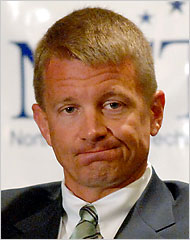
“Under federal acquisition regulations, the prosecution of the specific Blackwater individuals does not preclude the company or its successive companies and subsidiaries from bidding on contracts,” a State Department spokesperson told CBS. “On the basis of full and open competition, the department performed a full technical evaluation of all proposals and determined the US Training Center has the best ability and qualifications to meet the contract requirements.”
Representative Jan Schakowsky, who chairs the Intelligence Subcommittee on Oversight and Investigations, immediately blasted the State Department’s awarding of the contract to Blackwater. “This is a company whose cowboy-like behavior has not only resulted in civilian deaths; it has also jeopardized our mission and the safety of U.S. troops and diplomatic personnel worldwide. Instead of punishing Blackwater for its extensive history of serious abuses the State Department is rewarding the company with up to $120 million in taxpayer funds,” Schakowsky said. “I strongly believe that the former Blackwater should not be receiving further U.S. contracts, and I have repeatedly urged the U.S. government to no longer do business with this company. Though the name Blackwater has become synonymous with the worst of contractor abuses, the bigger problem is our dangerous reliance on such companies for the business of waging war.”
Earlier this year, Schakowsky and Senator Bernie Sanders reintroduced the Stop Outsourcing Security Act, which would phase out the use of private security contractors by the government. Ironically, Hillary Clinton was a co-sponsor of the legislation when she was a senator and running for president. Now, as Secretary of State, she is the US official in charge of most Blackwater contracts. Blackwater is also bidding on a contract potentially worth up to $1 billion to train the Afghan National Police.
The Grand Rapids Press and the BP Boycott
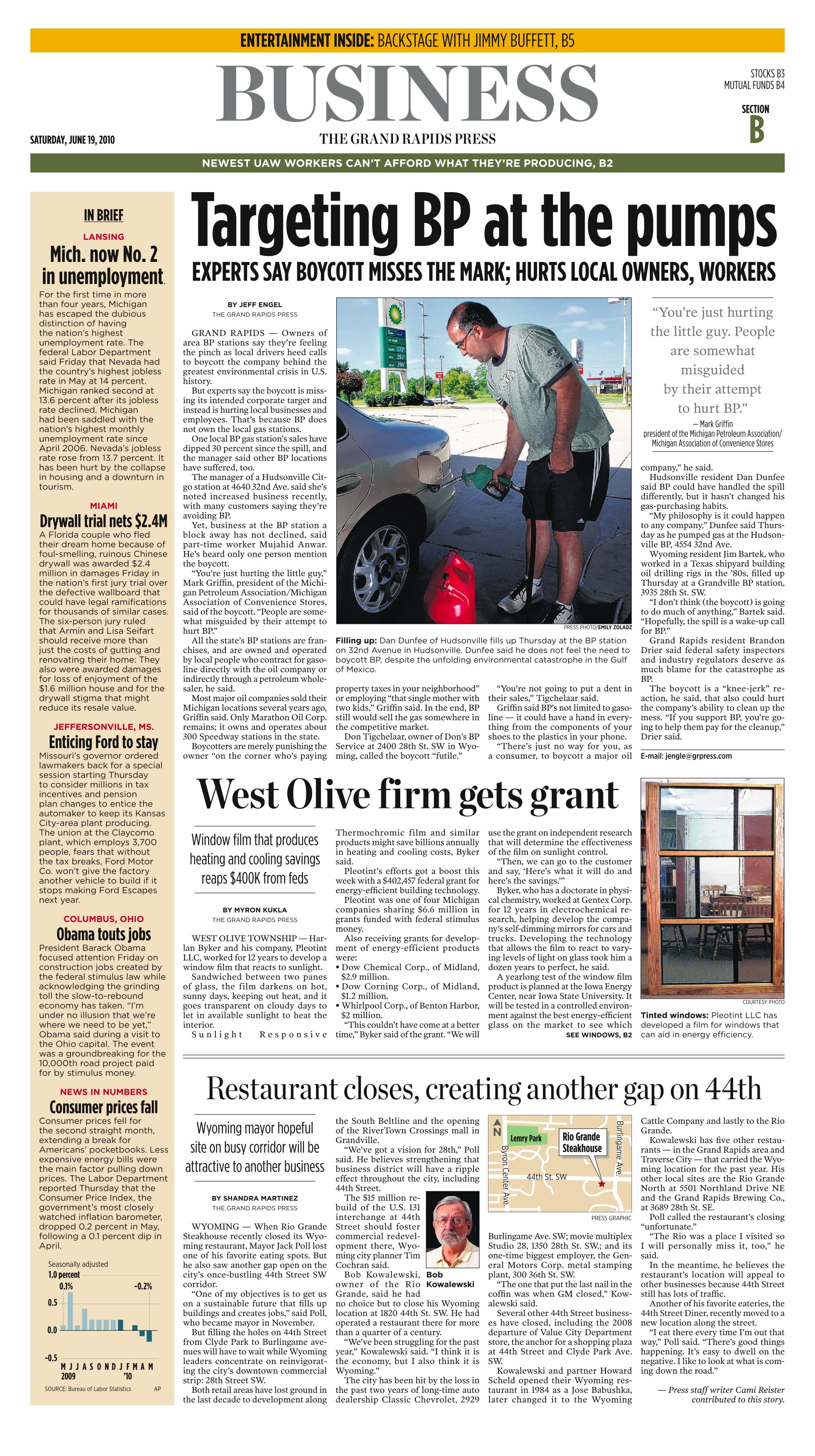
On today’s front page of the Grand Rapids Press Business section there is an article headline, “Targeting BP at the pumps: Experts say Boycott Misses the Mark; Hurts Local Owners, workers.”
With that kind of a title one might think that the Press spoke with people who have knowledge about the effectiveness of boycotts or how targeted boycott campaigns work. Instead the Press relies just one person whose credentials do not qualify them to address the effectiveness of boycotts.
The “expert” that the Press relies on is Mark Griffin, president of the Michigan Petroleum Association/Michigan Association of Convenience Stores (MPA/MACS). The MPA/MACS is essentially a business association that lobbies state legislators for the benefit of their members, which hardly qualifies Mark Griffin as an expert on this matter. He is merely defending his members, much like any business association would.
Griffin is quoted in the story as saying, “You’re just hurting the little guy. People are somewhat misguided by their attempt to hurt BP.” With such a statement one would think that the Press reporter would talk to someone who is actively involved in the boycott, at least providing readers with some balance.
However, the only other people that the Press cites in this story is a BP gas station owner and three consumers, none of which know anything about the organized boycott and therefore do not support it.

This article is another example of how the Press defends corporate and business interests, in addition to practicing poor journalism. The Press failed to report on the Grand Rapids BP boycott rally that took place yesterday in Grand Rapids and more importantly they spoke to no one who would have provided a counter perspective to Mark Griffin.
The Effectiveness of Boycotts
If the Press had bothered to practice journalism they could have found plenty of people who have participated in and organized boycotts in the past. For example in recent years the Coalition of Immokalee Workers has conducted boycotts against a variety of fast food chains in the US, like Taco Bell. Their boycott campaign was successful because it targeted locally owned restaurants.
Did these boycotts impact those individual owners and did they hurt workers? Of course they did, but that is the reality of any boycott, local business owners and workers will be impacted. However, this kind of pressure has historically forced local business owners to also pressure the corporation that is being targeted, which is the whole point of a boycott, to get consumers and other sectors of society to pressure the company that is the target of the campaign.
Other historical examples have been the grape and lettuce boycotts organized by the United Farm Workers, the Woolworth boycotts during the Civil Rights and the anti-Apartheid campaign against businesses making a profit in South Africa in the 1980s. All of these boycotts targeted local businesses that sold the products of the companies that were being targeted, which is why they were successful.
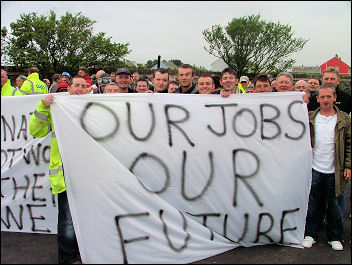
It’s official: suffering seems here to stay. For every job in America, there are six to seven workers competing for it. The unemployment rate in some Michigan cities is as high as 16 percent—and that doesn’t include all those who have exhausted their unemployment benefits months or even years ago. Michigan foreclosures on homes went up 46 percent in one year. Over one million residents here do not have any access to health insurance or affordable care.
But on the other side of the fence, take a look at the picture. Are big businesses suffering just like their workers? Quite the opposite, although they are working hard to hide that fact from the public. In February, for example, Ford announced it had $1.6 billion to retool facilities for more fuel-efficient vehicle manufacture. Its profits and “worker productivity” were up. Like many other companies, Ford is currently experiencing quarterly sales exceeding expectations. In March, its sales were up a staggering 43 percent.
But at the same time, Ford sadly announced that it wasn’t ready yet to start adding workers after having cut 47 percent of them in 2006. Blame the jobless recovery, a spokesperson said.
That term is everywhere. So what does “jobless recovery” really mean?
“Jobless Recovery” Means Exploitation of Workers
Many people who have jobs in Michigan are doing the work of two or three workers for one person’s pay. But they don’t dare complain because there’s an inexhaustible supply of fresh victims begging for a chance to take their places. Wages are stagnant, and have been for several decades. Benefits are eroding or have been cancelled completely. Pensions? A faint memory.
The creation of job scarcity—a boon to corporations—allows them to manipulate people and get them to accept working conditions that are untenable, even dangerous. And it fattens the bottom line: fewer wages are being paid out, and the work is still getting done, at a cost borne entirely by employees.
“Jobless Recovery” Means Union Busting
Earlier this year, Ford wanted its UAW workers to accept a wage freeze that would be in effect until 2015. The union rejected that demand. But GM and Chrysler workers were not so lucky. Their unions were forced last year to negotiate during the companies’ slide into supposed bankruptcy, and as a result, serious concessions were accepted.
This is only one way in which corporations are using the “jobless recovery” scenario to weaken and bust unions in this country. The scarcity of jobs in general creates an unprecedented labor pool, which is then used as a threat to unions, the traditional guardians of workers’ rights in this country. Anti-union rhetoric has notched up at the same time, making it sound like it is the unions who are responsible for the lack of jobs because of their supposedly outrageous demands for living wages and benefits.
The New York Times summed up this situation in a March 2010 article: “The declining influence of unions has made it easier for employers to shift work to part-time and temporary employees. Factory work and even white-collar jobs have moved in recent years to low-cost countries in Asia and Latin America. Automation has helped manufacturing cut 5.6 million jobs since 2000.”
“Jobless Recovery” Means Redistribution of Wealth
Representative Alan Grayson recently made the point that bank robbers can only steal as much money as a given bank holds at one time. But banks themselves have robbed the taxpayers of money they haven’t even paid into the system yet. The massive bailout that occurred under Bush and was sanctioned by Obama was the largest transfer of public money into private hands that has ever been accomplished: a crime unique in history. $12 trillion vanished right in front of our eyes.
This was the capper, at least so far, on a massive redistribution of wealth that began under Ronald Reagan. And at each point along the way, workers are promised that things will improve if they just accept the terms of the capitalists. Remember Obama’s promise that a big portion of the bailout money was going to go toward job creation? The numbers show that the Obama administration gave over 90 percent of taxpayer money to already profitable companies—with no requirement that they tell us what they did with it—and less than 10 percent for jobs programs.
Last month, 431,000 jobs were created in this country, which works out to 94 jobs per each Congressional district. All but 41,000 of those jobs were temporary census-taking positions. These are crumbs being tossed to people desperate for work and wages.
“Jobless Recovery” Means Class Warfare
Have you noticed all the economists who have started writing articles and making statements about how we’re now supposed to get used to the current poverty of jobs? Even the Obama Administration’s Department of Treasury issued a report stating that although business profits will recover by 2012, job availability will not significantly improve. In other words, we’re being told the “jobless recovery” is here to stay. Adjust your thinking. Learn to accept and scrape by.
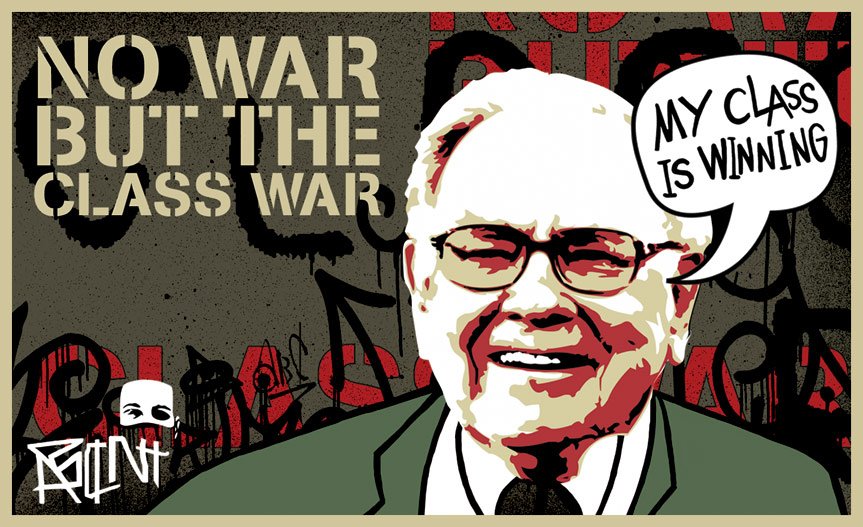
Be sure to read these statements for what they are: declarations of victory in a war against the working class. Even Representative Dennis Kucinich admitted that, when he said in December of last year, “The class warfare is over; we lost.”
But in this battle, only one side has been fighting so far: the capitalists, as they clean out the coffers and shatter the lives of ordinary people; as they control the government with campaign contributions and lobbyists and control the message by owning the mainstream media.
It’s time for workers to get into this war and fight back together. Only by creating a new system, one that honors collective ownership and the meeting of human needs, can this battle be reversed. It’s time to stand against those who have stripped so many in this country of so much. We don’t need a so-called recovery that offers us nothing. We need an out-and-out reinvention, a revolution.
Local Rally against BP joins worldwide outcry

A small group rallied near the driveway of the Eastown BP gas station today as part of a Rally Against BP, organized by members of The Bloom Collective. The rally was staged in solidarity with hundreds of other rallies happening around the world. Goals for the rally were to promote the national boycott against BP and to challenge our social dependence on oil.
A huge number of people biking and driving by smiled, waved, honked horns and gave enthusiastic “thumbs up.” A few asked what BP was and hadn’t even realized that their local gas station was affiliated with the corporation that caused one of the most horrific man-made disasters in America’s history.
It would have been nice if some of these folks had gotten out of their cars and joined the group on the sidewalk.
While this small rally may not make any recognizable impact on the current crisis, conversations among the group and with some passersby were both informative and inspiring. Only as people come together in community can change be effected. While most of the conversation focused on the BP spill, similar catastrophes in the US, Ecuador and Nigeria and the US government’s failure to respond, we also talked about what a post-oil community could look like.
Having a vision of such a future is the first step towards arriving there.

Yesterday, the Grand Rapids Press reported that the Kentwood-based company Borisch has announced another expansion to accommodate their growth in weapons manufacturing.
The Press article focuses on the business expansion and job growth that the weapons manufacturer has announced, stating “new contracts are spurring a $7 million expansion and the addition of at least 150 jobs within two years.”
With the job market so limited in Michigan, any announcement of new jobs tends to receive news coverage. However, the Press article doesn’t acknowledge that since these are jobs based on Pentagon contracts, taxpayers are really subsidizing these new jobs.
In addition, there is nothing in the article about what Borisch makes, other than a picture of an F16 fighter jet. The company makes parts for the F16 fighter jets, combat helicopters and accuracy systems for artillery. The US sells F16s to numerous countries, including Israel, which used F16s in its bombing of Gaza last year.
Borisch doesn’t provide specific enough information on what kind of combat helicopters and artillery they make systems for, but you can bet that these weapons are also used to terrorize innocent civilians around the world.
One last piece on Borisch is there public display of an Old Testament bible verse on their company logo, Psalm 115:1. This verse reads, “Not to us, O LORD, not to us but to your name be the glory, because of your love and faithfulness.” Like other military focused businesses in the US such as Blackwater, Borisch sees no contradiction in making weapons of war and promoting biblical values.
 Grand Rapids Institute for Information Democracy