Corporate welfare for corporate polluters in Michigan
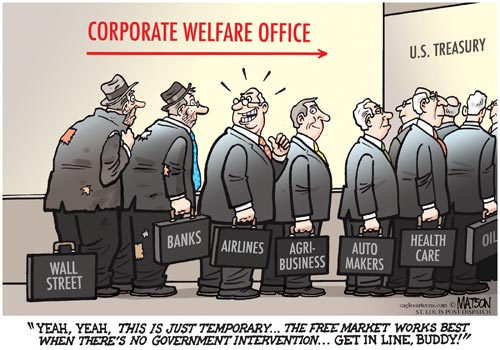
According to the business journal MiBiz.com Michigan Senator’s Levin & Stabenow have announced that the US government is providing huge taxpayer subsidies to major corporations in Michigan for energy-efficient building technologies.
The US Department of Energy funded projects in Michigan total $6,641,523 and will go to just four companies. Three of the four companies to receive taxpayer funded welfare funds are Dow Chemical (will receive $2,955,156), Dow Corning Corp. (will receive $1,241,120) and the Whirlpool Corporation (will receive $2,042,700) all have a record of pollution and deceiving the public.
Dow Chemical has been producing toxic substances that have caused a tremendous amount of disastrous consequences for human health and environmental integrity, not to mention the suffering caused from napalm production. Dow Corning is partly owned by the Dow Chemical Company and they have a long history of testing on animals for their silicone-based products.
The Whirlpool Corporation has a long history of anti-union activity and in recent years has also been involved in racist campaigns of gentrification and displacement in the Benton Harbor/St. Joseph area.
The business press reported this corporate welfare as “good” for Michigan, but it is important for us to seriously question this reality. First, why is it celebrated when corporations receive taxpayer money, but when poor people receive welfare they are vilified? Second, doesn’t government/taxpayer subsidies fly in the face of so-called free market principles, which call for limited or no government intervention with the economy? Third, why does the government and specifically Michigan Senators reward corporations with funding for energy efficiency when they have demonstrated not only a complete disregard for the environment, but a primary interest in increasing their own profits?

Organizers from Detroit and Rising Tide North America hosted a workshop on direct action and climate justice this morning. Part of the session was designed to discuss and finalize an action for the end of the US Social Forum on Saturday that will confront one of the most polluting industries in Detroit.
Detroit has a oil refinery facility that is expanding, a larger coal fired powered plant and a new waste to energy incinerator, all of which are huge polluters and are all located in low income & minority communities.
The presenters begin by providing a critique of the large national environmental groups, which have in many ways hijacked the discussion around climate change, which ignores climate justice. They mention that the focus of these groups is on band aide changes like changing light bulbs, but more problematic is the fact that these groups often partner with major corporations who are also engaged false solutions to change.
In contrast, the presenters of this session promote confrontation with these corporations & organizations that are attempting to co-op real climate change/climate justice. They also believe that instead of aligning with sources of economic & political power that a real climate justice movement needs to be in the streets and organize with the people.
Some of the actions that the presenters have participated in has been confronting companies that promote carbon offsets, which a really a myth and will not result in any serious change.
Direct Action Campaigns
One of the presenter, who is from South East Asia, made it clear that while people tend to think of young White activists as ones who engage in Direct Action, that in fact Direct Action really has its origin in land-based communities who have fought colonialism and other imperialist policies around the world.
A representative with the Ruckus Society shared a story about an action that they participated in a few years ago. Indigenous people on the Klamath River were confronted with dam projects and invited the Ruckus society to participate in a campaign to confront the dam projects, which were threatening one of the core elements of the native culture – salmon.
The campaign decided to confront the major financial backer of these damn projects, Warren Buffet. People first went to a shareholders meeting to confront him on his support for this dam project. Native woman from Omaha joined them and did a die-in to make a point about what these mega-dam projects will do to Native communities.
The organizers had people ask questions of Warren Buffet during the shareholders meeting, asking him to not fund such projects. In fact, so many people asked similar questions that the shareholders meeting ended the open mic session. Afterwards many of the shareholders then asked the Native women how they could support this struggle.
After the shareholders meeting native communities along the Klamath River began organizing direct action trainings, where the Ruckus Society merely provided support for these communities. Since then each of these communities have been participating, which eventually resulted in a written agreement to remove the dams along the river.
One lesson that the presenter wanted to affirm was that it was important in this campaign that the Ruckus Society did not impose their skills on these communities, rather they acted in solidarity and made sure that the campaign was owned by the Native communities.
Planning for Saturday’s Action

When organizers meet with people from Detroit, the people here emphasized that they wanted an action that was rooted in non-violence and reflected beauty. The presenter for this part of the session provided some evolution of Direct Action in the Americas, beginning with the Zapatistas in southern Mexico.
For this presenter, Seattle represented a turning point for how to organize, since the creation of the WTO presented a perfect opportunity to do a more broad-based campaign of Direct Action. He told those in attendance that people who had never participated in Direct Action join them in preventing government & corporate representatives from attending the WTO meetings.
What they learned from the Seattle action was the importance of decentralized organizing, which made it harder for police to stop the action and allowed for more diversity in how to engage in Direction Action.
Climate change/global warming is also a perfect issue to organizer a long term Direct Action strategy, not only because of the urgency of the issue, but because global warming is a clear example of what is wrong with global capitalism.
People Power Strategy is the model that one of the organizers use, which provides a power analysis of whatever people are confronting. The presenter gave the example of how people confronted the Serbian leader Slobodan Milosevic.
People Power Strategies are now being used in the global justice and climate justice movements. Another point the presenters made is that it is more important for people to fight corporate polluters in their communities and their states instead of challenging Obama on these policies.
Towards the end of the session people shared stories about local campaigns and examples of Direct Action that have worked. One woman shared a recent story about people taking to the streets in southern California for immigrant rights. People occupied an intersection and when it became apparent that the police were coming after those in the street many more people joined them, many of which were undocumented.
Another example of a Direct Action campaign focused on confronting incinerators in communities of color. People organized around a common theme of clean air and asthma, which made it a more effective campaign since everyone wants clean air. The campaign was also effective because the image of children suffering from asthma.
This session was inspiring and provided great examples of Direct Action campaigns as well as some principles and tactics that can be applied no matter where you live.
Switch to Petraeus Betrays Afghan Policy Crisis
(This article by Gareth Porter is re-posted from Common Dreams.)
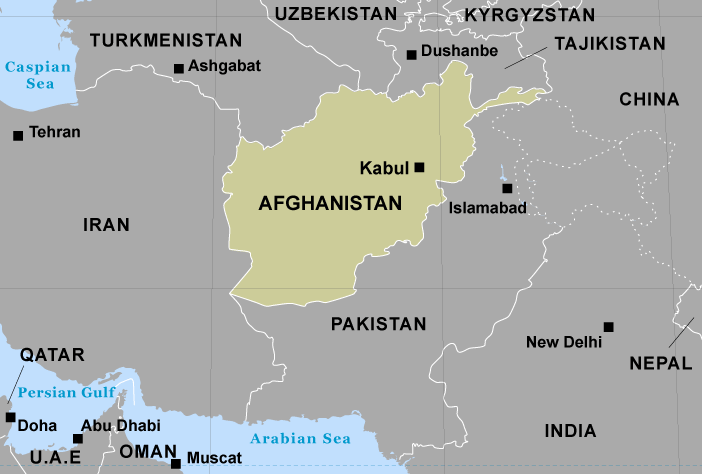
Despite President Barack Obama’s denial that his decision to fire Gen. Stanley A. McChrystal as commander in Afghanistan and replace him with Gen. David Petraeus signified any differences with McChrystal over war strategy, the decision obviously reflects a desire by Obama to find a way out of a deepening policy crisis in Afghanistan.
Although the ostensible reason was indiscreet comments by McChrystal and his aides reported in Rolling Stone, the switch from McChrystal to Petraeus was clearly the result of White House unhappiness with McChrystal’s handling of the war.
It had become evident in recent weeks that McChrystal’s strategy is not working as he had promised, and Congress and the U.S. political elite had already become very uneasy about whether the war was on the wrong track. In calling on Petraeus, the Obama administration appears to be taking a page from the George W. Bush administration’s late 2006 decision to rescue a war in Iraq which was generally perceived in Washington as having become an embarrassing failure. But both Obama and Petraeus are acutely aware of the differences between the situation in Iraq at that moment and the situation in Afghanistan today.
In taking command in Iraq in 2007, Petraeus was being called upon to implement a dramatically new counterinsurgency strategy based on a major “surge” in U.S. troops.
Obama will certainly be put under pressure by the Republican Party, led by Sen. John McCain, to agree to eliminate the mid-2011 deadline for the beginning of a U.S. withdrawal and perhaps even for yet another troop surge in Afghanistan. But accounts of Obama administration policymaking on the war last year make it clear that Obama caved into military pressure in 2009 for the troop surge of 2010 only as part of a compromise under which McChrystal and Petraeus agreed to a surge of 18 months duration. It was clearly understood by both civilian and military officials, moreover, that after the surge was completed, the administration would enter into negotiations on a settlement of the war.
Petraeus’s political skills and ability to sell a strategy involving a negotiated settlement offers Obama more flexibility than he has had with McChrystal in command. Contrary to the generally accepted view that Petraeus mounted a successful counterinsurgency campaign in Iraq, his main accomplishment was to make the first formal accommodation with Sunni insurgents.
Petraeus demonstrated in his command in Iraq a willingness to adjust strategic objectives in light of realities he could not control. He had it made it clear to his staff at the outset that they would make one last effort to show progress, but that he would tell Congress that it was time to withdraw if he found that it was not working.

As commander in Iraq, Petraeus chose staff officers who were skeptics and realists rather than true believers, according to accounts from members of his staff in Iraq. When one aide proposed in a memorandum in the first weeks of his command coming to terms with the Shia insurgents led by Moqtada al Sadr, for example, Petraeus did not dismiss the idea.
That willingness to listen to viewpoints that may not support the existing strategy stands in sharp contrast to McChrystal’s command style in Afghanistan. McChrystal has relied heavily on a small circle of friends, mainly from his years as Special Operations Forces (SOF) commander, who have been deeply suspicious of the views of anyone from outside that SOF circle, according to sources who are familiar with the way his inner circle has operated.
In an interview with IPS, one military source who knows McChrystal and his staff described a “very tight” inner circle of about eight people which “does everything together, including getting drunk”. “McChrystal surrounded himself with yes men,” said another source who has interacted with some of those in the inner circle. “When people have challenged the conventional wisdom, he’s had them booted out,” the source said.
The McChrystal inner circle has been accustomed to the insularity that Special Operations Forces have traditionally had in carrying out their operations, the source added.
The primary example of McChrystal’s rejection of outside expertise that challenged his beliefs cited by the sources is the case of David Kilcullen. Kilcullen, a retired Australian Army officer, is recognized as one of the most knowledgeable specialists on insurgency and was an adviser to Petraeus in Iraq in 2007-2008. Kilcullen is known for speaking his mind, even if it conflicts with existing policy.
After McChrystal took command of U.S. and NATO forces in Afghanistan last year, Kilcullen was slated to become an adviser on his staff. But after some early interactions between Kilcullen, and the McChrystal team, that decision was reversed, the sources said.
Kilcullen’s views on targeted killings as wrongheaded clashed with the assumptions of McChrystal and his inner circle. McChrystal’s staff was also supposed to create a “red team” of outside specialists on Afghanistan who could provide different perspectives and information, but after the inner circle around McChrystal tightened its control over outside information, the idea was allowed to die, according to one source.
Several members of McChrystal’s inner circle are officers who worked for the general during his five-year stint as head of the Joint Special Operations Command, which carried out targeted raids aimed at killing or capturing insurgent leaders in Iraq and Afghanistan from 2003 to 2008, the sources say.
Two of the key officers on McChrystal’s staff who were part of his former JSOC inner circle are his intelligence chief, Maj. Gen. Michael T. Flynn and his Deputy Chief of Staff for Operations, Maj. Gen. Bill Mayville. Flynn was McChrystal’s director of intelligence at JSOC from 2004 to 2007 and then his director of intelligence at the Joint Staff in 2008-2008. Mayville also served under McChrystal at JSOC. McChrystal’s political adviser, retired Army Col. Jacob McFerren, is not a veteran of JSOC. But he is described by one source familiar with McChrystal’s team as one of the general’s old Army “drinking buddies”.
Ban Great Lakes Drilling

(This action alert is from Progress Michigan.)
When U.S. Rep. Joe Barton apologized to BP executives for the “shakedown” they suffered – meaning the money the reckless drilling company set aside to begin paying for their oil spill in the Gulf of Mexico – he wasn’t, as he later backpedaled, speaking only for himself.
He was speaking for all 114 members of the Republican Study Committee, a caucus for extreme right lawmakers that includes Michigan Congressman Pete Hoekstra. The caucus issued a press release in defense of BP, making it clear the group and its members — like Barton and Hoekstra — are on the side of Big Oil.
Pete turned his back on the people in Gulf by defending BP. He turned his back on the people of the Great Lakes, where BP has dumped waste and toxins. It’s only a matter of time before he offers BP the keys to the kingdom and tries to open the Great Lakes for drilling. Tell Pete and his pals we won’t stand for “Drill, baby, drill” in Michigan, by signing this petition and sharing it with others.
USSF addresses women’s issues
“] It’s often said, “You can tell a lot about a society by the role its women play.” The community of folks gathered at the US Social Forum are an example of an adage in action, showing by example that a just world is possible for women.
In the meantime, a lot of work needs to be done. Scores of USSF workshops are sharing how to do that work. Several of them spoke to the issue of women and poverty.
In the workshop, “Women’s Poverty through th e Lens of Social Documentary photographer Milton Rogovin,” facilitator Toma Lynn Smith, of the Louisville National Organization of Women, presented some striking facts about how women are undervalued in the US.
- Women annually contribute $15 trillion worth of unpaid work to the US economy in the form of care-giving and housework.
- Though the first equal pay for equal work bill was introduced in 1950, women in 2010 only earn 77 cents for every dollar men earn.
- Traditional “women’s work” is valued less than “men’s work” requiring comparable skill. For example, a male van driver earns $1,382 a month while a female clerk typist earns $1,115.
- Women performing jobs traditionally held by men face many challenges from co workers and often lag in advancement.
- Men performing jobs traditionally held by women often are chosen for advancement over women co-workers.
From 1952 to 2002, Rogovin traveled the world taking photos of the working poor because, as he said, “The rich have their own photographers.” His photos show poor women toiling as coal miners, a bartender, a storefront preacher, sex workers, steel millers and caregivers.
One middle-aged woman attending the workshop wisely commented about a photo of a woman doing grueling work in a factory, “She seems to be saying ‘this is the length I will go to make things work for my family, so my daughter can become a teacher and my son an attorney… and that’s personal.”
Other worlds are possible
 Attending the US Social Forum now taking place in Detroit has one major drawback. With around a thousand workshops to choose among, how do you decide which nine or ten to attend? The bright side of this dilemma is that you are bound to find some topics that exceed your wildest workshop dreams.
That’s how I felt when I took part in “Other Worlds Are Possible: Visionary Fiction, Organizing and Imagining the Future.” I confess, I am a science fiction geek. When I stare at the two thousand worthwhile non-fiction titles on the shelves of The Bloom Collective during my shift, I am shamed that I can better describe the history and peoples of the planet Arakis than the roots of anarchism and its major players.
 Imagine my delight in hearing the facilitators, including poet and journalist, Walidah Imarisha, and Morrigan Phillips, editor and contributor to LeftTurn magazine, describe the role of visionary fiction in creating social change.
What is visionary fiction? Visionary fiction explores current social issues. It raises consciousness about identity in terms of race, class, gender and power. The plots involve social transformations happening from the bottom up. Ultimately, power will be wielded by the oppressed.
Did you know W.E. B. DuBois wrote a sci-fi short story, “The Comet” in the 19-teens where a working class black man and a rich white woman are the only two people left on earth? Other writers of visionary fiction discussed included Octavia Butler, Derrick Bell and Ursula LeGuin.
“White male sci-fi writers say visionary fiction bastardizes the genre,” one facilitator noted. “And authors of color are not acknowledged as writing that genre as their books are often shelved in the “Black” section in bookstores.”
After reading the introductory pages of Derrick Bell’s short story, “Space Traders,” workshop attendees discussed how the story addresses the historical oppression of people of color, the role of religion and hierarchy in colonialism and how racism shapes people’s judgments of themselves and others.
Unlike a non-fiction treatise of any of those issues, visionary fiction can engage a wider audience and remove barriers to seeing empire, militarism, racism, environmental concerns and gender inequity issues in a new and realistic light.
Another world is possible–but we have to envision it first. Write on!
I just finished participating in an amazing workshop with highly skilled organizers from New York City, known as Shift NYC. The workshop was designed primarily for people who could be allies with those who are most impacted/targeted by gentrification.
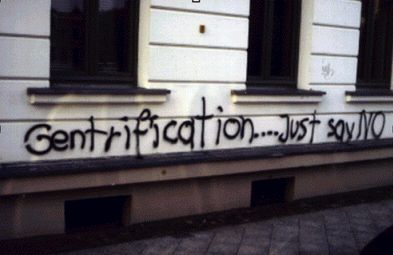
The session began with an exercise asking participants questions like – how long have you lived in the neighborhood you are in now? Have you ever found yourself intimidated by police coming into your neighborhood? Have people, homes or green space been displaced because of gentrification in your neighborhood? Are there organizations in your community working on anti-gentrification? Have you supported people who have been most impacted/targeted because of gentrification?
The session organizers then provided people with some working definitions of gentrification and acknowledged that it is a systemic problem and therefore it needs a response that calls for systemic change.
Gentrification – The phenomenon in which low-cost or “low-value” neighborhoods are developed and “improved” through purchase and renovation of land and businesses. This process transforms the neighborhood into a “high-value” neighborhood causing the displacement of long-term residents and businesses who are often low-income, poor, and people of color, to make way for the influx of middle class and upper class communities. Gentrification also involves and relies on the support of other institutions like police, education/schools, transportation, housing, etc to effectively pave the way for middle and upper class communities to move in.
The session organizers also pointed out that in addition to people being displaced by gentrification, cultures can be displaced as well as natural habitat by new structures or parking lots.
Shift NYC has worked with Right to the City, a national organization established in 2007 that focuses on urban justice and movement building. They session organizers stressed the importance of working with existing entities who do anti-gentrification work if they exist in your community.
The bulk of the session was devoted to small group discussion around what it means to be an ally with those that are negatively impacted/targeted by gentrification. They stressed the importance of accountability and self-interest for those who are allies, especially since being an ally inherently means we are acting from a position of privilege.
“If you have come to help me, you are wasting your time. But if you have come because your liberation is bound up with mine, then let us work together.” Australian Aboriginal Group

The small group discussion had each group arguing different ways in which people of privilege can respond. Some people of privilege will say that there is nothing they can do and therefore do nothing. A second response is when individuals decide to do something to help and that might include signing petitions or sharing skills that those individuals have. A third response was for people or privilege to use that privilege, but from a distance – not developing a relationship with those most impacted/targeted by gentrification. The fourth position was a form of solidarity, where people of privilege develop relationships with those impacted/targeted, listen to the needs/desires of that community and then using the resources/power of our privilege to work with those most impacted/targeted by gentrification.
The session did not deal with specific tactics used in fighting gentrification, because the organizers felt that since every community where this occurs has unique dynamics that makes it difficult to provide a simple blueprint for this kind of work.
The session participants seem very animated and inspired by the information and activities. It was clear that people felt better equipped to move forward to fight gentrification having participated in this session.
The True Cost of Coal – A Beehive Collective work

Here is a short video with footage of the latest Beehive Collective work called the True Cost of Coal. Another great example of the power of art to inspire and inform us about acts of injustice and acts of resistance around the world.
Anti-Imperialism is Green: USSF workshop

Global Exchange hosted a session to discuss and analyze the impact of US-based policies that impact other countries negatively with Climate Change. They showed a video that looked at the People’s Climate Summit in Bolivia, which points out that imperialist policies make climate disparities greater for the poorer countries of the world and that those of us in the US should pay massive reparations for what this country’s policies have meant abroad.
Michigan policies to confront this – Lansing Bike Co-op formed recently to provide affordable bikes to people, tools for repair, bartering, skill share and workshops for the community on a variety of topics. The bike co-op also has a garden and fair trade coffee project, which delivers the coffee by bicycle.
Another presenter talks about the Highland Park project, which is based in Detroit. The presenter asks people what barriers there are changing the culture in the US. Some identify a power imbalance, poverty, racism, corporate media, intertwining of economic and political power and the education system.
The question is then asked what solutions can we come up with to confront these imperialist projects. One person suggested identified local polluters and then engaging in various forms of direct action. People also mention it is important to not by into the idea that just changing personal behavior is enough to create systemic change. Another person pointed out that US militarism is a huge contributor to the climate crisis and that anti-war, anti-imperialist groups need to build alliances with environmental-focused groups when possible.
The presenter then begins to engage people about localized examples of truly sustainable communities. In the Highland Park area they are working to transform neighborhoods with their Green Economy Training. The project includes creating garden space and sustainable demolition, where resources from the homes demolished would be used for any new projects. Another component of the project is to create some alternative energy sources that would allow people to get off the grid of DTE and Consumers Energy.

Highland Park is a predominantly African American community, with about 75% of the population living in poverty. The project is a partnership with residents and other entities that have a commitment to transforming that community. It is evolving and may take a direction of its own, but the intent is to provides skills and resources to people from Highland Park the opportunity not only transform their community, but to create alternative futures through education and economic opportunities.
Besides Highland Park, they discussed another project in the Appalachian part of West Virginia. Since mountaintop coal removal is the biggest issue facing them, this project is not only confronting the coal mining industry, but looking at ways create a green economy that truly benefits to residents of works of Appalachia.
Another speaker shared stories of another project in the Washington, DC area. This project is called weatherize DC and is designed to build more equity in communities that are currently devastated by poverty. By doing weatherizing and education about energy efficiency, people not only can save on energy costs, it provides employment for people.
One of the presenters also mentions that there are other campaigns like one in Utah that is challenging tar sands mining, a bike caravan project in the New England states and a project in Cleveland that is similar to the one in Highland Park.
While there was interesting information about local projects around the country, the session did not really present any serious anti-imperialist analysis or strategy. Working at the local level to transform our communities is extremely important, but it is not enough to combat what US consumption and US militarism abroad has done to communities. In addition, not challenging US imperialism abroad is often because of privilege. People who have privilege in this society, even if they are working on climate change work in their communities, are the “beneficiaries” of US imperialism, which in the case of climate change means that they don’t feel the brunch of global warming to the degree that communities around the world do. As the Bolivians in the video screened at the beginning of the session said, the US must pay massive reparations to countries that US imperialism has impacted.
Separation of Oil & State

(This article is re-posted from Oil Change International.)
Last week, Barack Obama joined every President since Richard Nixon in calling for an end to our dependence on oil. Like both Bushes, Clinton, Reagan, Carter, Ford and Nixon, the rhetoric was great, but the specifics were…lacking.
We all know we need to end our dependence on oil. To get there, we need not only good ideas for clean energy policy and innovation, we need a separation of oil and state.
The Separation of Oil & State campaign is about breaking the co-dependent, dysfunctional, destructive relationship between the oil industry and the US government.

The sad fact is that after 40 years of tough talk from Presidents, the oil industry is giving and getting more money than ever before. Just two weeks ago, with the Gulf disaster spewing away, the US Senate defeated a measure that would have eliminated some oil subsidies. It’s outrageous.
Enough is enough. To break our nation’s addiction to oil, our Representatives will have to break their addiction to oil money. No more oily Congress. No more subsidies as rewards for campaign contributions. Our government should represent us, not the fossil fuel industry.
Join the Separation of Oil and State campaign and write your representatives in Washington today.
After you’ve taken action, please tell your friends about the campaign. We need to build a movement to demand that our government represent us, not the fossil fuel industry. Please help us.
Over the next several weeks, we’ll be providing new and updated tools to help you hold Washington accountable. We’ve heard enough promises, it’s time to demand action.
 Grand Rapids Institute for Information Democracy