
State Representative Kim Meltzer (R-Clinton Twp.) has stated that she plans to introduce immigration legislation like that recently passed in Arizona.
Just like Arizona’s law, Rep. Meltzer’s bill would require local police to ask for the immigration papers of anyone suspected of being in the U.S. unlawfully.
Not only would such a policy invite and virtually compel racial profiling, it would force police to divert scare resources away from public safety and solving serious crimes.
Sign this petition to send a message to your state representative, state senator and Governor Granholm to urge them to reject any effort to move forward this discriminatory and unfair bill.
(This story is re-posted from the Center for Responsive Politics.)
At least seven members of Congress reported holding a minimum of $15,000 in BP stock at the end of 2009, according to a preliminary analysis of personal financial disclosure reports by the Center for Responsive Politics.

The Clerk of the House and Secretary of the Senate on Wednesday released reports covering the personal financial activities of members of Congress and their families for 2009. The Center’s preliminary investigation focused on the reports of the 20 members of Congress who reported earning income from BP holdings or owning BP stock in 2008.
Of these, the seven who reported holding more than $15,000 in BP stock were: Rep. James Sensenbrenner (R-Wis.), Rep. Rodney Frelinghuysen (R-N.J.), Sen. John Kerry (D-Mass.), Rep. Fred Upton (R-Mich.), Sen. Judd Gregg (R-N.H.), Sen. Sam Brownback (R-Kan.) and Sen. Ted Kaufman (D-Del.).
Furthermore, at least one member of Congress bought five-figures worth of BP stock in 2009, the Center’s preliminary analysis found: Rep. Vernon Buchanan (R-Fla.).
In addition to becoming politically toxic, BP stock has seen its value drop by half since April 20, when an oil rig it operated exploded in the Gulf of Mexico. The disaster has since caused millions of gallons of fossil fuels to leak into the surrounding waters.
At least one congressman who owned BP stock in 2009 said he has since sold it off.
“Senator Gregg no longer owns any BP stock,” spokeswoman Laena Fallon told OpenSecrets Blog.
Fallon did not elaborate on when or why he sold the stock.
Sensenbrenner, an heir of Kimberly-Clark, reported at least $100,000 in BP stock. (Disclosure rules only require lawmakers to reveal the value of their assets and liabilities in broad ranges, not exact amounts.) In 2008, he had a net worth of about $13 million, ranking him 30th in the House.
Spokeswoman Wendy Riemann said the congressman inherited stock in Amoco in 1978, before the company was bought by BP. He has no plans to sell it, Riemann said.
Kerry’s wife, Teresa Heinz Kerry, held a minimum of $350,000 in BP stock at the end of 2009, according to Kerry’s newly released financial report. He, himself, owns only between $1,001 and $15,000 in BP.
Kerry spokeswoman Whitney Smith said the senator has no plans to sell off his small holding in BP stock, which he inherited in a family trust.
“Senator Kerry has been the Senate’s best environmental champion for more than 25 years and has written and urged legislation to end our dependence on foreign oil,” Smith said.
Smith added Kerry’s stockholdings in BP would not impact his vote on pending legislation.
“Inherited holdings in family trusts he has no control over whatsoever clearly have no impact on his fight for a green economy and a clean environment,” she said. “Indeed, by that standard, he’s cast scores of votes against his own economic interests, and these industries have spent millions against him in political and legislative campaigns.”
The offices of Reps. Buchanan and Upton and Sens. Kaufman and Brownback did not respond to requests for comment Wednesday. Rep. Frelinghuysen’s investment in BP was discovered after business hours Wednesday, and his office could not be reached for comment.
Deconstructing Obama’s BP Speech
(This article by Anthony DiMaggio is re-posted from CounterPunch.)

Obama’s speech to the nation addressing the gulf disaster was filled with more eye candy than substance, laden with propaganda and deception. It was primarily intended to exonerate his administration for its inaction and incompetence in dealing with the worst environmental disaster in U.S. history. A close examination of Obama’s speech is in order to sort through the misinformation that’s been disseminated to the public. Below I include excerpts from Obama’s speech, interspersed with my own clarifications of his distortions and lies.
Obama: Good evening. As we speak, our nation faces a multitude of challenges. At home, our top priority is to recover and rebuild from a recession that has touched the lives of nearly every American. Abroad, our brave men and women in uniform are taking the fight to Al Qaeda wherever it exists.
AD: The “War on Terror” and attempts to combat economic troubles at home run directly contrary to each other. U.S. education and health care are in such dire straits precisely because U.S. leaders prefer to spend nearly a trillion dollars a year on militarism, while states cry poor and demand massive budget cuts that throw thousands out of work at a time when they’re at their most vulnerable. U.S. officials know that, if given the choice, the public favors cuts in military spending and a renewed focus on job creation, economic rehabilitation, and other social spending. This is why Democrats and Republicans spend so much time on fear mongering, drumming up support for indefinite war among a reluctant public.
Obama: And tonight, I’ve returned from a trip to the Gulf Coast to speak with you about the battle we’re waging against an oil spill that is assaulting our shores and our citizens.
On April 20, an explosion ripped through BP Deepwater Horizon drilling rig, about 40 miles off the coast of Louisiana. Eleven workers lost their lives. Seventeen others were injured. And soon, nearly a mile beneath the surface of the ocean, oil began spewing into the water.
Because there’s never been a leak this size at this depth, stopping it has tested the limits of human technology. That’s why, just after the rig sank, I assembled a team of our nation’s best scientists and engineers to tackle this challenge, a team led by Dr. Steven Chu, a Nobel Prize-winning physicist and our nation’s secretary of energy. Scientists at our national labs and experts from academia and other oil companies have also provided ideas and advice.
AD: It should be common knowledge that Obama has not been active in managing this crisis. The New York Times reported in April that it took until a week and a half after the onset of the spill for Obama to begin publicly criticizing BP for its negligence. The Times reported that the Department of Homeland Security took nine days to classify the incident as “a spill of national significance,” and to establish a mobile command center. The “national significance” declaration itself was absurdly conservative, considering that it was based on assessments supported by an administration that assumed the Deepwater Horizon site was spewing just 5,000 barrels a day. Realistically, the flow was probably closer to 35,000 to 60,000 barrels per day, although no one would have known this from Obama and BP’s lackadaisical response.
Obama: As a result of these efforts, we’ve directed BP to mobilize additional equipment and technology. And in the coming weeks and days, these efforts should capture up to 90 percent of the oil leaking out of the well. This is until the company finishes drilling a relief well later in the summer that’s expected to stop the leak completely.
Already, this oil spill is the worst environmental disaster America has ever faced. And unlike an earthquake or a hurricane, it’s not a single event that does its damage in a matter of minutes or days. The millions of gallons of oil that have spilled into the Gulf of Mexico are more like an epidemic, one that we will be fighting for months and even years.
But make no mistake: We will fight this spill with everything we’ve got for as long it takes. We will make BP pay for the damage their company has caused. And we will do whatever’s necessary to help the Gulf Coast and its people recover from this tragedy.
Tonight, I’d like to lay out for you what our battle plan is going forward: what we’re doing to clean up the oil, what we’re doing to help our neighbors in the Gulf, and what we’re doing to make sure that a catastrophe like this never happens again.
First, the cleanup.
From the very beginning of this crisis, the federal government has been in charge of the largest environmental cleanup effort in our nation’s history, an effort led by Adm. Thad Allen, who has almost 40 years of experience responding to disasters.
AD: This claim is not substantiated by the historical record. As mentioned above, the Obama administration preferred a “let BP handle it” response from the beginning, to the point where even liberal pundits in the corporate media attacked Obama for his unwillingness to intervene. More than a month after the onset of the crisis, White House spokesperson Robert Gibbs argued that BP had “the technical expertise to plug the hole…It is their responsibility.” When asked by a reporter if a federal government takeover of the cleanup was possible, Gibbs answered a resounding “no,” contending that the Obama administration lacked the power to play anything more than a supervisory role.
Obama: We now have nearly 30,000 personnel who are working across four states to contain and clean up the oil…As the cleanup continues, we will offer whatever additional resources and assistance our coastal states may need. Now, a mobilization of this speed and magnitude will never be perfect, and new challenges will always arise. I saw and heard evidence of that during this trip. So if something isn’t working, we want to hear about it. If there are problems in the operation, we will fix them.
But we have to recognize that, despite our best efforts, oil has already caused damage to our coastline and its wildlife. And sadly, no matter how effective our response is, there will be more oil and more damage before this siege is done.
That’s why the second thing we’re focused on is the recovery and restoration of the Gulf Coast.
You know, for generations, men and women who call this region home have made their living from the water. That living is now in jeopardy. I’ve talked to shrimpers and fishermen who don’t know how they’re going to support their families this year. I’ve seen empty docks and restaurants with fewer customers, even in areas where the beaches are not yet affected.
I’ve talked to owners of shops and hotels who wonder when the tourists might start coming back. The sadness and the anger they feel is not just about the money they’ve lost; it’s about a wrenching anxiety that their way of life may be lost.
AD: What Obama doesn’t mention when talking about his photo-op meetings with gulf coasters is that they overwhelmingly blame him for failing to control the spread of the spill when he had the chance. The American public has not been fooled by the media and Obama’s claims that they are on top of the spill. According to a USA Today poll published on June 15th, 71 percent of Americans feel that Obama “hasn’t been tough enough when dealing with BP.” According to an AP poll from June 14th, just 39 percent of the public approve “of the way Barack Obama is handling the oil spill in the Gulf of Mexico.”
Obama: I refuse to let that happen. Tomorrow, I will meet with the chairman of BP and inform him that he is to set aside whatever resources are required to compensate the workers and business owners who have been harmed as a result of his company’s recklessness.
And this fund will not be controlled by BP. In order to ensure that all legitimate claims are paid out in a fair and timely manner, the account must and will be administered by an independent third party…The third part of our response plan is the steps we’re taking to ensure that a disaster like this does not happen again.
A few months ago, I approved a proposal to consider new, limited offshore drilling under the assurance that it would be absolutely safe, that the proper technology would be in place and the necessary precautions would be taken.
AD: Obama is attempting to project a false sincerity here in terms of his alleged concern with regulating big oil. In reality, Obama came out as strongly supportive of offshore drilling by discounting the possibility of a major spill. He claimed that “it turns out that oil rigs today generally don’t cause spills…they are technologically very advanced.” When confronted with the Deepwater Horizon disaster, Obama initially plunged forward with his blind faith in BP and the “drill baby drill” mantra. Disturbingly, and as reported in the last few days, the Minerals Management Service (supervised under Obama by the Department of the Interior) approved 198 leases for oil wells following the April 20th Deepwater explosion. Americans may be appalled to know that BP was the winner for 13 of those bids.
Obama: That obviously was not the case [that drilling was safe] in the Deepwater Horizon rig, and I want to know why. The American people deserve to know why. The families I met with last week who lost their loved ones in the explosion, these families deserve to know why.
AD: For those who “want to know why” the explosion took place, the recent investigation by Rolling Stone paints a picture of an Obama administration that was blissfully ignorant of the dangers that BP was taking in pushing ahead with its production schedule at the Deepwater Horizon. As the Associated Press reports, BP documents now reveal that the company had a history of “cutting corners in the well design [at Deepwater Horizon], cementing and drilling mud efforts and the installation of key safety devices”. The company attempted to unsustainably accelerate its production schedule in an effort to save money. As the Times of London reports, “the explosion on the Deepwater Horizon…came after the well was capped with a relatively cheap type of casting…in the days before the blast, the oil giant selected a casing that provided only a single layer of protection to prevent gas from leaking into the well…the decision to use the riskier method to finish its well was taken partly on cost grounds”. Simply put, Obama should have known the dangers involved with drilling, as proper regulation of BP would have revealed the perils involved in offshore drilling. That he still wants to “know why” the oil site was dangerous is a sign more of his willful incompetence than anything else.
Obama: And so I’ve established a national commission to understand the causes of this disaster and offer recommendations on what additional safety and environmental standards we need to put in place. Already I’ve issued a six-month moratorium on deepwater drilling.
I know this creates difficulty for the people who work on these rigs, but for the sake of their safety and for the sake of the entire region, we need to know the facts before we allow deepwater drilling to continue. And while I urge the commission to complete its work as quickly as possible, I expect them to do that work thoroughly and impartially.
Now, one place we’ve already begun to take action is at the agency in charge of regulating drilling and issuing permits, known as the Minerals Management Service. Over the last decade, this agency has become emblematic of a failed philosophy that views all regulation with hostility, a philosophy that says corporations should be allowed to play by their own rules and police themselves.
At this agency, industry insiders were put in charge of industry oversight. Oil companies showered regulators with gifts and favors and were essentially allowed to conduct their own safety inspections and write their own regulations.
AD: Obama’s own blissful ignorance of the criminal recklessness of MMS employees helped set the stage for the oil spill. The sad fact is that the spill could have been avoided if MMS bureaucrats had behaved more diligently in regulating the oil companies, and if Obama would have pushed for overhauling the MMS when it mattered most – before the Deepwater Horizon disaster (for more on Obama’s complicity, see the recent piece: “How the Obama Administration Made the Oil Spill Happen”. Obama did little to rein in the MMS upon assuming office. Investigative reports find that as of late 2009, the MMS provided permission to BP and other companies to drill in the gulf without obtaining the needed permits (the Deepwater Horizon well was one of the approved sites). The MMS had a history of overruling its own scientists and engineers whenever they raised questions about the lack of safety of drilling operations in the gulf.
Obama: For decades, we have known the days of cheap and easily accessible oil were numbered. For decades, we’ve talked and talked about the need to end America’s century-long addiction to fossil fuels. And for decades, we have failed to act with the sense of urgency that this challenge requires.
Time and again, the path forward has been blocked, not only by oil industry lobbyists, but also by a lack of political courage and candor…The transition away from fossil fuels is going to take some time. But over the last year- and-a-half, we’ve already taken unprecedented action to jump-start the clean-energy industry.
As we speak, old factories are reopening to produce wind turbines, people are going back to work installing energy-efficient windows and small businesses are making solar panels. Consumers are buying more efficient cars and trucks, and families are making their homes more energy-efficient. Scientists and researchers are discovering clean-energy technologies that someday will lead to entire new industries… You know, when I was a candidate for this office, I laid out a set of principles that would move our country towards energy independence. Last year, the House of Representatives acted on these principles by passing a strong and comprehensive energy and climate bill, a bill that finally makes clean energy the profitable kind of energy for America’s businesses.
Now, there are costs associated with this transition, and there are some who believe that we can’t afford those costs right now. I say we can’t afford not to change how we produce and use energy, because the long-term costs to our economy, our national security and our environment are far greater.
AD: Obama is clearly one of the naysayers who believes the transition from a petroleum economy to a renewable one is too expensive and requires too many sacrifices. His entire foreign policy, like his predecessors, is based upon using massive military force to prop up dictators in a region that sells the U.S. cheap oil. I’ve gone through the historical record at great length regarding American officials’ admissions that foreign wars are pursued in the name of dominating global oil reserves (see my recent book, When Media Goes to War, Monthly Review Press, 2010). The U.S. spends $1 trillion a year on its military empire in order to prop up its oil economy, while spending a pittance (comparably) on renewable energies that could help wean the U.S. off of oil. Obama’s 2009 federal budget included a meager $15 billion for developing renewable energy sources. The imbalance, then, between yearly spending on the oil economy and spending on renewables is a massive 67:1. Clearly, Obama hasn’t made renewable energy the serious priority that it needs to be.
Obama: Some have suggested raising efficiency standards in our buildings, like we did in our cars and trucks. Some believe we should set standards to ensure that more of our electricity comes from wind and solar power. Others wonder why the energy industry only spends a fraction of what the high-tech industry does on research and development, and want to rapidly boost our investments in such research and development.
All of these approaches have merit and deserve a fair hearing in the months ahead. But the one approach I will not accept is inaction. The one answer I will not settle for is the idea that this challenge is somehow too big and too difficult to meet.
You know, the same thing was said about our ability to produce enough planes and tanks in World War II. The same thing was said about our ability to harness the science and technology to land a man safely on the surface of the moon.
And yet, time and again, we have refused to settle for the paltry limits of conventional wisdom.
Instead, what has defined us as a nation since our founding is the capacity to shape our destiny, our determination to fight for the America we want for our children. Even if we’re unsure exactly what that looks like, even if we don’t yet precisely know how we’re going to get there, we know we’ll get there.
AD: The glittering generalities pushed by Obama above are insulting to those who actually follow the Obama administration’s militaristic policies in the Middle East, which buttress America’s continued addiction to oil. Generic references to the greatness of the American people are the essence of propaganda, designed to satiate Americans who are susceptible to appeals to their vanity, at the expense of real discussion of America’s problems. Sadly, such appeals to American vanity are often successful in the hyper-nationalistic American political culture, which typically places arrogance above open and level-headed dialogue in times of crisis.

Over the years GRIID has done lots of youth-based media projects. This week we are working with a group of students in the Holland area who are members of an organization called SLIC – Student Leaders Initiating Change.
This group of students is focusing on tobacco, alcohol and drug prevention and creating media to influence their peers. We know from research that the alcohol and tobacco industries target youth through a variety of means.
After spending the first day talking about how drug, alcohol and tobacco messages are normalized in media students began by producing media literacy pieces to help their peers understand the various techniques to target them. Here is a movie review video that some of the SLIC participants created.
In addition to media literacy pieces the students also created news pieces, conducted interviews with experts from the community and video profiles, where participants talked about why they decided to join the SLIC Media Project.
You can follow the SLIC Media Project on facebook.
BP Is Destroying Evidence and Censoring Journalists
(This article is re-posted from Alternet.)
While President Obama insists that the federal government is firmly in control of the response to BP’s spill in the Gulf, people in coastal communities where I visited last week in Louisiana and Alabama know an inconvenient truth: BP — not our president — controls the response. In fact, people on the ground say things are out of control in the gulf.
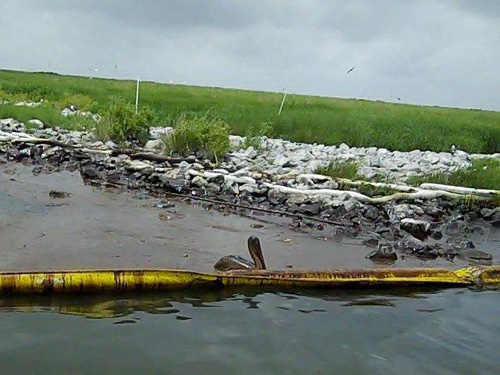
Even worse, as my latest week of adventures illustrate, BP is using federal agencies to shield itself from public accountability.
For example, while flying on a small plane from New Orleans to Orange Beach, the pilot suddenly exclaimed, “Look at that!” The thin red line marking the federal flight restrictions of 3,000 feet over the oiled Gulf region had just jumped to include the coastal barrier islands off Alabama.
“There’s only one reason for that,” the pilot said. “BP doesn’t want the media taking pictures of oil on the beaches. You should see the oil that’s about six miles off the coast,” he said grimly. We looked down at the wavy orange boom surrounding the islands below us. The pilot shook his head. “There’s no way those booms are going to stop what’s offshore from hitting those beaches.”
BP knows this as well — boom can only deflect oil under the calmest of sea conditions, not barricade it — so they have stepped up their already aggressive effort to control what the public sees.
At the same time I was en route to Orange Beach, Clint Guidry with the Louisiana Shrimp Association and Dean Blanchard, who owns the largest shrimp processor in Louisiana, were in Grand Isle taking Anderson Cooper out in a small boat to see the oiled beaches. The U.S. Coast Guard held up the boat for 20 minutes – an intimidation tactic intended to stop the cameras from recording BP’s damage. Luckily for Cooper and the viewing public, Dean Blanchard is not easily intimidated.
A few days later, the jig was up with the booms. Oil was making landfall in four states and even BP can’t be everywhere at once. CBS 60 Minutes Australia found entire sections of boom hung up in marsh grasses two feet above the water off Venice. On the same day on the other side of Barataria Bay, Louisiana Bayoukeeper documented pools of oil and oiled pelicans inside the boom – on the supposedly protected landward side – of Queen Bess Island off Grand Isle.

With oil undisputedly hitting the beaches and the number of dead wildlife mounting, BP is switching tactics. In Orange Beach, people told me BP wouldn’t let them collect carcasses. Instead, the company was raking up carcasses of oiled seabirds. “The heads separate from the bodies,” one upset resident told me. “There’s no way those birds are going to be autopsied. BP is destroying evidence!”
The body count of affected wildlife is crucial to prove the harm caused by the spill, and also serves as an invaluable tool to evaluate damages to public property – the dolphins, sea turtles, whales, sea birds, fish, and more, that are owned by the American public. Disappeared body counts means disappeared damages – and disappeared liability for BP. BP should not be collecting carcasses. The job should be given to NOAA, a federal agency, and volunteers, as was done during the Exxon Valdez oil spill in Alaska.
NOAA should also be conducting carcass drift studies. Only one percent of the dead sea birds made landfall in the Gulf of Alaska, for example. That means for every one bird that was found, another 99 were carried out to sea by currents. Further, NOAA should be conducting aerial surveys to look for carcasses in the offshore rips where the currents converge. That’s where the carcasses will pile up–a fact we learned during the Exxon Valdez spill. Maybe that’s another reason for BP’s “no camera” policy and the flight restrictions.
On Saturday June 12, people across America will stand up and speak out with one voice to protest BP’s treatment of the Gulf, neglect for the response workers, and their response to government authority. President Obama needs to hear and see the people waving cameras and respirators. Until the media is allowed unrestricted access to the Gulf and impacted beaches, BP – not the President of United States – will remain in charge of the Gulf response.
For more information on community rallies, please visit HERE.
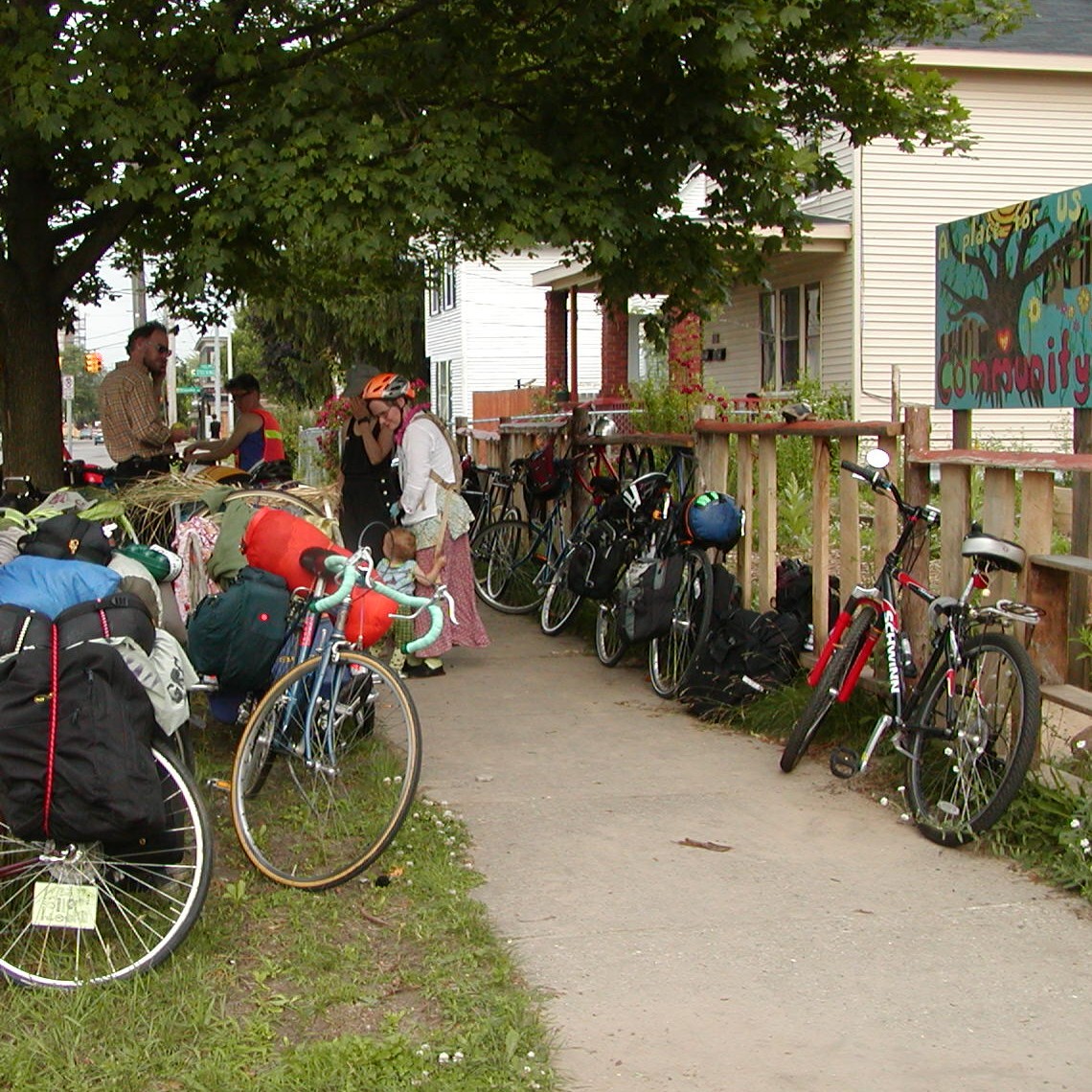 Sunday evening, The Grassroutes Caravan bicycled in to the Fourth Street Garden Oasis for a potluck and casual conversation with local folks gathered at the garden. En route to the US Social Forum in Detroit, the group of 23 cyclists included men and women of all ages—and even children in trailers. They had set out from Wisconsin around 4 a.m., ferried Lake Michigan and rode the Musketawa Trail from Muskegon to Grand Rapids.
The gathering shared food brought by local folks as well as home cooked spaghetti, salad and homemade bread made aboard the Permibus, which is accompanying the riders on their way to Detroit.

On Monday, after spending a day of volunteer work weeding for a local independent farmer at Blandford Farm, the Caravan presented its Variety Show. The  PermiBus puppeteers enacted humorous skits showing how permiculture could overthrow the system.
Thistle, Page and friends sang songs, including a powerful ballad about the BP oil disaster.
The Grassroutes Caravan Puppetistas concluded the show with a skit that demonstrated the power of community and the theme of the Social Forum, “Another world is possible. Another US is necessary!”

Once in Detroit, the Caravan will set up a bicycle city at the corner of Temple and Woodward, about a half mile from Cobo Hall, where the USSF takes place. The bike city will offer on-going bike maintenance and workshops.
If you missed the Caravan while they were in Grand Rapids, introduce yourself to them at the US Social Forum, Tuesday June 22 and through Saturday June 27. For information on how you can take part in this fantastic opportunity for envisioning another US, visit www.ussf2010.org.
 On Sunday, the Grand Rapids Press began a series of profiles on the Republican and Democratic candidates for Governor. These “profile” are in the Your Life section of the Press and read more like high school yearbook reflections.
The first candidate featured is State Senator Tom George, a Republican who has been involved in state politics for the past 10 years. The article includes some comments from George and a few of his supporters, but the bulk of the story is devoted to where he went to high school, his family life and his professional life as a doctor.
The article then concludes with the Press talking to political analyst Bill Ballenger and his assessment of why George will not win the Republican Primary. According to Ballenger George doesn’t have the money to do the advertising necessary to get enough name recognition. Not surprising that the Press allows such an assessment to go unchallenged, since they endorse the notion that money wins elections.
Unfortunately for voters, what is missing from this “profile” piece is any information on where George stands on issues. According to the candidate’s own web page, he considers himself Pro-Life, he favors the construction of new coal-fired power plants, that public employees contribute more to their health care benefits and he supports making Michigan a Right to Work State. These are basic positions, but information that one would be hard pressed to find in local news coverage.
Having served as a State Representative and State Senator over the past ten years also means that George would have a voting record, yet the Press in this profile piece and all previous coverage have not bothered to share any of that information with potential voters, but we do know that he likes to ride bike.
To add insult to injury, the Press editor Paul Keep in his Sunday column asks us to take a quiz on the gubernatorial candidates. The quiz, however, asks questions like “which candidate likes to have a Twix and Diet Coke for lunch?” The column is designed to further announce the candidate profiles for Governor that the Press will be running over the next two months, but most of the text is dedicated to banality. This is the type of reporting that contributes to a superficial political culture where people value what movies candidates like over substantive issues.
(This article is re-posted from Common Dreams.)

Josh Gerstein has an article in Politico on the massive silence coming out of the enviros on the BP oil catastrophe, which has been notable ever since the rig collapsed. This weekend the groups took out an ad in the Washington Post, not to criticize the administration for their response, but to praise the President for putting a hold on a drilling project in Alaska:
“President Obama is the best environmental president we’ve had since Teddy Roosevelt,” Sierra Club chairman Carl Pope told the Bangor Daily News last week. “He obviously did not take the crisis in the Minerals Management Service adequately seriously, that’s clear. But his agencies have done a phenomenally good job.”
If they aren’t saying anything negative, it’s because they believe there’s nothing to criticize:
Asked if Sierra Club has any concerns about the administration’s response to the spill, [Sierra Club’s Dave] Willett said, “Overall, we’re satisfied with the cleanup and recovery effort.”
Now, I listened to Mike Pence yesterday on CNN complaining about the administration’s cleanup efforts, and it was utter bullshit. They should’ve had a photo up of Pence with oil dripping off of his hands. The GOP has been waging a decades-long campaign for offshore drilling without limit, massive deregulation and complete contempt for environmental oversight that paved the way for this. The entire gulf is going to hell as a direct result of his actions. He’s in no position to criticize anything, and any journalist who lets him get away with it isn’t doing their job.
But the reluctance of the environmental groups to criticize the administration over the cleanup means they can’t credibly make that argument. Their decision to act as partisan cheerleaders has hamstrung their ability to act as trustworthy arbiters and advocates in the situation. We all know what their tone and tenor would be if George Bush was at the helm right now. If they are perceived as acting as an arm of the Democratic Party rather than stewards of the environment, they destroy their brand and the integrity of their message.
Part of it is because they’re in the veal pen, and the White House has done an excellent job of keeping them in line since they took office with groups like Common Purpose, Unity 09 and the “8:45 Call.” Matt Nisbet, a professor of environmental communications at American University, says “it’s difficult for the national environmental groups to be critics of the administration – they’re working so closely with the administration. … They have reacted cautiously and softly.”
There’s also “a practical sense among the groups that Obama is about the best they’re going to do when it comes to their key issues,” says Gerstein. And according to Doug Brinkley, “they’re feeling they have one person to do business with. … We’re down to like two Republican senators who want to deal with these environmental groups.”
The Sierra Club has one of the most well-known progressive brands, and they have a membership that is both deep and broad. Their ability to advocate for environmental causes doesn’t depend on access to politicians. It appears that they have they have opted for an “inside” game, and have completely dropped the ball on pressuring elected officials from the outside – right when they could have the most impact.
They also don’t want to jeopardize the passage of a climate legislation bill, and have been fearful from the start that making too much fuss about offshore drilling could endanger Kerry-Lieberman. Is the passage of some shitty big coal bailout what their members desire most? Because it sounds more like what the Democratic Party and its lobbyists want.
The “veal pen” strategy executed by the White House insures this silence, which Obama consciously uses as cover:
“We have responded with unprecedented resources, and when you look at what most of the critics say …and you ask them, specifically, what is it that the administration could or should have done differently that would have an impact on whether or not oil was hitting shore, you’re met with silence,” Obama said in an interview aired Tuesday on NBC’s “Today Show.”
But the Sierra Club isn’t alone. They’ve got plenty of company with the National Resources Defense Council:
“I think that made people plenty angry. Every time you see a picture like that, it breaks your heart,” Deans said. “Certainly, we’re outraged, but it’s not our job to generate outrage. It’s our role to try to focus that sentiment on priorities we need to make our country stronger.”
Some say that even though environmental groups aren’t dominating the debate, their issues certainly are -and are driving huge swings in public opinion against drilling and in favor of action on climate issues.
Well those swings are being channeled by the Center for Biological Diversity, the group that was out there proving that the administration’s actions didn’t match up with its words, and that MMS was still granting offshore drilling permits, even after Ken Salazar promised they wouldn’t. Meanwhile other groups were sitting on their hands, or doing what veal pen outfits do – reaping the benefits of a catastrophe by expanding their memberships and fundraising.
The oil industry has done a good job of buying the silence of many “environmental organizations.” PBS has been virtually silent on the spill, as sponsorship of its major shows is largely dominated by oil money. Media outlets that likewise depend heavily on advertising from oil companies have provided pathetic coverage of the spill and its consequences, focusing instead on completely stupid distractions like “has the President shown enough emotion.”
The environmental groups that have the brand names and the public trust are thus the only entities that can penetrate the message machine. When they speak, the public knows who they are and they listen. And they are the ones that the media goes to for quotes and commentary for just that reason. Their wide brand name recognition guarantees them that platform, and it’s difficult to organize around them when they’re AWOL.
Corralling the veal pen is a tactic that the White House has successfully used to cover their left flank since Obama took office. We saw it with the choice groups during the health care bill. As a result, Obama’s poll numbers with liberals stay high, and he feels no need to address the issues of the base. By stitching up the validators, he’s able to pursue a corporatist agenda while groups with brand name trust wage a public relations campaign to cast it as “progressive.”
These groups have demonstrated by both their action and inaction that they do not deserve that public trust. Unlike the Center for Biological Diversity, fawning groups like the Sierra Club have been successfully manipulated both by corporate money and by partisan gamesmanship. They’ve become such complete Washington DC creatures that they don’t know how to be advocates from the outside any more – their primary function is to give political cover in the midst of a PR battle. They have abdicated the role of non-partisan watchdogs, and the public should find new organizations independent of party control in which to place their trust.
Invisible hands pull strings in Michigan campaigns
(This article is re-posted from the Michigan Campaign Finance Network.)
In the case of Citizens United v. Federal Election Commission, the U.S. Supreme Court overturned precedent to allow corporations to make independent expenditures in election campaigns on a narrow 5-4 vote.

Less noted was Part IV of the Citizens United decision, where the Court ruled 8-1 that corporate spenders in election campaigns can be required to disclose the identities of their contributors and the amounts they give. The Court’s opinion said, “The First Amendment protects political speech; and disclosure permits citizens and shareholders to react to the speech of corporate entities in a proper way. This transparency enables the electorate to make informed decisions and give proper weight to different speakers and messages.”
So, what is the state of campaign finance disclosure in Michigan? In a word: pathetic.
The Michigan Chamber of Commerce recently asked the Department of State to make a declaratory ruling on disclosure requirements for its newly won right to engage in ‘express advocacy’ – those campaign communications that explicitly exhort a vote for or against a candidate.
The Department told the Chamber that it cannot solicit or accept a contribution from any entity that is given for the purpose of paying for campaign express advocacy. But if a sympathetic-minded person or corporation just happens to give the Chamber a million dollars without saying it is “purposed” for express advocacy, then the Chamber can use the million bucks to pay for TV ads that tell you how to vote and it will only be required to report that the source of the funds was its general treasury. It doesn’t have to reveal who contributed the money.
Furthermore, if the Chamber, or one of the political parties, chooses to buy television ads that say, “Kilgore has our values and he’s fighting for us,” or “Call Kilgore and ask him why he hates the elderly,” the sponsor of the ads doesn’t even have to report that it spent money. Under the prevailing interpretation of the Michigan Campaign Finance Act, an electoral communication that doesn’t explicitly tell you how to vote is not an expenditure.
A contribution is not a contribution unless it is purposed. An expenditure is not an expenditure unless it has magic words of express advocacy. That is not a Lewis Carroll fantasy. That is the operational interpretation of our law.
Over the past decade the Chamber and the political parties have spent more than $45 million for campaign television ads that carefully avoided the language of express advocacy. They reported nothing about that spending or the contributions that enabled it. I know the scope of this undisclosed spending because I collect the data from the public files of our state’s television broadcasters and cable systems.
Most of the money in the 2008 Michigan Supreme Court campaign was off the books. In the 2006 gubernatorial campaign, nearly $20 million was off the books. If you remember any TV ad from one of those campaigns, it is very likely that it wasn’t financially disclosed.
Why does this matter? Because campaign spending in a judicial election may compromise the impartiality of a judge. Because interest groups that pay for election campaigns expect to have their policy agenda addressed.
Citizens have a right to know whose money is driving political processes so they can properly evaluate the conduct of public officials.
This is not a matter of Republicans against Democrats. It is a matter of interest groups and political parties against citizens. Big-money donors’ desire for anonymity pitted against citizens’ need to know whose money is paying for election campaigns.
Transparency and accountability are progressive values and they are conservative values. In Michigan politics, transparency and accountability are an unknown ideal.
We need a new political culture. We need an end to the old shell game where the political masters of the universe arrogantly condemn the electorate to ignorance.
To legislators: If you want trust from an angry, disaffected electorate, write serious new campaign finance disclosure laws that cover all campaign ads.
To the angry electorate: If you want to take back your country, this is where to draw the line. This may be democracy’s last stand against the invisible hands that pull the strings that make politics inexplicably polarized and dysfunctional.
We’ll have better government when we have transparent politics. Not before.
Chomsky on the Israeli assault on the Freedom Flotilla
(This article by Noam Chomsky is re-posted from ZNet.)
Hijacking boats in international waters and killing passengers is, of course, a serious crime.

But the crime is nothing new. For decades, Israel has been hijacking boats between Cyprus and Lebanon and killing or kidnapping passengers, sometimes holding them hostage in Israeli prisons.
Israel assumes that it can commit such crimes with impunity because the United States tolerates them and Europe generally follows the U.S.’s lead.
As the editors of The Guardian rightly observed on June 1, “If an armed group of Somali pirates had yesterday boarded six vessels on the high seas, killing at least 10 passengers and injuring many more, a NATO task force would today be heading for the Somali coast.” In this case, the NATO treaty obligates its members to come to the aid of a fellow NATO country—Turkey—attacked on the high seas.
Israel’s pretext for the attack was that the Freedom Flotilla was bringing materials that Hamas could use for bunkers to fire rockets into Israel.
The pretext isn’t credible. Israel can easily end the threat of rockets by peaceful means.
The background is important. Hamas was designated a major terrorist threat when it won a free election in January 2006. The U.S. and Israel sharply escalated their punishment of Palestinians, now for the crime of voting the wrong way.
The siege of Gaza, including a naval blockade, was a result. The siege intensified sharply in June 2007 after a civil war left Hamas in control of the territory.
What is commonly described as a Hamas military coup was in fact incited by the U.S. and Israel, in a crude attempt to overturn the elections that had brought Hamas to power.
That has been public knowledge at least since April 2008, when David Rose reported in Vanity Fair that George W. Bush, National Security Adviser Condoleezza Rice and her deputy, Elliott Abrams, “backed an armed force under Fatah strongman Muhammad Dahlan, touching off a bloody civil war in Gaza and leaving Hamas stronger than ever.”
Hamas terror included launching rockets into nearby Israeli towns—criminal, without a doubt, though only a minute fraction of routine U.S.-Israeli crimes in Gaza.
In June 2008, Israel and Hamas reached a cease-fire agreement. The Israeli government formally acknowledges that until Israel broke the agreement on Nov. 4 of that year, invading Gaza and killing half a dozen Hamas activists, Hamas did not fire a single rocket.
Hamas offered to renew the cease-fire. The Israeli cabinet considered the offer and rejected it, preferring to launch its murderous invasion of Gaza on Dec.27.
Like other states, Israel has the right of self-defense. But did Israel have the right to use force in Gaza in the name of self-defense? International law, including the U.N. Charter, is unambiguous: A nation has such a right only if it has exhausted peaceful means. In this case such means were not even tried, although—or perhaps because—there was every reason to suppose that they would succeed.
Thus the invasion was sheer criminal aggression, and the same is true of Israel’s resorting to force against the flotilla.
The siege is savage, designed to keep the caged animals barely alive so as to fend off international protest, but hardly more than that. It is the latest stage of longstanding Israeli plans, backed by the U.S., to separate Gaza from the West Bank.
The Israeli journalist Amira Hass, a leading specialist on Gaza, outlines the history of the process of separation: “The restrictions on Palestinian movement that Israel introduced in January 1991 reversed a process that had been initiated in June 1967.
“Back then, and for the first time since 1948, a large portion of the Palestinian people again lived in the open territory of a single country — to be sure, one that was occupied, but was nevertheless whole. …”
Hass concludes: “The total separation of the Gaza Strip from the West Bank is one of the greatest achievements of Israeli politics, whose overarching objective is to prevent a solution based on international decisions and understandings and instead dictate an arrangement based on Israel’s military superiority.”
The Freedom Flotilla defied that policy and so it must be crushed.
A framework for settling the Arab-Israeli conflict has existed since 1976, when the regional Arab States introduced a Security Council resolution calling for a two-state settlement on the international border, including all the security guarantees of U.N. Resolution 242, adopted after the June War in 1967.
The essential principles are supported by virtually the entire world, including the Arab League, the Organization of Islamic States (including Iran) and relevant non-state actors, including Hamas.
But the U.S. and Israel have led the rejection of such a settlement for three decades, with one crucial and highly informative exception. In President Bill Clinton’s last month in office, January 2001, he initiated Israeli-Palestinian negotiations in Taba, Egypt, that almost reached an agreement, participants announced, before Israel terminated the negotiations.
Today, the cruel legacy of a failed peace lives on.
International law cannot be enforced against powerful states, except by their own citizens. That is always a difficult task, particularly when articulate opinion declares crime to be legitimate, either explicitly or by tacit adoption of a criminal framework—which is more insidious, because it renders the crimes invisible.
 Grand Rapids Institute for Information Democracy