Urban Farming Pilot Project Community Dialogue Session
Yesterday I attended an event that was billed as a “Community Dialogue” by people who had participated in what is called the Urban Farm Pilot Project. The project was facilitated through the GRCC Keller Future Center. However, yesterday’s gathering took place at the Goei Center, operated by Bing Goei, a member of the GR Chamber of Commerce and a current candidate for State Representative.

Some of the participants presented brief overviews of the various projects that small teams worked on, projects such as an Urban Agriculture Learning Lab, a Regional Food Awareness Communication Tool, Change through Farming Kits, Food Production and good health, and Indoor Farming.
All of these projects had some interesting ideas and you can look at details online, but what I found somewhat troubling was the heavy emphasis on these projects as being implemented within the private sector. Participants generally referred to these projects as having entrepreneurial potential. They also spoke primarily in terms of how these projects could connect businesses with customers.
Such a focus excluded any honest discussion on who would be the primary beneficiaries of such a project and who would not. Since most of the discussion focused on the business sector, people who are currently living in parts of the community that have limited access to healthy food, low income and disproportionately minority population were not really part of the conversation.
Project participants talked about how this project could enhance their career portfolios, but not how these projects could potentially create more equality and promote more justice in the community.
The emphasis on the entrepreneurial aspect of the project was underscored when one of the facilitators listed community partners in the project – the West Michigan Strategic Alliance, the Right Place Program, GR Chamber of Commerce, GVSU Center for Entrepreneurship, a consulting firm and several local design firms. Food was also donated to the project teams throughout their seven weeks by San Chez restaurant.
People from GRCC said they were interested in promoting a knowledge economy, with the triple bottom line (profit, people & planet) as the framework. They used language like trend analysis, asset mapping, talent retention, and even agro-hubs. What wasn’t discussed so much were concrete ways to use more urban space for growing food, how to involve more people and how eat healthy and local was a right, not just a smart business plan.
The morning ended with people being asked to provide feedback on a series of questions, which initially I thought were for the purposes of getting more input on urban agriculture. Instead, the point of the small group discussions was to answer predetermined questions that would help GRCC determine ways to get more people interested in other Future Center projects. In many ways I felt like they were not interested in what the community had to say or contribute, unless it fit into a process the project organizers had already determined.
Media Bites – Motorola Droid
In this week’s Media Bites we take a look at how the new Motorola Droid phone system is being branded to the public, with an emphasis on gender stereotypes in this ad. We also discuss how this kind of technology impacts us socially and what kind of environmental contamination is caused in the production and discarding of cell phones. Our critique ends with some information on the role that Motorola has played in support Israeli state repression.
“We’re F**cking Losing This Thing”
General McChrystal’s resignation has distracted the media from the real story found in the explosive Rolling Stone article. Check out the new video from Rethink Afghanistan.
G20: Illegitimate, Incompetent and Out of Control
(This article is re-posted from ZNet.)

You can’t formulate a sensible international economic policy without the basics: helicopters, snipers, riot police, attack dogs, tanks and miles of chain link fence. Wherever ministers of finance gather, the essential accessories for crowd control and popular repression are always to be found. But even by the historical levels of unaccountability, profligacy and cowardice set at meetings of the world’s richest economies, this weekend’s Canadian G8/G20 meetings raise the bar. By the time the teeth of the last protester are hosed from the soles of the last Mountie, the security bill will have topped one billion dollars. The six kilometer fence in the middle of Toronto cost $5 million alone but most of the rest of the bill is secret – ‘national security’ provides an alibi for backhanders and white elephants.
So what will Canadians (and the rest of the word) get for their money? Very little. The meeting will produce a tepid ‘big tent’ declaration with language elastic enough to stretch over the bickering interests of thrifty Europeans, improvident Americans, tightrope-walking Chinese, and restive Saudis. All done.
What’ll be worse, though, is what the G20 meeting will fail to do. It will prevent open debate about alternatives, it will let those responsible for the financial crisis maintain their veneer of legitimacy, and it’ll chip away at the institutions that, still, offer an alternative to the G20’s traveling circus. Here, just for the record, are three reasons why the G20 is already a failure.
- 1. The G20 is illegitimate
On the G20’s website, we read:
“The G-20 … brings together important industrial and emerging-market countries from all regions of the world. Together, member countries represent around 90 per cent of global gross national product, 80 per cent of world trade (including EU intra-trade) as well as two-thirds of the world’s population. The G-20’s economic weight and broad membership gives it a high degree of legitimacy and influence over the management of the global economy and financial system.”
To restate: because the G20 governments are rich and, with India and China among their number, populous, they are the legitimate managers of the global economy and financial system. First, of course, the G20 represents the sum of 46 democratic deficits (the European Union’s 27 members count as one G20 member). China and Saudi Arabia of course, don’t sully themselves with the pretense of democracy at all.
Do we gain much by diluting the club of former colonizing countries (the G8) with the formerly colonized ones? Not really. The Financial Times reports that the number of millionaires in Asia has finally overtaken that in Europe, and there’s no good reason to think that governments in the East are any less craven than governments in the West. At the G20, there will be a chance for ministers to receive advice from businesses – the so called B20. This rather hints at the class orientation of the G20’s leaders.
Of course, there’s one thing worse than having your government at the G20, and that’s not having your government at the G20. The G20, albeit awkwardly, admits that there might be something wrong with the world’s largest economies deciding what’s best for the entire world, particularly the hundred countries who aren’t invited. So the G20 have taken measures to increase the representation of poor countries in their favourite international fora: the IMF and World Bank. They’ve made progress too. Again, they congratulate themselves for
… the World Bank’s voice reform to increase the voting power of developing and transition countries by 3.13%.
It’s true! China, India and Saudi Arabia have more votes. But, in the part of the World Bank that makes so-called concessional loans, eleven African countries have seen a decline in their relative voting power, and Bangladesh has lost more voting power in the shuffle than the UK. And it’s a bit of a stretch to call the loans concessional – technically, the concession is meant to be a low interest rate, it’s always developing countries that have to make concessions in their economic policies in order to qualify for them.
Of course, there is an organization that does include every country in the world – the United Nations. And it’s the one organization that the G20 goes out of its way never to mention. Because the G20 members seem themselves as the UN’s replacement.
So, not terribly much legitimacy, even on the metrics that the G20 likes to hold itself to. And by the metric it doesn’t like to hold itself to, there’s even less legitimacy. Which group has been more affected by the recession, after all, than women? The United Nations knows all about this, with a series of investigations, reports and policies on gender and the impact of the financial crisis available here. The G20’s site doesn’t mention gender at all. Not once.
2. The G20 is incompetent
Here’s how the G20 represent themselves:
“To tackle the financial and economic crisis that spread across the globe in 2008, the G20 members were called upon to further strengthen international cooperation.”
As if the G20 were sitting the Batcave when, suddenly, the Batphone rang and Commissioner Gordon was asking them to save the planet. As if their policies hadn’t, in fact, facilitated the problem in the first place.
Despite a few changes of leadership since 2008, this is largely the same crew, armed with the same toolkit and the same instruction manual for the economy. It’s wishful thinking to hope that these governments are going to be able to fix the very problems that they’ve spawned.
Yet there has been, and continues to be, solid thinking about the economy outside the corridors of central banks and ministries of finance. Dean Baker, for instance, notes that:
“The economy thrived in the three decades following World War II with a financial sector that was proportionately on-fourth of its current size. There is no reason that the financial sector should use up a larger share of the economy’s resources today than it did three decades ago. Effective regulation will restore the financial sector to its proper role in the economy.” (Taking Economics Seriously, 2010, p79)
The United Nations has been thinking about the financial crisis for a while – and held a conference last year at which Nobelists like Joseph Stiglitz worked with representatives from every government (legitimate and otherwise) at the Conference on the World Financial and Economic Crisis and its Impact on Development to produce a plan of action . It’s one that almost every sane economist would endorse. It’s not terribly revolutionary, though it’ll take a revolution to get it accepted, because it recommends things like fiscal stimulus, strong regulation and investment in a green economy. In the scope and strength of its recommendations, it far outstrips the statement currently circulating for the G20. Yet it’s a vision that’s necessary in order to tackle the issues of sovereign debt, unemployment, climate change, gender inequality, and poverty.
3. The G20 isn’t in control
Perhaps the biggest problem is that the G20’s ministers, awed as they are by financial markets, can’t see their way to respond without capitulating to them. It’s not at all clear whether G20 members govern financial markets, or the other way round. But it’s becoming clearer. Britain under its new Conservative ( and Liberal!) government has decided that, in fact, it’s the financiers who run the country. In order to restore market confidence, the people have been served with the most austere cuts for decades in a recent ‘emergency budget’. The belt tightening has, so far, made the markets happy. The British Pound made some brief gains, and the the OECD pronounced it a ‘courageous budget’.
John Maynard Keynes, as quoted by his biographer in the Financial Times recently, had something to say about budgets like these:
When the Conservative-Liberal coalition that had succeeded the Labour government introduced an emergency budget in September 1931, Keynes again stood out against the chorus of approval. The budget was, he wrote, “replete with folly and injustice”. He explained to an American correspondent that “every person in this country of super-asinine propensities, everyone who hates social progress and loves deflation, feels that his hour has come and triumphantly announces how, by refraining from every form of economic activity, we can all become prosperous again.”
So, how to make those with super-asinine propensities listen? For the longer term, the good folk at places like the US Social Forum will be organizing for the future. Over this weekend, though, many good folk in Toronto will be trying hard to make some noise, present some alternatives, and avoid the boots of the Royal Canadian Mounted Police.
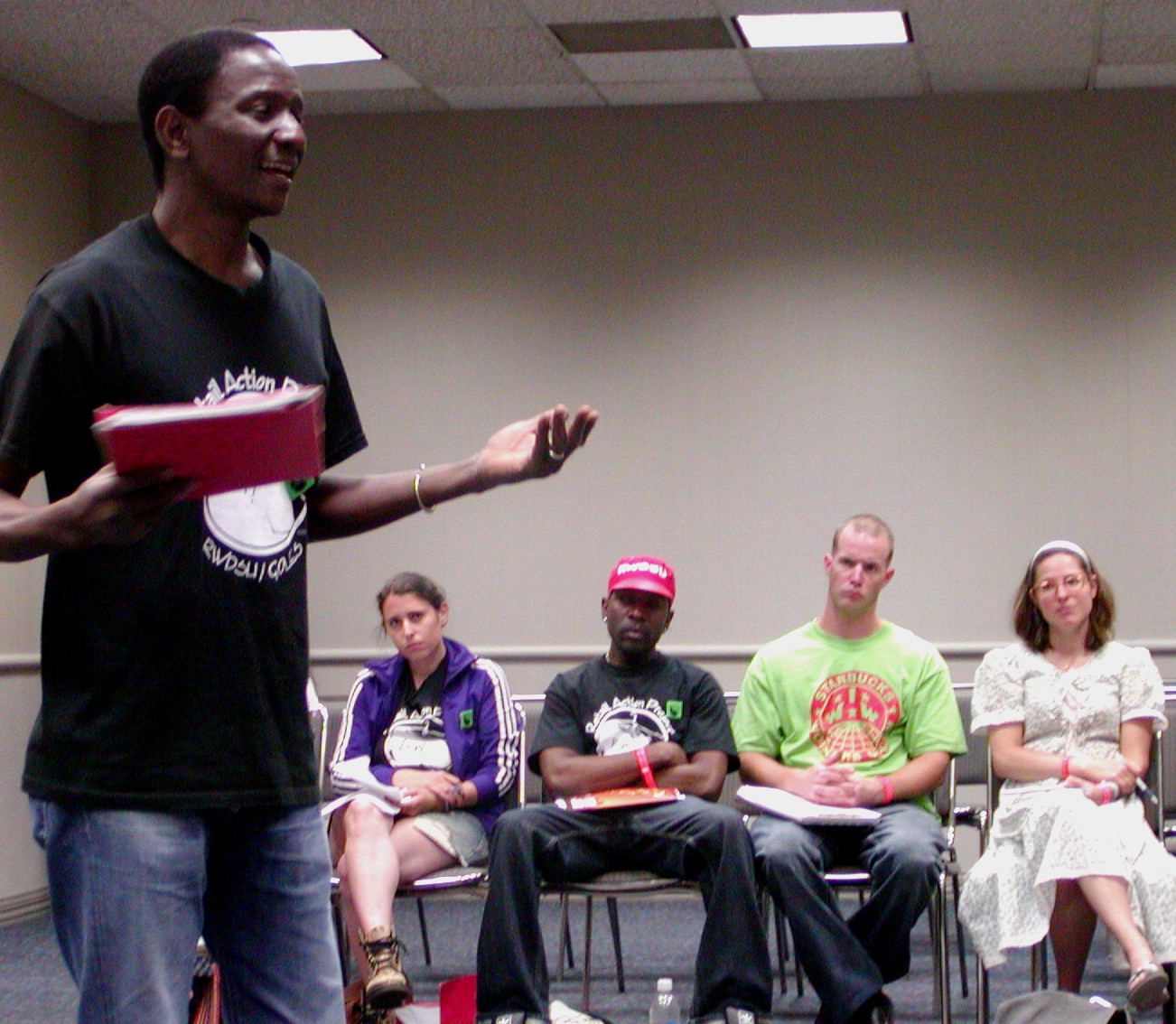 “Resistance in Retail,” a Friday morning workshop st the US Social Forum, brought together a panel of labor organizers that included Grand Rapids’ own Cole Dorsey, IWW Starbucks Union. Others on the panel represented New York City’s Retail Action Project (RAP) and Common Threads Art Collective, Wake Up Walmart and Chicago’s Grassroots Collaborative.
The panel starting by describing today’s retail workers and how retailers are making millions on their backs. For the most part, retail workers are not teenagers, college students or folks working to get out of the house and earn a little spending money. The huge majority of retail workers are supporting themselves, and very often their families, on wages so low that they have to work two or three different jobs just to make ends meet. The majority are people of color.
Retailers either offer no benefits or benefits hinged on an hours-worked quota system purposely coupled with an inability to get hours, preventing workers from accessing them. In other cases, (J.C. Penney and Whole Foods were cited as an examples), workers are terminated when they have enough seniority for benefits or, when benefits depend on being full-time, they are terminated and offered part-time positions at new-hire hourly rates.
“New York City retailers’ had 70% growth in sales from 2001 to 2007 but still pay the lowest wages–44% earn less than $10 an hour, an outrage in New York City where the cost of living is so high,” shared Chimuka, who works at Yellow Rat Bastard, a high-end skateboard and apparel shop in Manhattan. “It is like killing somebody.” He started at $6.25 hour but fought with RAP and won a union contract that guaranteed better wages for the store’s workers.
Romuald Ilboudo concurred. He stood up for better wages at Scoop NYC, a store frequented by the stars and paying workers poverty wages. “RAP taught us how to fight,” he said. “One, know your rights. Many retail workers are immigrants and need confidence. Learn how to approach new workers and mobilize them. (High turnover rates in retail make organizing difficult). Two, develop strategies for organizing and using media. And three, know how to file a complaint and where to get legal counsel. When we got fired, we received a $300,000 award.”
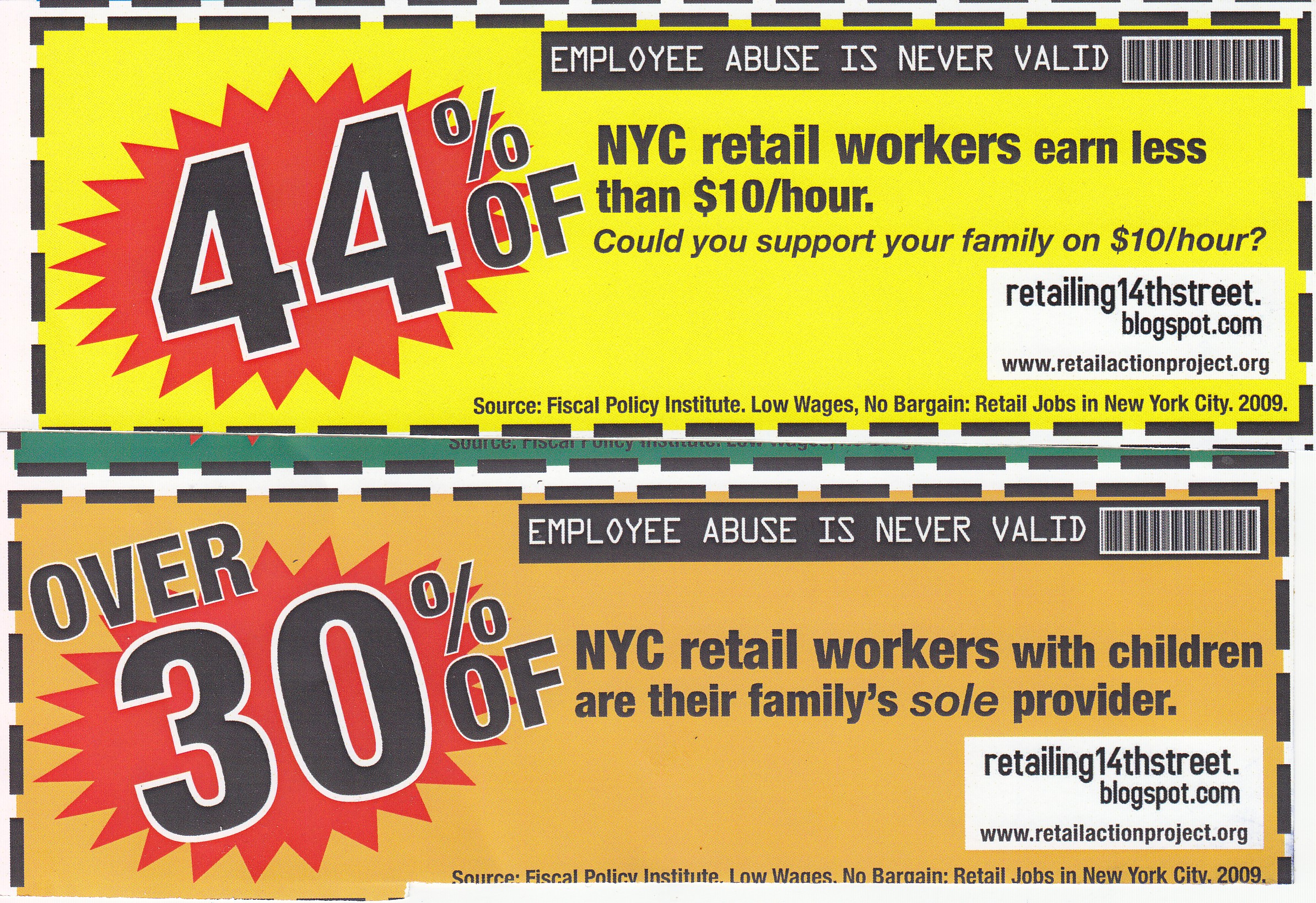 The Common Threads Art Collective is a group of RAP associated retail workers who are also artists. They put on exhibits that not only provide a venue for selling their work, but also make statements about the plight of retail workers. They also stage creative direct actions. They have handed out “subversive” coupons, displayed mannequins with a message outside of retailers, hosted a bread line and dressed as elves during the Christmas season.
Others on the workshop panel had fewer victories to share. Even though Walmart, as the world’s largest retailer, is guilty of the most heinous strategies for denying workers fair compensation, Wake Up Walmart faces a real struggle to get Walmart workers organized. But, Cynthia and Ernestine, two Walmart workers on the panel, are not giving up. “People are scared and have a right to be scared,” Cynthia said. “But with unity, we can overcome.”
Ernestine described her Walmart store as a plantation, with the store manager as an overseer. “No matter how hard we work, it’s never enough. To work like that on a daily basis and be paid such low wages, have your hours cut, be promised bonuses and not receive them, with no healthcare . . . Walmart makes billions of dollars and most of its workers are on food stamps and receiving government medical assistance. They can pick us off individually, but together we can make it work.”
Chicago’s Grassroots Collaborative has been fighting Walmart for six years. The morning of the workshop, they were dealt a stinging defeat. Chicago city government gave the go-ahead for the retail Goliath to build the first 22 planned Walmarts there. As part of its strategy to keep the retailer out, Grassroots Collaborative fought and won the passage of the Big Box Living Wage Ordinance. Mayor Daly vetoed it. A subsequent ordinance that requires corporations receiving subsidies or tax incentives to pay a living wage did pass, but probably will not help people working for Chicago’s new Walmarts.
“Six years of work went down this week,” said Amisha Patel, executive director of Grassroots Collaborative. “We’re taking on huge battles, we’re fighting capitalism. Capitalism is collapsing, but it’s collapsing on us.”
###
After reading this post, Amisha asked to clarify a few things in a comment. “I spoke about the discouragement of not winning all you want to in this work. In Chicago, we had worked to win higher wages for retail workers than was achieved this week. But getting walmart to sit down at the table and agree to wages $1 above minimum is a victory- it’s something we all must continue to build on.
We introduced the living wage for subsidized corporations bill, which would ensure that companies that get tax dollars don’t create poverty jobs. When passed, this bill could transform thousands of poverty jobs to living wage jobs, which absolutely would create more good jobs in the retail sector. We’re still working to move this forward.
Finally, I spoke about the discouragement of how hard it is to create transformative economic policies, but also that we get to feel those hard feelings and move through them so that we can keep working in a connected and powerful way. Capitalism will continue to work to keep us isolated, but we absolutely can and must keep working to build trust across divisions and build the labor-community coalitions that will win power for working families.
Grassroots campaign targets Chase Bank – 2010 USSF

This morning about 400 people gathered at a small park on Woodward Avenue in downtown Detroit to march a few blocks to the Chase Bank headquarters. The march was jointly organized by the Farm Labor Organizing Committee (FLOC) and Moratorium Now, a group working to end foreclosures, evictions and utilities.
FLOC president Baldemar Velásquez spoke to the crowd before the march began, telling people about the campaign that FLOC has against the tobacco company Reynolds American and its financial partner Chase Bank. The tobacco company pays workers unjust wages and forces workers to operate in near slave-like conditions.
As a way to pressure the tobacco company, the FLOC campaign is targeting their major financial backer, Chase Bank. FLOC organizers are calling for everyone who has money in Chase banks to withdraw their money the day after Labor Day this year. Right now the campaign is asking people to sign a pledge that they will boycott Chase if the farm workers demands are not met by the end of the summer. Here is a short video with Baldemar Velasquez addressing the crowd.
The crowd then marched to the Chase bank and stood on the steps to denounce their policies. Numerous people addressed the crowd and eventually a small delegation was allowed to go in to talk with Chase executives. After small confrontations with the bank security, delegates were allowed in to bring their demands. This next video has footage of the march, the delegation going into Chase and a representative of Moratorium Now!, a woman who had her home foreclosed.
The other group that was instrumental in organizing this march was Moratorium Now! They also addressed the audience and spoke about how Chase bank has benefited from home foreclosures. Moratorium has been organizing in Michigan for several years now and has confronted banks, landlords and utility companies.
By making the connection between farm worker rights, home foreclosure, eviction and utility rights the march organizers were able to make a stronger case for their demands and continue to develop a coalition with a more diverse group of allies that could lead to greater political power and making the changes they want.

Last night we attended on a session on the resistance to the racist policies in Arizona. The session consisted of media makers showing video and photos of the various ways that people have been responding to state repression in Arizona and testimonies from some of the people doing the resistance.
We first heard from some high school students who were protesting a law proposed over a year ago (and recently passed), which removed any classes from the curriculum that taught ethnic and cultural studies. Students organized demonstrations and engaged in civil disobedience, some of the chaining themselves to the doors of the State capital.
People with Pan Left Productions, a video collective, also showed clips from some of their work that dealt with both the ethnic studies ban and the most recent anti-immigration law.
There was also a Latina journalist who spoke during the workshop. She shared stories about how people were directly impacted from the new anti-immigration law and how it is destroying families. Here is a video of one of her stories:
Another group of activists and media makers from Maricopa County, where the overtly racist Sheriff’s Joe Arpaio has engaged in draconian policies against Latinos, immigrants and Native people. Activists have been targeting Arpaio for the past two years with daily protests outside his office, which has resulted in the owner of the building forcing the Sheriff to relocate. Here is a video about the reality in Maricopa County:
Activists and media makers also showed some clips from an soon to be released documentary called Under Arpaio, which is an investigative look into the policies and practices of Sheriff Joe Arpaio. You can view the trailer for this film on Vimeo by going to this link.
This session was not only inspiring because participants heard from people engaged in resistance, but also because media was being used as an organizing tool in that resistance.
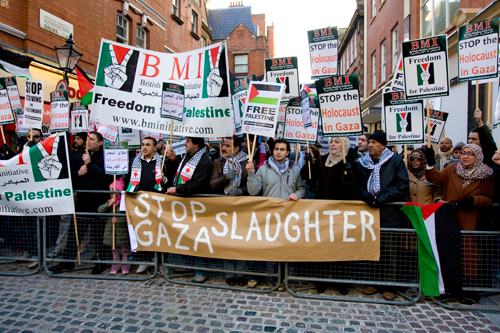
On Thursday afternoon I attended the Palestine Solidarity workshop, facilitated by the Lansing-based Peace Education Center. One of the presenters began by saying that it has been difficult to organize around support for the Palestinians since 1993. Before 1993, the PLO was the singular reason for people to rally around Palestinian rights.
Since then, the focus has shifted to the occupied territories and no longer just the PLO. This shift in focus has been due in part to both the fist and second Intifada, the community-based non-violent resistance to the Israeli occupation.
However, the presenter said that there has been an ongoing negative impact of the 1993 “peace accord” known as the Oslo Peace Accord. Many people in the US now see the “problem” of Palestine as an internal problem, because they now have control over their own territory. This perception amongst people in the US has made it easier for US policy makers to continue to unconditionally support the Israeli occupation.
Another presenter states that historically the Palestinian solidarity groups had a much stronger socialist or class-conscience base. There have been dozens of US-based organizations that have supported Palestine, but there has been an evolution of these groups. Some watershed moments for the US solidarity groups were the Israeli invasion of Lebanon in 1982 and the first Intifada in 1988. The presenter also points out that many of the previous region solidarity movements were linked with the Palestinian struggle, such as the Central American Solidarity movement and the South African anti-Apartheid movement.
After the 1993 Oslo Accord, people began to realize that despite the peace process more Palestinian land was being occupied by Israeli settlers. Another change in the Palestinian Solidarity Movement was the 2nd generation of Palestinians now living in the US. This new generation brought new energy and fresh ideas.
One difficulty that people working on Palestinian Solidarity in the US is that the Palestinian narrative is not even tolerated. In addition, anyone who speaks out on this issue will be charged with anti-Semitism. This is particularly the case of Palestinians and other Arabs living in the US, which underscores the importance of having more people participate in Palestinian Solidarity work.

The Boycott and Divestiture movement actually began in the early 1990s, based mostly on the experience of the South African Anti-Apartheid movement. This movement grew over the years.
A third presenter spoke about another aspect of the mainstream left and its silence on the Palestinian struggle. This silence could be considered a form of hostility to the issue, especially since the US contributes $3 billion a year to Israel, which translates to $7 million a day.
The US funding of Israel became the focus of much of the Solidarity work in the 90s and the most recent decade, particularly if the funding was framed as funding an illegal occupation.
Now the focus is mostly on the Boycott, Divestment and Sanctions (BDS) movement. The conditions of this campaign are when Israeli ends the occupation, dismantles the wall and recognizes the right of Palestinians.
Divestment is an action where people will not invest in companies that do business with Israel. Some of these companies are Motorola, Caterpillar and Viola. Sanctions currently don’t exist from the US, but this is a tactic if and when there will be enough public support to get the US government to impose sanctions on Israel.
Someone from Oakland, California spoke about the Longshoreman Union’s refusal to unload goods from an Israeli ship recently. This was an important victory, because the longshoreman also took the same position during the South African Anti-Apartheid campaign.
The rest of the conversation dealt with a variety of aspects of the difficulties within doing Palestine Solidarity work. These difficulties dealt with claims of anti-Semitism, nationalism, the right of return for Palestinians, Congressional support for Israel, international law, war crimes and cultural resiliency.
While the session did not spend enough time on practical solidarity work, the discussion was great and the history and analysis of Palestine Solidarity work was excellent.
Getting your story straight
 A Thursday morning workshop held at the US Social Forum, “Story-based strategy: How grassroots organizations can win the battle of the story” was designed to help organizers craft communications that inspire action.
The presenters, Patrick Reinsborough and Doyle Canning, based the workshop, and their recent book, RE: Imagining Change, on the human fascination with story telling. “Humans are story telling animals,” Reinsborough said. Both work for smartMeme, a national strategy center that links storytelling to social change.
The opening slide of their PowerPoint showed the stars in the night sky. Canning noted that humans weren’t happy with just gazing at the stars, instead they connected the stars to create characters and then told stories about them.
 The government, military and corporate marketing departments have keyed in on this human commonality. “Story telling is being used for government propaganda and by the media. Bush spun his ‘control mythology’ and advertisers and their psychologists have escalated their assault deeper into our heads to tell us how to believe,” Canning said.
How do these entities get the public to take action (or inaction)? By framing the story so only the story they want told gets through. The famous photo of Iraqis toppling the statue of Saddam Hussein was their example. In the version circulated by US media, it seems a hug throng of liberated Iraqis are pulling the statue down. An expanded shot of the scene shows that the crowd is  relatively small–and that the area is in fact circled by US tanks and troops imposing not a liberation, but an occupation. “When you expand the frame you make the invisible visible. The frame will always trump the facts,” Reinsborough said.
Organizers working for social justice can use storytelling, as well. They will find it more effective than presenting an uninterested public a list of facts. “No  one has ever marched on Washington because of pie chart,” he added. “Creativity is a renewable resource.”
Grassroots organizers can tell their story by first framing the conflict with a focus on the details that tell the story they want told. Then, by amplifying the voices of the charaters–those impacted by the injustice, they can engage people’s values. Next, show, don’t tell. Use engaging images or pop culture references. Last, and very important, the story should offer a vision.
“So often environmental groups only show a picture of the destruction. You need to use foreshadowing, a vision of what could be,” Reinsborough said. “This really brings people in.”
Levin again approves of the US Occupation of Afghanistan

In a statement released yesterday, Michigan Senator Carl Levin gave his approval on the decision of President Obama to nominate General David Petraeus to lead the U.S. occupation in Afghanistan.
Levin, who is the chairman of the Senator Armed Services Committee stated, “For many reasons, General Petraeus is a solid choice to take over in Afghanistan. He provides strength and continuity. Indeed, he was the architect of the counter-insurgency strategy — he literally wrote the book setting it out.”
This sort of statement clearly means that Levin condones the Petraeus designed counter-insurgency campaign in Iraq that left thousands dead, wounded and displaced. This same type of counter-insurgency in Afghanistan will also have disastrous results and it signals a stronger commitment to a military solution.
Levin goes on to say of the Petraeus nomination, “He also agrees with both key parts of that strategy: first, that additional troops be surged into Afghanistan by the end of the summer, and, second, that there be reductions in our troops levels in Afghanistan beginning in July 2011 as the essential way of getting the Afghans to focus on the need to transition to them the responsibility for their own security.”
This statement is consistent with previous statements by Levin that does not take into consideration that the Afghanis will never be able to provide adequate security in their country while an occupation exists and many Afghanis distrust the US-trained/financed local security forces.
 Grand Rapids Institute for Information Democracy