This interview with Noam Chomsky was conducted by Dr. Hamid Dabashi and is re-posted from ZNet.
On March 8, 600 protesters swarmed outside the Bank of America branch on Pennsylvania Avenue in Washington D.C. They succeeded in shutting down business at the branch and informed area residents about Bank of America’s shameful record of tax dodging.
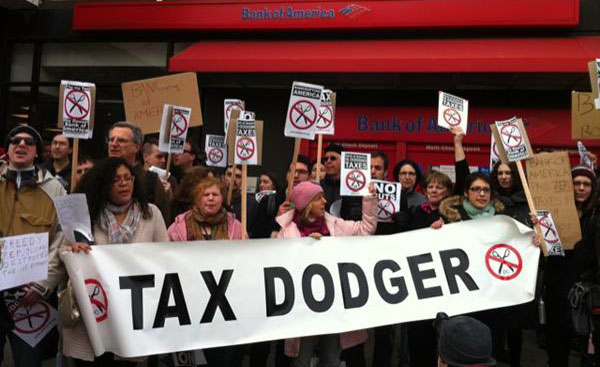 Under federal law, banks such as Bank of America are required to pay 35 percent of their pre-tax earnings in taxes. But the National People’s Action group has issued a report that Bank of America, along with JP Morgan Chase, Goldman Sachs, Morgan Stanley, Citigroup, and Wells Fargo, have all averaged taxes of 11 percent for the past two years, saving themselves a staggering $13 billion in revenue.
In cheating taxpayers, these banks have taken enough tax revenue out of the economy to have paid for three years’ worth of salaries for every American teacher who lost his or her job since the Wall Street bailout.
In 2009, Bank of America pocketed $45 billion in TARP funds and posted profits of $4.4 billion. And the bank did not pay one cent of taxes.
Meanwhile, Bank of America just issued a press release that explains how their new corporate bonuses in the D.C. area are “a plus for the local economy.”
If you’re asking yourself why you haven’t heard of this movement, the shutdown of Bank of America on Tuesday, or other Bank of America protests that have taken place since the end of February, that’s easy. It’s because no mainstream media outlets have covered these events. Only independent journalists have succeeded in getting information about the protests online and on You Tube, while TV networks, financial papers such as the Wall Street Journal, and even area newspapers such as the Washington Post are trying to pretend that nothing has happened.
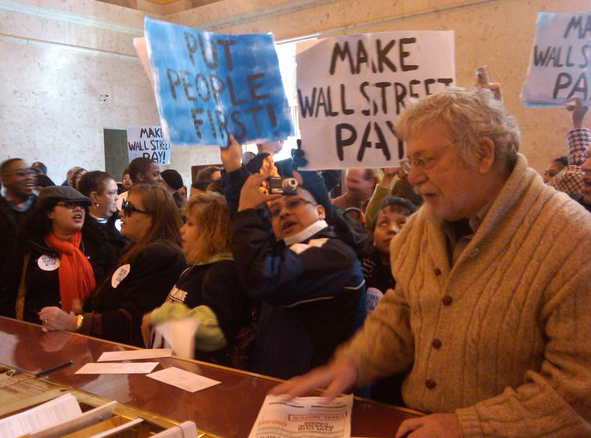 But even during the news blackout, there are still steps you can take. The National People’s Action website has a form you can fill out: it calculates how much you have lost in the economic crisis that followed on the heels of the Wall Street bailout. The site then generates a “bill” that is sent directly to your members of Congress.
Or, stop in at one of the Bank of America locations in Grand Rapids. The main bank, downtown is located at 40 Pearl Street N.W. Other branches are found at:
3886 Plainfield N.E.
6737 S. Division
2000 Lake Michigan Drive N.W.
1750 Michigan Street N.E.
6464 28Th Street S.E.
485 44th Street S.E.
2005 Breton Road S.E.
834 Leonard Street N.W.
Or, call the downtown location at 616-451-7944.
Tell them how you feel about their tax evasion and how you feel it’s hurting the economy—and making life harder for you and your family.
Grand Rapids coalition holds Press Conference against anti-immigration bill in Michigan
Today a coalition of about 15 people gathered today to hold a press conference against the recently introduced legislation in Michigan that seeks to adopt an Arizona-style anti-immigration policy.
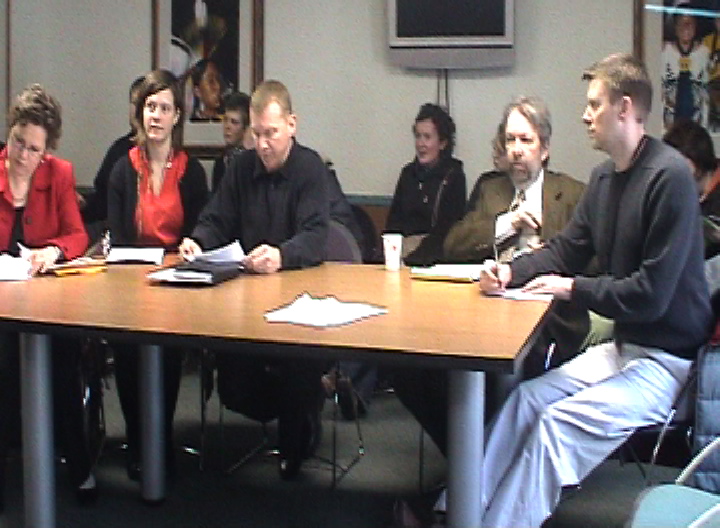
Local immigration attorney Rick Kessler began the press conference by saying, “people in West Michigan will not tolerate an Arizona-type anti-immigration law in Michigan.” Kessler was followed by several other people from different walks of life who also spoke out against the recently introduced legislation; legislation that was introduced by local State Rep. Dave Agema.
Kent County Commissioner Dick Bulkowski said that this law was bad for a variety of reasons, but spoke specifically about how it will divert limited resources of local law enforcement to stopping people looking for immigration status instead of focusing on public safety. Commissioner Bulkowski also objected the legislation because of the expected law enforcement and legal costs that would be at the expense of taxpayers.
Bulkowski was followed by Ryan Bates who addressed the economic costs to the State of Michigan if this legislation were to pass. Bates is with the Alliance for Immigrants Rights and Reform Michigan and he stressed how this anti-immigration law might prevent companies from coming to Michigan because it would make the state unwelcoming. Bates also stressed how Latino, Asian and Arab-American businesses have contributed to job creation and tax revenue to the state.
Miriam Aukerman with the Western Michigan branch of the ACLU focused on the legal and constitutional rights aspects of the proposed HB 4305. Here we’ll share her comments via video.
There were also representatives of both the Christian Reformed Church and the Catholic Church who were present who also express concerns about the recently introduced legislation.
The last speaker was Jessica Ennis with Bethany Christian Services. Jessica shared with those present information about the campaign to get Michigan Governor Rick Snyder to veto HB 4305. Ennis said that they are urging people to contact the Governor’s office by calling 866-957-9069 for English speakers and 866-563-5608 for Spanish speakers.

On Sunday, ABC showcased one of its newest TV shows called Secret Millionaire. The basic premise of the show is that millionaires go and live clandestinely in poor communities and then give money to people who are “deserving.”
On the surface the show is designed to tug on people’s heartstrings and make you feel good about what some people are doing in the world. However, what the show is really about is to communicate the message that anyone can be successful if you just work hard enough. In many ways Secret Millionaire is just a new manifestation of the Horatio Alger story, sort of a rags to riches myth.
Not surprising the first millionaire on the show was Dani Johnson who claims to be a self-made millionaire. Johnson does entrepreneur workshops, Finance consulting, spiritual equipping, which is the theme of her national radio show.
Johnson, who is a tall, busty, White woman, goes from one local program to another in Knoxville in search of people who are worthy of her money. In the process we see Johnson mostly interacting with programs that serve poor black kids. Johnson at one point in the show says that what is so cool about these programs is that they are “grooming these kids for success.”
Secret Millionaire is a glitzy program that is designed to serve two purposes. First, the show gets us to think about individual acts of charity and programs that serve the “poor.” This means that we never are confronted with basic questions about why so many people are poor and why people like Dani Johnson are so rich. We are led to believe that some people are successful because they work hard while others are lazy and worthless.
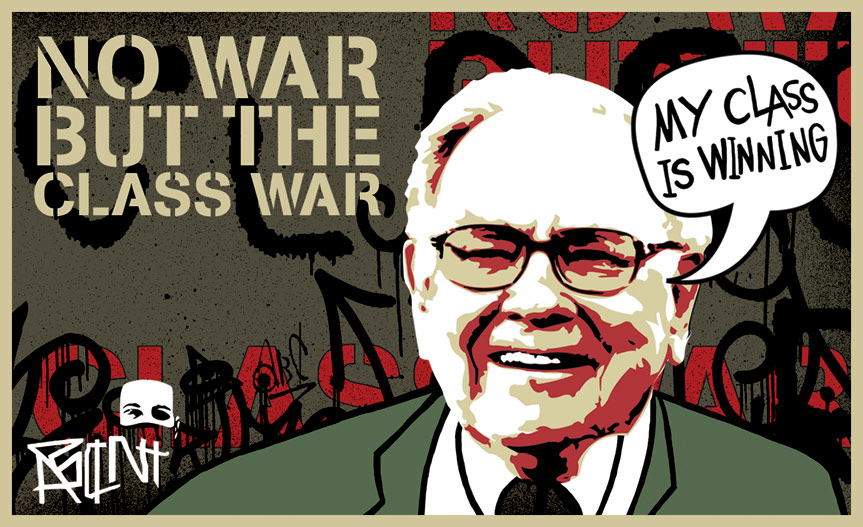
Secondly, the show promotes what some writers are calling philanthro-capitalism, which is essentially the idea that social change will come about when rich people “share” some of their wealth. In other words, we don’t need to build movements for social change, we just need to find rich people who will give us some of their wealth so we can design more feel good programs that might allow a few people to become “successful.”
Such programming is an insult to working class people of any generation, but it is particularly insulting as some many people are becoming victims of an economic restructuring program that is transferring more and more of the country’s wealth into the hand of the already disgustingly rich.
From the Wall Street Bailout, to tax breaks for the rich to an assault on working class wages, benefits and pensions, we are seeing the application of what Naomi Klein calls an economic Shock Doctrine. ABC’s Secret Millionaire is just one of the tools being used by the capitalist class to wage war on working people and in this case it is psychological warfare.
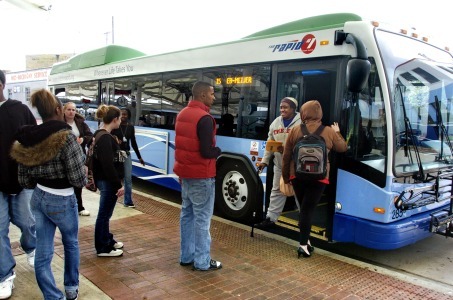
Today, about 75 people gathered at the LaGrave Avenue Church to hear from area legislators about their thoughts and commitment to public transportation.
 The forum began with Jennifer Kalczuk from the ITP/The Rapid who provided those in attendance with some background information on the current status of transit funding. She mentioned that there is money coming from the State, gas taxes and transit fare sales. Currently about 30% of their operating budget comes from the State.
Under the law ITP is eligible to receive up to 50% of their operating budget from the State, but it has been many years since that has happened. There is also a significant chunk of money coming from the federal government in matching funds for state operations. More details on State and Federal funding for public transit can be found on the website for Michigan Public Transit Association.
Jennifer also mentioned that ridership has been growing in recent years, especially since the ITP was created. Last year there was roughly 9.7 million riders, which includes all of their services.
However, the bulk of the forum was spent listening to the responses from three area elected officials, State Representatives Ken Yonkers, Roy Schmidt and Brandon Dillon. Representative Dave Agema and State Senator Dave Hildenbrand were also invited by unable to attend.
Dave Bulkowski with Disability Advocates of Kent County was the moderator of the forum and asked a series of questions to the state legislators. The first question was, What do you see is the State’s role in transportation infrastructure? Roy Schmidt responded by saying it was to maintain roads, transit and safe streets. Schmidt says that he doesn’t have a problem funding transit because he knows where the money is going, but he didn’t offer any evidence to support this claim.
Rep. Yonkers said that transportation includes airports, roads and bus services. “The State’s responsibility is to make sure that both the planning and the funding are there.” However, Yonkers says that we need to have more emphasis on a cultural transformation, since Michigan is still culturally dependent on car transportation. In fact, Yonkers said that if there is not a good State transportation infrastructure then there will be no economic development or real economic recovery.
How do you see public transportation within the transit structure? How much of it is a priority for you? Rep. Dillon says that the biggest investment is for roads and bridges, roughly 90% of the state budget for transportation. However, he does think that we need to raise the profile of public transit and the role that it plays for development and quality of life. Dillon also said there in no plans to cut existing funding levels for transit from Governor Snyder’s proposed budget.
Schmidt said that even while he was a GR City Commissioner he didn’t fully realize how important transit funding is, especially the model that GR is for the rest of the state. Schmidt says it is extremely important for jobs and general infrastructure.
Yonkers added that the State’s actions determine priorities with the bulk going to roads and bridges, but Yonkers said he is working on changing that. He thinks it is a cultural shift and that it has bi-partisan support. We have to grow grassroots interest and have a vision for what we want. Unfortunately, Yonkers did not provide any specifics or examples of how this cultural shift would take place.

What about the future of rail transit? Yonkers said he recently heard a talk from someone with Meijer who said it is cheaper to move goods via rail across the country than it is to move goods via trucks from Chicago to Grand Rapids. Yonkers said he would love to see a hi-speed rail from Grand Rapids to Lansing. “However, this will be a big battle, because it will require a change in the minds of voters.”
Rep. Schmidt addressed the issue of Amtrak and said he recently heard that the tax investment in Amtrak is nothing compared to the economic development it provides. He says that is not the public perception, but he failed to provide any evidence to support the economic data benefits because of Amtrak.
What about the State budget proposal and does it support transportation needs? All three representatives said they would support Snyder’s proposal and Yonkers feels that even though there are questions on the issue of efficiency that it should not detract from what the State Budget will provide for public transportation.
How else can money be raised or redirected at the State level to end up supporting transit? Schmidt said that they are looking at registration fees because he thinks that revenues will decline from the gas tax because of electric vehicles. When asked how big should the transportation budget be, Rep. Dillon says it is a difficult question to answer and it will have to be determined by the voters. “We don’t have the revenues we need to improve public transit in the state.” He kept saying that it depends on the public support for this, which avoided asking the question about what leadership elected officials could provide to push for increases in public transit. Yonkers stressed the need to “market” public transportation services well if you want people to support increased funding for it.
What about funding at the local level? What options to local systems have to generate funding? Schmidt says he thinks that it comes back to credibility, which is why he supports the May 3rd Millage. Dillon says he expressed ideas about how to deal with the loss of revenue sharing saying that local governments should have more control on ways to generate revenue if the State is unable and unwilling to provide adequate revenue sharing funds. Yonkers said that he believes in local government and local control. “If we are going to change how we finance the state then we need to give local governments the tools in order to do that. However, if we are talking rail then we need this issue to be a State effort.”
After the legislators finished their comments a few people got up to let everyone know about the upcoming May 3rd Millage and how people could get involved.
In some ways the forum was a disappointment in that those in attendance did not get to ask questions or voice concerns. Another thing that could have improved the forum would have been to provide some clear information on the voting record of state officials as it relates to transit, which you can access at Vote Smart or Michigan Votes.
Reclaiming the Commons film at the Bloom Collective 3/10

“For more than three decades, transnational corporations have been busy buying up what used to be known as the commons — everything from our forests and our oceans to our broadcast airwaves and our most important intellectual and cultural works.
In This Land is Our Land, acclaimed author David Bollier, a leading figure in the global movement to reclaim the commons, bucks the rising tide of anti-government extremism and free market ideology to show how commercial interests are undermining our collective interests. Placing the commons squarely within the American tradition of community engagement and the free exchange of ideas and information, Bollier shows how a bold new international movement steeped in democratic principles is trying to reclaim our common wealth by modeling practical alternatives to the restrictive monopoly powers of corporate elites.”
This is an important film for anyone who is concerned about local issues such as food, privatization of water, privatization and co-optation of public space and private control of what were once public services.
This Land is Our Land is being shown at the Bloom Collective space, located in the Steepletown Neighborhood Center on the corner of Fifth and Davis on the Westside of Grand Rapids. Refreshments will be available and a discussion will follow the film.
This Land is Your Land (film)
Thursday, March 10 at 6:30 PM
671 Davis NW, Grand Rapids
Suggested donation of $3 – 5
Energy Think Tank Expert unquestioned in Press story
Yesterday, the Grand Rapids Press ran a story headlined, “Dependence on Mideast oil costing U.S. dearly, expert says.”
The article is a preview of a talk that will happen tonight at Aquinas College by Rayola Dougher, the senior economic advisor for the American Petroleum Institute (API).
Dougher makes the claim that gas prices are going up because of the political instability in the Middle East. Press reporter Heidi Fenton does not question this assertion, nor does she seek out another perspective on the matter.
On top of the unquestioning claims about increasing gas prices the article also promotes the API staffer’s position that the US should import more of the petroleum from Canada, particularly from the Alberta Tar Sands. “It could more than double and account for more than one-fourth of all the oil the U.S. will need in the future, Dougher said. In addition the oil expert said importing this oil would create jobs since the petroleum from the tar sands would need to be refined in Texas.
The Press reported missed a huge opportunity here to practice basic journalism and ask questions about the claims made by API. First, there is no background information on the American Petroleum Institute. Readers of the Press did not find out that API organized groups of “energy citizens” to rally against the proposed climate legislation in the US in 2009.
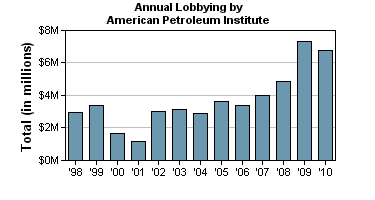 Secondly, there is no information in the Press story about the fact that API is fundamentally a lobbyist for Big Oil. According to the Center for Responsive Politics, API has spent between $4.5 million and $7.5 million on lobbying Congress in the past 3 years, spending $6,750,000 in 2010 alone.
Lastly, the Press article doesn’t tell readers anything about the Alberta Tar Sands project or the proposed Keystone XL Pipeline that would send the tar sands petroleum all the way to Texas. It would be important for people to know that the majority of the pipelines for the tar sands project from Canada to the US are under the operation of Enbridge, the company responsible for the oil pipeline disaster in Michigan last year.
A report from Tar Sands Watch provides some excellent analysis of the human and environmental cost of the Alberta Tar Sands project. You can see from the map all of the interlocking pipelines that are part of the tar sands project.

According to one activist website, “The tar sands are already slated to be the cause of up to the second fastest rate of deforestation on the planet behind the Amazon Rainforest Basin. Currently approved projects will see 3 million barrels of tar sands mock crude produced daily by 2018; for each barrel of oil up to as high as five barrels of water are used.” This source goes on to say that, “The tar sands mining procedure releases at least three times the CO2 emissions as regular oil production and is slated to become the single largest industrial contributor in North America to Climate Change.”
In addition, most of the pipelines that will transport the tar sands petroleum to places like Texas will go through Indigenous territories, according to environmental writer Andrew Nikiforuk.
So, while the premise of the article – that the US is too dependent on Middle East oil may have a bit of truth to it – the Press reporter never questions the claims that importing oil from Canada will benefit the US or how it will negatively impact the environment.
On Tuesday, March 8, women across the world will celebrate the 100th International Women’s Day. In Grand Rapids, the day will include two bridge walks to show solidarity with women in war- and conflict-torn countries.

Beginning at noon, Women for Women International will sponsor a “Join Me On the Bridge” gathering on the pedestrian bridge leading to the Gerald R. Ford Museum.
Then at 5 p.m., the Refugee Services Program in Grand Rapids is sponsoring a “Join Me On the Bridge” event which starts at 5 p.m. at Ferris State’s Riverfront Café, 219 N. Front Street. After events at the café, participants will march across the Fulton Street Bridge.
Originally, the IWD celebration was called International Women Workers’ Day, and was part of socialist countries’ culture to honor the women in their communities. The day had been chosen during the 1910 Second International, where delegates selected May 1 as an international workers’ day and March 8 as a day to honor women’s contributions and their equality in society.
The next year, the first IWD was celebrated by over a million people in Austria, Germany, Switzerland, and Denmark. In 1917, demonstrations by women factory workers on IWD in St. Petersburg triggered city-wide demonstrations the next day. The Tsar was forced to abdicate four days after that, giving a foothold for the first phase of the Russian Revolution. Lenin proclaimed International Women Workers’ Day a holiday in the Soviet Union in 1918.
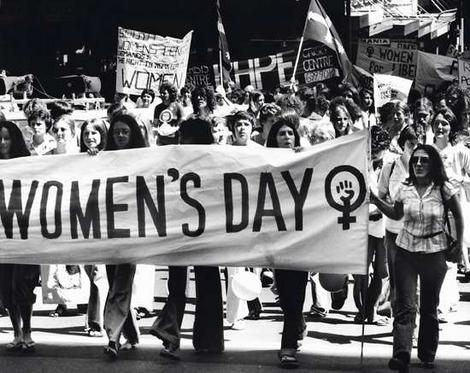 The day of celebration, however, was slow to be taken up by countries of the industrialized West. It was not really recognized in those countries until after the United Nations invited all its member states to proclaim and celebrate the day in honor of social justice and rights for women. That was in 1975.
In the United States, the women of the Socialist Party organized a widely attended IWD demonstration in 1911 after the Triangle Shirtwaist Factory fire in New York City. But regular celebrations were not common here until the 1970s.
Today, social and political awareness events are mixed with personal celebrations in many countries on March 8. In some countries such as Italy, Russia, and Albania, yellow mimosas are given to women to symbolize their sensitivity, hope, and strength. In many Balkan nations, gifts are given to women workers and speeches made honoring their contributions to society. In Portugal, restaurants are often closed to accommodate special women-only dinners and parties. The day was declared a public holiday in the United Kingdom in 2005.
March 8 is also a day of demonstrations of solidarity with women faced with specific challenges. In Poland, for example, women go out on a special strike called a Manifa on IWD every year to demand wage equity and to protest gender inequality. In Canada, there have been demonstrations and protests against the Catholic Church and the lack of separation of church and state on March 8 to raise awareness of the church’s institutionalized repression of women. In Detroit in 1996, 44 women were arrested at an IWD protest to show their solidarity for striking women workers from The Detroit News staff.
 In many countries, International Women’s Day is used to raise awareness of the many social challenges facing women: education, economic security, pay equity, social equality, gender discrimination, homophobia, physical and emotional abuse, and other health and safety issues.
March 8 has also become a day to acknowledge the places in the world where women are suffering in wars or military conflicts, or under religious restrictions and cultural repression.
A relatively new tradition is that of holding a bridge walk on March 8. In 2010, 108 of these walks were held in locations on four different continents. The marches commemorate those who have been killed in wars and military coups. They also honor the survivors who face the daily terror of physical danger, sexual violence, homelessness, intimidation by troops and military contractors, all while struggling to shelter and find food for their children.

Here in Grand Rapids, the first of two “Join Me on the Bridge” gatherings will take place from noon to 3.p.m. on the pedestrian bridge downtown adjoining the Gerald R. Ford Museum property. The purpose is to stand in solidarity with women in war-torn countries, women in the United States who face challenges, and also to meet members of the Grand Rapids community.
For more information on this Women for Women International event, contact Marie Maher Penny at mariemaher65@gmail.com or at (616) 241-5133.
The after-work event sponsored by the Refugee Services Program begins at 5 p.m. at the Riverfront Café. Attendees will listen to live music and hear the survival story of Florence Bish, a refugee from the Congo. Participants will also decorate a banner for use during the march. When the banner is ready, everyone will proceed to the Fulton Street Bridge for the bridge walk.
For more information about this “Join Me On the Bridge” walk, contact Chris Cavanaugh at ccava@lssm.org or at (616) 356-1934.
One Kent Coalition memo and the future of local politics
Last week we reported on the presentation by the One Kent Coalition to the Kent County Commission. The private sector coalition was proposing a new form of government that would consolidate Grand Rapids with other municipal bodies to have more of a metropolitan form of government.
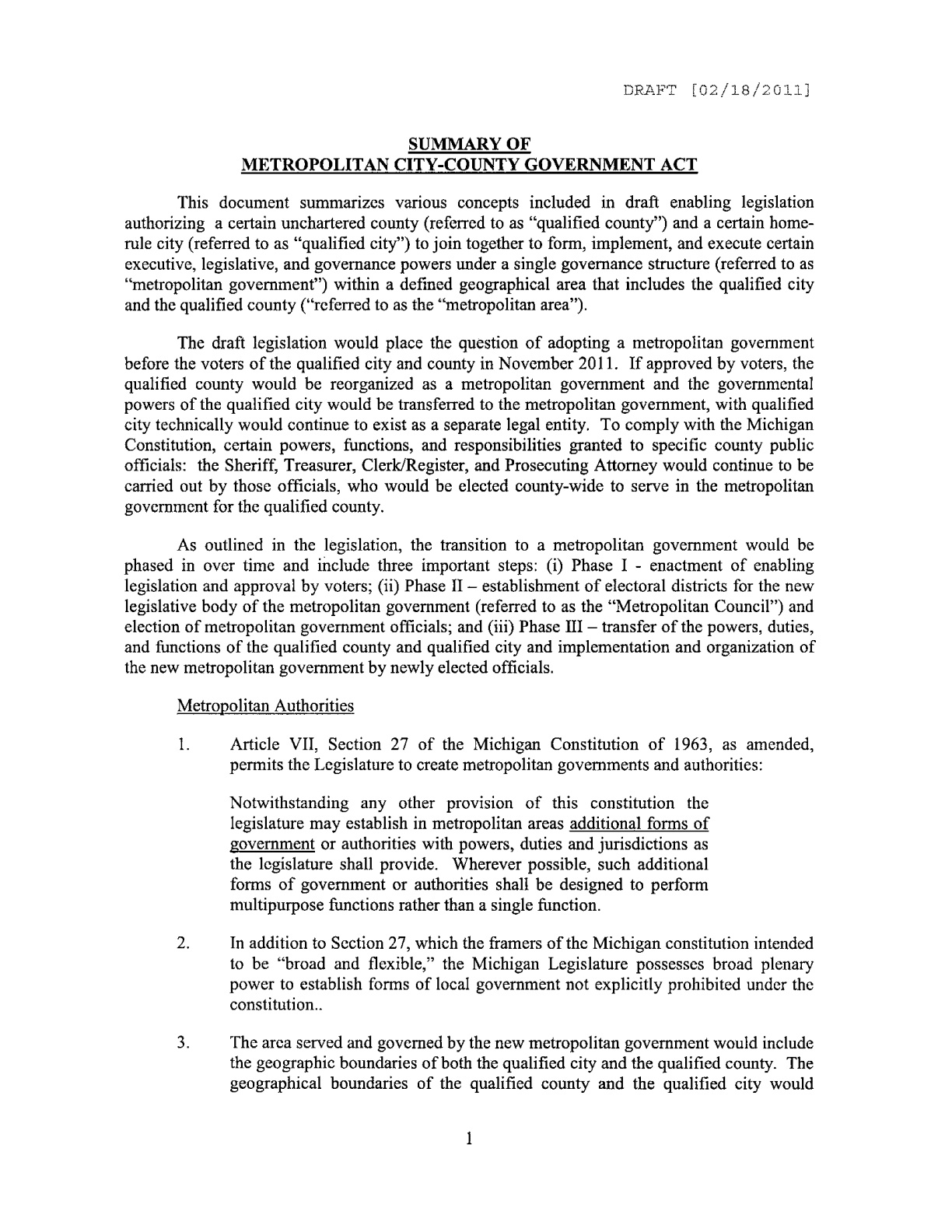
At the presentation last week the One Kent Coalition spokes person did not provide many details and avoided the issue of transparency even when asked who was part of the coalition and where their funds are coming from.
The names of those on the coalition were revealed shortly after the meeting. The list includes: Tom Butcher (GVSU), Nyal Deems (former EGR mayor), Betsy DeVos, Dick DeVos, Jeanne Englehart (GR Chamber), David Frey (Grand Action), Kurt Kimball (former GR City Manager), David Leonard (Spectrum Health Corp.), Greg McNeilly (Windquest Corp.), Marge Potter (former Kent County Comm.), Jared Rodriguez (West Michigan Policy Forum), Milt Rohwer (Frey Foundation) Peter Secchia, Peter Wege, Kate Pew Wolters, Tim Wondergem and Andy Guy (Wondergem & Associates).
When asked about a timeline for when this proposed change of local government might happen the One Kent Coalition spokesperson said that they had hoped that the State Legislature would approve an amendment this fall, which would allow for voters in Kent County to decide on the matter in 2012.
Earlier this week Grand Rapids Press reporter Jim Harger did a follow-up story on the One Kent Coalition and even posted a memo from the group that lays out the metropolitan government proposal.

What is revealing about the memo is that it states on three different occasions that the One Kent Coalition envisions a November 2011 vote on this issue, instead of a whole year later. So why the discrepancy? Are people with the One Kent Coalition not wanting to be very forthcoming with their plans?
In addition to the issue of when voters might weigh in on this matter there is one other point from the memo worth mentioning. In the last paragraph it states, “The metropolitan authority would be except from several existing statutes that are viewed as barriers to streamlining the efficiencies of government or the consolidation of departments, offices and personel. However, with respect to existing contracts, and collective bargaining agreements, those contract agreements would continue in place until their cuurent length of term. The legislation would not alter vested pensions or retirement rights or merit system employment benefits but does not restrict future changes.”
It is important to note that this group is thinking about collective bargaining and government employee pensions. Since many of the people on the One Kent Coalition are involved in the West Michigan Policy Forum and that group wants Michigan to be a Right to Work state it is safe to assume that they would not endorse the unionization of employees within this “metropolitan authority.” That they say “but does not restrict future changes” should be seen for what it is, their intention to make the kind of changes that will diminish the rights that union labor has.
Yesterday, MLive ran a story that former Secretary of Defense Donald Rumsfeld will be speaking at the Ford Museum on Monday, March 7.
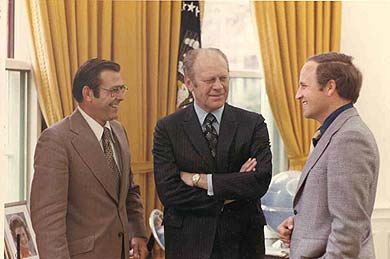
Rumsfeld is on a tour with his book entitled, Known and Unknown. The book title is based on a comment he made during a press conference while he was in the Bush administration, a comment that has been the source of much sarcasm.
The MLive story states, “Rumsfeld’s book has provoked controversy and criticism, most notably from Washington Post editor Bob Woodward, who said Rumsfeld tries to shift blame and whitewash his own errors of judgment.” The article doesn’t clarify what these “errors in judgment” might be or how widespread the criticism of Rumsfeld is beyond Woodward.
Rumsfeld’s History
It is no surprise that Rumsfeld would be speaking at the Ford Museum, since Rumsfeld was the Secretary of Defense under Ford. It was during 1975-76 that Rumsfeld made his mark as a proponent of militarism. Rumsfeld called for a $9 billion increase in the defense budget and began regular Congressional briefings on the growing “threat” of the Soviet Union, according to Andrew Cockburn’s biography of the former Secretary of Defense.
Cockburn also notes that Rumsfeld undermined disarmament talks with the Soviets and his anti-Soviet rumblings led him to a group of far right militarists known as the Committee for the Present Danger (CPD). The CPD had been around since the 1950s, but Rumsfeld and his associates helped to revitalize the organization.
Upon leaving the Ford Administration Rumsfeld turned to the private sector and became the CEO of the pharmaceutical company G.D. Searle & Company. It was during Rumsfeld’s tenure there that the company made millions with the creation of two sweeteners, Equal and NutraSweet.
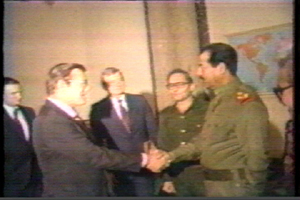
When Ronald Reagan was elected President in 1980, Rumsfeld’s politican connections would pay off and Rumsfeld was invited to be on numerous committees. However, the position that Rumsfeld most coveted during the Reagan years was his appointment as Special Envoy to the Middle East in 1983-84.
As Special Envoy to the Middle East Rumsfeld would solidify a special relationship between the US and Iraq’s leader Saddam Hussein. Rumsfeld made numerous trips to Iraq in 1983-84 to not only solidify relations with Saddam Hussein but to begin talks that would lead to a commitment by the US to provide weapons of mass destruction to the Iraqi dictator, all of which is well sourced in declassified documents by the National Security Archives. This is an important piece of history that was almost completely ignored in the build up to the US invasion of Iraq in 2002-03.
Rumsfeld and War Crimes
Shortly after George W. Bush was given the Presidency by the US Supreme Court in 2000, Donald Rumsfeld received a call to see if he wanted to have another go at being Secretary of Defense. Rumsfeld agrees and was part of the US imperial project from 2001 – 2006.
Rumsfeld was one of the proponents of going after Iraq within days of the 9/11 terrorist attacks, even though there was no evidence that Iraq had anything to do with it. Rumsfeld, like all of the high ranking Bush cabinet members, when on the offensive in 2002 to spread the propaganda that Iraq had WMDs. The Center for Public Integrity collected all of these statements in a report in 2008 to show that the WMD claims were false.
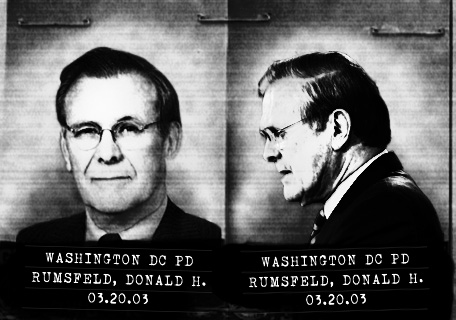
Unfortunately, the damage was done and the US invaded Iraq in March of 2003. The result of that 8-year war has left over a million Iraqis dead and the country in ruins. Rumsfeld and other high ranking officials in the Bush administration have been charged for war crimes because of the actual outcomes of the Iraqi policy from 2003 – 2008.
Numerous groups have filed lawsuits against Rumsfeld and other Bush cabinet members, lawsuits that began with Rumsfeld in 2006 when 21 Iraqi that fled to Germany charged the former Secretary of Defense with war crimes. Those charges and others like them have all made the following claims against Rumsfeld:
- Crime against peace – planning and carrying out a war of aggression.
- Complicity in the commission of a war crime – wanton destruction of cities and villages, devastation not justified by military necessity, ill-treatment of civilian population of or in occupied territory.
- Complicity in the commission of a war crime – torture, ill-treatment of detainees. Planned and executed invasions of Afghanistan and Iraq. Wrote memo instructing use of harsh interrogation techniques at Abu Ghraib.
Rumsfeld has not been back to Germany and even fled France in 2007 for fear of arrest by people who wanted to hold him accountable for authorizing torture in Abu Ghraib and Guantanamo.
Now Rumsfeld is on tour with his memoirs and hoping to re-write history. The Ford Museum will host him at an invitation only event and the local police will be present not to arrest him for war crimes, but to protect him from any public dissent. Such is the madness of the world we live in.

