The local group Healing Children of Conflict is hosting an open meeting for people who are interested in hearing the perspective of a Jewish writer/activist who will talk about the Israeli/Palestinian conflict.

Mark Braverman, noted author of Fatal Embrace: Christians, Jews, and the Search for Peace in the Holy Land and co-founder of Friends of Tent of Nations North America, will be speaking this Monday at the Christian Reformed Church headquarters in Grand Rapids.
Mark Braverman is a Jewish American with deep family roots in Israel/Palestine — his grandfather, a fifth generation Palestinian Jew, was born in Jerusalem and emigrated to the U.S. as a young man. Growing up in the United States, Braverman was reared in the Jewish tradition, studying Bible, Hebrew literature, and Jewish history. Trained in clinical psychology and crisis management, Mark worked with groups and individuals undergoing traumatic stress.
He now devotes himself full time to the work for a just peace in the Holy Land. Traveling to the Holy Land in 2006, he was transformed by witnessing the occupation of Palestine and by encounters with peace activists and civil society leaders from the Muslim, Christian and Jewish communities.
He has written and spoken on the role of religious beliefs in the current discourse in the United States and has worked with Christian denominations and ecumenical bodies on education and activism for a just resolution of the Israel-Palestine conflict. Mark serves on the advisory board of Friends of Sabeel North American and on the Board of the Israeli Committee Against House Demolitions-USA. He is also a charter member of American Jews for a Just Peace and has recently been appointed Consultant for Evangelicals for Middle East Understanding. Find out more at www.markbraverman.org.
Monday, March 21
2:00 PM
CRC Headquarters building
2850 Kalamazoo SE, Grand Rapids
Michigan Activists Play Yes Men-like prank on Enbridge
(This article is re-printed from the Yes Men.)
Earlier this week, the world learned of oil transport giant Enbridge’s strategy for handling inevitable oil spills along its proposed pipeline through pristine British Columbian wilderness: mop it up with human hair.
The cockamamie “MyHairCares” hoax, dreamed up by former oil workers and involving outreach to over 1000 hair salons, was promoted in a slick Video News Release and involved a flurry of conflicting press releases. The original story ran in a number of major news outlets (archive will be posted shortly here), but was pulled with no retraction or explanation after a terse denial by Enbridge that seemed to miss the point entirely. (For a longer, better denial click here.)
“This was a funny way to dramatize the fact that neither Enbridge nor any other oil company can prevent spills, and that they basically have no cleanup plan,” said Shannon McPhail, a former Canadian oil worker and Canadian spokesperson for People Enbridge Ruined in Michigan (PERM), the group responsible for MyHairCares. “What’s happening in Michigan proves that.”
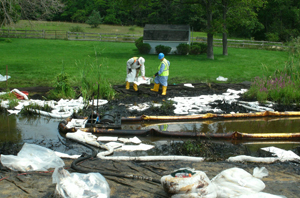
Between 1999 and 2008 Enbridge recorded an average of more than one oil spill every week. Just last summer, an Enbridge pipeline spilled more than 800,000 gallons of oil into Michigan’s Kalamazoo River. Enbridge is expected to face federal criminal charges for neglecting to maintain that pipeline; they are also accused of merely covering up, not actually cleaning up the oil. Further, a joint investigation by the Center for Public Integrity and CBS News found that Enbridge was coercing Kalamazoo spill victims into signing liability waiver forms. “Enbridge is manipulating and exploiting people who trust the company to do the right thing,” said former US Congressman Jim Oberstar, D-Minn., Chairman of the House Transportation Committee.
“We don’t want Canadian rivers or coastlines to end up like the oily mess that Enbridge has left in a number of places around here,” said US PERM spokesperson Rick Smith.

“In the U.S. Enbridge failed to maintain their pipeline, failed to clean up their mess, and are exploiting the victims,” said McPhail. “It would be madness to let them build a pipeline in Canada, especially through one of our planet’s last great wildernesses.”
Enbridge’s proposed Northern Gateway Pipeline would cut across the Rocky Mountains, the pristine Great Bear rain forest, and over 1,000 streams and rivers. The pipeline would carry 700,000 barrels a day of petroleum products across 1,170 kilometres between Alberta’s Tar Sands and the Pacific Coast, where supertankers would carry the crude though the treacherous Douglas Channel—an area in which currents render conventional oil containment booms useless.
“A major spill on the coast or in a river would be devastating and irreversible,” said McPhail. “Canada must not trade in our wilderness just to make some foreign oil companies rich.”
One salon owner contacted after the ruse lauded the activists’ approach to getting the media to pay attention to one of the most pressing environmental issues in North America. “I wasn’t tricked, I was educated,” said Brian Phillips, owner of World Salon in Toronto. “I had no idea what the people in Michigan were going through with Enbridge. We shouldn’t invite that treatment here in Canada.”
People Enbridge Ruined In Michigan (PERM) cooked up the “My Hair Cares” action with guidance from The Yes Men, as part of the Yes Lab for Creative Activism. Tomorrow, Canadian members of PERM will introduce themselves to the public during a noon press conference in front of Enbridge’s Vancouver offices. Free haircuts will available for all, and all clippings collected then (as well as any clippings mailed in by salons) will be donated to Michigan PERM members still struggling to clean up Enbridge’s mess in their community.
“Enbridge spends millions trying to convince people there’s no problem,” noted McPhail. “We had to be a bit clever to compete with that.”
Richest Members of Congress: Multi-millionaire Club

(This article is re-posted from Open Secrets.)
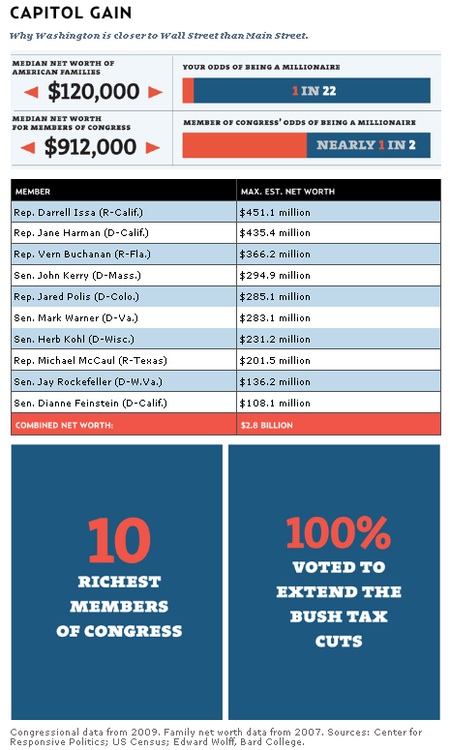
Mother Jones recently featured the Center for Responsive Politics in its March/April issue, using data on congressional members’ personal wealth. The magazine’s piece titled, “It’s the Inequality, Stupid,” highlighted the growing income and wealth inequality in America and used the Center for Responsive Politics to point out that members of Congress have a one in two chance of being millionaires compared to one in 22 for the average American family.
The piece also highlighted the fact that the 10 richest members of Congress all voted to extend the Bush tax cuts.
Mother Jones‘ cover story,”Plutocracy Now: What Wisconsin Is Really About,” prompted OpenSecrets Blog reporter Michael Beckel to examine union and corporate political action committees and their spending patterns over the past decade in Wednesday’s article, “Unions, Businesses Vie to Fill Democratic Pocketbook.”

Yesterday several thousand people converged on the Lansing State Capitol as part of the ongoing protests that are aimed at the draconian budget proposals and anti-workers legislation that Governor Snyder has put forth.
The protest occurred in stages with the first wave beginning at noon, followed by another at 2pm and a third one at 4:30pm. This writer was only there during the second wave.

The crowd was again dominated by organized labor groups representing many of the trade unions, nurses union, teachers union as well as government employees. However, there were also people there as students, senior citizens, environmentalists and activists of all stripes.
People carried signs that reflected their anger, some of which was targeted specifically at Governor Snyder and some of it because of the threats to local municipal autonomy, which was threatened with the new legislation that will allow the state to appoint “emergency managers” to communities that are facing a serious financial crisis.
Here is video that includes comments from a Detroit-based minister who addressed the crowd, followed by comments from a Grand Rapids member of the UAW.
After the speakers hundreds of people went into the Capitol building to confront legislators and to disrupt business as usually. Here is some footage of the Capitol occupation where people used chants about democracy, defending workers and slamming corporate bailouts. There were a few arrests reported, but most of those who came to the demonstration left willingly.
Interview with Robert Jensen

We talked with Robert Jensen who was in Grand Rapids to speak at the GVSU campus after a screening of the film The Price of Pleasure: Pornography, Sexuality and Relationships.
Our conversation centered around his analysis of pornography, particularly the harm in the production and consumption of pornography. Jensen also talked about the prevalence of racism and racist depictions in the production of pornography as well as a look at pornography through an anti-capitalist lens.
The interview included some discussion about the uprisings in the Middle East and the Midwest, then ended with his thoughts on working for social justice in the present moment.
3rd Annual Free Empowered Womyn’s Health Workshop
 Empowered Womyn’s Health
1 to 5 p.m. Sat. March 19.
The Bloom Collective
671 Davis NW (Steepletown Center)
Corner of 5th & Davis, Grand Rapids
The Bloom Collective invites women of all ages for a free workshop, Empowered Womyn’s Health, 1 to 5 p.m. Sat. March 19. The workshop is a skill-share with all women attending encouraged to share their health wisdom with each other.
The workshop is intentionally free because access to health information, or healthcare for that matter, should not be based on one’s ability to pay. Volunteers from the community are facilitating the following sessions.
- 1 – 2 p.m. Foods for the Feminine: how healthy real foods relate to women in various life stages of life. The workshop starts with a potluck lunch and healthy foods cooking demo with GRCC Dining Services Chef Nancy Rutledge. Enjoy samples of Nancy’s healthy creations and bring a dish to pass! The Bloom will provide vegan options.
- 2 – 2:45 p.m. The Childbearing Year: natural pregnancy, homebirth, breastfeeding. Midwife Shannon Pawson facilitates this session. Whether or not you plan on motherhood, our world needs all women as sisters in the cause of organic birth.
- 2:45 – 3:30 Bitches Brew: hands-on herbal decoction in the kitchen with women’s needs in mind. Take some home to try. Bloom intern, Bethany Scheffer, facilitates. Steepletown volunteer coordinator, Claire AK, will share advice on vitamins and supplements.
- 3:30 – 4:30 Shared Wisdom: How to pee standing up, sew your own pads, talk back to cat-callers… bring your best sister tips. Farmer Kelsie Hakeem will facilitate.
- 4:30 – 5 p.m. Yoga Nidra Session for Deep Rest. End the workshop by experiencing a session of yoga nidra, a meditative technique that provides opportunity for deep rest, renewed energy and setting intentions.
 Materials will be available for those who want to sew their own woman-healthy menstrual pads. Participants are encouraged to bring jars with lids to bring home their herbal tea and a blanket and pillow for the meditation session, if desired.
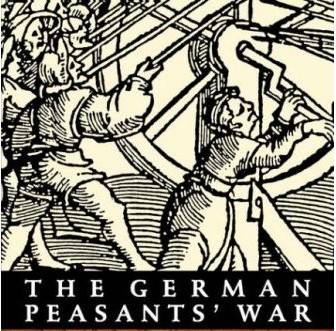
On this day in 1525, Nicholas Storch died, at the height of the revolution he helped to inspire: The German Peasants’ War, an uprising by laborers against the feudal system.
Storch was a radical. A weaver, he became a preacher of anarchist Christian views. He spread his ideas of the equality of all human beings and a communal sharing of goods and work. Unlike other members of the Zwickau Prophets, Storch was not a pacifist. He felt only direct confrontation and an uprising of the workers against the ruling class would result in bringing about the better world of his vision.
Storch’s teachings took hold among the laborers in his native Saxony. The war itself began with a series of uprisings in different Herrschafts. At the time, every Herrschaft (county) was ruled either by a king, a prince, or a princely count. Each held complete authority over the people under his jurisdiction. One of the first rebellions occurred because of unreasonable demands from the local ruling family:
During the 1524 harvest in Stühlingen, the Countess of Lupfen ordered serfs to collect snail shells for use as thread spools. This was the final straw in a series of difficult harvests, and within days, 1,200 peasants had gathered, created a list of grievances, elected officers, and raised a banner…within a few weeks, most of southwestern Germany was in open revolt.
Conditions were ripe for revolution. German coins had been devalued by the importation of silver and gold from Latin America. Prices rose, but rulers refused to lower their lease costs or allow the guilds to raise wages. Taxes on serfs and villagers were increased as well, because the rulers did not want to absorb the cost of a new imperial tax for the Holy Roman Emperor. The peasant class was forced to bear the brunt of these economic disasters in addition to ridiculous demands from their feudal lords.

As news spread of each local uprising against the serf status, more followed. Workers were fighting against well-funded and highly trained military forces: each ruling prince was required to keep a standing army and provide weapons for his soldiers.
The farmers and craftsmen could not afford horses, armor, or weapons. So they used pitchforks, scythes, wooden staffs, torches, and rocks. The ruling class expected these rock-throwing rebels to last a few days at best. Instead, the uprising turned into a war that lasted two years.
The serfs had two advantages. One was their solidarity, and the other was their ability to work hard physically to prepare for battles. They were able to build excellent trenches and field fortifications quickly. They linked their wagons together into a makeshift fort, and surrounded it with ground defenses. The princes’ armies had to split their forces to attack all sides.
Bands of disconnected peasants became, with the help of Storch, Thomas Müntzer, and other advisors, an effective army. Each band elected its own officers. Everyone had input in strategies and decisions, but captains made the final decisions. At the peak of the Peasants’ War, over 300,000 serfs and villagers were fighting across the German feudal states.
By the time Nicholas Storch died, it is likely that he and Thomas Müntzer had worked on drafts of The Twelve Articles, a list of demands that the peasant army presented to their rulers. When we read this list today, the concessions sound modest. The workers and villagers wanted to choose their own pastors, to fish and to hunt small game in the woods, to collect firewood to heat their homes in the winter. They wanted fair rents and taxes, and a return of their right to common grazing land—which they previously held, but were taken away by feudal rulers. And they wanted a voice in how they were governed.
But the rulers were stunned that their serfs, who they regarded as possessions, would make any demands at all. It was as if, one prince wrote, the farm animals demanded a new barn or the crops complained that they didn’t have enough water. The fighting continued.

By May of 1525, the Peasants’ Army was celebrating major victories across the war region. They had captured and gained control of several cities. Some Catholic bishops, along with the Elector of the Palatinate and a few of the princely counts, approached the peasant army and offered concessions. They also promised to meet the army’s Twelve Articles. Then the Peasant Army made a critical error: it took these rulers at their word.
Leaving a small standing army, thousands of peasants were sent home to attend to their fields and crops. A battalion of fighters and a band of councilors convened at Frankenhausen to draft a new constitution for the empire, allowing votes for the peasants. At this point, Martin Luther urged the feudal princes to destroy the “murdering and robbing band of the peasants.” Nicholas Storch’s comrade Thomas Müntzer was captured, tortured, and executed while working on the constitution. He was 28 years old at the time of his death. Saxony fell back under the rule of the Saxon princes. Defeats followed in Alsace, Württemberg, and Würzburg.
Over 100,000 rebels died in their attempt to gain a better life. Their fellow revolutionaries were punished across the German States with even more crippling taxes and were forced to pay war reparations. But, according to Karl Marx, who wrote extensively about the war, the peasant forces did manage to damage the existing feudal system. The Catholic Church lost control of much of its wealth and position in Germany. Many feudal rulers were bankrupted by their war costs and had to become, in their turn, the servants and courtiers of the most powerful princes. These overlords, Marx wrote:
…gained not only relatively, through the weakening of their opponents, the clergy, the nobility and the cities, but also absolutely through the prizes of war which they collected. The church estates were secularised in their favour; part of the nobility, fully or partly ruined, was obliged gradually to place itself in their vassalage; the indemnities of the cities and peasantry swelled their treasuries, which, with the abolition of so many city privileges, had now obtained a much more extended field for financial operations.
There would not be another uprising of the working class to match the Peasants’ War until the French Revolution, 264 years later.
Kellogg and the politics of sustainable certification
Last week the online business journal MiBiz posted a story that was headlined, “Kellogg Co. takes leadership stance in support of sustainable palm oil.”

The article states that the Battle Creek-based cereal company has committed to being part of the Roundtable on Sustainable Palm Oil (RSPO). The RSPO was an industry-founded entity with a mission that states:
“To advance the production, procurement and use of sustainable oil palm products through:
- The development, implementation and verification of credible global standards and,
- The engagement of stakeholders along the supply chain.”
The MiBiz article affirms the RSPO mission statement by citing both a Kellogg’s spokesperson and a representative of the World Wildlife Fund who says, “By supporting sustainable production in this way, Kellogg is demonstrating just the sort of responsible action that we want others to take. As the first in the U.S. food industry to take this step, they’re setting an example for others to follow.”
It all sounds pretty fabulous, right? Well, it seems that there is information that would question the so-called sustainable practices of the RSPO that Kellogg’s has decided to sign onto.
First, it is important to think about how much accountability there is with such an entity, especially since it is a self-police organization. There is no governmental or citizen-based mechanism for accountability.

Second, the RSPO is made up of entities from the banking industry, Consumer Goods Manufacturers, Palm Oil growers, Palm Oil Processors & traders, Retailers, Environmental Groups and other NGOs. The list from their website is a pretty mixed bag of entities such as ConAgra, Heinz, Cargill, Archer Daniels Midland, Nestle, and PepsiCo from the corporate world and the World Wildlife Fund and Oxfam in the NGO world. An important question for anyone to ask at this point is what is the track record of some of these multinational corporations on matters of ecological sustainability? If you do any research into many of these companies you will quickly discover that that have an awful record when it comes to sustainability.
Third, there is plenty of evidence that despite the claims made by the RSPO, the practices of palm oil production is quite unsustainable. In a 2008 article from Green Peace there is the claim that palm oil production has contributed significantly to deforestation in countries like Malaysia and Indonesia. The same article states that the RSPO is just another form of Greenwashing by a coalition of corporations in order to convince the public that what they are doing is good for the environment.
Another indication that the RSPO is not ultimately committed to ecological integrity is their rejection of greenhouse gas emissions standards. According to Friends of the Earth, “Clearing forests to expand oil palm plantations is increasing carbon dioxide emissions. It’s also having a devastating impact on forest communities by trashing the very resources they rely on for food and shelter.”

Author Heather Rogers (Green Gone Wrong) also has a critical take on the RSPO practices in a chapter on the ecological and social consequences of bio-fuels and palm oil. Rogers, who spent a great deal of time in Borneo doing research says that companies that are members of the RSPO have not only displaced local communities in order to plant palm tree plantations they have also cut down old growth forests in the process.
The Rainforest Action Network (RAN) has similar concerns, but states: “The RSPO can be an important tool, both for communities and for our work against the US Agribusiness giants. But the RSPO’s success and credibility depends on the work of organizations like SawitWatch, the Forest People’s Program, and other local NGOs who work to ensure that the RSPO is a real multi-stakeholder initiative, and works actively to ensure that community-level conflict is solved before oil palm companies are certified “sustainable.”
Clearly there are serious concerns about the effectiveness and lack of accountability with the Roundtable on Sustainable Palm Oil process and its member companies. Unfortunately, this was not something that MiBiz was willing to explore in reporting that Kellogg’s had taken a “leadership” position on this issue.
Yesterday, Wayne State University Professor Danielle L. McGuire spoke to an audience at the downtown campus of GVSU. The topic of her talk was based on her recently released book, At the Dark End of the Street: Black Women, Rape & Resistance – a New History of the Civil Rights Movement from Rosa Parks to the Rise of Black Power.
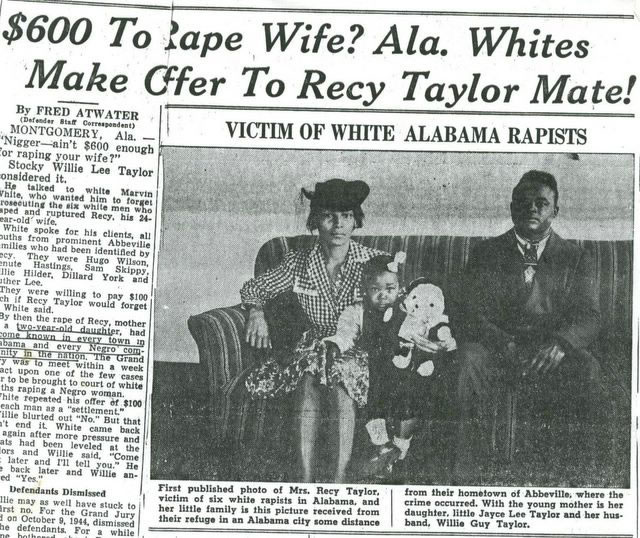
She began her presentation the same way the book begins by telling the story of Recy Taylor, a 24 year-old Black woman who while walking home was stopped by a carload of White men. The men forced her into their car and then raped her. The White men told her that if she said anything they would kill her. She told everyone she knew.
The NAACP got wind of the incident and sent their best investigator, Rosa Parks, to Alabama to interview Recy. What Rosa Parks discovered and what Professor McGuire found out was that a decade before the Montgomery Bus Boycott the Black community was already organized and resisting White Supremacy. The difference was Black people were not fighting for an end to racial segregation they were fighting against the sexual violence of White men against Black women.
McGuire said, “The modern Civil Rights movement was born out of the overwhelming incidents of sexual assaults by White men in the South.” It was the courage of Black women that gave birth to the tactics and strategies that challenged White Male Supremacy that would later be used for voting rights and other campaigns, according to McGuire.

Professor McGuire then went on to talk about the Montgomery Bus Boycott. She said that the popular version of the story is that Rosa Parks started the boycott because she refused to move to the back of the bus. However, McGuire said that another Black woman, Gertrude Perkins, was really the person who gave birth to the campaign. Perkins was a 25-year old black women who was abducted by White police officers, who then raped her. After the rape she told a local Black minister, who sent the story to a syndicated columnist and radio talk show host who reported on the assault the next morning. The local police would not investigate, even though they had a history of sexist and racist history.
Black people in Montgomery organized around this assault. One action was to hang a banner that read, “The Rapist was White.” It happened to be that the church where the banner was hung was the same church that Dr. King would later be pastor of. A local committee was also formed in response to the rape and this group was so effective in their organizing that they got a Grand Jury hearing and the local Black ministers together for the very first time.
Not long afterwards there was another incident of a rape of a Black woman by a local grocer. Again, the police would not investigate, so a boycott campaign against the store was begun, yet another tactic that was used by the Civil Rights movement.
In addition, there were organized campaigns against the bus system, even boycotts, because of the ongoing sexual harassment on the buses in Montgomery. The bulk of the riders were Black women who worked as maids in White homes and could only use bus transportation to get to work.
So when Rosa Parks refused to move to the back of the bus, it was no surprise that thousands participate, especially women who had been fighting racism and sexism on the buses for over a decade. “These women during the boycott walked to work and walked to protest the sexism and racism that women had experienced,” said McGuire.
Professor McGuire also told the story of Daisy Bates, in Little Rock, Arkansas who is known for her work in school desegregation. However, Bates got involved in Civil Rights work because her mother had been raped by White men. In fact, the newspaper she edited (Arkansas State Press), would often denounce the sexism and sexual assaults by White men.
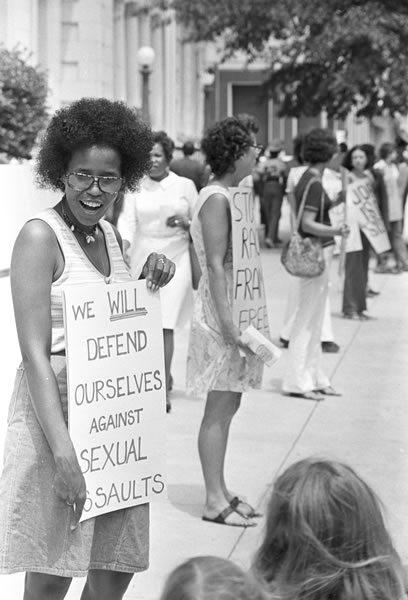
McGuire went on to say that so many of these southern Civil Rights struggles were born of women’s experience with sexual assault. McGuire also said it is important to put this history into proper context, by going back to slavery, where White slave owners often sexually assaulted Black women in slavery. This is where sexual assault by White men against Black women became normalized.
During Reconstruction White Supremacists used Sexualized violence as a tool against freed slaves. It was during this time that the White Supremacists used the myth of Black male sexual predators as a way to demonize Black men and maintain power. McGuire said there is an old saying that grew out of the Jim Crow era which said, “The closer a Black man got to the Voting box, the more he looked like a rapist.”
Professor McGuire also mentions the 1967 Supreme Court decision, which overturns the ban on inter-racial marriage. This decision was a watershed moment that not only led to greater equality and freedom in relationships but it also was a slap in the face to White Supremacists.
McGuire shared several other stories and cases that are in her book, but towards the end of the talk she emphasized the point that if we are going to fully understand the sexual and gender aspects of the Civil Rights movement, we have to come to terms with the sexual and gendered violence that activists had to endure. It was this very sexualized and gendered violence, which gave birth to the modern Civil Rights movement that McGuire said should radically alter how we approach that history.
GRIID 2011 Spring Classes
GRIID would like to announce that we are offering two more classes that begin in April.

Confronting White Privilege is the first class, which is one that we offered last fall. This class is designed to investigate institutional racism in the US and how it is being manifested today. We will be using a book by Tim Wise entitled, Between Barack and a Hard Place: Racism and White Denial in the Age of Obama.
Included in this 6-week class will be a look at the racial dynamics that exist in the Greater Grand Rapids area and what is or isn’t being done to promote racial justice. The Confronting White Privilege class will meet on Mondays from 7 – 9pm, beginning April 11.
The second class that GRIID is offering is a completely new class entitled US Policy in the Middle East and Revolutionary Movements. This class is designed to investigate US policy in the Middle East since WWII and the current revolutionary movements in countries like Egypt, Tunisia and Libya.

The class will be using Mark Zepezauer’s book Boomerang!: : How Our Covert Wars Have Created Enemies Across the Middle East and Brought Terror to America to explore these historical dynamics and numerous online resources to investigate the current uprisings. This second class will meet on Wednesdays from 7- 9pm, beginning April 13.
Both classes will meet at the Steepletown Neighborhood Center, located at 671 Davis NW in Grand Rapids. Both classes cost $20, which does not include the cost of the book.
If you would like to sign up for either class or receive additional information contact Jeff Smith at jsmith@griid.org or Mike Saunders at outobol@gmail.com. There are also downloadable flyers online at https://griid.org/griid-classes/.

