Recently the Michigan House of Representatives passed legislation that would reduce funding for public universities if those universities provide domestic partner benefits.

House Bill 4325 passed with 57 votes in favor and 53 against with the Republican majority determining the outcome. This vote was part of a larger public education funding piece, but area Rep. Dave Agema added an amendment that would punish universities who provided domestic partner benefits.
In a recent Media Release Agema stated:
“Public universities are thumbing their noses at the rule of law because of their special constitutional privilege dictating that we can’t tell them how to spend the money we appropriate to them. We can, however, not give them that money in the first place if they disregard the law, which is what this amendment does. It then uses the money from the universities that refused to change their policy and places it into the K-12 public schools retirement coffers to help eliminate the shortfall there. This could be worth up to $60 million to schools.”
According to a story in the Lansing City Pulse, “Fourteen of the state’s 15 public universities have introduced some form of same-sex benefits since voters approved a constitutional amendment in 2004 that banned domestic-partner benefits. The schools’ policies sidestep the ban by offering the benefits to other members of employees’ households.”
GVSU is one of those fourteen public universities in Michigan that offers domestic partner benefits. “Grand Valley offers Household Member Benefits in order to support the recruitment and retention efforts of the University in an effort to keep us competitive with other public universities who already offer similar benefits to their faculty and staff,” according to the university website.

The Director of the LGBT Resource Center at Grand Valley, Colette Seguin Beighley, responded to this decision in Lansing by stating, “Obviously, we are disappointed in the decision of the Michigan House to penalize the budgets of universities offering domestic partner benefits. Grand Valley has worked and continues to work hard to create a campus community that is welcoming for all students, faculty and staff including members of the lesbian, gay, bisexual and transgender communities. This budget penalty is a step backward for Michigan and will not help our ability to recruit and retain talent in our already hurting state.”
This is not the first time that Rep. Agema has taken such a strong anti-gay position as a legislator. According to State Rep. Jeff Irwin, “It was a complete surprise to me when Rep. Agema stood up and made this speech about punishing universities for violating our moral code as a state. He did raise the issue of morality specifically, and he did use the word ‘punish’ specifically.”
Agema has not been shy about his stance on this issue and has repeatedly posted comments on Facebook that reflect his anti-gay ideology. In one recent exchange with someone on Facebook he was asked why he would support government dictating who can marry who, especially since Agema claims to be a big proponent of smaller government that should meddle in people’s lives. Agema responded by saying, “It’s against natures laws, mans laws and God’s laws. Without a male and female the society dies in one generation….think about it!” Indeed, we should all think about what it means to have people like Dave Agema determining public policy.
On this day in 1855, anarchist and unionist George Speed was born in Maryland. He became the Chairman of the IWW Executive Committee, and played crucial roles in the Pullman strike, in fighting government oppression of unions, and in the Haymarket trial. He was also an early proponent of a racially diverse union, demanding no distinction be made between members of different races.

Speed started his working life as a hatmaker’s apprentice, and joined the Silk Hat Finishers’ craft union. Soon, his union activities eclipsed his craft skills, and he became a union organizer.
Speed’s union work took him to Louisiana and Texas to meet with timber laborers; to the Midwest to help organize industrial workers, and to California, where he spent much of his career meeting with and supporting the unionizing efforts of farm workers.
In 1903, Asian-American and Latino farm workers wrote to Samuel Gompers and asked for a union charter from the AFL. Gompers replied that the AFL would never accept members of Chinese or Japanese descent. He told the workers until they guaranteed they would turn away Asian members, they would not receive a charter. Speed spoke to this issue by saying, “The whole fight against the Japanese is the fight of the middle class of California, in which they employ the labor faker to back it up.”
He also noted, “…One man is as good as another to me; I don’t care whether he is black, blue, green or yellow, as long as he acts like a man and acts true to his economic interests as a worker.”
George Speed helped to support part of Coxey’s Army during 1894. The march was a protest over the unemployment of workers following the Panic of 1893. It was originally suggested by Jacob Coxey, a socialist from Ohio who actually was a member of the elite; he owned vast tracks of land, a silica manufacturing plant, and race horses. The size of the march on Washington, D.C., grew to 6,000 men, many of them members of unions.
Newspapers of the time started a panic over the event, calling the workers “tramps,” predicting massive riots from the “noisy, pillaging mob,” and charging various union leaders with trumped-up sex scandals. George Speed helped to face down government troops who attempted to stop the march—although, in fact, the group was never allowed to enter the capital—and learned some valuable lessons which he later applied that same year during the Pullman Strike.

George Speed played a central role in many union actions and strikes, but perhaps the most notable was the Pullman Strike of 1894. Three thousand Illinois railroad car manufacturing employees went out on strike after their wages were cut and their workday expanded to 16 hours. They paralyzed travel and shipping in two-thirds of the United States by doing so. But that was just the beginning. At its peak, the strike encompassed a quarter of a million workers in 27 states, making it one of the largest strikes in United States history.
The American Railway Union joined forces with the Pullman Car Company workers, and its members refused to switch tracks for any train that included Pullman brand cars. When threatened, 125,000 workers walked off the job.
The government attempted to muscle in by issuing an injunction to union leaders, which was simply ignored. United States Marshals and the Army were then sent in on the pretext that since the trains carried US Mail, the strike violated the Sherman Act.
Thirteen workers were killed and 57 wounded during the action. Eugene Debs, head of the Railway Workers union, was arrested and tried, but halfway through the trial the charges were dropped—apparently to avoid a victory by Clarence Darrow, who represented the union. Although mainstream media of the time crowed about the “defeat” of labor, the resulting Industrial Commission report firmly supported collective bargaining as a way to correct the power imbalance between capitalists and laborers. The Erdman Act of 1898 also made yellow-dog contracts (in which workers had to spurn union membership to get hired) illegal.
George Speed was one of the founding members of the Industrial Workers of the World when it was officially formed at a convention in 1905.
Speed’s experience in labor organizing proved helpful to many groups that were unionizing at the time. One example was in 1913; Speed was approached by a group of longshoremen who wanted to organize against unfair practices that included discrimination against minority workers. Speed helped the group draft a list of demands: a pay raise to all workers, regardless of race; a 10-hour day; time-and-a-half for night work; double time for Sunday work; and no retribution for striking. Although some of their demands were met, the strike leaders were then fired.
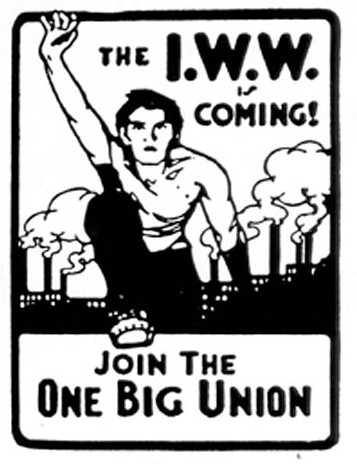
Speed notified the IWW, and the union organized a strike of 1,500 workers who demanded collective bargaining, their raise in pay, and the restoration of jobs. George Speed stayed in Philadelphia to meet with the strikers every day, giving them “the straight stuff” until all demands were met. He helped usher in a new decade of prosperity for Philadelphia longshoremen, and one which became an interracial model for other unions to emulate.
In 1917, George Speed was one of the IWW members in Chicago arrested on charges of violating the Espionage Act of World War I. The IWW “Wobblies” refused to enlist and encouraged draft dodging among its members; the union also supported strikes of lumber workers and miners whose work was deemed “crucial” to the war effort.
Other unions of the time took a placating approach to capitalists and encouraged their members to accept small, incremental changes and improvements. The IWW took a much more radical approach. It was targeted for the trial among the unions because it advocated an all-out attack on capitalism, including industrial sabotage. Leaders spoke of class warfare, especially during wartime. One IWW tract of the time stated, “In the case of wars, which every intelligent worker knows are wholesale murders of workers to enrich the master class, there is no weapon so forceful to defeat the employers as sabotage by the rebellious workers.”
The trial lasted for more than two months. The government tried to claim that the IWW wanted to replace President Woodrow Wilson with Kaiser Wilhelm and that they were accepting funding from Germany. At the same time, the suit claimed that the IWW was being run by Russian Bolsheviks. IWW members were called terrorists by the press.
When Bill Haywood, IWW’s leader, was called to the stand, he showed the charges for the baseless persecution that they were. If the IWW was anti-war, he argued at one point in his questioning, why would they be pro-German? “Germany today is the worst autocracy in the world,” he said.
Despite the absurdity of the charges, the jury deliberated for just over an hour and found all 100 defendants guilty. Fourteen of the top IWW leaders, including George Speed, were sentenced to 20 years in Leavenworth Penitentiary and fines of $10,000 each. Thirty-three other defendants received sentences of 10 years in prison.
At the time of the trial, George Speed was 64 years old and the Chairman of the IWW. He said on the record:
My idea of life is this: that the whole history is one of pain and struggle. That there are two classes in society absolutely antagonistic to each other—an employing class and a working class—and that the interest of the employing class is to buy labor in the cheapest market. I came to that conviction young, and when I got hold of a Marxian leaflet in 1883, it inspired me with a new life. Before that time, I was a little indifferent and a little careless, and after that I tried to devote my whole time to make life better for myself and for my fellow workers.
The trial triggered a wave of vigilante actions against IWW members across the country, with lynchings, beatings, and arrests. IWW’s headquarters in New York City were ransacked. But the IWW continued to stand firm in the tradition of its leaders like George Speed.
Today, the IWW continues to fight for the rights of workers, organize union actions, and participate in community actions such as the creation of food co-ops and food justice organizations. Member groups have organized protests against the Iraq War, demonstrations in opposition to sweatshop labor, and supported boycotts of companies like Coca Cola for its suppression of worker rights. Speed’s dedication to the working class continues on in the union which he helped to create.
Energy Industry Puts Positive Spin on Record Profits
(This article is re-posted from PRwatch.)

After Exxon Mobil posted first-quarter 2011 profits of $10.7 billion — $6.3 billion more than it earned last year by this time — the company put out a defensive statement arguing that it is not to blame for gasoline exceeding $4 around the country.
Instead, the company blamed skyrocketing gas and oil prices on the U.S. government, saying Exxon makes about seven cents on a gallon of gasoline, while state and federal governments collect 40 to 60 center a gallon in taxes. Jack Gerard, CEO of the American Petroleum Institute, the oil and gas industry’s lobbying group, spun his industry’s record income as a positive, saying high oil company profits signal a stronger U.S. economy. Gerard said Americans “should be proud” of a high-earning oil industry, since it supports millions of jobs and provides income for retirees in the form of profits paid on shares in people’s retirement accounts.
Exxon vice president Ken Cohen portrayed the push to eliminate $4 billion in government subsidies for the industry as an attempt to raise taxes on the industry, saying the subsidies help keep jobs from being exported to other countries.
Michigan Governor Rick Snyder spoke to a crowded room yesterday in the Amway Grand Plaza Hotel at an Economics Club luncheon.

The talk given by Snyder was almost identical to the one he gave 6 weeks ago in Grand Rapids to a Chamber of Commerce audience. Snyder stuck to his mantra of reinventing Michigan and gave his 4-month summary of what he feels his administration has accomplished.
Snyder boasted about the creation of a dashboard, which he thinks is a customer friendly way of providing Michigan citizens a way to measure government performance.
The Governor then outlined what he called his roadmap for making certain economic changes happen right away. In February he passed the elimination of the Michigan Business Tax (MBT) and said, “the wicked witch is dead.” He went on to say that eliminating the MBT was all about job creation and is the best thing for the Middle Class. After that comment the room gave him a resounding applause.
In March, Snyder said, the focus was local government reform, which he announced in Grand Rapids. His Emergency Financial Managers law was designed to “help our communities succeed.” Snyder also said that his revenue sharing revisions would make it easier for service consolidation and service management. In addition, he believes that cities will have to “compete for best practices” in order to get tax revenues and communities are “not entitled to that money.”
Snyder also mentioned his budget reform plan his work on changing how Michigan does education. Snyder believes the education system is broken and that this system is “geared to make money and not educate our children.”
Snyder then went on to say that once the budget is completed he plans to address the issue of health and wellness, followed by infrastructure improvements and workforce development, which he referred to as “talent development.” “The greatest resource we have is not the Great Lakes, it is people,” said Snyder. He wants to connect together people and resources that are developing talent.
The Governor ended his comments by talking about the need for Michigan to change its attitude and be more positive about the assets and resources in the state. Snyder called this Relentless Positive Action or RPA. The statement felt like we were all at a positive thinking workshop, but at the same time it made perfect sense, considering who was in attendance.
Like any politician Snyder was giving his audience what they wanted to hear and since his audience was the elite financial sectors of West Michigan his comments were well received. Many of the people in the room are direct beneficiaries of the kinds of economic policies that Snyder is imposing on the state, policies that also seek to privatize public services and give more tax dollars to the private sector.
All one had to do was look at who shared a table with the Governor to see who has access to political power. Surrounding Snyder was Sam Cummings, a local businessman who owns a substantial amount of downtown property in Grand Rapids. Next to Cummings was Senator Mark Jansen who has been highly supportive of Snyder’s policy decisions.

Also at the table were Mark Murray (Meijer), Fred Keller (Cascade Engineering), David Van Andel and right next to Snyder was Rich DeVos. Doug DeVos introduced Snyder and Dick and Betsy were seated at an adjacent table.
Considering who was surrounding Snyder it is no surprise that the Governor was so well received and why he kept referring to everything in business terms. Snyder must have said the word entrepreneurship a dozen times and even referred to his policies as creating “governmental entrepreneuralship.”
Outside of the Econ Club luncheon about 50 people had gathered to protest the Governor’s visit. People held signs while some marched and chanted slogans challenging the economic policies that are attacking working class people. However, such a small turnout did not seem to have much of an impact on Snyder or those at the luncheon and unlike the last time Snyder spoke in Grand Rapids he didn’t even mention the statewide protests.
However, while Snyder wooed the wealthy members of the Econ Club a press conference was held in Detroit to kick off a campaign to repeal the Emergency Financial Managers (EFM) law, known as Public Act 4, which we reported on yesterday. Whether or not this is the most effective strategy to reverse the policies of the current administration in Lansing remains to be seen.
The Academy Award winning film for best documentary in 2010, Inside Job, will be shown this Thursday by the Grand Rapids branch of the IWW.

“The film focuses on changes in the financial industry in the decade leading up to the crisis, the political movement toward deregulation, and how the development of complex trading such as the derivatives market allowed for large increases in risk taking that circumvented older regulations that were intended to control systemic risk. In describing the crisis as it unfolded, the film also looks at conflicts of interest in the financial sector, many of which it suggests are not properly disclosed. The film suggests that these conflicts of interest affected credit rating agencies as well as academics who receive funding as consultants but do not disclose this information in their academic writing, and that these conflicts played a role in obscuring and exacerbating the crisis.”
A discussion of the film will be facilitated by members of the IWW after the screening. The film is free and open to the public.
Inside Job
Thursday, May 19
6:00 PM
IATSE Labor Hall 931 Bridge St. Grand Rapids
Public Act 4, the signed version of HB4214, has been called “financial martial law” that can be waged against any city, town, or public school system in Michigan. GRIID recently reported on the EFM situation in Benton Harbor, where the law is being used to plan the seizing of public property to build an elite private vacation enclave. Despite reassurances at the time of its passage that the “extremes” of the law—such as firing elected officials, and targeting minority communities—would likely not be used because of political pressure, we are already seeing those exact actions put into play.

Now a group of Michigan activists have decided to stop the law cold—with a repeal effort.
Michigan Forward, a Detroit-based nonprofit, has been at the forefront of the repeal effort. Brandon Jessup, chairperson of the group, told GRIID that he was motivated to bring down Public Act 4 because Michigan citizens must “come to grips with this corruption—to speak up and call it corrupt.”
Citing corporate profit gambits that the EFM law allows such as “public parks being enveloped, water systems privatized, and the dangerous level of control that’s defined” in Public Act 4, Jessup says that the Michigan Legislature doesn’t appear to care about the consequences of what they’re doing.
“Snyder said during his campaign that he didn’t need Detroit’s vote,” Jessup told GRIID. “Our urban core needs to be renewed, not torn down and ‘developed’,” he added.

Michigan Forward is working with several groups in the state, including Rainbow PUSH Coalition, which is setting up a headquarters in Benton Harbor, and the Highland Park NAACP.
And now a northern Michigan activist group has also joined Michigan Forward to launch the drive to collect signatures for Public Act 4’s repeal. Reject Emergency Managers is a grassroots group working out of Traverse City. Spokesperson Betsy Coffia states that the name of the group indicates “our real focus, although we support the recall/repeal efforts and overall awareness over all the damaging policies and laws coming out of Lansing.”
In a recent interview, Coffia explained that she was “personally on the phone with my legislators and the Governor’s office prior to [Public Act 4] being signed, and said ‘make sure that you protect local populations, that they have the right to vote, to recall…they should have a say in whether their properties get sold.” None of those protections ended up in the final version of the law. At that point, she and other activists in Traverse City started to study Public Act 4 to determine what avenue could be used to overturn the legislation.
In order to repeal the law, first a petition needs to be drafted. Next, activists must collect 161,305 signatures of voters who want the EFM law repealed. That represents 5 percent of all Michiganders who voted in the election for governor.

Once 161,305 valid signatures are collected to meet the November deadline, the repeal will be placed on the 2012 ballot. However—and this is an important point—the signatures by themselves will suspend the law until the vote.
Michigan Forward submitted a petition to the Board of Canvassers on Friday, May 13. On Monday, May 16, press conferences will be held in Detroit, Traverse City, and Benton Harbor to launch the effort. The drive to collect signatures will start at the beginning of June.
Brandon Jessup explained to GRIID that signatures will not be held while being collected, but will be released in blocks as soon as they are available and verified. Even after the united groups obtain the 161,305 signatures needed, they will continue to collect signatures until the November deadline.
Jessup says that Grand Rapids will be crucial in the collection of signatures, and plans to launch a canvassing effort here. GRIID will keep readers informed, and you can also check Michigan Forward’s website and Reject Emergency Mangers’ Facebook page for up-to-date news on the repeal effort.
Here’s a video created by Flint Public Development which shows citizen outrage over Public Act 4. The video was recorded in Benton Harbor during the Blossomtime parade. Betsy Coffia appears in one interview. She explains problems with the legislation and describes the repeal process:
Film looks at how US Deportations separate families

One aspect of the current US immigration policy that is rarely discussed in commercial media is the harsh reality of how families get separated because of this inhuman policy.
Touring the US right now is the director of the film Tony & Janina’s American Wedding, a new documentary that puts a human face on how the current US immigration policy impacts families. The group Alliance for Immigrant Rights has organized the film tour in Michigan and Justice for Our Neighbors will host viewings in Holland and Grand Rapids on Tuesday, May 17.
“Tony & Janina’s American Wedding is a feature length documentary that gets to the heart of the broken, red tape ridden U.S. immigration system. After 18 years in America, Tony and Janina Wasilewski’s family is torn apart when Janina is deported back to Poland, taking their 6 year old son Brian with her. Set on the backdrop of the Chicago political scene, and featuring Illinois Congressman Luis Gutierrez at the heart of the immigration reform movement, this film follows the Wasilewski’s 3-year struggle to be reunited, as their Senator Barack Obama rises to the Presidency. With a fresh perspective on the immigration conversation, this film tells the untold human rights story of Post-9/11, that every undocumented immigrant in America faces today, with the power to open the conversation for change.”
The two West Michigan screenings are:
Tuesday, May 17th at noon Herrick District Library in Holland
Tuesday, May 17th – 7pm Woodland Celebration Cinema in Grand Rapids
(This article is re-posted from Reuters.)
The crown prince of Abu Dhabi has hired the founder of private security firm Blackwater Worldwide to set up an 800-member battalion of foreign troops for the United Arab Emirates, The New York Times reported on Sunday.

The Times said it obtained documents that showed the unit being formed by Erik Prince’s (pictured here) new company Reflex Responses with $529 million from the UAE would be used to thwart internal revolt, conduct special operations and defend oil pipelines and skyscrapers from attack.
The newspaper said the decision to hire the contingent of foreign troops was taken before a wave of popular unrest spread across the Arab world in recent months, including to the UAE’s Gulf neighbors Bahrain, Oman and Saudi Arabia.
The UAE itself has seen no serious unrest. Most of its population is made up of foreign workers.
Blackwater, which once had lucrative contracts to protect U.S. officials in Iraq, became notorious in the region in 2007 when its guards opened fire in Baghdad traffic, killing at least 14 people in what the Iraqi government called a “massacre.”
One former Blackwater guard pleaded guilty to manslaughter charges in those killings, and a U.S. court reinstated charges against five others last month. Prince has since sold the firm, which changed its name to Xe. The firm denies wrongdoing.
The newspaper said the Emirates, a close ally of the United States, had some support in Washington for Prince’s new project, although it was not clear if it had official U.S. approval.
Two UAE government officials contacted by Reuters declined immediate comment on the New York Times report, and the U.S. embassy in the UAE also had no immediate comment. It was not possible to locate Prince for comment.
The Times quoted a U.S. official who was aware of the program as saying: “The Gulf countries, and the U.A.E. in particular, don’t have a lot of military experience. It would make sense if they looked outside their borders for help.”
State Department spokesman Mark Toner told The Times the department was investigating to see if the project broke any U.S. laws. U.S. law requires a license for American citizens to train foreign troops.
Toner also pointed out that Blackwater, now known as Xe Services, had paid $42 million in fines in 2010 for training foreign forces in Jordan without a license, the Times said.
According to former employees of the project and U.S. officials cited by the Times, the troops were brought to a training camp in the UAE from Colombia, South Africa and other countries, starting in the summer of 2010.
They were being trained by retired U.S. military, and former members of German and British special operations units and the French Foreign Legion, the Times said.
Prince had insisted the force hire no Muslims, because they “could not be counted on to kill fellow Muslims,” the paper said.
Former employees also told the newspaper the Emirates hoped the force could be used to counter any threat from Iran, which the Arab states in the Gulf consider a foe.
Although The Times said the documents it obtained did not mention Erik Prince, former employees had told the newspaper he had negotiated the contract with Abu Dhabi Crown Prince Mohammed bin Zayed al-Nahyan.
Emiriati officials had proposed expanding the force to a brigade of several thousand if the first battalion was successful, the newspaper said.
Spectacle in the Service of Capital
Yesterday, MLive posted yet another article about the latest Rob Bliss “event.” Bliss and company will be filming a lip dub in downtown Grand Rapids to the Don McLean song “American Pie.”

While Bliss is hoping for another huge turnout he has also lined up numerous people who along with Bliss want people to come to downtown Grand Rapids and spend money. I have argued in previous postings about the Bliss phenomenon that while these events may be fun and engage lots of people, they ultimately serve capital interests.
Bliss only organizes these events in downtown Grand Rapids, which only benefits a small sector of the business community. Many of the businesses downtown are upscale and disproportionately benefit people who are already well off. Imagine if a zombie walk were to happen in the Burton Heights neighborhood or the Creston neighborhood or along the Grandville Avenue corridor. If people were buying food the money would surely land in the hands of small restaurants and grocery stores, many of which are owned by people of color.
However, the Bliss events are downtown and serve the businesses interests of some of the same people that Bliss has invited to be part of the lip dub. Among those involved who benefit from money being spent in downtown GR are Dick DeVos, Peter Seechia, Jim Dunlap (banker), Ryan Slusarzy (Amway Hotel), Jay Harnish (DeVos Hall) and Randy Finch (Ice Sculptures Ltd.).
On top of that there are numerous media personalities that also fit into this downtown spectacle in the service of capital model. You have 2 members of WOOD TV 8 (where Bliss works), a WXMI 17 reporter, an on air personality from WTNR, the entertainment website GRNow and a writer for Rapid Growth Media. All of these media entities promote this kind of activity (entertainment that makes money) disproportionately more than news and events that benefit working class people.
Rob Bliss has often been asked why he won’t do events for a cause and he says that he wants to remain apolitical and just promote fun in Grand Rapids. While it would be hard to question the fun that people have at Bliss events it is dishonest of him to say that his events are apolitical, especially when they serve the capital interests of so few.
Purely Upscale Grand Rapids

Earlier this year the Michigan Legislature voted to not only continue using taxpayer money to fund the Pure Michigan ad campaign, they increased it.
The funding was $15 million, but the state’s elected officials voted to add another $10 million bringing the total to $25 million, which Gov. Snyder signed onto in late March. This obviously raises numerous questions, particularly how the state can justify spending so much money to promote Michigan as a tourist destination, when so many public services and jobs are being cut.
Group Tour Magazine noted that much of the additional funding comes from Michigan’s 21st Century Jobs Fund, which again is taxpayers money being directed to benefit the private sector. The Group Tour Magazine article also noted that the TV ads will run 4,500 times just during this TV buying slot on numerous cables stations such as the Golf Channel, the Weather Channel, Fox, MSNBC and the Food Channel.
Just a few days ago the Michigan Policy Network posted a lengthy article provided some interesting analysis on the partisan aspect behind the funding of the Pure Michigan Campaign. The article acknowledges that there are differences between the state Republicans and Democrats, but the differences are only tactical in that both parties support using taxpayer funds to bankroll the ad campaign.
Pure Grand Rapids
The ads themselves focus on specific places throughout the state. One of the ads even features Grand Rapids and is worth deconstructing considering the content and representation of the commercial.

The GR Pure Campaign ad begins with a tight shot of someone playing the piano, which then cuts to a riverfront/skyline scene. From there we see people sitting outside on downtown Grand Rapids, followed by a tight shot of someone painting on a canvas and then a view from inside the public museum.
The next scene shows people walking in front of shops on Monroe Center, followed by an areal shot of downtown and then a couple dinning in an upscale restaurant. These images are followed by two different images of ArtPrize and then the commercial ends with video footage from Meijer Garden.
Like all the other Pure Michigan TV ads the voice is that of Tim Allen and the narrative in the Grand Rapids ad is positioning Grand Rapids as a place for “artful living” and “where food is art.” There are indeed some interesting things in Grand Rapids happening around both art and food, which has been the case for years. However, when the images of art are limited to ArtPrize or institutions such as Meijer Garden the commercial presents a very narrow view of the kinds of art experiments taking place in Grand Rapids. Why not highlight the Avenue for the Arts, ArtPeers, or the Festival of the Arts, which is celebrating 42 years in June?
Like the Fortune Magazine article on Grand Rapids from a year ago and many other promotional pieces about Grand Rapids, the Pure Grand Rapids commercial is focused on all things downtown and Meijer Gardens. Don’t these venues already have huge budgets to promote themselves? If people come to Grand Rapids and only visit downtown they would be missing out on the diverse neighborhoods in the city, all of which have interesting places to visit. Instead we get beautiful images of upscale people in downtown Grand Rapids……not exactly reflective of the majority of people who live in this community.
The focus on downtown GR in the Pure Grand Rapids commercial makes complete sense in terms of tourism promotion. Unfortunately, the people who will benefit from such tourism is a small sector of this community who are already well off while thousands of residents in this town are struggling to make a living.

