What is Planet of the Apes in a World without Black Power?
This article by Josh MacPhee is re-posted from Just Seeds.

I must admit, I ran out to see Rise of the Planet of the Apes the day it came out. I’ve been a life long fan of Planet of the Apes, but I honestly can’t remember what initially drew me to the movies as a teenager. Maybe it was the Philip K. Dick-like pretzel of time travel and alternate reality shifts, maybe it was simply the irresistible combination of science fiction and old-school primitive fantasy with loin clothes and sword fights (a la Conan), but I’ve had a deep affection for the whole thing ever since. It’s amazing to me that a 1963 French sci-fi book originally translated as Monkey Planet could turn into 7 feature films, a TV series, an animated cartoon, dozens of spin-off serial novels and comic books, as well as lines of toys and other merchandise tie-ins.
It wasn’t until I went back and watched all the films again later that I realized what makes them so interesting and compelling is not the hokey special effects (yeah, yeah, I know they were miles ahead of their time…) or Charlton Heston’s terrible acting, but the strange Hollywood channeling of white fear about Black Power.
Think about it, Planet of the Apes is a world run by violent, rage-filled, and seemingly irrational dark-skinned apes (clearly men in ape costumes), who have created a slave trade of (almost entirely) white humans, who are not simply silenced by their oppression, but ignorant, brutal, and literally mute, unable to speak! Apparently Black people in power leads to white people becoming completely stupid. I suppose in some ways that prediction has come true. Obama being elected—hardly Black Power!—has created an army of white nut jobs babbling incoherently about birth certificates.
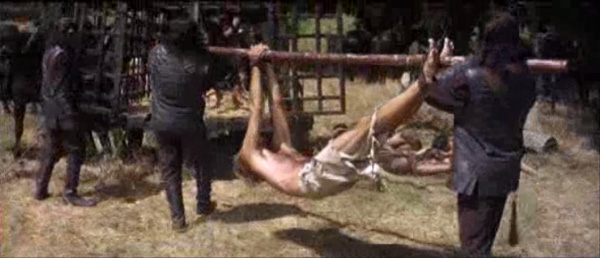
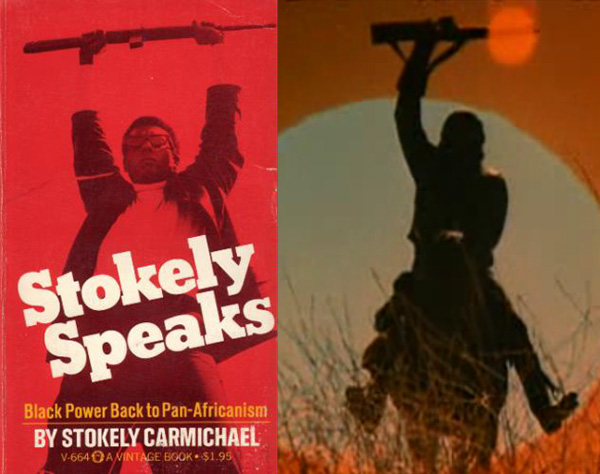
The new film, Rise of the Planet of the Apes, has some thrilling chase/fight scenes and impressive CGI, the acting isn’t terrible, and the plot is serviceable—in general I’d classify it as a mildly successful action film. But this isn’t supposed to be a generic action film, it’s supposed to be Planet of the Apes. Given that, the film seems to entirely miss the point. What was so powerful about the original Rise (titled Conquest of the Planet of the Apes, and released in 1972) was the fact that it was a combination slave revolt and prison riot in “apeface!” Conquest, and possibly even all the original films, would never have been made if the largely non-violent Civil Rights Movement hadn’t shifted towards Black Power in the late ’60s, national liberation struggles in the form of the Black Panthers and Brown Berets, and eventually by the early ’70s into small-scale guerilla warfare via the Black Liberation Army. Check out the similarities between the cover of Stokely Carmichael’s 1971 book Stokely Speaks, and the intro credits to the Planet of the Apes 1974 TV series:
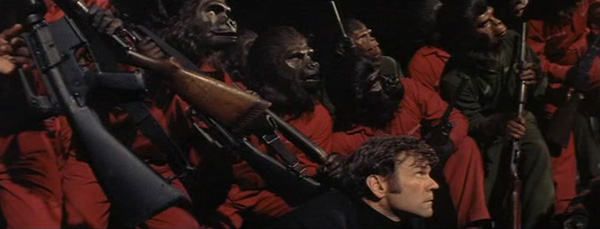
The original Planet of the Apes film was an astounding channeling of the sublimated (and sometimes not so sublimated) white fears of what would happen in a world run by Black people. Conquest of the Planet of the Apes was a reenactment of the race riots that swept across the U.S. throughout the 60s, and a strange brew of both celebration and denouncement of the prison riots that were taking over headlines, especially the Attica Rebellion of the previous year. I can only assume that by the time Conquest was filmed, the producers understood that a large part of the appeal of the franchise was its visceral articulation of white fear (of Black Power, miscegenation, emasculation), so they pushed it up a notch, creating a U.S. where primates truly are slaves—servants to humans with no free will. The opening credits of the film run on top of large groups of men dressed as gorillas and chimps walking while standing up, wearing red and green jumpsuits (respectively), and being corralled and threatened by armed, uniformed guards.
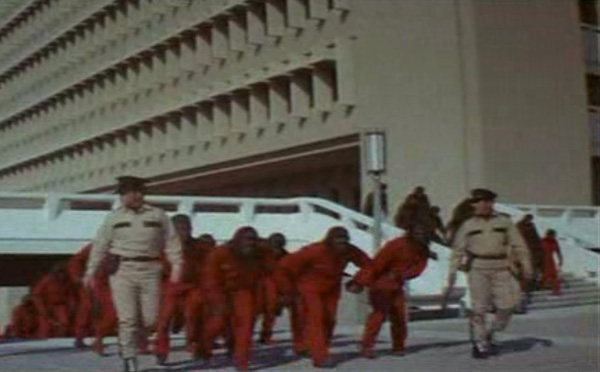
It is impossible to not read race, and the 1970s rise of the prison industry, into this. The rest of the film is an acting out of the apes coming to consciousness, rebellion, and eventual insurrection against their masters. Their revolt against the corporation that trains them to be good slaves is filmed just like a prison riot, and at one point a white guard actually bullwhips the black apes.
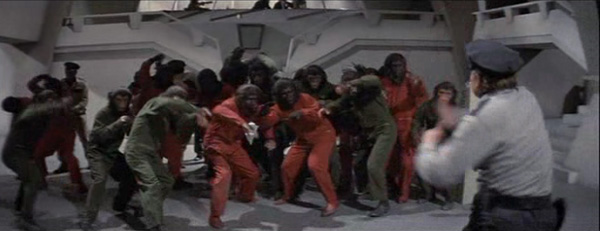
The larger revolt is certainly intended to evoke the urban riots of the ’60s in places like Detroit, Cleveland, and Watts. The apes are shown as intelligent and crafty, using advanced military planning to outwit the humans, as rioters often do (witness the past weeks’ revolt in the UK). If this wasn’t a clear enough indication for the audience that this film was about race (and full of references to the more political end of Blaxploitation films, like The Spook that Sat by the Door), the inclusion of a Black human character for whom the ape uprising causes both an identity crisis and an ethical dilemma—both terribly over-acted—throws the whole thing over the top.

The final insurrection/guerilla warfare scenes are potent not only because they echo the historical moment they were filmed, but they fulfill the promise of all revolutionary moments, that it is the oppressed that will liberate themselves. This is pop culture riffing off of Frantz Fanon, and it’s damn exciting. In a span of five short years Planet of the Apes went from a strangely racist science fiction thriller to an embodiment of Black Liberation.
The new Rise of the Planet of the Apes is anemic in comparison. After a single showdown with humanity (or at least with the San Francisco police force) the apes will rise, but not so much of their own doing. Their initial jump from simple chimps to an extremely intelligent column of primates is due to a human-developed virus tested on chimpanzees that smartens the apes, but also happens to kill off humans. In some ways this speaks to the contemporary fear of biology gone wild (a la dozens of zombie movies), but also sends some pretty confusing messages about the ethics of vs. the necessity of animal testing. (If this virus hadn’t been tested on primates, wouldn’t humans have just died anyway? Seems to me like an argument for more stringent testing protocols rather than animal rights.)
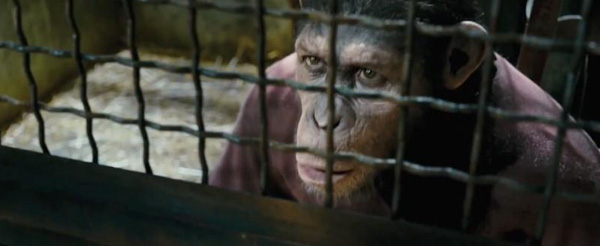
The race subtext has been completely, but only half-heartedly, replaced with this sub-plot of medical ethics, and the connected concern for animal welfare. One scene, where the main scientist/protagonist (played by James Franco) visits his bio-engineered chimp Ceasar in a poorly run and brutal primate facility, looks to be an almost shot for shot fictional remake of a similar scene in the recent documentary Project Nim. (In the above two images, the top one is from Rise, the bottom from Project Nim) We are made to feel for Ceasar and the other apes, but even with advanced CGI gorillas and baboons acting increasingly human, the animal rights narrative is no where near as compelling as the racial overlay in the original. While animal rights are becoming a larger narrative, they still pale in comparison to the reality of racial inequalities in our society. To call the eventual ape escape and victory against the humans in Rise a story about the ethics of animal treatment would be far-fetched. Such high morals are ill-fitting on 2011 CGI apes, just as they are on most actors in contemporary Hollywood movies.
But race is not entirely absent from Rise, it simply doesn’t seem to matter—on the surface at least. Franco’s character falls for and eventually partners with a South Asian veterinarian (who may also be the only female character in the film, if I recall correctly, and is played by Freida Pinto of Slumdog Millionaire fame), and his boss is a greedy, high-powered CEO who is both the main bad guy in the film, and also happens to be Black. So I suppose in forty years some things have changed, miscegenation with hot women of color is no longer taboo, but Black people in power is still the fastest way to end of us all.
This Day in Resistance History: Flying the Black Flag

On August 12, 1883, the first anarchist newspaper to be called “The Black Flag” (Le Drapeau Noir) was launched in France by French anarchist and feminist Louise Michel. The newspaper, as well as the use of the flag, had two purposes: to remind people of the workers’ battle and deaths in the Canut Insurrections of 1831-1834, and to stir support for another wave of worker resistance more than fifty years later.
The black flag as a symbol of anarchy had originated in Lyon, where silk workers used it during a series of revolts. Despite the French Revolution and the attempt to eradicate the elite from France, by 1830, the capitalists had the economy under an iron grip again. In Lyon, the major industry was silk weaving. The canuts, or silk crafters, owned their own looms and hired their own assistants. Women as well as men were employed, and apprentices lived in the homes of the canuts. Workshops cooperated with each other to meet order demands and set salaries for their workers.
But this collective system had been overtaken by la grande fabrique: a group of bankers, wealthy landowners, and silk traders. They set the prices for the final product, often forcing the canuts and their shops to work long hours for less and less pay. Finally, in 1831, the situation reached a breaking point during an economic downturn.
On November 22, 1831, workers across Lyon captured a fortress used as a police barracks and military base. They successfully fought off French infantry with stolen weapons, although the soldiers and police managed to kill or wound 600 workers. After capturing the fortress, the canuts raised a black flag over the building. It stood, they explained, for their rejection of a government that had inflicted misery and ignored their pleas for justice. This moment in history has held meaning for the French working class ever since.

Canuts then occupied the entire city of Lyon. King Louis-Philippe sent an army of 20,000 to retake the city. The town was placed under military rule with charges being brought against only 11 of the canuts; the King had ordered there be no executions and minimal disruption to the silk trade. But la grande fabrique still held sway. The economy in France improved, but capitalists decided that the workers’ wages were still too high. Initial attempts to lower them triggered massive strikes and worker resistance.
By 1833, conditions for workers worsened, even though the capitalists were taking in more money than ever before. Wishing to boost their profits even higher, la grande fabrique members appealed directly to the King and the government. The Count d’Argout, the Interior Minister, wrote that the canuts were living in “fabulous prosperity” and were grossly overpaid. The government ordered a further reduction in wages.
The result was a second battle between workers and the army in February of 1834, and this time over 10,000 canuts and their workers were subjected to lengthy prison sentences or deportation. The workers would not give up. On the day that the trial started, another wave of fighting broke out. “The Bloody Week” had started. The black flag of the workers, who had rejected their government and its right to control their craft, was raised again, this time over both Lyon and three neighboring towns.

Although the silk workers’ uprisings ended up failure, anarchist beliefs formed during this 19th Century resistance took root. They inspired the organizers of the Paris Commune of 1871. Louise Michel fought on the barricades during those battles. She was arrested, and told the jury, “If you are not cowards, then kill me!” Instead, she was deported to Canada, where she organized natives there to fight against France’s imperialist policies. When she returned to France, she continued her organizing and social justice work for the rest of her life.
By 1883, unemployment reached record heights across France and particularly in Paris. Michel launched her newspaper so she could detail information about worker resistance efforts. She also reminded readers of the role that the government had played in lowering raises and increasing poverty levels among the working class for half a century.
Michel personally raised a black flag over Paris in 1883 during general strikes that she helped organize to protest state control of wages on behalf of the wealthy elite. She took a black petticoat that she owned, cut it up and sewed it into a flag which she waved as a rallying point for workers during the fighting and protests. Due to Michel’s effective information campaign via Le Drapeau Noir, workers across France and especially in Lyon launched insurrections in solidarity with the Parisian workers.
Today, Lyon’s black flag, which stands for no flag—the complete rejection of nation-states and their corrupting power—has become an important symbol worldwide. As Louise Michel wrote in Le Drapeau Noir, “The black flag, with layers of blood upon it from those who wanted to live by working or die by fighting, frightens those who want to live off the work of others.”
Corporate Funding of Urban League, NAACP & Civil Rights Orgs Has Turned Into Corporate Leadership
(This article by Bruce Dixon is re-posted from Black Agenda Report)

“Not only is Bill Gates a cousin,” gushed academic Henry Louis Gates at the Urban League convention in Boston last week, “Bill Gates a brother.” Bill Gates, of course, is the founder of Microsoft, and one of the wealthiest men on earth. Invited to deliver the keynote address at the National Urban League’s annual meeting in Boston last week, the billionaire lectured the assembled on education and poverty, although Gates is not qualified to teach an hour in any classroom in the land, and has certainly never been poor.
Bill Gates has never been a friend of black people anyplace on earth. The Bill and Melinda Gates Foundation, a large investor in Monsanto, the company that invented genetic engineering, actually creates hunger on the African continent and undermines the food security of African nations by pushing genetically modified crops upon reluctant African farmers and their governments. If African farmers can be locked into planting patented crop varieties, instead of planting and saving their own seed as they have the last ten thousand years, they will be obliged to buy the expensive and environmentally destructive pesticides these frankenfood crops require, along with paying yearly license fees.
Inside the US, the Bill and Melinda Gates Foundation has been a key player in the drive to privatize public education. Gates Foundation staff helped write the guidelines for the Obama Administration’s Race To The Top program, under which states and school districts, in order to receive any federal education funds at all, had to hire consultants, often from the same Gates Foundation to write the detailed plans for closing thousands of neighborhood public schools, implementing high stakes testing and turning teachers into the cowed, insecure and casual WalMart style workforce preferred by private, often for profit charter school operators.
So how did the National Urban League become the mouthpiece and cheering section for corporate experiments on black school children at home and the hijacking of the global food system in Africa? The answer is that like the NAACP, the National Committee on Black Civic Participation, the National Council of LaRza, the National Conference of Black State Legislators and even the Congressional Black Caucus Foundation, the Urban League is now and has for some time past been completely dependent on corporate donations to keep going. Those that pay the bills, call the shots.
This is the new model of African American leadership – a leadership that covets, courts, kowtows and accomodates to power rather than speaking truth to it. This is why whenever the interests of ordinary black people conflict with those of corporate America, a great number of our well-funded black misleaders will inevitably side with their corporate sugar daddies rather than their constituents. It’s why the Congressional Black Caucus and Operation PUSH assisted in foisting subprime mortgages on countless black families, and why the NAACP speedily forgave the predatory loan practices Wells Fargo and Bank of America. It’s why Sharpton, the NAACP and the Urban League all endorsed the merger of AT&T with T-Mobile and Comcast’s swallowing of NBC.
It’s time to turn the page on the venerable civil rights organizations, whose model of corporate funding has allowed them to be utterly taken over by corporate interests and used against us at every opportunity. It’s time for something completely different.
(This article by Evan Bush is re-posted from iwatchnews.org.)
All but one member of a government advisory panel weighing the safety of one of the most contentious forms of energy development, known as fracking, have financial ties to the natural gas industry, scientists and some environmental groups are asserting. The scientists called for the ouster of its chairman, former CIA director John Deutch, who sits on the boards of two energy-related companies.

The group, which reports to Energy Secretary Seven Chu, is concluding that development of shale gas can be done safely provided that companies fully disclose the chemicals used in fracturing liquids, and that they face monitoring of their activities and rigorous standards for emissions of airborne contaminants.
While the Energy Department doesn’t regulate natural gas production, the Environmental Protection Agency is still months from reaching conclusions in its own study, and the panel is leaving largely unaddressed the most sensitive issue of toxic chemicals that may make their way into drinking water supplies, opponents of fracking fear the Energy panel’s recommendation can give a boost to the industry.
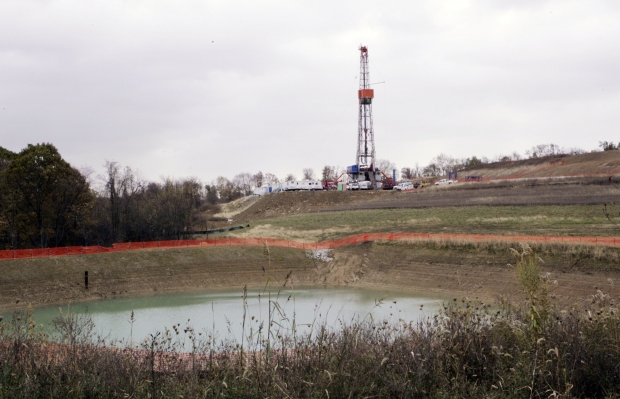
The committee, formed in May, was tasked to review fracking, also known as hydraulic fracturing, in which gas companies pump sand, water and chemicals into wells drilled into the ground to break up the earth below in order to release and then capture natural gas. Critics say fracking could be tainting groundwater, killing wildlife and, as iWatchNews has reported , giving off methane gas that contributes to global warming.
Earlier this year, in his State of the Union address, President Obama endorsed natural gas as part of the solution to feed the nation’s energy needs, and then sought to have the advice from the Energy Department panel.
In a letter to Chu , 28 scientists complained that the committee, formally known as the Natural Gas Subcommittee of the Secretary of Energy Advisory Board, “appears to be performing advocacy-based science and seems to have already concluded that hydraulic fracturing is safe.” The scientists ask Chu to replace Deutch “with a person with no financial ties to the natural gas and oil industry,” as well as add “independent members” to the committee.
An environmental group, the Environmental Working Group, previously objected to the advisory group’s makeup, saying Deutch received more than $1.4 million from energy companies Schumberger and Cheniere Energy between 2006 and 2009.
Other members of the committee said to have current financial ties to the natural gas and oil industry are Stephen Holditch, Kathleen McGinty, Susan Tierney, Daniel Yergin and Mark Zoback. The scientists said their “conflicts of interest make it appear that the subcommittee is designed to serve industry at taxpayer expense rather than serving President Obama and the public with credible advice.”
Energy Department spokesperson Tiffany Edwards defended the committee’s composition, saying it is “balanced” and that each member has experience and expertise, including technical and practical knowledge. “Some have said that the panel is too weighted toward industry, while others say it is too weighted towards environmentalists. We think we got it just right, and having a diversity of perspectives will only strengthen the final product.”
Industry representatives often serve on government advisory boards, including the one that advises Energy Department Secretary Chu. As iWatch News has reported , Chu’s advisory board on energy policy includes one of the president’s big campaign fundraisers, a venture capitalist who has invested in companies receiving seed money from the Energy Department.
A 1972 federal law, the Federal Advisory Committee Act, requires only that advisory committees be “fairly balanced.” There are an estimated 900 formal advisory groups scattered across the government, comprising some 65,000 committee members who counsel more than 55 agencies, according to a 2008 Government Accountability Office report . By advising agencies such as the EPA, FDA and Energy Department, members of the advisory committees can influence standards for food safety, environmental protection and energy use.
The role of advisory committees can be more important than it might seem. Industry players or technical experts with a vested interest in agency decisions gain access to regulators and a platform to advance arguments in Congress. Sometimes, agencies have faced legal challenges for ignoring the recommendations of advisory committees.
While the Obama White House has advertised efforts to minimize the direct influence of registered lobbyists, efforts at a crackdown have been soft. Last year, Obama appeared to call for an end to the membership of lobbyists on advisory committees – in the form of an announcement on a White House blog by Norm Eisen, then the president’s special ethics counsel. Lobbyists and executives from Boeing, International Paper Co., IBM and 13 other companies and trade organizations quickly complained – and threatened to circumvent the requirement by having their lobbyists simply stop registering.
“There are financial ties with the industry” on the fracking advisory panel, said Kyle Ash, a lobbyist for the environmental group Greenpeace. “The administration said they weren’t going to have special interests.”
The letter seeking Deutch’s ouster was signed by 28 scientists, including researchers and professors at the University of California, Cornell and Penn State.
While the Energy Department weighs its views on fracking, the EPA has undertaken a study on groundwater quality, due to be finished late next year. Among environmentalists’ concerns: The Energy Department’s advisory panel could influence the issue before that study is made public.
“We’re concerned their findings could undercut the Environmental Protection Agency’s findings, which have taken a lot more time and have been a lot more rigorous,” said Leann Brown, spokesperson for the Environmental Working Group.
In 2009, the Department of Energy predicted that shale gas, the kind of gas that fracking produces, would account for 20 percent of the United States total energy consumption in 2020.
In Pennsylvania, according to a study for the American Petroleum Institute, drilling in the Marcellus shale region, which is one of the most prominent in the country, has risen substantially over the past five years. In 2005, just three wells were drilled. In 2009, that number rose to 710.

On Wednesday, roughly 35 people gathered in front of the federal building in downtown Grand Rapids as part of a new campaign from MoveOn.org to present what they are calling the New Contract for the American Dream.
There are 10 points to this New Contract for the American Dream, including the creation of clean energy jobs, securing Social Security, a fair tax system, investment in public education and ending the wars and investing at home.
This action was in part a response to the national debt debate that had disasterous results for working people. A MoveOn member said, “The debt deal, which will do nothing to create jobs, forces deep cuts to important programs that protect the middle class while asking nothing of big corporations and millionaires. And though it does not require cuts to Medicare, Social Security and Medicaid benefits, it opens the door for these down the road via an unaccountable Congressional committee.”
“We have a simple message: “We need jobs, not budget cuts, “ said Jim Houston, a local MoveOn member. “We’re here today to say ‘enough is enough’ and demand Representative Amash stop his assault on the American Dream. It is far past time that Washington end the tax giveaways to corporations and the wealthy and use that money to revitalize our community and create good jobs that we so desperately need.”
Local MoveOn member Mike Franz address the small gathering before taking a copy of the new contract into the office of 3rd Congressional Representative Justin Amash’s office.
While some of the points in the New Contract for the American Dream is important, such as ending wars and investing in domestic programs, there was no indication how this group or MoveOn plans on making this happen. MoveOn has a history of being a Democratic Party front group and there is no indication that the Obama administration is embracing any of the 10 points presented in this contract.

I spoke with one participant at the MoveOn rally and asked him how they are going to achieve this platform and he said he didn’t know. However, the same person did say that what “we needed in America was to follow what the people are doing right now in England…….protesting in the streets in large numbers.”
This writer would agree that more direct action is certainly needed, but there was no indication that this group was advocating that kind of action. In fact, even before the MoveOn representatives addressed the gathering they were told by a Grand Rapids cop that they could not use the small amp they had with them or engage in loud chanting. The cop at one point even told one of the protestors that if “he yelled one more time he was going to get arrested.” The MoveOn spokesperson told the police that they would not use the amp and discontinue any loud chanting. So much for direct action or challenging the system.

For two weeks from the end of August and the through the first days of September activists from all over the country will descend upon DC to send a message to the Obama administration that the Keystone XL pipeline project from Canada will be a disaster for the US.
Tar Sands Action is organizing a massive civil disobedience campaign to say no to what could be the worst environmental devastating project on the planet. As of this writing the Tar Sands Action group has signed up 1,500 people who will engage in a massive sit in to pressure the Obama Administration to deny the “presidential permit” necessary for construction on the proposed pipeline from Canada through the US south to Texas.

For those who are not familiar with the Alberta Tar Sands Project there are great educational resources online that will put into perspective the magnitude of this ecological monstrosity.
Last year’s Enbridge pipeline disaster in Michigan is one example of what could happen on a larger scale. The Enbridge pipeline that burst was carrying tar sands oil and Enbridge is the main company for tar sands pipeline construction. A new report in April provides new information and analysis on both the 2010 Michigan oil spill and Enbridge’s role in the tar sands project.
Tar Sands Watch has excellent resources and identifies the main points for why this project must be defeated.
Global Warming – Greenhouse gas emissions from tar sands production are three times those of conventional oil and gas production [currently tar sands production emits 27 megatons per annum and is expected to rise to 108-126 megatons by 2015]. Thus, the tar sands are now poised to become Canada’s largest single emitter of greenhouse gas, compounding this country’s contribution to global warming. Additionally, tar sands production is expected to multiply as much as four to five times by the year 2015 to meet growing demands in the U.S. As a consequence, conservative estimates show that greenhouse gas emissions from the tar sands could well leap from 27 to 126 million tons by 2015.
Water Depletion – Oil sands plants typically use two to four barrels of water to extract a barrel of oil from the tar sands, but some extraction methods can use as much as 7 barrels of water. The amount of water needed for the tar sands is seriously lowering the water levels of the Athabasca River, the Mackenzie Valley watershed and other related water sources in the region. The amount of water which can be recycled back into the watershed is still very low, and contaminated water must be stored in tailings ponds, vast holding tanks the size of lakes, some as large as 15 square kilometers, containing hydrocarbons and other chemical by products from tar sands production. Additionally, toxic water spewing from tar sands production has infected fish and wildlife, causing sickness among Aboriginal peoples downstream.
Aboriginal Rights – Many aboriginal groups are being left out of the process and run over in the race for development of the tar sands. First Nations in Alberta, Saskatchewan and the Northwest Territories have claimed that traditional lands are being destroyed for tar sands exploration and extraction, and First Nations are not being included, or properly compensated for their lost and destroyed lands and water supplies.
Energy Insecurity – Currently, 66% of tar sands oil is being exported to the United States, while over 40% of the oil used in Canada is imported to fulfill the needs of Eastern Canada. When the Keystone pipeline is built from Alberta through to the States, the tar sands industry will become increasingly reliant on US refineries for processing and Canada will continue the tradition of providing raw resources to the United States instead of processing it (and creating more jobs) for ourselves. The tar sands industry is ensuring the energy security of the United States while ignoring the energy needs of the rest of Canada. Canada has surpassed Saudi Arabia as the number one exporter of oil to the United States. And, despite growing oil exports to the US, Canada is importing one million barrels of oil a day (over 40% from OPEC countries) to meet energy needs in Ontario, Quebec and the Atlantic provinces. Alberta oil reserves are being shipped south instead of east to meets needs of our own nation. What’s more, Canada is obligated to maintain its oil exports to the U.S. The proportionality clause of the North American Free Trade Agreement [NAFTA] requires Canada to continue exporting oil at a level that is the same or above the average volume of exports during the previous three years.
Militarism – The U.S. Department of Defense is the world’s leading consumer of petroleum, sucking up about 340,000 barrels of oil every day, more than the total national consumption of Sweden or Switzerland. The Alberta tar sands are the centerpiece of an energy corridor for exports to the U.S. which is increasingly geared to fuel America’s military machine. The U.S. military economy, which has been largely rebuilt and re-invigorated since the attacks of September 11, 2001, the ongoing war on terrorism, and the invasion of Iraq, has substantially increased U.S. demands for imported oil. The Pentagon is the single largest institutional buyer of oil in the world, consuming an estimated 85 percent of the U.S. Government’s use of oil. Canadian oil exports, which are now the U.S.’s number one source of imported oil, have become a major contributor in fuelling the U.S. war machine.
GRIID plans on writing more about this campaign and hopes to attend the action in DC later this month. If you know of anyone from Michigan that is going let us know.
CNN reporter says the poor are the problem

CNN reporter Carol Costello invited African American intellectuals Cornel West and Tavis Smiley to be part of a Live show to talk about their Poverty Tour. West and Smiley are traveling across the US to hear from people living in poverty, “so they will not be forgotten, ignored, or rendered invisible during this difficult and dangerous time of economic deprivation and political cowardice.”
Instead of discussing what West and Smiley have been hearing from people, the CNN pundit took a very reactionary position, first by reading a comment from someone who claims the poor are the problem, second by citing a Heritage Foundation report and then claiming the rich pay all the taxes.
The behavior of the CNN reporter showed no journalistic integrity and demonstrated that CNN is fundamentally no different than FOX News in that they represent an elite perspective and don’t have the slightest idea what it means to be part of the working class in this country.
Despite the ridiculous claims made by the CNN reporter, West and Smiley do an excellent job with their responses.
Obama’s Holland visit, electric cars and lithium mining
In the last week there have been several news stories about this week’s Holland visit by President Barack Obama. He will be visiting the Johnson Controls-Saft battery factory for a second time within the last 13 months.
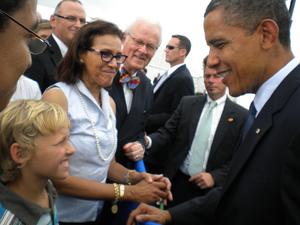
The coverage in local news has primarily been positive with little criticism of the Presidential visit because it is believed that the push to manufacture electric cars and batteries for those cars will create jobs and benefit Michigan’s economy.
First, it seems a bit strange that there has been little discussion about the fact that Johnson Controls-Saft battery factory received $168.5 million in tax incentives from the state. This huge tax incentive was on top of $300 million the company received from federal grants. Johnson Controls-Saft claims they will create 500 jobs from this endeavor, but this is somewhat misleading rhetoric.
Johnson Controls-Saft eliminated an estimated 1,000 jobs just from Holland (MI) in the past 15 years and moved them abroad with the passing of NAFTA and other trade agreements, according to the data-based created by Public Citizen. If 500 jobs are indeed being created with their new electric battery factory then that is a good start to replacing the 1,000 jobs they eliminated.
Another aspect of this deal is that the $300 million from the federal government and the $168.5 million in state tax incentives are essentially a form of corporate welfare. Public tax dollars are being used to subsidize a private company that will no doubt make substantial profits in the coming years, yet has made to promise to keep the electric car battery production in Michigan.
New Lithium Report
Beyond the “jobs” aspect of the President’s visit on Thursday is the information now coming out about a new report from U of M on projected global lithium deposits. MiBiz ran a story last week praising the news that there is enough global lithium production to supply the new electric car boom that Michigan companies are hoping to cash in on.
The MiBiz article states that the new report from the University of Michigan (in partnership with the Ford Motor Company) estimates that there is 39 million tons of lithium globally, enough to power electric vehicles through 2100. “We believe our assessment is a timely and comprehensive study that settles the question of whether the global resources are sufficient for electric vehicles using lithium-ion technology,” said one of the report’s main researchers.

However, the jubilant article does not explore what this will mean in terms of the environmental impact of lithium mining nor the need to reduce global carbon emissions by 80% by 2050.
There are a variety of mining companies engaged in lithium mining in numerous countries around the world, such as the US, Canada, China, Australia and several Latin American countries. One of the Latin American countries with some of the largest known lithium deposits is Bolivia.
Bolivia is a country that has seen its share of resource extraction, particularly from the mining industry. However since the anti-water privatization uprising in Cochibamba, Bolivia in 2000, that South American country has taken strong measures to resist future resource extraction, especially since lithium mining depletes local water sources and is very toxic. Indigenous President Evo Morales has even made it a point to challenge the rich countries of the world, like the US, to stop generating the bulk of the pollutants that are causing global warming for the entire world.
For serious environmentalists the idea that we need to reduce global carbon emissions by at least 80% by 2050 should drive whatever policies they would endorse. The majority of the global scientific community is pretty much in agreement on the need to have significant carbon reduction over the next forty years, as has been stated by the Intergovernmental Panel of Climate Change (IPCC).
This new report on global lithium deposits seems to be celebrating the fact that we can supply electric batteries for cars til 2100. There is no evidence that this will be sustainable and it doesn’t address how it fit into the need to reduce global carbon emissions by 80% over the next forty years. The news coverage doesn’t even ask what will the world do for transportation in 90 years when the lithium supply is depleted.
This is not the kind reporting we need. We need journalists that will ask hard and probing questions that can benefit all of us who are living in the age of global warming. However, considering that MiBiz is a pro-business publication it is no surprise that they would be thinking about short-term gains instead of long term sustainability.
61 Years of living with and lying about the Bomb
“History is a set of lies agreed upon.” Napoleon Bonaparte
Any current public discourse on history that deviates from the “official history” is usually seen as revisionist history. New interpretations of history are generally denounced by the government and media pundits. A recent example of this was found in a Grand Rapids Press editorial entitled “History and Heresy.”

In the Press editorial the writer states, “the historical record is comprised of facts and truth that endure for all time. It is not a mass of putty to be turned and twisted to fit what any generation’s captains of political correctness might want.” We beg to differ.
History is not set or static, since it should be made up of multiple points of view and experiences. Therefore, history can be fashioned on an ongoing basis, as long as new voices, analysis and information are brought into the discussion. Failure to allow a diversity of opinion on current or historical events often means that the current structures of power and their apologists fear that acknowledging a pluralistic may mean dismantling the present hegemonic reality.
The official position of the US government as to why it dropped the first generation of nuclear bombs on Hiroshima (Aug. 6) and Nagasaki (Aug. 9) was to prevent the deaths of American soldiers. Never mind the 200,000 Japanese civilians that died instantly and the thousands that died the years following due to radiation exposure. However, a reasonable question to ask at this point would be were the bombings necessary to save the lives of American soldiers?
A survey conducted by the US Department of War, which interviewed hundreds of Japanese civilians and military leaders after their surrender stated: “Based on a detailed investigation of all the facts and supported by the testimony of the surviving Japanese leaders involved, it is the survey’s opinion that certainly prior to December 31, 1945 and in all probability prior to November 1st, 1945, Japan would have surrendered even if the atomic bombs had not been dropped, even if Russia had not entered the war, and even if no invasion had been planned or contemplated.” (Zinn, A People’s History of the US) If this was the case, why then were these deadly weapons used?

General Leslie Grover, head of the Manhattan Project, described President Truman fully committed to using the bomb no matter what. Historian Gar Alperovitz states that the Soviets had agreed to not enter the war in the Pacific until 90 days after the war in Europe ended. The war in Europe ended on May 8, so the Russians would have entered on August 8. Alperovitz states that on July 28, 1945, “Secretary of the Navy James Forrestal said of Secretary of State James Byrnes that he was most anxious to get the Japanese affair over with before the Russians got us.”
Had the Russians entered the Pacific war before August the Japanese might have surrendered to the Russians alone or to them jointly with the US, thus eliminating a complete US occupation of postwar Japan and subsequent control of its economic future. The Cold War rationale and policy was firmly in place even before the end of WWII. If this dissenting opinion does not seem sufficiently convincing then let’s return to the “official position” and examine it.
Remember, the “official position” was that the US dropped the bomb in order to prevent the loss of American lives. Official historians always try to appeal to the emotional relief that thousands of US servicemen an women might have lost their lives if a conventional war in the Pacific continued. This is a sentimental lie that holds no weight for the thousands of soldiers who have died and continue to die because of Truman’s decision to drop the bombs on Hiroshima and Nagasaki.
Historian Martin Sherman notes that at least 12 US Navy fliers were in the Hiroshima city jail at the time of the bombing. On July 31, nice days before Nagasaki was bombed, the headquarters of the US Army Strategic Air Force in Guam sent a message to the War Department stating that an Allied prisoner of war camp was located just one mile outside of Nagasaki. They asked if the proposed target was to be changed and the reply came back, “Target previously assigned for Operation Centerboard remains unchanged.” Apparently those American lives were not relevant.
Shortly after Hiroshima and Nagasaki were annihilated, 1,000 US troops were sent to assess and clean up the damage. After 43 days of cleaning up the radioactive rubble, the Marines left. Soon after, many of them showed the same symptoms of radiation contamination as those of the bombing survivors.
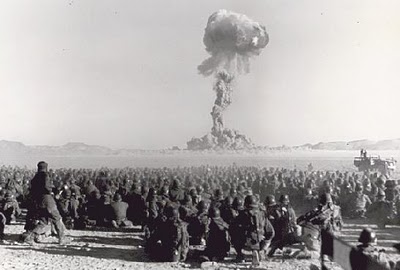
Upon returning to the US many of them were discharged from the military hoping to lead normal lives. Unfortunately for many of those veterans life was increasingly abnormal. According to numerous studies of these first Atomic Veterans, many of them “died from leukemia, heart disease, lung disease and cancer. Many also suffered from pain in their bones and joints, chronic fatigue and odd skin disorders.” (Wasserman & Solomon, Killing Our Own)
None of these veterans knew of the danger that exposure to radiation posed for them. In fact, they were told by a US military command press release that, “scientists had found no lingering radiation worth worrying about in Nagasaki.” Therefore hundreds of these veterans had their lives shortened because the US government considered them expendable. But this was only the beginning.
Starting in the Pacific in 1946 and in Nevada in 1951, some 300,000 more US soldiers were used as nuclear guinea pigs, exposed to deadly effects of radiation. However, statistics alone don’t convey the disregard for life. It’s important that we hear the voices of those men who were used by the US military. Kenneth Triple, who was on the USS Quartz in the Pacific during the nuclear testing, said at the time he was so sick “with diarrhea and vomited for days. I went from 128 to 70 some pounds. I turned a funny color and lost all the hair on my body. Later I was taken to a hospital and fed intravenously.” (Wasserman & Solomon, Killing Our Own) Ever since severe weight loss plagued him, along with calcium deposits in his eyes impairing his sight and sharp hip pains.
In 1979, the National Association of Atomic Veterans was founded by former Army Sergeant Orville Kelly and his wife Wanda. “I believe I should have been warned about the possible danger of radiation exposure and that medical examinations should have been conducted on a regular basis after my exposure. The truth is that I was never warned nor were examinations ever performed. During all those years I left the Army I was never once told to get a physical because I participated in nuclear weapons testing.”
In November of 1979, Kelly won his claim of negligence against the US government and received some monetary compensation, but then died in April of 1980. Remember, the objective was to prevent the loss of American lives.

This is still only the tip of the iceberg. The US government’s decision to use nuclear weaponry did not prevent the loves of lives or any other lives. In fact, the decision cost an enormous number of Americans their lives. In addition to the Atomic Veterans whose lives were lost or seriously debilitated, thousands of American laborers have been working in nuclear facilities. A December 3, 1989 New York Times article estimates that 600,000 US workers have been exposed to high levels of radiation. This does not include the thousands of Native Americans who have been exposed to the deadly effects of radiation since half of all uranium deposits needed in the production of nuclear weapons are on Native lands.
When mineral companies extract the uranium they usually use Native labor, paying very low wages. They also abandon mining sites that are highly contaminated, most often near main water sources. (Eichstaedt, If You Poison Us) Because of their proximity to these mining operations, Native Americans have a higher rate of leukemia and cancer than any other population in the US. Some Native American even contend that the Nevada test site is legally, by treaty, still on Newe Segobia (Shoshone) land, thus making them the most bombed sovereign nation in the world, since over 650 nuclear bombs have been tested there since 1951.
In 1985, Dr. Rosalie Bertell wrote No Immediate Danger, a book that attempts to give a comprehensive assessment of radiation contamination globally. In it she contends that no one on earth has escaped at least low levels of radiation exposure, since we are all downwind. Nertell estimates that between 10 – 12 million people have died or have been seriously disabled from nuclear weapons testing and production.
So what are we to make of all of this 61 years after the bombs were dropped on Hiroshima and Nagasaki? Clearly it is not a closed case. There is new information that keeps coming to the surface. In 1980, the American public finally had access to 85,000 feet of 16mm film that the US occupation forces used to document the effects of the bombs dropped on Japan. This was information to which we were previously denied and it further puts a human face on the pain and suffering caused from that decision to use the bomb in 1945.
Therefore, we owe it to ourselves and to future generation to not blindly accept what we are taught in school about the 1945 US bombings of Hiroshima and Nagasaki, or what the US government still proclaims today. The future of humanity could very well depend on our ability to question authority and official history.
Earlier today Wayne Pacelle, the President of the US Humane Society, spoke at the 28th Street Schuler Books while he made his way through the Midwest on a book tour. His book is entitled The Bond: Our Kinship with Animals, Our Call to Defend Them.

Pacelle talked about his own upbringing and how it influenced how he viewed animals. He developed at an earlier age, like many of us do, a bond with the family dog that led him to believe that we need to develop a bond with all creatures in order to respect them.
The President of the Humane Society also talked about how animals are also social beings and that like humans they need interaction with other creatures. Pacelle says that we even have a bio-chemical attraction to other people and species. These biological and bio-chemical reactions we have with other creatures also means we have the capacity to develop an emotional bond with animals.
Pacelle says that two-thirds of Americans have pets in their homes and 70% of the population engages in some sort of wildlife observation, whether that is looking at the birds in our backyard or going to designated parks and preserves to observe other animals.
However, on the other hand there are serious animal issues that we face in this country. The fact that we have animal rescue groups throughout the country is one indication that there is a nationwide problem. Pacelle says that there are groups that focus on all kinds of animal welfare issues such as the treatment of circus animals, zoo cruelty, the treatment of animals that are trapped, as well as groups responding to the fur industry and dozens more that focus on the well being of animals.
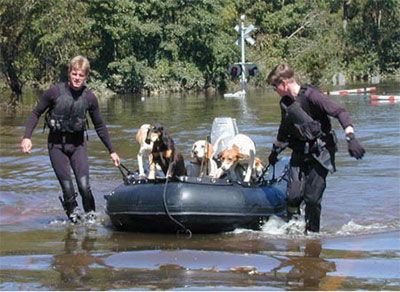
One recent incident that Pacelle cited underscores how Americans are responding to animal cruelty issues. He mentioned the grassroots organizing that developed after Hurricane Katrina to rescue animals. Pacelle said this was necessary because the federal government did not include animals in their rescue plan, but also because many people who were being rescued said they would not leave unless their dogs and cats would be rescued along with them.
However, despite all the compassion that people show towards animals Pacelle said there are thousands of puppy farms all around the country, where dogs are bred in a style similar to CAFOs (Concentrated Animal Feeding Operations). He also mentioned animal fighting as a major problem in the US.
When it came to what we can do, Pacelle focused on individual choices that people can make. What kind of food do we eat and how does that impact how animals are treated? Pacelle said that we have all participated in the exploitation of animals, but that should not deter us from make decisions about we do in the future. He also said that the choices available do not require much sacrifice.
However, Pacelle then seemed to contradict himself by talking about the history of struggle in this country, such as the fight against slavery, the outlawing of child labor and the fight to win the right for women to vote. It is on this tradition of struggle and resistance that the animal welfare movement is built, according to the Humane Society President.
This tension between individual choices and systemic change was further emphasized during the Q & A session where Pacelle said that “we can not do battle with every industry” and that “we must meet industry where they are.” This was in reference to a recent agreement the Humane Society made with the American Egg Board to craft legislation, which would require more space for egg laying hens. Therefore, Pacelle doesn’t seem to want to challenge the for profit food industry and their systemic murder of billions of animals annually for human consumption, he felt that just providing more space for the egg laying hens in their cages was adequate.

Most of the question surrounded the treatment of specific animals and some existing legislation both in Michigan and at the federal level, with virtually no discussion about animal liberation. People were more interested in what Michael Vick was doing with the Human Society than how humans might rethink our relationship to the non-human world as a whole.
While it was clear that the people in the room had a deeply passionate commitment to protecting some animals, there didn’t seem to be much interest in pushing the discussion outside of human-centered notions of what is means to challenge oppression that writers such as Jason Hribal (When Animals Fight Back), Anthony Nocella (Terrorists or Freedom Fighters?: Reflections on the Liberation of Animals) and Carol Adams (Neither Man Nor Beast: Feminism and the Defense of Animals) explore in each of their books.

