Holland City Council hears more on the anti-discrimination ordinance, but are they listening?
Last night about 40 people showed up at the Holland City Council meeting to continue their effort to get the council members to reverse their decision on including sexual orientation as part of the City’s anti-discrimination policy.
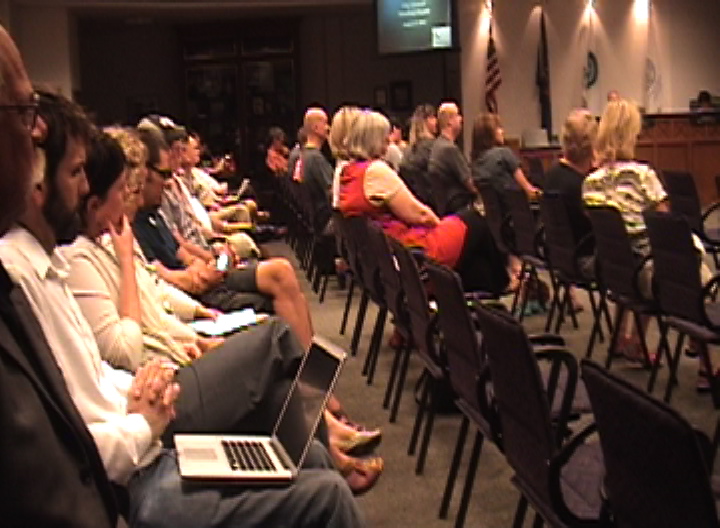
Again, members of Until Love is Equal, Holland is Ready and Holland PFLAG addressed the city council. A few people spoke as business owners to argue that it would be economically beneficial for the City to add sexual orientation to the ordinance. One person stated that most of the Fortune 500 companies in the US have policies that are inclusive in regards to sexual orientation.
Another Business owner, Dottie Rhoades, said that she thinks the vitality of Holland could depend on reversing their decision and stated that although her business is in Grand Rapids such policies have an impact on the entire region.
A woman then read a statement from the owner of Piper Restaurant, a statement which endorsed the inclusion of sexual orientation in the Holland City ordinance. The statement pointed out that the restaurant has always welcomed gay customers and has even employed LGBT youth.
Bill Freeman (Holland is Ready) then addressed the council and spoke to the council members who voted no for the ordinance. He spoke to the council members who voted no last time and clearly wanted to affirm the yes votes this time by addressing each of the four members who voted in favor of the ordinance.
The next person to address the council was a Dutch National, Girbe Eefsting. Mr. Eefsting wanted to address the claim that the no votes reflected Dutch heritage, which he said wasn’t the case since the Dutch have a long history of tolerance and acceptance. He then read a statement from the Dutch organization the Center for Culture and Leisure (COC):
“With this letter on behalf of my organization COC Netherlands – based in Amsterdam, The Netherlands – I would like to express my concern of the fact that the City of Holland, MI continues to keep laws in place that do not protect lesbians, homosexuals, bisexuals and transgender people from being fired from their job or put out of their house just because their sexual preference or gender identity.
We are absolutely outraged over the fact that at the recent occasion to change such discriminatory laws, the city of Holland, Michigan has elected to keep those in place specifically using the argument that it would be against “Dutch tradition” or not reflect the “Dutch heritage and/or values” to update such laws.
COC Netherlands has represented and represents the Dutch lesbian, gay, bisexual and transgender community for over 65 years, making us the oldest LGBT movement in the world. We are also an international LGBT human rights organization that is actively supporting LGBT activists in over 40 countries worldwide. Having obtained Ecosoc status at the United Nations, we are considered to be one of the most influential LGBT organizations in the world.
Our international support to LGBT communities around the globe is based on the core values of Dutch society. Such values include acceptance, tolerance and protection of vulnerable groups. We are proud to be a fundamental part of the Dutch multi-plural society. Our achievements as a human rights movement and our involvement and participation in society are a true example to the world. It shocks us that “Dutch tradition” is abused by the City of Holland, MI to withhold vulnerable groups from their protected rights by leaving discriminatory laws unchanged!
We widely and explicitly support the aims of the “Until Love is Equal” campaign. We call on the city of Holland to embrace the legacy of Dutch values providing equal rights, protection and opportunities to all!”
A few folks who have supported the City’s decision to exclude protections for the LGBT community also addressed the council. One man said that continuing to address this matter could distract the city from “more pressing issues.” He also stated that those who continue to push for sexual orientation in the ordinance are engaged in a form of harassment and suggested the City seek a restraining order on people who continue to push the issue.
A Holland woman followed and affirmed that this was harassment and that she believed that God’s laws are against homosexuality and that the council should stick to its decision.
Another Holland resident then said he had invited all the council members to a PFLAG meeting this coming Friday so that they could meet the families who are deeply affected by these kinds of decisions. He believes that people need to study and to learn that we cannot have “policies that are based on fear.”
Another opponent of including sexual orientation in the ordinance addressed the council first by making the claim that homosexuals commit more domestic abuse than heterosexuals. He made such claims without citing one single source. He also cited numerous biblical references, which he claimed condemned homosexuality.
In response to the claims that the LGBT community engages in more domestic abuse, Colette Seguin-Beighley addressed the council. Seguin-Beighley cites the Just the Facts Coalition report from 2008, which contradicts the claims made that gays commit more domestic abuse. Her statement closed the public comment period, which saw 9 speak in favor of sexual orientation being included in the City’s anti-discrimination ordinance and 4 against.
Just before the meeting adjourned Councilman Whiteman said that those who are for the ordinance are predominantly from “outside of this community.” He also says there is no evidence of harm and that he will not change his vote on this matter. The outgoing City Manager also said he would not speak to this issue other than to say people should move on so that other matters could be attended to, which in and of itself was clearly a statement that he was not a fan of a more inclusive ordinance.
To the matter of people not being from Holland who are demanding equality, justice and protection for the LGBT community, this attitude reflects a total lack of the history of struggle in the US. There have always been “outside” interest where injustice is concerned. During the Civil Rights movement racist southern Whites would often cite “outside agitators” as the problem.
It is true that people from around the country came to the south to participate in the struggle for racial equality, whether that was to participate in the Freedom Rides, the Montgomery Bus Boycott, marches or other forms of civil disobedience. People from all over the country to came to the south to fight the racist Jim Crow laws, laws that denied Blacks basic economic, civil and human rights. If this is the argument of some members of the Holland City Council then history is on the side of those who fight for equality.
Drive to Repeal Emergency Financial Manager Law Nears Its Goal

Michigan Forward and allied activist groups across the state are closing in on their goal of collecting signatures to repeal Public Act 4, Snyder’s punitive emergency financial manager law in the state. According to the Detroit Free Press, activists have collected 120,000 of the 161,304 votes they need to send the matter back to the voters. As soon as the necessary signatures are collected, the law will be suspended until the election and there should be a return to the less restrictive, former EFM policy. However, the Free Press noted it is possible that both laws would be suspended entirely; the point is unclear because of a lack of legal precedent.
This has opened the door for conservatives to object on the grounds that the repeal effort would cause “potential mayhem,” as state legislator Jase Bolger of Marshall called it.

But others would argue that the mayhem is already at work as the EFM in Benton Harbor plans to sell a public park to a development group for a private resort and golf course…the EFM for the Detroit Public Schools is selling 45 of its schools to charter-school companies…the EFM for the city of Ecorse has eliminated half its firefighters…and the EFM for the city of Pontiac disbanded the municipal police force and hired the Oakland County Sheriff’s Office to do the work, apparently after they finish for the day with their county duties. All of these changes were made under Snyder’s expanded Public Act 4 legislation. EFMs are also privatizing services, slashing wages and benefits, and laying off city and school system staff.
Next on the hit list: the city of Detroit—with Mayor David Bing petitioning Governor Snyder to be appointed the EFM there, according to one of his assistants—and the Highland Park School System.
Michigan Forward has announced that the allied groups collecting signatures have until March to gather the remaining ones, and they plan to continue to collect signatures until they have twice as many as they need. This will allow a healthy margin for what will undoubtedly be a vicious defense by the state in discarding as many signatures as possible.
Here in Grand Rapids, we’ve seen little activity regarding the signature drive, and what there has been appears to have been organized at the last minute. Since Grand Rapids is Michigan’s second largest city, it seems the most likely place to turn for the final push to gain the necessary signatures and a margin for error. We plan to keep you updated, and you can also check Michigan Forward’s Facebook page for information.
Starbucks CEO wants fiscal responsibility?
On Monday, Starbucks CEO Howard Schultz send out a letter to “Concerned Americans” with the suggestion that people withhold all campaign contributions before the 2012 Presidential Elections until Washington can figure out “long term fiscal challenges for this country.”

The announcement by the Starbucks leader was met with some support even liberal advocacy groups like Democracy 21. According to the Center for Responsible Politics, Democracy 21 sent Schultz’s letter to other campaign finance reform groups and posted the Starbucks CEO’s statement on their website.
While one can recognize in principle that the idea of withholding campaign donations until the economy is fixed, the proposal from Schultz is flawed in two ways.
First, the coffee baron does not clarify what is meant by fiscal responsibility. Does he mean that we need to produce and consume more to get the US economy going or does he mean there needs to be less regulation of the private sector? Without any articulation of what he means by fixing the economy we shouldn’t trust the intent of someone who has made millions by exploiting workers and farmers.
This brings us to the second reason why we shouldn’t take Howard Schultz’s proposal to seriously. Starbucks buys its coffee from around the world and doesn’t pay the farmers a fair wage for the coffee they grow, an issue that is explored in the powerful documentary Black Gold.
In addition, Starbucks doesn’t practice fiscal responsibility when it comes to its own workers. The coffee giant makes it a practice to hire workers and rarely give them 40 hours a week, thus avoiding the responsibility of paying them benefits. More importantly, Starbucks has a long history of targeting workers who either join a union or try to organize their fellow workers.
Attacking union members has been going on for several years now, especially since the IWW started organizing at Starbucks around the world. The Grand Rapids branch of the IWW has been organizing at Starbucks and demonstrating at various Starbucks locations around the city after one worker was fired for attempting to organize his fellow baristas.
Last month an IWW member was fired from a Starbucks in New York for her involvement in the union and just days ago another IWW Starbucks worker was targeted in Nebraska. The Omaha branch of the IWW filed an Unfair Labor Practice charge against the company for this action.
So, when Starbucks CEO Howard Schultz makes a proposal for people to withhold campaign contribution until politicians can create fiscal responsibility for the US, the public should respond by telling Schultz he needs to practice some economic responsibility by paying coffee farmers a fair wage and allow Starbucks workers the right to organize in his chain of cafes.
New Media We Recommend
Below is a list of new materials that we have read/watched in recent weeks. The comments are not a “review” of the material, instead sort of an endorsement of ideas and investigations that can provide solid analysis and even inspiration in the struggle for change. All these items are available at The Bloom Collective, so check them out and stimulate your mind.

Tropic of Chaos: Climate Change and the New Geography of Violence, by Christian Parenti – Perhaps the most urgent issue of our day is global warming. It is urgent for many people because of the small window of opportunity we may have to stop the trend towards warming the planet beyond a level that would be inhabitable by people. However, an often over looked reason why global warming is so urgent is that it is contributing right now to increased violence and militarism around the world. This is the thesis of Christian Parenti’s new book Tropic of Chaos. Parenti documents on a continent by continent basis how global warming is resulting in increased violence and in some cases significant military conflicts. In addition, Parenti points out how even US military planners are factoring in the ecological and social costs of global warming for their future plans, which will rely heavily on counter-insurgency measures and targeted at increasingly civilian populations most affected by climate change. A disturbing but important book for those concerned about the future of humanity.
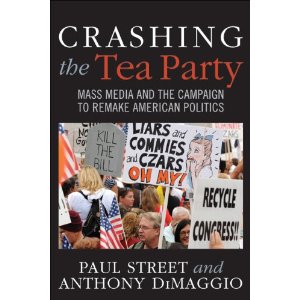
Crashing the Tea Party: Mass Media and the Campaign to Remake American Politics, by Paul Street and Anthony DiMaggio – Most books and commentary on the Tea Party are usually presented through a partisan lens. What is refreshing about Street and DiMaggio’s book is that it not only deconstructs the so-called Tea Party movement in the US, they juxtapose it with the original Tea Party to show how disconnected those involved with the current manifestation are from historical reality. In addition, the authors demonstrate that the Tea Party in many ways was purely a media creation along with major funding from wealthy reactionary sectors of American capitalism. Besides the well documented dissection of this so-called modern movement, the book frames the Tea Party within the boundaries of current political debate in the US demonstrating that there is no real populist movement from wither the Right or the Left and that the Tea Party (like MoveOn) is intrinsically part of the two party system and not representative of grassroots political opposition. An important book to read before the 2012 election madness.

Queer (In)justice: The Criminalizing of LGBT People in the United States, by Joey Morgol, Andrea Ritchie and Kay Whitlock – Over the past 6 months while doing research for the People’s History of the LGBTQ community Project in Grand Rapids we have learned some amazing things. The fight for LGBTQ equality is still going on today, but the emphasis might not be where it should be. This book by 3 authors/activists demonstrates that one of the most pressing issues for the LGBTQ community is how Queers are criminalized within the US “criminal justice” system. The authors make a compelling argument about how the LGBTQ is targeted by law enforcement and how the legal system still criminalizes people who challenge heterosexual norms. Queer (In)justice is essential reading for anyone fighting for LGBTQ equality and it challenges the current priorities of many of the mainstream LGBT organizations across the country which are focused on marriage equality and city ordinances.
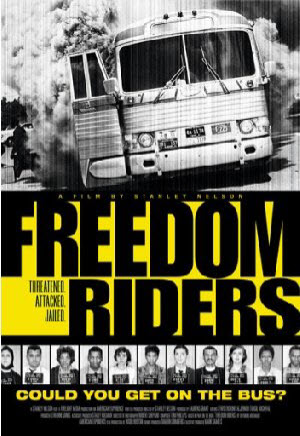
Freedom Riders (DVD) – This recent PBS documentary is based on the book with the same title, Freedom Riders, by Raymond Arsenault. The documentary focuses on the 1961 effort by the national civil rights group the Congress on Racial Equality (CORE), where Black and White citizens would ride Greyhound buses through the Deep South in order to expose the racial inequality that was institutional. Freedom Riders is a powerful testimony of the courage and risk that people were willing to take for racial justice that includes interviews by participants in the Freedom Rides as well as solid archival footage from that campaign. The film is a powerful tool both for investigating civil rights history in the US and the effectiveness of certain tactics within the strategy for racial equality. Highly recommended.
Confronting Back to School commercial madness
We are two weeks away from when K – 12 classes begin in Michigan and one thing worth thinking about is the amount of commercialism that children will be exposed to.
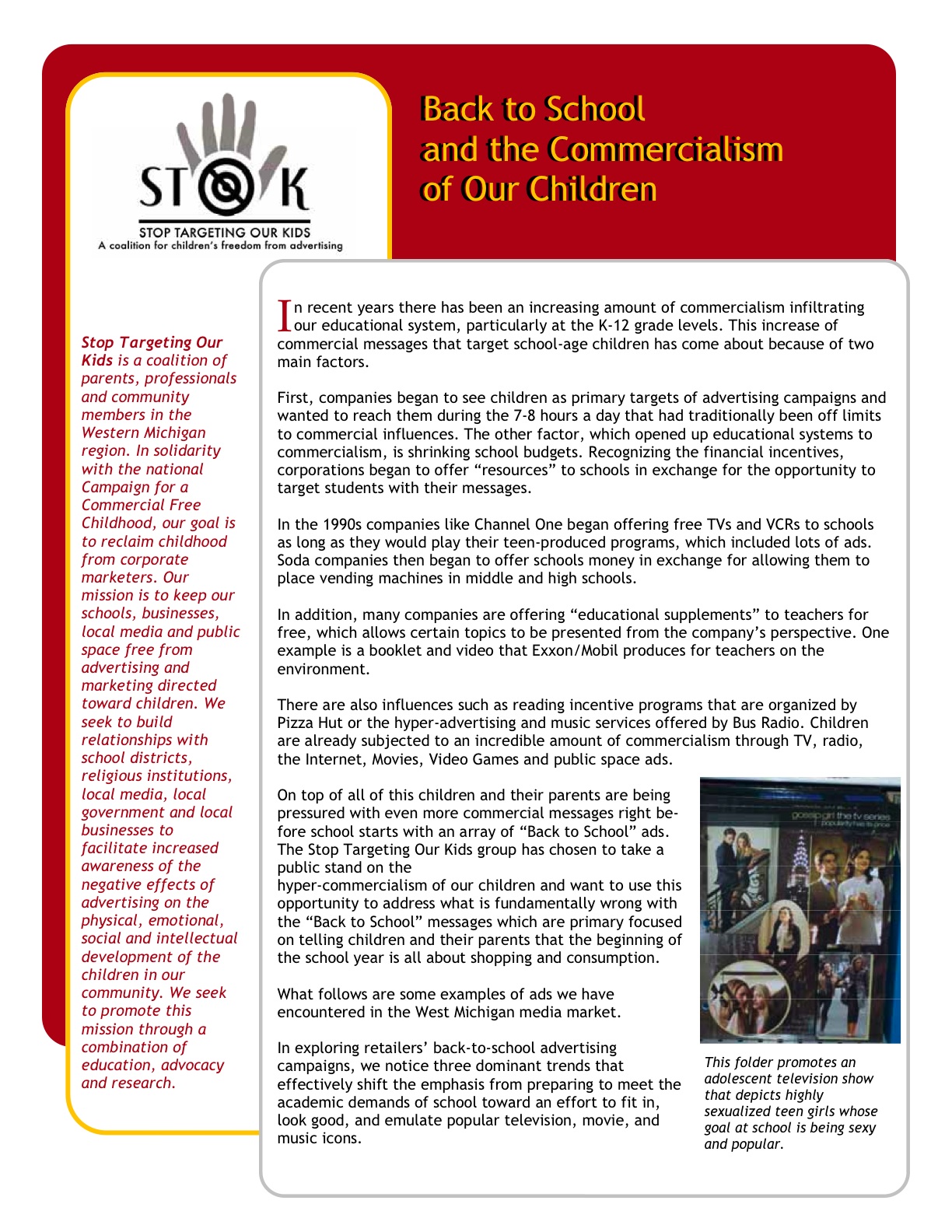
Last year the local group Stop Targeting Our Kids (STOK) produced a 3 – page informational sheet on commercialism in schools, particularly with the back to school theme. The information sheet points out that schools have become a favorite place for commercial messages.
In the last decade companies have been spending millions of dollars to find ways to target children while they are in school, through ad placement on the walls and book covers, fast food franchises getting cafeteria contracts and corporate created “educational materials” that are often sent to schools for free.
One example in recent years of corporate educational material that is sent to thousands of schools across the country was a coal industry produced curriculum document on the “benefits” of coal. Fortunately through the efforts of the Campaign for a Commercial Free Childhood that coal-industry sponsored material is no longer being distributed in schools.

In fact, the Campaign for Commercial Free Childhood (CCFC) also recent won another victory by getting one of the largest supplemental teacher material entities, Scholastic, to reducing the amount of corporate educational material they distribute.
According to a Media Release by CCFC:
“For years, Scholastic has produced teaching materials for corporate clients like Shell, Disney, and Nestle. In May, after a campaign led by CCFC, Rethinking Schools, and environmental groups, Scholastic pulled biased materials paid for by the coal industry. It was an important decision, but it didn’t go far enough. That’s why we asked you for help convincing Scholastic to stop distributing all corporate- and industry-sponsored teaching materials in schools.
We would prefer, of course, that Scholastic end all corporate sponsorships. But this is a huge step. Starting this fall, children will be exposed to significantly less corporate marketing in their classrooms. Already, Scholastic has agreed to end its partnership with SunnyD to promote sugar-laden beverages in elementary schools, and materials produced for corporations like DreamWorks, Disney, Shell, and Playmobile have been removed from Scholastic’s website for teachers. And Scholastic’s capitulation sends an important message to other companies working to subvert learning through the commercialization of teaching materials.”
This is certainly encouraging news and speaks to the importance of organizing for change. If you as a parent, student or educator in the West Michigan area are concerned about the commercialism in the schools you can contact STOK for more information.
Update on One Kent local government consolidation proposal
It has been a month since we last reported on the One Kent Coalition proposal to consolidate local government into one unit.
The One Kent Coalition is made up of area powerbrokers such as Dick & Betsy DeVos, Peter Seechia and David Frey, just to name a few. Ever since they first made public their proposal this group has come under scrutiny since there has been a lack of transparency and concerns about their motives.

The One Kent Coalition has generally stated that they want to make the area government more consolidated to be efficient, but more importantly they want to become more of an economic force in the country. However, a memo was revealed in March, which demonstrated other motives.
The memo from the group demonstrates two things. First, it shows that they want the issue to be on the ballot as soon as possible, which means less public dialogue. Second, the memo shows that the kind of government consolidation they are proposing would undermine public employee unions.
However, the local government consolidation group has not met in over a month because both the county and city government are frustrated with the One Kent Coalition group. Grand Rapids City Commissioner Bliss sent me a message saying that the county government is doing its own investigation of the issue and the Grand Rapids City government is actually working to oppose the draft legislation that the One Kent Coalition has drafted.
The draft is 38 pages long and is by no means easy to read. The draft legislation is calling for this new metropolitan government to be run by a CEO, a Chief Executive Officer, who would have executive power and would be elected by the public. There would also be a metropolitan commission who would adopt ordinances and budgets and be given legislative powers.
We will continue to watch this issue and report on the legislation once it is introduced at the state level. However, one thing that this process should tell us is that people with economic and political power don’t care about what the public thinks and will do whatever they can to keep their actions hidden from us no matter what.
GRIID Classes for Fall 2011

Starting in late September, GRIID will be offering two classes that will emphasize both education and action.
One class is a revised version of one we offered last year, Radical Sustainability. The new version will use the book Deep Green Resistance and include an investigation into our food, transportation and energy system. The class will also provide an opportunity for the participants to collectively develop a regional sustainability plan for West Michigan.
The other class is a first-time offering called Organizing for Change. In this class we will look at how to organizing, process, group dynamics, the use of tactics and how to develop a strategy. There is no text for this class, but we will be using lots of online materials, some resources from Project South and a look at numerous case studies for organizing in the US and around the world. The class will also do a power analysis of West Michigan.
Unlike in previous classes, these two classes will be 8 – weeks long, with the Radical Sustainability class on Mondays starting September 26 and the Organizing for Change class on Wednesdays starting September 28. Both classes will run from 7 – 9PM in the community rooms at Steepletown Ministries – 671 Davis NW in Grand Rapids.
Each class is $20 dollars, which does not include the cost of the book for the Radical Sustainability class.
For more information or to sign up contact either Jeff Smith jsmith@griid.org or Mike Saunders outobol@gmail.com.
MLive and the Obama visit to Holland
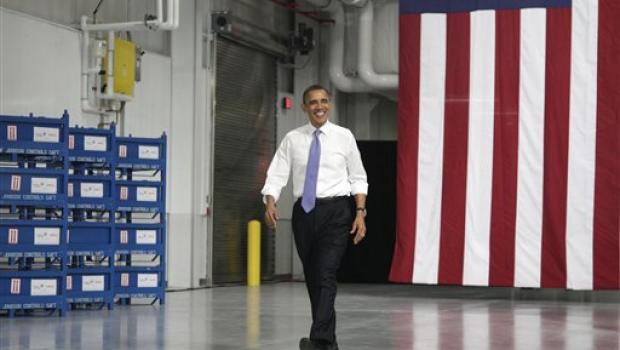
For the last 12 years GRIID has been monitoring the local news media and providing some news analysis of both issues and individual stories. An MLive article on the speech President Obama gave on Thursday at the Holland-based Johnson Controls is a perfect example of journalism as stenography.
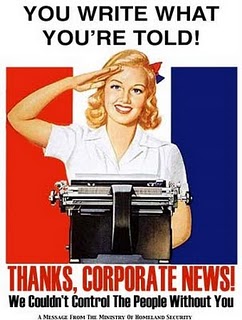
As a matter of clarification, journalism as stenography is when reporters either just quote or summarize the claims made by someone without verifying the claims. Verification is particularly important when reporting on power, such as when the US President is the subject of story. In fact, being a watchdog of power and verifying claims made are both basic principles of journalism.
In looking at the August 11 MLive story, we see that nearly the first half of the article is devoted to pointing out that President Obama was upset with Congress and partisan politics. This first quote that reporter Ursula Zerilli cites from the President was, “There is nothing wrong with this country; there is something wrong with our politics.”
While there could be lots of debate about what is wrong with politics in the US, there are some fundamental problems with the US that would contradict the President’s claim that there is nothing wrong with this country. There are millions of people who are unemployed and underemployed in the US; right now in the US there are roughly 634,000 homeless people; the US has the highest number of people in prison – 2.3 million; the average salary of a CEO is 344 times that of the average worker in the US; and the US spends more on the military and war than all other social programs combined.
The MLive reporter then cites the President making claims that the US credit rating could have been downgraded, where he again blames Congress. However, there have been plenty of astute observations that would also include the White House in the category of blame on the “debt ceiling” issue.
After additional comments that blamed Congress and partisan politics, the MLive reporter then said that the President wants to see “Made in America” stamps on products worldwide and young people driving American-made vehicles.
The MLive reporter could easily have asked if this was the case why would the President support trade policies that will result in more US based jobs being sent to other countries. The irony of this is that Johnson Controls, the very place that the President was making such a comment, has sent over 1,000 jobs out of the US since the passage of NAFTA.
As to the issue of the President wanting to see young people driving American-made vehicles, a competent reporter could ask why the White House used the bailout of the Big Three automakers as an opportunity to allow more auto-manufacturing jobs to be sent to countries like Mexico and China?
Next the MLive reporter says, “Obama and automakers agreed earlier this month to pegging overall fuel economy standards at 54.5 miles per gallon by 2025.” Unfortunately, this claim is only part of the story. What the President omitted and what the MLive reporter did not verify was that this new fuel standard will only be implemented in cars made starting in 2017 and not include any existing cars now in use or those sold before 2017.
The article then concludes with comments from the President about Johnson Controls and what the new electric car battery plant will mean for Michigan’s economy. The reporter does state that the factory received $168.5 million in state tax incentives and $299 million in federal grant funds to develop the electric car battery production.
Again, the reporter provides no history of Johnson Control’s outsourcing of jobs from West Michigan, nor the fact that the company has recently filed a lawsuit seeking to divorce itself from the French company Saft.
When the President of the US or anyone else that holds political or economic power is the focus of a news story, it is absolutely essential that local reporters practice good journalism. Failure to provide the public with critical analysis of those in power will most certainly result in a less informed and less engaged citizenry.
The Verizon Strike as the Next Wisconsin
This article by Mark Engler is re-posted from Dissent Magazine

The picket lines are up. This past weekend 45,000 Verizon workers on the East Coast, represented by the Communications Workers of America (CWA) and the International Brotherhood of Electrical Workers (IBEW), went on strike. The cause of the strike was the company’s attempts to win massive concessions from the unions. Verizon argued that the employees should give up gains they had won over many years of struggle and negotiation in previous contract fights.
As the Wall Street Journal put it, “Verizon Communications Inc. is seeking some of the biggest concessions in years from its unions.” Demands include the weakening of health-care benefits, cuts in pensions, reduced job security, and elimination of paid holidays such as Martin Luther King, Jr. Day. This despite the fact that the company reported billions in profit last year, and that, in the words of New York Times reporter Steven Greenhouse, “Verizon’s top five executives received a total of $258 million in compensation, including stock options, over the last four years.” The unions argue that Verizon has made some $20 billion in profit in the same time period, and Citizens for Tax Justice has pointed out that the company has done so while paying little to nothing in corporate income taxes.
Without a doubt, this is a conflict of national significance. As Bob Master, CWA District 1 legislative and political director, explained Wednesday in a conference call with supporters,
This is an enormously profitable company, which we believe is trying to take advantage of an anti-union environment and, in a sense, to replicate at a giant private-sector corporation what the governors of Ohio, New Jersey, and Wisconsin have been trying to do to the public sector. Our members feel very strongly that we need to draw a line here.
The parallel to Wisconsin is apt for several reasons. First, like the Republican elected officials in their attacks on unionized schoolteachers and other public employees, Verizon is taking aim at one of the last bastions of the American middle class. As a main strategy in its public relations, the company is trying to stoke resentment about the fact that the CWA and IBEW workers actually have living-wage jobs. It is hoping that “I don’t have a pension, why should they” logic will carry the day.
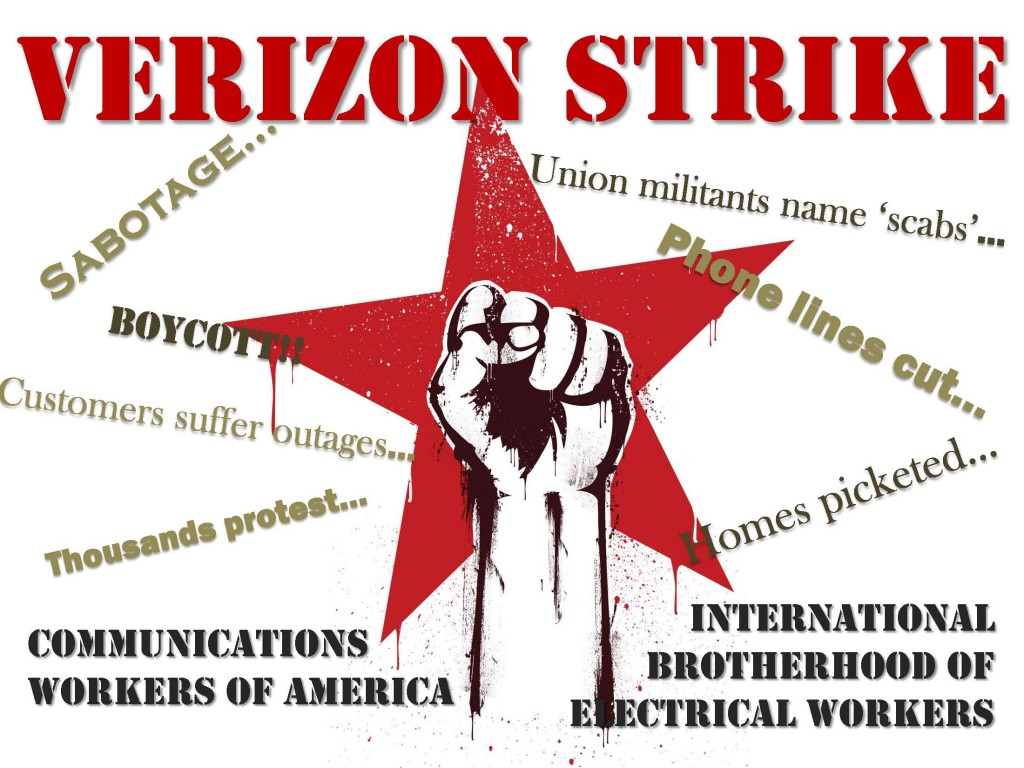
Accordingly, on Wednesday Verizon took out a full-page ad in the Philadelphia Inquirer suggesting that a typical employee makes $80,600 in annual pay and $42,000 in benefits. The union disputes this claim, contending that salaries are generally in the $60,000 to $77,000 range, and that benefits are less costly than the company would suggest. But, regardless, the debate over numbers misses some critical questions: What’s wrong with workers sharing in the profits of a healthy corporation? Isn’t that the way our economy is supposed to work?
(On a side note, it’s always a treat when companies plead poverty at the negotiating table and then turn around and spend big bucks on media spots, anti-union consultants, and pricey PR firms—but that’s another story.)
The fate of 45,000 middle-class jobs is a big deal for all of America. Last month, the entire U.S. economy had a net gain of only 117,000 jobs. Not only is that for the whole country, it represents a pretty decent month given the numbers from the past year. Furthermore, almost all of the new jobs now being created are low-wage. Given these realities—and the fact that concentrating all wealth in the hands of the rich is a very bad strategy for creating the kind of demand the economy needs to rebound—what happens to the Verizon workers is a matter of broad public concern.
Bob Master is right that Verizon’s aggressive bargaining stance, like Governor Scott Walker’s public-sector power grab, is the product of a political climate in which corporate interests feel they can do whatever they want to working people, and employees will have no recourse. The Verizon strike is unfortunately akin to Wisconsin in that it is a defensive battle—an effort to stop tragic rollbacks in previously established standards of fair employment.
The background for the contract dispute is that Verizon is now making most of its profits from its wireless services. While a small number of wireless technicians are involved in the strike, that part of the company is mostly non-union. In an ideal world, CWA and IBEW would be able to “bargain to organize,” balancing any concessions at the negotiating table for current union members with agreements that the company will remain truly neutral and allow workers at Verizon Wireless to make their own decision about whether or not to unionize. But this is not an ideal world. Like in Wisconsin, labor and its allies face a difficult fight merely to stave off the worst of a rabidly anti-union assault.
That said, there is a case for hope. The mass protests in Madison earlier this year gave some cause for optimism that a new type of energetic, broad-based, community-labor mobilization might become a lasting force in that state’s politics—and become a model for movements in other parts of the country. Wisconsinites’ success this week in recalling some Republican State Senators (although not as many as hoped) suggested that the struggle will be a long one, but that progressive efforts could have some real legs.
As for the strike, all those who have been wondering when working America will be fed up enough to finally stand up and fight should not sit this one out. If the Verizon strike becomes a rallying point in this country for a movement against runaway corporate power and for a fairer economy, it could have much broader implications than what contract terms are ultimately hammered out for those now walking the picket lines. That these workers are not rolling over in the face of company insistence on concessions is important and courageous. And they deserve widespread support.
***
Those on the East Coast can find a picket line to visit here.
Supporters all over the country will soon be able to “adopt a Verizon Wireless store” in their area and help to organize pickets at that location.
Finally, without even leaving your computer, you can sign the petition in support of the 45,000 CWA and IBEW workers on strike.
What is Planet of the Apes in a World without Black Power?
This article by Josh MacPhee is re-posted from Just Seeds.

I must admit, I ran out to see Rise of the Planet of the Apes the day it came out. I’ve been a life long fan of Planet of the Apes, but I honestly can’t remember what initially drew me to the movies as a teenager. Maybe it was the Philip K. Dick-like pretzel of time travel and alternate reality shifts, maybe it was simply the irresistible combination of science fiction and old-school primitive fantasy with loin clothes and sword fights (a la Conan), but I’ve had a deep affection for the whole thing ever since. It’s amazing to me that a 1963 French sci-fi book originally translated as Monkey Planet could turn into 7 feature films, a TV series, an animated cartoon, dozens of spin-off serial novels and comic books, as well as lines of toys and other merchandise tie-ins.
It wasn’t until I went back and watched all the films again later that I realized what makes them so interesting and compelling is not the hokey special effects (yeah, yeah, I know they were miles ahead of their time…) or Charlton Heston’s terrible acting, but the strange Hollywood channeling of white fear about Black Power.
Think about it, Planet of the Apes is a world run by violent, rage-filled, and seemingly irrational dark-skinned apes (clearly men in ape costumes), who have created a slave trade of (almost entirely) white humans, who are not simply silenced by their oppression, but ignorant, brutal, and literally mute, unable to speak! Apparently Black people in power leads to white people becoming completely stupid. I suppose in some ways that prediction has come true. Obama being elected—hardly Black Power!—has created an army of white nut jobs babbling incoherently about birth certificates.
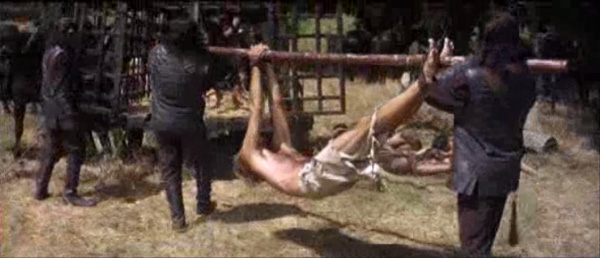
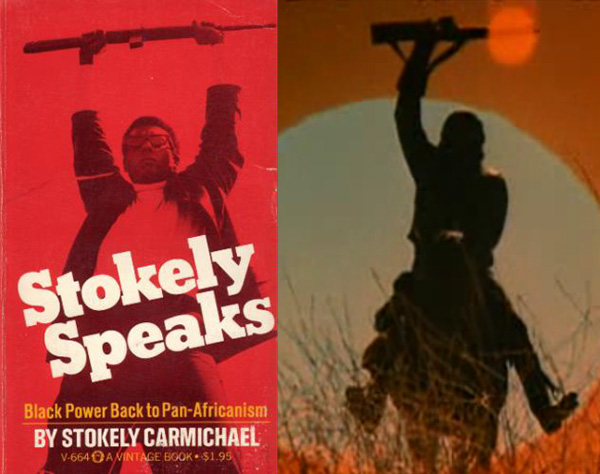
The new film, Rise of the Planet of the Apes, has some thrilling chase/fight scenes and impressive CGI, the acting isn’t terrible, and the plot is serviceable—in general I’d classify it as a mildly successful action film. But this isn’t supposed to be a generic action film, it’s supposed to be Planet of the Apes. Given that, the film seems to entirely miss the point. What was so powerful about the original Rise (titled Conquest of the Planet of the Apes, and released in 1972) was the fact that it was a combination slave revolt and prison riot in “apeface!” Conquest, and possibly even all the original films, would never have been made if the largely non-violent Civil Rights Movement hadn’t shifted towards Black Power in the late ’60s, national liberation struggles in the form of the Black Panthers and Brown Berets, and eventually by the early ’70s into small-scale guerilla warfare via the Black Liberation Army. Check out the similarities between the cover of Stokely Carmichael’s 1971 book Stokely Speaks, and the intro credits to the Planet of the Apes 1974 TV series:
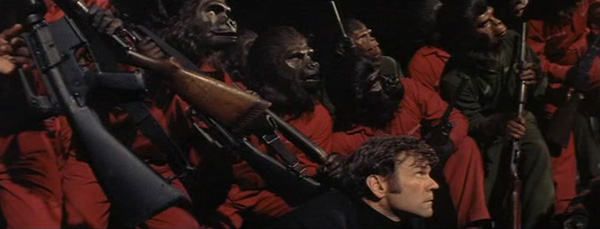
The original Planet of the Apes film was an astounding channeling of the sublimated (and sometimes not so sublimated) white fears of what would happen in a world run by Black people. Conquest of the Planet of the Apes was a reenactment of the race riots that swept across the U.S. throughout the 60s, and a strange brew of both celebration and denouncement of the prison riots that were taking over headlines, especially the Attica Rebellion of the previous year. I can only assume that by the time Conquest was filmed, the producers understood that a large part of the appeal of the franchise was its visceral articulation of white fear (of Black Power, miscegenation, emasculation), so they pushed it up a notch, creating a U.S. where primates truly are slaves—servants to humans with no free will. The opening credits of the film run on top of large groups of men dressed as gorillas and chimps walking while standing up, wearing red and green jumpsuits (respectively), and being corralled and threatened by armed, uniformed guards.
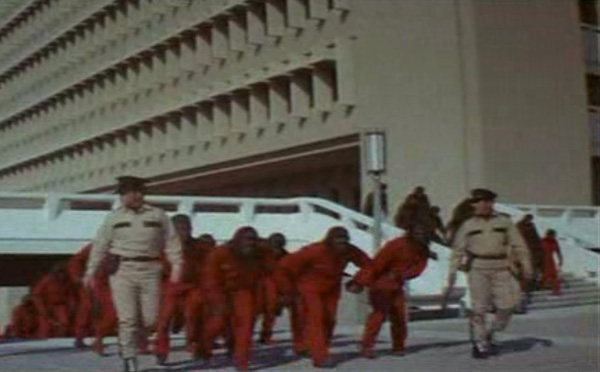
It is impossible to not read race, and the 1970s rise of the prison industry, into this. The rest of the film is an acting out of the apes coming to consciousness, rebellion, and eventual insurrection against their masters. Their revolt against the corporation that trains them to be good slaves is filmed just like a prison riot, and at one point a white guard actually bullwhips the black apes.
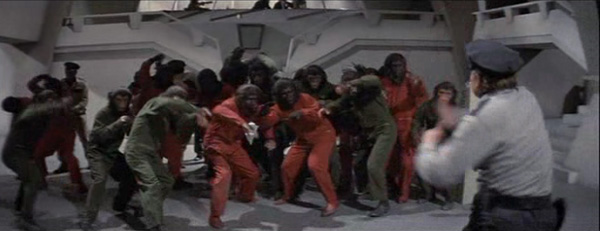
The larger revolt is certainly intended to evoke the urban riots of the ’60s in places like Detroit, Cleveland, and Watts. The apes are shown as intelligent and crafty, using advanced military planning to outwit the humans, as rioters often do (witness the past weeks’ revolt in the UK). If this wasn’t a clear enough indication for the audience that this film was about race (and full of references to the more political end of Blaxploitation films, like The Spook that Sat by the Door), the inclusion of a Black human character for whom the ape uprising causes both an identity crisis and an ethical dilemma—both terribly over-acted—throws the whole thing over the top.

The final insurrection/guerilla warfare scenes are potent not only because they echo the historical moment they were filmed, but they fulfill the promise of all revolutionary moments, that it is the oppressed that will liberate themselves. This is pop culture riffing off of Frantz Fanon, and it’s damn exciting. In a span of five short years Planet of the Apes went from a strangely racist science fiction thriller to an embodiment of Black Liberation.
The new Rise of the Planet of the Apes is anemic in comparison. After a single showdown with humanity (or at least with the San Francisco police force) the apes will rise, but not so much of their own doing. Their initial jump from simple chimps to an extremely intelligent column of primates is due to a human-developed virus tested on chimpanzees that smartens the apes, but also happens to kill off humans. In some ways this speaks to the contemporary fear of biology gone wild (a la dozens of zombie movies), but also sends some pretty confusing messages about the ethics of vs. the necessity of animal testing. (If this virus hadn’t been tested on primates, wouldn’t humans have just died anyway? Seems to me like an argument for more stringent testing protocols rather than animal rights.)

The race subtext has been completely, but only half-heartedly, replaced with this sub-plot of medical ethics, and the connected concern for animal welfare. One scene, where the main scientist/protagonist (played by James Franco) visits his bio-engineered chimp Ceasar in a poorly run and brutal primate facility, looks to be an almost shot for shot fictional remake of a similar scene in the recent documentary Project Nim. (In the above two images, the top one is from Rise, the bottom from Project Nim) We are made to feel for Ceasar and the other apes, but even with advanced CGI gorillas and baboons acting increasingly human, the animal rights narrative is no where near as compelling as the racial overlay in the original. While animal rights are becoming a larger narrative, they still pale in comparison to the reality of racial inequalities in our society. To call the eventual ape escape and victory against the humans in Rise a story about the ethics of animal treatment would be far-fetched. Such high morals are ill-fitting on 2011 CGI apes, just as they are on most actors in contemporary Hollywood movies.
But race is not entirely absent from Rise, it simply doesn’t seem to matter—on the surface at least. Franco’s character falls for and eventually partners with a South Asian veterinarian (who may also be the only female character in the film, if I recall correctly, and is played by Freida Pinto of Slumdog Millionaire fame), and his boss is a greedy, high-powered CEO who is both the main bad guy in the film, and also happens to be Black. So I suppose in forty years some things have changed, miscegenation with hot women of color is no longer taboo, but Black people in power is still the fastest way to end of us all.

