Michigan Forward, united with other activist organizations across the state, has set training sessions for people volunteering to help topple Public Act 4. This is the Emergency Financial Manager Act which has been called “fiscal martial law.”
By collecting signatures this summer, we can stop this law in its tracks before more communities and school systems are taken over by EFMs with unlimited power. Canvassers need to attend one of the training sessions to get started.
There are two training sessions available to Grand Rapids volunteers this Saturday, June 4. Both are from 10 AM to noon:
Lansing
Michigan AFSCME Council 25 (Lansing)
1034 North Washington Avenue
Lansing, MI 48906
Phone: 517-487-5081
Kalamazoo
Michigan AFSCME Council 25 (Kalamazoo)
3625 Douglas Avenue
Kalamazoo MI 49004
Phone: (866) 405-6800 Toll-free
You can pre-register for training using this form at the bottom of the page.
As soon as the required number of signatures are collected, the law will be suspended until the 2012 election. Throughout the summer and fall, check Michigan Forward’s website and Reject Emergency Mangers’ Facebook page for up-to-date news on the repeal effort.

(This article is re-posted from PRWatch.)
Scholastic, Inc., a leading publisher and distributor of children’s books and teaching materials, agreed to stop selling a coal industry-sponsored curriculum that it has distributed to 66,000 fourth grade teachers since 2009.
The curriculum was sponsored by the American Coal Foundation, which represents the interests of the coal mining industry. A May 11, 2011 New York Times story labeled the coal industry-created curriculum “unfit” for fourth graders because it failed to mention the negative aspects of coal mining and burning on human health and the environment, like removal of Appalachian mountaintops, toxic waste discharge, sulfur dioxide, mercury and arsenic discharges, lung disease and mining accidents.
The Campaign for Commercial-Free Childhood, which drew attention to and opposed Scholastic’s use of the curriculum, has also opposed Scholastic for its “SunnyD Book Spree,” which the company featured its Parent and Child magazine that encouraged teachers to have classroom parties with Sunny Delight, a sugar-fortified drink, and collect labels from the beverage to win free books.
The campaign has also objected to Scholastic’s promotion of Children’s Claritin in materials it distributed about spring allergies. Scholastic is a $2 billion business whose educational materials are in 9 of 10 American classrooms.
For information about efforts in West Michigan to challenge corporate-funded educational materials in schools contact the group STOK.
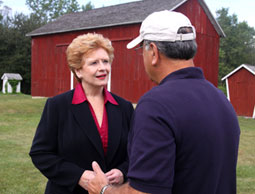
On Tuesday, Michigan Senator Debbie Stabenow hosted a hearing on the 2012 Farm Bill in East Lanisng that primarily served the interests of the agribusiness sector.
There was limited news coverage of the hearing and what coverage did exist was fairly superficial. The Lansing State Journal ran a very brief story that provided no context or details for readers.
The other stories we came across were not as brief but only provided the perspectives of Senator Stabenow and representatives from the agribusiness sector. A Detroit Free Press article gave one sentence to Senator Stabenow and a few lines to a 400-acre farmer from Midland who also serves as the director of the National Corn Growers Association.
Michigan radio aired a story that was a bit longer and cited a representative from the MSU Extension, Senator Stabenow and a cherry farmer from Leelanau County who is also the chair of the Young Farmers and Ranchers Committee with the American Farm Bureau, which according to SourceWatch is a right wing front group for US agribusiness.
Follow the Money
Since there has been limited reporting on the content of the Farm Bill hearing we can only draw some conclusions based on who attended and the history of the agribusiness sector in Michigan.

According to the online source Michigan Farmer the bulk of those who sat on panels and presented at the hearing were agribusiness people. Agribusiness groups represented were the Michigan Corn Growers Association, Michigan Sugar Company, US Apple Association, Michigan Pork Producers Council and the Michigan Milk Producers Association.
There is no mention of small farmers being present, those from the Community Supported Agriculture (CSA) sector, farm workers, farmers markets or the general public, which continues to have limited options with the food they buy.
One of the main reasons that the hearing was stacked with representatives from the agribusiness sector is because they depend so much on taxpayer subsidies. According to information from the Environmental Working Group, billions of dollars of government subsidies have been given to the large agribusiness sector in Michigan alone.
1 Corn Subsidies** 50,306 $2,030,750,107
2 Soybean Subsidies** 29,147 $556,331,027
3 Wheat Subsidies** 37,099 $327,709,169
4 Conservation Reserve Program 17,786 $310,264,447
5 Disaster Payments 20,085 $299,369,091
6 Dairy Program Subsidies 5,922 $208,146,457
7 Env. Quality Incentive Program 2,752 $76,280,887
8 Apple Subsidies 877 $27,716,155
9 Wetlands Reserve Program 309 $22,718,995
10 Livestock Subsidies 9,490 $22,708,057
This data is based on the amount of times each sector (the first number) has received a subsidy since 1995 and the total amount of government subsidies (second number) since 1995.
This amount of taxpayer provided subsidies raises numerous questions about what benefit there is to the consumer and to long-term sustainability. Small and independent farmers do not get these kinds of subsidies, yet they provide us with more of the fruits and vegetables that we actually eat. The corn and soy sectors often grow their crops for export or as feed for the livestock industry.
Do any of these sectors have to adopt environmental standards in order to receive subsidies? What kind of reporting are they required to do so that the public knows what they are eating and what risks are prevalent in farming communities when it comes to pesticide use?
If the apple industry is getting millions in subsidies why can’t they pay migrant workers a living wage to do the difficult work of picking apples? These are questions that likely were not raised during he hearing based on who spoke, but these are questions we all need to be asking if we are serious about food production serving the greater good.
Mobile Mugging: The AT&T, T-Mobile Merger
(This article by Jenn Ettinger is re-posted from Other Words.)

A recent T-Mobile commercial depicts a cellphone customer being harassed by two thugs in business suits, his pockets emptied, his wallet turned inside out, and every last penny shaken out of him. The gist: He’s being mugged by T-Mobile’s competitors, which all charge higher prices for less service than T-Mobile.
Ironically, T-Mobile is now about to be bought up by one of those muggers. While the commercial is supposed to sell people on T-Mobile, it really gives us a preview of what we can expect if AT&T’s planned $39-billion purchase of T-Mobile goes through. If the deal is approved, there’s reason to believe T-Mobile’s 33 million customers will have a lot in common with that mugged customer.
The deal would eliminate a competitor and leave two wireless giants — AT&T and Verizon — with unprecedented power. The two companies would control nearly 80 percent of the nation’s cellphone market, spelling bad news for consumers across the board.
AT&T’s service is consistently ranked among the worst of all cellphone providers, with a history of complaints about dropped calls, poor reception, and terrible customer service. Worse, it lures customers into long-term, high-cost contracts with exorbitant fees and exclusive deals with phone makers. And, as more of us use our phones to browse the Web or read email, AT&T no longer offers unlimited data plans. If T-Mobile customers who like their unlimited talk, text, and data plans want something like it from AT&T, they’ll have to shell out $50 more every month, with costly penalties for breaching AT&T’s arbitrary limits.

AT&T talks about the benefits of this merger, but for T-Mobile customers it would mean spending more and getting less.
T-Mobile has been able to compete in a market dominated by AT&T and Verizon by offering lower-price services and innovative new phones — all of it at risk with this merger. But AT&T has been using its deep pockets to lobby hard for approval of this takeover, arguing that buying T-Mobile will help it improve its network. But instead of investing its record profits to build a better network, the company has funneled them into its executives’ bank accounts. This merger is about nothing more than eliminating a competitor.
T-Mobile is playing both sides. While its commercials warn about AT&T and Verizon mugging the American people, its lobbyists urge Congress to approve the company’s merger with AT&T. On May 10, T-Mobile CEO Philipp Humm testified before a Senate subcommittee that this merger would increase competition and “lower prices for all customers.” But you can’t have more competition with fewer options. It just doesn’t add up.
At a time when people need to control their spending, AT&T will force them to dig even deeper into their pockets to pad its profits.
The Federal Communications Commission and the Department of Justice are both tasked with reviewing the merger and its potential impact on public interest and competition in the wireless market. Eliminating a competitor from the marketplace certainly doesn’t lead to more competition. Both agencies should recognize that this merger will ultimately lead to higher prices and fewer choices for all wireless customers.
New Video on Alberta Tar Sands – the most ecologically destructive project on the planet

We noted in our reporting on last year’s Kalamazoo oil spill that the company responsible for the oil pipelines that leaked a tremendous amount of oil into the Kalamazoo River was Enbridge.
We also made mention in that story that Enbridge is one of the major corporations involved in the Alberta Tar Sands Project, which according to numerous environmental organizations is the most ecologically destructive projects on the planet.
When Yves Engler spoke in Grand Rapids the other day, the author/activist noted that Enbridge is now Canada’s largest corporation. There is a great deal of information about the Tar Sands Project at Tar Sands Watch that looks at how this project contributes to ecological destruction, global warming, theft of Indigenous land and water depletion.
Here is a new video that exposes the insidious nature of the Alberta Tar Sands and who is profiting from this project.
On Monday, MLive.com reported that an “advisory group” has been established to study the proposal to merge the Grand Rapids City government with the Kent County government body.
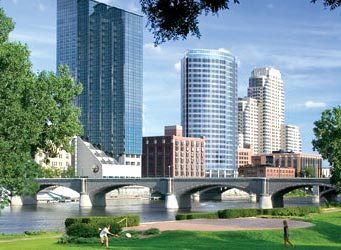
The proposed merger became public earlier this year at a Kent County Commission meeting where the somewhat clandestine group of local power brokers revealed their intent to make the Grand Rapids area into a larger government entity. The One Kent Coalition claims that this consolidation would “make Kent County more competitive in the global market.”
Those pushing such a claim are: Tom Butcher (GVSU), Nyal Deems (former EGR mayor), Betsy DeVos, Dick DeVos, Jeanne Englehart (GR Chamber), David Frey (Grand Action), Kurt Kimball (former GR City Manager), David Leonard (Spectrum Health Corp.), Greg McNeilly (Windquest Corp.), Marge Potter (former Kent County Comm.), Jared Rodriguez (West Michigan Policy Forum), Milt Rohwer (Frey Foundation) Peter Secchia, Peter Wege, Kate Pew Wolters, Tim Wondergem and Andy Guy (Wondergem & Associates).
According to MLive.com there is a 21-member study group that will discuss this proposal at bi-monthly meetings. Those invited to be part of this study group are, in alphabetical order:
Rosalynn Bliss, Grand Rapids 2nd Ward Commissioner
Tom Butcher, general counsel to Grand Valley State University
Bill Cousins, Cascade Township Manager
Harold Hamilton, Grand Rapids City Planning Commissioner
Carol Hennessey, Kent County Commissioner, D-Grand Rapids
Curtis Holt, Wyoming City Manager
Joe Jones, community outreach minister at Brown-Hutcherson Ministries
Christina Keller, Cascade Engineeering
Jerry Kooman, dean of external affairs, MSU College of Human Medicine
Senita Lenear, president, Grand Rapids Board of Education
Jim Lapeer, Cannon Township trustee
Dave Leonard, general counsel, Spectrum Health
Roger Morgan, Kent County Commissioner, R-Rockford
Greg Northrup, president, West Michigan Strategic Alliance
Marge Potter, former chairwoman, Kent County Board of Commissioners
Rick Root, mayor, city of Kentwood
Carlos Sanchez, West Michigan Hispanic Chamber of Commerce,
Jim White, Grand Rapids 3rd Ward Commissioner
Kate Pew Wolters, chairwoman, Steelcase Foundation
Mary Alice Williams, former Grand Rapids City Commissioner
Eric Williams, executive director, equity, community and legislative affairs, GRCC
Yesterday, Grand Rapids Press reporter Jim Harger provided some insight into the outcome of the group’s first meeting. Harger points out that some of the members of this study group are not thrilled with the proposal, such as Wyoming City Manager Curtis Holt who said the proposal, “read like a business plan that does not address local government concerns.” Others expressed concern that One Kent Coalition’s leader Nyal Deems was pushing for a decision by September so that state legislators could introduce legislation that would allow for this issue to be on the ballot in 2012.
What the Press reporter did not include in the story was a simple assessment of who is in this so-called advisory group. Many of the people included are either current or former government officials (11), along with some representatives from the education community (4), the private/for profit sector (5) and one non-profit representative with the religious group Brown-Hutcherson Ministries.
This begs the question as to why there are 5 representatives from the private/for profit sector and only one from the non-profit sector? The business community is significantly represented, but not organized labor or neighborhood-based groups.

Also not acknowledged is the fact that four members of the study group are part of the One Kent Coalition – Tom Butcher (GVSU), Dave Leonard (Spectrum Health), Marge Potter (former Kent Co. Comm.) and Kate Pew Wolters (Steelcase Foundation). Why would they allow anyone who is directly involved with the One Kent Coalition to “study” this issue when they clearly are biased in favor of local government consolidation?
It is also important to remember that the One Kent Coalition is not just interested in making government more efficient, but to weaken the public sector unions as was revealed in a memo from the group in March. That memo read in part:
“….with respect to existing contracts, and collective bargaining agreements, those contract agreements would continue in place until their current length of term. The legislation would not alter vested pensions or retirement rights or merit system employment benefits but does not restrict future changes.”
It is important that this “advisory group” is getting some attention, but it is more important that these meetings be made open to the public with full transparency. Something as critical as the future of local government cannot simply be left to people with vested interests and local government officials. GRIID has contacted several GR City officials who are part of this advisory group and will report back with information once we receive responses.
Documentary explores US Drug War this Saturday
A documentary film that looks at the impact of the drug war in the US will be shown this Saturday in Grand Rapids.

According to the film press kit, American Drug War: The Last White Hope –
35 years after Nixon started the war on drugs, we have over one million non-violent drug offenders living behind bars.
The War on Drugs has become the longest and most costly war in American history, the question has become, how much more can the country endure? Inspired by the death of four family members from “legal drugs” Texas filmmaker Kevin Booth sets out to discover why the Drug War has become such a big failure. Three and a half years in the making, the film follows gang members, former DEA agents, CIA officers, narcotics officers, judges, politicians, prisoners and celebrities. Most notably the film befriends Freeway Ricky Ross; the man many accuse for starting the Crack epidemic, who after being arrested discovered that his cocaine source had been working for the CIA.
AMERICAN DRUG WAR shows how money, power and greed have corrupted not just drug pushers and dope fiends, but an entire government. More importantly, it shows what can be done about it. This is not some ‘pro-drug’ stoner film, but a collection of expert testimonials from the ground troops on the front lines of the drug war, the ones who are fighting it and the ones who are living it.
This film screening is in conjunction with a new GRIID class, which is using the film to explore the impact of the US War on Drugs over the next 6 weeks. Anyone can attend the film, but if the content intrigues you then you can sign up to participate in the weekly discussions.
American Drug War
Saturday, June 4 beginning at noon
Heartside Ministry
54 S. Division
Interview with Yves Engler – Cars & Capitalism
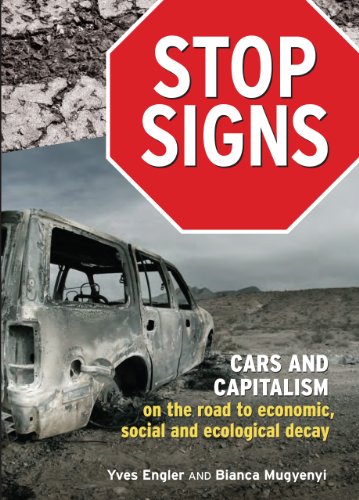
Yesterday, we had the opportunity to talk with Yves Engler, co-author of the new book Stop Signs: Cars and Capitalism on the road to economic, social and ecological decay.
The author is on a book tour via bus throughout the US and stopped off in Grand Rapids on Sunday to be part of a discussion at The Bloom Collective and the Green Party of West Michigan.
Yves spoke with us about numerous aspects of the book: the association of cars with freedom, cars & advertising, the political power of the auto industry, the health & ecological consequences of auto dependency and numerous examples of how communities are challenging the role of cars in society.
Earlier in May, we reported on a grassroots effort across Michigan to repeal Public Act 4, the EFM law that has been called “fiscal martial law.”
A petition has been drafted and accepted. Now Michigan Forward has notified GRIID that it is ready to begin collecting signatures in the Grand Rapids area. The Detroit-based organization is also going to spearhead the signature canvass here. And Grand Rapids is crucial to the success of this initiative, since it is the second-largest city in the state.
Throughout the summer, signatures must be collected and then verified. Once there are enough signatures to put a repeal vote on the 2012 ballot, it will suspend the new EFM law until the election. Snyder and the Michigan Legislature will be forced to go back to using the much more reasonable EFM law that was in use prior to this year.
Help stop Public Act 4 cold. Michigan Forward will hold training sessions for all canvassers. The canvass launch date is Saturday, June 4, and a training session will be held here that day in Grand Rapids. To sign up, use this link and fill out the form.

(This article was written by Joshua Sadowski)
Congress narrowly passed the extension of the warrant-less wiring taping bill known as “The Patriot Act” on Thursday. Parts of the law were slated to expire at midnight pending an extension from congress and signature by the president. The bill was nearly blocked by Senator Rand Paul from Kentucky, who filibustered for two days prior to reaching an agreement with opponents.
Paul opposed the bill on the grounds that it violated the privacy and civil rights of Americans. Senate Majority Leader Harry Reid of Nevada was a fierce advocate of the bill stating, “When the clock strikes midnight tomorrow, we would be giving terrorists the opportunity to plot attacks against our country, undetected.”
After passage of the bill, President Obama was awakened in the early hours of the morning in Paris to sign it, only minutes prior to expiration. The president used an autopen to sign the bill remotely, a technological first.
Media coverage of the bill’s passage was fleeting and unfocused. National Public Radio aired a story that focused almost exclusively on the history and constitutionality of an autopen being used by the president while in France. This type of story would only be appropriate after a thorough examination of the content of the bill itself. An article on NPR’s website chronicled the Paul-Reid debate, blow by blow, but again ignored the content of the bill and its continued implications for Americans.
The Associated Press release on the topic did mention ACLU opposition to the bill along with public opinion poll numbers, however avoided the official name of the bill altogether in the headline, referring to the Patriot Act as a “Terrorist Fighting Bill”. It is hard to know if the AP was intentionally trying to avert attention from the matter, as “Terrorist Fighting Bill” is quite euphemistic when compared to the other options such as “Wiretapping Bill”, or even “The Patriot Act”.
The New York Times used the occasion to scrutinize Rand Paul for his parliamentary procedures. The Grand Rapids Press did not carry the story.
Laura W. Murphy of the ACLU has commented that “we’d hoped for a much more progressive position out of the Obama administration (on The Patriot Act)”. Which begs the question: Why is a conservative “Tea Party” senator filibustering the extension of a law passed during the Bush administration with Obama in the White House? Are progressives left only with the Tea Party for advocacy in congress?

Locally, Michiganders have senators Debbie Stabenow and Carl Levin, both Democrats, to rely on to protect their interests. Stabenow and Levin both voted in favor of the extension. Grand Rapids is home to Michigan’s third congressional district, represented by Justin Amash. Amash is a Republican and was voted into congress with Rand Paul and likeminded Tea Partiers in 2010. Amash voted “No” on the bill. Amash has a record of not only breaking ranks with his party to join with other outlying Tea Party members of the house, but also of opposing intrusive government measures and even expansions of military power. Levin has long been a Democratic hawk, supporting all the current military efforts. Stabenow has a mixed record in terms of national security, but has consistently supported domestic surveillance and spying.
Obama has also been a long supporter of the Patriot Act, though one would not know that by simply listening to his words and speeches, as he has consistently fed the public anti-spying and, more poignantly during the campaign, anti-Bush rhetoric. However, while Senator Obama was bashing the bill in his speeches and accusing his opponents of being too hawkish on domestic spying, he was voting in support of it. It follows that now, President Obama has signed extensions of the bill at every opportunity. Occasionally though, congress has needed a little bit of encouragement.
Historically, the Obama White House has sent letters to senators Feingold and Durbin pressuring them to support the extensions. With Feingold swept out last year during “Tea Party Fever”, Obama may not have expected even more fierce opposition on Bush era legislation that is “tough on terrorists”. This year, the administration insisted that failure to extend the bill would compromise terrorist investigations and thus, national security. When that wasn’t enough, Obama sent his director of national security, James Clapper, to inform congress that “information obtained at the Osama bin Laden compound” may be at jeopardy if party members failed to support the bill. In only a few short years we have a seen a change in power from one party to the other, however the values of those in power has changed very little. The values of Senator Obama, such as governmental checks and balances and the civil liberties of citizens, among others, seem to be only obstacles to be hurdled by our current president. One gets the sense that 2006 Senator Obama would have some harsh criticisms of 2011 President Obama.
It appears that so long as President Obama is hawkish and right-leaning, he can avoid any scrutiny (or even much notice) from the press, and he can rely on fellow democrats to follow suite. Indeed, Rand Paul has received more flak for opposing this issue than the president has for supporting it. Obama taking the path of least residence here conforms with the democrat and republican consensus reached during the Carter administration and continuing ever since, which dictates expanding the American Empire abroad and keeping social spending to a minimum at home. Ultimately, this is just the latest example of Obama betraying his vast promises to the left during his campaign, and bowing to business and military interests. We are thus assured that any real change will not come from either of the two political parties that have dominated American politics for far too long.
 Grand Rapids Institute for Information Democracy