Mexico’s Hidden War
(This story is re-posted from Fault Lines/Al Jazeera.)

The spectacular violence of Mexico’s drug war grabs international attention. Some 40,000 people have been killed since 2006, when President Felipe Calderon deployed Mexican military and security forces in the so-called war against the cartels — often in gruesome and sadistic ways.
But behind the headlines, under cover of impunity, a low- intensity war is being waged.
In the second episode of a two-part series, Josh Rushing and the Fault Lines team travel to the state of Guerrero to investigate claims that Mexican security forces are using the drug war as a pretext to repress indigenous and campesino communities. In one of Mexico’s poorest and top drug-producing states, where struggling farmers are surrounded by the narco-economy, we ask about the cost of taking the struggle against dispossession into your own hands.

Last night US President Barack Obama addressed the nation on the matter of US involvement in Afghanistan. While the President said there would be some US troop removal he also arrogantly defending the US occupation of Afghanistan and gave no indication that the US has any plans to leave that country for years to come.
First, the timetable for US troop withdrawal Obama presented is misleading. Some defenders of the administration will no doubt argue that the President is keeping his word from his December 2009 speech where he announced that the US would begin withdrawing troops by July of 2011.
According to the online source Think Progress, “the United States would still have far more troops in Afghanistan than it did when Obama came into office and more than at any point during former president George W. Bush’s administration:

This means that the troop reduction would not put us much closer to actually ending the war by the end of 2012. Rather this would simply scale back the second surge of 30,000 troops that President Obama announced in December 2009. It would also maintain the first surge of 17,000 troops Obama ordered upon entering office. This comes at a time when a record number of Americans want to end the war in Afghanistan and the costs of which are putting the United States deeper into debt.”
US Foreign Policy analyst Phyllis Bennis also points out in an article that the number of US troops that the Obama administration plans to withdraw also doesn’t take into account the 50,000 NATO troops still present and the 100,000 Pentagon paid contractors.
Bennis went on to say that this limited troop reduction is not a real strategy since it does not address any long-term policy issues. There was no mention of the US military base construction, which is another indication the US has no long-term plans of leaving Afghanistan. Historian Gareth Porter who was interviewed on Democracy Now this morning echoed this notion that the US has no intention of leaving Afghanistan. Porter stated:
I think the second storyline is equally important, and that is that Obama likened the—what he called the “responsible” withdrawal from Afghanistan to what has been done in Iraq. And of course, that reminds us that what the President did in Iraq was to promise to withdraw combat troops, combat brigades, while in fact leaving them there well beyond the date that they were supposed to be withdrawn. So, I think we can look forward to, you know, beyond 2012, having combat troops continue to carry out the war, while the President is talking about withdrawing them. I think we’re in for a repeat of the Iraq experience there.

Another point about Obama’s speech is that he left out not only what the Afghani people think, he left out the fact that civilian casualties have been on the rise in Afghanistan with the so-called surge and that as we mentioned last week Afghanistan has become an extremely dangerous place for women.
In addition, much of the commercial news media coverage so far has accepted the claim from the Obama administration that the surge has worked. According to a report from the Afghanistan Analysis Network the Taliban have actually gained ground in several parts of the country, even in non-Pasthun areas, a reality that contradicts the claims of the White House.
This lack of questioning by the US media is reflected in the way they have framed the issue since the President’s speech last night. For example, the story this morning on MLive tries to present multiple views on the Obama’s announcement about troop withdrawal. However, the article does not question the claims of the administration by the way they have framed the story and they present no perspectives that challenge to overall policy of the past 10 years.
The Grand Rapids Press reporter has some pro-war and anti-war voices, but their comments are purely limited to the issues of US troop numbers in Afghanistan. The Press also spoke with political science professors from Calvin College and GVSU, but both of these “experts” fundamentally accept the US government’s rationale for being in Afghanistan in the first place. This type of reporting not only is misleading, it contributes to a general lack of understanding for the American public who have been forced to pay roughly half a trillion dollars to fund the nearly 10-year US occupation of Afghanistan.
New Media We Recommend
Below is a list of new materials that we have read/watched in recent weeks. The comments are not a “review” of the material, instead sort of an endorsement of ideas and investigations that can provide solid analysis and even inspiration in the struggle for change. All these items are available at The Bloom Collective, so check them out and stimulate your mind.

Howard Zinn on Race – This new collection of previously published essays and interviews is a marvelous tribute to a man deeply committed to racial justice in America. The essays are arraigned chronologically and span 5 decades of reflections from Howard Zinn on topics such as civil rights, sit-ins, marches, freedom riders, immigration and the university’s role in perpetuating racism. Zinn writes with clarity and not as an observer, but as someone who fully participated in the struggle for racial justice his whole life. The book ends with an interview with Zinn that took place during the 2008 presidential election where Zinn is highly critical of candidate Obama and calls on the need for new popular movements like the civil rights and black power movements of the 1960s and 1970s.

Deep Green Resistance, by Aric McBay, Lierre Keith and Derrick Jensen – For anyone who is not only concerned about the human caused destruction of ecosystems and species extinction Deep Green Resistance is must reading. This book not provides urgent analysis on the state of the planet it provides an important tactical and strategic framework for how we can engage in resistance to what the authors refer to as industrial civilization. This book does not advocate reform of the system, the benefits of green capitalism or the saving qualities of technology. Deep Green Resistance advocates for the dismantling of industrial civilization and the sharing of skills that will contribute to future autonomous communities that can lead the way to truly sustainable living. Deep Green Resistance is a dangerous book for dangerous times.

Homophobia: A Weapon of Sexism, by Suzanne Pharr – After hearing Suzanne Pharr speak in Grand Rapids earlier this year I was inspired to read here work. Homophobia is an excellent contribution to intersectional analysis and dialogue. What Pharr demonstrates in her book is how homophobia impacts women differently than men and that men often use homophobia as a weapon of male domination. Pharr’s book not only provides important analysis, she includes the stories and experience of numerous lesbian women who have been victimized by the sexist nature of homophobia in American society. However, what makes this book such an important resource is the concluding section on how this analysis can provide those doing anti-oppression work needed skills to organize in the fight against homophobia.
END-CIV: Resist or Die (DVD) – Filmmaker Franklin Lopez has done a marvelous job in this documentary of taking some of the fundamental premises in Derrick Jensen’s book Endgame and making them come alive through visuals. This documentary not only provides us with sharp analysis of the current state of the planet it provides compelling imagery and examples of how people are actively resisting around the world. This is an excellent tool for anyone serious about stopping ecological destruction.
Lawsuit seeks injunction on Emergency Manager law
(This article by Eartha Jane Melzer is re-posted from Michigan Messenger. Some of the sources used in this article were interview today on Democracy Now!)
In a lawsuit filed Wednesday in Ingham County court, citizens from across the state are asking that Michigan’s Emergency Manager law be declared unconstitutional.

The Local Government and School District Fiscal Accountability Act allows the governor to appoint Emergency Managers to take over local units of government, fire elected officials, sell off or privatize community assets and even dissolve whole cities.
The measure was rushed through the Republican-controlled legislature this spring as a move to protect against widespread municipal bankruptcies, with some of its supporters referring to it as “financial martial law.”
But in legal arguments filed in court this morning a group of 25 plaintiffs say the right of citizens to elect their local officials is guaranteed in the state Constitution and financial stress is not a legitimate ground for scrapping the democratic process.
“This is an infringement on basic democracy,” said plaintiffs attorney John Philo of the Sugar Law Center for Economic and Social Justice. “It really is an experiment in a new form of government — one person rule.”
The complaint alleges that the law “violates the rights of local voters by attempting to delegate law-making power and the power to adopt local acts to unelected emergency mangers, by suspending the rights of local electors to establish charters and to elect local officials, and by imposing substantial new costs and expenses upon local municipalities without providing new revenue,” the group argues.
The law is so extreme, the plaintiffs say, that it “establishes a new form of local government, previously unknown within the United States or the State of Michigan, where the people within local municipalities may be governed by an unelected official who establishes local law by decree.”
“Because it is such a radical change in how you govern a city it is untested waters legally,“ Philo said, “but if the Constitution is to have any meaning we think the law should be struck.”
“A financial emergency has never been found to be equivalent to invasion of a foreign government where you can make martial law and suspend the Constitution,” he added.
Philo said that according to the law’s criteria for state intervention 75 percent of Michigan communities could be subject to Emergency Managers.
Unfunded mandate
According to the law local communities are required to pay the salary, benefits and expenses of the appointed Emergency Manager and all costs of any employees or contractors hired by the Emergency Manager as well as legal costs and insurance.
These expenses have been substantial. In Benton Harbor Emergency Manger Joe Harris is paid $11,000 per month. Former Detroit Public Schools Emergency Financial Manager Robert Bobb made $425,000 during his final year on the job. The plaintiffs argue that requiring communities to pay these costs violates the 1978 Headlee amendment which requires the state to reimburse local governments for any new state mandated programs.
Plaintiff Emma Kinnard of Benton Harbor lost her elected officials when Emergency Manager Joe Harris used his new powers to strip the Benton Harbor City Commission of all decision making power in April.
Kinnard said that while she didn’t always agree with Benton Harbor’s local officials she was able to stay informed about city business and participate in city politics, but now there is no mechanism for public participation or oversight of local government, she said.
“This is not democracy this is dictatorship,” she said. “They talk about other communist countries … this is following the same things they were doing. How can this be democracy when there is no accountability … just one person in power?”
“Benton Harbor is a test center,” she said, “If it goes through in Benton Harbor they are going to start doing this all over the state.”
The suit names as defendants Gov. Rick Snyder and state Treasurer Andy Dillon.
There is also a federal suit challenging the Emergency Manager law, filed in April by Detroit’s city pension systems. That suit challenges the authority of Emergency Managers to change city charters and remove trustees from office.
Rep. John Conyers (D-Detroit) and others have argued that the Emergency Manager law violates Michigan and U.S. Constitutional prohibitions against laws that break contracts. Earlier this month the law was used by Pontiac’s Emergency Manager to void the city’s contract with its police dispatchers. A lawsuit over that action is also expected.
Press conferences are scheduled for several cities around the state — Lansing, Benton Harbor, Flint, Detroit and Monroe — to announce the lawsuit today. The plaintiffs have also launched a website.
Here’s the full legal complaint:
Climate Meetings Have Become Conferences of Polluters
(This article by Patrick Bond is re-posted from CounterPunch.)
Judging by what transpired at last week’s global climate negotiations in the former West German capital, Bonn, it appears certain that in just over five months time, the South African port city of Durban will host a conference of procrastinators, the ‘COP 17’ (Conference of Parties), dooming the earth to the frying pan. Further inaction on climate change will leave our city’s name as infamous for elite incompetence and political betrayal as is Oslo’s in the Middle East.
It appears certain that Pretoria’s alliance with Washington, Beijing, New Delhi and Brasilia, witnessed in the shameful 2009 Copenhagen Accord, will be extended to other saboteurs of the Kyoto Protocol, especially from Ottawa, Tokyo and Moscow, along with Brussels and London carbon traders.
What everyone now predicts is a conference of paralysis. Not only will the Kyoto Protocol be allowed to expire at the end of its first commitment period (2012). Far worse, Durban will primarily be a conference of profiteers, as carbon trading – the privatization of the air, giving rich states and companies the property-right to pollute – is cemented as the foundation of the next decade’s global climate malgovernance.
Indeed, a telling diplomatic move in Bonn was when Pretoria negotiators, weighed down by team members from maxi-polluters Eskom, Sasol and the National Business Initiative, tried to break African solidarity against European Union plans for opening up new carbon markets (in exchange for Europe emitting much more GreenHouse Gas pollution) – instead of doing the honorable thing by paying the EU’s vast climate debt to Africa straight up.
A local alignment is now approaching in which on the one hand Pretoria’s Bantustan-type politicians and officials will legitimize ‘climate apartheid’ once the COP17 begins at the Durban International Convention Centre, at the same time they support every homegrown, climate-destroying action in sight:
* building two of the world’s four largest coal-fired power plants for $20 billion each at Kusile and Medupi
* digging a vast new $14 billion port in South Durban, announced last week
* constructing a new $12 billion heavy-oil refinery in Port Elizabeth; and
* offering shale-gas fracking exploration rights to South African, Norwegian and US firms in the fragile Drakensburg mountain range
To top it off, the promised $100 billion/year Green Climate Fund, far larger than any other financing source ever assembled, is co-chaired by another Northern-pliant Pretoria politician, national planning minister Trevor Manuel, a man who takes his responsibilities so lackadaisically that he offered no visible objection to these eco-catastrophic investments.

Indeed as finance minister, Manuel repeatedly gave SA’s state power corporation Eskom the green light to continue supplying the world’s cheapest electricity to BHP Billiton and the Anglo American Corporation while raising poor people’s power prices to unaffordable heights so as to pay for the expensive plants.
Manuel apparently thought so highly of the Green Climate Fund (GCF) that in late April he preferred to stay home in Cape Town, unsuccessfully seeking votes for the ruling party (it lost to the conservative opposition in mid-May municipal elections), instead of going to the Mexico City conference where in absentia Manuel was given GCF design co-leadership. In all the talk of his joining the EU-rigged race for International Monetary Fund managing director, which Manuel quit on the last day, June 10, not a word was uttered about climate or his GCF co-chair responsibilities.
The GCF may do far more harm than good, especially if Manuel’s team authorizes the financing of ‘false solutions’ such as biotech, Genetically Modified trees and plants, timber plantations, nuclear energy, carbon capture and storage, or seeding the air with the coolant SO2 and the sea with iron filings to create algae blooms. He has already pronounced that the GCF should raise up to half its funds through carbon trading.
But Manuel will fail not only because of periodic carbon market collapses but because, as Third World Network director Meena Raman complained last week, “Only a few [6] days of negotiations have been set aside for the GCF Technical Committee between now and Durban, while there are many complex issues to resolve… [How can they] execute the difficult and important task in such a short period of time?” At the May 30 GCF workshop in Bonn, only co-chair Kjetil Lund of Norway attended parts of the session, but Manuel and the third co-chair, Mexico’s Ernesto Cordero Arroyo, were no-shows.
This typifies the disrespect that state and business elites show for climate negotiations. Because Pretoria can’t be trusted to lead the world in December, says Michele Maynard of the Pan African Climate Justice Alliance, “African civil society is calling on the South African Government to have an open, democratic and accountable process. That means saying when, where and who they are meeting and how they will let the people actually impacted by climate change have their say.”
Maynard continued, “This is all the more urgent as we hear that New Zealand and the US are driving the introduction of ‘soil carbon’ markets into the negotiations. These markets are false solutions that will only fuel the land-grab in Africa and seriously undermine the ability of poor Africans to feed themselves.”
The Kyoto Protocol will be the first casualty of Durban, everyone predicts. The North wants a voluntary ‘political commitment’ sometimes called ‘pledge and review’ to replace the binding emissions reductions requirements made in 1997 in Kyoto.
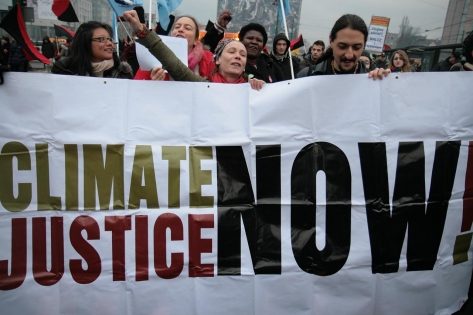
To be sure, the civil society movement Climate Justice Now! is disgusted by Kyoto’s
* low targets (just 5 percent decrease in emissions since 1990);
* ease of exit (especially by the world’s worst tar-sands polluter, Canada);
* lack of sanctions against big polluters for not participating (the US and Australia) or for missing even weak targets (nearly everyone);
* failure to penalize corporate beneficiaries of vast coal operations in sites like South Africa; and
* reliance on carbon markets to make emissions cuts more palatable to big capital, thanks to the sleazy deal done by Al Gore in 1997 in exchange for official US support (but the Senate vote against Kyoto was 95-0!).
Still, a binding global deal is ultimately needed, and replacing Kyoto with a voluntary ‘Durban Package’ would be disastrous given the US, EU and Japanese track-record on underfunding, cheating and bribery. Thanks to last December’s release of US State Department cables by Julian Assange and Bradley Manning (presumably, as he remains uncharged in Leavenworth prison in Kansas), it is undeniable that Clinton underlings Todd Stern and Jonathan Pershing are bullies who should be banned from all future negotiations. The EU’s Connie Hedegaard happily joined them to plot defunding the GCF in February 2010, according to WikiLeaks.
To meet scientific requirements for planet-saving emissions cuts requires a binding UN effort like that made in 1987 in Montreal to ban CFCs, the chemical that was widening the deadly ozone hole. But given the rise of neoliberalism (1990s), neoconservatism (2000s) and their subsequent fusion as the dominant ideologies within the United Nations, a repeat of the Montreal Protocol is not possible anytime soon.
So at the last two climate COPs, in Copenhagen (2009) and Cancún (2010), Pretoria lined up squarely with the worst environmental wreckers. The result, according to Bolivia’s Ambassador to the United Nations, Pablo Sólon, at a Bonn press conference, are “commitments of emissions reductions that leads us to a scenario of [a temperature increase of] 4 degrees Celsius. And that is absolutely unacceptable. We need to come out of South Africa with commitments of emissions reductions that will put us in a scenario of between 1 to 1.5 degrees Celsius in order to preserve our planet and life as we know it.”
Concluded Sólon, one of the few negotiators brave enough to speak truth to power inside UN’s dead space, “South Africa is the place to fight against the new apartheid against Mother Earth and its vital systems.”
Local activists will join this fight knowing their politicians and officials are terribly destructive. One reason Durban will be regarded in future as the city that amplified climate apartheid, is the elites’ hunger to codify and even celebrate market-based environmental governance, including the Reducing Emissions from Deforestation and forest Degradation (REDD) programme.
According to Sólon, “There is a proposal in the Cancún agreement that focuses everything on … guidelines in the capacity of forests to capture CO2. We must not focus on how to prepare forests for a market mechanism, we must fight deforestation now.”
REDD’s most dogmatic advocate has been the World Bank, which is also the trustee for the Green Climate Fund, leading to civil society demands for its repulsion. “The World Bank is part of the climate problem, not the climate solution,” Sebastian Valdomir of Friends of the Earth International said at Bonn. “Its appalling social and environmental track record should immediately disqualify it from playing any role whatsoever in designing the Green Climate Fund, and in climate finance more generally.”
Case in point: the Bank’s $3.75 billion loan to Eskom last year, mainly to fund the Medupi plant in spite of well-known conflicts of interest (African National Congress investments in Hitachi boiler construction) and worsening inability to pay for electricity by poor South Africans, who continue ‘service delivery protests’ at amongst the highest rate in the world.
Rather than expect the dubious bankers to tackle our greatest challenge, Sólon proposed an international financial transactions tax to fund climate aid. The North’s existing commitments, such as the supposed $30 billion in fast track funding pledged by Hillary Clinton at Copenhagen through 2012, is proving to be just as reliable as the G8’s Gleneagles Summit 2005 financing pledges to Africa.
Conferences of promisers are a dime a dozen, as they say in the US, and conferences of empty pledges, such as Clinton’s, as unveiled at Bonn by her own colleagues on June 7 (“there will not be $100 billion a year in the GCF”), have one main purpose: to deflect the world’s justified anger at how Northern pollution threatens us all.
There is another deflection trick we can expect in Durban, just as at the Johannesburg World Summit on Sustainable Development in 2002, when Third World Network’s Martin Khor condemned the host chair (Thabo Mbeki) for importing the exclusionary methodology of the World Trade Organisation’s ‘Green Rooms’. Venezuela’s negotiators in Bonn last week criticized Pretoria’s “proliferation of innovative ideas” that were hashed out beyond closed doors.
Against top-down disasters like these, can activists change the balance of forces? Last Friday as Bonn was drawing to a desultory close, the Durban-born leader of Greenpeace International, Kumi Naidoo, showed exactly the spirit required, while attempting delivery of a 50,000-strong petition to an offshore drilling rig run by Cairn Energy near Greenland.
As Naidoo approached the rig, the Leif Eriksson (named after a Scandinavian Viking, a tribe renowned for looting, pillaging and raping), he was hit by near-freezing water cannon blasts and then arrested ‘indefinitely’ for violating a court injunction.
Said Naidoo, “Arctic oil drilling is one of the defining environmental battles of our age. I’m an African but I care deeply about what’s happening up here. The rapidly melting cap of Arctic sea ice is a grave warning to all of us, so it’s nothing short of madness that companies like Cairn see it as a chance to drill for fossil fuels that got us into this climate change mess in the first place. We have to draw a line and say no more.” The same line will have to be drawn against the Durban Conference of Polluters, and it appears Saturday, December 3 will be a global day of action when in Durban and your hometown, the strongest possible stance will be needed to finally address the mess.
(This article by Diane Bukowski is re-posted from Michigan Citizen.)
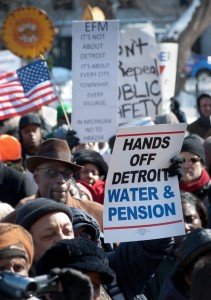
With no input from community members or city workers, a group of Detroit’s top business barons, appointed by U.S. District Court Judge John Feikens, is studying the possible sale, regionalization, or private management of the city’s water department.

The panel, which includes executives from GM, Ford, DTE and Detroit Renaissance, is also studying the possibility of a costly 50-year refinancing of the department’s $5.4 billion debt. Its final report is due in the spring, with Feikens set to act on it afterwards.
Feikens has said that he wants to end the ongoing war between Detroit and its suburbs over control of the department, which serves 4.3 million people in an eight-county area, employs nearly 3,000 workers, and has an annual budget of $1.48 billion. Detroit built the system over the past century, financing it with billions in bond issues.
Ford Motor Company executive Tim O’Brien, the panel’s co-chair, denied that Feikens will necessarily actualize the options being studied, but community and union leaders say they are alarmed.
“It’s just an outrage,” said Maureen Taylor of the Michigan Welfare Rights Organization. “Feikens should retire. He doesn’t have the right to steal ownership of the water department from us. We are certainly not above picketing outside his residence.”
Taylor said the water department has budgeted 45,000 water shut-offs to Detroit residents who can no longer afford rising rates this year, and the problem will only worsen if the city loses control.
John Riehl, president of Local 207 of the American Federation of State, County and Municipal Employees (AFSCME), has long protested internal privatization at the department. He has said costly private contracts have already resulted in the loss of thousands of jobs for city workers, and severe reductions in the quality of service, including failure to properly maintain the system.
“Such a takeover would be terrible for Detroit’s citizens and workers,” he said. “It means increased water rates and service cutbacks while private companies profit and Detroiters have no control.”
He said his union has asked for a public hearing in front of Detroit’s city council on the matter, but no date has yet been set.
The city’s charter forbids the sale or wholesale privatization of water department assets without a general vote of its residents. Detroit Mayor Kwame Kilpatrick has additionally said, “The City of Detroit will NEVER give up control of the Water Department.”
Feikens, who is 88, has supervised the Detroit Water and Sewerage Department (DWSD) under a federal consent decree related to pollution control since 1977. As a federal judge, he has the power to override state constitutional guarantees of the city’s ownership of DWSD, including its home rule provisions. But he has said he prefers that the city voluntarily concede some of those protections.
At an April meeting of the Southeast Michigan Consortium for Water Quality in Dearborn, Feikens summarized his stance.
“DWSD’s system, vital as it is to the health and quality of life in southeastern Michigan, has faced repeated challenges from some suburban communities who are prevented by the state’s constitution from having any say in the ownership or operation of DWSD,” he intoned.
“At the same time, the people of Detroit who provide this valuable service are barred by state law from receiving any financial benefit or profit for doing so. This dilemma will not be resolved by legislation or litigation. It demands cooperation on the part of the southeast Michigan communities and the agreement by DWSD to modify the protection given to it by the state’s Constitution as part of a regional settlement.”
He designated F. Thomas Lewand, of the law firm of Bodman, Longley and Dahling, LLP, as “Special Master” to oversee the study group, which he appointed last year. To date, Lewand has submitted $233,547.46 in itemized bills to DWSD under Feikens’ orders.
Those bills refer to extensive research on the possible sale of the water system, with assets first being transferred from the City of Detroit to the water department itself; the possible creation of a regional authority to oversee DWSD and the make-up of its board of directors; and the possible engagement of a private management group.
The bills also refer to research on the impact such alternative structures would have on the department’s eligibility for state and federal funds, and the possible assumption of the department’s bonded debt.
In an Oct. 17 ruling, Feikens ordered DWSD Director Victor Mercado to procure the services of banking firms to examine the department’s current bond structure, and options for restructuring its debt.
The department is not in deficit, and currently has AAA bond ratings on Wall Street. But Feikens told Crain’s Detroit Business, “. . .preliminary figures point to possible savings of up to $60 million a year if bond terms are pushed out to 50 years while keeping rates where they are at.”
Feikens said Detroit would perhaps retain about $40 million of that, while the suburbs would get $20 million. He said he is also looking at the possibility of Detroit charging user fees to the suburbs.
Serving on Feikens’ panel are former Michigan governor William Milliken, Ford Motor executive Tim O’Brien, DTE Vice-President Paul Hillegonds, General Motors executive Doug Rothwell, PVS Chemicals CEO Jim Nicholson, attorney David Lewis, businessman and former Piston Dave Bing, and S. Martin Taylor to the panel.
Many of those individuals are key figures in the recent formation of One D, a supergroup including New Detroit, The Detroit Regional Chamber, and Detroit Renaissance along with the United Way for Southeastern Michigan. They also head committees of Kilpatrick’s Next Detroit Transformation Team, which has recommended privatization and sale of city assets among other options.
O’Brien said the panel has only been doing its “homework.”
“It is premature for anyone to say that because we are studying options, that we have reached a conclusion that the system ought to be privatized or sold,” he opined. “That is not the direction we’re heading in. But it would be inappropriate to pre-empt our conclusions, which are due in the spring, by discussing them now.”
He continued, “The judge’s purpose is to allow this region in its totality to benefit from a system that has some of the highest water quality in the world and some of the lowest rates. But the region also has massive infrastructure problems that will require significant capital investment in the future.”
He said the panel is contemplating the restructuring of the department’s debt “not to make the banks wealthy, but because it makes sense for Southeast Michigan.”
O’Brien said community members and other stakeholders will be brought into discussions after the panel issues its final report.
Really Really Free Market planned for this Sunday
Really Really Free Market
Noon to 5 p.m.
Sunday June 26, 2011
The Bloom Collective
671 Davis NW, Grand Rapids
This Sunday, The Bloom Collective is hosting a Really Really Free Market on the lawn outside of Steepletown Center, at the corner of 5th St. and Davis Ave. NW. This is the fourth time the infoshop has hosted an “RRFM.” In fact, after hearing about Really Really Free Markets in other parts of the country, The Bloom introduced the idea to the area in July 2008 with this announcement:
Let’s share what we’ve got and ask for what we need, because there is enough for everyone. Let’s respond to the corporations that would rather the landfills overflow than anyone get something without paying. Let’s meet this month to show that we mean what we’ve been saying–we want an alternative, and we’re going to invent it for ourselves.
That market was a huge success. In addition to folks bringing and taking yard-sale type items, the day included musicians, free bike repairs, a family sharing kombuchu mothers, a sketch artist and introductory Spanish lessons. For a few hours, the market turned the vacant lot at the corner of Fuller and Wealthy into a microcosmic community living an alternative to capitalism. A neighbor in charge of maintaining the vacant lot came by with ideas of asking folks to leave. Instead, he walked away with a few free items he needed and a smile on his face.
That Really Really Free Market even got coverage in The Grand Rapids Press.
After that first Really Really Free Market, a group of dedicated local folks, known first as simply Really Really Free Market and then Good Morning Revolution, took on the task of hosting regular markets at the Wealthy/Fuller location and elsewhere around town. Today, the Really Really Free Market is pretty much an established event that radical folks and others look forward to attending on a regular basis.
Do you want an alternative to consumerism and greed, the two cornerstones of our economic system? Come on down to the Really Really Free Market on Sunday. Bring the stuff you don’t need, take the stuff you do. Share some food, music or whatever other talents you have. And, be inspired to find other alternatives that demonstrate another world is possible.
Carl Levin continues to support bloated military budget and corporate welfare for weapons contractors
On Friday, Senate Armed Services Committee Chair Carl Levin announced that the committee has completed its “mark up” of the 2012 Defense Authorization Act.

The proposed military budget for 2012 is as big as ever with Levin not only approving of the largest military budget in the world but gloats over the amount of contracts he was able to secure for Michigan contractors.
The report from the Senate Armed Services Committee is lengthy, but we’ll provide some of the major highlights of this bloated military budget:
- Extends through fiscal year 2017 significant funding for counter-insurgency training and programs, specifically for Afghanistan.
- Ongoing funding for projects fighting WMDs.
- $12.8 billion for Afghan Security Forces.
- Billions in funding to promote the use of renewable energy sources for the military – like that is not the most absurd contradiction ever.
- Authorizes $10.4 billion for U.S. Special Operations Command (USSOCOM), an increase of 6 percent above fiscal year 2011 levels.
- Renewal of DOD contracts for the failed War on Drugs.
- Increased funding for ballistic missiles.
This bloated military budget comes with perks for weapons contractors in Michigan. Here is a listing of the companies and the amount of the contracts they were awarded in the 2012 military budget:

- $444 million for the Family of Medium Tactical Vehicles (FMTV). Arvin Meritor of Troy, AAR Mobility of Cadillac, and a number of other Michigan companies are involved in the production of FMTVs.
- $685.8 million for the Army’s Stryker armored vehicle. General Dynamics Land Systems of Sterling Heights is the prime contractor for the Stryker armored vehicle. Many Michigan companies serve as suppliers in support of this program.
- $161.6 million for High Mobility Multipurpose Wheeled Vehicle (HMMWV) recapitalization. Many Michigan companies support the HMMWV program as suppliers.
- $663.9 million for the Abrams Main Battle Tank program. General Dynamics Land Systems of Sterling Heights is the prime contractor for the Abrams program and more than 200 Michigan companies serve as suppliers.
- $34.6 million for the Lightweight 155mm Howitzer. Howmet Castings of Whitehall is a major contractor for the Lightweight 155mm Howitzer program.
- $674.5 million for the Family of Heavy Tactical Vehicles. Detroit Diesel manufactures and supplies the engine for this program.
- $3.34 billion for Mine Resistant Ambush Protected (MRAP) vehicles. Spartan Chassis of Charlotte, Arvin Meritor of Troy, and Demmer Corporation of Lansing and many other Michigan companies are involved in this program.
- $250.7 million for Bradley Fighting Vehicle modifications. L-3 of Muskegon is a major contractor for the Bradley program.
- $1.8 billion for Littoral Combat Ship (LCS) construction. Marinette Marine, just across the Michigan border in Wisconsin, is one of two shipyards building LCS and employs several hundred Michigan residents and relies on many Michigan suppliers.
In addition, there is $2 billion allocated for universities to conduct research for the Department of Defense. Levin states, “Many Michigan universities perform high quality fundamental research for the Department of Defense in all fields of science and technology.”
It should come as no surprise to those who follow campaign finance that Senator Levin would fight so hard for military contracts to come to Michigan, especially since military contractors like General Dynamics and Lockheed Martin have been significant contributors to Levin over the years.
Some might argue that these contracts provide jobs in Michigan and while that is true the amount of money allocated to the military industrial complex in Michigan in the form of jobs is miniscule compared to the amount of money that has left Michigan to fund the US wars in Iraq and Afghanistan since 2001.
According to the National Priorities Project over $32 billion has left Michigan to fund these wars over the last 10 years while our schools are grossly underfunded, our infrastructure crumbles and the number of people living in poverty increases.
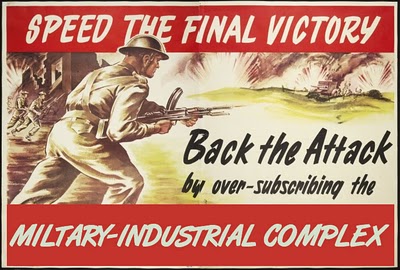
The “liberal” Senator Levin continues to demonstrate that he is beholden to the military industrial complex with his support for weapons manufacturers. At the same time Carl Levin’s support for the highly militarized foreign policy of the US shows he is a zealous supporter of the US imperial project abroad.

Earlier today roughly 50 people gathered in downtown Grand Rapids to protest the economic policies implemented by the Snyder administration in Lansing.
People gathered in front of the Grand Rapids Chamber of Commerce building at 111 Pearl Street since the GR Chamber has played a significant role in crafting and supporting these new economic policies such as the elimination of the Michigan Business Tax.

The local Chamber office was close today with a sign attached saying that their staff was on retreat. No one present at the demonstration knew if this was just coincidence or if the Chamber decided to avoid any confrontation.
The protest was organized with the help of several local unions, particularly the Teamsters who have begun a new organizing effort locally and across the country.
People held signs for more than an hour and moved along Pearl Street chanting slogans like, “the banks got bailed out, we got sold out” and “We will fight, we will win, Cairo, Madison, Michigan.” After about an hour 2 Grand Rapids cops arrived to tell the demonstrators that they were “being too loud.” One demonstrator asked how this could be when there are weekly outdoor concerts in the downtown area that create much more noise than people engaged in free speech. The cops didn’t seem interested in hearing any logical argument.
GRIID spoke with one of the organizers from the Teamsters, Terry Hoogerhyde and a retired teacher Esther Turner. Here are there comments:
 For the past several years, GRIID has been involved directly, or reported on, local actions that sought to raise awareness of the cost of the US’ continuing occupation of Afghanistan. Those actions included hosting journalist, Anand Gopal, peace activist Kathy Kelly, a teach-in on Ending Occupations with keynote Phyllis Bennis and marches that commemorated the eighth and ninth anniversaries of the US occupation of Afghanistan.
These marches reiterated the financial costs of the occupation that are being paid for with local and state tax revenue, revenue that could be used to fund our schools, healthcare, parks, food security, housing for the homeless or unemployment for the many now out of work.
One of the rationales for the paying the high costs of occupation that is often highlighted by the Whitehouse and US media is the liberation of Afghan’s women. Sad to say, the US presence in Afghanistan has only worsened women’s plight here. Women’s groups inside Afghanistan like RAWA and Afghan’s Women’s Mission have made this clear since the occupation began. Their accounts were recently corroborated in a June 15 article published in Al Jazeera English, “Afghanistan ‘most dangerous place for women.”
Afghanistan has been ranked as the world’s most dangerous country for women, with Congo taking a close second position, a Thomson Reuters Foundation expert poll has said. Violence, dismal healthcare and brutal poverty afflicts women in Afghanistan, while in Congo there are horrific levels of rape, the survey conducted by TrustLaw, an arm of Thomson Reuters, said on Wednesday. Pakistan, India and Somalia ranked third, fourth and fifth respectively in the global survey of perceptions of threats ranging from domestic abuse and economic discrimination to female foeticide, genital mutilation and acid attacks.
“Ongoing conflict, NATO airstrikes and cultural practices combined make Afghanistan a very dangerous place for women,” Antonella Notari, head of women change makers, a group that supports women social entrepreneurs around the world, said.
The survey asked 213 gender experts from five continents to rank countries by overall perceptions of danger as well as by six risks. The risks were health threats, sexual violence, non-sexual violence, cultural or religious factors, lack of access to resources and trafficking. Some experts said the poll showed that subtle dangers such as discrimination that don’t grab headlines are sometimes just as significant risks for women as bombs, bullets, stonings and systematic rape in conflict zones.
“I think you have to look at all the dangers to women, all the risks women and girls face,” Elisabeth Roesch, who works on gender-based violence for the International Rescue Committee in Washington, said. “If a woman can’t access healthcare because her healthcare isn’t prioritised, that can be a very dangerous situation as well.”
Afghanistan emerged as the most dangerous country for women overall and worst in three of the six risk categories: health, non-sexual violence and lack of access to economic resources. Respondents cited sky-high maternal mortality rates, limited access to doctors and a near total lack of economic rights. Afghan women have a one in 11 chance of dying in childbirth, according to UNICEF.

While Obama may be talking withdrawal, the terms are already being brought into question. Plans are already underway for a tenth anniversary march calling for bringing US troops home from Afghanistan. The Grand Rapids march is being coordinated through the United National Antiwar Committee. For information on getting involved, contact local organizer, Fermin Valle.
 Grand Rapids Institute for Information Democracy