Industry rationale for the Tar Sands Oil Pipeline a Lie

In recent weeks there has been more debate about the Keystone crude oil pipeline that is being proposed from Western Canada to the Texas Gulf Coast.
Most of the attention came from the mass civil disobedience campaign in late August/early September in Washington, DC in an attempt to send a strong message to the US government that such a pipeline would be disastrous for the environment and indigenous people.
Those who have been promoting or endorsing the Keystone tar sands pipeline have argued that one of the main benefits of such a project is that it will allow the US to rely less on foreign oil. However, a new report from Oil Change International exposes that justification as a lie.
The new report, entitled Exporting Energy Security: Keystone XL Exposed, found that:

- Keystone XL is an export pipeline. The Port Arthur, Texas, refiners at the end of its route are focused on expanding exports to Europe, and Latin America. Much of the fuel refined from the pipeline’s heavy crude oil will never reach U.S. drivers’ tanks.
- Valero, the key customer for crude oil from Keystone XL, has explicitly detailed an export strategy to its investors. Because Valero’s Port Arthur refinery is in a Foreign Trade Zone, the company can carry out its strategy tax-free.
- In a shrinking U.S. market, Keystone XL is not needed. Since the project was announced, the oil industry acknowledges that higher fuel economy standards and slow economic growth mean declining U.S. oil demand, even as domestic production is booming. Oil from Keystone XL will therefore displace American crude from new, “unconventional” domestic fields in Texas or North Dakota.
Oil Change International Director Stephen Kretzmann noted, “To issue a presidential permit for the Keystone XL, the Administration must find that the pipeline serves the national interest. An honest assessment shows that rather than serving U.S. interests, Keystone XL serves only the interests of tar sands producers and shippers, and a few Gulf Coast refiners aiming to export the oil.”
However, we know that big oil is one of the main contributors to electoral politics and you can bet they are buying influence to make sure the Keystone pipeline goes through. You can track which oil companies are giving money and to whom at http://dirtyenergymoney.com/#.
Music Legend Tony Bennett on 9/11 and US Foreign Policy

While people may be familiar with the music legacy of jazz singer Tony Bennett, they probably aren’t familiar with his politics.
Yesterday, on the Howard Stern show, Bennett, when confronted by the misogynist Howard Stern, told the radio audience about a private conversation he had with President George W. Bush. Bennett when on to challenge Stern who wanted to blame the war on terror on the people who hit the World Trade Center, by saying, “they flew the planes, but we caused it……..we were bombing them first.”
Senator Stabenow announces new legislation that benefits agri-business
Last week Michigan Senator Debbie Stabenow, Chairwoman of the US Senate Committee on Agriculture, announced that she and her colleagues were proposing a new piece of legislation called The Charitable Agriculture Research Act.

According to the Press Release from Stabenow’s office, this new legislation would “amend the tax code to allow for the creation of a new type of charitable, tax-exempt agricultural research organization (ARO).”
Similar legislation has been introduced in the House of Representatives by Congressman Nunes from California, known as HR. 2959.
Both Stabenow and Nunes state that the benefits of such legislation would be the increased investment from the private sector in future agriculture research.
Stabenow states, “This is a ‘win-win’ effort that builds on decades of success and momentum by continuing to pursue new research – and doing so in a cost-effective way by engaging the private sector.” Nunes adds, “This bill provides an incentive for donations to ag research, creating an important new funding source and providing significant future benefits to innovation, production, and success in agriculture.”
While neither Stabenow nor Nunes explicitly mention private entities that will benefit from such legislation, it clearly will allow greater incentives for private corporations to make greater investments in agriculture research at the university level.
According to the corporate dairy industry, this new legislation is a benefit to them and other corporations and private agriculture associations. They provide a long list of agri-business entities that support the legislation, such as the American Farm Bureau Federation – a right-wing lobbying group for agri-business, and the Biotechnology Industry Organization.
At a time when food production, nutrition and environmental sustainability are paramount, government officials should not be providing greater incentives for corporate agriculture to be involved in a food system that benefits them and not the public.
Congressional Millionaires To Weigh Obama’s Proposed ‘Buffett Rule’
(This article is re-posted from OpenSecrets.org.)
President Barack Obama’s plan for a new minimum tax rate for people who earn more than $1 million a year will likely affect some of the people who will have a say on whether the rule becomes law.

Namely: Congress.
Obama’s new tax proposal, which has been dubbed the “Buffett rule” after billionaire investor Warren Buffett, may include a change in how capital gains are taxed.
According to research by the Center for Responsive Politics, about 40 percent of members of the U.S. House of Representatives and nearly half of all U.S. senators reported capital gains in 2009.
Among the 176 current members of the House and 48 sitting senators to do so? Reps. Darrell Issa (R-Calif.), Michael McCaul (R-Texas), Nancy Pelosi (D-Calif) and Tom Petri (R-Wis.) and Sens. Mark Warner (D-Va.), Dianne Feinstein (D-Calif.), John Kerry (D-Mass.) and Richard Blumenthal (D-Conn.).
In contrast to Obama, many of the Republicans running for the GOP presidential nomination have proposed eliminating the capital gains tax.
Currently, according to the Tax Policy Center, the richest 0.1 percent of Americans pay 44 percent of all capital gains taxes, and 68 percent of the tax is paid by the richest 1 percent. The bottom 80 percent of Americans account for less than 3 percent of all capitals gains taxes paid.
Furthermore, according to the Center’s research, 244 current members of Congress were millionaires in 2009, the most recent year for which data is available. That figure includes 138 Republicans and 106 Democrats.
That lofty financial status is claimed by only about 1 percent of Americans. The median American family had a net worth of $96,000 in 2009, according to the Federal Reserve Board.
Of course, not all millionaires make more than $1 million in income annually — that’s an even loftier financial status enjoyed by an even more elite slice of Americans.
No matter how you look at it, though, members of Congress as a whole are a wealthy bunch — typically several times wealthier than most of their constituents.
The median net worth for a current member of the U.S. House of Representatives was $725,000 in 2009, according to the Center’s research, and the media net worth of a U.S. Senator was $2.4 million.
The richest member of Congress is Issa, whose net worth was valued between $156 million and $451 million. (When members of Congress disclose information about their financial assets and liabilities, they are allowed to do so by giving broad ranges.)
Here is a list of the 20 wealthiest current members of Congress, according to the Center’s research, based on their financial reports covering calendar year 2009. (The Center plans to unveil its analysis of lawmakers’ 2010 financial disclosures later this fall.).
| Rank | Name | Party | Min. Net Worth | Average Net Worth | Max. Net Worth |
| 1 | Rep. Darrell Issa (R-Calif.) | R | $156,050,022 | $303,575,011 | $451,100,000 |
| 2 | Sen. John Kerry (D-Mass.) | D | $182,755,534 | $238,812,296 | $294,869,059 |
| 3 | Sen. Mark Warner (D-Va.) | D | $65,692,210 | $174,385,102 | $283,077,995 |
| 4 | Rep. Jared Polis (D-Colo.) | D | $36,694,140 | $160,909,068 | $285,123,996 |
| 5 | Sen. Herb Kohl (D-Wis.) | D | $89,358,027 | $160,302,011 | $231,245,995 |
| 6 | Rep. Vernon Buchanan (R-Fla.) | R | -$69,434,661 | $148,373,160 | $366,180,982 |
| 7 | Rep. Michael McCaul (R-Texas) | R | $73,685,086 | $137,611,043 | $201,537,000 |
| 8 | Sen. James Risch (R-Idaho) | R | $38,936,114 | $109,034,052 | $179,131,990 |
| 9 | Sen. Jay Rockefeller (D-W.Va.) | D | $61,446,018 | $98,832,010 | $136,218,002 |
| 10 | Sen. Richard Blumenthal (D-Conn.) | D | $64,210,256 | $94,870,116 | $125,529,976 |
| 11 | Sen. Dianne Feinstein (D-Calif.) | D | $46,055,250 | $77,082,134 | $108,109,018 |
| 12 | Sen. Frank Lautenberg (D-N.J.) | D | $49,083,204 | $76,886,611 | $104,690,018 |
| 13 | Rep. Nancy Pelosi (D-Calif.) | D | -$7,356,915 | $58,436,537 | $124,229,990 |
| 14 | Rep. Gary Miller (R-Calif.) | R | $19,365,053 | $51,833,526 | $84,302,000 |
| 15 | Sen. Bob Corker (R-Tenn.) | R | $9,778,047 | $50,717,522 | $91,656,998 |
| 16 | Rep. Diane Lynn Black (R-Tenn.) | R | $14,673,049 | $49,409,519 | $84,145,990 |
| 17 | Rep. Rodney Frelinghuysen (R-N.J.) | R | $19,898,179 | $43,797,589 | $67,697,000 |
| 18 | Rep. Richard Berg (R-N.D.) | R | $19,347,579 | $39,164,515 | $58,981,451 |
| 19 | Rep. Nita Lowey (D-N.Y.) | D | $14,900,036 | $39,012,518 | $63,125,000 |
| 20 | Rep. Kenny Marchant (R-Texas) | R | $13,303,385 | $38,204,868 | $63,106,351 |
Bloom Collective to host planning event for the 10th Anniversary of the US Occupation of Afghanistan

The 10th Anniversary of the US Occupation is October 7, making this current war the longest in US history.
There are numerous actions being planned around the world. In the US there are actions planned in coordination with the Occupy Wall Street encampment, with online information at http://october2011.org/welcome.
The Bloom Collective will be hosting an event on Tuesday, September 27 at 7:00PM, in the basement level of the Steepletown Community Center, located at 671 Davis, NW in Grand Rapids.
According to the facebook announcement, they will show the film Million Dollar Militia (Big Noise Films – 22 minutes), a film that critiques the US effort to create an Afghan Army that will provide security if and when the US ever leaves.
After the film there will be an opportunity to brainstorm ideas for potential actions in Grand Rapids to draw attention to and resist the ongoing US occupation of Afghanistan.
Occupy Wall Street protests continue

It is now day 3 as thousands of people are marching, demonstrating and occupying an area near and around the US financial district known as Wall Street.
Organizers have been saying that they want this occupation to follow what has happened in Egypt, Tunisia, Greece, Spain and the UK, where the populations of those countries have been resisting government repression and global capitalism.
The Occupy Wall Street blog reported:
“Today, we occupied Wall Street from the heart of the Financial District. Starting at 8:00 AM, we began a march through the Wall Street area, rolling through the blocks around the New York Stock Exchange. At 9:30 AM, we rang our own “morning bell” to start a “people’s exchange,” which we brought back to Liberty Plaza. Two more marches occurred during the day around the Wall Street district, each drawing more supporters to us.
Hundreds of us have been occupying One Liberty Plaza, a park in the heart of the Wall Street district, since Saturday afternoon. We have marched on the Financial District, held a candlelight vigil to honor the fallen victims of Wall Street, and filled the plaza with song, dance, and spontaneous acts of liberation.”

The original call for this occupation was published by Adbusters in July; since then, many individuals across the country have stepped up to organize this event, such as the people of the NYC General Assembly and US Day of Rage. There’ll also be similar occupations in the near future such as October2011 in Freedom Plaza, Washington D.C.
Here is a segment from Democracy Now that frames the action in the context of what the Obama administration is doing to continually protect Wall Street.
Rep. Agema responds to citizen plea to abandon Islamaphobic legislation
 After reading the September 3, 2011 GRIID post on HB 4769, Anti-Sharia law legislation proposed by Representative Dave Agema, I decided to email him to voice my objections. As a mother of Muslim-convert son and grandmother of two beautiful Muslim grandsons, I asked him to reconsider his stance as in reality we are in no danger of being subjected to Sharia law here in Michigan. I further related that such legislation only serves to further the Islamaphobia that the nation’s fear-mongers are hoisting on those American folks without an understanding of how our Muslim American neighbors live. In short, I asked him to keep Michigan a safe place for my family. I shared with him that mainstream Islam consider Muslims, Christians and Jews all “People of the Book,” as they consider the Old and New Testaments as holy books as well as their Quran.
Agema emailed me a response. I forwarded it to my son, Abdul Nur, who converted to Islam some 12 years ago and has studied Islam at schools in Chicago and at the University of Medina, Saudi Arabia.
Agema: My bill has only to do with foreign laws entering our courts that are contradictory to our state or federal laws. As far as “People of the Book,” I have read large portions of the Koran and his prophets sayings that are all adhered to by Muslims. While this is America and we have freedom of religion, much of the Sharia law is anathema to our laws.
Abdul Nur: Part of sharia law is that when a Muslim lives in a foreign land, he agrees to the conditions put out by that land. Muslims in the U.S. don’t want to implement the Islamic Jurisprudence of Sharia; they want to benefit from the domestic rules of Islam such as marriage, divorce, inheritance etc.
Agema: (Under Sharia law) only Muslims will be allowed to carry guns.
Abdul Nur: This is an absurd notion considering my first point.
Agema: Sharia law allows a man to have four wives.
Abdul Nur: If this is a point that is extremely offensive to Christians, understand that most Muslims also don’t want to have multiple wives.
(Abdul Nur further explained that under Sharia law, the parties involved in any marriage must both want to be married, without coercion. I might add that the Quran isn’t the only holy book with polygamist heroes.)
Agema: . . . women have half the rights of a man.
Abdul Nur: This is 100% false. Women don’t have a blanket ‘half the rights of men’ law applied to them. There are some situations where women are given less money than men in inheritance, mainly because men are the providers, more often than not, in Islamic relationships.”
Agema: . . . a man can beat his wives.
Abdul Nur: There is little to no evidence to support such a thing, and the commonly quoted evidence is of a weak nature.
Agema: When a divorce happens the kids go to the father.
Abdul Nur: Not true at all, the child is allowed to choose in most cases which parent he would like to live with.
Agema: Also, if you are a Christian then you can’t abide by their beliefs that Jesus is not the Son of God nor Savior.
Abdul Nur: Good thing we live in America where we have freedom of religion, and separation of church and state, oh wait…”
Agema: Also look up the word “tequia-spelling may be wrong)(sic). This allows Muslims to lie to Christians (sic) and jews (sic) if it furthers Islam.
Abdul Nur: This Is common amongst Shi’ah Muslims, and is considered an egregious practice amongst orthodox Muslims. It’s quite ironic to hear a politician claiming that our fault in this world is lying to further our benefits.
Agema: Islam means submission. 60% of the Koran and Mohammed’s writings are about how to treat infidels or kafirs.
Abdul Nur: This doesn’t justify any kind of response, and is blatantly untrue. I really doubt anyone took the time to quantify the amount of the Islamic Law pertains to non-Muslim people. Not to mention that in Islamic states, for over 1,000 years, non-Muslim people had rights and the freedom of religion. Something that, unfortunately, cannot be said about most Christian countries.
Agema: They have a right to believe what they want but they don’t have the right to be free from our laws and constitution when they disagree.
Abdul Nur: I agree with this, and I don’t know a single Muslim that wishes to make non-Muslims subjected to Islamic law in this country.
Agema: This bill applies to UN mandates as well and any other law that comes our way that denies someones rights according to our constitution. Most are found in child custody cases and divorce cases that have crept into our judicials system.
Abdul Nur: What’s wrong with us referring to our beliefs in domestic matters if both parties wish for it to happen? We aren’t trying to make anyone else do it. We just want to live peacefully according to our religion. Should that be against the law?
Agema also wrote, “When these (Sharia law) enter our courts through progressive judges our justice system is in error and people’s constitutional rights are lost because they used these instead of ours (50 cases in 23 states.”
I looked up this bit of propaganda, which is being disseminated by an extreme right-wing think tank, the Center for Security Policy, a group which Source Watch describes as being part of the Islamaphobia network. The Center for Security Policy invented and disseminated the Ground Zero Mosque hoax and served as major inspiration to Norwegian terrorist, Anders Breivik, who bombed Oslo and murdered 68 people (mostly teenagers) at a youth camp in July 2011.
 What is Sharia Law?
According to the Islamic Society of Lansing, the group sponsoring a petition against HB 4769, “Sharia is a Muslim code of conduct, in the same way that the Bible guides Christians with their daily life. Sharia calls on Muslims to engage in daily prayers, give alms to the poor, partake in good deeds, and avoid sin. Sharia is not monolithic. While some elements of Islamic law are central to the faith, other elements are contextual based on time and place.
At no time does Sharia seek to supersede the Constitution or the local laws of the land. Muslims are obligated to abide by the laws of the country in which they reside as long as the country offers religious protection and grants the right to worship freely.
They go on to explain, “The bill does not specifically mention sharia, but as Muslims we feel that the legislation targets us based on its similarity to other “anti-Sharia” laws popping up in other states.
These bills play on the public’s fear of the unknown and capitalize on misinformation in the public discourse about the nature of Sharia. Additionally, the constitutionality of these laws will likely be called into question.”
This writer whole heartedly agrees with The Islamic Society of Greater Lansing summation of the bill. “HB 4769 does nothing to protect our legal institutions but only contributes to the growing climate of fear mongering against the American Muslim community which marginalizes and casts suspicion upon loyal Americans.”
Some ArtPrize Questions Courtesy of The Grand Rapids Press
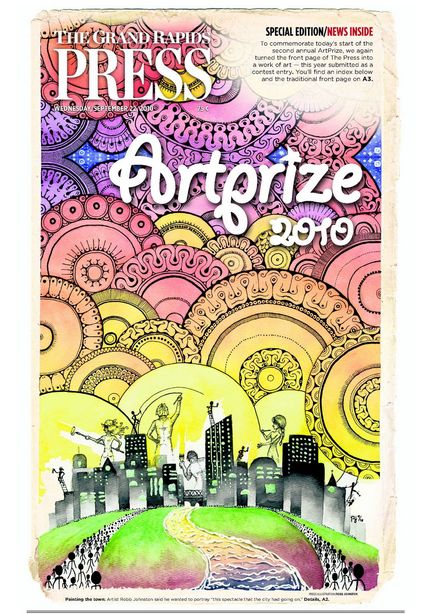
In Sunday’s Grand Rapids Press, Meijer Gardens curator Joseph Becherer (who will be curating the ArtPrize exhibits at the Gardens) enthuses about the event: “Can you feel the excitement?” he asks. “The energy?” Yes, we definitely feel the mosquito-like buzz, augmented by the constant local media coverage—as well as the sound of merchants and restaurateurs oiling the draws of their cash registers.
Becherer goes on to state that ArtPrize is a “discussion” and gives the readers some benchmark questions to ask themselves. So, in the case of economy, here are his questions and my answers. I’m offering them in advance, as I’m sure they will remain unchanged from my 2009 and 2010 answers.
The What. “What am I looking at?” Becherer advises we ask. “…What need might creating [this piece] fulfill for the artist?…What about it might attract or deter others? What value does it hold for you?”
Well, Joe. If I’m at ArtPrize, I could be looking at a piece that was specifically created to win a bucketload of cash. The need that caused the artist to create it was so that he/she could retire and actually do art with some meaning for the rest of his or her life.
What could deter others about the piece is wondering, “Did this piece actually come from a legitimate artistic vision? Does someone just suddenly dream that a giant Loch Ness monster or gigantic aluminum flowers might have a deep message about social justice, a personal trauma, childhood memory, or some other meaningful content? Or did they just think, ‘What’s the biggest and most attention-getting thing I can create for this circus?’”
Just having to worry about that issue means that many of the pieces automatically hold less value for me.
The How. “How was this object made? How does it hold together visually?…How does it compare with other art in your memory bank?”
Hmm. How the object was made, and how it holds together physically always seems to me to be a bigger concern at ArtPrize. As in, “Is that giant table and chair going to fall on my head?” As for how something holds together visually, since ArtPrize could be renamed “Battle of the Titanic Art Pieces Vying for Public Attention,” scale issues come to my mind. Is the Steam Pig actually larger than that pencil drawing of life-sized soldiers? Does that mean it will win? Did anyone notice those exquisite Japanese-style prints in the bank building? Nah. They were only 10” by 12”. They don’t have a chance.
As for how this all compares with other art in my “memory bank,” how do thousands of paper airplanes dumped off a building in a Midwestern city compare with the time I saw the Winged Victory in the Louvre? I really don’t think you want me to answer that question, Joe.

The Why. “This is a tough one. Ask yourself why this work was made from the perspective of the creator, the audience—and you.”
The answer: Why, Joe, is this a tough question? It was potentially made by the artist, as I mentioned before, because there is serious money involved. Why do people buy lottery tickets? Is that an artistic expression too?
The work could have been created after that artist captured one of the primo spots for ArtPrize public viewing, because frankly, if you’re not in the City Center, you’re toast. Location, location, location.
From the perspective of the majority of Grand Rapidians, the bigger, the better. We’re not, apparently, a very subtle population. Is it big and funny—like a monster pig or sea creature? Check: we love it. Does it have a heart-warming theme—like a giant penny for Mommy? Ahhh, cute….we love it. Does it display some technique we can’t figure out, like a sculpture made in shifting sand? Cool: we vote for that. But only if we get to see it while walking around the Monroe/pedestrian bridge area, eating a hot dog.
After all, we do have our standards.
And, from my perspective, why might this all be happening? That’s easy, too. According to the theory of the “creative class,” the next wave of big business profits are going to come from making city interiors appealing to so-called creative types so they’ll live there…and spend money there. The toehold is not what developers term gentrification (God forbid we ever use that word!) but “renewal.”
The DeVos family appears to know that the pyramid scheme model is dying; it’s only really working now in Third World countries, where people haven’t yet been stripped of all their available cash and still believe that American-style capitalism is going to make them rich…as opposed to just making the DeVos family richer.
So they’re branching out. Young Rick has marched to the front lines of the art world to start prepping the “creative class” strategy into a new cash cow for his family. He’s even offering his thoughts on “art entrepreneurship.” ArtPrize money is an investment, and the return on that investment could be huge. It’s already bringing in additional hotel, store and restaurant profits. Last year, there was even tacky “official” merchandise: hats and t-shirts for babies, drink bottles, and more. And that’s small change compared to its potential pay-out in years to come.
By contrast, a statement that was created by anti-“creative class” artists in the Detroit area a few years ago included this thought:
“We have seen what gentrification has done to other cities, displacing working class and poor people…In Detroit, it has faked progress, pretending to cure real issues of racism and poverty with fancy new buildings. Frankly we think it is boring and stupid. It is a cycle of destruction and reconstruction that could go on forever, but only benefits those who already have money. They say a rising tide lifts all boats, but that assumes that you have a boat.
Next time, Joe, please ask some harder questions.
Local Wage Theft Campaign kicks off this Tuesday in Grand Rapids
Wage Theft is a serious problem in the US, where workers are not regularly paid for the amount of hours they actually put in.

According to the Interfaith Worker Justice Center, “Wage Theft is the illegal underpayment or non-payment of workers’ wages. It affects millions of workers each year, often forcing them to choose between paying the rent or putting food on the table.”
Because of the growing awareness around Wage Theft, some communities have begun campaigns to both educate the public and get municipal governments to pass a Wage Theft ordinance. You can see which states and cities have adopted or are working to adopt such an ordinance across the country.
The Micah Center and the Michigan Organizing Project have been doing the ground work to organize a campaign against Wage Theft in Grand Rapids. With the support of Grand Rapids City Mayor George Heartwell, the local effort is being this Tuesday where the Micah Center will show a new documentary, which features local workers who have experienced Wage Theft.
The event will also let people know about how they can get involved in the Grand Rapids campaign. The event will be held on Tuesday, September 20 at Hope Reformed Church, located at 2010 Kalamazoo, SE, Grand Rapids. The event begins at 6:00PM.
For anyone who wants more information on the Grand Rapids Wage Theft Campaign and how they can get involved they should contact Jordan Bruxvoort, Associate Director of the Micah Center at: jordan.bruxvoort@gmail.com.
Food Charity or Food Justice: Part II
Last week we pointed out the problem with local journalists in their attempts to try to live off a fixed food budget as part of the Hunger Challenge Week in Grand Rapids.

We pointed out that their investigation should have focused on looking at the causes of hunger in West Michigan, instead of engaging in an exercise that, while well intentioned, did not actually look at addressing hunger.
Today, MLive ran a story about a local program that addresses hungry children, called Kids Food Basket. In that story, both the director of the organization, Bridget Clark Whitney, and board member Mary Ann Prisichenk both make statements that the organization is not interested in politics or the causes of poverty……..they just want to feed hungry kids.
Whitney is quoted as saying; “There are a variety of socioeconomic factors that come into play with kids and hunger, but … the bottom line is that kids need to get fed. What we say we will do — and we are doing — is attacking hunger.”
Attacking hunger is the agency’s catch phrase, which can be seen on its website over and over again. The agency acknowledges that hunger and poverty are a problem in the Grand Rapids area, citing the statistic that “36,860 children living in Kent County are food insecure.” The charity agency also noted that, “From 2000 to 2008, Grand Rapids had the largest spike in poverty among any US city at 8.9%.”
In the “why” section of their website the agency also states that nutrition is the basis of brain development and Childhood hunger is a national priority that must be addressed at the grassroots. Both of these statements are important, but it is the latter, which I think it is important to address.
First, let me just state upfront that the fact that Kids Food Basket feeds hungry children is important in that it does a form of triage work, where an immediate need is met. However, if our community is serious about attacking the problem of hunger, it is essential that we get the root of the causes of why 36,860 children in Kent County don’t have enough healthy food to eat.
Every year there are major food drives in this city. People through churches, businesses and non-profits donate food for the food bank system. Thousands of people volunteer at the soup kitchens and deliver meals to shut-ins and other vulnerable populations, along with the kind of work that Kids Food Basket does. These activities can help put a human face on hunger and often will make us feel good that we in some small way made a difference.
However, if we never get to the point of asking the question of why 36,860 children in Kent County don’t have enough to eat on a daily basis, then we are ultimately doing them a disservice. The number of children in poverty is clearly on the rise and there is no sign that this trend with change. In fact, it is likely that the number of children living in poverty and going hungry will increase, since at the local, state and federal level there are ongoing funding cuts for social programs and a drum beat from politicians on the need to implement further “austerity measures.”
If attacking hunger means that we just feed hungry children then we might as well just plan on doing this the rest of our lives and finding a whole lot more people to do it with us. If, however, we want to end hunger then we will have to look hard at both our economic system and who has wealth in this society. As Raj Ratel and many others in the food justice movement will tell you, the current food system and economic system are designed in such a way that lots of people will be malnourished.
We need for the people at the Kids Food Basket to keep feeding hungry children, but we also need for them and all the other agencies, which do food charity work, to begin to come to terms with the causes of childhood hunger. Once we have collectively wrapped our heads around those causes we can then develop a strategy to really attack hunger by eliminating it.
Some of this strategy might include challenging the existing system of food production in the US knows as agri-business. In this system food is grown as a commodity to be traded and not as a form of sustenance for all people.
One way to take on the agri-business system would be to have a real grassroots effort to alter federal funding it what is known as the Farm Bill. More importantly, we need a mass movement to take food production out of the hands of corporations and into the hands of regular people.
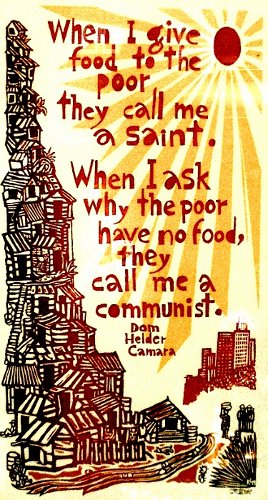
In order for these more systemic changes to take place we need to have a serious public conversation about hunger and food justice. If then, we are serious about eliminating hunger in our community we need all those who do the food charity work to support and endorse food justice work. Food justice work may not be as popular and it is in many ways work that is much more difficult to do. In fact, we can count on systems of power that will resist those efforts, but I for one think it is a much nobler goal to end hunger than to perpetuate its existence because we didn’t ask why people were hungry. As the great Brazilian Bishop Dom Helder Camera once said, “I brought food to the hungry and people called me a saint. I asked why people were hungry and people called me a communist.”
 Grand Rapids Institute for Information Democracy