More taxpayer money goes towards Urban Market Project
On Wednesday, MLive published a brief update on the proposed $27 million urban market that is slated to be built on Ionia Avenue.
Originally, the Urban Market planned on rehabilitating the old Sonneveld building just south the Wealthy St. overpass, but now the building, along with 6 others, will be demolished to make way for the new Urban Market project.
The MLive story does not specify which buildings along Ionia Avenue will come down, but they do identify it will be between Wealthy and Logan.
This is the latest twist in the ongoing coverage of the development of this urban market concept that has been evolving since 2009 when it was first proposed.
According to the MLive story the Downtown Development Authority (DDA) has applied for a $1 million grant from the DEQ for demolition, which is in addition to a recent $4.5 million grant from the Michigan Economic Growth Authority. At a Grand Rapids City Commission meeting in September the City approved the use of “water funds” for other improvements related to the market.
The funding mechanism appears to be changing over time and those behind the market continue to get funds from a variety of taxpayer-financed sources. Despite the high level of taxpayer funds being used in this project, the public has had virtually no say.
Minutes from the September DDA meeting provide us with some details on where some of the funding will come for this project:
- DDA would continue to own the property
- DDA would lease property to Urban Market Holdings, LLC (UMH) for 99 years
- UMH would rescind its request for development support from the DDA
- DDA would retain assets if the market ever failed
- Tax Increment from the project would be used to: Pay for street improvement to adjacent streets; Reimburse UMH for eligible redevelopment costs; Planned street improvements include street, utilities, street lighting, streetscape, putting Consumer Energy lines underground
- Ionia Avenue and Logan Street will be bring and McConnell Street will be asphalt
- Street improvements would be financed: Issuance of bonds payable over 20 years, UMH cash, DDA cash, and Grants; Bonds to be issued by the Brownfield Redevelopment Authority; Priority for bond payments using Tax Increment Revenue.
- An amount budgeted annually by the DDA for 20 years – $75,000 per year
During that September 2011 DDA meeting, DDA member John Canepa could not vote on these matters since he is on the board of Grand Action, the private group behind the urban market plan. In addition, another DDA member, Kayem Dunn, had to abstain from voting on this matter since she also sits on the board of the Urban Market.
These conflicts of interest reflect how interlocking systems of economic power work, something we pointed out in a previous article about the Urban Market. (another look article) Unfortunately, the commercial media has not focused much attention on who is behind this project and who will be the primary beneficiaries.
Instead, the local media coverage has mostly focused on how this project will be a benefit to the ongoing development of downtown. There is no doubt that this project will be a tremendous boost for downtown development, but the question that journalists should be asking along with this is, “who benefits with this development?”
Looking at a Grand Action document, we can see who the likely beneficiaries of such a project will be. They state:
The core of the Urban Market will be 16-20 vendor stalls that house independent, owner-operated businesses featuring a wide range of local fresh and prepared foods. These stalls have been designed to maximize food production within the Market, such as bread baking, butchering and sausage making, cheesemaking, ice cream/candy making, and pasta production. The tenant mix will also include produce, seafood, flowers, and a variety of ethnic foods. Tasting rooms for Michigan wineries and beer makers will complement several restaurants that feature Michigan food and drink.
So, ask yourself, who do you think will be spending their money at this urban market? One demographic that is not likely to buy food at the urban market will be people who live directly east and southeast of the 400 block of Ionia market location. The residents of this area are disproportionately Black and Latino with limited income levels and are not likely to purchase expensive cheeses or visit the wine tasting rooms.
The upscale aspect of the urban market will be in sharp contrast to what residents of the neighborhood I am describing have been accustomed to for decades. The only places to buy food in the immediate area are Family Dollar, various fast food establishments and convenience stores/gas station with a very limited amount of fresh produce. This area of the city could be classified as a food desert and the introduction of fresh food options is a good idea in principle. However, it would be naïve for people to think that low income and working class minorities will be frequent visitors to a market that has been described by the downtown power brokers as “tourist attraction” that would be “Disneyland like.”
Grand Action states in their background paper on this project, “To address the exploding youth obesity epidemic, the Urban Market will provide hands-on opportunities for kids to be involved with every aspect of planting, harvesting, preparing, and eating healthy foods, including the country’s first teaching kitchen designed specifically for elementary school-aged children.” On the surface this sounds noble, but the question is, will the parents of these children be able to afford and feel comfortable buying food at such a location?
The new urban market will likely target urban professionals who live in or near downtown Grand Rapids and potentially some of the residents in the Heritage Hill neighborhood. There will be others who make the urban market a destination that might be incorporated into other downtown activity, but those activities disproportionately attract a more upscale, racially homogenous crowd.
An additional concern with this project should be to ask whether or not it will gentrify the neighborhoods east and southeast of its Ionia location? As someone who lives in the neighborhood just east of the urban market location it seems that this project adds to the gentrifying nature of the downtown expansion that will negatively impact the poor communities of color that have been my neighbors for the past 27 years.
Community Stops Local Immigrant’s Deportation: Calls for Deportation Relief for More Families
This article is re-posted from the Alliance for Immigrants Rights & Reform in Michigan. GRIID was pleased to receive such news, both because it speaks to the power of direct action and because it means that there are plenty of people who support immigrant rights and immigration justice.
On Tuesday, Ann Arbor immigrant Lourdes Salazar learned that her December 27th deportation had been postponed for one year through Deferred Action. She will remain in the country to enjoy Christmas with her family in the United States.
Lourdes came to the United States in 1997 with hopes of creating a better life for her family. She is the mother of three U.S. citizen children ages 13, 9, and 7 who need Lourdes to stay in the United States with them. Lourdes’ husband was deported back to Mexico in 2010 leaving Lourdes as the only parent these children have.
Lourdes is extremely happy that she has been granted deferred action. “I want to thank everyone who has signed my petition, made phone calls and sign onto letters of support. This experience has taught me so much. I want to teach others about my struggle so that they can learn how to stand up for their families. No one else should have to go through what my family is going through.”
Efforts to stop her deportation included the support of various local and national advocates including the Washtenaw Interfaith Coalition for Immigrant Rights, the Social Work Allies for Immigrant Rights, Dreamactivist.org, Alliance for Immigrants Rights – Michigan, Migrant Immigrant Rights Advocacy, Immigrant Rights on Campus, St. Francis of Assissi Catholic Church, Michigan Immigration and Labor Law Association, and St. Mary Student Parish Catholic Church.
Lourdes would like to thank the 2,500 supporters who signed onto her petition, and the letters of support from the Ann Arbor County Commission, Senator Levin, Congressman Dingell, the Jesuit Provincial of Chicago-Detroit, and the Bishop of Lansing.
“Although we are very happy that Lourdes has been granted deferred action and she will get to spend a wonderful Christmas with her family, we want to push on President Obama to implement Prosecutorial Discretion for all those families that did not get Lourdes’s support and will spend this Christmas separated from their loved ones.” Priscila Maritnez from the Alliance for Immigrant Rights.
In an announcement on August 18, 2011, Secretary Napolitano stated the Administration would instruct Immigration and Customs Enforcement to suspend the prosecution of non-criminal immigrants with long-standing ties to the United States, especially in cases involving families. Lourdes has been in the country for 14 years, has three US Citizen children, and a U.S. citizen brother who has applied to fix Lourdes’ immigration status.
Social Justice Training opportunity begins in January at GVSU
Last year GVSU launched its first social justice training — Change U: Training for Social Justice. The community response was overwhelming. This program impacted West Michigan by fostering community collaboration and movement building right here in our towns and cities. 
Change U brought community members, faculty, and students together to explore the importance of solidarity. Over 100 people were a part of these successful trainings and have since begun to utilize their new skills and knowledge in West Michigan communities to create effective and collaborative justice groups. GVSU invites you to join our Change U community and continue on your path to create change!
Grand Valley State University is hosting Change U: Training for Social Justice again this year in the winter of 2012. The purpose of Change U is to further strengthen social justice movements on and off campus by fostering cross-issue, intergenerational, and diverse partnerships between the GVSU community and social justice efforts throughout the area.
The four-month training will look at how issues such as racial and economic justice intersect with issues such as gender and disability justice. Participants will have the opportunity to learn concrete skills and strategies from a diverse team of trainers, including nationally recognized leaders in social justice movements, who specialize in multi-issue and cross community organizing. Participants will also develop skills enabling them to have an institutional analysis as well as the capacity to develop strategies and tactics to respond to institutional oppression. These trainings will build community, develop capacity and support movement building here in West Michigan.
Community members in West Michigan, as well as Grand Valley State University students, faculty and staff are invited to apply to participate in this social justice training series. Pursue your passion to create change in your community, join the revolution.
Availability is limited, so visit http://www.gvsu.edu/socialjustice/ for more information and to fill out an application today to ensure a spot. The social justice training session begins the second or third week of January, depending on which sessions you sign up for.
Sign the Petition for the Repeal of Snyder’s Emergency Manager Law
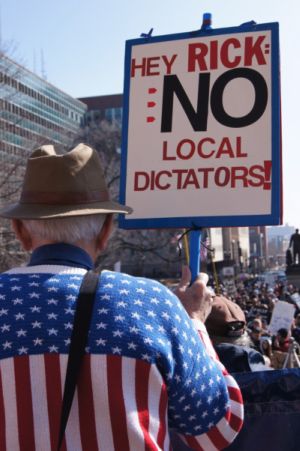
Michigan Forward is arranging for an allied group of labor organizations, civic leaders, and community organizations across the state to collect signatures for the repeal of Public Act 4, Snyder’s law that allows the state seizure of city and school assets, the firing of elected officials, the cancellation of union contracts, and the privatization of public services such as water and sewage.
Grand Rapids is one of the cities that will have a signing station with petitions.
Petitions have been circulating for months, and Michigan Forward is nearing its goal. If the required number of signatures can be submitted by the deadline, Public Act 4 will be suspended until it can be voted on by the people of Michigan. The law would revert back to the previous version of emergency management, which has many more checks and balances and does not give sweeping powers to appointed managers.
In Grand Rapids, you can sign on petition on Saturday, December 17, and Sunday, December 18 at:
Teamsters Local 406
3155 Eastern Ave SE
Grand Rapids, Michigan 49508
Phone: (616) 485-3024
Special Office Hours: Noon – 3PM
Help put a stop to Snyder’s seizure of assets and control of local governments and school systems. Make a point of stopping by between noon and 3PM on either day to sign the petition, and help push this repeal into the hands of Michigan residents. Your signature is a holiday gift you can give to our community and citizens across the state.
Image from Lansing Online News
Films as Commercials: Product Placement in 2011 Movies

Last week I heard a radio commercial that was a cross promotion for the new Mission Impossible film and a local BMW dealer.
The cross promotion wasn’t just a coincidence, since BMWs are featured in the new Tom Cruise film. The radio spot was not only encouraging people to head to the theater to catch the fourth installment of Mission Impossible, they were letting people know that the local BMW dealer would be present at the theater to promote their cars.
This kind of marketing of films is becoming more commonplace as Hollywood producers are using product placement as a means to generate addition funds for film production. Even the new Twilight film features products and brands such as Apple, Belstaff, Crest, ESPN, HTC, LG, Pepto-Bismol, Rainier, Volvo and Yahoo. After all, vampires are consumers too.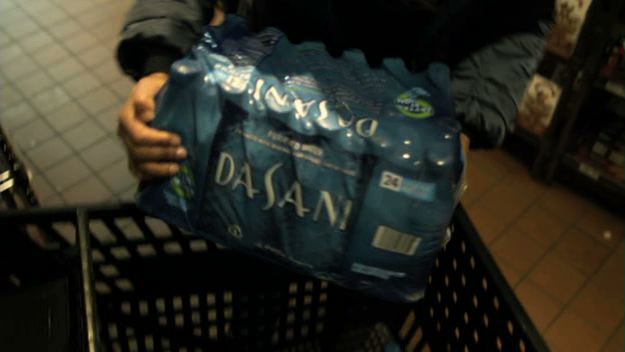
Basically there are two kinds of product placement in Hollywood films these days. First, you have films where products are used as merely background items, used by main characters or sometimes even named by characters. A film like Contagion contains 44 different products or brands – Audi, BBC, BMW, Bud Light, Centers for Disease Control and Prevention, Chevrolet, Citibank, CNN, Coca-Cola, Dasani, Dell, Delta, Dole, Facebook, FEMA, Geico, Kellogg’s, Kellogg’s Corn Flakes, Lenovo, Lumix, Lysol, Mazda, Medex, Mercedes, Minnesota Department of Health, NBC, Panasonic, Purell, Rayovac, Red Cross, Rimowa, Samsung, Sony, Sony Ericsson, Sperian, StarKist, Taco Bell, The North Face, Twitter, USA Today, Vicks, World Health Organization and YouTube.
However, no one product or brand are dominant in the film, not do they become integral to the plot in any significant way. These products and brands are presented in such a way that normalizes their use in our daily lives without beating us over the head with obvious intent. For instance, one character is told to leave town because of the deadly virus and is seen in a store buying items to take with her on the road, items such as the Dasani brand of bottled water.
Other movies such as Limitless (24), Battle Los Angeles (19) and the Green Lantern (18) also include a significant number of products/brands, but none of them are integral to the plot or overtly presented. However, with superhero films like the Green Lantern (Dos Equis, Miller, Pabst, Guinness, Harper Lager), Thor (Budwesier) and Captain America (Cornona), each of the superheroes either consume branded beer or beer logos are prominent. This is a not so subtle way for beer companies to normalize the consumption of alcohol to the underage audiences that consume these movies in high number.
Then there are the films where the products/brands are more woven into the plot, where characters not only use the products, they discuss them and utilize them in very overt ways.
The Transformers franchise is not only based on Hasbro toys, but the each of the three films has been 2 – hour commercials for Chevy vehicles.
There are numerous other products/brands presented in Transformers: Dark Side of the Moon, such as NASA, Waste Management and Fox News, but it was another car that stood out in terms of overt product placement. The girlfriend of the main character gets a Mercedes from her boss, which is viewed online at one point and in another scene she slips into the $200,000 car. In the end, Transformers: Dark Side of the Moon was the absolute winner of most products/brands of films in 2011, with 69.

Another films that is loaded with product placement and brands is Hall Pass. In Hall Pass, 2 men are given permission from their wives to take a week off from being married. They go out with 3 other friends to a local Applebee’s to start their week of freedom. For several minutes the 5 men are in Applebee’s and at one point one of the friend’s says, “Are you guys sure that Applebee’s is the best place to meet hot, horny women at?” One of the men with a hall pass responds, “What are you thinking Olive Garden?” In fact, it is difficult to find a spot in the film where the characters are not using products or naming them, whether it is asking for Splenda in the coffee shop, eating Ben & Jerry’s ice cream in the hotel or talking about a friends Toyota Prius.

The last film worth mentioning that is riddled with product placement and brands is the Adam Sandler film Just Go With It. There are numerous sequences in the film where products and brands are front and center. Early on in the film, Sandler’s wife goes shopping in brand name stores such as Barney’s, The Gap, Louis Vuitton, Gucci and Old Navy.
In another scene in Just Go With It, Adam Sandler takes 2 kids out to eat at Pizza Hut, where the of the place is displayed prominently and a discussion happens with pizza and Pepsi being consumed during this sequence. There is another long sequence where the main characters all vacation in Hawaii and stay at the Waldorf-Astoria Hotel, where all sorts of products are consumed, including a scene where two characters are testing on Sony Ericsson phones. All total, there are 51 products/brands used in Just Go With It.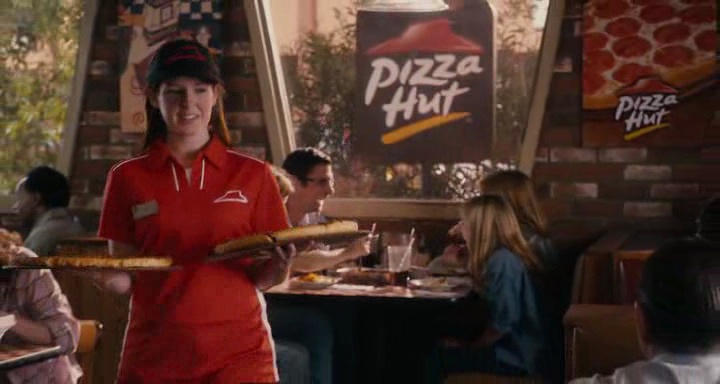
2011 may have broken all records for the use of product placement and brands in films and it speaks to the increasing level of hyper-commercialism in our culture. The increased use of products and brands in films is not only an assault on the public it is an insult to millions of Americans who are living in poverty and just trying to survive.
For more information on Product Placement in 2011 films go to http://www.brandchannel.com/brandcameo_films.asp. Also, check out our 2010 film study or product placement and other films themes.
The most recent issue of MiBiz included one of their quarterly publications known as MiEnergy. The insert consisted of a look at what the editors named Michigan’s Top Energy Projects of 2011, along with ads for “energy companies.”

The insert begins with comments from the publication’s managing editor Joe Boomgaard who says, “The MIBiz editorial team, with input from energy insiders, developed a list of 10 energy developments taking shape in 2011.” Unfortunately, the editorial staff didn’t provide any specifics on whom these “energy insiders” are.
The first two projects identified were a wind energy project in Gratiot County and a proposed project in Holland, MI. The two short articles identify how wind energy production is on the rise around the state. Unfortunately, the article doesn’t address clearly what all the energy is being produced for, but it is clear that it will primarily benefit private companies like Consumers Power. The only person sourced in the article is from GVSU who states, “This is a multimillion or even multibillion dollar business opportunity in terms of sales, manufacturing value and economic development for the area.”
A third project identified is the new battery production facilities in Holland and Muskegon, in order to meet the “demand” for electric vehicles. We have addressed the flaws in this production in a previous article, where we point out the unsustainable nature of such production.
There are additional articles on some test cases for a smart grid in Grand Rapids and an article about US Department of Energy grants going to GVSU to do more research on the viability of wind energy generation and its impact on wildlife. The DOE gave $1.4 million in grant money, which was matched by $1.33 million coming from the State of Michigan. In neither of these articles is there any discussion about the need to reduce the energy consumptions by both the private and public sector, thus adopting a mindset that believes that we can continues to consume energy at an increased level without much concern, since it will be “renewable energy.”
This perpetual growth mindset is also reflected in an article about the growth of car battery charging stations around the state and another article that touts bio-fuels as a solution. The bio-fuels article presents the idea that we can produce an adequate amount of agriculture-based fuel, even though that a great deal of research has shown that bio-fuels are not a viable solution, particularly because of the impact it is having environmentally and socially, causing a serious rise in food prices globally.
Another story features the energy efficient steps that the Van Eerden Foodservice Company has taken at its Grand Rapids warehouse. While energy efficiency is generally important, this narrow view of the context is misleading. Van Eerden is a food distributor. They don’t focus on locally grown foods, rather they participate and profit from an agri-business food system that is extremely damaging to the environment and is heavily dependent on fossil fuels. Highlighting their decision to make the warehouse space more energy efficient, a warehouse that stores food from the agri-business industry, doesn’t really promote energy efficiency.
One last article is about a project called the Better Buildings for Michigan initiative, which is a two-year, $30 million state program funded from tax money. Part of the project is designed to provide energy audits to homeowners, but there is no indication if money will be provided to help people upgrade their homes to be more energy efficient.
The business press insert not only takes a superficial look at energy issues it presents primarily energy projects that will primarily benefit the private sector. Not surprising considering the source, but many of these projects are also being embraced by more liberal sectors of society and environmental groups that are only interested in mildly reforming the system instead of creating a new system.
The most interesting omission from this insert is the lack of any larger context on energy issues and its relationship to global warming. How can such an analysis be excluded, especially on the heels of the dire warnings coming from civil society after yet another failed Global Climate Summit? One major reason for the omission is that the insert was 50% ads by energy companies and business associations, which are positioning themselves to be the beneficiaries of most of the new “energy projects” featured in the insert.
Holiday Movies with Meaning
It’s almost Christmas, and every time you turn on the TV, there they are: the holiday movies that threaten your blood glucose levels with their syrupy scripts and relentless cheer. Or worse, movies that cheer on consumerism and Yuletide greed. If you feel you’ll scream if you see a single scene from It’s a Wonderful Life or Deck the Halls again, try one of these films instead. They offer a dose of reality, a change of pace, and some genuine substance. The Grand Rapids Library system has copies of some of the films featured here.
Frozen River
Two women, one White and one Mohawk, share a single problem: poverty. Melissa Leo plays Ray, a single mother desperately trying to make the last payment on a mobile home. Her gambler husband left her, stealing all of her savings. If she can’t come up with four thousand dollars by Christmas, she loses everything. Lila, played by Misty Upham, is trying regain custody of her child but is in trouble with the tribal police.
They team up as smugglers, transporting goods in terrifying trips across the frozen St. Lawrence between New York State and Quebec. But what Ray and Lila don’t know when they accept the job is that the illicit goods are human—immigrants who are entering the country in the vehicles the women drive. These two have already tried everything legit to get their lives on track. In the constant rejections and humiliations they face, you see the whole story of what it means to be a working class American today. But in this job the risks become more formidable with each trip they make across the frozen river.
One of the best features of this movie is its realistic portrayal of the Mohawk Nation and culture. These Indians aren’t ennobled or demonized; they are just people carrying on as best they can. And Melissa Leo’s Oscar-winning performance as Ray is unforgettable. This is a Christmas movie about class inequity and the desperation of poverty. But it also shows how Ray and Lila never lose track of what’s truly important. They hang onto their integrity—even when it seems like a luxury they can’t possibly afford.
The Holly and the Ivy
Made in the early 1950s, The Holly and the Ivy was a startling film when it was released, and it still has power to move viewers today. Amidst the hypocrisy of the Fifties and the ghosts of World War II losses, this film dared to portray a family with serious problems—and a vicar’s family at that.
Sir Ralph Richardson plays an Anglican priest whose grown children return home for Christmas. Each of them has a grudge against their saintly father. Jenny wants to go to South America with her lover, but feels her father, a widower, would be lost without her. She wants her other sister, Margaret, to take over as her father’s caregiver. But Margaret has a secret she’s hidden from the family, certain that her minister father would never forgive her for it. She’s also becoming an alcoholic in an effort to forget her past, and in one scene passes out on the floor during a Christmas Eve gathering. Their younger brother, played by Denholm Elliot in one of his first film roles, is hostile and angry because he knows Margaret’s secrets and feels he can’t be honest with his father to try to fix things.
Today, this film may seem more mainstream, but when it was released, it was shocking in its frank portrayal of defiance of authority, the hypocrisy of conservative Christian values, and its lessons about how concealing the truth undermines relationships. This is one of Richardson’s best performances. He portrays someone who put so much zealous effort into his work that he neglected the needs of his own children. His remorse on finally realizing that is wrenching to watch.
The great Irish stage actress Maureen Delaney as the vicar’s plain-speaking sister is an acidic foil to the rest of her clammed-up and overly polite family. The Holly and the Ivy is shown every Christmas in the UK, but it’s hard to track down here in the States. It’s worth the effort if you can find it. 
Babette’s Feast
If an artist is unable to create, is that person still an artist? It’s the central question of this simply told tale, set just before Christmas 1885 in Denmark’s remote coastal region of Jutland. We learn that years ago, two daughters of a seemingly benign but actually repressive and selfish minister were prevented from marrying their suitors. Years later, both men play parts in the aging sisters’ lives. One sends a refugee their way—a Paris Communard whose revolutionary activities have put her life in danger. The other suitor returns at the very end of the film to attend a holiday dinner party held in honor of the departed minister’s 100th birthday.
Babette, the Frenchwoman who found shelter working as a servant in Denmark for the two sisters, begs them to allow her to cook a “real French dinner” for the party. She has just won the Paris lottery, and asks to pay for the feast herself. At first, the viewer thinks this is a charitable gesture, but in fact Babette wants no constraints on her vision for the meal. For, as it turns out, she had been the head chef at Paris’s most celebrated restaurant—an unheard-of position for a woman of the time. And after all the years of cooking ale-bread and dried fish fillets for her Danish employers, she longs to express herself again as a chef and an artist.
Babette’s Feast offers profound subtexts. The two sisters and their church members sing a hymn which says no father would give a stone to his hungry child—but that’s exactly what their father has done to them. They are shadows of the adults they might have been had they not been chained to his ambitions. Babette is deprived in another way—bereft of her husband and son, revolutionaries who were executed as the Paris Commune collapsed, she has been wrenched away from her life’s work. But she allows herself for one night to be the person she once was.
When the sisters discover that Babette has spent all her lottery money on the meal, they are horrified that she is once again poor. Babette says simply, “An artist is never poor.” The holiday gift all three main characters receive is finding they still, despite everything, can share in the transforming power that great art brings to those who encounter it.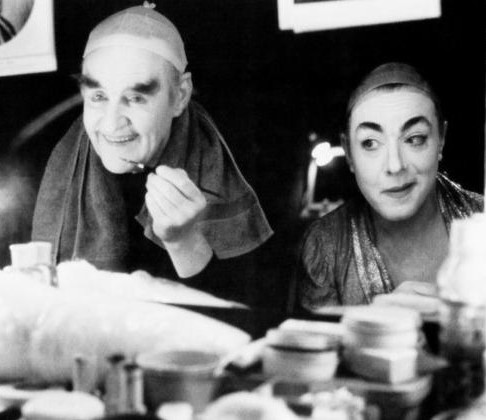
A Midwinter’s Tale
In the 1990s, Kenneth Branagh directed a game-changing, four-hour-long version of Hamlet which did not receive much attention in the States. But A Midwinter’s Tale, which he wrote as an antidote to all of the headaches he endured while directing his epic Hamlet, shows how the production nearly drove him insane.
A Midwinter’s Tale opens with Joe Harper, an out-of-work actor, explaining how he decided to direct a cooperative ensemble version of Hamlet: “It was late November, I think, and I was thinking about the whole Christmas thing: the birth of Christ, the Wizard of Oz, family murders—and quite frankly, I was depressed.”
During the course of the two weeks’ of rehearsal, leading up to the actors’ Christmas Eve debut, a testy bigot is forced to room with an openly gay actor. The gay man is grieving over rejection from his son, the product of his one and only heterosexual encounter. A former child actor is desperately trying to cast off his fame so he can play adult roles. An alcoholic struggles with his addiction. A gun-shy costume designer tries to regain her artistic confidence. Joe’s witch of an agent hounds him over the telephone on a daily basis. And, as Joe’s sister points out, selling Hamlet as a Christmas play to the locals is not going so well. (“Hello, kids…come and watch a four-hundred-year-old play about a depressed aristocrat.”) Branagh’s use of social issues such as consumerism, substance abuse, and prejudice against LGBTQ people is direct and pointed.
It could have been cheerless, but in the hands of Branagh and his script, this is one of the funniest films I’ve ever seen. Michael Maloney is hilarious as the distracted director who doesn’t even have time to rehearse his role as Hamlet because he’s soothing egos, playing referee, and begging the designer to present her set and costume designs—which she can’t force herself do until the last rehearsal. John Sessions is campy, caustic, and heartbreaking in turns as the gay actor who is cast as Queen Gertrude (“I travel with my own tits”). Richard Briers, Julie Sawalha, and Nicholas Farrell are equally wonderful.
As you watch this group of actors work through their problems and prejudices to find ways to accept each other, you realize you’re watching a version of a dysfunctional family at Christmastime. And the fact that they communicate with zingers worthy of Monty Python makes it all the more enjoyable.
Millions
It is days before the UK changes its currency from pounds to Euros. Main character Damian explains, “The French have said au revoir to the franc, the Germans have said auf wiedersehen to the mark, and the Portuguese have said… whatever to their thing.” People are madly exchanging the soon-to-be-worthless pounds into Euros, and doing quite a bit of compulsive holiday shopping as they do.
At this end-of-an-era moment, Damien is hit with a bag of money falling out of sky, a bag containing hundreds of thousands of pounds. Bank robbers have tossed the bag off a train, and it lands on Damien’s playhouse. And so begins the dilemma of the film: what should happen to the money next?
As it happened, director Danny Boyle jumped the gun on this film: the UK backed out at the last minute and decided to keep the pound sterling as its monetary unit. But that doesn’t detract from the message of the movie: that money is a toxic substance which changes people in unpredictable ways, and usually for the worse. Funny and moving in turns without resorting to sentimentality, this film is filled with surprises. Everyone—from Damien’s brother to his father to the bank robbers to the Mormon missionaries down the road—have plans for the cash.
But only Damien understands there is a difference between want and need…and he’s the one who finds the best possible end to the conflicts that his windfall have created.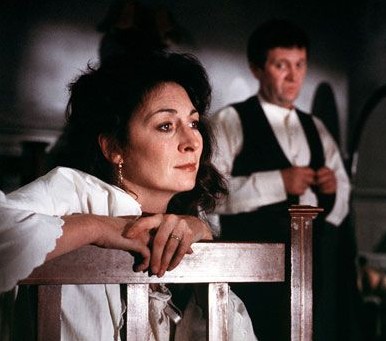
The Dead
The setting is Dublin, at the turn of the 20th century, on the twelfth day of Christmas. Beneath the proper, polite holiday party attended by a professor and his wife, you can feel the tension of a place that is about to explode into revolution. The Irish have had enough of their subjugation by the British, and although the hostess forbids political discussion at the dinner table, hints of the emerging rebellion are everywhere.
Gabriel Conroy, nephew of the party’s hostess, and his beautiful wife Gretta participate in the dancing, music, and pre-dinner festivities. It gradually emerges that Gabriel, with his allegiance to all things English, feels some disdain for his wife and his family, who are wholly and traditionally Irish. And he seems unable to communicate with Gretta—a shortcoming which brings about his shocking epiphany, when he suddenly understands that she never really loved him. “How poor a part I’ve played in your life,” he thinks, watching Gretta fall sleep. “It’s as if we never lived together as man and wife.”
Joyce intended this alienation to symbolize the chasm between the cold, distant British and the passionate people of Ireland. As with all of his short stories, this one, his most famous, is built on a foundation of political commentary.
The Dead was director John Huston’s last film. It stars his daughter Angelica, with his son Tony creating the screenplay. That may account for the familial intimacy of this short film. You feel you truly are a member of this family, attending a party and watching as one era slips away and something more authentic stands ready to replace it.
Occupy Local Radio
Ok all you Michiganders. In 2012, all radio stations in Michigan must renew their licenses with the Federal Communications Commission (FCC).

Since the 1996 Telecommunications Act was passed, all radio and TV stations are only required to renew their broadcasting license every eight years. It use to be every year and then every three years, but with ongoing deregulation of the broadcasting industry it is now only every eight years.
It is rare that the FCC has not re-issued radio or TV licenses, but this does provide the public with an opportunity to challenge whom broadcasters ultimately serve.
The radio landscape in the Greater Grand Rapids area is pretty bleak in terms of both music and news/information. If you like classic rock, modern country, pop, easy listening, and classical music then you might be happy with what options are available on local radio. However, if you are looking for good hip hop, rap, international music, R & B, Gospel, punk rock and indie rock, chances are you will be thoroughly disappointed when going up and down the digital dial.
The only station that plays music from local musicians is WYCE, but hearing local music on that station is still the minority of the time. In fact, local radio is somewhat of a joke in this city, like most cities across the country.

One of the main consequences of the 1996 Telecommunication Act was to allow companies to go from owning no more than 3 stations in any given market to owning up to 8 stations in any given market. This essentially killed the idea of local radio. A company like Clear Channel went from owning a few dozen stations in 1996 to now owning a few thousand. Clear Channel then wasted no time downsizing staff at local radio stations, automating radio broadcasting and choosing from a much smaller list of music. Anyone who drives cross-country will tell you that you will hear the same songs played all day long across the country. Contrary to the first MTV video by the Buggles, video did not kill the radio star, media ownership deregulation did.
This consolidation of ownership also drastically impacted local news/information on radio. Again, downsizing of staff meant less local radio news is being produced and it has been replaced with syndicated talk shows. In Grand Rapids that means on WOOD Radio you get 3 hours every Monday through Friday of Glen Beck, Rush Limbaugh, Michael Savage, Sean Hannity and Dave Ramsey. That’s 12 hours of hate speech and misinformation 5 days a week and 3 hours of money management advice.
Change the channel you say. Well, the other stations give you more of the same, a liberal version of the syndicated talk shows, plenty of Christian programming, more sports than anyone could possibly listen to and just a sliver if independent news/information by tuning in to Reality Radio in Grand Rapids. Sure there are a few local NPR affiliates, but WGVU does little local news programming and the Michigan Radio station in the area has one reporter who covers all of West Michigan.
So what can be done? First, we can all file formal complaints to these stations by sending either an e-mail or regular mail that they are required to put in their public files. The amount of letters and their content could sway the FCC to not renew broadcasting license.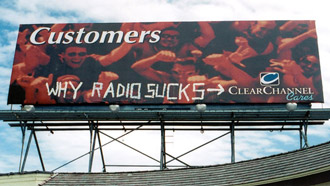
Second, get the ALCU to file a lawsuit against these stations for violating your first amendment rights. Since most people do not have access to these airwaves, which are public, we do not have the capacity to communicate with hundreds of thousands of our fellow citizens. This tactic was used by racial minorities in the 1950 and could be used again.
Third, groups of people based on religious beliefs, race, national origin or sexual orientation could begin to demand that their communities have a regular slot on local radio stations…..say at least an hour a week to share information specific to their community needs and interests. What do you think would happen of a group of Native Americans went down to Clear Channel’s offices or WGVU or WJRW and said they want their own radio show?
Lastly, what if members of the public in general or Occupy Grand Rapids decided to occupy the radio stations in Grand Rapids and demand that they actual serve the vital interests of this community, particularly those of working people and not the advertisers and owners of the stations? Who knows what would happen, but it would be fun to try and maybe, just maybe, we might have democratic control of the radio stations in our community.
Occupy GR brings attention to Levin initiated repressive legislation

Late Wednesday afternoon, a small group of people involved with Occupy Grand Rapids held a protest in front of the federal building in downtown Grand Rapids.
In addition to holding signs for nearly two hours as motorists and pedestrians went passed, three members of the group attempted to go inside and talk with Senator Levin’s staff. They were denied entry because the Senator’s office was, “conducting interviews and would not be able to meet with anyone.”
Michigan Senator Carl Levin, along with Senator John McCain, introduced legislation (National Defense Authorization Act) that would allow “the military to pick up and imprison people, including U.S. citizens, without charging them or putting them on trial.”
Senator Levin has denied that such legislation would allow the military to imprison US citizens without charging them or putting them on trial. Levin is the current chair of the Senator Armed Services Committee.
Here is a short video where two members of Occupy GR speak to why they were protesting Senator Levin today.
Occupy Grand Rapids produces first zine, continues occupation
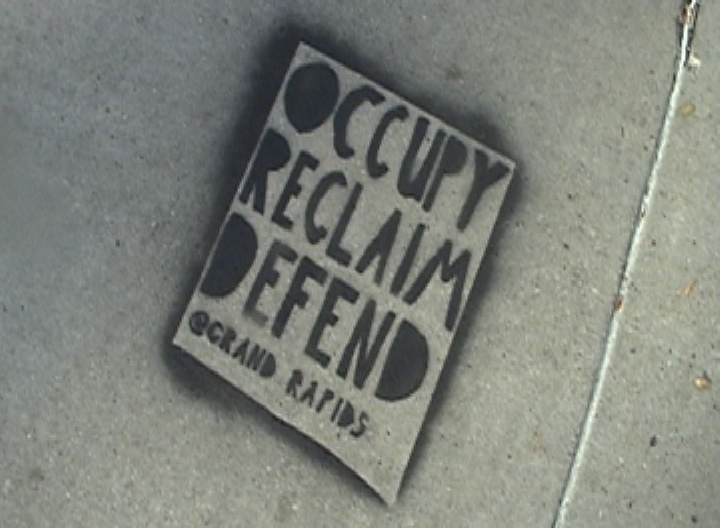
Despite the lack of much news coverage, Occupy Grand Rapids still exists and continues to do important work.
Some people are still sleeping outside at Fountain Street Church, while others are having a regular presence at Monument Park on the corner of Fulton & Division. They are having formal rallies every Wednesday (4 – 6pm) and Saturday (2 – 6pm).
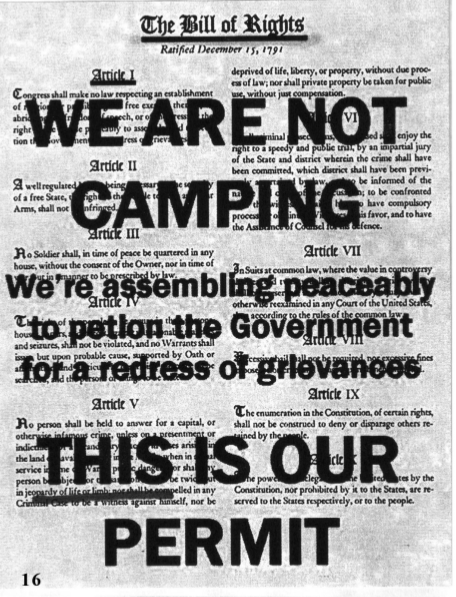
Occupy Grand Rapids is also having General Assembly meetings three days a week (Sunday 2pm, Tuesdays and Thursdays 6pm) to provide a forum for discussion and direction that the local occupy will take. General Assemblies are held at the base camp, which is outside of Fountain Street Church near the north side entrance.
In addition, some people involved in Occupy GR have produced a zine called the Occupocalypse, which can be downloaded or obtained at the Occupy GR base camp and gatherings at Monument Park.
The 20-page zine is very visual, with great images and content that speaks to the aspirations and vision of those involved.
Lastly, the Occupy GR wiki site also has a calendar so you can keep up with a new actions planned, follow the General Assembly meeting minutes and find any new resources that are available.
 Grand Rapids Institute for Information Democracy