We Live in a White Supremacist Apartheid System: Tim Wise addresses racism at Grand Rapids forum
Yesterday, the Partners for a Racism-free Community (PRFC) held their annual conference on racism in Grand Rapids.

PRFC, formerly known as the Racial Justice Institute, is a faith-based entity that seeks to educate the community on racism and diversity and seek solutions to make Grand Rapids a racism free community.
The keynote speaker for this year’s forum was nationally known anti-racist author and activist Tim Wise. Wise became an anti-racism organizer while in college in the 1980s and working on the campaign to end racial apartheid in South Africa. Wise has written numerous books on the topic of racism and White privilege, the most recent being Dear White America: Letter to a New Minority.
Wise began his talk by addressing the importance of having a collective conversation about race and racism. He stated that it is a difficult discussion, particularly for racial minorities, who often, after talking about their experiences of being discriminated against, are easily dismissed or marginalized by White people.
Wise then goes on to say that for White people, the difficulty of having these conversations in the presence of people of color is that they will worry that their comments will be misunderstood. Thus, many White people will become silent for fear of saying the wrong thing. This silence, Wise says, will only affirm to people of color that White people have something to hide about racism.
Wise then made it clear that in the next 25 – 30 years White people will no longer people the majority. This means that as a future minority White people might want to start changing their attitudes about racism, particularly institutional racism.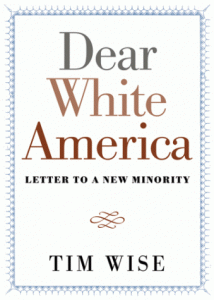
The next point that Wise wanted to make was that just because we have a person of color in the White House, it does not mean that the condition of the vast majority of people of color has improved in any meaningful way.
Wise then made some cracks about the Tea Party, which got a loud applause from the audience. However, Wise went on to say that Liberal and Progressive sectors of this country are equally unwilling to seriously confront the problem of racism in the US.
In fact, Wise went on to say that Barack Obama is even unwilling to address the problem of racism in the US. He even cited a comment from Obama in his 2004 Democratic Convention speech where he said, “there are no Black Americans or White Americans, nor Latino Americans, only Americans.”
Wise called this a blatant lie by Obama and a lie that the then Senator from Illinois was well aware of. Wise says that just a few months before that 2004 speech there was a report from MIT that demonstrated serious job discrimination across the country. A few months after the speech the Justice Department came out with a report on the disparity of racial profiling by law enforcement, where people of color are pulled over 3 to 4 times more often than White people.
He went on to point out that the War on Drugs is not about drugs, it is about race. This is another issue that Obama will not address, even as the President of the United States.
Wise then went on to address the current economic crisis and said that we have all been led to believe that the Wall Street financial collapse was not about race. Wise said that every major financial institution implicated in the Wall Street crash was White, but we are supposed to believe that race had nothing to do with it? He said, “imagine if those people were Black. Do you think that their ethnicity would have been a topic of conversation?” Wise said it wasn’t a topic of conversation for White people because we live in denial about racism and have so much privilege that it prevents us from having that kind of lens in which to view the world.
White Denial, however, is not a new thing, according to Wise. In 1962 a Gallop Poll, it showed that 2 out of 3 White people said that Blacks had just as many opportunities as White people did. White folks thought so because they do not have to know anything about the lived experience of Black and Brown people. In fact, Wise said the same thing is true in 2012.
Then Wise went on to name the kind of system that we live in today. He said, “we live in a White Supremacist Apartheid system and that this is the kind of phrase that we need to use when talking about this country if we are serious about the problem.”
During the Q & A Wise further articulated this point about a White Supremacist Apartheid System when addressing the issue of White being a racial minority in the US within the next generation. He did not mean that just because Whites will not make up a majority of the population they will stop holding power. Wise pointed out that during the height of South African Apartheid, Whites comprised of only 6% of the population. The White power structure will remain even if Whites are a minority in terms of numbers.
Wise also addressed the issues of meritocracy and objective inequality in the US. For example, the unemployment numbers in the US are astronomical, in part because of the economic crisis. Wise made it clear that we cannot overcome the economic crisis without coming to terms with the racial disparity within this crisis. For instance, we have double-digit unemployment for Whites, so now it is a topic. But people of color have had double-digit unemployment for decades. Again, privilege doesn’t let us see what we don’t want to see.
By way of wrapping up his talk Wise talked about the need for White people to give up privilege. However, he said that giving up privilege will be costly, but if we are serious about justice and solidarity it is absolutely necessary for White people to give up their privilege.
Racism in Grand Rapids
Besides the lecture by Wise, there were opportunities in the afternoon to go to breakout sessions. The session that this writer attended dealt with what Wise had to say and what it means for Grand Rapids.
About 60 people attended this session and on many levels it was quite instructive. First, virtually every person of color spoke about the harm they and their family members have experienced in Grand Rapids from racism. People talked about how their kids are treated in school, how the police engage in racial profiling, how the lack of opportunities and discriminatory practices from landlords, employers and teachers makes them not want to stay in town. In fact, one Black women said that when she finished a grant funded job she has right now she will leave Grand Rapids.
Another thread that was addressed had to do with what one woman called “Grand Rapids nice.” This notion of people be nice is really just another form of patrimony and it is a shallow way of dealing with the deeply rooted and institutional forms of racism. One woman summed it up well when she said, “Grand Rapids does charity real well, but not justice.”
I stated during this conversation that we did have a White Supremacist Apartheid system in Grand Rapids and that until we are willing to acknowledge this we cannot seriously address racism. Another person made the comment that there is a power structure that perpetuates racial and economic injustice and what we really need is a redistribution of wealth.
This breakout session clearly demonstrated that racism is deeply entrenched in this community. However, the facilitators did not lead people to a point of discussing concrete actions aside from the existing opportunities with PRFC, none of which really address institutional racism.
There are seminal events in US labor history and February 24, 1912 is one of them. On this day 100 years ago, police attacked women and children who were family members of those on strike.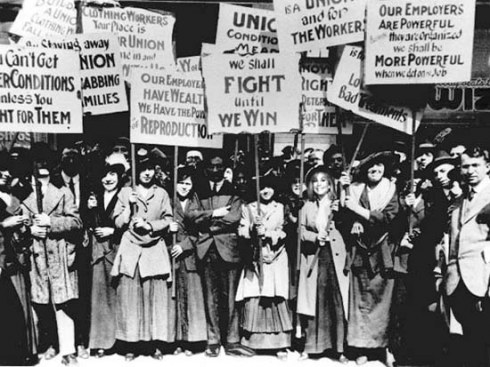
The police brutality was so overt that news of the repression spread like wildfire. People from all over the world heard about what the Textile owners were having the police do to workers and their families. Even the wife of US President Howard Taft came to investigate the repression, since the thought of women and children being beaten by police, was too much to bare for the First Lady.
The infamous Lawrence Textile Strike of 1912, however, was more than just a global outrage against police brutality, it was a major victory for organized labor.
Workers at the Lawrence factory had been enduring hardship for years, working long hours for little pay. Before the 1912 strike there wasn’t much of a union presence, with the AFL and the IWW the only two unions that had made attempts to organize the mostly immigrant workforce.
However, the economic conditions of workers had become worse at the beginning of 1912 because of a new law that reduced the amount of hours that women and children could work in factories from 56 to 54. While this doesn’t seem like a big shift, it made an impact because the textile owners speed up the machines so that they would not lose money with the shortened work week.
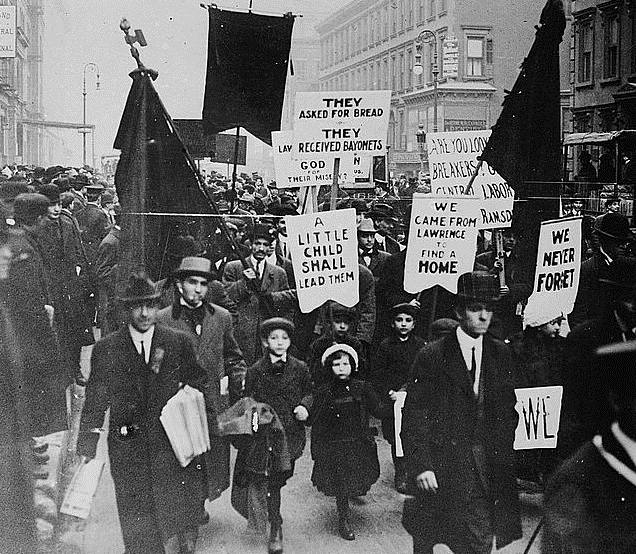
Workers were on average only making $3 – $7 a week and it was not enough to make a living off of. Such low wages for a 54-hour work week led to a strike that began in January of 1912 in Lawrence, Massachusetts. In addition, such low wages and poor living conditions led to Lawrence having an infant mortality rate of 172 out of 1,000. The economic and social desperation was the context for the 1912 strike.
Once the strike began the IWW began to aggressively organize amongst the immigrant workers, which was a challenge since there were at least seven different languages spoke by those in the factory. However, the IWW was up to the task and found organizers from each immigrant community that made communication a non-issue.
As the weeks went by the strike became more intense with intimidation and harassment being a daily response by the factory owners. The Lawrence Textile factory had 35,000 workers in 1912 and wasn’t about the lose money because of the strike. The company brought in scab workers, workers who were often attacked by strikers who resented the attempt to undermine the strike.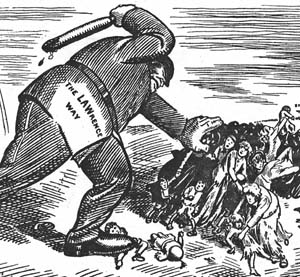
Conditions in the town became so dire that striking workers and the IWW proposed sending children and some women to other cities to live with relatives since the strike caused even greater hardship. The decision to send the children away was really made by the women workers, who made up the majority of the factory workforce. The famous IWW organizer Elizabeth Gurley Flynn stated during this strike, “The IWW has been accused of putting women in the front. The truth is, the IWW does not keep them in the back, and they go to the front.”
Once it became known that children were being sent away to live with other family members word got out across the country that the striking workers needed more solidarity. The famous reproductive rights champion, Margaret Sanger, even came to Lawrence to help with organizing the children who were put on trains. Children were leaving in groups of one hundred or more. This tactic of sending children away caught the attention of the factory owners and the local police who then began to harass the women and children who were going to the train station. It was in this context that led to the February 24, 1912 police repression, where parents and children arriving at the station were beaten with clubs, arrested and charges with “congregating.”
Shortly after this incident there was such a national outcry that the US Congress held hearings to determine what had happened. Again, the IWW organized striking workers to testify before Congress on the conditions of the factory, poor wages and the violence during the strike. Many adults gave testimony, but it was the testimony of the children that moved members of Congress to act. According to Sharon Smith in her book, Subterranean Fire: A History of Working Class Radicalism in the United States, “one 14-year old girl testified that she went on strike because ‘there wasn’t enough to eat at home.’”
Within a week the textile factory owners capitulated and on March 14 signed a labor agreement with the workers. The IWW union members were so delighted by the outcome that they began to sing the famous song, the Internationale in seven different languages.
The 1912 Lawrence Textile Strike and the organizing of women and children came to be known as the Bread & Roses campaign and will forever live on as one of the great victories for workers and radical union politics in US history.
The success of the labor organizing during the 1912 strike is important for several reasons. First, the IWW demonstrated that language and nationalist differences do not have to be a barrier to labor organizing. Second, it was critical that women were in leadership positions during the strike, something that none of the other industrial unions such as the AFL allowed at the time. Third, the success of the 1912 Lawrence Textile strike demonstrated that workers were receptive to the more radical message of the IWW, a message that stood in clear contrast to the business unions of the day. These are all lessons that are relevant for labor organizing in the 21st Century and should make the 1912 Bread & Roses campaign required reading for those wanting to organize workers today.

LGBT organizations and allies pressure Kent County on “Bag a Fag” policy

Earlier today several Michigan LGBT groups and allies sent a letter to the Kent County Commission as a follow up to a December action where people addressed the commissioners on the matter of the Sheriff Department’s unjust sting operations that target gay men.
Equality Michigan, The LGBT Network of Western Michigan, Holland is Ready, the Grand Rapids Community Relations Commission and Plymouth UCC all signed onto a letter, which states:
Dear Kent County Commissioners:
As you already know, there has been an effort on the part of the Michigan ACLU to meet with the Kent County Sheriff’s Department (KCSD) about unlawful sting operations.
The ACLU of Michigan believes that the KCSD is unlawfully targeting gay men at parks in Kent County in undercover sting operations that are both unconstitutional and ineffective.
(See link http://grandrapidslgbthistory.files.wordpress.com/2011/10/kent-county-gay-stings-letter-no-appendices.pdf)
We, the undersigned organizations, support the position of the ACLU of Michigan. It is our understanding that the ACLU has been trying to meet with the KCSD for more than 6 months, but they refuse to have a face-to-face meeting to discuss the policies and practices of the KCSD regarding this matter.
Our collective organizations represent thousands of residents of Kent County and we are asking you to take immediate action on this matter as lives are being ruined.
We will not rest until this matter is dealt with in a timely fashion, and we have confidence that you will take proper action to assist the ACLU and our organizations to ensure that this kind of discrimination does not occur in the future.
Please respond to this message immediately if you, 1) have questions, and more importantly 2) when you have taken the necessary actions. We await your response.
Respectfully,
Grand Rapids Community Relations Commissions
The Lesbian and Gay Community Network of West Michigan
Equality Michigan
Plymouth United Church of Christ
Grand Rapids Institute for Information Democracy
Rev. Bill Freeman
Connie Bellows
Thomas J. Ozinga
Colette Seguin Beighley (West Michigan Board Member — Equality Michigan)
Colette Seguin Beighley, a board member of Equality Michigan said of the effort,
If illegal sexual activity is occurring in Kent County Parks (Note: the ACLU Freedom of Information Act revealed NO public complaints), it would be helpful for the Kent County Sheriff’s Department (KCSD) to respond in a way that builds alliances rather than destroys lives.
Last summer when a similar issue arose outside Lansing, Ingham County Sheriff Gene Wriggelsworth reached out to local LGBT organizations and the Michigan Gay Officers Action League (MI-GOAL) to develop a community-based response vs. a law enforcement response. This successful intervention led to a request from the Ingham County Sheriff’s Office (ICSO) for MI-GOAL to provide further training for their officers. As a result, MI-GOAL has created a two-hour training module entitled “Law Enforcement and the LGBT Community” which will be hosted seven times in the next few months by the ICSO Training Division.
This partnership is an example of constructive alliances that create solutions, build community and stop the targeting marginalized populations.
Already, several commissioners have responded and pledged to contact the Kent County Sheriff’s office. The Western Branch of the ACLU told this writer yesterday that the Sheriff’s office still has not agreed to meet with them regarding this matter, even though they have been requesting a meeting since June of last year.
Those who signed onto the letter are asking for additional support from the community by way of sending Kent County Commission Chairperson Sandi Frost Parrish e-mails (sandiparrish@hotmail.com) asking the Commission to take action on behalf of this civil liberties and human rights issue.
Barack Obama Deals Crippling Blow to Unions, Black Economic Self-Help
This article by Bruce Dixon is re-posted from Black Agenda Report.
Black people love to talk about economic self-help, about what old Elijah Muhammad used to call “doing for self.” What we don’t look at most of the time, is what collective economic self-help actually looks like in the real world. Mostly, it does not look like individual entrepreneurship, everybody starting their own small business.
In the real world, a great portion of the things we use and consume every day from the electric power, transport and communications grids, along with the appliances, vehicles and devices used thereon are produced, delivered and utilized by and through organizations with many hundreds or many thousands of employees. Think about the cable, mass transit and highway systems, the internet and the health care industry. Think government. Think Wal-Mart and McDonalds and you’ll be thinking about the places where millions of poor people work. Any black conversation about collective economic self-help that ignores the existing workforce in existing workplaces is a pretend conversation.
In the real world, the most successful collective economic self-help organizations of the last hundred and fifty years have been labor unions. A single 3 day strike by the black led New York City transit workers in 2005 protected the homes, the medical care, retirement security, college educations and living standards of more black families than the half-dozen wealthiest black Americans – that would be Oprah, Puffy, Bob Johnson, Tiger Woods, Bill Cosby and some real estate guy have employed or helped in their entire careers.
In the real world, working people, especially black and brown working people, are eager to help themselves, and the most potent way to do that has been to form and join unions. When offered the chance, black women are the most likely joiners, followed in order by black men, Latino women and men, and finally by white women and men. Why then, has US private sector union membership dipped to around 6% of the workforce? It’s not because unions were outmoded or greedy or not in step with the times. It’s because increasing corporate domination of US political life has resulted in laws and court decisions which have made most strikes illegal, collective bargaining extremely difficult, and organizing unions in the first place nearly impossible. It’s long been illegal, for instance, to fire workers suspected of union activity, but the fines are so small and long delayed that employers routinely violate the law and pay the fines as an inconsequential cost of doing business.
This week President Obama betrayed the collective economic interest of black and working people by signing into law new restrictions on the formation of unions. From now on bosses in many sectors can file anti-union lawsuits and depose under oath workers who sign union cards. Employers can add unpaid ghosts and no-show workers to eligibility lists to prevent union drives from getting a majority of eligible signatures. The same law also makes it easier for corporations to dismiss union recognition and contracts by changing their ownership.
This was no compromise forced upon the president by unreasonable Republicans. This was the unprovoked and naked surrender of our rights to economic self-help, our rights to struggle for a living wage, for dignity and security for all our families by a Trojan Horse black president elected with black and union support, but governing on behalf of his real masters, the lords of capital.
Grand Rapids IWW to host May Day fundraiser at Bartertown

On Monday, February 27 the Grand Rapids branch of the IWW will host a fundraising event at the only worker run business in town, Bartertown Diner.
The event is a fundraiser for the IWW in order to cover costs of hosting their annual May Day celebration at Martin Luther King Jr. Park in the southeast part of Grand Rapids.
According to the IWW blog, “For the last 2 years the closest Saturday to May 1st MLK Park has been reserved for a community celebration. Hundreds of people from the community have come to the park for food, entertainment, and resources to organize for a better Grand Rapids and society. This year the celebration will take place April 28th at Martin Luther King Jr. Park from 12 noon to 8 pm. There will be a diverse group of acts from solo to rap to rock. There will continue to be a community potluck from 12-2 and food provided by Food Not Bombs and Bartertown Diner. This year will also see another Really, Really Free Market at the park where people can give and take items at no cost. Money from the benefit dinner will go to securing the park, insurance, and a sound system for the celebration.”
The benefit includes a special three-course meal prepared by the Bartertown Chefs with the food will be served by members of the IWW.
3rd Annual May Day Benefit Dinner
Monday, February 27
7:00 – 9:00PM
Bartertown Diner & Roc’s Cakes
6 Jefferson Avenue in Grand Rapids
Tickets are $25
The Ford Airport, Dick DeVos and global sustainability
Earlier today MLive reported that Dick DeVos addressed an audience of 80 businessmen, some with the Grand Rapids Chamber of Commerce and some with the Regional Air Alliance of West Michigan.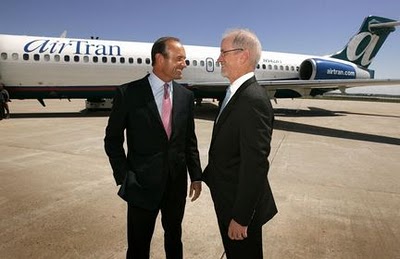
The article essentially states that DeVos was calling for more regional businesses to utilize the Ford International Airport. The article cites DeVos who claims that there is no reason for regional business people to use any other airport, because the Ford airport is the most cost effect.
The MLive reporter did not verify such claims made by DeVos and the only other person cited in the story was Joseph Tomaselli, who chairs Ford Airport’s Board. Interestingly enough, Tomaselli is the CEO of the Amway Grand Hotel, one of the DeVos owned hotels in Grand Rapids and a member of the Grand Rapids Downtown Development Authority (DDA). Another example of the inter-locking systems of power in this city.
Dick DeVos is the Chairman of the Board of Directors of the Regional Air Alliance of West Michigan, which also has representatives from OXFORD Partners, Meijer, Treystar Group and Passageways Travel joining DeVos on the board.
In addition, there are numerous private and public entities listed as members and supporters of the Air Alliance, such as Amway, Autocam, Gentex, Herman Miller, Metro Health, Rockford Construction and another DeVos owned entity The Windquest Group. Several area universities are also members along with the Grand Rapids Press. This begs the question as to why a news agency would be a member or supporter of an organization whose main goal is to get more people to travel by plane from the Ford International Airport. The Grand Rapids Press membership in the Regional Air Alliance of West Michigan also calls into question the credibility of their reporting on the Alliance and area air travel in general.
Beyond the incestuous nature of the power brokers in this story, the other issue not addressed by the reporter was the question of ecological sustainability. DeVos and his business network often makes the claim that they practice environmental sustainability. If this is truly the case, how does increased air travel fit into the notion of sustainability?
The British journalist and environmental writer George Monbiot in his important book Heat: How we can stop the planet burning, devotes a whole chapter on the ecological costs of air travel. Monbiot states:
There are two reasons why flying dwarfs any other environmental impact a single person can exert. The first is the distance it permits us to cover. According to the Royal Commission on Environmental Pollution, the carbon emissions per passenger mile “for a fully loaded cruising airliner are comparable to a passenger car carrying three or four people”. In other words, they are about half those, per person, of a car containing the average loading of 1.56 people. But while the mean distance travelled by car in the UK is 9,200 miles per year, in a plane we can beat that in one day. On a return flight from London to New York, every passenger produces roughly 1.2 tonnes of carbon dioxide: the very quantity we will each be entitled to emit in a year once the necessary cut in emissions has been made.
The second reason is that the climate impact of aeroplanes is not confined to the carbon they produce. They release several different kinds of gases and particles. Some of them cool the planet, others warm it. In the upper tropo-sphere, where most large planes fly, hot, wet air from the jet engine exhaust mixes with cold air. As the moisture condenses, it can form “contrails”, which in turn appear to give rise to cirrus clouds – those high wispy formations of ice crystals sometimes known as “horsetails”. While they reflect some of the sun’s heat back into the space, they also trap heat in the atmosphere, especially at night; the heat trapping seems to be the stronger effect. The overall impact, according to the Intergovernmental Panel on Climate Change, is a warming effect 2.7 times that of the carbon dioxide alone.
In addition to the environmental costs of air travel, it is important to keep in mind the primary reasons for air travel and those costs to the environment. The number sector of society that travels is the business community, which more often than not are traveling to do business deals that will further deplete resources, create a larger gap between the 1% and the 99% and contribute to global warming.
When Dick DeVos and his circle of business aren’t traveling to make deals that will land them more money they are flying long distances to vacation at exotic locations. For DeVos, this is not done on regular commercial airplanes, he flies on private planes owned and operated by the DeVos Family.
Victories and Losses in the Killer Coke campaign

Over the past decade there has been an international campaign to hold the Coca Cola Company accountable for its complicity in the murder of union organizers in Colombia.
This campaign has included unions from all around the world, student groups, environmentalists and religious groups, all of which opposed Coca Cola’s dismal human rights and environmental record.
There have been some recent victories that are worth mentioning in this campaign. First, a Killer Coke supporter and union member found out that Coca Cola had given a $10,000 donation to the United Farm Workers. Members of the Killer Coke campaign contact the UFW and after sharing information about their work and the anti-worker practices of Coca Cola, the UFW terminated their relationship with the multinational beverage company and removed any references to Coca Cola from their website.
Second, after several years of organizing on campus, a student group in Vermont finally got the University of Vermont to terminate its 10-year contract with Coca Cola. The student group worked hard to educate and mobilize students and faculty to exposed Coca Cola’s human rights and environmental record. This was no small feat and it results in Coca Cola losing an estimate 1.1 million bottles of their beverages not being consumed on campus. The student group used many of the great educational resources available through the Killer Coke Campaign, like the one here on the right.
Sadly, there continues to be human rights abuses against union organizers in Colombia. “On January 26, in Barranquilla, reports indicate that Ricardo Ramon Paublot Gomez, a leader from Sinaltrainal, the National Union of Food Workers, who was employed by the National Industry of Sodas-Industria Nacional de Gaseosas S.A. (Coca-Cola) was murdered by gunfire.”
Sinaltrainal is the union that represents Coca Cola workers in Colombia and has been the target of numerous assassinations over the years. For decades the Coke union in Colombia has been fighting against unfair labor practices and repression by Coca Cola, the Colombian military and death squads, which has resulted in the numerous union worker deaths.
This most recent murder prompted AFL-CIO leader Richard Trumka to send a letter to President Obama urging him to postpone the Free Trade Agreement (FTA) with Colombia that was signed last fall. Trumka writes, “I am both alarmed and outraged by these murders, especially as they have taken place in such quick succession. I fear that the passage of the Colombia FTA has now given a green light to the enemies of democratic labor unions in Colombia to launch a new wave of anti-union violence, just as happened in Guatemala after the signing of DR-CAFTA.”

DeVos Family funds another new “development” entity coming to West MI
Yesterday, MLive reporter Jim Harger posted a story about the Detroit-based Urban Land Institute’s (ULI) announcement that they were opening up a branch office in Grand Rapids.
This brief article was a “happy piece” about the ULI and the organization’s thoughts on moving to Grand Rapids. One of their representatives said, “The resurgence of downtown Grand Rapids, the exciting redevelopment of downtown Benton Harbor, the Lansing riverfront redevelopment and the revitalization of downtowns in Battle Creek, Kalamazoo and Holland are just a few examples of the transformative activities in our region.”
According to the Urban Land Institute website, “the 30,000 members worldwide represent the entire spectrum of land use and real estate development disciplines, working in private enterprises and public service. As the pre-eminent, multidisciplinary real estate forum, ULI facilitates the open exchange of ideas, information and experience among local, national and international industry leaders and policy makers dedicated to creating better places.”
Such a statement requires one to ask who will be benefiting from these “better spaces.”
The Urban Land Institute is essentially made up of real estate professionals seeking to invest in urban centers around the world. Their Board of Directors is made up of sme of the most powerful real estate people/companies in the world. According to ULI they focus on 5 areas of urban development:
- Resort and residential
- Retail and destination development
- Office and industrial development
- Transportation and parking
- Real estate finance and capital markets
The Urban Land Institute also has a foundation, which channels money into projects that primarily benefit real estate development and has partnerships with other foundations and financial entities such as Bank of America.
Bank of America is also a sponsor of the Urban Land Institute, along with many other major economic players in the country and the DeVos Family, which is listed as a Gold Sponsor.
The DeVos Family’s financial support of ULI makes complete sense, especially since they own a tremendous amount of downtown Grand Rapids property, with new investments like the purchasing of the old Morton House apartments building, which is slated to be another hotel. The Morton House did provide low income housing to people in Grand Rapids for years, but the DeVos purchase forced those people to relocate.
It also makes sense for the DeVos Family to financially support a non-profit entity like the Urban Land Institute, which can provide the research and advocacy to bolster other land deals in Grand Rapids down the road. Such an entity fits in with the strategic scheme of Rick DeVos and his family funded project known as ArtPrize.
The Urban Land Institute recently endorsed the transfer of state taxpayer funds to remove buildings on the south end of downtown Grand Rapids to make way for the new “Urban Market” that is now underway. The Urban Market is a project spearheaded by Grand Action, a Dick DeVos-founded entity that was behind the Van Andel Arena construction and other downtown development projects.
Unfortunately, the readers of MLive would not as easily connect the dots on the DeVos/Urban Land Institute relationship, since their article did not bother to investigate the real function of this real estate front group.
EXPOSED: The 19 Public Corporations Funding The Climate Denier Think Tank Heartland Institute
This article is re-posted from Think Progress.
One in a series of posts about the Heartland Institute’s inner workings, from internal documents acquired by ThinkProgress Green. Heartland has issued a press release claiming that some of these documents were sent to an outsider under false pretenses and that one document in the set is a fake, but the AP independently verified their contents.
Internal documents acquired by ThinkProgress Green reveal that the climate-denial think tank Heartland Institute received funding from at least 19 publicly traded corporations in 2010 and 2011. The companies’ combined contributions exceeded $1.3 million for an array of projects. As Think Progress Green reported on Tuesday, the Heartland Institute’s projects included a secret plan to teach children that climate change is a hoax.
The companies backing the Heartland Institute:
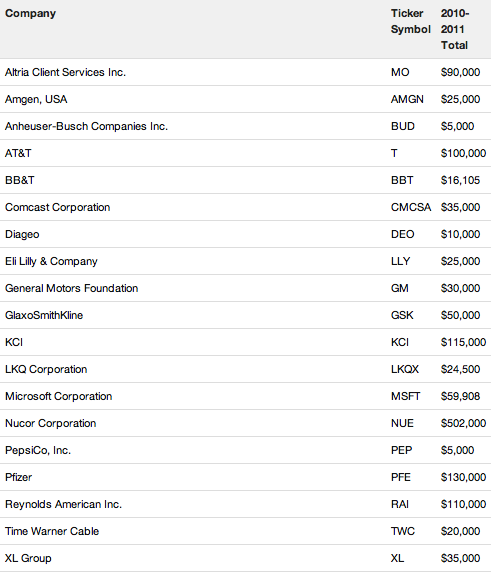
Some companies have issued statements about their contributions, but none have committed to ending their support for the Heartland Institute.
“Diageo provided a small contribution (nearly two years ago) to Heartland Institute – related to an excise tax issue,” a spokesperson said. “We vigorously oppose climate skepticism and our actions are proof of this. We will be reviewing any further association with this organization.”
While disavowing climate denial, Microsoft has indicated no intention to stop its in-kind tax-deductible contributions to the think tank.
“GSK absolutely does not endorse or support the Heartland Institute’s views on the environment and climate change,” a Glaxo Smith Kline spokesperson said. “We have in the past provided a small amount of funding to support the Institute’s healthcare newsletter and a meeting.”
Asked about the contributions, General Motors defended the Heartland Institute as “careful and considerate,” even though the radical think tank has accused “Government Motors” of “corporate welfare-sucking” and told people to “never again buy a GM car or truck.” Forecast The Facts has established a petition to GM asking them to stop funding climate denial.
US Needs to ‘Back Away from Kill Your Way To Peace’
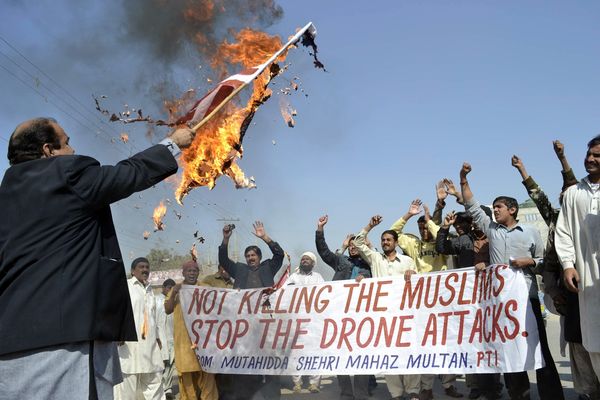
Since 9/11 much of US policy in the Middle East has been based on indiscriminate killing of civilians believed to be either terrorists or collaborators with terrorists.
This policy has involved targeted assassinations and the use of military drones that have resulted in thousands of deaths in countries like Afghanistan, Pakistan, Yemen and Syria.
The news source Russia Times did an interview with Jeremy Scahill based on a recent article he wrote for The Nation magazine. In this 15 minute interview Scahill talks about the US military drone strikes and the idea that the Obama administration has “normalized assassination.”

