Earlier today, MLive posted an article from the Center for Michigan’s online blog the Bridge centered around the taxpayer cost for prisons in Michigan.
It is worth noting that MLive does not often utilize “independent” news sources, but then again the Bridge is not really independent, despite their claim of practicing “public interest journalism.” If one looks at who sits on their board (mostly people with power) and who gives them money (Amway, Meijer, DTE, etc), it would be hard to consider them an independent news source that will challenge economic or political power.
Understanding the framework in which the Bridge operates it is not surprising the direction they took in their article on prison funding in Michigan. The article begins by stating that Michigan legislators are considering sending as many as 43,000 current inmates to a private prison in order to reduce the State’s prison budget.
The article refers to, “Bills in the House (Bills 5174 and 5177) and Senate (Bills 877-878) would allow the Department of Corrections to send hundreds of adult inmates to a currently shuttered private prison in Baldwin. The Baldwin facility is owned by Florida-based GEO Group, formerly known as Wackenhut Corrections Corp. It has been shuttered for the past six years.”
The story does cite two Michigan legislators, Rep. Joe Haveman (R) and Sen. John Proos (R), both of whom support increased prison privatization. Rep. Haveman is quoted as saying that private prisons are a good choice because it creates, “more competition,” an attitude which sees the locking up of human beings as an opportunity to make money.
The article does not provide much background information on the Florida-based GEO Group, formerly known as Wackenhut Corrections Corp. Wackenhut Corrections Corp. was one of the first private prison entities in the US and has a long history of abuse and mismanagement. The GEO Group, Inc. operates 65 prison facilities in the US and 7 outside of the country.
The GEO Group, Inc. is a publicly traded company and since they operate to make money they are always working towards ways to maximize profits for their investors. For instance, in 2011, the GEO Group spent $220,000 lobbying members of Congress on issues of Homeland Security and Immigration. Since 2004, the private prison company has given over $1 million to candidates running for office,
The Bridge story that appeared on MLive does acknowledge some reports on prisoner abuse at GEO Group facilities, citing a Sentencing Project report. The article also notes that there is a growing group of private/public sector partners that are advocating for ways to reduce the costs to the State for prisons, but acknowledges that these costs are partly because of paying prison employee pensions.
Not surprising, a coalition of entities from the public and the private sector have their own coalition, The Michigan Corrections Reform Coalition, which the Center for Michigan is part of. This coalition appears to be designed to redirect public money into the private sector, under the guise that they want to save taxpayers money. Two West Michigan representatives of The Michigan Corrections Reform Coalition are Jeanne Engelhart (former President of the GR Chamber of Commerce) and Mike Jandernoa (former CEO of Perrigo).
The Bridge article that appeared on MLive did mention the Citizens Alliance on Prisons & Public Spending, which advocates for spending more money on prevention that incarceration. However, alternatives to incarceration are an issue that is not adequately dealt with, nor the Bridge article even address the growing prison abolitionist movement in the US.
In the final analysis the Bridge article fails to investigate beyond the superficial, does not make the reveal much information on the power behind this push for private prisons and more importantly, the writer accepts the private or public prison system without considering the possibility of prison abolition.

The Obama administration is asking for $3.1 billion in military aid for Israel in the 2013 foreign appropriations bill. This continues to make Israel the largest annual recipient of US military aid over the past 3 decades.
The military aid that the US provides Israel is used for a variety of purposes and weapons systems, fighter planes, tanks and military intelligence equipment. The $31 billion is also used to provide the Israeli military with tear gas.
The End the Occupation Campaign is calling on people of this country to pressure the US Congress to stop providing tear gas because of how it is being used. Here is a statement from the End the Occupation Campaign with some action ideas:
Three years ago this week, a colleague and I were shot at and nearly killed by the Israeli military with a U.S.-supplied high-velocity tear-gas projectile. Had the canister been fired a few inches to the left, it would have done to one of us what it has done to so many Palestinian, Egyptian, Bahraini and U.S. civilians: cause severe, often permanently debilitating injuries, or death.
Two weeks after we were targeted in the West Bank village of Ni’lin, Tristan Anderson, a 37-year-old from California was shot with a high-velocity tear gas canister while filming a Palestinian protest against Israel’s land expropriation. Tristan spent the next fifteen months in the hospital before being transferred back to the United States. He remains paralyzed on the left side and blind in his right eye.
In December of last year, Mustafa Tamimi, a 28-year-old from the West Bank village of Nabi Saleh was shot and killed by the Israeli military at close range with a U.S.-supplied tear gas canister.
Two siblings from the West Bank village of Bil’in, Jawaher and her brother Bassem, were both killed by tear gas during demonstrations against land theft and resource confiscation by Israel’s illegal settlement complex.
Israel has shown a clear pattern of misusing U.S.-supplied tear gas against Palestinian and U.S. civilians, so far, with total impunity. As U.S. taxpayers, we have the means and moral obligation to demand accountability, especially when these weapons are being used against people demonstrating for freedom, equality, and basic human rights.
In the recently passed 2012 budget, the Secretary of State is required to certify within 90 days that Middle Eastern countries are not misusing U.S. supplied tear gas against civilians and nonviolent demonstrators.
With your help, we can ensure that Members of Congress and the Secretary of State hold Israel accountable for the lethal and ongoing misuse of U.S.-supplied high-velocity tear-gas projectiles.
Send this letter to your Members of Congress to ensure that Israel, along with Egypt and Bahrain, are held accountable for grave violations of U.S. laws and fundamental human rights committed with these deadly high-velocity tear gas canisters.
Before you send the letter, please consider also quickly calling your Members of Congress (their numbers will be displayed right next to the letter) to let them know how important this issue is to you with the suggested talking points provided here.
What we can learn from the 2012 Farm Bill hearings Sen. Stabenow has already hosted in Washington
Earlier today, Michigan Senator Debbie Stabenow hosted the second of four scheduled hearings on the 2012 Farm Bill in Washington, DC.
The hearing held this morning focused on energy conservation and the 2012 Farm Bill. According the Senator’s own Press Release, “Senator Stabenow worked with other agriculture leaders to develop a plan to consolidate 23 conservation programs into just 13, while maintaining the same conservation tools currently available-and in some cases strengthening them.”
Stabenow is praised in the press release for bringing together a bipartisan group of leaders and farmers from across the nation to create a solution that will both save money and create more agricultural jobs. However, the press release doesn’t say who was involved in the process, how jobs will be created and what those jobs will actually look like.
Who Gets Invited
Those invited to speak at the hearing were made up of primarily government entities, farmers and spokespersons for large national conservation foundations such as the National Fish and Wildlife Foundation (NFWF). The NFWF was created in 1984 and has always been stacked with government and corporate people on its board of directors. More importantly, the NFWF has a list of corporate partners, which would make any serious conservationist sick to their stomach. Companies like Walmart, Altria, Budweiser, FedEx and a litany of oil companies such as BP, Conoco/Philips, Chevron and Exxon/Mobil.
The “farmers” that were invited were representatives from people who own large farms that use primarily heavy equipment and farms that grow mostly mono-crops. Some of those farmers that spoke were from Mattson Farms and the Darrel Mosel Farms. Both of these farmers are beneficiaries of significant farm subsidies through previous farm bill legislation. You can search farms subsidies across the country or county by county by going to the Environmental Working Group’s farm subsidy database site and those in Michigan can click here.
The first of the four Farm Bill hearings being held in Washington took place on February 15. The focus of this hearing was Energy and Economic Growth for Rural America.
Listening to the comments it was interesting that much of the discussion and much of what Senator Stabenow spoke about in her comments was the emphasis on agricultural energy production such as bio-fuels and the expansion of the use of agriculture-based products such as soybean based materials that will be used to make seats for cars.
Besides all the ecologically unsound ramifications of bio-fuels, the continued push for such a direction of using farmland for fuel, this decision will have devastating consequences on global food prices and will contribute to widespread hunger.
Those who addressed Senator Stabenow and the Agricultural Committee were exclusively representatives from agribusiness, government and private energy corporations.
For instance, Virent is a corporation that refers to itself as a crude oil replacing company. It is true that the company is developing chemical and plant-based energy resources, but the company is really operating with a green capitalism framework. Virent’s corporate partners include on of the largest members of the global food cartel – Cargill. In addition to Cargill, Virent has a close partnership with companies such as Shell, Coca Cola and Honda, which should be a clear indicator of who will be the primary beneficiaries of the 2012 Farm Bill.
This writer listened to the majority of the commentary from business and government during the February 15 Farm Bill hearing. The commentary from virtually every person who addressed the committee clearly was speaking on behalf of corporate America, despite the occasional rhetoric on sustainability. You can listen to the entire hearing, which is streamed on the Agriculture Committee’s web page.
After looking at who was invited and what was addressed at the first two 2012 Farm Bill hearings, there doesn’t seem to be any indication that the Agricultural Committee is hearing local, small farming and food voices or that those voices don’t really matter because they do not have any representation during these government hearings.
Mazda’s new SUV gets fictional approval from the Lorax and the Truffula Trees, but no one else
This analysis of the cross-promotional and hyper-commercial nature of the Lorax film with Mazda, was written by Kevin Timmer.
Mazda has partnered with Universal Pictures upcoming release of the film “Dr. Seuss’ The Lorax 3D” in a commercial for the car company’s compact SUV, the CX-5.
In the ad we see the “crossover SUV” driving on a Truffula tree-lined road with a saccharine, Amélieësque banjo strumming. The narrator rhetorically asks us who:
“Delivers fuel efficiency without compromising the joy of driving?” (A Brown Bar-ba-loot shrugs. “Mazda. With Skyactiv technology”, he says.)
“Received the only certified Truffula Tree Seal of Approval?” (A Swomee-Swan squawks. “Mazda. With Skyactiv technology”, he repeats.)
Before the narrator can even start asking his next question the Lorax chimes in. (voiced by Danny DeVito) Annoyed by the repetition, he who speaks for the trees finally speaks for the audience,
“I don’t know, you’ve only said it like a billion times,” in DeVito’s recognizably angry, throaty voice that’s sure to perpetuate the destructive idea of the environmentalist as an uncooperative, cynical grouch.
The narrator returns, “Only Mazda could re-imagine driving with revolutionary Skyaactiv technology,” as two Humming-Fish sell out with “Truffula Tree Friendly” and “Uncompromised Driving” placards.
The car keeps driving along the rolling hills of orange-, red- and pink-tuffed trees.
“We build Mazdas. What do you drive?” (Surely not the even greener horse-drawn Once-ler Wagon)
“Zoom Zoom,” is whispered by a child off-screen
“Ahem. Aren’t you forgetting something?” The Lorax reminds the narrator it’s time to scratch HIS back as the scene turns into a white, Mazda logo’d background.
“Oh and do see Dr. Seuss’s the Lorax in theaters this March.”
Dr. Seuss’ book “The Lorax”, published in 1971 by Random House, is a fable about consumerism and pollution told from the perspective of The Once-ler, a former entrepreneur who made a profit from cutting down Truffula trees to make a multi-purpose clothing item called a Thneed. As business booms he’s visited by the Lorax and asked to stop cutting down so many trees. The Once-ler ignores these pleas and eventually finds no more Truffula trees in a polluted landscape and then no more profits. The story is recounted to a child who is entrusted with “the last Truffula seed of them all” and told to grow a new forest. The book is currently #14 on Amazon.com’s list of most popular books, and #2 on their list of Children’s Classics (alongside five other Seuss titles in the top 20). Personally, this book had a significant impact on this writer’s youth.
Universal Pictures previously adapted “How the Grinch Stole Christmas” and “The Cat in the Hat” into live-action films starring comedians Jim Carrey and Mike Meyers as the titular characters. There was no reason to believe the latest adaptation would be any better or NOT have tie-ins. “The Cat in the Hat” partnered in 2003 with junk food companies aimed at children like Burger King, Kellogg’s, Hershey, Pepsi as well as MasterCard, Febreze and Ray-o-Vac batteries. In 2000 “The Grinch”‘s face was seen on Oreos, Sprite, stamps from the US Post Office and McDonald’s Happy Meals.
“Dr. Seuss’ The Lorax 3D”, rated PG, will be released on March 2nd, the author’s birthday, in 269 Imax screens in the US in addition to thousands of other traditional, digital and digital 3D screens. It is estimated that many millions of Americans, especially impressionable children, will be seeing this film this spring.
A fourth grade class from Massachusetts successfully petitioned Universal to “green up” the website promoting the movie, saying, “Our 4th grade class read Dr. Seuss’s, The Lorax, and liked that the Lorax character “spoke for the trees.” We do this at our school by running a recycling program and by canceling unwanted catalogs –www.CatalogCancelingChallenge.com! The book encourages people to help the planet. We enjoyed that in the end the Once-ler realized that life is not just about making money, it’s about what’s best for others and the environment.
We were excited for The Lorax movie to come out in March, but when we went to the movie website, there was absolutely nothing about saving the Earth which is what Dr. Seuss wanted us to learn. The site is more about selling tickets. The trailer did not include much about the environment, either!”
Early in February Reuters re-printed a Universal Pictures press release that justified the distributor’s partnerships with 70 other companies.
“By bringing Dr. Seuss’ messages from “The Lorax” to consumers, UP&L and its partners hope to help empower consumers, young and old, to make more informed choices for their families and the environment, as well as support smarter, environmentally-conscious choices in everyday life.
To date, Universal has 69 partners globally totaling $58.4 million in media value. Domestic partners include; The Environmental Protection Agency, Seventh Generation, Whole Foods Market, HP, Mazda, Comcast, DoubleTree by Hilton, Pottery Barn Kids, Stonyfield Farms, and, returning for its second partnership with Universal and Illumination Entertainment, IHOP. This marks the first-ever major studio film promotion for Whole Foods Market and Seventh Generation and the first ever on-pack promotion for Stonyfield Farms.”
“For years The Lorax has been inspiring people of all ages to take part in protecting their environment. Dr. Seuss’ classic is an enduring and meaningful story about how valuable our environment is, and how we all have a responsibility to protect it,” said EPA Administrator Lisa P. Jackson.
“Help[ing] consumers take their own steps to cut energy use,” is another ploy to make the average consumer think that they must take the initiative “to shrink their carbon footprint and protect our planet”. This ignores the real culprit of energy consumption and environmental degradation: industrial corporations that make these products and have the money to advertise the Gandhian “Be the Change…” philosophy and the products themselves. This echoes the enterprising Once-ler’s interpretation of the Lorax’s “UNLESS” engraved on his stump to mean, “Unless someone like you cares a whole awful lot, nothing is going to get better. It’s not.” And this is accepted as the path to sustainability by most on the left.
This promotes green capitalism (the idea of environmentally sustainable economic growth) and lifestyle capitalism (the idea that the only way to save the planet is to buy something). “Reduce, reuse, recycle” isn’t a message that’s profitable enough to advertise unless it’s printed on a bag.
The Guardian noticed several of the Ten Signs of Greenwash from sustainability communications agency Futerra’s Greenwash Guide in the commercial: “It seems Mazda’s corporate communications team have almost used them as a checklist when devising their advert. In the ad a “Seussified” Mazda CX-5, that’s a “compact SUV” to you and me (10 Signs of Greenwash #5: best in class?), cruises caringly through a pre-deforested landscape of truffula trees (#3: suggestive pictures)… So not entirely revolutionary then, and as for being the only car that is in receipt of the “truffula tree seal of approval – ‘We care an awful lot!'”, don’t get me started (#8: imaginary friends).”

I’d add that it’s also guilty of:
#6 “Greening a dangerous product doesn’t make it safe”: An SUV runs on gasoline that contributes to CO2 emissions.
#7 “Gobbledygook”: “Skyactiv technology” is said three times but not explained.
The Atlantic partially identified the issue with this new “crossover SUV” model.
“If Americans are ditching their Cherokees for leaner, greener models, then the CX-5 and its automotive cousins represent an improvement over the old status quo. But if auto buyers are actually choosing crossovers over smaller cars, that’s a different story entirely. By offering them slightly improved gas mileage on a fundamentally less efficient design, car companies would be helping consumers indulge in their worst impulses. Yes, you can have a big car without feeling too much pain at the pump or feeling guilty about global warming. Yes, you can have your cake and eat it too.
Small, gas burning cars cost thousands of dollar less than hybrids like the Toyota Prius but can still do 40 mpg on the highway, making them broadly appealing for cost conscious drivers. Meanwhile, despite the fanfare around electric vehicles such as the Chevy Volt and Nissan Leaf, some automakers are ditching hybrid models to focus on better gas engine technology.”
Uh oh. The writer also recognized the “conundrum for environmentalists” as the CX-5 is a “step up” from the Cadillac Escalade but not quite as ‘eco-friendly’ as a Chevy Volt.
“And while [SUV’s like the CX-5] might help us pump a little less gas now, they might help keep us dependent on dirty fuel in the future… Mazda’s car isn’t completely without its green merits. But using everyone’s favorite orange eco-warrior to advertise something that falls in the mushy middle of environmentally friendly vehicles is a bit, well, disrespectful.”
Last night Stephen Colbert commented on the ad and the idea of the Lorax “selling out”. He joked that he didn’t like the book, calling it, “[An] environmental screed about a little orange tree hugger, trying to kill the good Thneed-producing jobs that the Once-ler was creating with nothing more than unwanted Truffula tree tufts.” This echoes Fox News’ Lou Dobbs recent criticism of the movie, saying it “pits the makers against the takers” and sells an anti-industrial agenda.” The movie’s 70 corporate tie-ins are something Colbert commends, though. “Everybody knows: The more tie-ins, the more good something is,” concluding with a rhyming tribute to Dr. Seuss:
“This cashtacula sellout is not quite enough.
I’m demanding more branding of Loraxian stuff.
With what you can buy, boy, the sky is the limit.
A Filet o Fish meal with real Humming-Fish in it.
Filmmakers get cracking the market is lacking
A splendiferous Lorax-themed drill made for fracking.
Or the fine certain something that all people need.
Indeed you’ll succeed if you sold us a thneed.
They’re easy to make if you only take,
All the Truffula tufts off the trees by the lake.
They’re comfy and thick as the thick ironies
Of the Lorax and Seuss hawking big SUVs.”
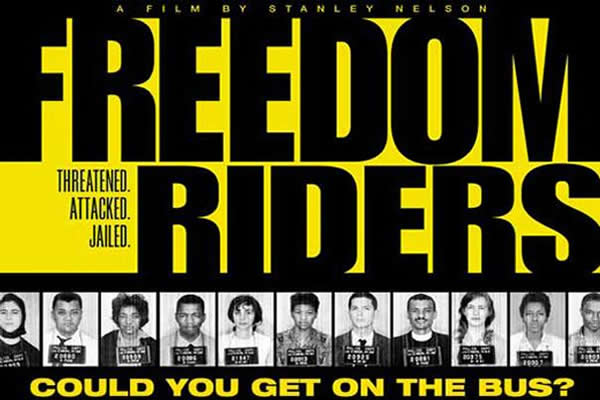
The GVSU Office of Multicultural Affairs hosted the last of its Black History Month events today on the Allendale campus. Their guest earlier today was Diane Nash, a participant in the 1961 Freedom Riders campaign in the US South. Nash is part of the recently released documentary film entitled Freedom Riders that has been screened in the area over the last month.
Nash was not part of the originally group of Freedom Riders, but she knew that in the event that they needed assistance, she and others would be willing to join in. Ms. Nash spoke about how the original group was beaten and one of the buses was burned. Despite the violence inflicted against the Freedom Riders, Nash and others quickly decided to take action and organize another bus ride.
Nash told the GVSU audience that her boyfriend at the time gave her a ride to Birmingham, Alabama so she could hook up with other activists in the area to keep the campaign alive.
The speaker went on to say that they needed to raise money quickly and asked some of the Civil Rights groups like the Southern Christian Leadership Conference (SCLC) to provide them with the necessary funds to keep the campaign going. The SCLC initially was reluctant to give the funds out of fear of the violence they might face. However, they were eventually able to get the necessary funds and they set out to take the next steps.
Some of her fellow Freedom Riders contacted the news media, while others contacted the US Justice Department. Diane Nash was given the role of the coordinator of this second leg of the Freedom Riders campaign. Nash said they set up an office in Nashville and offered people training in non-violence and well as engaged in fundraising efforts. Part of the non-violence training was to prepare people for how to deal with going to jail in the event that they were arrested. They had one phone, according to Nash, designated for nothing more than taking calls from those who would be on the buses.
Nash mentioned that the Kennedy Administration tried on numerous occasions to try to get Nash and the other Freedom Riders from continuing the campaign. Nash said that near the end of the campaign she and other members of the Student Non-Violent Coordinating Committee (SNCC) were invited to Washington and asked to shift their focus from direct action to voter registration. Most of the SNCC members refused to stop their direct action approach.
Nash said that the legacy of these efforts of SNCC and the Freedom Riders is relevant for today. However, in order to apply these historical tactics and strategies to today, Nash said, we need to have a better understanding of what actually happened.
The former Freedom Rider then talked about the kind of non-violence campaigns and what this tactical approach truly meant. The Freedom Riders used the Gandhian approach of non-violence, which is known as Satyagraha, or truth force.
This kind of non-violence, according to Nash, was not a form of pacifism that people often assume non-violence looks like. On the contrary, Satyagraha is not just the absence of violence. Non-Violence is an active, participatory activity that both reflects the strength of ones convictions and confronts injustice directly.
One example of how this non-violence was manifested were the lunch-counter campaigns, where people not only were arrested for sitting in White only sections, but people protested those companies with marches and boycotts.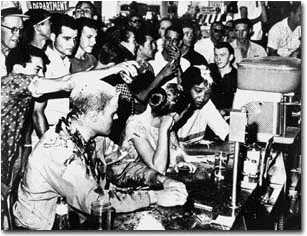
Nash then spent a little bit of time talking about the notion of unconditional love, which is what many of those involved in the Freedom Struggle understood to be what motivated them. The Greek word agape is one of the three Greek words for love and it is the one that is most directly connected to the Gandhian notion of non-violence.
The speaker went on to talk about the campaign to desegregate lunch counters in the south. She gave one example of how after weeks of confronting business owners in one community, one of the owners actually changed his mind and went to the other business owners and asked them to desegregate. Nash said this would not have happened had they seen these owners purely as enemies.
Another point Nash wanted to make was that the only way that oppressors can maintain oppression is with the cooperation of the oppressed. As long as those of us who being oppressed and exploited are willing to put up with the oppression, liberation will not occur.
Nash went on to talk about the difference between a protest and a non-violent campaign. A protest, according to Nash simply lets those in power know you object to whatever it is they are doing. A non-violent campaign has clear steps, goals and objectives that need to be followed in order for the campaign to be successful. She identifies the phases necessary for a successful campaign, with the first being investigation into what the main objective is. Once people can come to an agreement about this main objective then the campaign can move on.
The second phase involves education, where information is disseminated to those who will be potentially involved in the campaign. The third phase is negotiation, where you make contact with your opponent and that while you tell them you don’t hate them you do not approve or accept what it is they are doing.
The fourth phase is demonstrations, such as marches and sit-ins. The Fifth stage is resistance, where you engage in efforts to wear down the opposition, such as boycotts, tax resistance, strikes, work stoppages or setting up parallel organizations. The final step is making sure that you take steps to prevent the problem from reoccurring. This might involve creating a film company, a historic museum or education functions to make sure people know the history so that the injustice does not repeat itself.
Nash then went on to stress that the victories they won were not without sacrifice or risk. Indeed, no struggle really is won that is painless. However, Nash said that not all the work was risky and often people participate in campaigns in a variety of ways. Nash talked about how the famous Black singer Harry Belafonte was asked to be part of the Freedom Rider campaign. Belafonte decided not to participate, but he did support the struggle with money and public endorsement.
Nash ended her talk by pointing out that injustices are rampant today in the US and the world. However, she believes that the non-violent campaigns of the 1960s could work today to bring about change.
Nash said that voting is not enough to bring about change. “Elected officials do not and will not bring about the change that we need.” Can you imagine if we had waited for elected officials to desegregate the south? Those changes never would have come about.
The former Freedom Rider left the audience the clear message that change will never come about if we do not take action. It is true that we need to talk about injustice, we need to educate ourselves, but more importantly we need to take action to bring about change.
Amidst Election spectacle, US media advocates for war with Iran
While Michigan is focused on the spectacle of the GOP primary today, the Obama administration and much of the national media are pushing for war with Iran.
Fairness and Accuracy in Reporting (FAIR) noted that earlier this month ABC News ran a story about members of the US intelligence community who believe that Iran is now likely to strike inside the US.
Just a few days ago Simon Tisdall, a reporter for the Guardian, wrote that the government and media hype around Iran is strikingly similar to what the US public heard in the buildup to the 2003 invasion of Iraq.
The comparison of the drums for war with Iran now and the 2003 Iraq invasion is a theme that Al –Jazeera recently explored on one of their TV programs. Al-Jazeera states:
Something sounds familiar. ‘Long-range nuclear missiles’, ‘terrorist sleeper cells’, ‘WMDs’: terms which quickly became part of the media’s vocabulary in the run up to the 2003 US-led invasion of Iraq. Fast-forward to 2012 and they are featuring heavily once again, only now it is not about Iraq, but Iran. Last time, the media’s saber-rattling followed the Bush administration’s lead in selling the attack on Iraq. This time, the so-called ‘Iranian Threat’ is a narrative being constructed by the US media all by itself – with scant public support from the Obama administration.
Here is a link to the thoughtful Al-Jazeera story.
Racial Graduation Gaps at Michigan Public Universities
This article is re-posted from The Center for Michigan.
There is a 22-percent gap between white and black graduation rates atMichiganpublic universities – significantly wider than the national public university racial gap of 16 percent. Wayne State University has the largest racial graduation gap in the state, and the largest in the nation among public universities.
Here are rates for 2009, the most recent year available, for all schools (all figures represent percentages):
Central Michigan University
White: 58.7
Black: 45.2
Gap: 13.5
Eastern Michigan University
White: 45.2
Black: 25.1
Gap: 20.1
Ferris State University
White: 49.2
Black: 21.6
Gap: 27.6
Grand Valley State University
White: 61.4
Black: 55.3
Gap: 6.1
Lake Superior State University
Not available.
Michigan State University
White: 81.0
Black: 58.7
Gap: 22.3
Michigan Tech
White: 66.9
Black: 71.4
Gap: -4.5
Northern Michigan University
White: 46.1
Black: 33.3
Gap: 12.8
Oakland University
White: 45.1
Black: 15.4
Gap: 29.7
Saginaw Valley State University
White: 41.8
Black: 11.7
Gap: 30.1
University of Michigan
White: 94.6
Black: 78.9
Gap: 15.7
University of Michigan-Dearborn
White: 50.3
Black: 34.5
Gap: 15.8
University of Michigan-Flint
White: 47.3
Black: 27.3
Gap: 20.0
Wayne State University
White: 44.6
Black: 8.6
Gap: 36.0
Western Michigan University
White: 55.6
Black: 39.7
Gap: 15.9
Source: The Education Trust
DeVos funded think tank Acton Institute on the move in Grand Rapids

Last week, Rapid Growth Media (RGM) posted a short article about the Acton Institute’s announcement that they would be buying and moving into the Wim-CAT building on the corner of Sheldon and Fulton Street in downtown Grand Rapids.
The RGM story focused on the new location, but also including some commentary from an Acton representative on the future use of the space they purchasing. The only comment about the Acton Institute referred to the group as, “a faith-based proponent of free-market economies worldwide.”
Considering the history of their founder and current President Robert Sirico and the organization itself is one of supporting far right positions, it is worth taking a critical look at what the Acton Institute is about and who they are aligned with.
The organization was founded in 1990 by Fr. Robert Sirico, whom at the time was a Paulist Priest working with the Catholic Information Center in downtown Grand Rapids. Sirico had already aligned himself with the more reactionary sectors within the Catholic Church on issues such as US policy towards Latin America, particularly in opposition to the Liberation Theology movement.
My first encounter with Sirico was a forum we organized in Grand Rapids in 1991 to debate Liberation Theology in Latin America. It was clear that Sirico sided with the Vatican in its opposition to Liberation Theology as was manifested by the witch hunt that then Cardinal Ratzinger (now Pope Benedict) engaged in by silencing and marginalizing Latin American Catholic clergy, a topic explored in numerous books and most recently in The Pope’s War: Why Ratzinger’s Secret Crusade Has Imperiled the Church and How It Can Be Saved.
The Acton Institute’s decision to take a position against Liberation Theology stems mostly from its promotion of free-market capitalism. Liberation Theology advocated for justice for the poor and a redistribution of wealth. The Grand Rapids-based think tank believes that capitalism is the best remedy for economic equality, despite the historical track record of capitalism leaving a path of suffering, exploitation and inequality in its path.
The Acton Institute supports economic policy that promotes deregulation of the economy and austerity measures (similar to what Michigan is experiencing under Gov. Snyder). It is no surprise then that the DeVos family has been a big supporter of the Acton Institute, with Betsy DeVos previously serving on the Board of Directors and the DeVos family being major donors to the think tank. Richard DeVos Sr. was also given the Faith and Freedom Award from the Acton Institute in 2010. You can see from the graphic below the interlocking systems of power that connect the DeVos family and the Acton Institute.
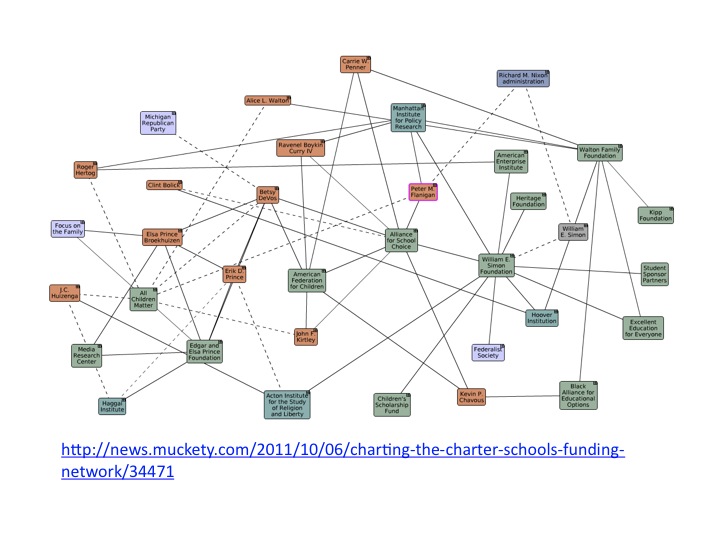
The current Board of Directors at the Acton Institute is a mix of corporate CEOs and religious leaders, such as Calvin College President Gaylen Byker, J.C. Huizenga of the National Heritage Academies (advocates the privatization of public education), John Kennedy (Autocam), Sidney Jansma (Wolverine Gas & Oil Corp) and John Gordon (Gordon Food Service).
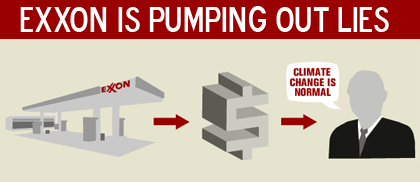
The Acton Institute also has a history of denying global warming and taking a very critical attitude towards much of the focus of environmental justice work throughout the world. According to the website Exxon Secrets, the Acton Institute has received over $300,000 from Exxon/Mobil since 1998 to engage in anti-global warming propaganda. One way the group has used this money was to organizing public screenings of a climate denial film, which they showed at the Wealthy Street Theater in Grand Rapids a few years back.
The Acton Institute’s Environmental Stewardship web page links to the Cato Institute, Competitive Enterprise Institute, the Free-Market Environmental network, Green-Watch, the Heartland Institute and the Heritage Foundation. All of the entities linked from the Acton Institute web page take a pro-business, anti-regulation, anti-worker, anti-environmental position and influence both state and federal policy.
Considering this history, we thought it would be useful for people to understand a bit more about the Acton Institute and have some background on the think tank that will be sharing a building with the West Michigan Center for Arts and Technology.
Record spending by MI lobbyists in 2011 according to new report
This article is re-posted from the Michigan Campaign Finance Network.
Reported Lansing lobbying expenditures totaled $35,348,800 in 2011, according to figures compiled by the Michigan Campaign Finance Network from reports filed with the Michigan Department of State. That amount is up by 11 percent compared to 2010 and it is a new state record for annual lobbying spending.
Reported lobbying expenditures had shown robust growth of 85.7 percent from 2001 to 2008, increasing from $18,459,254 to $34,278,459. However, they dropped in 2009, and again in 2010, to $31,831,842, the lowest reported total since 2006.
“This leading indicator suggests that the recession is over in Lansing’s money-in-politics sector,” said Rich Robinson of the nonpartisan Michigan Campaign Finance Network.
Multi-client firms dominated the top of the list of the state’s leading 200 lobbyists, as they normally do. Governmental Consultant Services, Inc. was first at $1,354,102. It was followed by Kelley Cawthorne at $1,196,765.
Third on the 2011 list was StudentsFirst. The education choice organization led by former Washington, D.C. superintendent of schools Michelle Rhee reported spending of $955,818, including $900,000 spent for advertising. Former Rep. Tim Melton (D-Auburn Hills) resigned his seat from the 29th District of the Michigan House of Representatives in 2011 to join StudentsFirst.
Following StudentsFirst on the list of the top 200 lobbyists were multi-clients Karoub Associates ($935,659), MHSA ($611,290) and Wiener Associates ($604,077).
The Michigan Health and Hospital Association was the top spender among Michigan-based interest groups at $533,070, good for seventh place on the top 200.
Some notable Grand Rapids entities in the top 200 lobbyists in Michigan were Meijer ($61,868), GVSU ($61,598) and the law firm of Warner, Norcross & Judd ($50,029).
“The reports filed by Michigan’s multi-client lobbyists illustrate the great weakness of our state’s lobbying disclosure system,” said MCFN’s Robinson. “The firms report spending and they name their clients, but they don’t report how much they spend representing those clients.”
A report released last week by Texans for Public Justice shows the results of Texas’ more rigorous reporting standards. All lobbying contracts between lobbyists and their clients must be reported.
Let them eat cake While Michigan legislators were passing laws to reduce citizens’ dependence on unemployment insurance and cash assistance for needy families in 2011, they drank and dined heartily thanks to a quarter-million dollars of private sector influence peddlers’ welfare for officeholders. Lobbyists reported spending almost $92,000 for food and beverages for individual legislators, and another $160,000 for food and beverages for legislators at group receptions.
Freshman Rep Frank Foster (R-Pellston) was the leading beneficiary of the lobbyists’ hospitality, enjoying $4,291 of individual dining perks, in addition to his share of the group receptions. That was consumed over 103 House session days in 2011.
Senate Majority Leader Randy Richardville (R-Monroe) was the leading individual consumer of lobbyists’ hospitality in the Senate with $4,181 in complimentary repast.
The 30 leading individual consumers of lobbyists’ hospitality, each of whom enjoyed at least $1,000 in dining perks, consumed 59 percent of what was reported.
AT&T, reporting its activity as Michigan Bell Telephone, was the leading provider of group food and beverage, having spent $41,254, including $22,000 for a reception for the 2011 State of the State address.
Fixing the holes Michigan lobbying disclosure can be described most charitably as spotty. Multi-client firms report what they spend, but they don’t report what is spent for whom.
Lobbyists report some of the dining and travel perks they provide, but not unless their spending exceeds arbitrary reporting thresholds (in 2011: $55 for dining, and $725 for travel and accommodations). There easily could have been tens of thousands of dollars of additional dining and travel hospitality for legislators in 2011 that was not disclosed.
Gifts, including tickets for entertainment, are banned, unless their value is less than $57.
Financial transactions between lobbyists and officeholders, or members of their families, don’t have to be reported unless they exceed $1,150. A lobbyist could loan an officeholder $1,000, but the state doesn’t ask and the lobbyist probably won’t tell.
Some lobbying spending simply isn’t reported. The Detroit International Bridge Company spent $6 million in 2011 for television advertisements exhorting viewers to tell their legislators and the governor to stop a new public-private international bridge between Detroit and Windsor. None of that advertising was reported in the state’s lobbying disclosure system and DIBC isn’t even registered as a lobbyist in Michigan.
Here are a few simple reforms that should be adopted: • Multi-client firms should report all contracts, naming the client and the amount of each contract. • All food and beverage hospitality provided by a lobbyist to a lobbyable official should be reported from the first dollar spent. • All travel and accommodations provided by a lobbyist to a lobbyable official should be reported from the first dollar spent. • All entertainment gifts for lobbyable officials should be prohibited. Gifts should be limited to plaques, or the like, given in recognition of service. • Any financial transactions between a lobbyist and a lobbyable official, or a lobbyable official’s family member, should be reported from the first dollar. • All lobbying advertising should be reported, whether it is direct or indirect.
Lobbyists should be presumed to be rational economic actors who represent rational economic actors. Citizens should have a right to know what they are spending to advance their clients’ interests.
Top 200 Michigan State Lobbyists – 2011
Silver Spoon Supper Club – 2011
Reflections on the Manipulation of Populism
This article by Paul Street is re-posted from ZNet.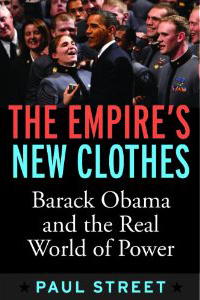
A slightly shorter version of this essay was originally published on Counterpunch. Long after its leading encampments have been torn down – often with brute force and (educationally enough) predominantly by Democratic mayors and with the approval and involvement of a Democratic White House – the populist Occupy Movement deserves major credit for changing the United States’ political discourse. It helped bring the nation’s savage economic inequalities and the unmatched democracy-, society-, and ecology-destroying power of the wealthy Few (the instantly famous “1%”) into the national political discussion in ways that will give it a deserved place in future American history textbooks. It performed the remarkable service of calling out the name and address of the nation’s true unelected masters: corporate-financial capital and Wall Street.
Why did it emerge in the late summer and early fall of 2011? There were precursors and inspirations from recent history that helped spark and explain the timing of the Occupy moment, of course: occupations of public space (Cairo’s Tarhir Square) to protest the rule of a dictator in Egypt and to protest neoliberal austerity measures in Spain and Greece; the December 2008 occupation of the Republic Door and Window plant on Chicago’s North Side; and the mass popular upheaval in Madison, Wisconsin in February and March of 2011 – a remarkable rebellion that included a 16 day people’s occupation of the Wisconsin State Capitol. Within New York City, not far from where OWS broke out, activists earlier the same year launched an outdoor encampment (“Bloombergville”) to protest Mayor Bloomberg’s plans to cut social services and jobs – an action that provided an interesting link between the Madison upheaval and Occupy, that utilized many of the same organizational methods that would be employed by Occupy movements across the nation, and that provided some of OWS’ early activists.
Only the 1 Percent Took Your House Away
Beneath and beyond these immediate sparks, however, there lay deeper developments that provided the fuel for Occupy’s sparks to catch fire. Occupy and the broader popular and populist spirit of sympathetic opposition to the rich and corporate few it helped capture arose when it did, I think, because of the bursting of two bubbles: the hyper-collateralized real estate, credit, and finance bubble of 2001-2007; and the electoral-politics Obama hope and change bubble of 2007-2011. The popping of the first bubble – sparked by a wave of foreclosures in poor black and Latino communities that Wall Street had pumped with a wave of super-exploitive sub-prime home loans – laid bare the true elite and its culpability for the decline and indeed the breaking of American life and society. As Barbara Ehrenreich and John Ehrenreich argued in a December 2011 Mother Jones essay titled “The 1% Revealed,” the transparent crashing of the national and global economy by the financial shenanigans of the super-rich undermined the ability of the right-wing to credibly continue its longstanding fake-populist game of blaming the professional and managerial “liberal elite” for everything wrong in America. It exposed the real masters, “the 1 percent who are, for the most part, sealed off in their own bubble of private planes, gated communities, and walled estates.” Compared to the corporate and Wall Street elite, “professionals and managers, no matter how annoying, were [shown to be] pikers. The doctor or school principal might be overbearing, the professor and the social worker might be condescending, but only the 1 percent took your house away.”
The Class One Serves
The bursting of the second bubble reflected the realization that American democracy (or what’s left of it) is no less crippled by the dark cloud of big money and the many-sided machinations of capital when Democrats hold nominal power than when Republicans do. Elected in the name of progressive change and a promise to clean up a corrupt Washington, the Obama administration has been a tutorial on who rules America and the underlying conflict between capitalism and democracy. With its monumental bailout of hyper-opulent financial overlords, its refusal to nationalize and cut down the parasitic financial institutions that had paralyzed the economy, its passage of a health reform bill that only the big insurance and drug companies could love, its cutting of an auto bailout deal that rewarded capital flight and raided union pension funds, its undermining of desperately needed global carbon emission reduction efforts at Copenhagen (2009) and Durban (2011), its refusal to advance serious public works programs (green or otherwise), its green-lighting of offshore drilling and numerous other environmentally disastrous practices, its roll-over of Bush’s regressive tax cuts for the rich, its freezing of federal wages and salaries, its cutting of a debt ceiling deal (in the summer of 2011) that was all about cutting social programs instead of tax increases on the rich, its disregarding of promises to labor and other popular constituencies, and other betrayals of its “progressive base” (the other side of the coin of promises kept to its Wall Street and corporate sponsors, who set new campaign finance records in backing Obama in 2008), the “change” and “hope” presidency of Barack Obama brilliantly demonstrated the reach of what Edward S. Herman and David Peterson call “the unelected dictatorship of money,” which vetoes any official who might seek “to change the foreign or domestic priorities of the imperial U.S. regime.” It richly validated radical analysts’ jaded take on the plutocratic reality behind the heavily personalized, candidate-centered “electoral extravaganzas” (Nom Chomsky) that big money and big media stage for the citizenry every four years, telling us that “that’s politics” – the only politics that matters. In its presidential, as in its other elections, U.S. “democracy” is “at best a guided one; at its worst it is a corrupt farce, amounting to manipulation…It is an illusion,” the left historian Laurence Shoup observed in early 2008, “that real change can ever come from electing a different ruling class-sponsored candidate.”
John Pilger put it well at a socialist conference in San Francisco in July of 2009. “The clever young man who recently made it to the White House is a very fine hypnotist,” Pilger noted, “partly because it is indeed exciting to see an African American at the pinnacle of power in the land of slavery. However, this is the 21st century, and race together with gender and even class can be very seductive tools of propaganda. For what is so often overlooked and what matters, I believe, above all, is the class one serves.”
The lesson – driven home by the wildly unpopular elite-manufactured debt-ceiling crisis of July and August 2011 – suggested the wisdom of the late radical historian Howard Zinn’s clever maxim that “the really critical thing isn’t who’s sitting in the White House, but who is sitting in – in the streets, in the cafeterias, in the halls of government, in the factories. Who is protesting, who is occupying offices and demonstrating – those are the things that determine what happens.” As Zinn explained in an essay on the “election madness” he saw “engulfing the entire society, including the left” with special intensity early in the year of Obama’s ascendancy:
“The election frenzy seizes the country every four years because we have all been brought up to believe that voting is crucial in determining our destiny, that the most important act a citizen can engage in is to go to the polls and choose one of the two mediocrities who have already been chosen for us…… Would I support one [presidential] candidate against another? Yes, for two minutes – the amount of time it takes to pull the lever down in the voting booth…But before and after those two minutes, our time, our energy, should be spent in educating, agitating, organizing our fellow citizens in the workplace, in the neighborhood, in the schools. Our objective should be to build, painstakingly, patiently but energetically, a movement that, when it reaches a certain critical mass, would shake whoever is in the White House, in Congress, into changing national policy on matters of war and social justice.” (H. Zinn, “Election Madness, The Progressive, March 2008).
The Bubbles Co-Joined (2003-2008)
The two bubbles that burst have a curious linkage that goes back well before the collapse of Bear Stearns, Lehman Bros., AIG, and Washington Mutual. In an early May 2008 CounterPunch essay titled “The Obama Bubble Agenda,” the Wall Street veteran and left commentator Pam Martens reflected on a curious reason for high finance’s record-setting investment in the Obama campaign:
“The Wall Street plan for the Obama-bubble presidency is that of the cleanup crew for the housing bubble: sweep all the corruption and losses, would-be indictments, perp walks and prosecutions under the rug and get on with an unprecedented taxpayer bailout of Wall Street…..Who better to sell this agenda to the millions of duped mortgage holders and foreclosed homeowners in minority communities across America than our first, beloved, black president of hope and change?”
Obama, it should be remembered, did not step onto the stage of national celebrity and contention without first being carefully vetted by the financial and political investor class beginning in 2003. “On condition of anonymity,” Ken Silverstein reported in the fall of 2006, “one Washington lobbyist I spoke with was willing to point out the obvious: that big donors would not be helping out Obama if they didn’t see him as a ‘player.’ The lobbyist added: ‘What’s the dollar value of a starry-eyed idealist?’” (K.Silverstein, “Barack Obama, Inc.: The Birth of a Washington Machine,” Harper’s, November 2006)
The favorable political credit rating given to Obama by the investor class reflected among other things his remarkable “yes” vote in the U.S. Senate on the so-called Class Action Fairness Act of 2005. A Republican bill backed and signed with great gusto by President Bush on February 18, 2005, it was a “thinly-veiled ‘special interest extravaganza’ that favored banking, creditors and other corporate interests” (Matt Gonzales) over and against workers, consumers, and the public by making it more difficult for ordinary people to sue corporate abusers. The bill had been long “sought by a coalition of business groups and was lobbied for aggressively by financial firms, which constitute Obama’s second biggest single bloc of donors” (Silverstein). As Martens explained, that vile legislation amounted to “a five-year effort by 475 lobbyists, despite appeals from the NAACP and every other major civil rights group. Thanks to the passage of that legislation, when defrauded homeowners of the housing bubble and defrauded investors of the bundled mortgages try to fight back through the class-action vehicle, they will find a new layer of corporate-friendly hurdles.” (P. Martens, “The Obama Bubble Agenda,” CounterPunch, May 6, 2008, http://www.counterpunch.org/2008/05/06/the-obama-bubble-agenda/)
The Manipulation of Populism by Elitism
Ironically enough, Obama now gets to channel the populist Occupy spirit in fashioning his campaign for re-election against (in all likelihood) the spectacularly wealthy Mitt Romney. A web blurb from the Democratic Congressional Campaign Committee says “Stand with President Obama: the top 1% Need to Pay Their Fair Share!” The Democrats are eager to portray Romney as “Mr. 1%” and to identify Congressional Republicans with “those at the very top.” Liberal and Democratic activists, columnists, reporters, and politicians revel in noting that Romney pays less than 14 percent on more than $40 million in mostly investment-based income over the previous two years. “He makes more in one day than most Americans make all year,” proclaimed the elite Democrat Gerald McEntee (president of the American Federation of State, County, and Municipal Employees, AFL-CIO), on the liberal-Democratic Huffington Post last month. Entitled “Mitt Romney and the 1%,” McEntee’s column described the leading Republican presidential contenders Romney, Newt Gingrich, and Rick Santorum, as “the candidates of the 1%, for the 1% and by the 1%” – as if Obama was not also such a candidate and not flying around the country raising vast sums of political capital from the nation’s financial elite at one push fundraising dinner after another.
The Democrats would certainly be campaigning against the Republicans along these anti-plutocratic lines even if Occupy had never emerged. Knowing well that the majority of the population has for some time been deeply displeased with the wildly disproportionate wealth and power of the corporate and financial Few, they are old hands at what the late and formerly left Christopher Hitchens once described as “the essence of American politics…the manipulation of populism by elitism. That elite is most successful,” Hitchens wrote in a 1999 study of the Bill Clinton presidency:
“which can claim the heartiest allegiance of the fickle crowd; can present itself as most ‘in touch’ with popular concerns; can anticipate the tides and pulses of public opinion; can, in short, be the least apparently ‘elitist.’ It’s no great distance from Huey Long’s robust cry of ‘Every man a king’ to the insipid ‘inclusiveness’ of [Bill Clinton”s slogan] ‘Putting People First,’ but the smarter elite managers have learned in the interlude that solid, measurable pledges have to be distinguished by a ‘reserve’ tag that earmarks them for the bankrollers and backers.”
Even the Republican candidates have not been able to resist the fake-populist campaign meme encouraged by the actually populist Occupy moment. Smarting over defeats in the Iowa Caucus and New Hampshire primary, conservative Republican presidential candidate Newt Gingrich went after Romney for eliminating thousands of jobs while amassing millions in personal wealth during his previous career as the CEO of the rapacious equity capital firm Bain Capital Management. “You have to ask the question,” Gingrich told reporters in connection with Romney’s economic record: “is capitalism really about the ability of a handful of rich people to manipulate the lives of thousands of people and then walk off with the money?” A Talking Points Memo article on Gingrich’s comment bore an amusing if not wholly accurate title: “Gingrich Goes Full ‘Occupy Wall Street’ on Romney.”
A Rick Perry ad in Iowa said that Romney “made millions buying companies and laying off workers.” Imagine! Perry went after Romney in South Carolina for talking about how he was once worried about receiving a “pink slip” himself. “I have no doubt that Mitt Romney was worried about pink slips, whether he was going to have enough of them to hand out because his company Bain Capital with all the jobs that they killed, I’m sure he was worried that he’d run out of pink slips,” Perry said.
Romney was compelled to release his tax returns – revealing his offshore tax havens and low overall tax rate (reflecting his utilization of a controversial filing method that is available only to wealthy investors) – partly under pressure from his Republican rivals.
But of course neither the Republican candidates nor Obama would ever admit something that I suspect many of the smarter Occupiers are able to acknowledge – that, yes, Newt, capitalism really is pretty much “about the ability of a handful of rich people to manipulate the lives of thousands of people and then walk off with the money.”
But that’s a topic for another essay – one I already wrote: http://www.zcommunications.org/what-s-good-for-capital-by-paul-street


