Occupy Doesn’t Have a Platform — It is a Platform
This article by Kevin Carson is re-posted from the Center for a Stateless Society.
The Occupy movement comes under frequent attack from the institutional Left (and, it goes without saying, from the liberal establishment) for not offering a clear list of official demands — for, in other words, not offering a platform.

But that criticism misses the point. Occupy doesn’t have a single platform, in the sense of a list of demands. But it is a platform — a collaborative platform, like a wiki. Occupy isn’t a unified movement with a single list of demands and an official leadership to state them. Rather, Occupy offers a toolkit and a brand name to a thousand different movements with their own agendas, their own goals, and their own demands — with only their hatred of Wall Street and the corporate state in common, and the Occupy brand as a source of strength and identity.
Although the ends are quite different, the model of organization is much like that of al Qaeda: An essentially leaderless organization, a loose network of cells, each of which adopts the al Qaeda brand or franchise for its own purposes. It’s a much more effective use of resources to provide a common platform and then let a thousand flowers bloom.
A conventional, hierarchical activist institution wastes enormous resources on administrative apparatus and endless negotiations just to get everyone on the same page, before anyone can do anything.
A common platform allows any number of movements, made up of voluntary aggregations of individuals with shared goals, to build on it on a modular basis, and to act without waiting for permission from the headquarters of the One Big Movement. And whenever they do anything that seems to work well, any other node in the network can adopt that tactic as its own without asking anyone’s leave.
That’s why the glocal Occupy movement is throwing off innovations like a fission reaction throws off neutrons. If anything, it’s done so even more since the wave of shutdowns in the U.S. divorced it from occupation as a primary tactic and scattered its seeds to the wind.
But let’s go back a ways. The Pentagon Papers weren’t published pursuant to an official decision by a nationwide anti-war movement, and Woodward and Bernstein didn’t try to found a national political movement to impeach Nixon. In both cases, the immediate actors simply published the information, and allowed anyone who would to leverage that information. They thereby created a free platform that could be developed by any number of antiwar and anti-Nixon activists for their own ends.
Fast forward to Summer 2010. Julian Assange simply published the cable dump at Wikileaks. Every single activist movement that piggybacked on that platform, starting with the uprising in Tunisia, did so on its own initiative, making — its own judgment — the best use of the free, common platform offered by Assange. So it’s gone from Tunisia to Egypt, to the Arab Spring, to Madison, to the demonstrations in Britain and Spain and Greece, to Occupy Wall Street, and back out to the global Occupy movement in hundreds of cities around the world.
Now, with the Occupy movement (thanks to Bloomberg et. al) no longer wedded to occupying public squares, the wave of innovations seems to roll in on a weekly basis. First Occupy Our Homes, and now Occupy the Ports.
According to Lester MacGurdy at Oakland Occupier, Occupy Oakland has begun to deal with police evictions by retreating, waiting until the cops are gone, then going back. Police are essentially heavy infantry who move slowly and ponderously into place, and can move only as quickly as their bloated logistical train moves with them. Protestors are light infantry who can disperse and re-concentrate on short notice. ”The tactical evolution that evolved relies on two military tactics that are thousands of years old — the tactical superiority of light infantry over heavy infantry, and the tactical superiority of the retreat over the advance.” You can bet this will be standard procedure for every Occupy group in America in a week’s time.
The corporate state and its thugs in black uniforms and kevlar are big, impressive, and make lots of loud noise — just like a T. Rex blundering into a tar pit. The resistance is small, agile and resilient — just like a swarm of piranha. And in the end, we’ll hang their bleeding heads on our battlements.
In the immortal words of Bob Marley: “The stone that the builder refused shall be the head cornerstone.”
Rape in the US Military: America’s Dirty Little Secret
This article by Lucy Broadbent is re-posted from ZNet.
“It was eight years before I was able to say the word that describes what happened to me,” says Maricella Guzman. “I hadn’t even been in the Navy a month. I was so young. I tried to report it. But instead of being taken seriously, I was forced to do push-ups.”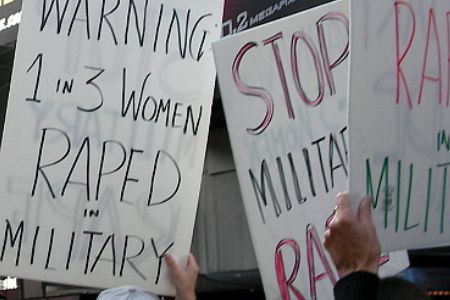
“I can’t sleep without drugs,” says Kate Weber. “But even then, I often wake up in the middle of the night, crying, my mind racing. And I lie there awake in the dark, reliving the rape, looking for a second chance for it to end with a different outcome, but he always wins.”
Rape within the US military has become so widespread that it is estimated that a female soldier in Iraq is more likely to be attacked by a fellow soldier than killed by enemy fire. So great is the issue that a group of veterans are suing the Pentagon to force reform. The lawsuit, which includes three men and 25 women (the suit initially involved 17 plaintiffs but grew to 28) who claim to have been subjected to sexual assaults while serving in the armed forces, blames former defence secretaries Donald Rumsfeld and Robert Gates for a culture of punishment against the women and men who report sex crimes and a failure to prosecute the offenders.
Since the lawsuit became public in February, 400 more have come forward, contacting attorney Susan Burke who is leading the case. These are likely to be future lawsuits. Right now they are anxiously awaiting a court ruling to find out if the lawsuit will go to trial. The defence team for the department of defence has filed a motion to dismiss the case, citing a court ruling, dating back to 1950, which states that the government is not liable for injury sustained by active duty personnel. To date, military personnel have been unable to sue their employer.
Whether or not the case goes to trial, it is still set to blow the lid on what has come to be regarded as the American military’s dirty little secret. Last year 3,158 sexual crimes were reported within the US military. Of those cases, only 529 reached a court room, and only 104 convictions were made, according to a 2010 report from SAPRO (sexual assault prevention and response office, a division of the department of defence). But these figures are only a fraction of the reality. Sexual assaults are notoriously under-reported. The same report estimated that there were a further 19,000 unreported cases of sexual assault last year. The department of veterans affairs, meanwhile, released an independent study estimating that one in three women had experience of military sexual trauma while on active service. That is double the rate for civilians, which is one in six, according to the US department of justice.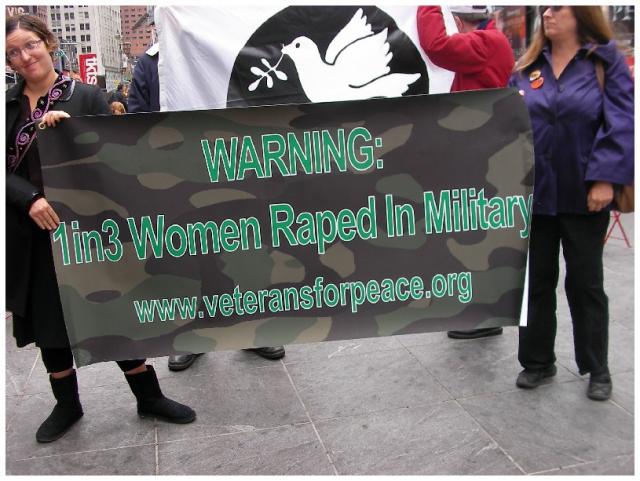
“For years, I thought I was the only person this had happened to, but it’s an epidemic,” says Weber, 36, who recounts being raped 16 years ago in Germany, and describes herself as a “high-functioning” sufferer of post-traumatic stress disorder (PTSD) as a result.
She is now married and lives in San Francisco with her four children, but even after years of therapy, still cannot sleep at night. “Rape is so widespread in the American military, it’s sick.”
Worse still, the victim is likely to be blackballed by her own unit, and sometimes even demoted, according to Weber. “I first tried reporting the rape to my staff sergeant, he told me to be quiet and not tell anyone. So then I tried to tell a woman sergeant, who was beneath him, because I thought she’d be more sympathetic. She just cursed me for jumping the chain of command and not coming to her first. I went to the doctor, who did at least make a record of it, but he did nothing. I also told my ‘battle buddy’, a fellow female soldier. She said, ‘I know that guy. He’s married and he would never do such a thing. You’re a liar and a slut.’ Before long, I was being called a whore and a bitch by everyone. The guys were warning each other: ‘This one will accuse you of rape, so stay away from her.’ I was 18 years old, it was the first time I had ever been away from home. I had no idea what to do.”
Stories such as Weber’s are commonplace. On mydutytospeak.com, where victims of military rape can share their experiences, there are breathtaking tales of brutality and mistreatment. Only 21 years old, and weeks into her military training, Maricella Guzman says she ran to tell her supervisor in the hours after her rape at a military boot camp in Great Lakes, Illinois. “I burst into his office and said, ‘I need to speak to you,’ ” explains Guzman, now 34, and a student at a college in Los Angeles studying psychology, who talks about many lost years when she couldn’t function as a result. “One of the procedures if you want to speak to someone in the navy is you have to knock three times on the door and request permission to speak. But I didn’t do that. I was too upset. So my supervisor said ‘Drop’, which means push-ups. So I did the push-ups. But I was still in tears. I said, ‘I need to talk to you.’ He said ‘Drop’ again. Every time I tried to say anything, he made me do push-ups. By the time I was composed in the way he wanted me to be, I couldn’t say anything any more. I just couldn’t.” After that, Guzman didn’t try to tell anyone for another eight years.
It is so well known that sex offenders go unpunished and victims penalised for reporting incidents, that most say nothing. Michelle Jones describes how she was still lying on the floor of her room in the barracks, her ripped shorts by her ankles, when her rapist stood over her and said, “I’ll tell everyone you’re a dyke and you’ll get booted out if you report this.”
She was two-thirds of her way through her service. “I didn’t want to lose my job,” says Jones, 39, who is now an IT consultant living in San Jose, California, and gay. Under the (now-repealed) USDon’t Ask, Don’t Tell policy, openly gay people were barred from the military. Jones wasn’t even sure she was gay at the time. But it wasn’t worth the risk of reporting. “If I had spoken out, I would have been the one investigated,” she says. “And it wouldn’t have done any good anyway. I could tell you about 15 other women I know who had tried to report a rape and got nowhere.”
Rape in any circumstance is brutal, but in the military the worst effects are compounded. Victims are ignored, their wounds left untended, and the psychological damage festers silently, poisoning lives. Survivors are expected to carry on, facing their attacker on a daily basis. “Unlike in the civilian world, a military rape survivor cannot quit his or her job and move on,” explains Anu Bhagwati, executive director of theService Women’s Action Network, an organisation spearheading a campaign to reform this aspect of military life. “It’s like rape in the family. Many victims often receive additional threats from their attackers.”
Bhagwati refers to the case of 24-year-old lance corporal Maria Lauterbach, a marine preparing to testify that she was raped by fellow marine, Cesar Laurean, when she went missing in 2007. Although it was never proved that Laurean raped her, he was later convicted of her murder. Weber found her attacker hiding in her room three times in the months that followed the rape. “He’d lie in wait just to scare me,” she says.
Rape by a fellow serviceman also represents the most unfathomable betrayal to a soldier, according to Bhagwati. “You have to understand that from day one when you sign up, you are told that the people you work with are your family, that you will risk your life to save theirs. You live that uniform. It’s who you are. And then, to be raped by one of your fellow servicemen? It’s institutional misogyny.”
There are too many stories of military rape for the Pentagon to ignore. “This is now a command priority,” says a spokesman for the department of defence. “We clearly still have more work to do.” But the sheer statistics beg the question: why is rape in the American military so common in the first place? “We looked at the systems for reporting rape within the military of Israel, Australia, Britain and some Scandinavian countries, and found that, unlike the US, other countries take a rape investigation outside the purview of the military,” explains Greg Jacob, policy director at the Service Women’s Action Network. “In Britain, for example, the investigation is handed over to the civilian police.
“Rape is a universal problem – it happens everywhere. But in other military systems it is regarded as a criminal offence, while in the US military, in many cases, it’s considered simply a breach of good conduct. Regularly, a sex offender in the US system goes unpunished, so it proliferates. In the US, the whole reporting procedure is handled – from the investigation to the trial, to the incarceration – in-house. That means the command has an overwhelming influence over what happens. If a commander decides a rape will not get prosecuted, it will not be. And in many respects, reporting a rape is to the commander’s disadvantage, because any prosecution will result in extra administration and him losing a serviceman from his unit.”
With men and women cooped up in barracks away from home, living in an atmosphere where domination through strength is part of daily training, opportunity is another undeniable factor. Most rape survivors blank out the awful details of their attack, but all describe the ease with which it was engineered. Guzman had been on night watch training. “It was the middle of the night and someone grabbed me from behind. He pulled me into this dark space, a room of some kind. The door shut. He grabbed my throat and I remember being thrown to the wall.”
Weber says she was lured outside a dance by an officer, who told her he wanted to discuss military business. “He led me up the fire escape of this building, and began to kiss me,” she explains. “I resisted, but then he turned me around so my rear was at his front. He kicked my legs apart, and tore off the back of my skirt and underwear and raped me.”
Jones says her attacker refused to leave her room in the barracks after a group of fellow soldiers had been partying together there. “Everyone had left except for him. I opened the door for him to leave, but he grabbed my neck from behind, and forced himself on me.”
But military rape is not only a women’s issue. According to the Veterans Affairs Office, 37% of the sexual trauma cases reported last year were men. “Men are even more isolated than women following rape,” Bhagwati says. “Because it has an even bigger social stigma.”
Rick Tringale is one of few men to speak about what happened to him. He was 18 years old and in his first few weeks of training, he says, when he woke up in his bunk in the middle of the night thinking that it was raining. Someone was urinating on him.
“As I came to consciousness, I realised that I was being held down with a blanket and then I was beaten.” Tringale, 43, says his life changed for ever following a brutal gang rape, that led to him going AWOL from the army, and subsequently becoming homeless.
“Next thing I remember is being dragged down the hallway. There was a lot of blood, a lot of pain, I was crying and I remember trying to run away, but I was dragged to the latrine, and hit a whole lot more. I remember the white tiles splattered with blood and seeing familiar faces and they were all hitting me. More guys were crowding into the bathroom too, and they’re yelling, ‘Kill him, kill him, kill him.’ ”
Tringale believes he was either knocked unconscious or what happened next was too horrible for his memory to recall. All he remembers is waking up in his bunk the next day, with his platoon dormitory empty. He says his face was a mess, his nose broken, his whole body beaten and he had been raped. He made it to the emergency department, but in the middle of the examination by the doctor, who was initially sympathetic, the phone rang. “The doctor was talking to someone, and looking at me. Then, when he came off the phone, he said: ‘You’re a phoney, your company says you shouldn’t be here, and you’re fine.’ He sent me away. I became a different person after that. Everybody in the squad platoon knew what had happened – there was no way anyone could have missed it.”
Tringale completed his training, but he became known as the “crazy guy” because any part of his training that was dangerous, he would push himself to the limit, like holding on to hand grenades so long they were seconds from exploding in his hand. He tried killing himself three times. It was after the third attempt while stationed in Germany, after being talked down off the roof of a building, that he was sent to a civilian psychiatrist, whom he told about his experience. She diagnosed PTSD and recommended Tringale be sent home. But he was also seen by a military doctor, who told him, “If there’s something wrong with your mind, you’ll have to stay here in this locked ward.”
“I looked around at this locked ward,” says Tringale. “That was when I decided I had to get out. I went AWOL.” For the past 25 years, Tringale has lived with the nightmares and trauma. Because he was not honourably discharged, he lost his paycheck, his pension, and he has not had the regular support of the programmes set up by the veterans affairs department for those suffering from PTSD. For a while he held a job on a paramedic ambulance, but like many veterans who suffer from PTSD, he was also homeless for many years. He neither drinks, nor takes drugs. Two years ago he married, and became a stepfather to three children. He has never shared his story with his wife. “Our society treats men differently when they have been raped,” he says. “In society’s eyes I am somehow less of a man because I have been raped, or I must be a latent homosexual. Rape is a very emasculating thing.”
Like the others in this article, Tringale wants to share his story in order to help those who might have experienced the same. “Eighteen veterans kill themselves every day,” he says. “That’s the statistic. We don’t know what percentage of them are victims of rape, but if I can share my story and make someone else feel that they are not alone and there is hope, then I have done my duty.”
Suicide and homelessness are common outcomes for sufferers of MST (military sexual trauma). Forty per cent of homeless women veterans have reported experiences of sexual assault in the military, according to the Service Women’s Action Network. “Other common effects of MST are feelings of isolation, sleeping problems, hyper-vigilance, depression, and substance abuse,” explains Dr Amy Street, a clinical psychologist at the VA Hospital in Boston who works with victims (VA hospitals are run by the veterans affairs department). “Victims talk about feeling numb, being cut off from emotions, unable to function. The best treatments are therapies, which require sufferers to talk about their attacks. This is very uncomfortable for them, but they are effective.”
But because most victims do not report their attacks, it is usually many years, if at all, before they find their way to such therapy groups. Guzman began talking about what happened to her only because she met a therapist who was working at a VA hospital who recognised some of her symptoms. Guzman was depressed, couldn’t keep up friendships, unable to function. She, too, had tried to kill herself. “I was an empty shell of a person,” she explains. “I’d heard of PTSD before, but I’d associated it with people who had seen combat. Not me. When I was diagnosed, everything started to click in. I wasn’t crazy. All the things I’d suffered started to make sense. Bear in mind, the rape had been my first sexual experience. I grew up in a very strict Catholic culture and rape is such a big taboo in my community. It wasn’t something I could talk about. I felt very ashamed.”
But talking has helped her. “I have no shame talking about it any more,” she explains. “My family and friends all know now, and that’s been an important part of my recovery. On a daily basis, I am still sleep deprived, and I have a lot of nightmares. I still find relationships with men very difficult, and I don’t think I’m ever going to get married and have children. It’s one of the costs of this trauma. But this year at school, I’ve had A grades back to back, which has been amazing. That’s simply because of the support I’ve been getting.”
Weber also speaks highly of the VA hospital where she received therapy three times a week. “I used to live in my robe. Wouldn’t go out. Stay awake all night. I developed a substance abuse problem, because numbing yourself is all you want to do. I went through two marriages, and lost my bearings in life completely. But I’m doing better now than I’ve ever done before. In therapy you learn that not everyone is out to get you, that you’re not about die. They teach you how to live life without so much fear.
“I’ve been clean and sober for two years. But I don’t blame the other survivors I know that still want to stay loaded or die, for this type of pain I feel is indescribable. But I’m grateful that I’ve survived. What’s important now is to get the word out and make the case for change.”
The worker-run restaurant Bartertown is offering the first in a series of classes designed for working class people on December 27.
Bartertown, which opened earlier this year, wants to provide a forum for people to share information on ways to eat better, eat local and promote food justice. The promotional information for these workshops states:
The idea is to discuss, teach and learn from each other on how to make good food at a reasonable price, and in a responsible fashion. The smartest thing you can do is arm yourself with the knowledge of food.
The first class will be addressing the local food movement along with the slow food movement. For a lot of us these new trends seem to be targeted towards the upper class. If you can afford it then you can be a part of it. Also what is local? Do you really know what you are buying? Many don’t and get fooled everyday. We will be preparing a meal and having an open discussion.
These classes will be free and open to anyone. No need to register beforehand.
Class War Kitchen #1
Tuesday, December 20, 2011 6:00 – 8:00PM
Bartetown Diner
6 Jefferson, SE, Grand Rapids
Naomi Klein – Interview with Occupy Vancouver
This video is reposted from Common Dreams.
On Dec. 1, Naomi Klein joined “Occupy Condos: Take the Pantages!” to show support for affordable housing in the DTES.
After the march, members of Occupy Vancouver media team were able to sit down with Naomi and capture her thoughts on the Occupy Movement, the tar sands pipeline, and how to prepare for the largest economic shock yet.
New Media We Recommend
Below is a list of new materials that we have read/watched in recent weeks. The comments are not a “review” of the material, instead sort of an endorsement of ideas and investigations that can provide solid analysis and even inspiration in the struggle for change. All these items are available at The Bloom Collective, so check them out and stimulate your mind.

The United States of Fear, by Tom Engelhardt – This new book, by the creator of TomsDispatch, is one of the best critiques of US foreign policy in the Bush/Obama years. Engelhardt not only writes well, he presents information in a way that would allow you to talk with anyone sitting in a bar about what drives US foreign policy. While the book is focused on post-9/11 policy matters, the author weaves in other historic examples over the past century. Engelhardt covers issues like the US occupations of Iraq and Afghanistan, the use of private mercenary forces, US bases abroad, the increased use of un-manned predator drones, military spending, the US intelligence establishment and the propaganda-like reporting from the major daily news sources on Washington’s activities abroad. Engelhardt makes it clear that not only have Bush administration policies continued since Obama took office, the current administration has actually gone further in some areas than the previous administration.

Class War 2012, by Eric Michael Moberg – Class War 2012 is a collection of essays that deal broadly with the topic of class warfare. Written in a populist-style, the essays cover a broad range of examples of resistance to oppression and slavery. There is a chapter on the Vietnamese resistance, Algerian resistance, the Mexican resistance of 1910 and today, the Haiti Slave revolt and Native American resistance to US colonialism. Readers will learn of the courage of Geronimo, Ho Chi Minh, Comandante Ramona, Emiliano Zapata and countless people who have fought is campaigns of liberation. The book also is mixed with criticism of US corporate control of the electoral system, the power of corporations and the attack on the poor and middle class. Where the book falls short is not linking the great examples of resistance Moberg cites with the possibility for resistance in the US today. He does cite the Occupy Movement, but most of his recommendations focus on electoral reform, redirecting funding from the military to social spending and better government regulation. It’s as if the author didn’t learn from his own examples from history about how change has come about around the world. Despite this flawed analysis, mot of the book is valuable and inspiring.

Anarchism and Its Aspirations, by Cindy Milstein – If anyone is looking for a clear articulation of the principles of the political philosophy of anarchism, Cindy Milstein’s small book would be an excellent choice. Milstein presents anarchism is a very readable and practical way. Her presentation of anarchism consists of current and historical examples, demonstrating the viability of such a political philosophy. The author also discusses ideas such as autonomy, horizontal organizing, accountability, liberation, freedom, affinity groups, direct democracy, direct action and the importance anti-capitalist analysis. In addition, Milstein talks about why joy, spontaneity and beauty are also central aspirations of anarchism. A short, powerful book that should be in the back pocket of all those who truly want a better world.
The Camden 28 (DVD) – In August of 1971, 28 people participated in an action to take and destroy draft records from a federal building in Camden, New Jersey. This film documents that action with archival footage and interviews with most of the 28 who were arrested for protest the US war in Vietnam. What is interesting about this case is that there was one person, who was a friend of several of the protestors, who had cooperated with the FBI to thwart the action. The film deals with this infiltration and the sense of betrayal by many. The Camden 28 also includes information about the trial, where Howard Zinn gave testimony on the real reasons for the US actions in Vietnam. An excellent film that not only reveals something about US resistance to the Vietnam war, but what motivates and gives people courage to take such actions.
US Militarism in 2011 Hollywood Films

In the past week we have posted articles looking at both product placement in films for 2011 and the sexual objectification of women. This posting will focus on militarism, particularly US militarism.
Presenting the US military in a positive light is nothing new for Hollywood, which has been producing pro-US military movies since WWII. However, as Carl Boggs, author of the book The Hollywood War Machine: U.S. Militarism and Popular Culture states, since 9/11 the cooperation between the US military and Hollywood filmmakers has deepened.
Filmmakers since 9/11 have not only sought out the cooperation of the US military, they have given over screen rights to the most powerful military in the world. It is now common practice for the US military to have say in the scripts of films where the US military is involved, such as allowing the use of equipment, weapons, locations and actual personnel.
The US military as backdrop
There were several films where the US military was not central to the plot, but still made their presence known. One example is the film Warrior, a film about the Ultimate Fighting Competition (UFC). In this film one of the main fighters is a former US Marine who served in Iraq. At one point in the film US soldiers in Iraq recognize this UFC participant from video circulating on the Internet. Word gets out that this fighter had risked his life to save other Marines. As a tribute to the former soldier, dozens of Marines show up to the UFC match to show their support.
Now there have no doubt been examples of individual heroism by US troops in Iraq, but acknowledging such heroics outside of any context is extremely misleading. Warrior, like so many other films, did not communicate contextual facts such as, the US invasion of Iraq was based on a lie, that over a million Iraqis have been killed since 2003, that the US has set up dozens of military bases, which are not closing down and that the US drastically re-wrote the Iraqi constitution during the time that Paul Bremer was in charge of the country just after the initial invasion.
Other films that have US military representation in a secondary role are Contagion and the Green Lantern. Contagion is based on a world wide viral breakout and the US military plays a role in keeping the public misinformed and contained. In the Green Lantern, the US military doesn’t have a prominent role, but we do see the main character in a US fighter jet early on in a scene where the Pentagon is testing new drone planes. In films like this that use US weaponry, even in a minor role, it serves to normalize the idea that US weaponry is a necessary part of American life.
When films are commercials for the military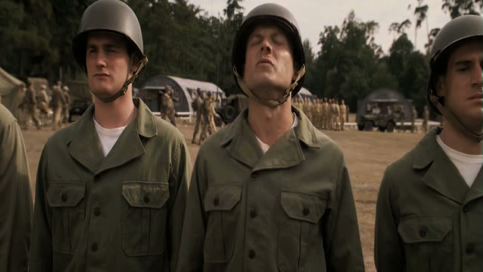
There were also films in 2011, where the US military plays a central role. The three films we want to look at are Captain America, Transformers and Battle Los Angels.
Captain America is set during WWII, after the US has entered the war in 1941. The enemy portrayed in this film is the Nazis, which is why the character who plays Captain America wants to enlist. The film uses scenes from US military bases in the US and Europe, along with the use of military aircraft. Captain America promotes the US on USO tours and encourages audiences to buy bonds.
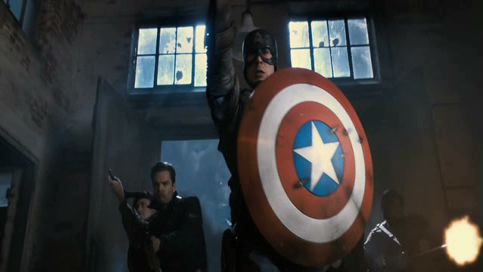
Once Captain America joins the soldiers at the front line he is presented as only killing bad guys, which of course it not what really happened during WWII. Plenty of civilians died in Europe and the Pacific at the hands of the Axis countries and the Allies, something overtly missing in the film. In Captain America we are led to believe that the US involved in Europe was for nothing more than a noble cause, even though Captain America doesn’t fight Nazis, he fights against a group called Hydra. Hydra has one maniacal leader and a legion of followers that are presented as very Nazi-like, thus making any and all US military actions seem just and pure.
Transformers: Dark Side of the Moon continues the central role of the US military just like the first two films in the series. An elite group of US soldiers works with the robots to thwart evil around the world. There is one scene early on the film where the US soldiers & their robot friends attack an “illegal nuclear site” in the Middle East. There is no clear indication which country this scene takes place in, but one could easily conclude that they are referring to a country like Iran, despite Iran being a credible nuclear threat.

The other overt military theme in Transformers is the role of NASA. NASA is presented both in a historical role and contemporary role. The film uses in the early moon landings as a context for the robot wars and even includes former astronaut Buzz Aldrin in the film. In the present day of the film NASA plays a significant role as a place to store alien weapons and we even see a space shuttle liftoff as an opportunity for the robots allied with the US to deceive the Decepticons. Lastly, in order to destroy the enemy robots the US soldiers use Tomahawk missiles to blow them up near the end of the film.

Transformers not only uses US military locations and personnel, it portrays US weapons as playing a vital role in keeping humanity safe. This last point is what makes a film like Transformers so dangerous in terms of maintaining the propaganda that justifies the massive US military budget in the real world.

The last film we looked at was the movie Battle Los Angeles. This science-fiction movie is centered around an alien invasion on the west coast. The main characters are US soldiers who rescue US civilians and fight off the alien invaders who seem to have them outmatched in terms of weaponry. However, the US military has soldiers who are driven with the will to win and the film is filled with scenes of acts of courage.
After an intense battle with the aliens a small group of US soldiers finally figures out the weakness of the aliens. Exhausted and bloodied, the surviving soldiers return to base, where they are greeted with a heroes welcome. A commanding officer tells them to get some R&R and go have breakfast. However, the platoon Sgt. Decides to load up his gun and the other soldier follow, demonstrating that US soldiers won’t rest until the enemy is defeated. Battle Los Angeles not only utilizes US weaponry, US military locations and military personnel the film is essentially a 2-hour commercial for the US military.
Normalizing Sexual Objectification: 2011 Hollywood Films
The other day we posted an analysis article looking at product placement/branding in Hollywood films. This article will take a look at examples of hyper-sexualization in 2011 Hollywood films and messages about sexual assault.
Like previous years, 2011 was not much different for Hollywood in terms of how women were represented as sexual objects for male pleasure. In the film Just Go With It, Adam Sandler continues to play a character that gets to act out his male fantasies. Sandler plays a plastic surgeon who gets his female assistant to play his ex-wife as a means to get a young woman to like him even more. Both the young woman and his assistant (played by Jennifer Aniston) are presented as being hyper-sexual objects for the camera, with the slow motion and accompanying music, which has become the standard when women’s bodies are shown on the big screen.

Other films that objectify women and presents them as being available for men are films like 30 Minutes or Less and 50/50. In 30 Minutes or Less (filmed in Grand Rapids), both the “good guys” and the “bad guys” in this comedy use women for nothing more than sexual pleasure. One of the good guys gets a blowjob early on in the film while his friend watches from the porch steps. After the woman performs oral sex on this character says thanks just seconds after he has an orgasm and gets out of the car. One of the “bad guys” in the film goes to a bar, where a woman takes her top off and tells him sexual fantasies based on his claim to have access to a million dollars.
In 50/50, the main character is diagnosed with cancer and struggles to come to terms with his disease. His best friend, played by Seth Rogan, convinces him to use his cancer as a means to “get pussy.” While at a bar the guys pick up two women and play up the cancer angle. After having drinks and spending time on the boardwalk, the guys end up taking the women home with them. Before they take the women home the character with the cancer tells his friend he is tired and wants to go home. His friend says, “Don’t throw this all away. Don’t waste my time, man.” While the film does a good job of personalizing the struggle people can have with cancer, the sexual use of women by men adds nothing substantive to the plot and just adds to Seth Rogan’s resume of play characters which treat women as nothing more than objects.

Another film that presents women in a hyper-sexualized way is the Bad Teacher. The main character is played by Cameron Diaz, a teacher at a middle school with no real teaching skills. She decides she needs breast implants in order to win the affection of a fellow teacher. While at the plastic surgeon’s office she is shown felling and talking about another woman’s breasts. Not only does this scene fulfill male fantasy it presents women as willing to go to any length to get a man.
However, the breasts implants are too expensive, so Cameron Diaz’ character tries numerous ways to get the funds she needs. In one scene she shows up to at a school car wash dressed in short shorts and revealing top. As she washes the cars she acts in very sexualized ways, again accompanied by slow motion and a hard rock song, Sweet Cherry Pie.
Other films that objectify women are Conan the Barbarian and The Change Up. In Conan, the female objectification takes place when Conan liberates slaves. Ironically, the male slaves look dirty and undernourished, but the women just happen to be clean, healthy looking and topless. Of course, their “freedom” also means they now become “available” for Conan and his other barbarian friends.
In The Change Up, the two main characters are men, who because they pissed in a public fountain together end up switching bodies. In this comedy, Jason Bateman’s character is now inside Ryan Reynolds’ body. Reynolds’ character is a bit of a slacker but does have an upcoming acting gig, which Jason Bateman’s character must now fulfill. The surprise is that the acting job in a role in a pornographic film, which is also presented in a humorous way.
Another scene in The Change Up has Ryan Reynolds in Jason Bateman’s body. Bateman’s character is married and now Ryan Reynolds thinks he has the opportunity to sleep with Bateman’s wife. He is waiting in the bed as she comes in the room with nothing on and walks towards the bathroom in, you guessed it, slow motion. Viewers see the woman’s breasts close up and then as she moves past the camera here is a tight shot of her butt.
Male attitudes about sexual harassment
The last example we want to take a look at is the film Horrible Bosses. In this film the three main characters are men, all of which have bosses they hate. The plot in this comedy centers around these three guys trying to figure a way to get their bosses killed.
One of the characters has a female boss who is sexually harassing him on the job, coming on to him and doing things that would certainly be considered sexual harassment as it is legally defined. Early on in the film the three guys are at the bar talking about how much they hate their bosses. When it gets to the guy who’s boss is a woman, the other two guys don’t show any empathy for his situation. Here is how the dialogue goes at this point:
“At least you’re boss isn’t sexually harassing you.” (guy 1) “Oh my god here we go.” (guy 2) “You are never gonna get any sympathies from us.” (guy 3) “It’s like a totally hostile work environment. It’s not funny. Today my boss started spraying water on my crotch so she could see the outline of my dick.” (guy 1) “That’s great. Why don’t you just fuck her.” (guy 2)
The dialogue continues with his friends who don’t consider it sexual harassment what is happening to him and then one of them sees a woman in the bar that he is going to go talk to. This guy says, “I’m going to go talk to that woman about her vagina.” Imagine if a group of female friends were talking in a bar and one of them said she was being sexually harassed by her male boss. Do you think that her friends would tell her that she would get no sympathy from them and that she should just “fuck” her boss?
Not only does this scene in Horrible Bosses dismiss that men can be sexually harassed at work, it normalizes that men always want to have sex and that to not take advantage of an opportunity to have sex means you are less than a man. Lastly, what we found in the 2011 Hollywood films we looked at was that sex was almost exclusively presented through the eyes of men, where women were simply made to be available for male pleasure, often in demeaning ways.
More taxpayer money goes towards Urban Market Project
On Wednesday, MLive published a brief update on the proposed $27 million urban market that is slated to be built on Ionia Avenue.
Originally, the Urban Market planned on rehabilitating the old Sonneveld building just south the Wealthy St. overpass, but now the building, along with 6 others, will be demolished to make way for the new Urban Market project.
The MLive story does not specify which buildings along Ionia Avenue will come down, but they do identify it will be between Wealthy and Logan.
This is the latest twist in the ongoing coverage of the development of this urban market concept that has been evolving since 2009 when it was first proposed.
According to the MLive story the Downtown Development Authority (DDA) has applied for a $1 million grant from the DEQ for demolition, which is in addition to a recent $4.5 million grant from the Michigan Economic Growth Authority. At a Grand Rapids City Commission meeting in September the City approved the use of “water funds” for other improvements related to the market.
The funding mechanism appears to be changing over time and those behind the market continue to get funds from a variety of taxpayer-financed sources. Despite the high level of taxpayer funds being used in this project, the public has had virtually no say.
Minutes from the September DDA meeting provide us with some details on where some of the funding will come for this project:
- DDA would continue to own the property
- DDA would lease property to Urban Market Holdings, LLC (UMH) for 99 years
- UMH would rescind its request for development support from the DDA
- DDA would retain assets if the market ever failed
- Tax Increment from the project would be used to: Pay for street improvement to adjacent streets; Reimburse UMH for eligible redevelopment costs; Planned street improvements include street, utilities, street lighting, streetscape, putting Consumer Energy lines underground
- Ionia Avenue and Logan Street will be bring and McConnell Street will be asphalt
- Street improvements would be financed: Issuance of bonds payable over 20 years, UMH cash, DDA cash, and Grants; Bonds to be issued by the Brownfield Redevelopment Authority; Priority for bond payments using Tax Increment Revenue.
- An amount budgeted annually by the DDA for 20 years – $75,000 per year
During that September 2011 DDA meeting, DDA member John Canepa could not vote on these matters since he is on the board of Grand Action, the private group behind the urban market plan. In addition, another DDA member, Kayem Dunn, had to abstain from voting on this matter since she also sits on the board of the Urban Market.
These conflicts of interest reflect how interlocking systems of economic power work, something we pointed out in a previous article about the Urban Market. (another look article) Unfortunately, the commercial media has not focused much attention on who is behind this project and who will be the primary beneficiaries.
Instead, the local media coverage has mostly focused on how this project will be a benefit to the ongoing development of downtown. There is no doubt that this project will be a tremendous boost for downtown development, but the question that journalists should be asking along with this is, “who benefits with this development?”
Looking at a Grand Action document, we can see who the likely beneficiaries of such a project will be. They state:
The core of the Urban Market will be 16-20 vendor stalls that house independent, owner-operated businesses featuring a wide range of local fresh and prepared foods. These stalls have been designed to maximize food production within the Market, such as bread baking, butchering and sausage making, cheesemaking, ice cream/candy making, and pasta production. The tenant mix will also include produce, seafood, flowers, and a variety of ethnic foods. Tasting rooms for Michigan wineries and beer makers will complement several restaurants that feature Michigan food and drink.
So, ask yourself, who do you think will be spending their money at this urban market? One demographic that is not likely to buy food at the urban market will be people who live directly east and southeast of the 400 block of Ionia market location. The residents of this area are disproportionately Black and Latino with limited income levels and are not likely to purchase expensive cheeses or visit the wine tasting rooms.
The upscale aspect of the urban market will be in sharp contrast to what residents of the neighborhood I am describing have been accustomed to for decades. The only places to buy food in the immediate area are Family Dollar, various fast food establishments and convenience stores/gas station with a very limited amount of fresh produce. This area of the city could be classified as a food desert and the introduction of fresh food options is a good idea in principle. However, it would be naïve for people to think that low income and working class minorities will be frequent visitors to a market that has been described by the downtown power brokers as “tourist attraction” that would be “Disneyland like.”
Grand Action states in their background paper on this project, “To address the exploding youth obesity epidemic, the Urban Market will provide hands-on opportunities for kids to be involved with every aspect of planting, harvesting, preparing, and eating healthy foods, including the country’s first teaching kitchen designed specifically for elementary school-aged children.” On the surface this sounds noble, but the question is, will the parents of these children be able to afford and feel comfortable buying food at such a location?
The new urban market will likely target urban professionals who live in or near downtown Grand Rapids and potentially some of the residents in the Heritage Hill neighborhood. There will be others who make the urban market a destination that might be incorporated into other downtown activity, but those activities disproportionately attract a more upscale, racially homogenous crowd.
An additional concern with this project should be to ask whether or not it will gentrify the neighborhoods east and southeast of its Ionia location? As someone who lives in the neighborhood just east of the urban market location it seems that this project adds to the gentrifying nature of the downtown expansion that will negatively impact the poor communities of color that have been my neighbors for the past 27 years.
Community Stops Local Immigrant’s Deportation: Calls for Deportation Relief for More Families
This article is re-posted from the Alliance for Immigrants Rights & Reform in Michigan. GRIID was pleased to receive such news, both because it speaks to the power of direct action and because it means that there are plenty of people who support immigrant rights and immigration justice.
On Tuesday, Ann Arbor immigrant Lourdes Salazar learned that her December 27th deportation had been postponed for one year through Deferred Action. She will remain in the country to enjoy Christmas with her family in the United States.
Lourdes came to the United States in 1997 with hopes of creating a better life for her family. She is the mother of three U.S. citizen children ages 13, 9, and 7 who need Lourdes to stay in the United States with them. Lourdes’ husband was deported back to Mexico in 2010 leaving Lourdes as the only parent these children have.
Lourdes is extremely happy that she has been granted deferred action. “I want to thank everyone who has signed my petition, made phone calls and sign onto letters of support. This experience has taught me so much. I want to teach others about my struggle so that they can learn how to stand up for their families. No one else should have to go through what my family is going through.”
Efforts to stop her deportation included the support of various local and national advocates including the Washtenaw Interfaith Coalition for Immigrant Rights, the Social Work Allies for Immigrant Rights, Dreamactivist.org, Alliance for Immigrants Rights – Michigan, Migrant Immigrant Rights Advocacy, Immigrant Rights on Campus, St. Francis of Assissi Catholic Church, Michigan Immigration and Labor Law Association, and St. Mary Student Parish Catholic Church.
Lourdes would like to thank the 2,500 supporters who signed onto her petition, and the letters of support from the Ann Arbor County Commission, Senator Levin, Congressman Dingell, the Jesuit Provincial of Chicago-Detroit, and the Bishop of Lansing.
“Although we are very happy that Lourdes has been granted deferred action and she will get to spend a wonderful Christmas with her family, we want to push on President Obama to implement Prosecutorial Discretion for all those families that did not get Lourdes’s support and will spend this Christmas separated from their loved ones.” Priscila Maritnez from the Alliance for Immigrant Rights.
In an announcement on August 18, 2011, Secretary Napolitano stated the Administration would instruct Immigration and Customs Enforcement to suspend the prosecution of non-criminal immigrants with long-standing ties to the United States, especially in cases involving families. Lourdes has been in the country for 14 years, has three US Citizen children, and a U.S. citizen brother who has applied to fix Lourdes’ immigration status.
Social Justice Training opportunity begins in January at GVSU
Last year GVSU launched its first social justice training — Change U: Training for Social Justice. The community response was overwhelming. This program impacted West Michigan by fostering community collaboration and movement building right here in our towns and cities. 
Change U brought community members, faculty, and students together to explore the importance of solidarity. Over 100 people were a part of these successful trainings and have since begun to utilize their new skills and knowledge in West Michigan communities to create effective and collaborative justice groups. GVSU invites you to join our Change U community and continue on your path to create change!
Grand Valley State University is hosting Change U: Training for Social Justice again this year in the winter of 2012. The purpose of Change U is to further strengthen social justice movements on and off campus by fostering cross-issue, intergenerational, and diverse partnerships between the GVSU community and social justice efforts throughout the area.
The four-month training will look at how issues such as racial and economic justice intersect with issues such as gender and disability justice. Participants will have the opportunity to learn concrete skills and strategies from a diverse team of trainers, including nationally recognized leaders in social justice movements, who specialize in multi-issue and cross community organizing. Participants will also develop skills enabling them to have an institutional analysis as well as the capacity to develop strategies and tactics to respond to institutional oppression. These trainings will build community, develop capacity and support movement building here in West Michigan.
Community members in West Michigan, as well as Grand Valley State University students, faculty and staff are invited to apply to participate in this social justice training series. Pursue your passion to create change in your community, join the revolution.
Availability is limited, so visit http://www.gvsu.edu/socialjustice/ for more information and to fill out an application today to ensure a spot. The social justice training session begins the second or third week of January, depending on which sessions you sign up for.
 Grand Rapids Institute for Information Democracy