The role of Humanitarian Aid in Haiti
This article by Jake Johnston is re-posted from CounterPunch. Editors Note: There is a Haitian speaker at Calvin as part of their January Series. His approach has been to create a business to respond to the crisis in his country.
 “Donors and aid organizations prefer to be the boss of their own money. And they want to be in charge of how to spend it, where to spend it, and if to spend it at all,” Linda Polman, author of The Crisis Caravan: What’s Wrong with Humanitarian Aid, recently told an interviewer. The statement goes to the root of what many believe has been the greatest failure of the relief effort in Haiti: the exclusion of Haitian voices from the decision-making process.
As the two-year anniversary of the earthquake approaches, hundreds of thousands of earthquake survivors remain in camps with little or no basic services. Even though many aid organizations still have large pools of funds, some are pulling out of camps and discontinuing essential services such as the provision of water and sanitation. One hundred and twenty-five thousand transitional-shelters (T-shelters), small structures meant to last up to a few years, are expected to be built eventually, but this number is based on what NGOs pledged, and not the needs on the ground. The result is that, even after these shelters are completed, hundreds of thousands of people will still be left solely with “emergency” solutions, generally not much more than one or two tattered tarps, that were meant to last no longer than a few months.
With billions of dollars pledged and conditions in camps still deteriorating, the question remains: Where is the money, and has it met any of the real needs of the Haitian people? This is the subject of an upcoming documentary by Michele Mitchell and her team with Film@11 airingon PBS in January. Mitchell told me, “one thing I heard constantly, first from Haitians and then even from some aid workers, was that the Haitians in the camps, the people who the relief money was supposed to help, were almost entirely excluded from the planning process. If the NGOs weren’t asking questions, how did they know the right thing to do?” In Haiti: Where Did the Money Go? the viewer is taken from interviews with some of the largest NGOs operating in Haiti to interviews with those in the camps. The juxtaposition of the grandiose accomplishments listed by the NGOs (and the lifestyles which some aid workers have) with the squalid living conditions in the camps makes clear the severe disconnect between the Haitian people and those who are supposedly there to help.

The problem is not simply with NGOs, but with donors as well. And it is largely systemic. As an aid worker from one of the largest relief organizations in Haiti told me, “[t]he NGO pool in the last 10 years has turned from a pool of actors to a pool of contractors,” adding, “[p]eople fly from crisis to crisis at 10 cluster meetings and write proposals for funding… If they generate a contract they deliver a job, if they don’t then they piss off.” With all the scrambling around for money and proposal writing, one critical voice is left out: the beneficiary’s.
Nowhere is this clearer than in the provision of shelter, which remains the most glaring failure of relief efforts nearly two years after the quake. Anindependent evaluation of agencies providing shelter, commissioned by the International Federation of the Red Cross, illustrates this disconnect clearly. The evaluation finds that shelter provision was based more on supply, i.e. what NGOs wanted to deliver, as opposed to demand, i.e. what Haitians actually needed. “Affected people were not consulted nor their capacities considered, the response was what those with the [foreign] money decided,” one Haitian interviewee told the evaluation team.
The construction of transitional shelter was constrained by the tremendous amount of rubble clogging the capital and while the evaluation found that “money was not an issue for the shelter response,” there was very little allocated to rubble removal. Why? In the words of the evaluating team, “donors… had already allocated their funds for T-Shelter construction,” while NGOs were “reluctant to spend their privately-raised funds.” Perhaps a new T-shelter makes for a better fundraising picture than a wheel-barrow of cement.
Meanwhile, as the construction of “T-shelters” was delayed further and further and conditions in the camps continued to worsen, NGOs either would not, or could not change tack. This was due to “commitments with donors” as well as an “unwillingness to work in other transitional shelter options,” according to the evaluation. It’s better PR to put your NGO logo on a new T-shelter than on a rental subsidy or repaired home.
As for the shelter that has been provided, family size was not considered and a two-tarps-per-family standard for “emergency” shelter was not based on families’ actual ability to create an adequate shelter. Unsurprisingly the result was that “emergency and interim shelter did not enhance protection or reduce the risks of gender-based violence, including sexual exploitation and abuse.” In fact, as the evaluation team explains, nearly “all the participants in the focus groups described the conditions of the emergency shelter solution as ‘infrahuman’, ‘unbearable’, or simply ‘very bad.’”
As the two-year commemoration of the earthquake approaches, there will be numerous reports on the billions of dollars raised by NGOs or pledged by donors, and how relatively little of it has been spent on the ground. Certainly anyone donating $10 dollars to a relief organization probably assumed it would be spent to alleviate the massive suffering caused by the earthquake. Two years later, the suffering continues and hundreds of millions of dollars are sitting in interest-bearing accounts. It’s an appalling situation that should be investigated by the U.S. Congress, but equally troubling is the growing evidence that much of the money that has been spent has failed to address the real needs of the Haitian people.
To this day, there is no meaningful plan to deal with the housing crisis and the hundreds of thousands who remain displaced. Despite the billions pledged and donated, the little that has reached the ground has failed to sustainably address the issue. If solutions are to be found, and Haitians’ rights are to be respected, foreign donors and NGOs should begin by listening to those they are in Haiti to help and start reacting to demand, not supply.
Jake Johnston is an international researcher at the Center for Economic and Policy Research. He writes on Haiti-related issues for the blog Relief and Reconstruction Watch.
Media Monopoly Revisited
Editors note: the media monopoly presented in this article is not just national, it’s also monopolized locally as we have documented. This article by Patrick Morrison is re-posted from FAIR.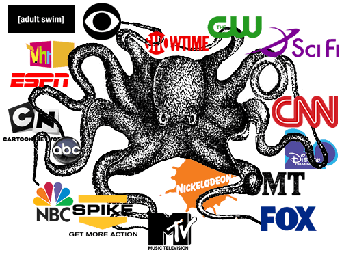
The introduction of the original 1983 edition of The Media Monopoly, Ben Bagdikian’s classic investigation of media consolidation, concluded: “When 50 men and women, chiefs of their corporations, control more than half the information and ideas that reach 220 million Americans, it is time for Americans to examine the institutions from which they receive their daily picture of the world.” When the second edition was released in 1987, the number of people controlling half the media was down to 26. By 1993, as the last edition went to print, the number had fallen to 20.
To arrive at these alarming numbers, Bagdikian—who has been a Washington Post editor and the Dean of the Graduate School of Journalism at Berkeley—charted revenue numbers for each media category. The biggest companies whose combined market share exceeded 50 percent of their sector were counted by Bagdikian as the dominant media corporations.
Since these figures have not been updated since 1993, Extra! used the same methods to calculate a new Media Monopoly number. Based on 2009 revenue figures, the most recent that are available (from Advertising Age, 12/20/10), the number of corporations dominating the media sectors analyzed in Bagdikian’s most recent edition—newspapers, magazines, motion pictures, television and book publishing—has fallen to 15. Expanding the analysis to include emergent technologies like cable television, satellite radio and the Internet, the number of corporations dominating the American media remained at 20.
However, to suggest that as many as 20 corporations dominate U.S. media is somewhat misleading. The five corporations highlighted in Bagdikian’s 2004 The New Media Monopoly—News Corp, Viacom, Bertelsmann, GE and Disney—are far more powerful than many of their counterparts. Take Hearst, for example, one of the companies in the controlling half of the magazine industry. The owner of magazines like Harper’s Bazaar and Cosmopolitan as well as TV and newspaper properties, Hearst’s 2009 net revenue was over $3 billion. Yet compared to Disney’s $18 billion in net media revenue for 2009, it’s clear that even the dominant can be dominated.
And the dwindling number of corporate owners is only one side of the story Bagdikian began telling in 1983. The other component is a media environment increasingly dependent on a commercial model. As the number of owners goes down, overall advertising revenue continues to soar; even in the recession year of 2009, $309 billion was spent on ads (Advertising Age, 12/20/10).
In some industries, like network TV and the motion picture industry, ownership dominance has remained fairly static, while other sectors, like book publishing and radio, have seen their numbers shrink, whether through loosening FCC regulations or traditional takeovers and mergers. As ownership and cross-ownership limitations continue to be either weakened or repealed outright, powerful telecommunications corporations like Comcast and AT&T are now legally free to begin eyeing not only infrastructure, but the content flowing through their pipes. These efforts, if successful, would position these companies above even the currently most powerful media corporations.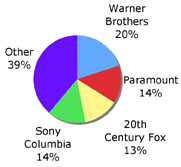
Movies
Throughout its history, the motion picture industry has been dominated by a handful of studios. With the movies consolidated from their beginnings in the early 1900s via the Hollywood cartel system, the studios receiving the majority of revenues continue to be familiar, with some combination of the major six firms raking in the lion’s share—the particular few on top depending on the vagaries of box office receipts.
In 2009, Time Warner’s Warner Brothers, Viacom’s Paramount, Sony/Columbia and News Corp’s 20th Cen-tury Fox together accounted for more than 60 percent of the $10.6 billion box office take, according to the website Box Office Mojo. Back in 1988, the same companies were mostly on top, with Disney’s Buena Vista Films instead of Columbia in the top four. Going back a few more years, to 1975–79, Universal was in the top four rather than Disney, with the rest of the list unchanged. These six studios together took 80 percent of the box office in 2009.
Newspapers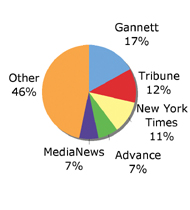
In 1989, the total circulation of daily newspapers in the United States was 63 million, (journalism.org) and 14 chains distributed over half of these papers. Unlike with other media sectors, Bagdikian chose to use circulation rather than revenue to determine the dominant newspaper groups, since individual revenue figures were seldom available. He suggested, though, that revenue figures would have revealed the industry to be dominated by even fewer corporations.
With revenue data now made available by Advertising Age, it’s clear that Bagdikian’s prediction was correct. In 2009, five corporations received over half the newspaper industry’s $19.7 billion revenues: Gannett Co. (publisher of such papers as USA Today and the Arizona Republic), Tribune Co. (L.A. Times, Chicago Tribune), New York Times Co. (New York Times, Boston Globe), Advance Publications (Oregonian, Plain Dealer) and MediaNews Group (San Jose Mercury News, Denver Post).
Magazines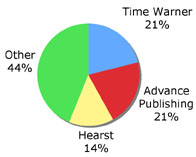
Once a diverse medium, magazines have seen a consolidation rivaled only by radio. In 1981, there were 20 corporations dominating magazine publishing. By 1988, Time Inc. had merged with Warner, and News Corp had purchased Triangle Publications, joining Hearst to take over half the revenue of the entire industry. For 2009, the number of corporations receiving half of the $12.6 billion of magazine advertising revenue remains at three, with one change: News Corp, through the sale of nine magazines, including Seventeen and New York, has been replaced by Advance Publications, owner of Conde Nast. Time Warner still receives the lion’s share, with 40 percent of the market.
With Hearst’s recent $914 million purchase of Hachette’s magazine properties (including 102 titles in 15 countries, such as Elle and Popular Mechanics—Crain’s New York Business, 1/31/11), which came too late to be reflected in this survey, the number of magazine publishers that control half the market has probably been reduced to two.
Radio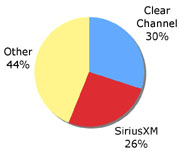
The radio industry in 1982 was dominated by 10 corporations. At the time, the “7/7/7” rule meant one corporation could own up to seven AM stations, seven FM stations and seven TV stations—a limit that was expanded to 15/15/15 in 1985.
With the passage of the 1996 Telecommunications Act, all radio ownership caps were removed, save for regional caps preventing ownership of more than eight stations in any market. Within a week of the Act’s passage, around $700 million was spent on newly available media properties (Common Cause, 5/9/05).
Fifteen years later, the radio industry stands as the most consolidated industry in the media, with two companies, Clear Channel Communications and Sirius XM, controlling over half the revenue for 2009. Since 1995, Clear Channel has increased its ownership from 43 radio stations to 850 in 150 U.S. cities.
Like Clear Channel, SiriusXM benefited directly from government policy. Satellite broadcasting was established in 1990, and the FCC issued two licenses, stipulating that the recipients, Sirius Satellite Radio and XM Satellite Radio, would not be permitted to merge. In 2008, the FCC changed its mind, allowing the merged satellite radio company to overtake the traditional radio powerhouses, CBS and Cumulus Media, in advertising revenue (FCC ruling, 10/19/10).
Network Television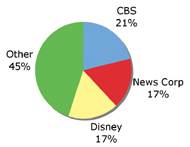
According to the Pew Research Center (12/20/10), TV is the primary news source for 66 percent of Americans. Three companies took in over half the broadcast TV advertising revenue for 2009: CBS, News Corp (Fox) and Walt Disney (ABC). With the addition of NBC, the top four companies receive 70 percent of all broadcast TV ad revenue.
Since the emergence of News Corp’s Fox in 1986, the number of companies controlling the airwaves has remained static, though the owners of those companies continue to change. In 1985, ABC was bought by Capital Cities, which in 1996 sold ABC to Disney. CBS, acquired by Westinghouse in 1995, was taken over by Viacom in 2000. In 2005, Viacom and CBS split, creating its modern incarnation, CBS Corp. GE bought NBC in 1986; in 2009, after this study’s time frame, it sold 51 percent of its stake to Comcast, the nation’s largest cable provider.
Cable Television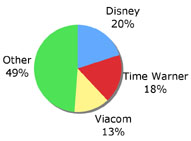
While Bagdikian did not survey the emerging cable systems when editions of The Media Monopoly were still being published, he certainly would have remarked on the quickness with which the cable industry has consolidated. As with the Internet, cable television was initially celebrated as a technological breakthrough that would challenge the dominant networks while giving voice to new individuals and ideas. Such hopes were dampened as cable rapidly became as concentrated as broadcast TV.
For 2009, three cable networks received over half the $49 billion in advertising revenue: Disney, Time Warner and Viacom.
If broadcast and cable TV were treated as a single sector, four companies would have dominated its $74 billion market in 2009: Disney, News Corp, Time Warner and NBC.
Book Publishing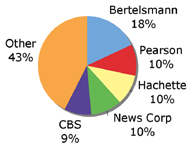
In 1980, 11 corporations received over half the revenue from book sales. By 2009, the number of corporations controlling half the $23.9 billion market had fallen to five: Bertelsmann (owner of RandomHouse), Pearson, Hachette, News Corp (Harper Collins) and CBS (Simon & Schuster). Of the five, four have significant holdings in other media industries. Pearson, while not vertically integrated, takes solace in being the largest education company in the world.
Internet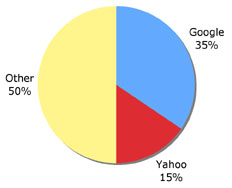
Since Bagdikian’s 1993 analysis, the Internet has exploded onto the media scene, lauded as a egalitarian medium, flush with potential for democratic enrichment.
Idealistic visions have a long history of attaching themselves to new communication technologies. Old-time radio hobbyists certainly felt their early broadcast experiments were the beginning of a better future. Yet with the 1927 Radio Act, the hobbyists were replaced by a government-sanctioned monopoly based on a commercial model. As television began, it too felt the potential for democratic enrichment. Yet instead of opening up the new medium to new players and voices, television likewise went the way of the commercial model.
The Internet’s fate is far from written. However, at this moment, most individuals in the United States may choose from only one or two Internet service providers, and the corporations that currently control the pipes are beginning to make unprecedented gains into the content that flows through them. Provider Comcast, already the highest-revenue media company in 2009, purchased NBC and Universal in 2011.
The revenue from online content is quickly consolidating as well. For 2009, two companies, Google and Yahoo, received over half the $20.9 billion in advertising revenue. As the two leading search engines, these companies use commercially driven algorithms to influence how people explore the Web. Unsurprisingly, then, a majority of users still go to traditional media on- and offline. In measuring media diversity online, political scientist Matthew Hindman of Arizona State (New York Times, 6/2/03; Television Quarterly, Spring–Summer/04) found that the Internet produces levels of audience concentration greater than those of traditional media, while also disadvantaging local content providers.
Monopoly vs. Democracy
In interpreting the First Amendment in 1945, Supreme Court Justice Hugo Black emphasized that “the widest possible dissemination of information from diverse and antagonistic sources is essential to the welfare of the public.” As giant media companies continue to push an interpretation of the First Amendment that focuses only on their freedom to speak, the freedom to hear “diverse and antagonistic voices” has all but disappeared.
While the country is becoming more diverse racially—and remains half female—the heads of all 20 corporations are still white males. Lack of diverse ownership leads to non-diverse newsrooms and viewpoints: According to the American Society of Newspaper Editors (4/16/09), ethnic minorities make up less than 13 percent of newsroom employees, less than 4 percent of television station ownership, and less than 8 percent or radio station ownership. This in a nation revealed by the 2010 census to be 36 percent minority. Women, meanwhile, are 37 percent of full-time newspaper newsroom staff.
Writing for Extra! (6/87), Bagdikian observed, “The American audience, having been exposed to a narrowing range of ideas over the decades, often assumes that what it sees and hears in the major media is all there is.” Since that day, the range of what the American audience hears is controlled by fewer and fewer people. As fast as new technologies are created, they are consolidated in the hands of well-positioned corporations for commercial use.
As the newspaper industry attests, the market is failing to protect the core principles of diversity and localism. Major cities like Houston, Seattle, Denver and Cincinnati are down to one local daily newspaper, a status that is becoming the default condition. While the Internet has sparked optimism, its current news production through blogs and web pages cannot replace well-funded investigations produced by experienced editors and journalists.
As companies collect vertically integrated media properties, market logic inclines them to produce lowest common denominator fare on a national level, neglecting not only their public interest standard obligations, but their crucial responsibility as the fourth estate. Without paradigmatic shifts in the way national media is consumed and regulated, communication technologies, old and new, will continue to serve a corporate minority that is inherently contradictory to the values of democracy.
This morning MLive posted their yearly story on what people can do with their Christmas trees now that the holiday is over.

The article mostly consists of information on where one can take their tree to be recycled. Besides listing where one can take their holiday trees the article cites the hotel manager for the downtown Grand Rapids Holiday Inn, which is offer free Christmas tree recycling this week.
However, the language that the MLive writer uses at the beginning of the article is worth noting, when he writes, “it’s time to give your lovely Douglas Fir the heave-ho before the carpet is completely covered in pine needles.”
This kind of language reflects the general attitude of the culture about Christmas trees that is similar to how the culture tends to view many living things……as nothing more than a commodity to be consumed and discarded once it has served our purpose.
Christmas tree production in the US is a major industry, with roughly 350,000 acres of land committed to Christmas tree production, with an estimated 25 – 30 million sold in the US each year.
If one were to do an online search about the ecological impact of Christmas tree production, most of the first few pages on any search would take you to sites by the Christmas tree industry. These sites of course are not only arguing that that Christmas tree production is “green,” but the industry frames the debate between real and artificial trees.
A good example of this “comparison” comes from the National Christmas Tree Association, with the headline, Making an Eco-friendly choice. However, the debate should not be limited to or focused on real trees versus artificial ones. Instead, we need to change the debate to, is Christmas tree production necessary and is it really environmentally sustainable?

Let’s look at the later question first. Most Christmas trees are grown as a mono-crop, which means that it’s usually the only thing planted in significant numbers in a specific area. Mono-crops are never good for any ecosystem, because they are more susceptible to disease and insect infestation. The usual way that Christmas tree growers deal with this problem is by applying pesticides. According to the group Beyond Pesticides, there are 25 different pesticides used in Christmas tree farming in the US. The use of these pesticides are “linked to one or more adverse effects, including cancer, hormonal disruption, neurotoxicity, organ damage, reproductive/birth defects, asthma, environmental effects and more.”
This means that the pesticides are brought into your home when you put up a Christmas tree, but it also means that the wildlife that interacts with the sprayed trees – birds, insects and small mammals – will also be adversely effected. In addition, those who work on Christmas tree farms that use pesticides will also be negatively affected. In the US there are small family owned Christmas tree farms and there are larger ones, which disproportionately rely on migrant workers. So, not only does the Christmas tree industry put migrant workers at risk of pesticide exposure, they also rely on paying low wages.
Now to the question of whether or not Christmas trees are even necessary. Christmas trees were incorporated into the Christian holiday centuries after the beginning of their religious tradition. Christians in northern Europe incorporated evergreen trees into their celebration because of their interaction with Druids. Druids worship these trees because they remained green even in the dead of winter. However, Druids did not kill the trees by cutting them down and putting them into their homes. This would have been antithetical to their religious beliefs.
However, since there has been a strong theological tendency within Christianity to view nature as there for human use, they had no problem killing the evergreen trees for their own religious purposes. However, it seems rather ironic that Christians kill something to celebrate a holiday based on the birth of their savior, use it for a few weeks and then discard it like any other commodity.
It seems that instead of encouraging people to recycle their Christmas trees, we might want to ask more fundamental questions like do we even need to grow these kinds of trees solely for the purpose of using them for a few weeks during a religious holiday? Not surprising, these are not questions that MLive reporters are asking.
Lowe’s All-American Muslim Fiasco and the Politics of Normalcy
This article by Michelle Chen is re-posted from Common Dreams.
Their slogan is “Never Stop Improving,” but lately, “Never Stop Denying” seems more fitting. Lowe’s has rebuffed a 200,000-signature petition to reinstate ads on the new reality television series All-American Muslim on The Learning Channel.
The retail giant stepped into a big political hubbub once word got out that the company decided abruptly to pull its advertising from the show, which depicts daily life in the Muslim American community, shortly after receiving some nasty backlash from a hardline evangelical group, the Florida Family Association. Apparently showing normal people on television who happen to be Muslim is a sin, and a threat to national security, and would make Jesus mad.
These arguments are nothing we haven’t heard before of course, but activists were jarred when they heard that a big box behemoth like Lowe’s would be cowed by the condemnation of a fringe group of anti-Muslim crusaders. Then again, the FFA did wage a rather virulent campaign to terrorize corporations who dared put their ads on the show. According to the group’s website:
the show profiles only Muslims that appear to be ordinary folks while excluding many Islamic believers whose agenda poses a clear and present danger to liberties and traditional values that the majority of Americans cherish.
Aside from Lowe’s, the campaign also targeted such household names as Hershey’s and Campbell’s Soup, urging supporters to call customer service to voice their rage.
Of course, wingnuts in Tampa aren’t the only ones who wield social media to spread their gospel. The reaction to the reports of Lowe’s pandering to anti-Muslim haters has proven to be much more of a political minefield than running a few commercials on show designed to be emphatically banal. the controversy has provided endless fodder for parodies about home-improvement jihadis, inspired a nationwide boycott, and prompted Russell Simmons to step up to replace the lost financing.
The interfaith Mecklenburg Ministries gathered 200,000 signatures to pressure Lowe’s to reverse its decision, but to no avail. Even in the wake of accusations of “engaging in Jim Crow-style discrimination,” the company’s damage control unit continues to insist that the pulling of the ads was a marketing decision and not a cave to FFA.
Still, Lowe’s spokespeople apparently have not settled on talking points about the influence of hate-mongering critics on their ad campaigns. While Lowe’s VP of Marketing Tom Lamb sheepishly told the Charlotte Observer that “The decision was absolutely not, despite what’s been reported in the media, influenced by any one group,” another spokesperson, according to the Hollywood Reporter, claims that “decisions to pull commercial spots from shows that are considered controversial are made perhaps 8-10 times a year.” As if outraged customers were supposed to find that reassuring.
But in the midst of the hooplah, you’ve got to wonder if the show is worth all the hype, positive or negative. Zaki Hazan had an alternative take on Huffington Post, questioning the hyper-assimilationist mission of the show:
My “meh” reaction to the program comes, I think, from my general dislike of the omnipresent desire among many to turn religions into demographics, and compartmentalizing a far-ranging faith group that includes so much diversity into a single reality cast and labeling it “All-American” just seems counter-intuitive to me. I’ve long held that the best way to demonstrate how “All-American” Muslims are is to just do it without hanging a lampshade on it. Muslim lawyers on lawyer shows, and it’s no big deal. Muslim cops on cop shows, and it’s no big deal. Because, guess what? It’s no big deal.
Now, fringe groups will always spout their bigotry, and probably no reality show will compel them to recognize their disconnect from the real world. What All-American Muslim ostensibly aims to do is to overcome stereotypes held by “average Americans” by showing them that the Lebanese neighbors next door aren’t so scary after all. But the real question is: what does that say about our public discourse? Maybe what prime time television needs right now isn’t a showcase of Muslims being as ultra-American as possible but a conscientious exploration of why our image of the “All American” is actually a complete fiction, why terms like “melting pot,” “tolerance” and “diversity” have become tools for sugar-coating racial and ethnic difference, masking ugly tensions that block honest dialogue and reinforce hierarchy. Lowe’s image problem will probably pass once the controversy subsides, All-American Muslim may or may not change public perspectives, and given the show’s current ratings, it seems many might just shrug and change the channel.
In any case, the bigger picture won’t get much airtime, because corporate television isn’t quite ready to shift the lens away from “Look! they’re just like us!” and toward an idea of “American” that isn’t bound up in assumptions of middle-class normalcy. What would happen if we all just stepped back from our television screens and turned our gaze toward the real America outside our living rooms?
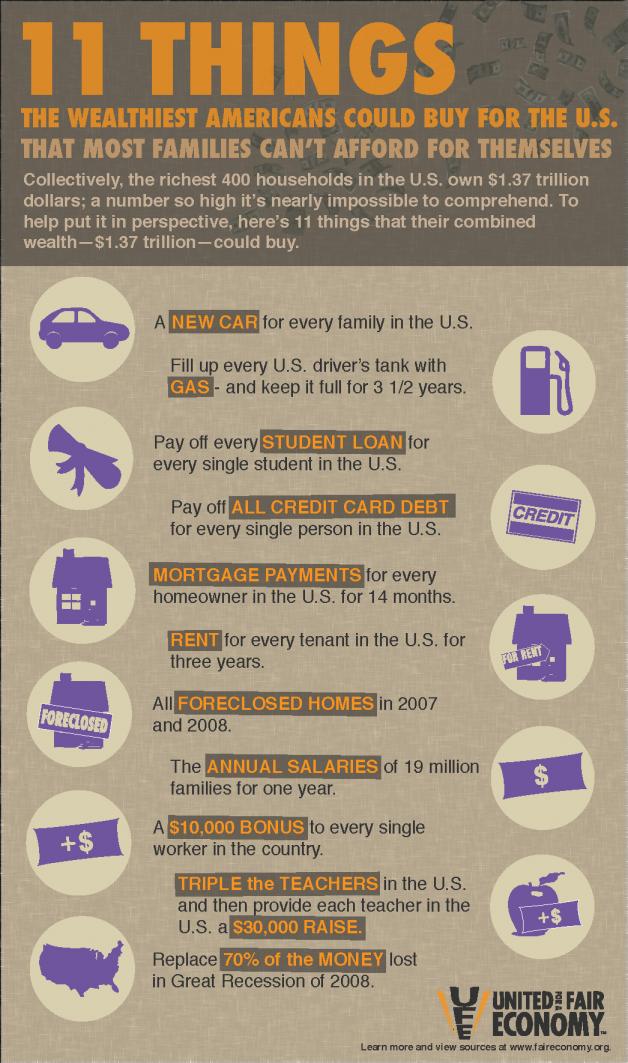
11 things the wealthiest Americans could buy for the US
Editors note: We do not think that the wealthiest Americans will buy the 99% anything. The current wealth disparity in the US will only change when there is systemic change through an anti-capitalist uprising or some other form of revolution. Having said that, the following graphic does present wealth disparity in the US in an instructive way.
Your Christmas Gifts from the One Percent
It’s the most wonderful time of the year, the song says…for the top 1 percent of wealthy Americans, that is. For the rest of us, things are not looking so great.
The paid heavies of the 1 percent, also known as politicians, are as busy as elves in Santa’s workshop, issuing a series of coups against the poor, the unemployed, and the working class to wind up 2011. And some of their creations are real stunners.
In Congress, of course, there’s the payroll tax drama, which could force millions of working-class Americans to dish out more payroll tax in January; and will cost Americans on Medicare the care of those physicians who can’t afford to take another cut in payment for services. Happy New Year!
Here in Michigan, lapdog-to-the-rich Rick Snyder has delivered some great gifts to his wealthy handlers….but coals in your stocking and mine. We’ll be paying more taxes out of our dwindling paychecks in order to pay for Rick’s huge tax cuts to corporations. He’s put us in danger from Emergency Financial Managers who are pillaging our city and school assets, turning public parks into private playgrounds for Michigan’s wealthiest residents, and who are handing out fat privatization contracts for public services that we used to have some say in controlling.
Snyder also made heavy cuts and changes to workers’ compensation in the state, another enormous gift to employers. And of course his slashing of social services put our already vulnerable working poor and unemployed in even more daily jeopardy, but pours more money in the pot for the capitalists who are supposedly creating jobs for everyone.
Under Dick and Betsy DeVos’s tree, he’s placed a fabulous gift: anti-public-school legislation passed at the last minute before the legislature closed down for the holidays. This new law will lift the limit on how many charter schools Michigan can have. The DeVos family for years has dreamed of destroying public school education in the state, and here’s their Christmas wish come true.
For the workers of Michigan, Snyder has thoughtfully provided 2,000 jobs with living wages—his total full-time job creation for the state in his first year of office—for the half-million unemployed in Michigan to share equally between them. (It works out to a four-thousandth of a job per person who needs one.)
But maybe the most iconic Christmas surprise for workers is coming from the 1 percent via leading presidential candidate Newt Gingrich. Gingrich has proposed re-instating child labor in the United States.
No, you didn’t read that wrong.
In a speech at the Harvard Kennedy School of Government and a series of follow-up press conferences this November and December, Gingrich called the laws that protect children against labor violations “stupid.” He subsequently explained why:
1. It deprives children of important life lessons. “Really poor children in really poor neighborhoods have no habits of working and have nobody around them who works,” he explained. This dovetails with the conservative talk radio hosts who are constantly complaining about the laziness of the poor and unemployed. Gingrich feels that if children, starting at the age of 10, are forced to work, they will grow up learning better values than their elders.
He’s never one to be held back by facts. The majority of poor children live in households with at least one working parent, and often with parents who have multiple jobs. In the poorest households, those of America’s 9.9 million single mothers with children, 65 percent of those women hold at least one job.
2. Our current protective laws for children are creating a criminal class, according to Gingrich. At a fundraiser in Iowa, he elaborated on that idea, stating that children from poor families have no “habit” of earning money “unless it’s illegal.” Apparently, forcing them to work at an early age will keep children from all of the criminal activity in which they currently engage.
Again, facts don’t support his words. There’s been an alarming increase in child poverty in the United States. The U.S. Census Bureau estimated that in 2010, 2 million American children lived in poverty. Between 2008 and 2009 alone, the number had jumped 10 percent. But violent crime in the United States is currently at the lowest level in 20 years. And yet politicians, right-wing TV and radio shows, and law enforcement officials continue to claim that child poverty is now, or will very soon, make that rate skyrocket. Gingrich has hopped on that fear-mongering bandwagon.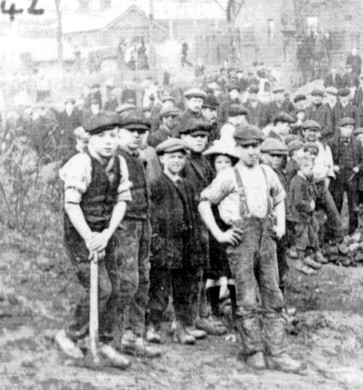
3. Gingrich’s real reason for lifting child labor law protections? It’s his gift to the 1 percent, and a fat one: union-busting. He alluded to it in his Harvard address:
“You say to somebody, you shouldn’t go to work before you’re what, 14, 16 years of age, fine,” Mr. Gingrich said. “You’re totally poor. You’re in a school that is failing with a teacher that is failing. I’ve tried for years to have a very simple model. Most of these schools ought to get rid of the unionized janitors, have one master janitor and pay local students to take care of the school. The kids would actually do work, they would have cash, they would have pride in the schools, they’d begin the process of rising.”
So there’s your real reason for this idea in a nutshell: hiring children, in schools and elsewhere, supplies the wealthiest capitalists with a whole new, cheaper labor force—one that replaces “expensive” union employees with children who are required to work. The pro-child line that this would help kids begin to “rise” from their poverty is just the ribbon on the box. The 1 percent know that.
They also know that they would be placing children in dangerous working conditions. Take those school janitorial jobs. Janitors don’t just sweep floors and empty wastebaskets. They’re responsible for maintaining the furnace and cooling systems, for trouble-shooting electrical problems, for trash compacting and paper shredding, and for handling corrosive chemicals. In fact, janitorial jobs at schools are close to equal with police work in the number of non-fatal injuries, says the U.S. Bureau of Labor Statistics. And now we have Gingrich proposing that ten-year-old children without health care benefits be the ones handling those chemicals and crawling through airshafts to fix HVAC problems. Plus, those pesky unionized salaries and benefits will be a thing of the past—kids will work for pennies on the dollar!
Gingrich’s capitalist owners include Charles Schwab, Robert Wood Johnson (of Johnson & Johnson), Freddie Mac, and casino overlord Sheldon Adelson, one of the five richest people in America. All of them could benefit, directly or indirectly, from accessible and cheap child labor.
There are those who wishfully want to believe that ideas like this are linked to one political party or another. They aren’t. Both parties have politicians who are bought and paid for by the wealthiest Americans. It just happens that most of the 1 percent hold hyper-conservative opinions because those benefit business. But you’ll find plenty of so-called liberal politicians who are waging war on the working class as well, also at the behest of their political contributors. This isn’t politics. It’s class warfare.
Gingrich’s, Snyder’s, and other lawmakers’ Christmas gifts have all helped to make true overlords out of the wealthiest 1 percent, whose net worth during the past 30 years has increased 300 percent on average. CEO pay has reached an average of $9.3 million, while the average salary for the bottom half of Americans is $26,364 and predicted to fall as jobs continued to shift overseas.
It’s been a while since someone has channeled Dickens’ depiction of misery in London’s underclass with such a pitch-perfect tone as Newt Gingrich. But if we don’t stop the wealthy capitalist handlers of Gingrich, Snyder, and other politicians, just imagine what our Christmas gifts next year might look like in this new Gilded Age that is being built around us.
In Honor of Howard Zinn
This video is reposted from ZNet.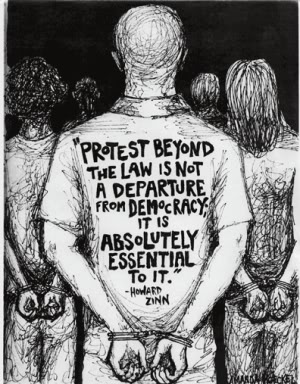
Noam Chomsky, noted author and philosopher, and Anthony Arnove, filmmaker and editor, spoke on Sunday, Dec. 4, at SUNY-New Paltz in tribute to the legacy and life’s work of the late Howard Zinn (1922-2010), American historian, activist and playwright.
This event was titled “Honoring Howard Zinn: An Historian Who Made History.” Presentations by Chomsky and Arnove considered Zinn’s leading role in promoting peace and social justice in the contemporary world. A question-and-answer session follow follows the formal lectures.
Zinn, who played a pivotal role in American civil rights and anti-war movements, wrote more than 20 books, including his best-selling and influential “A People’s History of the United States.” His memoir, “You Can’t Be Neutral on a Moving Train,” was also the title of a 2004 documentary about Zinn’s life and work. He was Professor of Political Science at Boston University from 1964 to 1988.
How do we coddle the Super-Wealthy?

Groups vow to fight Snyder’s decision to sign legislation that eliminates domestic partner benefits
Yesterday, Michigan Governor Rick Snyder signed House Bill 4770, which eliminates health care benefits for domestic partners who work in the public sector.
The Michigan ACLU and numerous LGBT organizations had aggressively fought the new legislation, which passed in the House in September and in the Senate earlier this month.
Voting on the bill was nearly unanimous along partisan lines, with Republicans voting for the legislation and Democrats against. Local State Representative Dave Agema introduced the bill, which adds to his long list of far right legislative proposals, along with anti-immigration, anti-union and anti-Muslim bills.
The statewide LGBT organization Equality Michigan responded to Snyder’s decision by saying, “The Governor’s support for this bill is appalling. He has put hardworking gay and lesbian couples and their children into harm’s way by eliminating important health care coverage.”
The Director for ACLU Michigan added, “The decision to take healthcare benefits away from families just in time for the holidays is mean-spirited and cruel. Governor Snyder had an opportunity to show real leadership and put an end to the political games; instead he approved an extreme policy that sets our state back, jeopardizes our economy and puts our families at risk. The bill serves no other purpose than to single out a small minority of people and deprive them of critical protections as guaranteed by the U.S. Constitution.”
Both the Michigan ACLU and Equality Michigan plans to fight this decision by Governor Snyder, although no specifics are available on what kind of a campaign either group will develop. We will provide updates when any efforts develop.
New Economic report underscores the money making function of ArtPrize
Yesterday, MLive reported on a new study that looked at the economic impact of ArtPrize this past fall.
The report was prepared by the Anderson Economic Group, which was contracted by the local group Experience Grand Rapids. The 37-page report provides an overview of the findings, attendance, attendance experience, economic impact analysis, quality of life benefits, cultural and long-term benefits.
The MLive article provides a brief summary of the findings and cites only three sources, a consultant with the Anderson Economic Group, the VP of marketing for Experience GR and the executive director of ArtPrize.
The MLive article doesn’t question the findings of the report or ask any independent questions of the sources cited. Instead, the story essentially communicates the message that downtown art event was an economically beneficial to Grand Rapids.
The commissioned report defines economic impact as the new economic activity directly or indirectly caused by ArtPrize. This excludes any activity associated with Art- Prize that merely replaces or displaces other economic activity in the region. The net benefits provide a true measure of the economic activity that would not have occurred without ArtPrize.
Some of the data shows that about 73% of those who attended traveled from outside of Grand Rapids and 31% traveled from outside of Kent & Ottawa County. The report also states that $15.4 million was generated directly because of ArtPrize and $4.6 million in new earnings for local households.
The data provided by the Anderson Economic Group certainly supports the normal arguments for the benefits of ArtPrize, which is that it is a great economic stimulator for Grand Rapids. However, the report and most news reporting on the local art extravaganza does not ask fundamental questions about which entities & individuals were the beneficiaries of the money spent by attendees and the ArtPrize organization.
As we have reported before, the primary beneficiaries of money spent by attendees were hotel owners, parking lot owners, downtown restaurants, bars and other retails shops. While one could add that wait staff may have made more money in tips during this time, the bulk of the money made from attendee spending went to a small group of business owners in downtown Grand Rapids.
When looking at the money spent by ArtPrize as an organization, the Anderson report states the bulk of this money was spent on local resources. This is a true statement, but incomplete. It’s incomplete in that a great deal of the money that ArtPrize spent went to a small circle of businesses, many of which are either owned by the DeVos family or closely connected to the DeVos family as we pointed out in another recent article based on 2010 filings. This is one area in which the Anderson report falls short, in that it does not qualify who the economic beneficiaries are. They do report that $4.6 million in new earnings for local households, but provide no analysis of who made up these local households.
The other main conclusion from the report in that ArtPrize provides long-term cultural benefits. The report identifies these benefits as ARTcation – where schools are bringing children on field trips to downtown Grand Rapids; University participation and the educational speaker series that was held during ArtPrize.
Providing children an opportunity to experience art is a valuable cultural experience, but ArtPrize is not the only cultural event in Grand Rapids that would be beneficial for children to be exposed to. In terms of local university participation the report concludes it was beneficial to students and the local campuses indentified. In contrast, there are local students and faculty that this writer has talked with that have a critical perspective of ArtPrize, which are not acknowledged in this report.
Lastly, the speaker series identified in the Anderson report consisted of eight separate events where a speaker or a panel spoke on issues related to ArtPrize. The report does not provide any details on the speaker series, but if the event we wrote about at GVSU was any indication of the quality of the speaker series then that conclusion should also be questioned.
The report concludes by stating that ArtPrize is beneficial to Grand Rapids because it makes it a stronger tourist destination “highlights the city’s ability to foster creativity and entrepreneurship.” This concluding comment in many ways sums up the real purpose of ArtPrize, which is to make money, particularly money for those who are disproportionately in a higher income bracket.
 Grand Rapids Institute for Information Democracy