Justin Amash, the GR Press and voting records
Every Sunday the Grand Rapids Press runs what they call the “Political Polpouuri” section, which consists of a few political sounds bites that are something one would find read at the top of the hour on a classic rock station.
This Sunday’s polpouuri included a short blurb about 3rd Congressional Representative Justin Amash. The sound bite mentions that Amash is only one of 12 members of Congress to not have missed a vote in 2011 and that he posted explanations of all his votes on his facebook page.
The brief news piece also quotes Amash and states he is asking all of his facebook friends to donate $9.48 each for his re-election campaign this year. While there is certainly something to be said for members of Congress who show up for all the votes, the Press tidbit on Amash is problematic in many ways.
First, it appears that the Grand Rapids Press is just reprinting information directly from Rep. Amash without questioning or challenging any of his claims. The Press would better serve the public by publishing Amash’s voting record, which is easily attainable at http://www.votesmart.org/candidate/105566/justin-amash. People can search by most recent votes or by category.
Showing up for every vote might say that Amash is consistent, but it doesn’t tell us anything about where he has stood on key issues. Amash did recently vote against the National Defense Authorization Act, which gives the US military the power to detain US citizens without charging them of anything. In October, Amash voted for the Coal Residuals Reuse and Management Act, which many environmental groups opposed since it weakens regulations on coal ash disposal. Amash also voted for legislation that would repeal EPA emissions regulations for cement manufacturers, which environmental and public health groups opposed because of the toxic pollution that humans and animals are exposed to from cement production.
This past fall, Amash voted for three separate trade bills that restructure trade policies with South Korea, Colombia and Panama. These trade agreements pave the wave for greater corporate profits and drastically reduces worker rights in the three countries and the US, according to the analysis of Public Citizen.
Second, while it is useful at some level for Congressman Amash to post information on why he voted the way he did at his facebook page, it does not replace the necessary role that an independent news source should play in investigating and critiquing said voting record. The news media cannot just act as stenographers for those who have political power, they need to create real transparency and hold elected officials accountable for their actions.
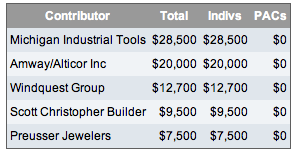
Lastly, for the GR Press to report that Amash is asking his facebook friends to donate $9.48 for his re-election campaign is a bit misleading in terms of who is primary funding sources are for the 2011-2012 election cycle. According to the Center for Responsive Politics, the top 25 campaign donors so far are all corporations, such as Michigan Industrial Tools (owned by the Amash family), Amway/Alticor (DeVos & Van Andel), Windquest Group (DeVos), Koch Industries and Bank of America. All of these entities gave between $2,500 and $28,500. These amounts make the $9.48 that individuals might give to his re-election campaign seem ridiculous since it is the large donors, which truly influence policy.
This is the first 2012 election “article” the Grand Rapids Press has run and based on previous election coverage monitoring it is reflective of the weak reporting we are likely to see all year.
New Media We Recommend
Below is a list of new materials that we have read/watched in recent weeks. The comments are not a “review” of the material, instead sort of an endorsement of ideas and investigations that can provide solid analysis and even inspiration in the struggle for change. All these items are available at The Bloom Collective, so check them out and stimulate your mind.
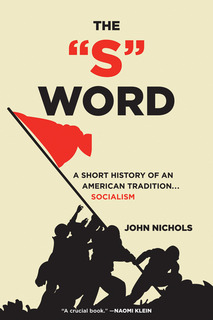
The “S” Word: A Short History of an American Tradition……..Socialism, by John Nichols – Nation columnist and author of numerous books on corporate media in the US John Nichols has written a very interesting book about how much socialism and socialist policies have been apart of US history. Nichols chronicles how entrenched socialist policies and people advocating socialism have been deeply entrenched throughout this country’s history, from Thomas Paine to Walt Whitman and from Horace Greeley to Helen Keller. Nichols also sheds light on socialist policies advocated by labor movements and local municipalities for more than 150 years. A useful antidote to the claims from the far right that the Obama administration is engaged in socialist politics. Nichols provides documented examples of socialism that has been practiced in this country and it looks nothing like what the current administration is up to.
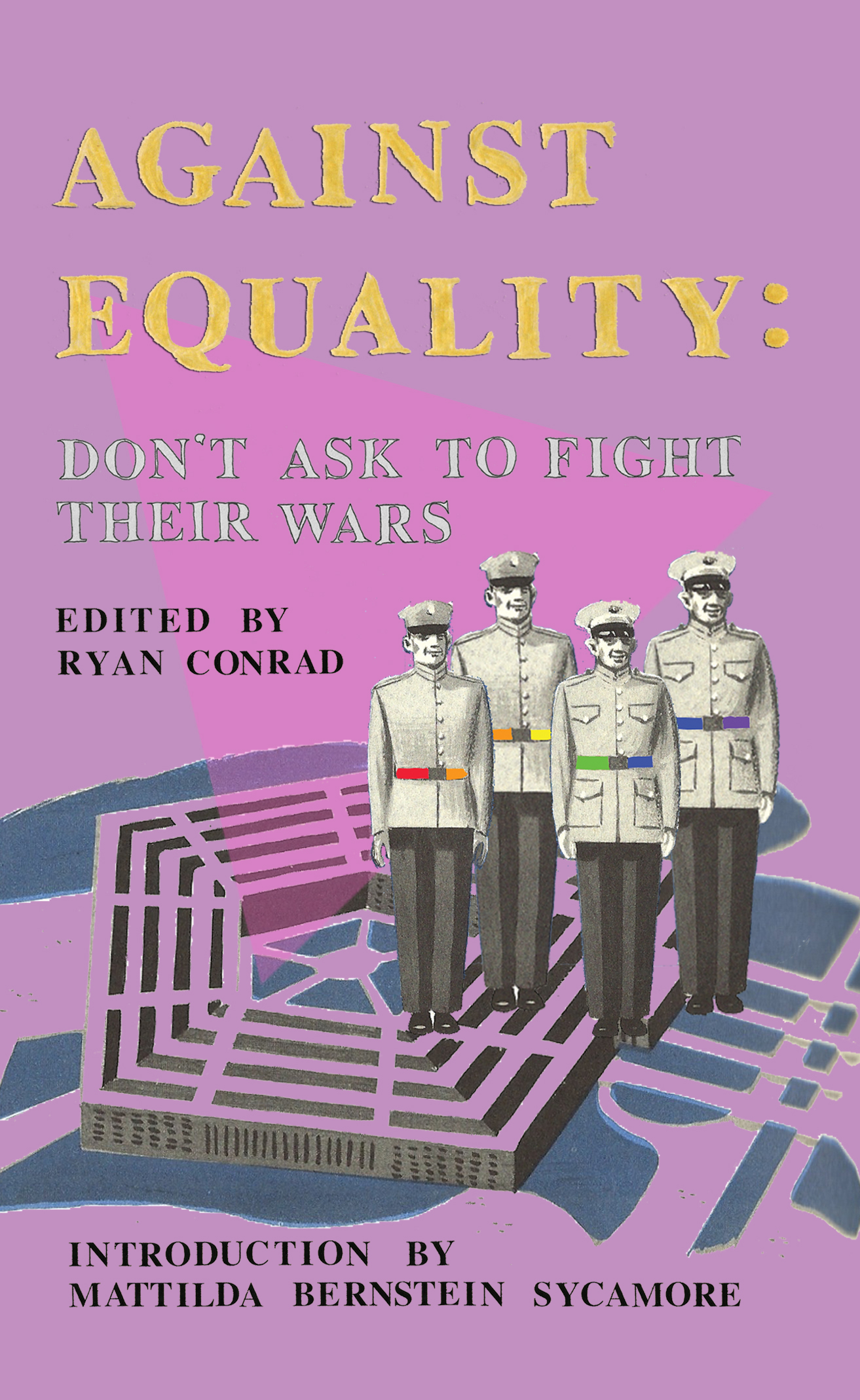
Against Equality: Don’t Ask to Fight Their Wars, edited by Ryan Conrad – This new short book by the radical queer group Against Equality is a collection of essays in response to the passage of the US military policy of Don’t Ask, Don’t Tell. These essays are a powerhouse of analysis of why the mainstream LGBT movement’s support for Don’t Ask, Don’t Tell does nothing more than support oppressive institutions like the US military. The writers collectively challenge the assimilation politics of groups like the Human Rights Campaign, which primarily support policies that benefit members of the LGBT community that are White and more economically well off. The analysis provided in this collection of essays are important since they look at race, gender, class, colonialism and imperialism when discussing the highly problematic policy of allowing gay men and lesbian women to join the military. An important contribution to a growing body of work from growing radical queer community.
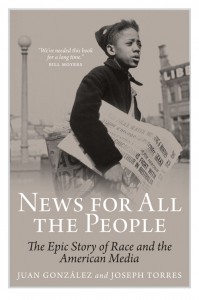
News for All the People: The Epic Story of Race and the American Media, by Juan Gonzalez and Joseph Torres – News for All the People is simply one of the best book I have read on the US media in recent years. Gonzalez and Torres have given us a gift in understanding not only the history of media in the US, but how media has evolved through a race lens. The co-authors present part analysis of how racial minorities have been represented in US media, part history of US media policy and part history of minority produced media in the US over the past 200 years. There are amazing stories of when the first Black newspaper first began, the first Native American radio show and the incredible Latino broadcasters that did cross border organizing and information dissemination. News for All the People is not only a fabulous resource of media history, it is an inspiration and an affirmation of why media analysis and independent media are crucial to any social change work we undertake.
The Black Power Mixtape 1967 – 1975 (DVD) – This new documentary shows some never before seen footage of interviews with people involved in the Black Power movement in the US. Based on recently rediscovered film footage at a Swedish TV station, this documentary provides an interesting look at the message and actions of Black Power activists and organizers such as Stokely Carmichael, Elaine Brown, Eldridge Cleaver, Huey Newton, Bobby Seale and Angela Davis. Maybe the most powerful commentary is provided by Davis, when she responds to a questions from a Swedish reporter about the issue of violence. In addition to the archival footage there is also commentary by contemporary Black writers and musicians reflecting on the significance of the messages presented by those who identified with the Black Power movement. However, despite the power of these newly discovered interviews, the film lacks some historical analysis on the relevance of the Black Power movement for today.
It’s not about the creative class, it’s about Justice
As we reported, last week Michigan Governor Rick signed House Bill 4770, which is legislation that will end domestic partner benefits for public sector workers.
House Bill 4770 was introduced by State Rep. Dave Agema, who has a history of introducing and supporting far right policies that target immigrants, Muslims, workers and the poor. Agema pushed House Bill 4770 because he supports anti-LGBT policies, despite his claims that he just wants to fix the state budget.
However, many people and some LBGT organizations have been arguing that eliminating domestic partner benefits for public sector workers won’t do the economy in Michigan any good because it will not help the state to “retain and attract members of the creative class.”
This language is straight from Richard Florida and is often the mantra of area chambers of commerce. But this argument is ultimately misleading and even harmful.
First, the argument that there can be no discrimination in hiring practices for Michigan’s economy to thrive just doesn’t hold up to history. Michigan’s economy was thriving in the late 19th century and through most of the 20th century even at a time while racial minorities were second-class citizens. The auto industry in Michigan did not suffer from Jim Crow laws that were still in place up until the Civil Rights movement forced the federal government’s hand in passing some reforms. In fact, the Big Three automakers benefited from racial discrimination.
Second, Michigan’s economy, like the rest of the country, has not been hurt from treating women as second-class citizens. Women still don’t make the same amount of money that men do for the same amount of work. After decades of efforts to eliminate the wage gap, women still only make 77% of the wages that men make, according to the National Committee on Pay Equity. Most Michigan businesses have not suffered historically because they pay women disproportionately less than men.

Third, the argument that discrimination against LGBT couples will not attract the creative class only holds up for those in the LGBT community who are part of the young, urban professional sector. What about people who identify as LGBT or Queer and are in the working class? Surely there are those who identify as LGBT who work in fast food, who change the beds in hotels, who work as cooks, janitors, factory workers, take care of the elderly and do all the jobs that are not part of the so-called creative class. Using the creative class argument just re-enforced tiered class structure, which values those who work in IT or marketing over those who care for the sick.
Fourth, supporting this creative class argument with data from the Human Rights Campaign (HRC) is not only weak, it echoes a pro-corporate position that is based on identity politics. As we have noted in recent local news coverage about Whirlpool’s 100% rating from HRC, the narrow identity politics approach ignores other aspects of corporate behavior such as labor practices, environmental concerns and the electoral influence of such companies. Just look at HRC’s corporate partner page and you can see companies like Nike, Goldman Sachs, BP, Chevron and Chase Bank. It’s a line-up of some of the most environmentally destructive, anti-worker and greed driven entities on the planet. Hell, even the poster child for corporate greed, Bank of America, is a corporate partner of HRC.
Lastly, when arguing against discrimination we should always argue passionate from the perspective that it is about justice! We cannot create a slippery slope argument like retaining talent, but should champion the basic idea that no one should be denied health care benefits. Do you think that public sector workers who no longer have domestic partner benefits in Michigan are thinking, “damn, now we won’t be able to attract the creative class.” No, they are thinking, how the hell are we going to afford medical treatment for people we care about.
Until we are motivated primarily by justice we will not be able to protect each other from the inequality that is inherently part of contemporary neo-liberal capitalism. We need to think and act through an intersectional lens that incorporates gender, class, race, sexual orientation, immigration status and the environment into how we discern the politics and practices of the corporate world and government policies. If there is no justice, there will be no peace.
Occupy Our Food
This article/video is re-posted from Common Dreams.
On this past December 4, food activists from across the country joined the Occupy Wall Street Farmers March for “a celebration of community power to regain control over the most basic element to human well-being: food.”
The rally began at La Plaza Cultural Community Gardens where urban and rural farmers talked about the growing problems with the industrial food system and the solutions based in organic, sustainable and community based agricultural production. This was followed by a three-mile march from the East Village of Manhattan to Zuccotti Park, the birthplace of the Occupy Wall Street movement.
This video by Anthony Lappe offers an inspiring glimpse into this new movement. Check it out and then go to Food Democracy Now, a grassroots community dedicated to building a sustainable food system, to find out how you can help.
This interview with Noam Chomsky is re-posted from ZNet.
A darling of the left, Noam Chomsky is well known for his articulate criticisms of US foreign policy. The American intellectual takes special interest in how the US coddles authoritarian regimes under threat, in particular when political and economic interests are involved.
Chomsky is a longtime professor in the department of linguistics and philosophy at the Massachusetts Institute of Technology, where he is also famous for developing theories involving the “manufacture of consent” and the dissemination of propaganda through mass media.
Recently, he offered to share his personal views on post-Mubarak Egypt with Egypt Independent.
Egypt Independent: What is your view on the unfolding of events regarding the military’s transitional period? And where do you think the US stands on this?
Noam Chomsky: From the outset, there has been every reason to expect that the US and the military, which are of course closely allied, would do what they can to limit functioning democracy.
Egypt Independent: For what particular reasons, in your opinion?
Chomsky: The military, for obvious reasons: they want to maintain the maximum of political control and protect their considerable economic interests. The US government, for a range of reasons: The narrowest is that they are well aware of Egyptian public opinion, as reported in polls run by the most prestigious US polling agencies, and the last thing they want is for those opinions to be reflected in policy, as would happen in a functioning democracy. The broader reason is that in general, democracy is considered a threat to power interests, at home as well. Abroad, it is well-established in mainstream scholarship that the US has supported democracy if and only if it conforms to strategic and economic interests, and there isn’t the slightest evidence that these understandable, if deplorable, commitments have changed.
Egypt Independent: Why the continued statements from Washington condemning military brutality and advocating the flourishing of democracy?
Chomsky: Of course there is a rhetorical commitment to democracy and all good things, but only the most naïve take such protestations seriously, on the part of any state. And practice, including very recent practice, fully accords with the traditional doctrines.
Egypt Independent: What do you mean by “traditional doctrines?”
Chomsky: When a favored dictator is endangered, as happens over and over, Washington follows a fairly straightforward procedure: Support him as long as possible. If it is no longer possible, for example, if the army turns against him, then issue ringing declarations about our yearning for democracy and then work hard to keep the former system of domination and control in place, as much as possible. Examples abound: Somoza, Marcos, Duvalier, Chun, Ceausescu, Mobutu, Suharto, and others. That the same procedure was followed in the case of Mubarak should surprise no one.
Egypt Independent: Do you sense that the US would be willing to compromise principles such as human rights in order to maintain interests such as Israel and the Camp David accords?
Chomsky: Principles such as “human rights” cannot really be compromised, because they are not seriously upheld in the first place — except, of course, with regard to enemies, or where major power interests are not at stake. The evidence on this is overwhelming, not just for the US of course, so much so that it is superfluous even to recall some of the numerous examples. US power centers, state and private, have longstanding strategic and economic concerns in the region, which they continue to regard as vital. Government policies reflect these concerns, as did those of Britain and France in their days in the sun (and still, even as minor powers). And the same is true of others.
Egypt Independent: With regards to the US, do you believe everyone is on the same page across the board? i.e: state department, congress, white house, defense etc.
Chomsky: Systems of power are not homogeneous, so there are some differences within the government and the business-based power centers that have an enormous role in setting domestic and foreign policy. But the spectrum is not very broad. There are of course those who depart from the consensus, those whom Kennedy-Johnson National Security Adviser McGeorge Bundy called “wild men in the wings.” And there are forces outside, including public opinion when large segments of the public are organized and active. But within the operative spectrum, only restricted options are tolerated, as the record clearly reveals.
Egypt Independent: Recent reports have surfaced alleging that the US Senate has motioned to make its annual US$1.3 billion in military funding in fiscal year 2012 contingent on the transfer of power to a civilian government — on the basis human rights violations and “misuse” of tear gas, etc. What do you make of this?
Chomsky: The word “allegedly” is important. The US has laws prohibiting transfer of arms to states that resort to torture, serious human rights abuses, and other crimes — for example, Israel’s gross violation of the Geneva Conventions in the occupied [Palestinian] Territories. Are they applied in any significant measure when they interfere with strategic and economic interests?
Egypt Independent: With regards to public opinion, what are your views on the persistent use of counter revolutionary propaganda through the state media, particularly with regards to distorting news reportage of collisions between the military and protestors, in post-Jan 25 Egypt?
Chomsky: Authoritarian regimes of course try to restrict and control thought and its expression. Some, like Nazi Germany, seem to have been quite successful in doing so, Bolshevik Russia somewhat less so, but that was over a much longer period without ongoing military conflict as a mobilizing force.
Egypt Independent: But despite increased skepticism from Egyptians towards state media earlier this year, state propaganda continues to prove particularly effective in diverting and distorting public opinion over time. What do you think makes it so?
Chomsky: I presume it is a reflection of more fundamental concerns. Struggle against harsh and brutal systems is costly. People have to survive, a matter of particular concern for those at the edge of survival in the first place. As the struggle goes on, and people do not see concrete gains in their daily lives — rather, disruption and insecurity — it is natural that many would seek stability, which means subordination to power. A side effect might be greater willingness to accept propaganda that places the blame for hardships on the struggle for freedom and justice. That is a common phenomenon in such struggles, throughout history.
Egypt Independent: Recently, there has been what some have described as “media warfare” between independent journalism and state mass media. Do you think that this is actually a two-sided “struggle” with increasing horizontal/social media platforms posing a threat, or is it too marginal to have an actual impact on established information hierarchies?
Chomsky: On the likely impact, I do not know enough to express a judgment with any confidence. Whatever the judgment, it is clear what should be done: extend the challenge, and enlist larger groups into participation with it. It is no doubt an unequal battle, but systems of power do not necessarily win. The overthrow of Mubarak is only one illustration. It is not necessarily a losing battle. What to do depends on judgments of those directly involved.
Egypt Independent: Speaking in regards to previously threatened dictatorships with strong US ties, as you mentioned with respect to “traditional doctrines,” any views on how you see things playing out this time and/or hopes for optimism?
Chomsky: The greatest hope for optimism is offered by the courageous people who have been risking great danger in Tahrir Square to overthrow a brutal regime, inspiring others throughout the world; and by the many like them today and throughout history who have refused to cower in silence in the face of oppression and injustice. That is how the world has become a more decent place, not without regression, often at an agonizingly slow pace, but with many significant victories.
What the local 1% thinks about the economic outlook for 2012
It is nearing the end f 2011 and that often means that people are looking to next year, sometimes even making predictions.
This is what one of the main business publications did in its year-end issue. They asked West Michigan business leaders to comment on what they thought the 2012 economy will look like.
The “economy” is one of those nebulous terms that suggest there is this large entity that we all participate in. While it is true that national and international economic trends do impact all of us, the economy is not some hegemonic entity that only functions one way. Indeed, in the age of speculative capital, people can make money without producing anything tangible.
The US economy is a form of neo-liberal capitalism, where the state is highly protective of the market and taxpayers often subsidize big business. Some companies still produce products and in that model make profits off of the labor of workers. So, it is not surprising that a business publication asked business people and not workers to predict the economic outlook for 2012. Working people would have a lot to say about the economy, but as it is with news coverage in general, their opinion don’t matter that much unless they are speaking as consumers.
What the local 1% thinks about the economy
MiBiz asked dozens of business leaders to chime in and offer a brief forecast on the economic outlook for 2012, particularly for West Michigan. As could be expected most had positive things to say about the economy in West Michigan considering many of those business leaders saw significant profits in 2011 and have enjoyed the benefit of state and regional policies that favored business over labor.
Curt Pullen, the executive VP at Herman Miller said, “Despite lingering uncertainties, we believe that our people, with our highly responsive business model and proven ability to execute our strategy, will enable us to continue to grow and prosper.” At some level you have to admire the way that business people talk. It seems as though Pullen is only referring to his company and not the economy as a whole, thus we could translate his comment as they will continue to make profits by marketing office equipment around the world, benefiting from trade policies that have opened up foreign markets to US manufacturers.
Joseph Papa, CEO of Perrigo, had a similar statement that focused on his company’s economic outlook. “With the continued shift in consumer behavior to store brands, we’re confident that any economic impact will only enhance the benefits to Perrigo and its customers.” Well, in a profit based health care system, Perrigo is certain to continue to make significant profits.
Mitchell Watt, President and CEO of Triangle Associates, thinks there will be a slight decline in revenue in 2012. This is the case for his company, which has been making significant amounts of money in recent years from taxpayers when school millages are passed. “There are pockets of opportunity in the college market, particularly those with private allocations. In the K-12 market, we see a slight decline in the quantity, value and passage success rate of bond referendums due to continued public concerns over the slow economic recovery.”
Cascade Engineering CEO Fred Keller also sees a positive outlook for 2012, especially for his company. His statement touts their sustainability projects, but then he admits that the main profit growths will be in the sectors that make containers and truck parts. So much for sustainability.
Carl Erickson, President of Atomic Object, is pretty excited about the future. He says, “Strong corporate earnings and new sources of venture and angel money in Michigan fuel the demand for software development from both large companies and startups.” Not a surprising statement considering who is on their client list.
Tom Fehsenfeld, President of Crystal Flash and founding member of the West Michigan Sustainable Forum, had this to say. “One of our major businesses is selling diesel fuel, and diesel is a good index of the economy because it moves goods. In the last few months we are seeing some solid increases in year-to-year sales trends.” More diesel fuel sales are good for Crystal Flash, but not so good for the environment and public health.
The duel leaders at Amway, Steve Van Andel and Doug DeVos, are delighted with what 2012 has in store for their company. “Our optimism is because direct selling continues to have great appeal for people in our top markets, including China, Japan, the US, Korea and Russia. The industry has become a $132 billion global industry that provides an opportunity for almost 90 million people to sell own their own business.” Translated, this means that those near the top of the Amway pyramid will make a ton of money off of those who do the actually selling at the grassroots.
In another section of the MiBiz publication there are several business leaders hoping for a push in 2012 to make Michigan a Right to Work state. One example is Tim Schowalter, CEO of Pioneer Construction, who says, “I think Governor Snyder has been doing a great job providing leadership in Lansing particularly in regards to balancing the budget. I would like to see him champion the Right to Work legislation so Michigan will be more attractive to major companies looking to locate here.” Translated, this means dismantle labor unions so that companies can make even bigger profits.
One additional question posed to area business leaders had to do with the 2012 election and its impact on the economy. Some thought that the partisan bickering is bad for business, but Robert Roth, CEO of RoMAn Manufacturing Inc. had the most honest assessment when he said, “Quite frankly, if Obama wins and we retain a Republican House and enough Republican power in the Senate, it will be more of the same.”
While these statements are short, they do give us a window into the mindset of the local 1%……and it doesn’t look good for those of us who make up the 99%.
Mass Black Incarceration Ending? Don’t Hold Your Breath

This article by Glen Ford is re-posted from Black Agenda Report. Editors Note: Black scholar and author of the book The New Jim Crow: Mass Incarceration in the Age of Colorblindness, will be speaking at GVSU on January 18 (5pm – Allendale Campus/Kirkof) and January 19 (10am – Allendale Capus/Cook-DeWitt Center).
For the first time since 1972, the total number of people held in U.S. prisons has gone down. And, for the second year in a row, the number of persons under supervision – such as parole – by state departments of correction, decreased.
Does this mean the beginning of the end of mass Black incarceration in the United States? Not hardly. That would require an historic reversal of a nationwide policy to find new places to put Black people who refused to stay “in their place,” in the wake of the Civil Rights and Black Power Movements. There is little in the current American political conversation that indicates white people have reconsidered – or even acknowledged – their extraordinarily broad support for placing more Black people in captivity over the past 40 years than at any time since slavery.
It takes the government almost a year to tabulate the past year’s prison statistics, so the latest numbers are from 2010. They show about 7.1 million people under some kind of correctional supervision – one out of every 33. That’s down 1.3 percent from 2009, the year that saw the first decrease in supervision in two generations. The total population in state and federal prisons – not counting local jails – stood at 1.6 million inmates, down six-tenths of one percent. State prison populations decreased by almost 11,000, and local jails by almost 19,000, but federal prison populations grow by eight/tenths of one percent, to almost 210,000 inmates. That was, however, the smallest percentage increase in a generation – since 1980.
Half of the states reported decreases in their prison populations, with California and Georgia shrinking the most.
Speculation on why prison populations have, at least temporarily, peaked, centers on the financial crisis. It is true that states are experiencing unprecedented difficulties paying their bills. Some states have clearly responded to their fiscal crises by finding ways to incarcerate fewer people. Michigan reduced its prison population by 6,000 inmates in three years, mainly by decreasing the number of inmates who wind up serving more time in jail than they were originally sentenced to. California is under court order to cut its prison population by 30 percent, or 40,000 inmates. But the court order came too late to have a significant effect on 2010 prison numbers.
Only half the country has seen any decrease, at all. Twenty-four states and the federal prison system increased their inmate populations, with Illinois, Texas and Arkansas leading the pack. And states have found other ways to cut down on inmate costs without putting fewer people in prison, through wholesale privatization of prisons, and imposition of draconian fees on prisoners, probationers and parolees.
The Pew Research Center on the States cites programs that divert some offenders to probation, and accelerated release of low-risk inmates. However, studies have shown that such diversion programs tend to serve disproportionately white offenders. Therefore, it is highly premature for anyone to speculate that the era of mass Black incarceration may be ending. For the foreseeable future, one out of eight of the world’s prison inmates will continue to be African American.
The Top Ten Revolutionary Videos of 2011
This list is re-posted from Dissident Voice.
At the end of the year, news agencies around the world, including the BBC, report the ten most popular YouTube videos of the past year. The lists inevitably contain some of the most banal, irritating, or mildly amusing videos of the past year, but rarely do we see the BBC and their ilk reminding us of the startlingly powerful images of resistance and revolution. So, in honour of those who were maimed or killed in 2011 in service of a better world, here are ten of the most memorable moments of revolt in 2011:
1. “Suicide that sparked a revolution” Upload date: January 19, 2011; Source: Al-Jazeera English
The self-immolation of Menobia Bouazzizi, a young Tunisian man, was the spark that ignited the Arab Spring.
2. “The Most AMAZING video on the internet #Egypt #jan25 Upload date: January 27, 2011; Source: hadi15
Beginning on January 25, the Egyptian people revolted against its Western-backed dictator, Hosni Mubarak. At the height of the protests, anywhere from 250,000 to 1 million people occupied Tahrir Square in Cairo.
3. “Go Forth and Revolt” Upload date: August 17, 2011; Source: go4thREVOLT
This parody of a Levi’s commercial reminds us never to accept corporate co-optations of revolutionary acts or symbols.
4. “I AM NOT MOVING – short film – Occupy Wall Street” Upload date: October 10, 2011; Source: CoreyOgilvie
Taking its lead from the Arab Spring, Occupy Wall Street attempted an insurrection in the heart of finance capitalism. While many people accused it of being too white, too amorphous, or too masculine, OWS rehearsed the pluralistic politics of the world to come, and brought considerable mass media attention to the crimes of capitalism.
5. “Oakland Policeman Throws Flash Grenade Into Crowd Trying To Help Injured Protester” Upload date: October 26, 2011; Source: kresling
There was no shortage of police brutality captured on video in 2011. Veteran Scott Olsen was shot in the head by an Oakland police officer, while defending Occupy Oakland from a police assault.
6. “London Riots. (The BBC will never replay this. Send it out.) Upload date: August 9, 2011; Source: mYcHeMiCaLrOmAnCeGaL
Darcus Howe, a West Indian writer and broadcaster, called the London Riots what they were: an insurrection. This wasn’t the explanation a condescending BBC newscaster wanted.
7. “Anonymous—Message to the American People” Upload Date: December 3, 2011; Source: anonymous04210
Hacktivist collective Anonymous continued to attack repressive state and corporate apparatuses in 2011, promoting the Guy Fawkes mask and V for Vendetta to the status of revolutionary icons for the digital age. In this video, Anonymous addresses what may be the most draconian piece of legislation the United States has ever seen, the National Defense Authorization Act 2012, which appears to enable the US government to detain American citizens indefinitely and without trial, another expression of creeping global fascism.
8. “Oil Gateway” Upload Date: September 16, 2011; Source: stimulator
Colonial resource extraction has always harmed indigenous communities and the environment. Oil extraction is no different. The planned Keystone Pipeline extension and Northern Gateway pipeline would expand production in the notorious tar sands of Alberta. Dozens of First Nations communities in Alberta and British Columbia united in 2011 to oppose these pipeline projects.
9. “Police pounded by petrol bombs in Athens” Upload Date: February 23, 2011; Source: ReutersVideo
“Austerity” was the word of the year for 2010. Greece was ground zero of the global austerity agenda. After stealing as much as $29 trillion of public money, the global finance capitalists decided to re-engineer capitalism on the backs of workers worldwide. In Greece, the opposition to austerity has been militant.
10. “Shocking Video: ‘Blue bra’ girl brutally beaten by Egypt military” Upload Date: December 18, 2011; Source: RussiaToday
The symbolic import of this video cannot be overstated: the vicious beating of an Egyptian woman by members of the military captured the dominant visual meme for 2011, the visible brutality of state actors against domestic populations. In particular, the gendered violence on display reminds us that women of colour, especially living in the Global South, continue to receive the brunt of state capitalist violence.
Of course, there are more than 10 such videos. If you have a personal favourite from 2011, please post it in the comment section below.
Grand Rapids Press acts as an echo chamber for the Military

Since the 9/11 terrorist attacks GRIID has conducted 7 different studies of the local news media’s coverage of the so-called war on terror, with particular attention to the US wars in Iraq and Afghanistan.
The last study we conducted in the summer of 2009 looked at the Grand Rapids Press coverage of the US occupation of Afghanistan, now in its 11th year. In that report we identified three major elements about the Press coverage: 1) the paper did not question the Pentagon’s framing of the US motives for being in Afghanistan, 2) the sources used in the coverage were primarily Associated Press stories with predominantly US government/military personnel being those cited in the articles, and 3) when there was any local reporting it focused on local military families who were in support of the war in Afghanistan.
Today, the Grand Rapids Press continues this type of pro-military reporting with an article entitled, Families of troops in Afghanistan want Americans to remember ‘there is still a war going on.’
The article by Press reporter Ted Roelofs cites exclusively military family members, military personnel and a wounded veterans project coordinator, all of which are supportive of the ongoing US occupation of Afghanistan.
Apart from the sources cited the other major problem in this story is the tone of both the sources and the Press writer himself. Early on in the article the Press reporter is talking about one family that has both a son and a daughter in the military that are likely headed to Afghanistan. The Press reporter then says the military family member, “is justifiably proud of their service.” The reporter doesn’t qualify what he means by justifiably, but it seems clear to this writer that such a statement is an endorsement for those in the military.
This pro-military attitude is continued with a statement from one of the military family members who talks about his kids going to Afghanistan. “I think it’s the greatest thing that could happen. Without people like that, we would not have the rights for these boneheads to be protesting against their government.”
Of course this military dad has every right to believe what he is saying, but the Press reporter doesn’t question such a statement or at least balance it out with an anti-war perspective.
Don’t forget there is a war in Afghanistan
Besides the pro-war sentiments in both the military families and the Press reporter the other major journalistic flaw in this story is that it is implied in the headline that we need to be reminded of the US war going on in Afghanistan.
One could certainly argue that corporate media has failed to make the US war in Afghanistan an issue over the past year. According to the Project for Excellence in Journalism only 2% of all major news stories in 2011 were about Afghanistan. This is a drop from the 2010 coverage of Afghanistan, where 4% of the major US news coverage was devoted to that war.
However, beyond the failure of the US media to make the US occupation of Afghanistan news worthy, there is also the failure to report on it outside of the framing provided by the Pentagon.
First, there is very little coverage of US veterans of that war, both those who are suffering from physical and psychological wounds as has been well documented in a 10-part series entitled Beyond the Battlefield.
Second, there is virtually no reporting on what the impact of the 11-year US occupation has had on the Afghan people. The Chicago-based group Voices for Creative Non-violence have been documenting atrocities committed against the Afghan people since 2009.
Third, there has been a virtual blackout in the commercial news media about US veterans who have served in Afghanistan and are now speaking out against this war. There was a major speaking tour this past October and Afghan war vets have been an active part of Occupy movement around the country. I wonder if the military family member cited in the Press article would call these veterans “boneheads” as well?
Lastly, we are all remind of the 11-year US war in Afghanistan in an indirect way, since the money spent on this brutal military occupation has cost the public over $486 Billion and counting. This means that for the state of Michigan, over $11 Billion has left the state to pay for this war and over $175 Million has left Grand Rapids. Thus, we are all too often reminded of this war since the lack of funding of public services has diminished significantly, leaving families by the millions in the US without basic necessities as adequate housing, food, education and health care.
If the Grand Rapids Press reported on the US occupation of Afghanistan through an independent lens and not that of the Pentagon, we might actually not need to be reminded of the 11-year war by military families who seem to have contempt for those who oppose the war.
Graphics to undermine the 1%
We have posted several graphics in the past week that provide useful visual analysis of the wealth disparity in the US. On December 23 we posted one on how we coddle the super wealthy and on December 24 we posted a graphic on how the wealth of the rich could be redistributed to benefit the public.
Today’s graphic also looks at wealth disparity in the US, but uses an American flag to make a point. We encourage people to share these digitally, to download them and use them in zines or make flyers and post them around town in order to counter the images and messages of capitalism.

 Grand Rapids Institute for Information Democracy