Northern Border Coalition forms to push for Immigrant and Immigration Rights in Michigan
This article is based on information available from Alliance for Immigration Reform Michigan.
For the first time ever, Northern border states have united to urge the Department of Homeland Security to reform the Border Patrol division of Customs and Border Protection.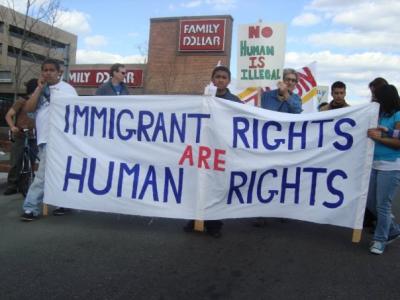
For years, northern border residents have endured civil and human rights violations, documenting a long history of racial and religious profiling, harassment, abusive interrogation, searches without probable cause, road checkpoints and sweeps of public transit.
In response, many residents and advocacy groups, organized under the Northern Borders Coalition, have signed on to a major position statement, which calls on Secretary Janet Napolitano to take back control of her rogue department. This Sign-On letter was delivered to Sec. Napolitano on February 7, in coordination with several other events during the month of February that call attention to the fundamental problems with the way DHS patrol our nation’s northern borders.
The sign-on letter was put together by northern border organizations that work with, for, and in the communities that suffer abuses by border patrol agents. These organizations included Alliance for Immigration Reform- Michigan and New York Immigration Coalition, among others. In addition to the sign-on letter, additional organizing efforts include a Northern Border Conference in Detroit on February 23 & 24, and a “We Are the Border” National Day of Action on February 28th. That day of action marks the one-year anniversary of the death of Alex Martinez, a US Citizen, who was shot and killed by U.S. Border Patrol and Local Law Enforcement in Washington State. His story is just one of thousands of people who’ve been mistreated in border communities. It’s clear that U.S. Border Patrol is abusing their authority and our communities.
For example, in 2011 at a family birthday party in Nooksack, Washington, a small girl had an accident and fell in the driveway. Her mother called 911 for an ambulance. In addition to medical help, firefighters, Sheriff’s Deputies, and Border Patrol agents all arrived at the home. Border Patrol agents walked around the party asking people for names and other information. Many guests ran inside the home and closed the door. The residents of the home were U.S. Citizens with the last name of Martinez (different family than the example listed above).
“Racial profiling, aggressive interrogation, and questionable collaboration between Customs and Border Protection (CBP) and state and local law enforcement have become the norm along the northern border in New York,” said Chung-Wha Hong, executive director of the New York Immigration Coalition. “Such enforcement tactics fail to secure our border and violate constitutional safeguards that apply to U.S. citizens and immigrants alike.”
Short Film exposes Enbridge environmental practices
This video is re-posted from EcoWatch.
Editors Note: Enbridge, the company responsible for the more than 1 million gallons of oil that leaked into the Kalamazoo River in the spring of 2010, is a major part of the Alberta Tar Sands Project and would make millions if the Keystone Pipeline Project were approved in the US. This powerful film includes a section on the ecological disaster that happened in Michigan nearly 2 years ago.
Filmmaker Corey Ogilvie has produced a great new short film on the risks versus benefits of Enbridge’s proposed new pipeline that would take raw bitumen from the tar sands to the coast of British Columbia.
This film focuses on the impacts of the inevitable spills from the pipeline. There are, of course, also impacts from the pipeline when it doesn’t spill—upstream impacts on Alberta’s land, air and water from digging up the tar sands, and downstream impacts from the climate change caused by burning the oil.
Small group of labor activists protest outside Amash’s office on unemployment benefits issue
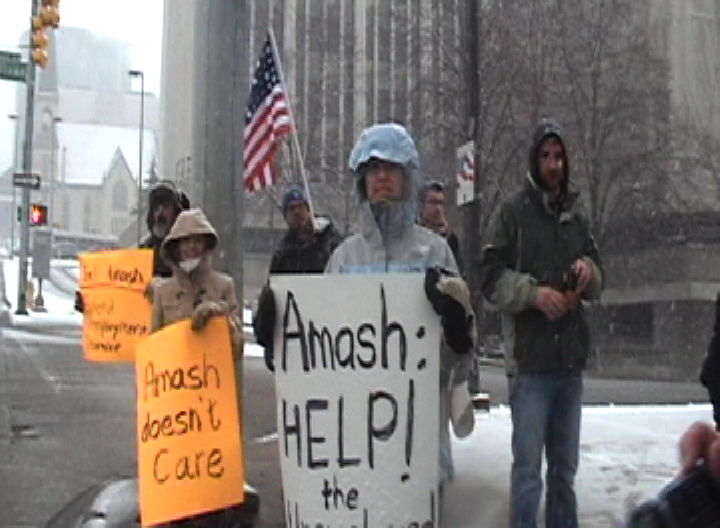
Earlier today about 15 people gathered in front of the federal building in downtown Grand Rapids to make a statement about Rep. Justin Amash’s position against extending unemployment benefits for millions of Americans.
One protestor we spoke with was a retired UAW worker (Dale), who said, “this was the most anti-worker Congress he has seen” in his life and that these policies are just one tactic being used in “the war on working people.”
The protest was one of several happening across Michigan today and was called for by the AFL-CIO to call out Republican legislators who do not support extending unemployment benefits and who want further conditions placed on those who do. However, the Democratic Party has recently said they would agree to cutting the length of time people could be on unemployment, according to a Huffington Post story posted today.
The only commercial media entity to show up today was WZZM 13 who interviewed Sue Levy from the UAW. GRIID also interviewed Levy and filmed the first two questions asked by the channel 13 reporter. Sue wanted to address the issue of the GOP proposal of drug testing for unemployment recipients, but the TV 13 person said, “we are not going there.” GRIID asked Sue Levy what her thoughts were on the proposed drug testing as well as her thoughts on ending corporate welfare benefits.
Bank Bailout 2: Obama Lets Mortgage Abusers Off the Hook
This article is re-posted from Common Dreams.
The Obama administration announced this morning that the five largest U.S. banks have agreed to a $26 billion ‘settlement’ to end lawsuits over abusive practices that forced millions of families from their homes and helped bring about the nation’s financial meltdown.
After months of talks with state and federal officials, the banks have reportedly agreed to help some homeowners reduce their mortgage debt or refinance their homes at lower rates. Over 4 million familes lost their homes to foreclosure yet just 750,000 people who lost their homes to foreclosure will receive a one-time check for just $1,800 to $2,000, which for many will barely cover the cost of moving. The deal will only help a fraction of the struggling homeowners affected by the bank’s practices.
New York and California have reportedly signed off on the deal after initially holding it up in protest of lenient treatment of the banks.
The deal gives banks immunity from civil lawsuits for “robosigning,” a practice whereby homeowners were rapidly evicted without proper vetting.
In his January 24th State of the Union address, President Obama promised a fresh investigation into mortgage abuses that led to the financial meltdown. Now, before that investigation has even begun, Obama is granting these 5 “too big to fail” banks immunity from “robo-signing” abuses.
* * *
UPDATE: Matt Taibbi writing at Rolling Stone:
…this looks like America’s public prosecutors just wilted before the prospect of a long, drawn-out conflict with an army of highly-paid, determined white-shoe banker lawyers. The message this sends is that if you commit crimes on a large enough scale, and have enough high-priced legal talent sitting at the negotiating table after you get caught, the government will ultimately back down, conceding the inferiority of its resources.
* * *
Yves Smith, writing at NakedCapitalism:
The Top Twelve Reasons Why You Should Hate the Mortgage Settlement
[…] As we’ve said before, this settlement is yet another raw demonstration of who wields power in America, and it isn’t you and me. It’s bad enough to see these negotiations come to their predictable, sorry outcome. It adds insult to injury to see some try to depict it as a win for long suffering, still abused homeowners.
1. We’ve now set a price for forgeries and fabricating documents. It’s $2000 per loan. This is a rounding error compared to the chain of title problem these systematic practices were designed to circumvent. The cost is also trivial in comparison to the average loan, which is roughly $180k, so the settlement represents about 1% of loan balances. It is less than the price of the title insurance that banks failed to get when they transferred the loans to the trust. It is a fraction of the cost of the legal expenses when foreclosures are challenged. It’s a great deal for the banks because no one is at any of the servicers going to jail for forgery and the banks have set the upper bound of the cost of riding roughshod over 300 years of real estate law.
2. That $26 billion is actually $5 billion of bank money and the rest is your money. […]
3. That $5 billion divided among the big banks wouldn’t even represent a significant quarterly hit. […]
4. That $20 billion actually makes bank second liens sounder, so this deal is a stealth bailout that strengthens bank balance sheets at the expense of the broader public.
5. The enforcement is a joke. The first layer of supervision is the banks reporting on themselves. […]
6. The past history of servicer consent decrees shows the servicers all fail to comply. Why? Servicer records and systems are terrible in the best of times, and their systems and fee structures aren’t set up to handle much in the way of delinquencies. […]
7. The cave-in Nevada and Arizona on the Countrywide settlement suit is a special gift for Bank of America, who is by far the worst offender in the chain of title disaster. This move proves that failing to comply with a consent degree has no consequences but will merely be rolled into a new consent degree which will also fail to be enforced. […]
8. If the new Federal task force were intended to be serious, this deal would have not have been settled. You never settle before investigating. It’s a bad idea to settle obvious, widespread wrongdoing on the cheap. […]
9. There is plenty of evidence of widespread abuses that appear not to be on the attorney generals’ or media’s radar, such as servicer driven foreclosures and looting of investors’ funds via impermissible and inflated charges. While no serious probe was undertaken, even the limited or peripheral investigations show massive failures (60% of documents had errors in AGs/Fed’s pathetically small sample). […]
10. A deal on robosigning serves to cover up the much deeper chain of title problem. […]
11. Don’t bet on a deus ex machina in terms of the new Federal foreclosure task force to improve this picture much. If you think Schneiderman, as a co-chairman who already has a full time day job in New York, is going to outfox a bunch of DC insiders who are part of the problem, I have a bridge I’d like to sell to you.
12. We’ll now have to listen to banks and their sycophant defenders declaring victory despite being wrong on the law and the facts. They will proceed to marginalize and write off criticisms of the servicing practices that hurt homeowners and investors and are devastating communities. […]
* * *
And at Firedoglake, Scarecrow writes of the ‘settlement’:
Obama’s Guiding Principle: Leave No One Accountable
[…] The Obama Administration has followed a predictable pattern we now recognize. It has consistently functioned like criminal defense counsel, whose mission is to get their criminal clients, the major corporations and executives who fund their elections, off with no admission of guilt, no forced resignations, and as little harm to their reputation, or that of the counsel, as possible. To do this, they neutralize anyone with an ounce of public purpose in their veins.
Its role is then to convince the public that whatever you thought or feared was going on in America, and whoever you believed had caused the collapse of America’s economy, caused millions to lose their jobs, their homes and their retirements and continued to loot the country, it’s time to look forward. Because everyone who matters — and that’s not you — now agrees, they say, to function in the public interest, even though it’s a bald face lie, since nothing has changed and the looters and their complicit overseers are still in charge.
Obama’s people have performed this function for America’s looters over and over again. They did it for Wall Street, the banks, the rich tax evaders, the insurance companies, the oil companies, the gas companies, the coal companies, the CIA, the DoD, and numerous torturers and their legal/policy enablers and associated war criminals in the previous administration.
Consistent with this strategy, Obama’s team must silence, neutralize or punish anyone who protests or blows the whistle on the massive criminality and corruption involved. It must also emasculate the left and what’s left of the liberal wing of the Dem Party, using the argument that the Administration is not nearly as awful as the other Party’s people, who openly glorify looting and killing and vilifying the victims.
But of course, when we were ruled by the latter, everyone with any humanity was repulsed by the open looting and killing and indifference and was willing to say so. When the Administration sanctions it, however, we are supposed to bite our tongues, because it could be worse.
Well, it’s worse, and it’s more insidious and corrupting of our souls than where we were four years ago. It is evil.
New Media We Recommend
Below is a list of new materials that we have read/watched in recent weeks. The comments are not a “review” of the material, instead sort of an endorsement of ideas and investigations that can provide solid analysis and even inspiration in the struggle for change. All these items are available at The Bloom Collective, so check them out and stimulate your mind.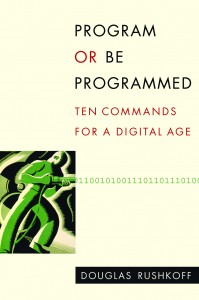
Program or Be Programmed: Ten Commands for a Digital Age, by Douglas Rushkoff – Living in an increasingly digital world, despite all the claims of freedom and wonder, does come with consequences, political, social, cultural and personal. In his newest book, Douglas Rushkoff gives us another gem. The media & culture theorist presents ten ideas or guidelines about how we might navigate in the online world. Many of these notions are not likely to be new to people, but Rushkoff presents a fresh take on the implications of human interaction in the digital world. The author discusses the amount of time we spend online rather than in person, whether that is in person with others or just ourselves. Program or Be Programmed also takes on issues of online identity, scale, complexity and choice. In addition, the author challenges us with the notion that the less we know about programming in the digital world will likely result in our collectively being programmed. What the author means by that is that we will often begin within the framework of interaction and information that has been determined by someone else, not through our own initiative and creativity. An important book for those grappling with digital reality and its social implications.

Postmodern Imperialism: Geopolitics and The Great Games, by Eric Walberg – The political term The Great Game first came into use in the 19th Century referring to the political conflict between Russia and Great Britain. Ironically, this conflict was best manifested in both countries desire to control and rule what is now modern day Afghanistan. The author uses The Great Game theme as he explores geopolitics, particularly in the Middle East. Walberg presents a very interesting thesis on the major applications of The Great Game theory over the past 100 years and identifies three “rules” for how it is applied, particularly by the US. The three “rule” are; 1) neoliberal trade policies supported by international finance; 2) imperial wars and occupation and; 3) Empire exceptionalism, which is really a reference to US global policy. The book is well sourced and covers a great deal of historical ground, although at times unnecessarily. However, Postmodern Imperialism is a value resource for anyone wanting to understand global geopolitics and contemporary US foreign policy.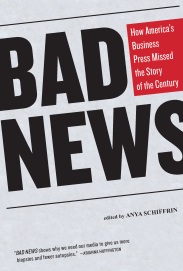
Bad News: How America’s Business Press Missed the Story of the Century, edited by Anya Schiffrin – How is it that there was so little reporting on the impending financial crisis in 2008 by the mainstream news media? This is one of the main questions answered by numerous writers in this interesting collection of essays on the US news media’s role in the recent global financial meltdown. Some authors argue that the mainstream news media generally reports the official narrative on economic matters and rarely steps outside the accepted economic framework. Other contributors discuss the media through a class lens as large corporate entities who are financially tied to the world of Wall Street and therefore have no incentive to report on the policies and practices of the financial sector. There are also a few writers whose critique centers more on the decades long decline of journalism in the US their failure to hold both political and financial power accountable. A worthy collective of articles with analysis that would be helpful to anyone who wanted to better understand the 2008 economic crisis.
Plastic Planet (DVD) – A fascinating documentary that looks at the often hidden realities of plastic in the modern world. Directed by Werner Boote, investigates how plastic is produced, how it is used and more importantly the environmental and health consequences of a powerful global industry. The film uses archival footage from 1950s US Tupperware parties to industry promotional video that stands in sharp contrast to the devastating impact of the fossil fuel and chemical based product known as plastic. Plastics are so pervasive that they are now is all the major bodies of water, in the soil, in the bodies of fish, birds, other species and humans. The film has great production value and provides viewers with a wealth of information on one of the most pervasive and toxic substances current used by most of the world.
Obama Joins the Democracy Sell Off……again
This article by Tim Karr is re-posted from Common Dreams.
President Obama succumbed late Monday to the dark logic of the Super PACs, instructing top West Wing staffers to help raise money for the so-called “independent” groups that have been successful in picking winners and losers thus far in 2012.
“We decided to do this because we can’t afford for the work you’re doing in your communities, and the grassroots donations you give to support it, to be destroyed by hundreds of millions of dollars in negative ads,” Obama’s campaign manager Jim Messina wrote supporters in an email Monday night.
This is no small news — which explains why the New York Times placed this story on page one today — as it signals that the president has reversed his earlier stance against working with Super PACs and joined others on the low road to political influence.
It also sounds the starting gun for the real race to win the White House in 2012 — one that will very likely award the candidate who raises the most cash with victory in November. In this case, though, it won’t be the victor who gets the spoils, but the wealthy corporations and individuals that funded him.
What’s really happening in 2012 is a transfer of money and power unlike any other in the history of U.S. politics. It’s a process that’s unfolding in corporate boardrooms and corridors of political power, far from public view or scrutiny.
Here’s what we’ve found:
1. Money Wins Elections: According to the Center for Responsive Politics, the federal candidate who raised more money in 2008 won his or her race nine out of 10 times. Former White House political czar Karl Rove knows this well. His Super PAC American Crossroads and 501(c)(4) group Crossroads GPS recorded an unbroken string of victories in 2010 after spending an estimated $40 million. This year he’s aiming to raise more than five times that.
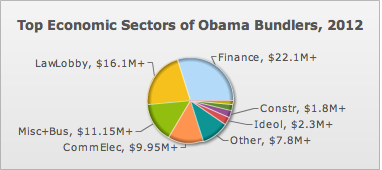
2. The Wealthiest Give the Most: Thanks to the 2010 Citizens United decision, the overwhelming majority of political contributions (in terms of dollars) now come from the wealthiest corporations and individuals. According to the Sunlight Foundation, almost half of the contributions to the nine largest super PAC spenders thus far came from just 22 donors, who each gave more than $500,000. Nearly 80 percent of their donors were those who gave more than $100,000. It’s a list that includes some of the wealthiest hedge fund managers (Julian Robertson: $1 million for pro-Mitt Romney Super PAC), Hollywood execs (Jeffrey Katzenberg: $2 million for pro-Obama Super PAC) and property developers (Bob Perry: $2.5 million for Karl Rove’s Super PAC).
3. There’s More Being Spent Now than Ever Before: 2012 will break all previous records for contributions to campaigns, Super PACs and even less accountable 501(c)(4)s, all of which are concentrating their spending on media buys in local television markets. Kantar Media’s Campaign Media Analysis Group estimates that candidates, political parties and independent groups will spend up to $3.3 billion to buy TV ads during the 2012 election season. That’s a 57 percent increase over the estimated $2.1 billion that was spent on local ads during the 2008 election cycle.
4.Political Ads Work: The reason so much money is being spent on so many ads is that it’s a proven formula for success. Newt Gingrich saw a near-complete reversal of his political fortunes in both Iowa and Florida after “Restore Our Future,” a pro-Romney Super PAC, plowed many times more money into ads in those states than Gingrich’s counterpart. Romney’s camp and his allies aired nearly 13,000 television commercials in Florida, compared with fewer than 300 by Gingrich and his supporters, according to a study by the Wesleyan Media Project. As in Iowa, this on-air onslaught coincided with the decline of Gingrich support in the polls, and, ultimately, at the ballot box.
5. Broadcasters Are a Part of the Problem: The broadcasters benefiting most from this massive transfer of money oppose any effort that would require them to better disclose who’s buying political influence. Broadcasters balked at the Federal Communications Commission proposal to put online the political advertising information in their “public files,” preferring to keep this information hidden away. But it gets worse. According to Free Press’ recent report Citizens Inundated, stations are also providing less of the sort of local political coverage that would help viewers separate political fact from fiction in an election year.
6. Transparency Can’t Take a Back Seat to Business as Usual: The FCC chair who is supposed to hold stations accountable just got a signal from his boss in the White House that this backdoor money-and-media game is now business as usual in Washington. The FCC would do well to ignore that message and push broadcasters to embrace the sort of transparency and accountability that would shed light on the money that makes these Super PACs tick. This action becomes even more important now that the president has decided to cast his lot with these shadowy outside groups.
Powerful film about the 1960s Freedom Riders will be screened in Grand Rapids on February 16
Next week, the powerful documentary, The Freedom Riders, will be screened in Grand Rapids. The event is a joint effort between the Grand Rapids branch of the IWW, The Bloom Collective and Occupy GR.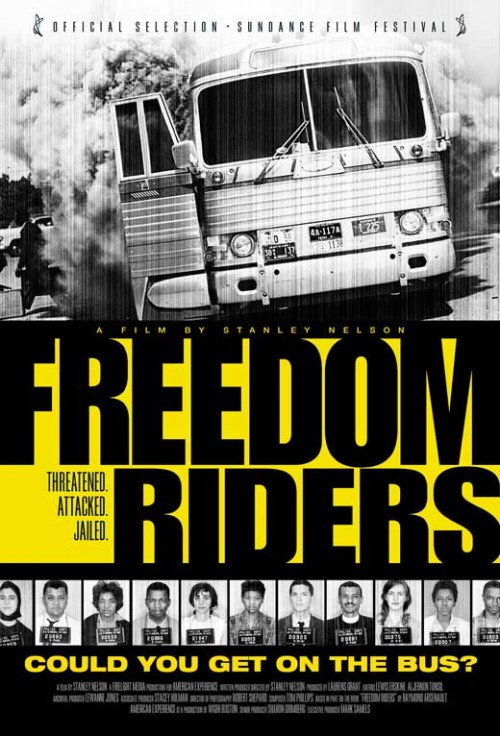
In 1961, segregation seemed to have an overwhelming grip on American Society. Many states violently enforced the policy, while the federal government, under the Kennedy administration, remained indifferent, preoccupied with matters abroad. That is, until an integrated band of college students-many of whom were the first in their families to attend a university-decided, en masse, to risk everything and buy a ticket on a Greyhound bus bound for the Deep South. They called themselves the Freedom Riders, and they managed to bring the president and the entire American public face to face with the challenge of correcting civil-rights inequities that plagued the nation.
Veteran filmmaker Stanley Nelson’s inspirational documentary is the first feature-length film about this courageous band of civil-rights activists. Gaining impressive access to influential figures on both sides of the issue. Nelson chronicles a chapter of American history that stands as an astonishing testament to the accomplishment of youth and what can result from the incredible combination of personal conviction and the courage to organize against all odds.
The film will be shown on February 16 at 7:00PM.
The location is:
IATSE Labor Hall
931 Bridge St. NW
Grand Rapids, MI.
The film is free and open to the public. A discussion will follow.
The Grand Rapids group Healing Children of Conflict (HCC) is hosting another film series over the next several months on both the GVSU and Calvin campuses.
The three-film series looks at the Middle East, with particular emphasis on the Israeli/Palestinian conflict. The first film is a documentary entitled, The Iron Wall, which looks at the Israeli settler expansion and the massive wall that is still under construction and is creating tremendous animosity amongst Palestinians.
The second film in the series is the 2008 animated documentary entitled, Waltz with Bashir. Waltz with Bashir looks at the horrors of the 1982 Lebanon War. The third film in the series is the 2006 film, Encounter Point. This film tells the story of an Israeli settler, a Palestinian ex-prisoner, a bereaved Israeli mother and a wounded Palestinian bereaved brother who sacrifice their safety, public standing and homes in order to press for a grassroots movement for nonviolence and peace.
The HCC film series is part of the group’s mission, which is to do education work around global conflicts that the US is involved and children are being seriously wounded. All 6 film-screening dates are free and open to the public.
Iron Wall
February 15, 7:00PM at GVSU – Manitou Hall Room 102, Allendale Campus
February 22, 7:00PM at Calvin College, Bytwerk Theater
Waltz with Bashir
March 14, 7:00PM at GVSU – Lake Huron Hall Room 142, Allendale Campus
March 15, 7:00PM at Calvin College, Bytwerk Theater
Encounter Point
April 4, 7:00PM at GVSU – Lake Huron Hall Room 142, Allendale Campus
April 5, 7:00PM at Calvin College, Bytwerk Theater
Super Bowl Ads Part II: Budweiser and brand loyalty
The only alcohol company that ran ads during the 2012 Super Bowl was Anheuser-Busch, which has been one of the top companies to feature new ads during the big game for years.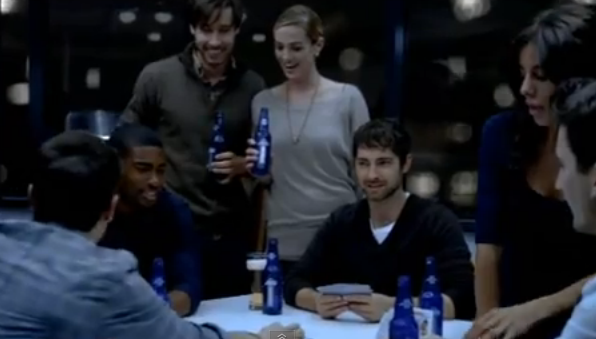
The company aired five different commercials, with three different themes. There were two commercials devoted to rolling out their new brand, Bud Light Platinum. One of those ads is in a factory setting, where the new age beer is being processed. The other Bud Light Platinum ad takes place in a high rise building featuring young urban professionals who mix work and play. As is with most advertising that targets the twenty-somethings, this ad is full of “pretty people.”
A second theme in the Budweiser ads that ran during this years Super Bowl was the theme of prohibition. The first ad featured a sad and dull society, with everyone focused on working. However, once prohibition is lifted everyone celebrates and Budweiser is delivered to a local saloon by the Clydesdale horses. The other prohibition themed ad takes viewers on a historical timeline ride from decade to decade from the 1920s all the way to the present, showing how in every era Budweiser has been enjoyed by the masses.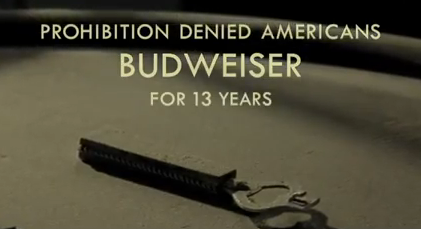
What is interesting about Anheuser-Busch’s use of the prohibition theme is that the company did better than most during that period. The company produced near-beer, a product that would rival the non-alcoholic beers on the market today. The company also received special licenses during prohibition to make beer above the near-beer level for “Medicinal purposes,” thus allowing them to stay ahead of their competitors. Lastly, the company was selling malt syrup, which they said was for making companies, but some sources acknowledge that this product was for those who wanted to make their own beer at home.

The last ad that Budweiser featured during the 2012 Super Bowl was an ad that continued a marketing trend begun by the beer company in the 1980s. Budweiser featured a dog named Wego, which when called by someone would hear, “Here We Go.” This has been a tag line of Budweiser ads in recent years and in is the command in this ad for the dog to go fetch beer for people.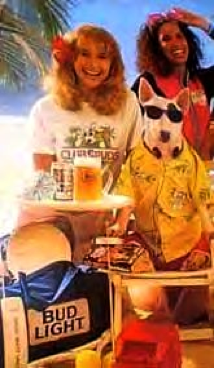
This marketing trend, using dogs or other animals, that act human began with the company’s create of the character Spuds McKenzie in the 1980s and has been repeated by their use of frogs, lizards, horses and mice. Wego is just the most recent in a long line of animals used to grab the attention of children in order to build Brand Loyalty. Developing brand loyalty works like this; if we can get children to think of our brand when they think of beer, it will increase the likelihood that they will purchase Budweiser when they are of drinking age. The use of animal characters who act human is the tool they use to plant their brand in the minds of children, a technique that advertisers have been using, which is based on their understanding of brain development in children.
Super Bowl commercials Part I: Male Fantasy and feminist bitches
Over the next several days we will offer up a few critiques and some media deconstruction of ads that were featured during the 2012 Super Bowl.
The annual game has been the most watch TV day of the year for the last three decades, with an estimated cost of each commercial being $3.5 million. In addition to the cost, marketers know that the viewership has changed with the introduction of a celebrity music half-time show and the creation of Super Bowl commercial parties – which was an idea that was thought to be grassroots, when in fact it was something that the ad industry created and is now being mimicked by the public.
In today’s installment, we’ll look at body images and hyper-sexual messages that were part of several Super Bowl spots.
One company that has made it a point to use women’s bodies to brand their image is Go Daddy. These commercials are almost becoming predictable, featuring professional race car driver Danica Patrick.
This year’s Go Daddy spot was fundamentally no different that previous ads during the Super Bowl, with at least one woman naked. In this ad, Patrick is accompanied by another woman as they paint Go Daddy phrases on the body of a third woman. The usual suggestive language is used throughout the spot and the all too familiar Go Daddy jingle at the end as we are told that even more is to be revealed at Go Daddy online.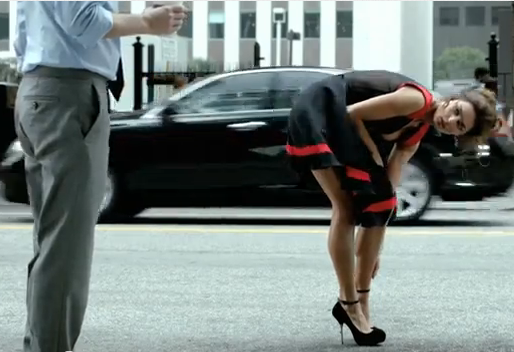
However, a commercial by Fiat robbed Go Daddy of its annual “sexist ad” status, when the car company unveiled their new ad during the Super Bowl. In this spot a nerdy looking guy is walking down the street with a latte and is stopped dead in his tracks when he sees a woman bent over in the street wearing a stunning black and red dress.
The woman sees that he is looking at her and snaps at him in Italian, saying, “What are you looking at? Were you stripping me with your eyes?” However, the woman then warms up to the man, embracing him and then dipping her finger into his latte. Some of the foam drips off her finger onto her chest. She continues to talk to him in Italian saying, “Poor thing, You could do no less. Did it make your heart skip a beat? Did it make you dizzy? You’ll be lost thinking of that sensation forever.” She then leans in as if to kiss the man and all of a sudden he wakes up and the Fiat Abarth is parked in the street where he first saw the woman. Essentially Fiat is using male fantasy as a means of selling their new car. Indeed, Fiat refers to this commercial as Seduction.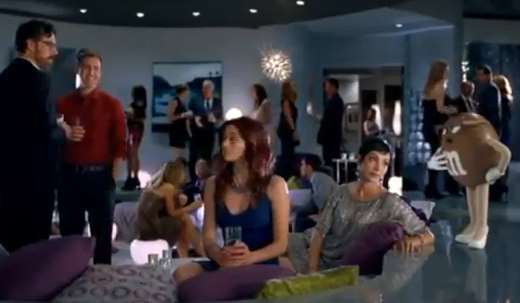
Another interesting commercial that dealt with body image and sexual content was an M&M spot. A female M&M character is talking with two woman, while two men look on. The men are laughing and the M&M character asks the women why they are laughing. One of the women says, “They think you are naked.” The female M&M character explains that her outer coating is chocolate colored and she then shames the men who walk away in embarrassment.
Up to this point the add could be viewed as empowering for women, since all the female characters in the spot seem disgusted with the behavior of men, plus the female M&M character calls out the adolescent male behavior. Unfortunately, the ad doesn’t end there. A male M&M character moves the audience back into a silly mood when he takes his outer coating off thinking the female character is nude. This is all accompanied by the male M&M character dancing and music blaring in the background. The female M&M character continues to look disgusted at the end of the spot, but the “humorous” component of the spot shifts the focus away from women’s confidence and onto the “guy acting silly.”
Of course, we can’t forget the H&M commercial featuring soccer legend David Beckham. In this spot Beckham is only wearing his underwear, while the camera moves up and down his body, while we hear the song Please Don’t Let Me Be Misunderstood, sung by the Animals.
I think the spot is problematic on two levels. First, it presents a body image of men that most men simply will never achieve. This beauty standard for men in media certainly can impact how men see themselves and it might also influence what women are attracted to, by normalizing the 6-pack ab body.
However, the more devastating aspect of the ad is that it gives some men fuel to say that men and women’s bodies are being equally exploited in media, so women should just shut up and stop complaining about it. In fact, this comment and many more explicit are all over the blogosphere and on youtube, where men are complaining about “feminists” and “bitches.”
The problem with such observations is that just because a man’s body is being used to sell a product, doesn’t mean there is parity in regards to the larger social consequences of this kind of objectification. Men are not being sexually assaulted by women every 6 seconds in this country and men are not suffering from some form of eating disorder at the astronomical rates that women are because of the gender norms that have been imposed on society. Men who want to say, “we are now even,” because of the David Beckham ad just don’t want to acknowledge the tremendous privilege they have.
 Grand Rapids Institute for Information Democracy