iPads, iPhones, iPocrisy
This article by Scott Nova is re-posted from CounterPunch.
The New York Times’ revealing series on why Apple produces most of its iPhones and iPads in China beautifully illustrates one of the defining dynamics of contemporary capitalism: abusive labor conditions in the overseas factories of US corporations are not, contrary to industry rhetoric, a problem to be solved; they are a highly prized driver of profitability.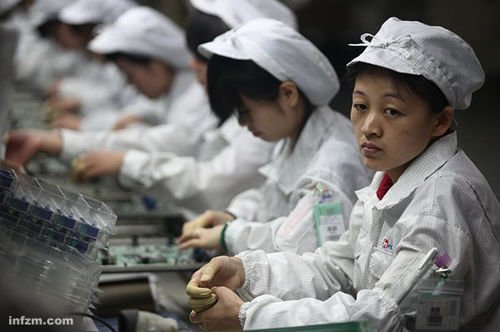
The Fantasy World of “Corporate Responsibility” vs. the Real World of Global Supply Chains
While Apple and its competitors know they must pay lip service to concern for worker rights, lest their brand’s image be tarnished, the practical reality is that if worker rights were genuinely respected in places like China, production costs would be higher, deliver times slower, and profits correspondingly lower. The last thing these brands want is for any of the countries where they exploit low-wage labor to actually enforce their own workplace laws, much less comply with international standards.
This is why there is a yawning gap between the public rhetoric of these corporations on labor rights issues and the actual manner in which they operate their supply chains. Their public statements are suffused with pious expressions of concern for workers and accounts of ostensibly strenuous efforts to promote labor rights compliance by their suppliers. In practice, these corporations maintain a production model that routinely exploits the very labor abuses they claim to abhor. The Times reporters exposed this mammoth hypocrisy, on the part of the world’s most revered and profitable company, by getting former Apple executives to speak candidly (albeit anonymously) on the subject – the kind of enterprising effort to pierce the corporate public relations veil that is seen all too rarely in mainstream journalism.
Here is new Apple CEO Tim Cook, articulating the company’s official position – that it is deeply committed to uprooting abuses in its supply chain, but that this arduous work that will take years to complete: “We care about every worker in our worldwide supply chain…Every year we inspect more factories, raising the bar for our partners… [W]e’ve made a great deal of progress and improved conditions for hundreds of thousands of workers. We know of no one in our industry doing as much as we are, in as many places, touching as many people.”
Meanwhile, here is a former Apple executive, telling the truth: “We’ve known about labor abuses in some factories for four years, and they’re still going on. Why? Because the system works for us. Suppliers would change everything tomorrow if Apple told them they didn’t have another choice. If half of iPhones were malfunctioning, do you think Apple would let it go on for four years?” The abuses in question include unconscionable safety practices that have led to numerous workplace deaths and injuries.
‘The speed and flexibility is breathtaking.’
And consider this charming tale, also told to the Times by a former Apple executive. The Times writes: “One former executive described how the company relied upon a Chinese factory to revamp iPhone manufacturing just weeks before the device was due on shelves. Apple had redesigned the iPhone’s screen at the last minute, forcing an assembly line overhaul. New screens began arriving at the plant near midnight. A foreman immediately roused 8,000 workers inside the company’s dormitories, according to the executive. Each employee was given a biscuit and a cup of tea, guided to a workstation and within half an hour started a 12-hour shift fitting glass screens into beveled frames. Within 96 hours, the plant was producing over 10,000 iPhones a day. ‘The speed and flexibility is breathtaking,’ the executive said. ‘There’s no American plant that can match that.’”
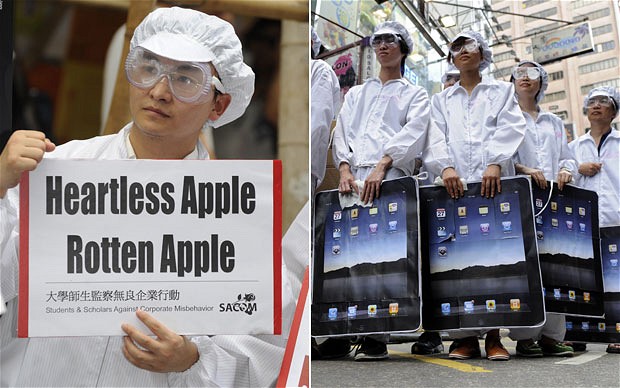
A wonderful story about the responsiveness of Chinese manufacturers to their customers’ needs, no doubt. Except that the management methods upon which this awe-struck Apple executive heaps such fulsome praise constitute massive violations of Chinese labor law. These laws strictly limit overtime hours – a mandate routinely ignored in practice, to Apple’s evident delight.
Imagine finally closing your eyes after a grueling 12-hours shift on an ultra-high-speed production line, only to be shaken from sleep moments later and forced back onto the line for another dozen hours of punishment. Imagine doing this for a cruel joke of a wage, under the thumb of managers whose idea of motivational strategy is to penalize slower workers by making them stand at attention, immobile, for hours, as a lesson to their fellow employees. This is the price workers pay for the “breathtaking speed and flexibility” that enable Apple to implement, in a few days, design changes that would take a month at any factory whose managers did not have the power to drag the entire workforce out of bed when it suits Apple’s needs. (On the plus side, the workers do get a biscuit.)
This former Apple executive’s unusually candid description of what actually goes on at Apple’s overseas plants was, of course, dutifully denied by the company that runs the facility. Like all of Apple’s suppliers, that company, Foxconn, is well-schooled as to the official line on labor rights issues. According to the Times, Foxconn claims that “a midnight shift, such as the one described, was impossible ‘because we have strict regulations regarding the working hours of our employees based on their designated shifts, and every employee has computerized timecards that would bar them from working at any facility at a time outside of their approved shift.’” The Times notes that “employees, in interviews, have challenged those assertions.”
Indeed they have; recall that this is the same production facility where the brutal regime has driven substantial numbers of workers to suicide, which they usually commit by leaping from the roof of the overcrowded dormitories. (Foxconn’s solution to this horrific development? Putting up nets outside the dorms and forcing workers to sign pledges not to kill themselves.)
Here is Cook again defending the company to Apple’s US workforce: “Any suggestion that we don’t care is patently false and offensive to us.” And: “We insist that our manufacturing partners follow Apple’s strict code of conduct, and to make sure they do, the Supplier Responsibility team led more than 200 audits at facilities throughout our supply chain last year. These audits make sure that working conditions are safe and just…”
It’s a good thing these “auditors” weren’t around the night Foxconn was dragging thousands of exhausted workers out of bed at midnight in order to make sure Apple got all those iPhones to stores on time.
If It Wanted, Apple Could Triple Workers’ Wages World-Wide and Still Make $40 Billion in Profits
Apple’s labor practices, and its public hypocrisy, are particularly appalling when one considers the resources at the company’s disposal. In the fourth quarter of 2011 alone, Apple cleared more than $17.5 billion in pre-tax profits; total profits for the last twelve months were $43 billion, on $128 billion in revenue. Apple could triple the wages of every one of the nearly 700,000 manufacturing workers in its global supply chain (to a little less than $3.00 an hour in China) at a cost of roughly $3 billion. That is about 7% of pre-tax profits. Apple could implement these increases, providing a decent income to more than two million people – workers and their families – and still maintain a profit margin over 30%. It could address the grievous safety hazards in its factories for far less.
Unfortunately, Apple (like its competitors) will do none of this until and unless it is forced to do so by some combination of public pressure in the countries where its products are mainly sold and worker protest in the countries where they are made. By the perverse moral logic to which today’s captains of industry subscribe, a corporation would never voluntarily reduce its profits, however modestly, to accomplish an irrelevant purpose like paying a decent wage to the people around the world who make its products.
The good news is that with worker protest in China growing, and with unions and labor rights activists in the US beginning to recognize Apple’s vulnerability to an energetic corporate campaign, there is at least some prospect that Apple might eventually be forced to clean up its act. In the meantime, Apple will continue to demand the “speed and flexibility” it requires, while its communications department continues to publish fairy tales about benevolent corporate leaders who “care about every worker.”
Who is influencing the 2012 Election with money from Grand Rapids?
The Center for Responsive Politics just updated their database on financial contributions for the 2012 Election cycle.
The new data shows that President Obama is way ahead of any of the GOP challengers, having raised $125 million so far. The next closest candidate in terms of money raised is Mitt Romney, who has raised $56 million.
Much has been made of the recent Supreme Court decision knows as Citizens United, which has allowed Corporations and other entities to make unlimited donations during election cycles. However, it would dishonest to not recognize that money has always influenced electoral politics in the US and that the richest 1% has always made it a point to buy influence by buying candidates or financing partisan politics.
Looking at the data recently compiled by the Center for Responsive Politics, one can see that there are a small number of people locally who are trying to influence the democratic process by giving large sums of money to candidates and political parties as the nation prepares for another Presidential Election in November.
In the 49503 zip code area we found that the largest donors in the 2012 election cycle so far are mostly members of the DeVos Family. Richard DeVos Sr. has contributed $70,900 so far, with his wife Helen giving an additional $60,400. Dick DeVos has contributed $41,300 to date and his wife Betsy has given $33,300. The other two sons of Richard DeVos, Doug and Dan have also made sizeable contributions, with Doug DeVos giving $44,300 and Dan DeVos throwing in $73,300. The wives of Doug and Dan DeVos have also contributed to influencing the election with Doug’s wife Maria contributing $31,300 and Dan’s wife Pam chipping in $5,000. Collectively, these members of the DeVos family have sought to influence the 2012 elections by contributing $359,800 so far, with 9 months of giving still ahead of us. It should be mentioned that Peter Seechia has also contributed a sizeable amount, giving $30,800.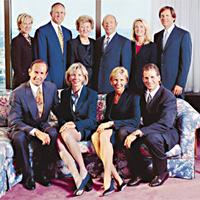
The largest recipients of this money from the 49503 zip code are: the Republican National Committee ($358,700) and Justin Amash ($61750), with other candidates receiving substantially smaller amounts.
From the 49504 zip code area the two largest donors are Susan and Michael Jandernoa, who have contributed a combined amount of $81,600. Jandernoa is the CEO of the Perrigo Company. Their money has primarily gone to the Republican National Committee and Pete Hoekstra who is running against Michigan Senator Debbie Stabenow.
In the 49506 zip code area the largest donors are Mark (Meijer CEO) and Elizabeth Murray, which have contributed a combined $40,800 to date. Other sizeable contributors have been JC Huizenga $5,000 and Crystal Flash President Thomas Fehsenfeld $5,000. The largest recipients from this zip code area are again the Republican National Committee and Pete Hoekstra.
From the 49546 zip code area (East Grand Rapids) the largest donors are: Calvin College President Gaylen Byker $65,100, Amway executive Suzanne Vanderweide giving $30,800 and Kate Pew Walters $10,000. The largest recipient from the 49546 zip code area are again the National Republican Committee.
Lastly, the largest donors from the 49512 zip code area are John Kennedy (Autocam CEO) $165,800 and Nancy Kennedy $40,800. The top recipient of money coming from the 49512 zip code area are the Republican National Committee and the Republican Party of Michigan.
Clearly the largest contributors from Grand Rapids are giving to the GOP, but as we noted earlier the Obama campaign is way ahead of all other contenders. However, it is useful to note whom the big money players are in electoral spending from this city and it speaks to their contempt for anything resembling real democracy.
The Sierra Club Took Millions From Fracking Industry
This article by Russell Mokhiber is re-posted from CounterPunch.
 Last week, I wrote an article about how Chesapeake Energy, through its fracking activity, was destroying the rural way of life in West Virginia.
After the article ran, an insider called me with a tip – Sierra Club has taken money from Chesapeake Energy.
I called Sierra Club on Monday and asked – Are you taking money from frackers – in particular Chesapeake Energy?
Waiting for a response, I called Sierra Club activists in West Virginia to see if they know anything.
Two of them – Jim Sconyers and Beth Little – e-mailed Michael Brune, the executive director of Sierra Club, and asked him whether the Club has taken money from Chesapeake Energy.
Brune writes back to Little and Sconyers:
“We do not and will not take any money from Chesapeake or any other gas company. Hope all’s well with you both.”
Simultaneously, I get an e-mail from Maggie Kao, the spokesperson for the Sierra Club.
On Tuesday, Kao writes to me: “We do not and we will not take any money from any natural gas company.”
I write back – I understand you do not and will not.
But have you taken money from Chesapeake?
That was Tuesday.
All day Wednesday goes by.
All day Thursday goes by.
And I can’t get an answer.
Then Thursday night, Kao writes says – okay, Brune can talk to you at 7:30 pm EST.
And by the way, Kao says – check out this story just posted in Time magazine.
The headline: How the Sierra Club Took Millions from the Natural Gas Industry – and Why They Stopped.
Turns out, Sierra Club didn’t want the story to break in Corporate Crime Reporter.
The millions from frackers.
And how as late as Tuesday, Sierra Club tried to mislead it’s own members about the money.
According to the Time report, between 2007 and 2010 the Sierra Club accepted over $25 million in donations from the gas industry, mostly from Aubrey McClendon, CEO of Chesapeake Energy – one of the biggest gas drilling companies in the U.S. and a firm heavily involved in fracking.
Time reported that the group ended its relationship with Chesapeake in 2010 – and the Club says it turned its back on an additional $30 million in promised donations.
Waiting to speak with Brune.
And ask him what he meant by:
“We do not and will not take any money from Chesapeake or any other gas company.”
Lisa Wright was on the executive committee of the Sierra Club’s Finger Lakes chapter in upstate New York.
But she soon got fed up with the national organization’s coziness with the natural gas industry and Chesapeake Energy.
Wright wanted Sierra Club to take a position against fracking – similar to a position the Club took on coalbed methane – it’s too dangerous to regulate – you have to prohibit it.
But Sierra Club wouldn’t budge.
Sierra Club’s position was to regulate, not prohibit.
So, on May 3, 2011, in an e-mail to Sierra Club’s executive director Michael Brune, Wright withdrew her membership.
“National Sierra Club has handled its affairs in regards to shale-gas in such an egregiously arrogant, ill-informed and out-of -touch manner that I simply cannot continue to pretend that my grassroots efforts in association with Sierra Club will in any way help the movement,” Wright wrote to Brune. “The high level associations of the gas industry with NGOs – evident in the Aspen Energy Summit – is like an infection that cannot be cured with sophisticated PR campaigns that obfuscate the underlying problem of your corporate associations.”
“It is my hope that you will reconsider your views on America’s shale-gas future, and provide the forward-thinking leadership that the Sierra Club brand once promised.”
On May 11, Brune wrote back, thanking Wright “for her thoughtful response.”
But then he added:
“Before I sign off, I do want to be clear about one thing: we do not receive any money from Aubrey McClendon, nor his company Chesapeake,” Brune wrote. “For that matter, we do not receive any contributions from the natural gas industry. Hopefully this will alleviate some concerns. Thank you for all your work.”
So, when Wright heard yesterday that in fact Sierra Club had taken $25 million from Chesapeake Energy between 2007 and 2010, she went back and dug up her e-mail correspondence with Brune.
“I took his response to mean that he had not taken any money from Chesapeake or the gas industry,” Wright toldCorporate Crime Reporter. “It was misleading.”
Brune’s position is that his “do not and will not” position was not misleading – because he didn’t address the past.
But Brune is going to be facing an angry grassroots this weekend when he holds a conference call for members to address the issue.
He might want to consider a different answer.
How Sierra Club Misled Its Members about the $25 Million from Chesapeake Energy
Lisa Wright was on the executive committee of the Sierra Club’s Finger Lakes chapter in upstate New York.
But she soon got fed up with the national organization’s coziness with the natural gas industry and Chesapeake Energy.
Wright wanted Sierra Club to take a position against fracking – similar to a position the Club took on coalbed methane – it’s too dangerous to regulate – you have to prohibit it.
But Sierra Club wouldn’t budge.
Sierra Club’s position was to regulate, not prohibit.
So, on May 3, 2011, in an e-mail to Sierra Club’s executive director Michael Brune, Wright withdrew her membership.
“National Sierra Club has handled its affairs in regards to shale-gas in such an egregiously arrogant, ill-informed and out-of -touch manner that I simply cannot continue to pretend that my grassroots efforts in association with Sierra Club will in any way help the movement,” Wright wrote to Brune. “The high level associations of the gas industry with NGOs – evident in the Aspen Energy Summit – is like an infection that cannot be cured with sophisticated PR campaigns that obfuscate the underlying problem of your corporate associations.”
“It is my hope that you will reconsider your views on America’s shale-gas future, and provide the forward-thinking leadership that the Sierra Club brand once promised.”
On May 11, Brune wrote back, thanking Wright “for her thoughtful response.”
But then he added:
“Before I sign off, I do want to be clear about one thing: we do not receive any money from Aubrey McClendon, nor his company Chesapeake,” Brune wrote. “For that matter, we do not receive any contributions from the natural gas industry. Hopefully this will alleviate some concerns. Thank you for all your work.”
So, when Wright heard yesterday that in fact Sierra Club had taken $25 million from Chesapeake Energy between 2007 and 2010, she went back and dug up her e-mail correspondence with Brune.
“I took his response to mean that he had not taken any money from Chesapeake or the gas industry,” Wright told Corporate Crime Reporter. “It was misleading.”
Brune’s position is that his “do not and will not” position was not misleading – because he didn’t address the past.
But Brune is going to be facing an angry grassroots this weekend when he holds a conference call for members to address the issue.
He might want to consider a different answer.
That Takes Ovaries to be performed in Grand Rapids this week
In the tradition of The Vagina Monologues, That Takes Ovaries: Bold Women, Brazen Acts brings a strong feminist message to West Michigan this week with two separate performances.
That Takes Ovaries!: Bold Women, Brazen Acts is a unique performance that utilizes activist theatre to tell the real-life stories of women and girls who have performed courageous actions and focuses on the bold, brazen, outrageous, and courageous things women have accomplished.
Performances will be held February 9th in the Grand River Room in Kirkhof on GVSU’s Allendale campus, and February 10th at Wealthy Theatre in Grand Rapids. Tickets are $10 for GVSU students and $15 for community members. Tickets for the February 9th performance can be purchased at the 20/20 desk in Kirkhof, while tickets for the Wealthy Theatre performance can be purchased through the Wealthy Theatre box office at www.wealthytheatre.org/ovaries or by calling 616-459-4788.
If you have any questions please contact the GVSU Women’s Center at 616-331-2748 or email ThatTakesOvariesGVSU@gmail.com.
LGBT and pro-immigration activists confront Rep. Agema
Earlier today 10 people from West Michigan went to the Rainbow Grill in Grandville, Michigan to confront State Representative Dave Agema about his recent hateful legislative proposals, some of which are now state law.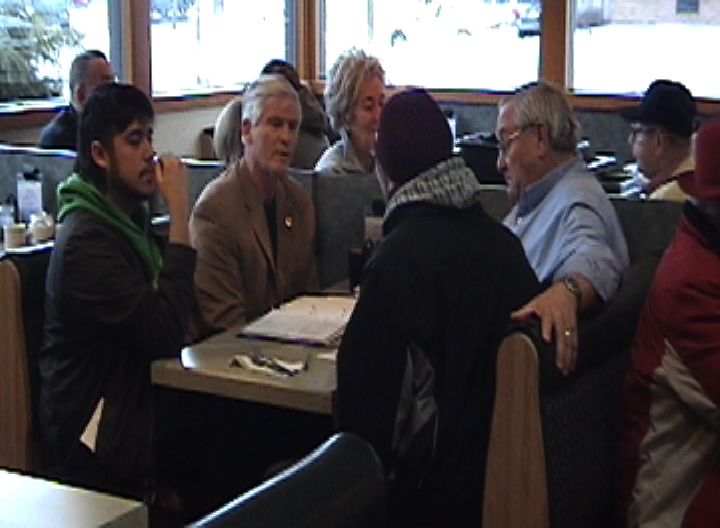
The issue that brought most people out today to confront Rep. Agema was the legislation to eliminated domestic partner benefits to some state employees, which the Representative introduced. The legislation was passed by both the House and the Senate late last year and signed into law by Gov. Snyder just before the holidays.
However, there were also people who came today to address Agema’s anti-immigration stance, anti-Muslim position and his support for the anti-union proposed Right to Work policy.
The activists who came to confront Agema found out 2 weeks ago at a rally in Lansing that the area Representative did not have a local office and only meets with constituents once a month at the Rainbow Grill.
Once Agema arrived people sat down with him at a booth and began to express their feelings and perspectives on issues of concern to the LGBT community, immigrant community and working people who all have been targets of Agema introduced and co-sponsored policies.
It appeared that the State Representative was not used to people actually showing up to talk with him on important matters. The group made it very clear that they all intended to speak to Agema who was clearly agitated by their collective confrontation.
After roughly 90 minutes of people directing their anger at the State Representative, Agema said he needed to go to another meeting. The group followed him outside and continued to confront Agema as he kept trying to leave. The group as a whole told him how much his policies were causing harm to people and that despite the Representative’s claims to follow the law, the group continued to press him on how his policies harm some of the most vulnerable members of this community.
Besides confronting Agema, members of the group passed out information sheets on how Agema’s policies impact working families.
The group found out that the Grandville Representative only meets with local constituents on the first Saturday of every month from 8:00AM to 9:30AM at the Rainbow Grill on Chicago Drive. Some of those who confronted Agema said they plan to come back next month and bring more people.
The Intersection of Sports and Politics: An afternoon with Dr. John Carlos & Dave Zirin
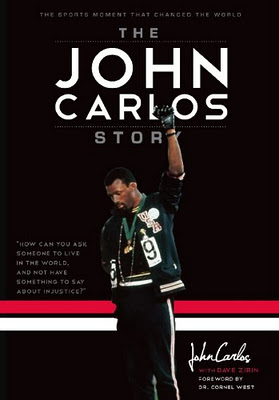
On Thursday, I had the opportunity to spend time with 1968 Olympic Athlete Dr. John Carlos and left sports writer Dave Zirin while they were in Grand Rapids to give several talks.
After speaking with a few different smaller groups, we were able to sit down and interview both of them for about 40 minutes. The interview is posted below.
For the main presentation the audience of at least 600 was shown a portion of the documentary, Not Just a Game: Power, Politics and American Sports. The section that was shown dealt with the hyper-commercialism of sports today and the contrast of present days athletes like LeBron James to former athletes like Muhammad Ali and John Carlos.
After the 15-minute clip, Carlos and Zirin took the stage. Zirin chose to just ask question of the Olympic legend, instead of having a formal presentation. Dr. Carlos talked about that moment in 1968 in Mexico City, when he and Tommy Smith made that amazing statement on the medals stand.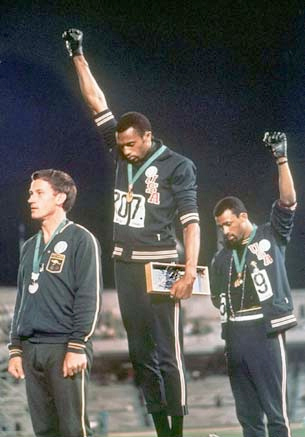
The former athlete also talked about his relationship to his father, his early acts of civil disobedience and growing up in Harlem. While Dr. Carlos talked about his relationship with Malcolm x and his meeting with Dr. Martin Luther King Jr., I could see on the faces of many of the students present a sense of awe. This sense of awe was reflected in the line of people who wanted to get their book signed by Dr. Carlos and how many students wanted a picture taken with the Olympic great.
Dave Zirin also told the audience about the day that he and John Carlos spoke to the Occupy Wall Street in New York City. The main point that Carlos made that day and repeated to the audience at GVSU, is that we all have to make critical decisions in life about whether or not we do things that benefit just ourselves or take action that benefits the greater good. It is in these moments, said Dr. Carlos, that we define who we are and what we stand for. “Don’t come to the end of your life with regrets about making a difference in the world. Even though it might be unpopular, take a stand for justice when the opportunities present themselves!”
The Deal That Saved Detroit and Banned Strikes
This article by Laura Flanders is reposted from CounterPunch.
President Obama is, as AP puts it, “wearing his decision to rescue General Motors and Chrysler three years ago as a badge of honor” on his reelection campaign. It saved jobs and working communities, brought the US auto industry back from the brink. In January, U.S. auto sales were up eleven percent over a year ago, and a proud president was cooing to the college students of Ann Arbor, Michigan:
“The American auto industry was on the verge of collapse and some politicians were willing to let it just die. We said no… We believe in the workers of this state.”
You’re going to be hearing a lot about the deal that saved Detroit in the next few months, not least because likely opponent Mitt Romney was against it. Then Governor Romney wrote in the fall of 2008 that if the big three auto companies received a bailout “we can kiss the American auto industry goodbye.” Romney bad; Obama good; Big Three back. The Deal with Detroit story is gold dust for Democrats. Reality is a bit more complicated.
For one thing, it was Republican President Bush, not the Democrats’ Barack Obama, who originally decided not to stand by as the auto makers died. The deal saved an industry – US cars are still being made in the US — but it came at such a high price that in many ways it’s a whole new industry. The American auto industry that built middle class lives as well as cars — that one we kissed good-bye, and it may be a while before we see it back again.
To review: in the fall of 2008, President George W Bush announced a $17.billion loan, split into $13.4 billion at once and another $4 billion in February. The billions for Detroit were tied tight with all the string that had not been attached to the trillions simply given away to Wall St. The Treasury never forced the financial industry to hand over majority shareholder control in exchange for access to the Troubled Asset Relief Program. No CEO of AIG or Bank of America or Well Fargo had to shrink a wage or skimp on a pension. (Far from it, the Government Accountability Office found that the “standard agreement between Treasury and the participating institutions does not require that these institutions track or report how they plan to use, or do use, their capital investments.”)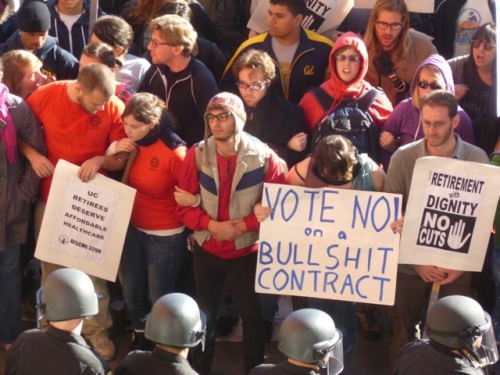
Big bucks for the Big Three, by contrast, came with all sorts of ties – mostly around the neck of the United Auto Workers and their members. When the deal was finally worked out, under Obama’s “Car Tsar” (a man with zero manufacturing experience but oodles of admiration from NY developer Steve Rattner and Lawrence Summers) the worker’s concessions amounted to a slash in all-in labor costs from around $76 per worker-hour in 2006 to just over $50. Abandoning decades of principle, the UAW approved a two-tier wage structure in which new hires start at t$14/hr — roughly half the pay and benefits of more senior line workers. To top things off, Treasury demanded — just one more teeny thing – a strike ban. The pièce de no résistance! Under the government’s agreement with the companies, any strike by workers is grounds for forfeiting the loan.
The timing couldn’t be more poignant. Seventy-five years ago, in the winter of 1936-37, it was a strike at General Motors that won the first victory for the one-year-old UAW, and won for organized labor the respect that made it possible to negotiate for those middle-class auto-makers’ lives. Late on December 30, 1936, autoworkers in Flint occupied a General Motors plant launching a strike that within less than a month, involved 135,000 workers in 35 cities across the country. When the union called for support in early January, 150,000 people showed up at Detroit’s Cadillac Square in a show of solidarity.
The Sit-Down Strike as it came to be known, ended on Feb. 11, 1937 with a defeat for GM, but for forty-four days, the company used ever tactic to end the occupation. (Take courage Occupy Wall St!) In the dead of winter, owners turned off the heat to the occupied plants. Knowing the strikers’ depended on “solidarity kitchens,” they cut off food delivery. When police moved in on one of the plants in Flint in January, workers pelted officers with engine parts and police fired back tear gas and bullets, sending 28 injured workers to the hospital. Women formed an Emergency Women’s Brigade. The next time police threatened to storm the plant gates, they found their way blocked by women locking arms — the indominatble “Rolling Pin Army.”
The battles of 75 years ago forced GM negotiators to recognize the union as the bargaining agent for the workers, and for a while at least, factory owners across the country negotiated in fear of a sit-down. Seventy-five years later Obama and the Democrats are cheerleading the deal that saved Detroit – and did away with the right to strike, at least temporarily. Now US auto sales are on the rise and with unemployment what it is, the companies say there’s a line around the block for those $14/hour entry-level jobs .
“On the plus side we still have US based auto production,” says Ed Ott, former chair of the New York Central Labor Council. What are union rights going to be like going forward? “The unions say we’ll build back up. Let’s hope they’re right.”
A more likely scenario is $14/hour auto jobs are here to stay. If the US wages low enough, they may draw jobs back from where they’ve gone to. As long as no one here is looking to increase taxes on the factory owners, offshore wages right here save employers the trouble and cost of off-shoring. What’s it mean for those workers’ families? Unless their low-wage lives are subsidized by more taxpayer-dollars in the form of free or low cost public services and help they’re in for pretty lean years. UAW President Bob King (praised for his “flexibility” ) is hopeful union strength will build back up. Heaven knows how.
Lucky us. We missed it the first time. Now, it looks as if we get to experience the Gilded age all over again – and in another half century or so, some auto worker may decide to sit down and occupy a factory.
Occupy the Super Bowl: Now more than just a slogan
This article by left sports writer Dave Zirin is re-posted from his blog Edge of Sports.
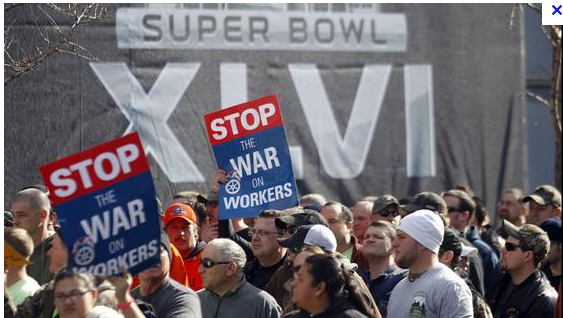
The sheer volume of the Super Bowl is overpowering: the corporate branding, the sexist beer ads, the miasma of Madison Avenue produced militarism, the two-hour pre-game show. But people in the Labor and Occupy movements in Indiana are attempting to drown out the din with the help of a human microphone right at the front gates of Lucas Oil Stadium.The Republican-led state legislature aims to pass a law this week that would make Indiana a “Right to Work” state. For those uninitiated in Orwellian doublespeak, the term “Right to Work” ranks with “Operation Iraqi Freedom” and “Fair and Balanced” as an phrase of grotesque sophistry. In the reality-based community, “Right to Work” means smashing the state’s unions and making it harder for non-union workplaces to get basic job protections This has drawn peals of protest throughout the state, with the Occupy and labor movement front and center from small towns to Governor Mitch Daniels’s door at the State House. Daniels and friends timed this legislation with the Super Bowl. Whether that was simple arrogance or ill-timed idiocy, they made a reckless move. Now protests will be a part of the Super Bowl scenery in Indy.
The Super Bowl is perennially the Woodstock for the 1%: a Romney-esque cavalcade of private planes, private parties, and private security. Combine that with this proposed legislation, and the people of Indiana will not let this orgy of excess go unoccupied. Just as the parties start a week in advance, so have the protests. Over 150 people – listed as 75 in USA Today, but I’ll go with eyewitness accounts – marched through last Saturday’s Super Bowl street fair in downtown Indianapolis with signs that read, “Occupy the Super Bowl” “Fight the Lie” and “Workers United Will Prevail.” Occupy the Super Bowl has also become a T-shirt, posted for the world to see on the NBC Sports Blog.
The protests also promise to shed light on the reality of life for working families in the city of Indianapolis. Unemployment is at 13.3%, with unemployment for African American families at 21%. Two of every five African American families with a child under 5 live below the anemic poverty line. Such pain amidst the gloss of the Super Bowl and the prospect of Right to Work legislation is, for many, a catalyst to just do something.
April Burke, a former school teacher and member of a local Occupy chapter, said to me, “I see Right to Work for what it is: an attack on not only organized labor but on all working class people… Because strong unions set the bar for wages, RTW laws will effectively lower wages for all. Rushing the passage of RTW in the State of Indiana on the eve of the Super Bowl is an insult to the thousand of union members who built Lucas Stadium as well as the members of the National Football League Players Association who issued a statement condemning the RTW bill.”
As April mentioned, the NFLPA has spoken out strongly against the bill. When I interviewed Player Association president DeMaurice Smith last week, he said,
“When you look at proposed legislation in a place like Indiana that wants to call it something like ‘Right to Work,’ I mean, let’s just put the hammer on the nail. It’s untrue. This bill has nothing to do with a ‘right to work.’ If folks in Indiana and that great legislature want to pass a bill that really is something called ‘Right to Work’ have a constitutional amendment that guarantees every citizen a job. That’s a ‘right to work’. What this is instead is a right to ensure that ordinary working citizens can’t get together as a team, can’t organize, and can’t fight management on an even playing field. So don’t call it “Right to Work”. If you want to have an intelligent discussion about what the bill is, call it what it is. Call it an anti-organizing bill. Fine… let’s cast a vote on whether or not ordinary workers can get together and represent themselves, and let’s have a real referendum.”
But Gov. Mitch Daniels, who was George W. Bush’s budget director didn’t get this far by feeling shame or holding referendums. This is the same Mitch Daniels who said in 2006,”I’m not interested in changing any of it. Not the prevailing wage laws, and certainly not the right to work law. We can succeed in Indiana with the laws we have, respecting the rights of labor, and fair and free competition for everybody.” In other words, he’s that most original of creatures: a politician who lies.
If Daniels signs the bill before the big game, demonstrations sponsored by the AFL-CIO in partnership with the Occupy Movement will greet the 100,000 people who can afford the pilgrimage to Lucas Oil Field. The NFLPA, I’ve been told by sources, will also not be silent in the days to come. As Occupy protester Tithi Bhattacharya said to me, “If the bill becomes law this week then it is very important for all of us to protest this Sunday. We should show the 1% that the fate of Indiana cannot be decided with the swish of a pen by corporate politicians – the Super Bowl should be turned into a campaign for justice and jobs.”
Occupy the Super Bowl. Now it’s more than just a slogan.
[BTW: I like the Giants, 24-20]
Noted author Norman Finkelstein spoke to audience at GVSU
Last night, author Norman Finkelstein addressed a crowd of roughly 250 at the downtown campus of GVSU. The event was hosted by the student group Peace M.E.ans, which is committed to education and dialogue around the conflict between the Palestinians and Israel.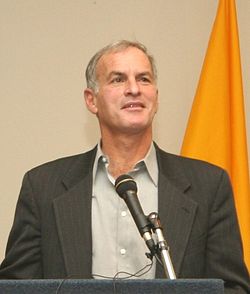
Finkelstein began by talking a bit about his own history of being involved in the Israeli/Palestinian conflict. He said that the June 1982 Israeli invasion of Lebanon was what motivated to pursue this issue both academically and politically.
He next addressed the notion that some people believe that he is obsessed with the topic of Israel/Palestine, but Finkelstein clearly stated that this issue is still a serious problem and that since the Palestinians can’t give up, neither should we.
Finkelstein spoke about the longevity of this conflict and stated that its origin was with the Balfour Declaration of 1917, the same year as the Russia Revolution. However, unlike communism, the Israeli/Palestinian conflict still continues. In some ways, Finkelstein says, the conflict seems rather “insane.”
The speaker stated that with the ongoing discussion about jump starting the peace process, Finkelstein thinks that the conflict needs to truly be resolved and we should do away with ridiculous clichés like “Peace Process.”
Finkelstein also believes that the majority of Americans at least are aware of the fact that there is a serious problem between Israelis and Palestinians. What has changed in recent years is that more people recognize that Israel has a greater burden of responsibility for the conflict.
The noted author then stated that he believes that there is a greater chance to resolve this conflict than there has been in recent years. First, some of their strongest allies in the region, such as Turkey, have distanced themselves from Israel. The current President of Turkey recognizes that the population of his country supports the Palestinian struggle. Another traditional ally of Israel, Egypt, has also shifted its position since the overthrow of the three decades dictatorship of Mubarak.
Finkelstein then said another reason why there is a strong chance for resolving the conflict is because Israel’s political stock has declined. He referred to an annual BBC poll of worst countries in the world and the list always includes Iran, North Korea, Pakistan and Israel.
Another reason why the timing is ripe for resolving the conflict is the fact that virtually every country supports the Palestinians right to have their own state. Finkelstein even said that the majority of US citizens polled agreed to a Palestinian state. Despite the public support for Palestinian statehood, President Obama opposes it, both major parties, the US House and Senate and all the major news agencies in the US. Finkelstein believes that with all the major political institutions and major media in opposition to Palestinian statehood it is amazing that the majority of Americans think otherwise.
Finkelstein also stated that there has been a shift amongst American Jews who are having a difficult time justifying Israeli policy.
The speaker then shifts to this notion of how Israel continues to engage in war and devastation, citing the Israeli support for the US invasion of Iraq in 2003, the bombing of Lebanon in 2006, the Israeli war on Gaza……..and now they want a war with Iran. Finkelstein, speaking as if he is utterly astounded, spoke about the audacity of Israel’s desire to go to war with Iran, despite the fact that they are still burying bodies in Gaza.
To illustrate the brazen disregard for human rights that Israel has, he mentions a resolution the UN passed, implementing a ceasefire in Lebanon. For the next three days after this ceasefire resolution Israel drops 1 million cluster bomblets on civilians. In 2009, Finkelstein also said Israelis dropped phosphorous bombs on Palestinians, even hospitals.
Finkelstein said the time is now to present reasonable and uniform solutions to the American people before you lose them. A one state, two state or a secular state solution? Finkelstein says this seems very confusing to many people, so we need to present a reasonable goal to the public.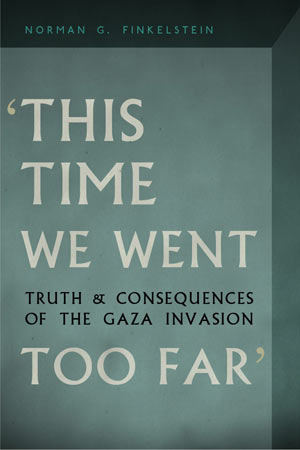
The solution that Finkelstein presented is in part based on what others have thought about a solution. Finkelstein says he looked to Gandhi, who faced a similar situation, when the British was occupying India. Gandhi thought that the only thing that would work in India was a non-violent revolution, which Finkelstein believes is the only viable strategy that Palestinians can use to end the Israeli occupation.
Gandhi said that politics is not about influencing public opinion it is about getting people to take action because they already known what is wrong. Therefore, when people engage in civil disobedience it can motivate others to want to do the same. Finkelstein said that we have to move beyond our collective indignation and take action against injustice.
First, politics is not about what you support, it is about what the public is willing to support. Politics is not about you personal moral code, especially if you want to build a political movement.
The obvious answer to what should be done about the Israel/Palestinian conflict is a full Israeli withdrawal from the territories occupied since 1967 and a resolution to the Palestinian refugee right of return. There is virtually a global consensus on these matters based on UN General Assembly Resolutions. Everyone votes for it with the exception of the US, Israel and sometimes a few island nations in the south Pacific.
If you turn to the International Court of Justice it is clear what should be done, since they clearly state that you cannot obtain land through violence and force. Also, under international law you cannot transfer one population to the land of the occupied group, such as what the Israelis have done with the settlements. Both Amnesty International and Human Rights Watch have stated that the Palestinian refugees have a legal right of return to the lands now occupied by Israel.
You can draw three conclusions from this matter. First, despite the claim of these dynamics being controversial, they are not controversial within the international community. Secondly, from a legal point of view Israel doesn’t have a leg to stand on. International law is behind the Palestinians on these major aspects of the conflict. Third, and related to the first two, is the fact that Israel is a state. This means they have the same rights and responsibility as all states to follow international law. So, if you want to assert the illegal occupation of Israel, the illegality of the settlements and the right of refugee return, you must also recognize the right of Israel to exist and maintain its pre-1967 borders.
Therefore, Finkelstein believes that the only realist position to take is to stand behind international law and accept the pre-1967 borders. There is no point to take the position that the 1948 means in which Israel won statehood was unjust, so we want them to leave that land altogether. So, the Palestinians need to accept the Israeli state, is the argument. However, Finkelstein states that Israel signed peace agreements with Egypt in 1979 and Jordan in 1994 and both those countries did not agree to acknowledge Israel’s right to exist. So why are they doing this with the Palestinians.
Finkelstein spoke for over 2 hours straight, which seemed hard on many of the audience members. For this writer, what was difficult to hear was a different kind of argument and focus from Finkelstein. He strayed from his usual assault on Israeli and US policy towards Palestinians and he didn’t spend adequate time on the current US administration’s policies that have continued Israel’s assault on Gaza, construction of settlements and pushing for war with Iran.
It was a side of Finkelstein that one would not get from his books and his previous lectures and it left this writer a bit confused.
Capitalist Chaos at the Grand Rapids Press
When you’ve got a failing business, what’s the classic solution, according to capitalist wisdom?
1. Remove any policy impediments that would halt massive layoffs.
2. Hire a hatchet man to replace your old-guard management. Give him a hatchet.
3. Start by eliminating your most experienced (and therefore best-paid) workers.
4. Make hollow promises that those who take on more work will survive another round of layoffs. See who can stand up to the stress.
5. If possible, re-form your company so you can pretend that changes are being made because of a major business shift, not to fatten your bottom line.
6. Put the hatchet into overtime. Get rid of everyone above a certain pay grade. Cut middle management to the bone. Keep your youngest and cheapest employees.
7. Under the banner of the “new” company, hire in young workers at a pittance of what you used to pay and give them two or three times the workload that people in their position formerly had. Also, sell off expensive assets.
8. Preserve the salaries and bonuses of your top executives. But put any executives you want to get rid of into jobs in which they will clearly self-destruct.
Welcome to the remade Grand Rapids Press, run by its “new” owner, MLive Media Group. Have we just seen the capitalist step-by-step “reorganization” plan above used as its road map? Judge for yourself:
According to Rob Kirkbride, a former reporter who blogs about newspaper topics, the Press used to have two “cornerstone pledges” to their employees: no jobs would be eliminated because of the economy or because of changes to technology. Kirkbride writes, “Booth Newspapers, which owned the Press, changed its policy a couple of years after I left and they have not stopped cutting jobs since.” This was about the same time that Mike Lloyd retired and Paul Keep was brought on as Press editor.
The first staffers to go were some of the most popular reporters and columnists, like Tom Rademacher and Ruth Butler. Other familiar bylines started to disappear, returning occasionally to freelance. The hatchet fell like a guillotine, however, when the “new” MLive Media Group made cuts in all eight of its newspaper staffs: 550 jobs were lost across the state, including 146 here in Grand Rapids. As Dan Gaydou, formerly publisher of the Press and now president of MLive Media Group, said adroitly in a statement, “We’ve been clear since the moment we announced the launch of MLive Media Group that we’d be a smaller company as a result of the transition.” No kidding.
And to twist the knife in even deeper, Gaydou added “…all these employees are eligible to apply for new jobs within MLive Media Group and Advance Central Services Michigan, and we have and will continue to encourage them to do so.” I’d interpret that as: it may be possible to get a job again, as long as you’re willing to put up with a massive pay cut and probably be forced to take on additional responsibilities as well.
Those saying “no thanks” to the offer included Ed Golder, an award-winning op/ed writer for the Press, who packed his bags and accepted a job directing communications at the Department of Natural Resources in December.
So, as the blood is mopped up, what will the new Grand Rapids Press look like?
The Press has put Julie Hoogland, a former education editor, into an equivalent of Paul Keep’s job. Instead of a managing editor, there are going to be three “managing producers of content” who will be taking stories from reporters and transferring them into online media and print.
Paul Keep has been named executive editor of the print versions of all eight newspapers now controlled by the new organization. Given the MLive Media Group’s emphasis on their web presence, this job appears to be the equivalent of the Inuit putting one of their elderly onto an ice floe to drift off and die. After all, it’s clear to everyone in the business that print newspapers are on life support.
Who’s left to do the reporting? The Press has retained a few of its most skilled writers, including Shandra Martinez, Jim Hargar, John Serba, and Jeffrey Kaczmarczyk (probably one of the best writers the Press has ever employed). John Gonzalez, who used to be the overlord of a whole entertainment department, has been bumped to an entertainment reporter position. But many of the survivors are the greenest (and therefore probably less-well-paid) of the former staff reporters.
These include Troy Reimink, who often seems incapable of separating objective reporting from personal commentary and injects frat-boy humor into news stories. The surviving staff also includes Garret Ellison, who last year posted a story about an Occupy Grand Rapids protest that some attendees claimed was false or exaggerated. Even after posted film footage showed that certain details of Ellison’s story did not seem to match what happened at the event, the Press allowed the story to stand—probably because Ellison’s spin appealed greatly to its conservative readership base.
Ellison has also thrown notable online tantrums when readers try to tell him that he has misspelled something. But he won’t have to worry about his lack of grammar and spelling skills any longer. That’s because the Press staff no longer includes any copy editors.
Anyone who has ever worked in any kind of publishing knows that writing without editing is madness. And with a young, inexperienced staff, it’s a kind of madness that truly points to how low costs are much more important now at the Press than any kind of journalistic integrity. Although the suits like Gaydou and Keep are lining up to crow about their new, improved product, details are already leaking out about the craziness of the business model these capitalists have created.
A retired reporter from Lapeer, who runs an excellent blog site called Free From Editors, wrote on January 9, 2012 about an applicant for one of those MLive reporting jobs. At the interview, the prospective employee was told that driving the Press’s web traffic was the job’s focal responsibility. He was also told, “Reporters will self-edit.”
I admit, when I read that line, I shuddered. There are very few people left at the current Press who are even capable of self-editing, and they are seasoned enough to know that it’s a bad idea. There are also plenty of prima donnas who seem to believe that even their typos are marks of their genius, and now they’ll never get a chance to hone their craft.
According to the blog story, MLive reporters will be given backpacks, laptops, and smartphones. They are expected to shoot videos of every source on the smartphone, and then shoot the whole bundle with an article to HQ to keep feeding the website. And—this really shows how the stated MLive “commitment to print” is a string of empty words—the interviewee was told that the print version of the paper was not a priority and would “just end up filling itself.”
It was also made clear in the interview that reporters were expected to work themselves into a frenzy, not writing and filing carefully investigated stories but “producing content.” There is also a hint that the compensation was dismal when balanced against the amount of work expected. Or, as the interviewee noted, the whole thing is “a nightmare, honestly…the stress level is through the effing roof up there.”
Brand-new staffers will not even work in a newsroom. The Press sold its newsroom/office building downtown to Michigan State University for a cool $12 million. What they have provided for employees is an office they are calling a “hub,” although from the video of the place, it’s clear it’s nothing more than a drop-in way station. Its sterile blue and white rows of countertops are reminiscent of a robot-run factory from a 1960s cartoon like The Jetsons. I suspect that the true Press hub will probably be some hipster bar like Hopcat, where exhausted reporters will be downloading their stories and videos over beers and crack fries.
More freedom in a job is always desirable, but there’s also value in connecting with and learning from more experienced staff members. In the chilly atmosphere of the “hub,” it’s hard to imagine anyone will want to hang around for long. So consistent, casual interaction there seems unlikely.
Many readers sense that worse days are coming. In comments made on a Sunday column by Paul Keep in which Keep sings the praises of the print editions he’ll oversee, one reader from Kalamazoo sarcastically noted that he dropped his Gazette subscription when his paper “had been blown down the street by the slightest of breezes.” Another savvy reader pointed out that there would no longer be any investigative reporting, just AP wire stories and stuff rehashed from other web sites. “You have hurt the local communities,” the reader told Keep. “They are angry. You expect them to be grateful?”
For years, the Grand Rapids Press has been, in my opinion, a mediocre paper at best, with an occasional news series or reporter standing out from the rest. I’ve often wondered what it would look like at rock bottom. With no copy editors, few experienced reporters, the cheapest available staff overworked to the point of collapse, and an emphasis on quantity over quality, it appears I’m about to find out.
MLive Media Group hub photo used by permission from Ari B. Adler from his site Here Comes Later: http://aribadler.wordpress.com/
 Grand Rapids Institute for Information Democracy