Natural Gas Industry claim that fracking will make the US more energy independent is simply not true
This article is re-posted from Ecowatch.
Post Carbon Institute‘s Fossil Fuels Fellow David Hughes is currently researching and writing Drill, Baby, Drill: Can Unconventional Fossil Fuels Usher in an Era of Energy Independence? Slated for a January 2013 release, the report findings refute fossil fuel industry claims that unconventional supplies of oil and gas in North America will provide vast quantities of useful energy, be environmentally benign, create jobs and provide a robust economic boost.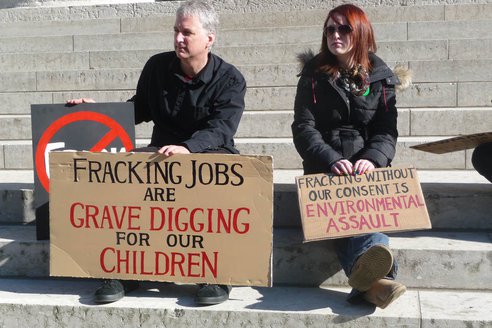
While impacted communities and environmental activists are raising the alarm over the environmental and health impacts of fracking and production of bitumen in the Alberta tar sands, the key argument used by oil and gas proponents—that these resources can usher in a whole new golden era of energy independence and security—hasn’t really been challenged. That’s where our report comes in. Hughes’ previous report, Will Natural Gas Fuel the 21st Century?, has been downloaded more than 17,000 times by citizens, advocates and government officials. The report states:
Natural gas has increasingly been touted as a “bridge fuel” from high-carbon sources of energy like coal and oil to a renewable energy future. This is based on renewed optimism on the ability of horizontal drilling and hydraulic fracturing to access natural gas from previously inaccessible shale gas deposits. A review of the latest outlook (2011) of the U.S. Energy Information Administration(EIA) reveals that all eggs have been placed in the shale gas basket in terms of future growth in U.S. gas production. Without shale gas, U.S. domestic gas production is projected to fall by 20% through 2035. Shale gas is characterized by high-cost, rapidly depleting wells that require high energy and water inputs. There is considerable controversy about the impacts of hydraulic fracturing on the contamination of surface water and groundwater, as well as the disposal of toxic drilling fluids produced from the wells. A moratorium has been placed on shale gas drilling in New York State. Other analyses place the marginal cost of shale gas production well above current gas prices, and above the EIA’s price assumptions for most of the next quarter century. An analysis of the EIA’s gas production forecast reveals that record levels of drilling will be required to achieve it, along with incumbent environmental impacts. Full-cycle greenhouse gas (GHG) emissions from shale gas may also be worse than previously understood, and possibly worse than coal.
Even assuming the EIA forecast for growth in shale gas production can be achieved, there is little scope for wholesale replacement of coal for electricity generation or oil for transportation in its outlook. Replacing coal would require a 64% increase of lower-48 gas production over and above 2009 levels, heavy vehicles a further 24% and light vehicles yet another 76%. This would also require a massive build out of new infrastructure, including pipelines, gas storage and refueling facilities, and so forth. This is a logistical, geological, environmental, and financial pipe dream. Although a shift to natural gas is not a silver bullet, there are many other avenues that can yield lower GHG emissions and fuel requirements and thus improve energy security. More than half of the coal-fired electricity generation fleet is more than 42 years old. Many of these plants are inefficient and have few if any pollution controls. As much as 21% of coal-fired capacity will be retired under new U.S. Environmental Protection Agency regulations set to take effect in 2015. Best-in-class technologies for both natural-gas- and coal-fired generation can reduce CO2 emissions by 17% and 24%, respectively, and reduce other pollutants. Capturing waste heat from these plants for district and process heating can provide further increases in overall efficiency. The important role of natural gas for uses other than electricity generation in the industrial, commercial, and residential sectors, which constitute 70% of current natural gas consumption and for which there is no substitute at this time, must also be kept in mind. Natural gas vehicles are likely to increase in a niche role for high-mileage, short-haul applications.
Strategies for energy sustainability must focus on reducing energy demand and optimizing the use of the fuels that must be burnt. At the end of the day, hydrocarbons that aren’t burnt produce no emissions. Capital- and energy-intensive “solutions” such as carbon capture and storage are questionable at best and inconsistent with the whole notion of energy sustainability at worst.
Climate Crisis and Climate Policy
This video is re-posted from ZNet.
Robin Hahnel speaking at Aalto University, Helsinki on climate change and climate policy. The talk was organized by Parecon Finland and Aalto University as part of Aalto University Master’s program on Creative Sustainability.
Hahnel is the author of numerous books on economic theory, with one of his most recent books being Green Economics: Confronting the Ecological Crisis. Hahnel is also a regular contributor to Znet.
Poet/Activist who was censored from Aquinas College last year, is featured speaker at GVSU Take Back the Night event – October 3
Last year we reported that poet/activist Stacey Ann Chin, who was scheduled to speak at Aquinas College, had her event cancelled because she is an out Lesbian.
Chin, who is a passionate speaker and gifted spoken word artist will share her work at this year’s Take Back the Night event at GVSU on Wednesday, October 3.
According to GVSU calendar event:
Starting at 7pm Staceyann Chin, survivor, author, advocate and artist, will be the featured speaker for the annual GVSU’s Take Back The Night march. Chin will offer an interactive, provoking, and challenging presentation around ending sexual assault. Survivors, activists, and all who care about their campus community are welcome to attend. The march around campus will follow her program.
GVSU Take Back the Night
Wednesday, October 3
7 – 9PM
GVSU Allendale Campus – Kirkhof Center, Grand River Room
For more information contact Theresa Rowland rowlanth@gvsu.edu
ALEC’s (Corporate) Love Affair with Fracking
This article by Sara Jerving is re-posted PRWatch.
Sometimes you can judge a book by its cover. Just one look at the cover of the brochure for this year’s annual meeting of the American Legislative Exchange Council (ALEC) reveals where some of the corporate bill mill’s loyalties lie: with the “natural” gas industry. The full-page ad on the brochure’s cover — paid for by the American Gas Association, a trade group for gas utilities companies — identifies just one of the corporate underwriters that litter the pages of the conference booklet shared with all of the elected representatives and unelected corporate lobbyists who attended the convention at the luxurious Grand America resort. (To see a pdf of the ad, which appeared in a key spot on the inside cover check downloads below.)
The conference brochure listed some 15 corporations that stand to benefit from the expansion of fracking, including Chevron, Exxon Mobil and Koch Industries.
Through ALEC, corporate lobbyists have an equal vote with state legislators on ALEC “model” bills, that are pushed in states across the nation. Often the bills were drafted by the corporate lobbyists before being approved by ALEC “task forces.” ALEC’s legislative agenda includes efforts to bar taxes on windfall profits of energy companies and numerous bills that would make it harder to regulate carbon or address global climate changes, as well as bills that would make it harder to hold these and other companies accountable when Americans are killed or injured as a result of a corporation’s product or practices in regulated industries.
ALEC’s corporate wish list also includes legislation that creates loopholes specifically for companies engaged in the extraction of oil and gas through the controversial process of hydraulic fracturing or “fracking.”
As companies have dramatically expanded fracking operations over the past few years, the industry has found an eager companion in ALEC to help facilitate the rush to industrialize land in many rural communities but with few rules to address the problems endemic to fracking. Last December, a “model” bill was approved through ALEC and then pushed in some states that would ensure that a loophole from rules of the Clean Water Act that was created for the industry at the federal level is effectively in place at the state level, along with other initiatives that benefit the oil and gas industry in the states.
Fracking has come under heightened scrutiny over the past year as the public has learned more about the toxic chemicals in fracking fluid, the vast quantities of drinkable water that fracking uses and leaves behind as waste, as well as links between fracking and the contamination of wells and other health and environmental ills.
ALEC’s Model “Disclosure” Bill Allows Companies to Skirt Disclosure

During the process of fracking, large quantities of water, along with sand and chemicals, are pumped into shale to crack the rock and allow oil and gas in the seams between layers of the shale to be released. Recent technologies have made accessing these deposits cheaper, leading to a rapid-fire expansion of fracking across the country. A key part of the controversy with fracking is that the chemicals are not disclosed by all of the companies involved in fracking, which have labeled them “trade secrets,” making it harder for people to know what chemicals and carcinogens are in the fracking fluid and waste water. During the George W. Bush Administration, Congress created an exception to the safety rules of the Clean Water Act to help companies keep the fracking chemicals secret, companies like Halliburton — which had been led by Dick Cheney, Bush’s Vice President. It’s called the “Halliburton loophole,” but it benefits many other companies.
In December 2011, as reported by The New York Times earlier this year, disclosure language for a bill on fracking was approved by ALEC at its “States and Nation Policy Summit” in Scottsdale, Arizona. As Common Cause discovered, that model bill was proposed by Randy Smith of ExxonMobil, and the vote to approve the loophole was unanimous among the legislators and there was only one dissenting vote among the corporate members (although the dissenter is not known). A detailed list of the corporations and politicians that have recently been members of that ALEC task force is available here.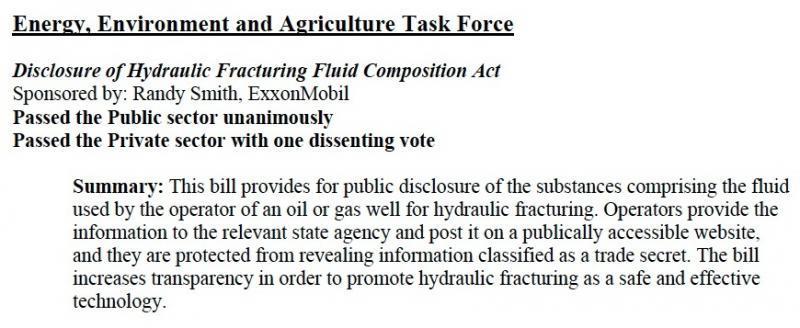
What the “Disclosure of Hydraulic Fracturing Fluid Composition Act” has done is pave the way to further the spotty disclosure that the industry has grown accustomed to, where companies can still guard the names and quantities of toxic chemicals as “trade secrets.” Exxon Mobil, the largest producer of shale gas in the country, gave a pittance — an estimated $12,500 donation out of revenue of nearly half a trillion dollars in 2011 — to help sponsor that ALEC meeting. According to the publicly traded company’s 2011 report on donations, ALEC received a total of $86,500 for the entire year from Exxon, which is the largest company in the world in terms of revenue.
In March, ALEC’s Energy, Environment and Agriculture Task Force staff Director Todd Wynn touted that states including Pennsylvania, Ohio, New York, Illinois and Indiana had taken up the “model” disclosure bill. In the same blog post Wynn bragged that, “ALEC has been at the forefront of the effort to retain state sovereignty over hydraulic fracturing, and our recently adopted model bill, the Hydraulic Fracturing Fluid Disclosure Composition Act, aims to preempt the promulgation of duplicative, burdensome federal regulations from U.S. Environmental Protection Agency (EPA).” (Documents from Common Cause showing ALEC tracking that bill are available upon request.)
Wynn is not just a cheerleader for ALEC’s oil and gas company agenda, he’s also expressed some unusual views on climate change. According to ExxonSecrets.org, Wynn has previously said:
I think that global warming could be a net benefit for the planet in fact.
Before joining ALEC, Wynn worked for one of its sister organizations, the “Cascade Policy Institute,” one of the so-called “think tanks” that are part of the “State Policy Network,” which has received Koch money and given donations to ALEC. Wynn says he studied climate impacts while getting a degree in economics. His views on climate change are most definitely not shared by most of the leading scientists in the world. Bill McKibben, for example, recently reiterated that devastating consequences of the current rate of climate change in an interview with the Center for Media and Democracy’s PRWatch, which included his views on fracking and climate change.
Utah Meeting Gathers Frack-Friendly Crowd

The romance between ALEC and fracking continued at this year’s ALEC meeting in Utah — an appropriate location for the frack-friendly ALEC crew. In May, the U.S. Secretary of the Interior Ken Salazar approved a major shale gas project by Texas-based Anadarko Petroleum Corp. in Utah’s Uinta Basin — expected to develop more than 3,600 new wells over the next decade.
In another industry-friendly move, Utah’s Governor Gary Herbert, who spoke the ALEC conference’s opening luncheon, signed a bill into law in March demanding that Congress hand over 30 million acres of federal land to the state by 2015 or the state will sue. According to the Associated Press, Lawmakers in Utah and Arizona have said the legislation is endorsed by ALEC. As documented by the Center for Media and Democracy’s ALEC Exposed Project, ALEC drafted the “Sagebrush Rebellion Act,” which was “designed to establish a mechanism for the transfer of ownership of unappropriated lands from the federal government to the states.” According to the Southern Utah Wilderness Alliance, the governor’s initiative would open up millions of acres of the “Wilderness Study Areas and proposed wilderness areas to oil and gas development” but in the process would cost Utah taxpayers enormously.
At the meeting, the CEO of the Institute for Energy Research (IER) Dr. Robert Bradley was one of the featured speakers. Bradley, formerly a director of policy analysis at Enron, also spoke at the 2011 ALEC conference in New Orleans. He is also an “adjunct scholar” at the right-wing think tank the Cato Institute and specializes in “global warming alarmism.” IER is a non-profit group focused on global energy markets that pushes for deregulation, advances climate change denial, and attempts to discredit renewable energy sources. The group’s 2010 IRS 990 form said that its focus was narrowed in on “impediments to domestic energy production, including government restrictions on access, burdensome regulations, and the favoritism of energy sources that are unsustainable in the marketplace.”
IER received some $307,000 from Exxon Mobil between 2003 and 2007, according to the publicly traded company’s “Corporate Giving Reports.” IER also received a total of $235,000 from Koch Family foundations between 1997-2010, according to a Greenpeace report. Koch Industries, an ALEC member, also profits from the expansion of fracking. Unlike Exxon, because Koch is not a publicly-traded company, any corporate donations to groups like IER, AEA, or AFP are not publicly disclosed.
IER is a “partner” organization of the American Energy Alliance, a 501(c)4 organization which calls itself the “grassroots arm” of IER. Thomas Pyle is president of both organizations, and is a former lobbyist for Koch Industries and former energy policy aide for former House Majority Leader Thomas D. DeLay, who resigned from the leadership following his indictment on conspiracy charges. Wayne Gable, also a former lobbyist for Koch Industries and former president for two of the Koch Family foundations, is on the board of both IER and AEA.
In 2011 IER and AEA launched “Energy for America” as a joint initiative with a laser point in on fracking, with an aim to “educate” the public on the practice. In October 2011, AEA and IER, in partnership with Koch Industries’ astroturf group Americans for Prosperity, started a “Energy for America” bus tour to encourage the expansion of domestic exploration of oil, gas and coal, targeting U.S. Senate battleground states for the upcoming 2012 elections.
Additionally, Brownstein Hyatt Farber Schreck is one of the three chairs of the ALEC Energy, Environment, and Agriculture Task Force. One of its clients is Freeport LNG, which owns and operates one of the first liquefied natural gas import terminals built in the United States. According to the law firm’s website, “For the last nine years, Brownstein has been the lead counsel in the structuring, strategy and development of the $1.2 billion receiving and regasification facility with commercial output capacity of more than 2.0 billion cubic feet of natural gas per day.”
ALEC’s History of Promoting Fracking
ALEC’s courtship with fracking goes back much further than last December. Prior to the approval of the chemical disclosure bill, there have been at least two ALEC resolutions passed to push for the expansion of fracking. The first was passed in December 2004, which was six months before the federal “Energy Policy Act of 2005” was passed, which included the “Halliburton Loophole” which exempted corporations from having to disclose the chemical make-up of fracking fluid in accordance with the Clean Water Act of 1972. Titled the “Resolution Encouraging Development of Liquefied Natural Gas,” the resolution stated, “ALEC encourages coordination among state agencies that oversee permitting for regasification, and between local, state and Federal government agencies, in order to facilitate and streamline regasification terminal permitting.” (“Regasification” relates to the way that gas which is converted to a liquid of a smaller volume than in its gas form is turned back into gas.)
The other resolution, titled the “Resolution to Retain State Authority over Hydraulic Fracturing,” states that the “American Legislative Exchange Council supports continued jurisdiction of the States to conserve and properly regulate oil and gas production in their unique geological and geographical circumstances.” This resolution pushes for regulation at the state-level rather than the federal level — under the assumption that the majority of states may impose weaker environmental standards than would be implemented under the U.S. Environmental Protections Agency (EPA) or Congress.
Corporate Pressure Heavy in Lead-Up to Approval of “Disclosure” Bill
In the lead-up to the approval of the chemical disclosure bill’s approval, the oil and gas industry had a strong presence at ALEC annual meeting in August 2011 in New Orleans. The Louisiana Host Committee for this conference had at least 13 corporate lobbyists, two of them representing two of the most profitable fossil fuel corporations in the world: Neil Buckingham of Shell and Jeff Copesky of Exxon Mobil. Buckingham is Shell’s Louisiana lobbyist, while Copesky is Exxon Mobil’s Southern Region lobbyist. Both of the massive global corporations they lobby for have joined in on the fracking agenda and earned a combined $49+billion dollars in 2010. Nearly one-eighth of the highlighted sponsors of the 2011 ALEC conference were players with a stake in domestic shale gas expansion. These included BP, Exxon Mobil, Chevron, Shell, ConocoPhillips, Chesapeake Energy, EnCana Corporation, CN (Canadian National Railroad), among others. If the 2011 sponsorship name levels were the same as for 2010, this amounted to over a quarter of a million dollars in contributions to underwrite the convention expenses.
At this conference, one of the workshops “Why Wait? Start Energy Independence Today” featured industry talking points such as shale gas is “clean, abundant, cheap, and it’s ours.” The ALEC 2011 Annual Meeting brochure, previewing the workshop, read “. . . [W]e as elected officials, policy makers and industry representatives must come together to create a 21st century energy policy that reduces our dependence on foreign oil and promotes the use of our most abundant, clean burning and American produced fuel, Natural Gas.”
 Since 2010, the Center for Media and Democracy has been documenting that even though the fracking industry is engaged in PR campaigns pushing fracking for our “national security,” the rate of export of natural gas by for-profit corporations to other countries has increased dramatically, as shown in the chart at the side. In addition, an August 2011 report titled “Pipe Dreams: What the Gas Industry Doesn’t Want You to Know about Fracking and U.S. Energy Independence,” written by Food and Water Watch, shows that contrary to the industry’s talking points, a significant amount of shale gas drilled in the U.S. is exported to foreign countries such as Japan, Australia, India, and China.
A second ALEC workshop “Unconventional Revolution: How Technological Advancements Have Transformed Energy Production in the United States,” included, among other panelists, Robert Bryce from the Koch-funded Manhattan Institute. The workshop “highlight[ed] the tremendous opportunities cleaner-burning natural gas offers for job creation and economic development. . . .”
In April 2011, researchers at Cornell University published research indicating that, despite long-standing assumptions and PR about “cleaner-burning” gas, the burning process for shale gas may be dirtier than that of coal in some respects. Also, in June 2011, The New York Times‘ Ian Urbina wrote a piece which called into question the profitability of shale gas.
Two weeks before ALEC’s summer 2011 meeting, Louisiana Governor Bobby Jindal announced that the state would be paying Cheniere Energy $6.5 billion to build a shale gas liquefacxtion facility at Cheniere’s Sabine Pass terminal in Cameron Parish, located in southwest Louisiana, right on the Gulf Coast shoreline. (Liquefying is a process through which methane gas is changed so it can be transported more easily by truck or train and also used to run vehicles.)
During the annual meeting, Jindal was awarded ALEC’s 2011 Thomas Jefferson Freedom Award. (Jindal is not only pushing the ALEC corporate gas agenda but has also been instrumental in attempting to implement ALEC’s public education privatization agenda in New Orleans in the aftermath of the Katrina disaster.)
Crippling Local Zoning Laws and Pushing for a Weak EPA
Beyond the effort to thwart real disclosure of fracking fluid, other “model” ALEC bills have been crafted to push forward the expansion of fracking. An ALEC bill titled “An Act Granting the Authority of Rural Counties to Transition to Decentralized Land Use Regulation,” was passed by ALEC’s Energy, Environment, and Agriculture Task Force at its Annual Meeting in August 2010 in San Diego. This model legislation would repeal all land use planning and zoning for “rural” counties by both county and state governments, taking away the local democratic process for communities to set local zoning rules. Legislation similar to this bill has been pushed in states including Pennsylvania, Ohio, Idaho, Colorado, and Texas. On July 26, the Pennsylvania Commonwealth Court struck down Pennsylvania’s version of this law stating that it “. . .violates substantive due process because it does not protect the interests of neighboring property owners from harm, alters the character of neighborhoods and makes irrational classifications.”

ALEC has also taken up the promotion of fracking in its April 2012 document called “The Economy Derailed: State-By-State Impacts of the EPA Regulatory Train Wreck.” In it, ALEC attempts to discredit Josh Fox’s Academy award-nominated film “Gasland,” which documents effects of fracking on communities across the country and the report claims that citizens do not need to worry about air or water contamination. It calls EPA efforts towards heightening federal regulations “duplicative and unnecessary” and that “the states themselves are best poised to ensure environmental protection from hydraulic fracturing processes.”
No Signs of a Break-Up
The relationship between ALEC and the oil and gas industry has proven to be mutually beneficial, advancing the corporate agenda on fracking at the expense of protections for ordinary Americans. Although 40 corporations, four non-profits, and 70 legislators have left ALEC, there is no indication that the big oil and gas companies that have helped bankroll ALEC are planning to leave any time soon.
New Media We Recommend
Below is a list of new materials that we have read/watched in recent weeks. The comments are not a “review” of the material, instead sort of an endorsement of ideas and investigations that can provide solid analysis and even inspiration in the struggle for change. All these items are available at The Bloom Collective, so check them out and stimulate your mind.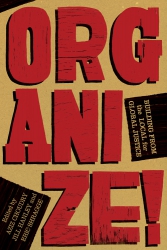
Organize: Building from the Local for Global Justice, edited by Aziz Choudry, Jill Hanley and Eric Shragge – This new collection of essays and reflections comes from activist/organizers from New Zealand, Canada and the US. The topics that are dealt with range from immigration, gentrification, Palestinian solidarity, food justice, feminism, queer politics to class-based organizing. Besides the powerful stories of organizing around numerous justice issues, there are also numerous essays that deal with group dynamics, consensus, collaborating, the role of music & art, privilege and fundraising. This collection of essays and reflections provides the reader with lots of concrete tools for organizing, but more importantly, it provides us with lessons learned and best practices to do both the internal and external work when organizing for social justice.

Anti-Racism in US History: The First Two Hundred Years, by Herbert Aptheker – Many books, both popular and scholarly, have examined racism in the United States, but this unique volume is the first to examine the existence of anti-racism in the first two hundred years of U.S. history. Herbert Aptheker challenges the view that racism was universally accepted by whites. His book thoroughly debunks the myth that white people never cared about the plight of African-Americans until just before the outbreak of the Civil War. It is always refreshing to come across a book that not only provides new insight into issues, but one that demonstrates that there is a long history of anti-racist and anti-White Supremacy organizing and resistance in the US. An important book for those wanting to understand this history and those wanting to continue to make history doing anti-racist work.
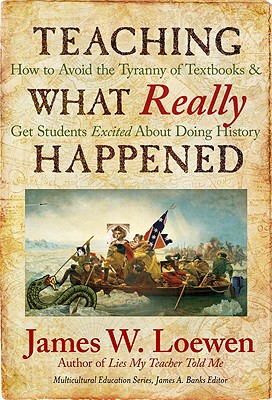
Teaching What Really Happened: How to Avoid the Tyranny of Textbooks & Get Students Excited About Doing History, by James W. Loewen – From the author of Lies My Teacher Told Me and Lies Across America, this latest book by James Loewen is essential for those who teach US history and care about how it is taught. Loewen’s book is a treasure of examples and techniques that educators can use to both motivate and engage students about learning history. History is often the worst subject for students in K-12 grades, but Loewen provides a fabulous framework with which to see history as relevant, interesting and a tool for actually making history. The examples Loewen provides hit on key historical moments in US history that provide a perfect springboard to look at a variety of ways educators can approach teaching history that makes it come alive. Like the rest of his books, Teaching What Really Happened is a must read.
Pink Ribbons Inc. – All of us know a woman who has been diagnosed with or has died from breast cancer. We have seen or may have attended one of the thousands of breasts cancer awareness events or even worn the pink ribbon, but how much do we know about the breast cancer awareness industry. Pink Ribbons Inc is an amazing investigation into both the co-opting of breasts cancer awareness by corporations/capitalism and how we have failed to seriously question where the money that is raised from pink ribbon events/sales actually goes. Highly recommended.
Business blog perpetuates Pinkwashing in story about the auto industry and Breast Cancer Awareness

October is Breast Cancer Awareness Month and that means we will all be seeing more and more of the pink ribbons on products being sold.
Corporations like KFC, ConAgra, Occidental Chemical and Johnson & Johnson are all telling consumers that if they buy their products with the strategically placed pink ribbons on the box, the company will donate money to the Susan G. Komen Foundation.

Sounds like a good thing, right? According to Samatha King, author of the groundbreaking book Pink Ribbons Inc: Breast Cancer and the Politics of Philanthropy, most of the commercial sponsorship of breast cancer awareness is nothing more than pinkwashing.
I good example pinkwashing is an article in Michigan Loves Manufacturing, touring the ongoing commitment of GM and Chevrolet to “support the fight against cancer.” The article is essentially a PR piece listing the fabulous things that these auto companies will be doing to raise money for breast cancer awareness, such as walks, incentives for customers to bring their car to GM/Chevy service stations, test car drives and displaying a pink Chevy Camaro at various events during the month of October, which will result in money being donated to the American Cancer Society.
There are two major reasons why this is an example of pinkwashing. First, the money that will be raised by Chevrolet/GM may not even be used in finding a cure for breast cancer, let alone information about breast cancer prevention. What companies like Chevrolet/GM are doing is tapping into the branding of Breast Cancer Awareness as a way of attracting customers and having their name associated with this campaign.
The second reason, which is related to the first, is a bit more insidious, but speaks to the issue of pinkwashing more directly. GM and Chevrolet are auto companies that by their very nature are major polluting industries. Auto manufacturers contribute to pollution by their role in requiring the use of metals and plastics needed for the production of their vehicles, which results in the mining and extraction of resources that contribute tremendously to the polluting and contaminating of soil, water and humans. Auto companies pollute by manufacturing cars and trucks at their facilities all over the world and by the pollution generating from millions and millions of people driving cars and trucks on a daily basis around the global. The main culprit is the toxins that are emitted from the auto exhaust system, which have been link to cancer in humans and animals.
What researchers like Samantha King and the new film Pink Ribbons Inc. demonstrate is that the very toxins and pollutants that the auto industry (and other industries) generate, all contribute to increasing the chances that people will get cancer, particularly breast cancer. This is the most insidious aspect of pinkwashing, since some companies are not only making money by branding themselves as allies against breast cancer, but because they are major contributors to breast cancer.
The group Breast Cancer Action has some really good resources on understanding the pinkwashing phenomenon. They provide good resources on how to avoid buying into pinkwashing consumerism with a tool called Think Before You Pink. They also have really good information on various campaigns, which target specific industries, like the auto industry and a toolkit for people who want to organize around this issue in their local communities.
Brought To You By “Clean Coal:” All You Need To Know About the 2012 Obama- Romney Debates
This article by Bruce Dixon is re-posted from Black Agenda Report.
A few weeks ago, we wrote about the top 15 things that Mitt Romney and Barack Obama agree on. It was a list that easily could have been longer.
Both agree on more money for the military, more wars in more countries, more drone killings, more privatizations of schools, roads and everything else in sight, and more bailouts for banksters, and continuing the 40 year war on drugs. Both say no, though in different language to minimum wage increases and the right to organize unions and strike. Both say no to climate change treaties, or even negotiations that might lead to such treaties, and both say no to foreclosure moratoriums, WPA style job creation programs and Medicare For All. Neither one will prosecute banksters or torturers, or talk much at all about poverty, although the last time there were this many poor a Democrat called for a War on Poverty.
Given their areas of agreement alone, the presidential debates won’t be real debates. The so-called Presidential Debate Commission is a private corporation founded by leaders of the two corporate parties, who choose the format, the location, the moderators and the questions, and explicitly draw up the rules to exclude candidates and parties other than Democrats and Republicans.
Although the broadcast airwaves have existed longer than the sun, and cable networks everywhere run beneath public roads and streets, US law lets private corporations determine on their own what political messages reach the population by controlling news and demanding large sums of money for a few seconds of commercials. These large amounts of money can only be gotten from the same plutocratic shot calling individuals and corporations who make the careers of Republicans like Mitt Romney and Democrats like Barack Obama possible.
How irresponsible, how locked down, how deceitfully scripted and divorced from the real world in which most of us live are these presidential debates? Besides everything the candidates agree on, and who runs the so-called debate “commission”, all you need to know is that one of the marquee sponsors of the 2012 presidential debates, and the 2008 ones as well, is an industry front group called the American Coalition for Clean Coal Electricity. Both Republican and Democratic presidential candidates are deep in the pocket of “clean coal,” as they are in the pockets of Big Ag, Big Insurance, military contractors, Wall Street and other centers of real power.
One answer to the lack of real discussions presented us by the rigged “commission” on presidential debates will be Occupy The Debates, a project undertaken by Occupy activists in multiple cities, in which a live meeting will entertain live questions from a live audience. Occupy the Debates’ first scheduled public meeting will be in Denver CO, the same evening as the first so-called “debate” between the two corporate candidates. Occupy the Debates will be streamed live on the internet that evening, and will include the participation of Black Agenda Report co-counder Glen Ford. Several occupy movements around the country are expected to follow suit and organize their own local events over the next few weeks. For more information on real debates on real issues, visit Occupy the Debates, either on FaceBook or at www.occupythedebates.org.
Several events planned for Domestic Violence Awareness Month in Grand Rapids
October is domestic violence awareness month and several local organizations are hosting informational events and providing opportunities for people to participate in solidarity with those that are victims of domestic violence.
The following events are put on by the GVSU Women’s Center, YWCA of Western Michigan, Safe Haven Ministries and a number of other sponsoring groups.
Candlelight Vigil
Monday, October 1, 2012 at 5:30pm
Location: YWCA of West Central Michigan (25 Sheldon Blvd, Grand Rapids)
A quiet vigil to honor women who have lost their lives to domestic violence.
Clothesline Project (Grand Rapids)
October 1-5, 2012 from 9am-5pm
Location: YWCA of West Central Michigan (25 Sheldon Blvd, Grand Rapids)
A visual display aimed at raising awareness of violence against women. The Clothesline Project is a collection of T-shirts with messages and illustrations that have been designed by women survivors of violence or by someone honoring a woman who has been killed.
Silent Witness Program
Tuesday, October 2, 2012 at 12pm
Location: Grand Valley State University (Allendale), Kirkhof Center, Rm 2263
This is an annual event held at GVSU to remember women and children from Michigan who have lost their lives due to dating or domestic violence in the past year. These individuals are represented by full-sized cardboard silhouettes, each assigned with their own story. Story readers represent GVSU student organizations, faculty, staff and community members. http://gvsu.edu/women_cen/module–event–index.htm
Take Back the Night
Wednesday, October 3, 2012 from 7-9:00pm
Location: Grand Valley State University (Allendale), Kirkhof Center, Grand River Rm
Starting at 7pm Staceyann Chin, survivor, author, advocate and artist, will be the featured speaker for GVSU’s annual Take Back The Night march. Chin will offer an interactive, provoking, and challenging presentation around ending sexual assault. Survivors, activists, and all who care about their campus community are welcome to attend. The march around campus will follow her program. http://gvsu.edu/women_cen/module–event–index.htm
Spitting Game
The College Hook-Up Culture
Wednesday, October 10, 2012 at 6pm
Location: Grand Valley State University (Allendale), Kirkhof Center, Rm 2204
This provocative film gets inside the hook-up scene, and explores its gender politics, sexual health, peer pressure and self-esteem. Receiving the Best Social Awareness Documentary award at Delray Beach Film Festival, Denice Ann Evans, CEO of J’Hue Film Productions will lead a discussion following the film.
Clothesline Project (Allendale)
October 15-19, 2012 from 9am-4pm
Location: Grand Valley State University (Allendale), Kirkhof Center lobby
A visual display aimed at raising awareness of violence against women. The Clothesline Project is a collection of T-shirts with messages and illustrations that have been designed by women survivors of violence or by someone honoring a woman who has been killed.
The Clothesline Project can be viewed in the Kirkhof Center on the Allendale Campus and on the Holland Campus. There will be T-shirt making workshops in 1201 Kirkhof from 9am to 5pm October 15-19 and on the Holland Campus from 9am-8pm October 15-19. http://gvsu.edu/women_cen/module–event–index.htm
The Bro Code
How contemporary culture creates sexist men
Thursday, October 25, 2012 at 6-7:30pm
Location: Grand Valley State University (Allendale), Kirkhof Center, Rm 2270
In The Bro Code, filmmaker Thomas Keith takes aim at the forces in male culture that condition boys and men to dehumanize and disrespect women. Keith breaks down a range of contemporary media forms that are saturated with sexism — movies and music videos that glamorize misogyny; pornography that trades in the brutalization of women; comedy routines that make fun of sexual assault; and a slate of men’s magazines and cable TV shows whose sole purpose is to revel in reactionary myths of American manhood. The message he uncovers in virtually every corner of our entertainment culture is clear: It’s not only normal — but cool — for boys and men to control and humiliate women. By showing how there’s nothing natural or inevitable about this mentality, and by setting it against the terrible reality of men’s violence against women in the real world, The Bro Code challenges young people to step up and fight back against the idea that being a real man means disrespecting women. Featuring interviews with Michael Kimmel, Robert Jensen, Shira Tarrant, J.W. Wiley, Douglas Rushkoff, Eric Anderson, and Neal King. http://gvsu.edu/women_cen/module–event–index.htm
Walk a Mile in Her Shoes
Monday, October 29, 2012 from 6-9pm
Location: Grand Valley State University (Allendale), Kirkhof Center, Grand River Rm
In an effort to raise awareness of rape, sexual assault and gender based violence, Grand Valley State University Inter Fraternity Counsel (IFC) is hosting Walk A Mile In Her Shoes.
This eventis an international men’s march to increase understanding about rape, sexual assault and gender violence. Founded in 2001, with the idea that men must be a part of the solution to end sexual violence, walks are held around the country each year. Specifically, men are invited to wear high heels and then actually “walk a mile in her shoes.” This event is not only for men, nor must everyone wear high heels. We invite all community members to participate in this event.
Walk A Mile In Her Shoes challenges societal and behavioral norms, encouraging us to pause and seriously consider the message. High heel shoes can symbolize the oppression that women face when they are victims of sexual violence. When men wear high heels, they can experience for a while the limits; the uncomfortable and constraining gender norms that society places on women. Organizers hope that men “step up” and challenge attitudes that lead to rape and sexual violence.
The proceeds from Walk A Mile In Her Shoes go to support GVSU’s RAD (Rape Aggression Defense) Program, which is designed to teach both self-defense and larger issues around gender socialization and sexual violence. http://gvsu.edu/women_cen/module–event–index.htm
Domestic Violence Orientation
Tuesday, November 27, 2012 OR
Tuesday, January 22, 2013 from 6-9pm
Location: Safe Haven Ministries (3501 Lake Eastbrook Blvd, Grand Rapids). This is a free seminar offered six times per year. Contact (616) 452-6664 or go to http://www.safehavenministries.org/news–events for more info and to register.
Tim Wise on Racism 2.0 and the Burden of Blackness in the Age of Obama
This audio clip from a speech by Tim Wise is re-posted from his blog.
Section from a longer 2008 speech, 10 days after the presidential election, in which I discuss how racism of a 2.0 variety — which I explain in the clip — may be in full effect despite the election of Barack Obama to the office of the presidency.
I also explore how black folks and people of color generally must meet a much higher threshold of acceptability to white voters than white candidates have had to meet, in terms of education, erudition, style and affect, and how the “archetype of acceptable blackness” may become more constricting then ever with the election of President Obama.
Listen by clicking here racism-2-0-and-the-burden-of .
Protest being planned for October 24 DNR Land Auction in Lansing
In May, we reported on a protest at a DNR land auction in Lansing, where the state of Michigan was auctioning off mineral rights to oil & gas companies. This auction is part of a larger push by oil & gas companies to explore for and extract natural gas through the method known as fracking.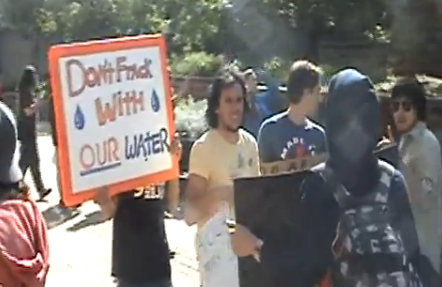
In May, over 100 people showed up to protest the auctioning off of not only public land for drilling, but also the auction off of clean water, the contamination of land, the destruction of wildlife and the threat to human health.
On Wednesday, October 24 there is another DNR land auction scheduled in Lansing and plans are already underway to protest the further exploitation of Michigan by gas and oil companies.
Citizens Against Drilling on Public Land (CADPL) created a facebook event page yesterday as the first visible sign of a protest against the land auction on October 24.
The event page reads in part:
Michigan’s DNR is supposed to protect our natural resources, and by leasing our public land and state parks to oil and gas companies, they are ignoring their duty to Michigan’s citizens.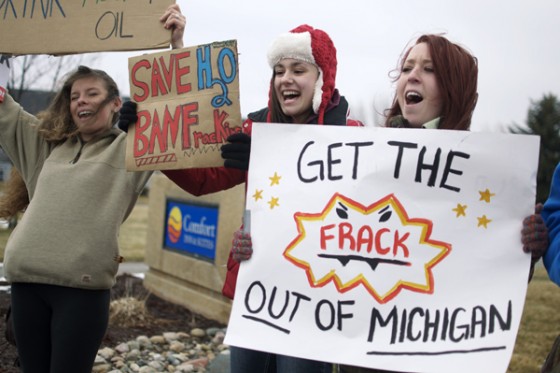
CADPL has worked hard in the past few months to organize a coalition of citizens and organizations that oppose this auction. We have generated over 1300 public comments to the DNR, 1000 petition signatures, and have been endorsed by both statewide and national organizations. Still, the DNR has decided to collude with Big Oil and Gas and once again serve as the stage on which the industry can conduct their show.
On October 24, we will be at the auction to tell the DNR to STOP THE SHOW. We do not want fracking and drilling in our public parks!
Stay tuned; more information to come.
We encourage people to be part of the resistance to fracking in Michigan, by participating in whatever level people are capable of on October 24.
The Grand Rapids group, Mutual Aid GR plans to participate in the protest and will be holding a meeting before the October 24 land auction date. For those who are in West Michigan and want to be part of planning, participating and supporting any and all actions that day, contact Mutual Aid GR online at http://www.facebook.com/MutualAidGR.
The Land Auction begins at 8:00AM on Wednesday, October 24 in the Lansing Center, located at 333 E. Michigan Ave, in Lansing.
 Grand Rapids Institute for Information Democracy