Earlier today I sat down with poet/activist Staceyann Chin, who is the featured speaker at the GVSU Take Back the Night event on the Allendale campus. I interviewed Chin at her hotel room, where she was resting with her 8-month old daughter Zuri-Siale.
I had been listening to her spoken word on YouTube videos in recent days and was amazed at her skill with words, her passion and her insights into the human condition. I was even more impressed with her in person, since she was able to respond to my questions, while giving full attention to her daughter during the interview.
GRIID – I was reading your Facebook page earlier today and noticed that you stated that you yourself are a victim of rape. You also said that the only shame that should be felt, “belongs to the fucking coward who attacked you!” How has your own experience as a survivor informed your work as an artist and as a human being in general?
Staceyann – When you have experienced sexual assault or rape or some form of violation, you understand the problem differently. When I speak about my own experience, it is easier for other women to feel solidarity. This lived experience resonates with survivors.
People can perceive you as a survivor. Your body becomes an example of someone who has kept breathing. Every time I speak out about it, I become less afraid and I take back power from my attacker. My speaking re-affirms the fact that you can keep breathing, living, loving and laughing. The trauma brought about by the assault need not cripple you, in ways that makes you feel alone, like when you are not part of a community of survivors. When I speak out against rape, I feel a kind of uplifting.
We live in an age when the first person narrative is both powerful and provocative. It means a great deal to women to hear or read that kind of personal narrative. It is important because so much of media, particularly TV, will not say things like rape and when they do it is always very clinical or in very legalistic terms. We don’t get from media a more honest sense of rape, the way it feels, the way I felt, the sounds and the smells that come with it. So for me, I have to speak out about it all the time.
GRIID – The Take Back the Night event will be an indoor event tonight, which is different from its origin as a more confrontational action that took place outdoors, often in the streets where women were assaulted. Those Take Back the Night actions were meant to demonstrate women’s collective power, but also to send a message to rapists that their actions would not be tolerated. It seems that the Take Back the Night events have become less political and radical. What is your sense of this?
Staceyann – The change in Take Back the Night might also be a larger reflection of what has happened to feminism as well over the years. Feminism has to some degree been driven indoors. Women were reclaiming their bodies in the 1960s and 70s, but since female identities are so prescribed there is less emphasis on taking control of our bodies. As a feminist who loves bacon, who shaves her arm pits and doesn’t wear heels, I always get people questioning how can I be a feminist and……

The change with Take Back the Night also has something to do with feminism being under attack, where people are saying we don’t need to study gender anymore. Hell, even women’s centers are closing or are near to closing because of a lack of funds. What has happened to Take Back the Night is a reflection of what has happened to feminism in general. The confrontational edge has somehow been lost. Feminism used to be about smashing open doors and now it seems more “diplomatic.”
This is really important, especially since we have politicians talking about “legitimate rape,” which invites the notion that there is illegitimate rape. We have lost that “take no prisoners” edge. We lose some of the power that made us warriors. The current climate may open a whole new wave of action, but we need to take feminism back to the streets. We need to be more visible and demand that society look more closely at the safety of women’s bodies, even little girls’ bodies. Being a new mother has only underscored the need to fight in this struggle. I am in it for the long haul, but having a child means that there is no way I will let anyone harm her, even if I have to use force. The way I see it is if every woman in every part of the world said that rape will end tomorrow or else, you might see a serious change.
GRIID – I saw in one of the YouTube videos you talking about how when White men were involved in Act Up, it was because it affected them, but when people of color are dying of AIDS at a much higher level all of a sudden these White men are not to be found. As someone who identifies as a Lesbian, feminist from Jamaica, how important is it for those involved in struggles to see the intersectionality of justice issues?
Staceyann – If I am only concerned with my body, then that struggle is selfish. If I am only interested in my own rights, people will see how selfish that is. If I am only concerned about Black rights, even at the expense of others, then that is a major problem.
We have to be concerned about the community as a whole. There are poor White, Black, immigrants, women, all kinds of people who are being dispossessed of freedom. Until I am concerned about the global community, then what we are rallying for is to ask permission from the current gate keepers. We should be knocking down the wall instead of asking for permission to the same rights that everyone should have. If we knock down the walls then everyone will have access to the same big, beautiful garden. This is the kind of world I want to fight for and this is the kind of struggle we should be in.
Editor’s note: Since Staceyann Chin is a spoken word artist, it is important that you hear her, so we included a YouTube video of her talking and then reading some of her work.
Notes from OKT’s 2011 Bicycle Tour of Fruit and Nut Trees
 This week’s tour and more:
Thursday Oct. 5:
OKT Tree-mapping Workshop with Lee Mueller, 6-8 p.m. , Kroc Center, 2500 Division Ave. SouthSaturday Oct. 6:
OKT 2012 Bicycle Tour of Fruit and Nut Trees
with Forager & Cyclist, Laura Casaletto
2-4 p.m.
Meet at Garfield Park’s Madison Avenue parking lot,
south of Burton Street SE
Last fall, a dozen or so folks met in Eastown for Our Kitchen Tables’s Bicycle Tour of Fruit and Nut Trees. Sunny skies, comfortable temperatures and a brisk breeze made for a lively, enjoyable ride.
Seasoned cyclist, Josh McBryde, planned the route and led the tour across Wealthy Street and over to Cherry Park. On the way there, tree expert, Laura Cassaletto, pointed out various trees and their edible uses, bringing the group to its first stop alongside an old apple tree, full of ripe fruit, outside of a two-flat apartment house.
After assuring us that she had gotten permission from the property’s owner, Laura invited everyone in the group to pick and enjoy an apple. She mentioned that the tree’s owner had told her that the apples were not good for eating as they had not been sprayed with pesticides. The group broke into laughter. And, with a close eye for worms,we took bites of the “imperfect” fruit. All were amazed at the incredible flavor these small, old fashioned, untended apples offered.
Laura recommended foraging such untended apple trees around the city. She likes to use them for applesauce. When the apples are put through the food mill, it’s easy to pick out any critters that might have eaten their way inside the fruit.
In Cherry Park, the group identified different varieties of nut trees, scavenged nuts from off the ground and even cracked and ate a few. Heading back across the neighborhood, a stop near Diamond and Cherry yielded a look at mulberry trees (already done fruiting) as well as locust trees. Seasoned urban forager, Richa, shared that the spring flowers from the locust tree are delicious. (At the conclusion of the tour, he shared a loaf of his homemade acorn bread).
Crab apples, yes.
Along the route, Laura pointed out that ornamental crab apple trees have edible fruit. She explained that crab apple trees are related to the rose, and like the rose, are edible. High in vitamin C, their edible fruit can be identified by the “crown” at the bottom of the fruit. While fruit with a crown is edible, she warned not to forage white fruit and berries, “White is the color of death.”
She also advised us to try new foraged fruits and nuts in small quantities to see how our own body reacts to it. Because trees, like people, are individuals, the fruits and berries eaten from them have differences in flavor and in how they align with each individual person’s digestive system.
 Bittersweet, no.
In Wilcox Park, the group snacked on plump wild grapes and tried edible, though bitter, viburnum berries. We also learned that the colorful bittersweet nearby was just for decoration and not an edible. The group ended its tour at Aquinas College, where Josh handed out tree identification maps the college provides to visitors. We stopped to gather, crack and snack on beech nuts beneath an elephantine beech tree.
A 16-year-old on the tour remarked, “It was so cool to learn that if I had to, I could get enough to eat from nature.” Cool indeed. Food is growing all around us. Let’s learn to appreciate it!

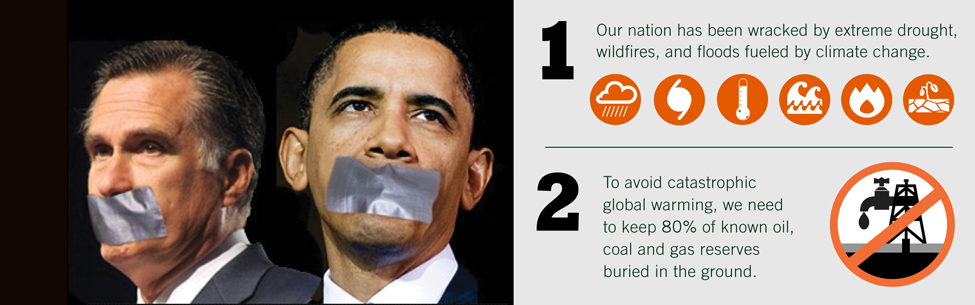
A national organization that has been trying to hold broadcaster accountable on how they report on global warming is now trying to get the two main Presidential candidates to make climate change a campaign issue.
Their campaign called Climate Silence, states:
Although Barack Obama and Mitt Romney sprinkle their speeches with mentions of energy and climate, they have remained stubbornly silent on the immediate and profound task of phasing out a carbon-based economy. Their failure to connect the dots and do the math imperils our nation and prevents the development of a national and global plan to respond to the most urgent challenge of our era. It’s time for their climate silence to end.
We don’t think that either candidate will make climate change an issue until they are forced to do so by grassroots pressure in the form of direct action. This campaign to get people to sign a petition, while commendable, is not enough.
It is important that we recognize that the candidates are not paying attention to climate change and climate justice, but the strategy should be focused on getting more and more people to confront and dismantle the main perpetrators of carbon emissions, the fossil fuel industry.
Arctic Ice Melt, Psychopathic Capitalism And The Corporate Media
This article by Media Lens is re-posted from Dissident Voice.
Last month, climate scientists announced that Arctic sea ice had shrunk to its smallest surface area since satellite observations began in 1979. An ice-free summer in the Arctic, once projected to be more than a century away, now looks possible just a few decades from now. Some scientists say it may happen within the next few years.
The loss is hugely significant because Arctic sea ice reflects most solar energy into space, helping to keep the Earth at a moderate temperature. But when the ice melts it reveals dark waters below, which absorb more than 90 per cent of the solar energy that hits them, leading to faster warming both locally and globally.
Peter Wadhams, professor of ocean physics at Cambridge University, warns that the Arctic may be ice-free in summer as soon as 2015. Such a massive loss would have a warming effect roughly equivalent to all human activity to date. In other words, a summer ice-free Arctic could double the rate of warming of the planet as a whole. No wonder that leading NASA climate scientist James Hansen says bluntly: “We are in a planetary emergency”.
In a comprehensive blog piece on the Scientific American website, Ramez Naam points out that:
The reality of changes to the Arctic has far outstripped most predictions. Only a few years ago, in the 2007 Intergovernmental Panel on Climate Change report, the bulk of models showed the Arctic ice cap surviving in summer until well past 2100. Now it’s not clear that the ice will survive in summer past 2020. The level of sea ice we saw this September, in 2012, wasn’t expected by the mean of IPCC models until 2065. The melting Arctic has outpaced the predictions of almost everyone – everyone except the few who were called alarmists.
As well as global warming from carbon dioxide (CO2), there is the additional risk of warming from methane (CH4) being released into the atmosphere. Huge quantities of methane are locked up in land permafrost. But even vaster quantities exist as methane hydrates frozen below the shallow waters of the Arctic Ocean’s continental shelves. Naam warns:
If even 10% of the northern permafrost’s buried carbon were released as methane, it would have a heating effect over the next decade equivalent to ten times all human greenhouse emissions to date, and over the next century equivalent to roughly four times all human greenhouse emissions to date’
That’s just the methane on land, trapped in the permafrost. If the methane hydrates buried on the Arctic continental shelves were to be released, that would have a warming effect equivalent to hundreds of times the total human carbon emissions to date.
Although Namm says ‘we are probably not in danger of a methane time bomb going off any time soon’, recent observations show that Arctic methane is being released into the atmosphere. And there is scientific controversy over how serious and how rapid this release is.
In summary, Naam points to a triple whammy effect:
1. Warming from the greenhouse gases we are currently emitting.
2. Warming from the loss of ice and permafrost in the Arctic, and the exposure of dark water and dark land below.
3. Warming from the release of more carbon into the atmosphere as the permafrost and the Arctic sea floor methane begin to melt.
The situation is already dire. According to a new report commissioned by twenty governments, more than 100 million people will die by 2030 if the world fails to tackle climate change. Five million deaths already occur each year from air pollution, hunger and disease as a result of climate change and carbon-intensive economies. This death toll would likely rise to six million a year by 2030 if current patterns of fossil fuel use continue. More than 90 per cent of those deaths will occur in developing countries.
On a sane planet, action would have been taken long before now to limit the risk. But, as Greenpeace International head Kumi Naidoo notes, fossil fuel industries have been working hard to corrupt the political process:
Why our governments don’t take action? Because they have been captured by the same interests of the energy industry.
As we noted in an alert last year, a Greenpeace study titled Who’s Holding Us Back? reported:
The corporations most responsible for contributing to climate change emissions and profiting from those activities are campaigning to increase their access to international negotiations and, at the same time, working to defeat progressive legislation on climate change and energy around the world.
Greenpeace added:
These polluting corporations often exert their influence behind the scenes, employing a variety of techniques, including using trade associations and think tanks as front groups; confusing the public through climate denial or advertising campaigns; making corporate political donations; as well as making use of the “revolving door” between public servants and carbon-intensive corporations.
Unsurprisingly then, meaningful action on tackling climate change is nowhere on the political agenda.
Drilling To Oblivion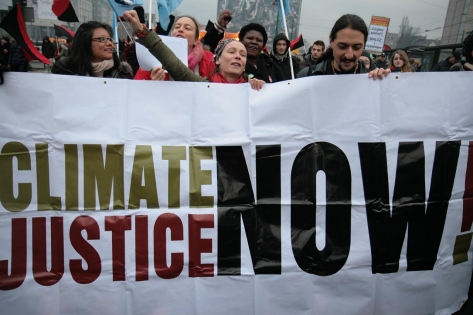
Around the same time that a record low in Arctic sea ice was being recorded, a new report from the UK’s House of Commons Environmental Audit Committee urged a halt to all oil and gas drilling in the Arctic, at least ‘until new safeguards are put in place.’ Committee chair Joan Walley MP said:
The shocking speed at which the Arctic sea ice is melting should be a wake-up call to the world that we need to phase out fossil fuels fast. Instead we are witnessing a reckless gold rush in this pristine wilderness as big companies and governments make a grab for the world’s last untapped oil and gas reserves.
Caroline Lewis, member of the committee, warned that “the race to carve up the Arctic is accelerating faster than our regulatory or technical capacity to manage it.”
But the record of corporate capitalism shows that powerful industrial forces will do all they can to lobby governments to allow for continued economic exploitation of the planet’s resources. According to the US Geological Survey, within the Arctic Circle there are some 90 billion barrels of oil – 13 per cent of the planet’s undiscovered oil reserves – and 30 per cent of its undiscovered natural gas. The race for corporate profits is now on, with Shell already committed to a ‘multi-year exploration program’ in the Arctic.
The receding Arctic ice is a ‘business opportunity’ for those wishing to exploit newly available shipping routes. Cargo that now goes via the Panama Canal or the Suez Canal will, in many cases, have a shorter Arctic route, ensuring ‘efficiency savings’ for big business.
Companies are also licking their lips at the prospect at getting their hands on vast deposits of minerals as Greenland’s ice cap recedes.
‘For me, I wouldn’t mind if the whole ice cap disappears,’ said Ole Christiansen, the chief executive of NunamMinerals, Greenland’s largest homegrown mining company, with his eyes on a proposed gold mining site up the fjord from Nuuk, Greenland’s capital. ‘As it melts, we’re seeing new places with very attractive geology.’
A good example of the psychopathic mind-set at the heart of corporate capitalism. Science writer Peter Gleick responded incredulously on Twitter: ’25 foot sea rise?’ For that is indeed the catastrophic scale of global sea level rise that would occur with the melting of the Greenland ice sheet.
The BBC Parks The Problem
The BBC’s extremely poor and biased coverage of climate change continues to dismay seasoned observers. As Verity Payne and Freya Roberts noted on The Carbon Brief website, the corporation’s “fondness for pitting non-experts against each other over particularly complex areas of climate science reached surreal heights” in a recent BBC2 Newsnight segment on Arctic sea ice loss. The encounter between Conservative MP Peter Lilley and the Green Party’s new leader Natalie Bennett eventually degenerated into an argument over the merits of locally-sourced food. Payne and Roberts concluded:
It’s hard to understand how, over a year after the BBC Trust reviewed the corporation’s science coverage, paying particular attention to topics such as climate change, this is what we end up with.
In fact, the BBC’s awful performance is not that much of a mystery. The corporation has always been a reliable supporter of state and corporate power. But particularly since the fallout from reporting the government’s ‘sexing-up’ of discredited claims about Iraq’s supposed weapons of mass destruction, when heads rolled at the BBC, the broadcaster has been at pains not to offend the government and allied interests. Its abysmal failure to inform the British public of the coalition’s effective dismantling of the National Health Service is another key example.
According to former BBC correspondent and editor Mark Brayne, who was privy to internal editorial discussions in 2010, the BBC has ‘explicitly parked climate change in the category “Done That Already, Nothing New to Say”.’ Brayne added:
On climate change, that BBC journalistic urgency to be seen to be fair now means, after a period between Al Gore’s Inconvenient Truth and the disaster of [the 2009 UN Climate Summit in] Copenhagen when global warming was everywhere in the output, that the Corporation has been bending over backwards to reflect the opposite, sceptical view.
Consider the analogy of two men at a bar, says Brayne. One man claims that two plus two equals four, and the other that two plus two equals six. The BBC solution to this disagreement? ‘Put them both on the Today Programme, and the answer clearly lies somewhere in the middle.’
The Today programme, BBC Radio 4’s ‘agenda-setting’ morning programme, is a serial offender when it comes to irresponsible climate coverage. On July 13 this year, veteran interviewer John Humphrys interviewed Ralph Cicerone, president of the US National Academy of Sciences. Part of the interview went like this:
JH: But to say nearly every spot on the globe has warmed significantly over the past 30 years and indeed the entire planet is warming is different from saying it’s going to continue to warm to such an extent that we have to spend vast and unimaginable amounts of money to protect ourselves against a catastrophe that many people, some distinguished scientists say, isn’t actually proven.
RC: Well of course the way you’ve worded it, it was quite strong; “vast and unimaginable sums of money”, I don’t think I’ve heard anybody make such a proposal.
Moments later, Humphrys made the idiotic assertion that:
You can’t absolutely prove that CO2 in the atmosphere is responsible for global warming.
As climate writers Christian Hunt and Ros Donald put it politely:
If the Today programme brought this level of research and preparation to interviewing politicians, it probably wouldn’t be taken particularly seriously.
In fact, the standard of political debate on Today, as with the rest of BBC News, is on a similarly appalling level: routinely tilted towards state-corporate power, and all at public expense.
Meanwhile, BBC News happily chunters along issuing a stream of articles and broadcasts about Britain’s “dreadful weather” this year and how it has, for example, ‘cost rural Britain £1bn’ in lost income. But you would be hard pressed to find any links drawn between this and human-induced climate change.
Guarding The Mythology Of “Feeble Response”
Greens like to flock to the Guardian almost as though it were the house paper of the environment movement. One recent Guardian editorial noted that:
Pessimists in the climate change community warn that within the next century global mean temperatures could rise by 6C. A fierce, sustained drought in the US, with 170 all-time US heat records broken in June alone, has already hurt world food stocks.
These are important points. But given the observed rapid changes in the Arctic under global warming, the Guardian’s pejorative use of ‘pessimists’ should probably be replaced with ‘realists’. The Guardian continued:
The global response to these signals of potential calamity has so far been feeble.
This hugely understates the problem. But, even more damning, it diverts attention from root causes. As mentioned earlier, huge vested interests have mounted decades-long campaigns of disinformation, fierce lobbying and intimidation to subvert and bully governments into (a) avoiding what needs to be done in the face of climate chaos; and (b) providing tax breaks, subsidies and other measures to enhance rapacious corporate practices under the guise of boosting economic ‘growth’ and ‘job creation’ (newspeak terms for corporate profits).
Senior Guardian editorial staff seem unable to move beyond the same anodyne waffle they have been publishing for thirty years:
Britain’s “greenest government ever” has shown what it thinks of scientific evidence, by placing a homeopathic medicine enthusiast in charge of the National Health Service, and a reputed climate skeptic as environment secretary. The outlook is not promising.
The Guardian has almost nothing to say about the deep-rooted changes required to redress the imbalance of power in society; or about its own role in pushing climate-damaging policies and practices. The Guardian is a corporate newspaper dependent on advertisers for around 70 per cent of its income. Put simply, like other corporate media, it is part of the problem.
Media Malpractice – Challenging The Decline In Coverage
In the US, climate blogger Joe Romm notes that the decline in corporate media climate coverage has been well documented, both in print and the evening news. Bill Blakemore of ABC News observes that a number of the climate scientists ‘are perplexed by — and in some cases furious with — American news directors.’ Blakemore elucidates:
‘“Malpractice!” is typical of the charges this reporter has heard highly respected climate experts level — privately, off the record — at my professional colleagues over the past few years.
Complaints include what seems to the scientists a willful omission of overwhelming evidence the new droughts and floods are worsened by man made global warming, and unquestioning repetition, gullible at best, of transparent anti-science propaganda credibly reported to be funded by fossil fuel interests and anti-regulation allies.
Blakemore adds that he has spoken with climate scientists who ‘agree with those, including NASA scientist James Hansen, who charge that fossil fuel CEOs are guilty of a “crime against humanity,” given the calamity that unregulated greenhouse emissions are quickly bringing on.’ With 100 million deaths from global warming predicted by 2030, the charge is no hyperbole. Indeed this surely represents the greatest crime in all human history. And yet governments and big business, shielded by the corporate media, are getting away with it.
It probably comes as no surprise that the worst US media offenders belong to the Murdoch stable. A study by the Union of Concerned Scientists (UCS) shows that Fox News had been “misleading” viewers about climate science in 93 per cent of primetime programmes that addressed the subject over a six-month period in 2012. Fox News hosts and guests “mocked and disparaged statements from scientists and drowned out genuine scientific assertions with cherry-picked data and false claims.” The opinion pages of the Murdoch-owned Wall Street Journal performed slightly better: only 81 per cent of the examples studied were misleading, according to the UCS analysis. Similar surveys of the UK media are sorely needed. And, more to the point, action taken to challenge this corporate media complicity in history’s premier crime.
We have to re-examine our assumptions about what might be most effective in changing things for the better. For years, left and green activists have argued that we should work with corporate media to reach a wider public. For a long time the argument may have seemed unassailable. But after decades of accelerating planetary devastation and rapidly declining democracy, the argument has weakened to the point of collapse. By a process of carefully rationed corporate ‘inclusion’, the honesty, vitality and truth of environmentalism have been corralled, contained, trivialised and stifled.
Corporate media ‘inclusion’ of dissent has deceived the public with the illusion of openness and change, while business-as-usual has taken us very far in the opposite direction. Ironically, meek ‘cooperation’ has handed influence and control to the very forces seeking to disempower dissent. And in the absence of serious left/green criticism, corporate media performance has actually deteriorated.
Why should progressives help this system sell the illusion that the corporate media offers a ‘wide spectrum of views’ when its biased output overwhelmingly and inevitably promotes Permanent War for resources and war on the planet? The corporate media must be confronted with the reality of what it is, and what it has done. It is vital that this be highlighted to the public it has been deceiving.
While the power of the internet remains relatively open, there is a brief window to free ourselves from the shackles of the corporate media and to build something honest, radical and publicly accountable. Climate crisis is already upon us, with much worse likely to come. The stakes almost literally could not be higher.
We Don’t Get to Vote Against War next month
Americans are less than 5 weeks away from the November 6 Election date, but one thing that will not really be on the ballot is war.
People have the “choice” between two parties that both have embraced imperialist policies for more than a century, but people will not get to vote against war, particularly the 11 year US/NATO war/occupation of Afghanistan.
The Afghanis have been suffering from war and political turmoil since 1979, with much of the violence either perpetrated by the US or its proxy forces in that country. In the presidential election of 2008, many people who opposed the Iraq war voted for Barack Obama with the belief that Obama was an anti-war candidate, a belief that was not rooted in fact.
During his brief time in the US Senate, Barack Obama did not vote against the ongoing funding for the US war/occupation of Iraq and while he has said he was opposed to the reasons for going to war, he has never apologized or suggested that the US pay massive reparations to the people of Iraq for the devastation wrought by the US military and paid assassins (private military contractors).
On the matter of the US war/occupation of Afghanistan, Barack Obama has always been in support of that US military campaign. While he was a US Senator, Obama voted for ongoing military engagement and for all funding requests related to Afghanistan.

As President, Obama not only has continued the US military occupation of Afghanistan, his administration has significantly escalated it, adding an additional 60,000 US troops. In addition to the escalation of troops, the Obama administration has increased the use of drones to target insurgent leaders, both in Afghanistan and Pakistan. This increase in the use of drones has not only been disastrous, since it has increased the number of dead civilians, it has created tremendous opposition to US presence in the region, especially from Pakistan.
The Obama administration, and fellow Democrats like Michigan Senator Carl Levin, have claimed that the goal of the Afghan policy is too train Afghanis to police their own country, but this policy has been an utter failure as has been documented by independent reporters like Gareth Porter and he team of writers involved with the Afghanistan Analysts Network.
The platform position of Presidential candidate Mitt Romney on Afghanistan is certainly not any better and not much different than the Obama administration, so there is no lesser of evil position here.
Besides Iraq and Afghanistan, the Obama administration began a military campaign in Libya, is supporting one group in a military conflict in Syria, continues to support the Israeli occupation of Palestinian land, has supported the military coup in Honduras and Paraguay and the further militarization of Colombia, with the construction of several US military bases in that Latin American country.
Thus, it seems that once again, if one votes for either Democrat or Republican next month in the Presidential Election, voting for Romney or Obama is a vote for war and militarism.
Here is a good interview with Gareth Porter talking about how Afghanistan has not been part of the presidential debates to this point.
This brief article is re-posted from Common Dreams.


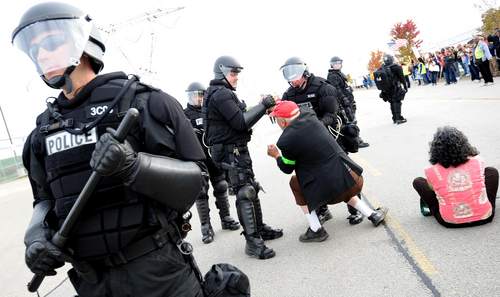
When about 650 members of community, labor and faith organizations rallied today in Elwood, Illinois in support of workers at a key Walmart warehouse striking to protest “poverty wages,” sexual harassment, racial discrimination and extreme work conditions, they were met with riot-gear-clad police and the private security Illinois Law Enforcement Alarm System Mobile Field Force who surrounded them, arrested all 47 who committed civil disobedience by sitting in the road, and told the other peaceful protesters to disperse or risk “chemical or less lethal munitions being deployed.”
“They call us bodies and that’s what we feel like.” – Mike Compton, one of the striking warehouse workers.
BP Wants To Blame Workers For Deepwater Horizon Spill, Says U.S.
This article by Puck Lo is re-posted from Corpwatch.
BP, the British oil company, has been accused of attempting to blame “blue collar workers” in order to divert attention from management failures of “gross negligence” over the Deepwater Horizon spill in 2010. The allegations were made by the federal government in a recent legal filing by the U.S. Department of Justice that was initially kept partly secret.
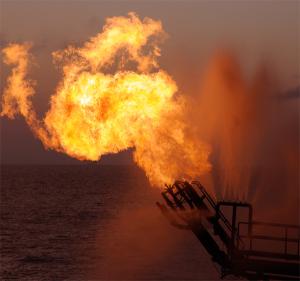
Deepwater Horizon – jointly owned by BP and Andarko Petroleum at the time – was deployed to work on Macondo, a mile-deep underwater well in the Gulf of Mexico. In April 2010 the rig caught fire, exploded, and sank. Over the following 87 days the oil well spewed nearly five million barrels into the ocean 40 miles off the Louisiana coast until the well was successfully capped with cement. Almost 70,000 square miles of water and over 1,000 miles of coastline were polluted by oil slicks, scientists say. Coral reefs and dolphins in the area continue to show signs of ill health to this day.
In mid-August BP asked U.S. district judge Carl Barbier to to dismiss a pending lawsuit by the federal government that is currently scheduled to be heard in January 2013. Instead, the company asked the judge to approve a $7.8 billion settlement, reached with 125,000 victims of the gulf disaster that includes tourist businesses and fish workers.
The federal government acted swiftly to submit a new federal legal brief to the court in New Orleans on August 31, according to legal experts, in order to convince Barbier to deny the company petition and allow the lawsuit to proceed. In their filing the government lawyers made a forceful case against the oil giant.
“BP’s management in London purposefully limited the investigation by excluding any of the systemic management failures that led to the disaster,” the lawyers wrote of an internal inquiry conducted by Mark Bly, a BP executive.
“This was a decision designed to ensure that the public and legal lines of accountability would be focused exclusively on blue collar rig workers and other contractor/defendants – but at all cost, not upon BP management and the inexplicable behaviors that coursed through the pages” of the internal BP emails. “The behavior, words, and actions of these BP executives would not be tolerated in a middling size company manufacturing dry goods for sale in a suburban mall,” the government lawyers added.
These sentences were blacked out by the government in deference to a “confidentiality claim” by the company but Barbier ordered them made public.
Cartainly individual BP workers are already being prosecuted. In April, federal prosecutors filed the first criminal charges against an individual involved in the accident. Former BP engineer, Kurt Mix, was charged with obstruction of justice for allegedly deleting hundreds of text messages sent between himself and a BP supervisor during the crisis. Mix pleaded not guilty and awaits trial in February 2013. BP has claimed that management actions in the Deepwater Horizon spill “did not constitute gross negligence or willful misconduct” on part of the company itself.
However, a presidential panel that investigated the accident has found otherwise, calling the catastrophe preventable. The panel determined that the companies involved had taken hazardous and time-saving risks. In December 2010 the Justice Department filed a lawsuit against BP and eight other companies, including Andarko Petroleum and Transocean. Halliburton, a contractor for the well that blew out, was not named in the lawsuit.

Experts say that the new filing shows that the government has become increasingly frustrated with BP’s attempts to evade responsibility. Justice Department lawyers took special issue with BP’s internal investigation noting that the company omitted from its report several revealing and embarassing emails between BP top officials that “sounded a clarion cry of impending disaster.”
“Just as BP attempted to have the public, Congress, and others focus only on what happened on the rig or in the shoreside offices of its contractors, the BP engineers and executives who drafted these and other documents were the people who actually exercised the direct authority and control over nearly every aspect of what ultimately went wrong on the rig on April 20th,” the filing’s authors wrote.
David Uhlmann, a University of Michigan professor and former environmental crimes prosecutor told Reuters that the new filing “contains sharper rhetoric and a more indignant tone than the government has used in the past.”
The government lawyers also accused BP management of refusing to learn from a 2005 Texas City refinery explosion that killed fifteen people. ”What is most striking,” the brief said, “is the utter lack of any semblance of investigation of the systemic management causes deeply implicating the corporate managers and leadership who caused and allowed the rig-based mechanical causes to fester and ultimately explode in a fireball of death, personal injury, economic catastrophe, and environmental devastation.”
The Justice Department filing reminded Barbier to rule only on whether the settlement agreement meets legal standards during an upcoming November 8 hearing and cautions against allowing BP to admit evidence or present testimony before the January trial.
The stakes are high. Under the Clean Water Act, violators are fined $1,100 for every barrel of oil spilled. In cases of gross negligence, that fine is increased to $4,300 per barrel. If a federal judge agrees that BP is indeed liable for gross misconduct, the company would have to pay $21 billion more than the $5.5 billion they planned for, according to Reuters.
BP responded to the news agency with a statement noting that it “believes it was not grossly negligent and looks forward to presenting evidence on this issue at trial in January.”
“In its filing, the U.S. Government made clear that it does not oppose the settlement reached by BP resolving economic loss and property damage claims stemming from the Deepwater Horizon oil spill. Other issues raised by the Government simply illustrate that disputes about the underlying facts remain,” the company said.
The August 31 legal brief also concluded that “BP did not act alone” and blames Transocean for its role in the disaster as well. Both the Justice Department and BP are appealing a ruling made by Barbier that let Transocean off the hook for oil that spilled underwater.
Meanwhile BP told Forbes that it has largely completed clean up from the spill, and the area has mostly recovered. Environmental experts disagree – Robert Haddad, head of the National Oceanic and Atmospheric Administration’s assessment and restoration effort, and Doug Inkley, a senior scientist with the National Wildlife Federation, told the Wall Street Journal that the region is still suffering from the spill.
The one business that has fully recovered is the oil industry. Following a six-month federal moratorium on drilling and a two-year lull after the BP explosion, the Wall Street Journal reports that over 4,000 platforms are now pumping oil and gas from 35,000 wells via nearly 30,000 miles of pipelines in the region. BP alone currently has six rigs drilling and is still the largest player operating in the area. Transocean is reportedly negotiating a partnership that would lead to a contract for four ultra-deepwater drillships similar to Deepwater Horizon.
“The only thing Macondo did was delay the entry or delivery of some ultra-deepwater rigs,” Leslie Cook, senior research consultant at Quest Offshore, told AOL Energy. The federal lawsuit is not the only one against BP for managament negligence. Six investment groups that bought shares in BP before and immediately after the catastrophe sued the company in Texas earlier this month stating that they would not have bought shares “had they known the truth,” the Daily Telegraph reported.
Pomerantz Haudek Grossman & Gross filed the lawsuit on behalf of investment firms like GAM Fund Management, Skandia Global Funds and the South Yorkshire Pensions Authority.
“BP paid only lip service to … (safety) reforms, lacked any tools for dealing with oil disasters such as deep-water spills and continued to operate by sacrificing safety for savings,” the groups filing suit stated. “BP’s reform failures led directly to the April 2010 disaster.”
Obama’s Double Game on Outsourcing
This article by Roger Bybee is re-posted from ZNet.
A wickedly barbed Barack Obama TV ad features Mitt Romney croaking “America the Beautiful” while the camera pans over scenes of Bain Capital sending jobs to Mexico and China and Romney’s use of tropical tax havens.
The ad, designed to define Mitt Romney as a job destroyer in the eyes of working-class voters in industrial states, has reportedly been effective. With 86% of Americans convinced that the offshoring of jobs contributes significantly to the nation’s economic problems, the 2012 election’s outcome may very well hinge on the perception of Obama as the defender of the public interest versus Romney the “vulture capitalist” and offshorer.
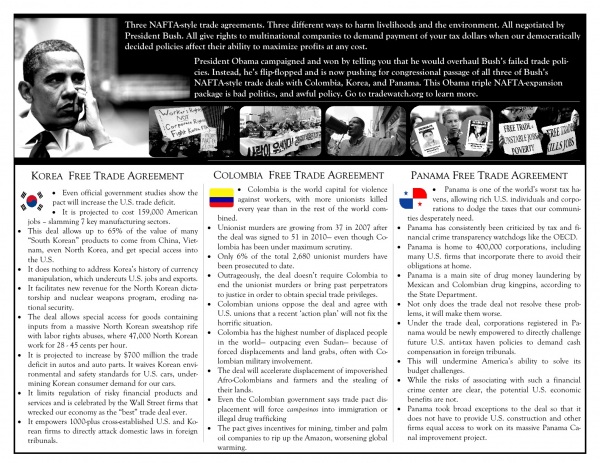
But is Obama’s record much better? Obama has aggressively promoted a set of new “free-trade” agreements that foster the shift of production from the United States to low-wage offshore sites—often in authoritarian nations denying basic labor rights. At the same time, these agreements directly and severely constrain democratically elected governments under an emerging doctrine of global corporate supremacy privileging maximum investor profits over protections for workers, consumers, and the environment. Instead of challenging the corporate prerogative to relocate family- and community-sustaining U.S. jobs to low-wage dictatorships, Obama has resorted to high-profile but hollow gestures.
About-Face on Trade Agreements
Since Obama took office, he has expressed ardent support for “free trade” agreements that provide the ground rules under which companies like Bain can generate such massive profits. Obama’s backing for these agreements, modeled on the investor rights-centered North American Free Trade Agreement (NAFTA), directly contradicts his hard-hitting message in the 2008 presidential campaign. “Decades of trade deals like NAFTA and China have been signed with plenty of protections for corporations and their profits,” he declared before GM workers in Janesville, Wisconsin, “but none for our environment or our workers who’ve seen factories shut their doors and millions of jobs disappear.”
Despite his campaign rhetoric, Obama has championed George W. Bush-negotiated “free-trade” deals with labor-rights pariah Colombia, tax-haven Panama, and South Korea. Trade economist Robert Scott of the Economic Policy Institute (EPI) estimated that the South Korea deal alone will cost 159,000 U.S. workers their jobs. Union leaders also worry that the agreement will serve as a “funnel” for component parts produced under near-slavery conditions in North Korea and China under a South Korean label, says Matt McKinnon, political director for the International Association fo Machinists and Aerospace Workers (IAMAW).
Meanwhile, the Obama administration is hammering out the biggest, farthest-reaching, and most secretive “free trade” deal ever, the Trans-Pacific Partnership (TPP). The TPP would include numerous nations on the Pacific Rim, including Australia, Brunei, Canada, Chile, Malaysia, Mexico, New Zealand, Peru, Singapore and Vietnam. U.S. Trade representatives have negotiated its terms under such an unusual level of secrecy, with only 600 corporate executives apprised of the content, that even pro-”free trade” members of Congress have complained about being excluded from the talks.
An analysis of leaked TPP documents led Public Citizen’s Global Trade Watch to conclude in June that the deal would “extend the incentives for U.S. firms to offshore investment and jobs to lower-wage countries.” The TPP would also create expanded powers for corporations to challenge—before secretive dispute resolution tribunals—protective regulations on finance, the environment, workplace safety, and other vital measures enacted by democratically elected governments.
Phantom “Insourcing”
Obama is promoting the notion of tax incentives for firms to “insource”—i.e., bring jobs back to the United States. Since last fall, he has been busy declaring that U.S.-based manufacturers are suddenly returning to America’s shores. Obama has suggested that rising labor costs in China are a central factor in these decisions by U.S. firms.
The purported insourcing trend would be reinforced by substantial tax credits equalling 20% of the costs of relocating jobs back to America. There are fundamental problems with this model, under which “good firms” would be rewarded with taxpayer money, “bad” firms engaged in offshoring would be punished with the loss of tax credits, and U.S. workers would, presumably, benefit from a greater supply of family-supporting jobs.
For one thing, there is almost no evidence of a meaningful trend toward insourcing. EPI’s Robert Scott told Dollars & Sense, “I have seen no evidence of this [insourcing] in our trade performance. The U.S. trade deficit [in goods] has risen much faster than the GDP the past three years,” reaching $738.4 billion in goods for 2011. (The total deficit including services was $599.9 billion.)
Labor costs are rising in China, but not sharply enough to drive away U.S. companies, both EPI’s Scott and University of Wisconsin labor economist Frank Emspak told Dollars & Sense. Chinese labor costs—starting from a base as low as 30 cents an hour—are climbing in the range of 5% to 30% per year, hardly enough to make a significant difference to the U.S. firms that have invested so heavily in China. For example, Milwaukee-based Johnson Controls has continued to expand rapidly in China, and now has no fewer than 60 plants there. General Electric recently shifted the headquarters of its medical equipment division from Wisconsin to Beijing.
Moreover, U.S.-based firms like Apple have developed intricate and effective supply chains in China. As global justice advocate Walden Bello has pointed out, “Chinese suppliers, with subsidies from the state, have established an unbeatable supply chain of contiguous factories, radically bringing down transport cost, enabling rapid assembly of an iPod or phone, and thus satisfying customers in a highly competitive market in record time.”
In any case, since so many U.S.-based firms can legally avoid paying corporate income taxes, it is hard to imagine how sufficient incentives can be constructed, at least through tax credits alone, to influence their conduct. David Cay Johnston, tax expert and writer for Reuters, sees little hope that Obama’s tax plans will yield more jobs in the United States, though they will likely produce a further windfall of tax benefits for the corporations. Scott of EPI agrees. “The corporations will use their ability to set up subsidiaries overseas, manipulate their prices and profits, and shift revenues,” predicted Scott.
Labor’s Response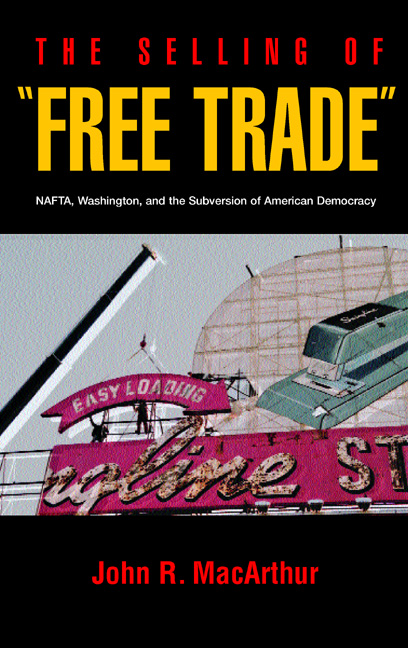
AFL-CIO President Richard Trumka, frustrated with Democrats selling out labor, fumed last year that he’d had “a snootful of this shit.” While he seems to be aware of the emptiness of Obama’s pledges against the offshoring of jobs, Trumka is holding off on public criticism of the administration on volatile trade issues as we draw closer to the November election. Asked about the TPP, Trumka told Mike Elk of In These Times, “This president has been better on trade than the last several presidents. He has enforced the trade laws better than I think anybody else and done a good job at that. Do we disagree on some things? Absolutely we do…. We will continue to work with them.”
But others in and around the labor movement view the current moment as our last chance to pressure Obama to step back from promoting the TPP and instead start taking effective action against offshoring. That is the stance adopted by the 5,000-member Association of Western Paper and Pulp Workers (AWPPW), which recently held a demonstration of several hundred outside an Obama fundraiser in Portland, Ore.
For many in labor, it’s now-or-never. “Where is the sense of urgency that the TPP must be stopped?” demands Chris Townsend, political director of the United Electrical, Radio, and Machine Workers (UE). “It’s an absurd moment when people in the Administration are saying that ‘free trade’ and the TPP will do anything but create more destruction.”
John R. MacArthur, who detailed the Clinton administration’s machinations for NAFTA in his 2001 book The Selling of Free Trade, sees close parallels between the manipulative strategies of Obama and Clinton on trade. While adopting a populist tone of concern about the fate of workers and the U.S. manufacturing base, they both remained committed to the “free trade” policies enriching their large donors. MacArthur points to the contributions pouring into Obama’s campaign “from hedge-fund partners and law firms structuring deals based on ‘free trade’.”
While Obama has drawn criticism from Democrats close to Wall Street—Newark Mayor Cory Booker, former Pennsylvania Gov. Ed Rendell, and Massachusetts Gov. Deval Patrick—over his attacks on Bain Capital and the private equity industry as a whole, MacArthur regards this conflict as a mere “pantomime” to confer illusory populist credentials on Obama. “It helps to keep people ignorant,” argues MacArthur, “about the push for free trade going on behind the scenes.”
Not all of labor has been diverted by the pantomime. The critical “action behind the scenes” has riveted the attention of some unions like the UE and the APPW, whose leadership sees passivity on the TPP and offshoring as ultimately suicidal for workers. “These trade agreements have been the number one job killer for our members,” the APPW’s vice president, Greg Pallesen, told Dollars & Sense. “Our members have made it clear they are sick and tired of the trade agreements. If we don’t take this moment to act and put pressure on the president, when will he listen?”
Unworthy Victims: Afghan Civilians Deaths still go under reported in US media as the US begins year 12 of war in Afghanistan
Editors Note: As we approach the beginning of the 12th year that the US military has been occupying Afghanistan, we do a series of articles highlighting the often overlooked aspects of the human and material cost of that occupation.
Eleven years ago the US began what was then called Operation Enduring Freedom, against the Afghani people, unjustly blaming the Taliban for their role in harboring al Qaeda.
In the first months, several thousand Afghan civilians were killed from US areal bombing, the use of cluster munitions and from US soldier raids on Afghan homes and communities. The death of Afghan civilians went under-reported on most US media and particularly in local news media.
GRIID did a study from October 7 – December 21 in 2001 of the three Grand Rapids-based TV stations and found that during that 75 day period, there were only 5 stories about wounded or dead Afghan civilians and in just three of those stories did viewers actually see images of wounded Afghanis.
Independent researchers, like Professor Marc Herold, found that there were several thousands dead or wounded Afghan civilians during the first months of the US onslaught in Afghanistan.
Since the early months of the US war in Afghanistan, the trend to under report civilian deaths has continued. In 2005, GRIID conducted another study on local TV news coverage of Iraq and Afghanistan. Not only was there no coverage of civilian deaths, there were only a total of 3 news stories about the US war in Afghanistan from the three TV stations combined over a 100 day period.
A third study was conducted in 2009, with the focus being on the Grand Rapids Press. In this 100 day study, not once were Afghan civilian deaths mentioned, even though a great deal of attention was devoted to US soldier deaths.
This disparity of which deaths get coverage in US media is what Professor Edward Herman names as “worthy and unworthy victims.” US soldiers are worthy victims, while Afghan civilians are unworthy.
Yesterday, it was reported on Common Dreams that the 2,000th US soldier has died in Afghanistan, but the lack of coverage of Afghan civilians is still disproportionately low.
This tragic milestone highlights the ongoing dangerous conditions for US and NATO soldiers in the war-torn country, but also serves as a reminder that though accurate and timely reports follow each death of a western soldier killed in Afghanistan, the death of ordinary civilians caught in the middle of a war that has dragged on for nearly eleven years are hardly mentioned at all.
Part of this story is that for most of the war statistics of Afghan civilians killed were not kept at all. From the end of August, 2012 to when the United Nations began keeping track in 2007 (six years after the US/NATO invasion), the UN estimates that 13,431 Afghan civilians had been killed.
Looking at the entirety of the war, most (conservative) estimates put the number of civilian Afghan dead at over 20,000.
To put it plainly: for every US soldier killed in a war that fewer and fewer seem willing to defend or explain, ten innocent Afghan civilians—doing their best to go about their lives under constant violent threat—are killed in war that eleven years later shows no sign of ending.
Local Anti-Fracking Activists Sentenced, Prison Industrial Complex Alive and Well in Grand Rapids
This article is by Rachael Hamilton.
Friday morning at 8:30, the three local activists who were arrested last week during a protest in observance of International Anti-Fracking Day, were arraigned and sentenced at the Grand Rapids 61st District Court, in front of Judge Benjamin Logan.
All three activists plead guilty to the charge of trespassing, and received substantial fines in response to their action of occupying Wolverine Oil and Gas, a local company that has spent money lobbying in favor of fracking, and has purchased gas and mineral rights to frack land in Barry County.
Despite the action being executed as a group, and in contradiction with usual courtroom custom, Logan arraigned each activist separately and did not provide time for any of them to further explain their actions. This was in stark contrast to the other folks in the courtroom also being arraigned at that time, who were asked questions regarding their actions, albeit in a condescending tone, and at least given time to explain themselves. All those who stood in front of Logan that morning faced both his deadpan drone of bureaucratic law and procedure, and his condescending attitude of paternal lecturing and disrespect. It appeared that Logan’s intention was to patronize all those in his courtroom, and deny any further platform to the activists.
This writer and the three activists noted aspects of the prison industrial complex inherent in the courtroom. All others present for arraignment were young Black and Latino women and men, charged with petty crimes such as minor drug possession and driving on a suspended license. While some plead guilt and others not guilty, it is safe to say they too will be charged hefty fines to the court. They were also subjected to Logan’s humiliating and morally superior commentary with statements such as one declaring that the only people who are out early in the morning are police officers and criminals, wondering which of those groups this gentleman fell into, in response to the individual explaining why he was driving his car at 2:30 in the morning. This statement not only ignores the multitude of valid reasons someone may be out at that time, but forgets that in our country we enjoy the freedom of not having a state imposed curfew. It reflected a moralistic sense of what underprivileged folks should be doing with their time. Such a display not only affirmed the concept of the prison industrial complex, but also spoke to the criminal justice system as what author Michelle Alexander calls the new Jim Crow—the biased treatment of disproportionately young black and brown members of society.
Jeff Smith, one of the activists charged with trespassing, stated after the court appearance that he was “not surprised by the court’s indifference to what we did, but their treatment of people of color was yet another reminder of the white supremacist criminal society we live in”.
Deirdre Cunningham, another of the activists, acknowledged that her experience in the courtroom mirrored that of her experience in the holding cell a week prior while they waited to be bonded out by fellow activists. There she encountered only women of color, one of whom was pregnant with children at home and faced a bond of $3,000. Cunningham stated “never could I have imagined, or will I ever forget the look of her, as she tried to decide whether to stay a few days or owe such a fee as to guarantee she’ll be back when they catch up with her again”.
Yet companies and corporations such as Wolverine, guilty of acts that are poisoning our drinking water, will not face this ridicule and contemptuous language from a judge. They will not be held financially responsible for their actions. But they will be permitted to continue committing their crimes and be celebrated in our community.
For those of you for whom this does not sit well, please consider participant in an action against the next gas and mineral rights land auction on Wednesday, October 24th in Lansing. For more information, you can contact the local Mutual Aid group at grpeoplesassembly@gmail.com.
 Grand Rapids Institute for Information Democracy