COP18, Another ‘Conference of Polluters’
This interview between Patrick Bond and Busani Bafana is re-posted from ZNet.
There is no political will among rich nations to find funding for developing countries experiencing the brunt of changes in global weather patterns, and the current climate change conference will fail to do so, according to Professor Patrick Bond, a leading thinker and analyst on climate change issues.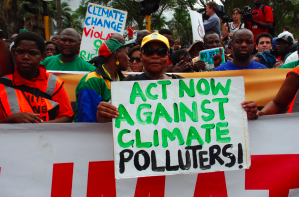
“The elites continue to discredit themselves at every opportunity. The only solution is to turn away from these destructive conferences and avoid giving the elites any legitimacy, and instead, to analyse and build the world climate justice movement and its alternatives,” Bond, a political economist and also the director of the Centre for Civil Society at the University of KwaZulu Natal in South Africa, told IPS.
As the 18th Conference of the Parties (COP18) to the United Nations Framework Convention on Climate Change (UNFCCC) began in Doha, Qatar on Monday Nov. 26, Bond described past COPs as “conferences of polluters”. He believes COP18 will be no different.
“Qatar is an entirely appropriate host country for the next failed climate conference. On grounds of gender, race, class and social equity, environment, civil society voice and democracy, it’s a feudal zone, and the Arab world’s best mass media, Doha-based Al Jazeera, can’t tell the truth at home,” said the professor and author of the book, “Politics of Climate Justice”.
Excerpts of the interview follow:
Q: What is in it for Africa? What is Africa likely to get or to lose from this conference?
A: The most hopeful opportunity is that with the passing of (Ethiopia’s prime minister) Meles Zenawi a few months ago there is a chance for fresh leadership, unencumbered by revelations about Washington’s influence.
Meles was unveiled as purchasable in the WikiLeaks’ U.S. State Department cables from February 2010 … Meles’ pro-Washington stance meant that though he was the loudest official African voice for climate debt and lower northern emissions, it was hard to take the continent seriously.
Sadly, since the quietening of the eloquent Sudanese voice from Copenhagen, Lumumba di Apeng (Sudanese diplomat and chief negotiator for developing countries at COP15), no African leader has made a positive impression.
And though there is a possibility that adaptation funding may flow a bit more to Africa, evidence so far confirms that the West pays elite Africans instead of the people most adversely affected. The Qatar meeting won’t change these crippling problems.
Q: What progress do you anticipate on the Kyoto Protocol in Doha?
A: None at all. The only hope they have is to boost the Green Climate Fund – but already the main polluters like the U.S. have signalled that in spite of Hillary Clinton’s 100 billion dollars a year promise at Copenhagen in 2009, they won’t support it financially, so it is empty and cannot begin to meet either mitigation or adaptation requirements.
Q: From your writings, you hold quite strong views about the Green Climate Fund. Why?
A: Although a vast “climate debt” payment mechanism from the global north to the global south is urgently required, probably on the scale of a trillion dollars a year, we must be critical of the proposed Green Climate Fund from the outset, because its huge potential was destroyed even at the level of design.
This is in part because African elites like the late Zenawi and (South Africa’s former minister of finance) Trevor Manuel played critical co-chairing roles from 2009 through last year.
Because of their pro-market ideology, Manuel especially bought into the insane argument that emissions trading can provide up to half the fund’s revenues, when in reality, these markets are sputtering to their deaths, as witnessed in 2010 at the main U.S. market, in Chicago, and the collapse of the European market over the past 18 months.
That means that there’s insufficient pressure on the north to raise funds through penalising polluters by fining – and then rapidly banning – emissions. It is also likely that the fund’s tiny revenues will be squandered on what we term “false solutions” – a variety of corporate-designed gimmicks to allow them to continue polluting.
What is needed is wide-ranging investment in a post-fossil society, as well as a reparations mechanism to get resources to people suffering from climate change – such as a “basic income grant” for those in affected areas, without interference by the likes of local tyrants – and one leading pilot study for this comes from rural Namibia, funded by German churches, whose results are most encouraging.
Q: How are we doing then on global climate governance?
A: As the (COP17) Durban disaster proved, the idea of global management of the climate catastrophe, given the present adverse balance of forces, is farcical in general…
It is beyond doubt now that any progress at the multilateral level will require two things: first, a further crash of the emissions trading experiment, so as to finally end the fiction that a market run by international bankers can solve a problem of planet-threatening pollution caused by unregulated markets; and second, a banning of delegations from Washington – the U.S. government and Bretton Woods Institutions – since that’s the city most influenced by climate denialists. Hence every move from the U.S. State Department amounts to sabotage.
Q: What of the 2012 climate change negotiations prior to Doha?
A: For every tip-toe step forward taken in Durban – in a context in which during this century, 200 million additional Africans are expected to die early because of extreme droughts and floods – there were reversals by leaps and bounds…
Because of WikiLeaks, we know in great detail that the U.S. State Department is slyly bribing even the occasional courageous delegation, such as the one from the Maldives right after the Copenhagen fiasco. So given the degree of bribery, bullying and corruption from Washington, why would we expect the COP system to suddenly become functional?
Q: What is the future of climate change negotiations?
A: To sum up, the 1987 Montreal Protocol should have immediately been expanded to incorporate greenhouse gases, but instead, because Washington insisted on ineffectual carbon trading a decade later in Kyoto – we have simply not seen an appropriate degree of political will and strategic sophistication, and until this changes, we will not be successful at the multilateral scale.
That means the future of any potentially successful negotiations is actually between activists and the popular support they rally to the cause on the one hand, and governments – and the corporations that often control those governments – on the other.
Even public consciousness has shifted quickly, as a result of extreme weather in the most backward regions of the world, like the northeastern U.S. These are the only bright lights in the world’s efforts to halt climate change, and I feel that if more people know these stories, they would lose their despondency and take action against both their local polluters and crony-corporate governments.
Strike Launches Largest Union Drive in U.S. Fast Food History
This article by Peter Rugh is re-posted from Dissident Voice.
While the emblems of Wendy’s, McDonald’s, KFC, Domino’s and other greasy dynasties are hard to escape in the American landscape, those who cook, clean, ring up orders and otherwise serve as the fulcrum of these franchises often go unnoticed. These workers, however, were hard to miss today as they stepped off burger assembly lines across New York City and into the street, picketing in front of their workplaces. The strike, which took place at numerous restaurants across the city, is the start of the largest effort to unionize fast food workers in American history.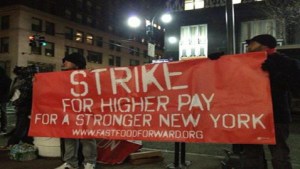
Organizers are calling the campaign Fast Food Forward.
Revenues in the fast food industry are expected to near $200 billion this year. Yet the demands of their workers are modest: $15 an hour and the right to unionize with the Fast Food Workers Committee.
“We’re out here for better wages, better working conditions, and union protection,” said Michael, an 18-year-old employee of a Burger King located not far from Wall Street. Michael says that growing up he was encouraged to “go the right way and get a job,” but now that he has a job he’s having trouble getting by. “There’s people my age that try to let this stabilize them. We got bills, we got rent. We’re living from check to check, hoping the next one will be better and it’s not. We can’t live on this.”
Gregory, an East Harlem KFC worker several years older than Michael, said he and his coworkers earn minimum wage ($7.25 an hour), receive food stamps and still don’t have enough to get by and provide for their kids. Gregory lives in Rockaway, Queens — an area that was inundated with floodwaters from Superstorm Sandy. When he sought back pay from his employer for time lost during the storm, his request was denied. He was given a meal on the house instead.
Working conditions at fast food franchises tend to be about the same across the board: highly exploitive. The fast food industry provides cheap, warm meals to those pressed for time, who often cannot afford more nutritious forms of nourishment. Simultaneously, these corporations take advantage of economic desperation in the black and brown, immigrant and working-class communities where they can get away with paying starvation wages and reaping gargantuan profits. Wendy’s, for instance, took in $615 million in 2011, an increase of 6 percent. But workers say checks from their employer often bounce, and some check cashing outlets won’t accept them.
Organizers with New York Communities for Change (NYCC), which has been working behind the scenes for months to build the strike, say that McDonald’s recruits in homeless shelters. Nearly every “benefit” listed on the company’s website, including free uniforms, appears with an asterisk beside it, indicating that the supposed perks are “subject to availability and certain eligibility requirements and restrictions.” Profits at McDonald’s have ballooned 130 percent in the past four years.
The largest of the fast food behemoths, McDonald’s, was also the swiftest to shift into damage control mode today, issuing a statement informing the public that the company is committed to a dialogue with their employees “so we can continue to be an even better employer.”
Asantewwa Ricks with NYCC said that before she began working on the strike drive, she thought fast food employees were “18-, 19-year-old kids who wanted cash for Beats headphones and True Religion jeans.” She has since learned that is not the case. Often, workers remain in the industry for years and see little to no bump in their salary. The minimum wage they receive often forces tough choices on them, such as whether to work late, or to make it back before the shelter where they reside locks its doors. At an organizing meeting early on in the campaign, Ricks asked a room full of fast food workers if they had ever suffered on-the-job injuries. Just about everyone present lifted up scars from grease on their arms.
A coalition of unions and community-based workers’ rights groups gathered ahead of the strike on Tuesday in a meeting room at the Service Employees International Union headquarters in Manhattan to discuss ongoing campaigns seeking dignity and improved pay for the working poor citywide. More than 100 people attended, representing roughly 40 organizations, along with a cluster of clergy from a variety of faiths. The coalition had helped spearhead a day of action on July 24, which saw hundreds of low-wage workers from the city’s five boroughs congregate in Union Square, and it has also been working with car wash employees demanding raises above the $5.25 hourly standard and, in some cases, back pay. Workers at four car washes have already won union representation in recent months.
City Council Speaker Christine Quinn, who spoke at the July 24 rally, sent an aide to Tuesday’s meeting. Quinn is currently ahead in the upcoming mayoral race, but she has drawn ire from workers’ rights advocates over her opposition to sick pay legislation. While NYCC is circulating a petition for her to back the bill, the Daily News reports that wealthy business owners — who have already thrown over a quarter of a million dollars her way — sent a letter of their own to Quinn demanding just the opposite. Jonathan Westin, a lead organizer with NYCC, said while the group disagrees with Quinn on the issue of sick pay, he views it as a positive sign that she appears interested in the demands of fast food workers.
Perhaps seeking an edge on Quinn, two other Democratic contenders for mayor were on hand, Bill Thompson and Public Advocate Bill de Blasio. The candidates stood in pressed suits, at opposite ends of the room, grinning at one another. It is with good reason that politicians are showing an interest in the fast food workers’ fight for a union; bystanders receiving leaflets from picketers Thursday were widely sympathetic to the cause.
“These guys shouldn’t be making 7.25 an hour,” said Steve Carlson, a union carpenter. “That’s crazy. Especially in Manhattan, the cost of living is so high.”
Still, while politicians might lose campaign contributions that sway an election by standing up for a cause like this, workers could lose their jobs. By organizing in the workplace, walking off and gambling on solidarity, they have risked the only means of subsistence available to their families and themselves. Westin said that since workers began the union drive six months ago there have been instances of retaliation from management, but he declined to elaborate because these cases are currently being dealt with in court. For those on strike and their supporters, however, the potential benefits outweigh the risks.
“The goal of this strike is for workers to be able to put food on their table and buy their children presents for Christmas,” Westin said, though he admits this is a long term battle and likely won’t be resolved by the holidays.
The fast food strike that broke out today may have larger implications than are immediately apparent. There are 50,000 fast food workers in New York City, and while those who walked off were few in number by comparison, the strike could galvanize workers elsewhere to take a stand as well. If the push for a union is successful, it will be an illustrative example to those both in the industry and in other low wage professions that standing up to the boss can pay off.
For Michael and his fellow Burger King employees, walking off the job was about more than a wage hike or forming a union. These demands are a means to a higher end. “We work hard, as if we were slaves,” he said. “It’s not only the wages. It’s also about how we get treated. We deserve respect.”
Snyder on Michigan’s Energy Future and Fracking
On Wednesday, Michigan Governor Rick Snyder delivered a talk in East Lansing on the future of the State’s energy and environmental policy.
The summary of the Governor’s message on the government site is of course glowing, naming the talk as Affordable and Reliable Energy, A Cleaner Environment, No Regrets for Our Future.
In his talk on the state’s energy future, Snyder tends to focus on the need to get home owners to make their homes more energy efficient and relying on the private sector to solve some of our problems of energy generations and transmission.
Snyder perpetuates the notion that the state needs to produce more energy in order to be more economically prosperous. The Governor is operating within the Capitalist framework, thinking that economic growth can co-exist with environmental sustainability, which we believe to be an impossible outcome.
On the matter of how Michigan should generate more of its own energy, Snyder identifies three areas of what he believes would create energy independence for the state. First, he identifies Nuclear Power, but only talks about waste disposal and that Yucca Mountain seems like a reliable solution for Michigan’s nuclear waste. This has been an ongoing debate in Congress and there has been substantial public resistance as well. In addition, there has been plenty of new evidence of safety concerns over both the Palisades and Davis Besse reactors, an issue that Snyder never addresses in his recent talk.
The second area of energy that Snyder addresses is electrical energy, generated by coal-powered plants. Snyder focuses on the issue of a national grid and then states, “I know people disagree about the new EPA rules for coal plants, but I think we can all agree it’s not in the best interest of the environment or the country to risk massive outages to get there at a breakneck pace.” Seems like Snyder is not in a hurry to cut Michigan’s dependency on coal for electricity generation, which would be an unsustainable and environmentally destructive route to continue.
The third area of energy the Governor addresses is natural gas. Snyder states:
A recent presidential order recognized the benefits of natural gas as a reliable, affordable, clean and domestic part of our energy future. The President got this right and we need him to follow through. We need timelines that will let us look seriously at transitioning existing plants to this fuel, a commitment to pipeline infrastructure and a stable, environmentally protective set of regulations that allow companies to create a business plan built around new natural gas supplies. Michigan has done what it can in leading the way on this issue. We will do whatever we can to help our federal partners develop and implement a consistent strategy in short order.
Snyder makes it clear that he is sold on natural gas being the savoir of the state’s energy needs. Later on in his talk Snyder addresses the issue of horizontal hydraulic fracturing.
Hydraulic fracturing, or “fracking,” has received increased attention lately. This technology is being used in combination with horizontal drilling to reach some natural gas and other resources that otherwise could not be developed. This innovation is already benefitting Michigan in the form of unusually low natural gas prices and additional money from state leases that goes to our public lands and our parks. But some have expressed concerns about what these technologies mean for Michigan’s environment.
Neither fracking nor horizontal drilling is a new technology—they have been used in Michigan for many decades. None of the fracking that has been done in Michigan has resulted in a single water quality problem. In fact, fracking’s deeper wells likely pose less risk to our groundwater than the shallower wells we are more used to. With our water withdrawal statute, as well as our strong regulatory history of natural gas drilling, we are better prepared – more adaptable – than most other states.
That said, it’s important that our citizens understand what fracking is really all about. That’s why the University of Michigan’s Graham Sustainability Institute is undertaking an evaluation of fracking. At their invitation, the state is participating in the steering committee for this effort alongside environmental and industry groups. At the end of the process, the public will have well-reasoned, objective explanations of what this technology is and is not. We will also have a Michigan-focused evaluation of the various implications of fracking. This is a great example of collaboration and a public university serving the needs of the state, and I am looking forward to seeing the results.
Snyder is clearly embracing the coming explosion of fracking in Michigan and the lie about it not being a risk to environmental destruction and public health. Snyder presents the illusion that the state is engaged in doing research to determine that the fracking is safe and beneficial for the state. The University of Michigan’s Graham Sustainability Institute might sound like a bastion of environmental integrity, but the Institute often promotes a Green Capitalism approach to environmental issues and their advisor’s are made up of the Big Green Groups and corporations such as Dow, neither of which have a commitment to environmental or climate justice.
Snyder’s position on fracking should be a clarion call to activists across the state that we need to get ready for a serious battle to stop the fracking onslaught coming our way.
Fossil Fuel Divestment Campaign comes to GVSU
The international group 350.org is spearheading a campaign to get campuses across the US to divest from investing in any companies making a profit from the extraction or burning of fossil fuels.
The campaign has its own website http://gofossilfree.org, which includes regular updates and some well-designed resources on how and why to divest from the fossil fuel industry. There is also a listing of the Top 200 Fossil Fuel Companies, companies that will be targeted in this campaign.
As of this writing there are about 100 campuses nationwide that are participating in the Fossil Fuel Divestment Campaign, with Grand Valley State University being one of them.
There is an online campaign to send letters to GVSU President Thomas Haas, which includes the following text:
Climate change is accelerating. We are witnessing the increasing impacts of a warming planet more and more consistently; in this last year alone our country experienced record-breaking heat, droughts, and hurricanes, which impacted hundreds of thousands of people and cost our country hundreds of billions of dollars. Hurricane Sandy alone caused $50bn in damages. Experts agree that global warming caused by humans burning fossil fuels will continue to accelerate and intensify these tragic climate disasters. The scientific consensus is clear and overwhelming; we cannot safely burn even half of global fossil-fuel reserves without dangerously warming the planet for several thousand years.
As public pressure to confront climate change builds, we call on Grand Valley State University to immediately freeze any new investment in fossil-fuel companies, and to divest within five years from direct ownership and from any commingled funds that include fossil-fuel public equities and corporate bonds. We believe such action on behalf of Grand Valley State University will not only be a sound decision for our institution’s financial portfolio, but also for the wellbeing of its current and future graduating classes, who deserve the opportunity to graduate with a future not defined by climate chaos.
Grand Valley State University is known across the country and the world for being one of the most environmentally-friendly universities in the world. As an institution and a community we are well on our way to initiating action geared toward sustainability and the environment. We need to continue on this path and continue to lead other institutions and universities on the path of sustainability and environmental action.
If any additional efforts are organized at GVSU around this campaign, we will report on those efforts in the future.
This article by Amy Mall is re-posted from EcoWatch.
The George Washington National Forest in Virginia is currently a target for natural gas leasing, yet this area is home to the headwaters of the Potomac and James Rivers.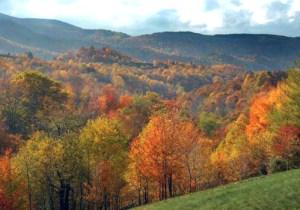
The Department of the Interior’s Bureau of Land Management (BLM) is in the process of developing new rules for fracking on more than 750 million acres of public and private land across the country. A final rule could be released as early as December.
The current rules are woefully inadequate and need to be dramatically strengthened to protect health and the environment. Even Interior Secretary Ken Salazar has said that the current rules “… are in many ways outdated …”
BLM has the opportunity and obligation to be a leader in regulating fracking. But the BLM’s current draft for new rules is too weak. The rules need to be strengthened in many ways that the Natural Resources Defense Council (NRDC) has detailed in previous blogs, such as requiring companies to disclose the chemicals they use before fracking begins; requiring baseline water testing in an area before fracking begins in order to determine if contamination has occurred; establishing the highest standards for well design and construction; and prohibiting the use of open air pits to store or dispose of toxic fracking waste.
The stakes are high—fracking comes with serious risks and stronger rules are essential to protect the health and safety of millions of people nationwide.
It’s not only wildlands like the pristine mountain ranges and magnificent red rock canyons in the western U.S. that fall under the category of “public lands.” It’s true that BLM’s new rules will govern oil and gas fracking in California, Wyoming, Colorado, Utah and New Mexico. And protecting those lands for wildlife and wilderness qualities is critical.
Drinking water for millions at risk
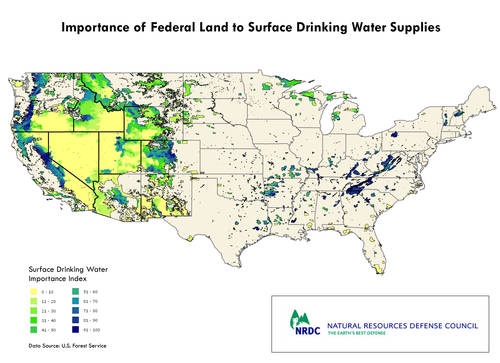
But in addition, the rules will also apply to national forests nationwide that are the sources of drinking water for tens of millions of Americans. Priority drinking watersheds, and other sensitive natural, scenic and recreation areas, should be made off limits to fracking in BLM’s new rule. The toxic waste that can spill or leak, dangerous air pollutants, harms to streams and forests, and threats to drinking water from contamination in watersheds that serve millions of people are too severe to allow oil and gas development to proceed in places like this. A map below illustrates federal lands and their importance to surface drinking water supplies.
Take, for example:
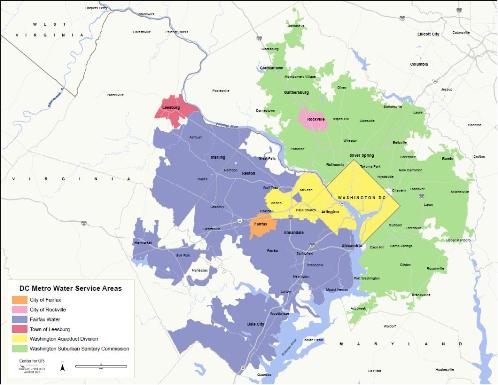
Washington, D.C.: The George Washington National Forest in Virginia is currently a target for leasing, yet this area is home to the headwaters of the Potomac and James Rivers. The waters in this forest feed the drinking water supplies for approximately four million people, including all of Washington, D.C., northern Virginia, and Richmond (see our map below), and more than 260,000 residents of the Shenandoah Valley. While the U.S. Forest Service has proposed keeping horizontal drilling and fracking out of here, its plan has yet to be finalized, and would still allow vertical drilling with fracking in nearly the entire area if it is approved. Not only are the risks of fracking here far too great—whether horizontal or vertical—but the proposed new BLM rules are inadequate to properly safeguard the drinking water resources that depend on this forest from any kind of fracking that might move forward here, regardless of the outcome of the Forest Service’s new plan.
Denver and western Colorado: The White River National Forest in Colorado, where oil and gas leasing is in the works, is home to the main reservoirs for Denver’s drinking water and parts of water projects that serve Aurora and Colorado Springs, among other cities. Its crystal clear streams provide drinking water to many local communities, including Glenwood Springs, Silt, New Castle, Carbondale, Redstone, Vail, Aspen, Basalt, Eagle, Gypsum and Rifle. And it is also the source of most of the water in the Upper Colorado River—which ultimately sustains 30 million people downstream in Arizona, Nevada and California. Additionally, the White River National Forest is the most visited national forest in the nation because it is home to some of America’s most spectacular wild beauty, unparalleled outdoor recreation opportunities including Aspen and Vail, incredibly valuable wildlife habitat and prized hunting and fishing spots.
Athens, Ohio: The Wayne National Forest is facing oil and gas leasing of more than 3,000 acres. Most of the acreage lies directly along the Hocking River and the underlying aquifer that serves as the sole source of drinking water for more than 70,000 people in four Ohio counties: Athens, Hocking, Perry and Morgan. This includes major metropolitan areas like Athens and Nelsonville, and Ohio University. According to the City of Athens, the sole-source aquifer is shallow, averaging a maximum of 60 feet below ground level, and is therefore “especially susceptible to pollution from surface level and near-surface level contamination.” The Burr Oak Regional Water District opposes any fracking near the aquifer, saying that contamination would pose a “serious and catastrophic health risk to the people and communities that depend upon this water source.”
The BLM has more work to do in order to deliver a stronger and more, protective fracking rule to help safeguard the health of the millions of people and the more than 700 million acres across the country it will govern. From California to Virginia, Michigan to Texas, and the many places in between, our drinking water sources, communities and wild places are too precious for anything less.
Here is a map of areas in the Washington, D.C. metropolitan region that are primarily served by water from the Potomac River; this map does not include areas in Frederick County, MD:
And here is a map of federal lands nationwide and their importance to surface drinking water supplies, based on data from the U.S. Forest Service “Forests to Faucets” program:
Gaza Quiz
This quiz by Stephen Shalom is re-posted from ZNet.
An uneasy cease-fire has been declared ending Israel’s attack on Gaza, Operation Pillar of Defense. Take this quiz to see how much you know about the situation.
1. How did the people of Gaza come to be where they are?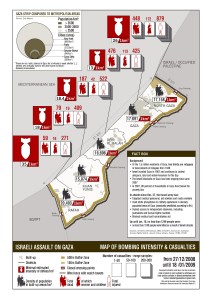
a. A majority of them are descendants of refugees who in 1948-1949 fled or were driven out by Israeli forces from territory that was supposed to be part of the Arab state of Palestine but was taken over by Israel, and they were never permitted to return.
b. Some of them are descendants of residents of the Arab town of Majdal, who, after the 1948-49 war were evacuated from different parts of the town and concentrated in a neighborhood surrounded by barbed wire (to make way for Jewish settlers) and then expelled to Gaza.
c. Gaza was conquered by Israel in October 1956 and subjected to massacres; Israel withdrew under international pressure in March 1957.
d. Gazans came under Israeli occupation in 1967 when Israel—in a war in which, in the words of Prime Minister Menachem Begin in 1982, “we had a choice … We decided to attack [Egypt]”—conquered the Sinai (since returned to Egypt), Gaza, East Jerusalem (annexed), the West Bank, and the Golan Heights (annexed).
e. All of the above.
2. In 2005, Israel under Prime Minister Ariel Sharon “disengaged” from Gaza. Which of the following statements about the disengagement is true?
a. Israel’s Gaza “disengagement” was a unilateral move, not worked out with any Palestinian leaders at all.
b. Israeli settlers were removed from Gaza, but more new settlers moved to the West Bank in 2005 than left Gaza and more Palestinian land was taken over on the West Bank than was given up in Gaza.
c. Ariel Sharon’s chief aide, Dov Weisglass, told an interviewer for an Israeli newspaper: The significance of the disengagement plan “is the freezing of the political process. And when you freeze that process you prevent the establishment of a Palestinian state and you prevent a discussion about the refugees, the borders and Jerusalem. Effectively, this whole package that is called the Palestinian state, with all that it entails, has been removed from our agenda indefinitely.”
d. All of the above.
3.Israel says that its occupation of Gaza ended in 2005. Which of the following conditions that exist to this day raises a question about whether there has actually been an end to Israeli control of Gaza?
a. Israel prohibits Gaza from engaging in air commerce with or air travel to or from other nations.
b. Israel prohibits Gaza from engaging in sea commerce with or sea travel to or from other nations.
c. Israel prohibits Gazans engaged in fishing from going more than 3 nautical miles off shore, denying them access to 85% of their fishing waters.
d. Israel has declared a formal no-go zone for Palestinians inside Gaza covering more than 3 percent of the total land area and another 14 percent within which entry is effectively restricted due to a real risk of gunfire, excluding from Palestinian use 35% of the land suitable for farming.
e. The Israeli army carries out incursions into this zone a number of times a week.
f. All of the above.
4.Which of the following reflects the Israeli attitude toward Gaza and its people?
a. The statement in a 1956 Knesset speech by Israeli Prime Minister David Ben Gurion: “If I believed in miracles, I would pray that Gaza would be washed down into the sea.”
b. The statement by Israeli Prime Minister Yitzhak Rabin in 1993: “If only it [Gaza] would just sink into the Sea.”
c. The fact that in Israeli slang, “go to Gaza” means “go to hell.”
d. All of the above.
5.The Palestinian organization Hamas rules within Gaza. Which of the following is true regarding Hamas?
a. A descendant of the Muslim Brotherhood, it was promoted in its early years by Israel and the United States, which were eager to establish a counterweight to the then-dominant secular Palestinian organization Fatah.
b. It won a plurality in the Palestinian legislative elections in January 2006.
c. It took over Gaza in 2007 after Fatah, working with Israel and the United States, launched a failed coup against it.
d. All of the above.
6. Hamas refuses to accept the three Israeli-U.S. conditions: that it recognize Israel, renounce violence, and agree to accept all agreements previously accepted by the Palestinian Authority. Which of the following is true?
a. Israel and the United States have refused to recognize an independent Palestinian state, with Washington even blocking UN recognition of nominal Palestinian statehood.
b. Neither Washington nor Tel Aviv has renounced violence (to say the least).
c. Nonviolent protest against the Israeli occupation has been brutally repressed.
d. Israel “previously accepted” the Fourth Geneva Convention, but when the World Court found Israel’s construction of the Wall on the occupied West Bank to be in violation of that convention, Israel refused to remove it and the United States supported its refusal.
e. Israel signed the Oslo Accords which state that “The two sides view the West Bank and the Gaza Strip as a single territorial unit, whose integrity will be preserved during the interim period” and yet has pursued a policy of trying to separate Gaza from the West Bank.
f. Hamas has indicated on numerous occasions that it was willing to accept an independent Palestinian state on the 1967 borders, with East Jerusalem as its capital, along with a truce that could last 20, 30, or 50 years, or even indefinitely.
g. All of the above.
7.Israel says it can’t trust Hamas to maintain cease-fires. Which of the following is part of the historical record?
a. A study found that from 2000 to 2008, it was “overwhelmingly Israel that kills first after a pause in the conflict” and that this pattern “becomes more pronounced for longer conflict pauses,” with Israel unilaterally having interrupted 96% of the periods of nonviolence that lasted longer than a week and 100% of the periods of nonviolence lasting longer than 9 days.
b. In 1997, Hamas leader Khaled Meshal made an offer to Israel through King Hussein of Jordan for a thirty-year cease-fire. Israel ignored the offer and then tried to assassinate Meshal in Amman.
c. Following its 2006 electoral victory in Gaza, Hamas secretly conveyed a message to the Israeli government that it “would pledge not to carry out any violent actions against Israel and would even prevent other Palestinian organizations from doing so,” if Israel stopped its undercover assassination program and ended its military attacks in Gaza and the West Bank. Israel did not reply.
d. In June 2008 a six-month truce was arranged between Israel and Hamas, and broken by Israel on the night of Nov. 4-5, 2008.
e. All of the above.
8.Israel claims that its blockade of Gaza is simply a means of keeping out weapons from the territory. Which of the following is true?
a. The blockade has always included a ban on almost all exports from Gaza, crippling the economy, while having no connection to weapons imports.
b. Dov Weisglass, an adviser to former Prime Minister Ehud Olmert, explained that “The idea is to put the Palestinians on a diet, but not to make them die of hunger.”
c. The Israeli Ministry of Defense did a study in 2008 of the minimum daily humanitarian food needs of Gaza and then, until June 2010, Israel proceeded to allow in less than that amount.
d. Among the items Israel prohibited being imported into Gaza before June 2010 were notebooks, cilantro, sage, jam, chocolate, French fries, dried fruit, fabrics, and toys.
e. Even though food is now allowed into Gaza, Israel still restricts exports, imports of basic construction materials, despite a shortage of approximately 250 schools and some 71,000 housing units, and restricts travel between Gaza and the West Bank.
f. All of the above.
9.Which of the following describes conditions in Gaza on the eve of Operation Pillar of Defense?
a. The people of Gaza have lower per capita incomes than they did in the 1990s, despite improvements over the past three years.
b. The unemployment rate in 2011 was 29% and during the first quarter of 2012 unemployment stood at 47% for women and 58% for people between 20 and 24 years old.
c. 44% of households were food insecure in 2011 and another 16% were vulnerable to food insecurity.
d. 10% of children suffer from stunting (long-term exposure to chronic malnutrition).
e. 39% of people lived below the poverty line.
f. Currently, more than 90% of the water supplied through Gaza’s aquifer does not meet the safety standards of the World Health Organization and is unfit for drinking.
g. All of the above.
10.Israel launched Operation Pillar of Defense on November 14, 2012, claiming it needed to respond to an unrelenting barrage of rockets from Hamas. Which of the following is an accurate statement of the lead-up to November 14?
a. From October 30, 2012, until Nov. 10, 2012, there were a total of 2 rockets fired from Gaza, which fell in open areas causing no casualties or damage.
b. On November 4, Israeli forces shot and killed a 23 year-old mentally-challenged Palestinian walking approximately ten meters from the fence on the Gaza side. The Israeli military did not allow a Palestinian ambulance to retrieve the body for two hours.
c. On Nov. 8, Israeli troops operating within Gaza were fired on by Palestinians; Israeli fire killed a Palestinian boy.
d. On Nov. 10, Palestinian armed factions fired on an Israeli military vehicle patrolling on the Israeli side of the fence, injuring four soldiers. Israel responded by firing tank shells hitting a residential area, killing 5 civilians, including 2 children, and injuring 36 civilians, including 9 children.
e. Palestinian rocket attacks began on Nov. 10, after more than a week of quiet.
f. All of the above.
11.What happened on November 13, the day before the Israeli targeted assassination of Ahmed al-Jabari, Hamas’ military chief?
a. Palestinian rocket fire decreased from 64 on Nov. 11, to 35 on Nov. 12, to 1 on the morning of Nov. 13.
b. Palestinian rocket fire ended, but then, in the words of the Israeli government, “Following the launch of Israel’s operation Pillar of Defense … rocket fire from Gaza resumed on Wednesday evening (14 Nov)…”
c. Reuters reported that “After five days of mounting violence, Israel and the Palestinians stepped back from the brink of a new war in the Gaza Strip on Tuesday, [Nov. 13,] sending signals to each other via Egypt that they would hold their fire unless attacked. … Ismail Haniyeh, prime minister of Gaza’s Hamas government, praised the main armed factions in the enclave for agreeing on Monday night to a truce. ‘They showed a high sense of responsibility by saying they would respect calm should the Israeli occupation also abide by it,’ he said.”
d. A draft proposal for a long-term cease-fire, with mechanisms to ensure compliance, had been agreed to by an Israeli negotiator and Hamas’s deputy foreign minister, and was being submitted to Ahmed al-Jabari and Israeli security officials for their consideration. Jabari, who had authorized the negotiations, received a copy of the proposal the day he was assassinated.
e. All of the above.
12.Israel (and the United States) claim that the Israeli attack on Gaza was a lawful act of self-defense. Which of the following statements about self-defense conform to international law and morality?
a. Military force in self-defense must be a last resort, having exhausted non-military means (such as accepting a cease-fire, negotiating a long-term cease-fire, and, most decisively, ending the occupation of Palestinian territory).
b. Self-defense is not permissible against someone legitimately resisting illegal occupation (and so, for example, Japanese troops in China from 1937-45 had no right of self-defense against attacks from Chinese forces).
c. Even when self-defense is permitted, the measures taken must not disproportionately endanger civilians.
d. All of the above.
13.If a cease-fire was possible without Operation Pillar of Defense, which of the following is a plausible explanation for why Israel launched its attack?
a. Because Israel always wants to maintain its deterrent power, meaning that fear of its massive military response will keep subject people in line.
b. Because an election is coming soon in Israel and wars and Palestinian rockets tend to help politicians’ electoral prospects.
c. To test out the Iron Dome system and send a message to Iran.
d. Because Pillar of Defense weakened Mahmud Abbas’s Palestinian Authority, while strengthening Hamas, which serves the Israeli interest in being able to insist there is no partner for peace.
e. All of the above.
14.Which of the following statements was made by an Israeli official or personality?
a. Israel’s Deputy Prime Minister Eli Yishai: “We must blow Gaza back to the Middle Ages, destroying all the infrastructure including roads and water.”
b. Israel Katz, Israel’s transport minister and member of Netanyahu’s Likud party, on 11 November: “we must detach from Gaza in a civilian manner—electricity, water, food, and fuel—and transition into a policy of deterrence, just like in Southern Lebanon.”
c. Avi Dichter, Israel’s Minister of Home Front Defense: “there is no other choice, Israel must carry out a formatting action in Gaza, actually format the system and clean it out, the way we did in Judea & Samaria during Operation Defensive Shield.”
d. Knesset member Michael Ben-Ari of the National Union party: “Brothers! Beloved soldiers and commanders—preserve your lives! Don’t give a hoot about Goldstone! There are no innocents in Gaza, don’t let any diplomats who want to look good in the world endanger your lives[;] at any tiniest concern for your lives—Mow them!”
e. Rabbi Yaakov Yosef, son of Israel’s former Chief Rabbi and spiritual leader of the Shas party, Rabbi Ovadia Yosef: “The army has got to learn from the Syrians how to slaughter and crush the enemy.”
f. Gilad Sharon, the son of former prime minister Ariel Sharon, in the Jerusalem Post: “The residents of Gaza are not innocent, they elected Hamas. The Gazans aren’t hostages; they chose this freely, and must live with the consequences….We need to flatten entire neighborhoods in Gaza. Flatten all of Gaza. The Americans didn’t stop with Hiroshima—the Japanese weren’t surrendering fast enough, so they hit Nagasaki, too.”
g. All of the above.
15.Which of the following is a UN statistic regarding the casualties of Operation Pillar of Defense?
a. More than twenty-five Palestinian civilians were killed for every Israeli civilian killed (103:4).
b. More than twenty-five Palestinian combatants were killed for every Israeli combatant killed (55:2).
c. Israel, with its arsenal of highly advanced “smart” weaponry, fired without being under pressure, killed as high a percentage of civilians among all those it killed (65%) as did Hamas (67%), with its inaccurate rockets fired under great pressure.
d. All of the above.
16.Which of the following is true regarding U.S. military aid to Israel?
a. Israel is the largest cumulative recipient of U.S. foreign assistance in the world since 1945, having received $115 billion in bilateral assistance, about two-thirds of which has been military aid and which in recent years has been almost entirely military aid.
b. U.S. military aid to Israel has helped transform Israel’s armed forces into one of the most technologically sophisticated militaries in the world and has helped Israel build a domestic arms industry that ranks as one of the top 10 arm exporters.
c. One of the main Israeli weapons used to attack Gaza have been F-16 aircraft, provided by the United States. From 2000 to 2009, the United States paid for and delivered at least 93 F-16D fighter jets, valued at $2.48 billion, and licensed and paid for at least 13,559 spare parts and co-production parts for Israel’s arsenal of F-16s.
d. All of the above.
17.In which other way has the United States aided Israel in its assault on Gaza?
a. The Obama administration blocked a United Nations Security Council statement calling for a cease-fire on November 20, 2012 to end Operation Pillar of Defense.
b. President Obama told Israeli Prime Minister Netanyahu “no country can be expected to tolerate rocket attacks against civilians,” but failed to note that no people should have to live under occupation, with bombs and shells falling on them, killing far greater numbers of innocent civilians.
c. The United States has blocked efforts to hold Israel responsible for its previous assault on Gaza, by rejecting the Goldstone Commission Report.
d. President Obama declared that Israel cannot be expected to negotiate with Hamas.
e. The United States has defended Israel’s right to stop humanitarian aid ships bound for Gaza.
f. The Obama administration, by its use of targeted drone killings, has normalized the practice that Israel now uses to such murderous effect.
g. The United States has over many years blocked efforts to move in the direction of a long-term solution to the Palestinian-Israeli conflict, among many other acts vetoing a Security Council resolution condemning Israeli settlements in the Occupied Territories.
h. All of the above.
18.Which of the following is a way to put pressure on the Israeli government to end its occupation of Palestine, and on the United States government and corporations which support that occupation?
a. Support the work of the U.S. Campaign to End the Israeli Occupation to cut off U.S. military aid to Israel.
b. Support the work of Jewish Voice for Peace and its “We Divest” campaign to pressure TIAA/CREF to divest from companies that profit from the Israeli occupation.
c. Support the work of Code Pink and its Stolen Beauty campaign to boycott beauty products made in the occupied territories.
d. Support other campaigns that aim to achieve justice for Palestinians.
e. All of the above.
Answers and Sources, click here.
AIDS and Activism Part III – ACT UP and the power of direct action
This is the third of a three part series that began earlier this week. In Part I, we posted the chapter on AIDS and the Gay Community in Grand Rapids from the film “A People’s History of the LGBTQ Community in Grand Rapids. In Part II, we focused on the silence of the US government in the 1980s and the homophobic response to AIDS by the Religious Right.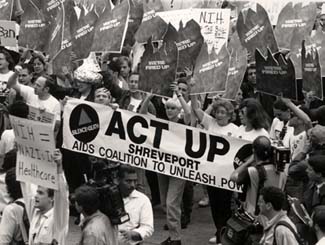
We left off in Part II of this series talking about the virulently homophobic responses from the Religious Right in the 1980s around the issue of AIDS. In Part III, we want to focus on the creation and work of the group AIDS Coalition to Unleash Power (ACT UP).
ACT UP was founded in 1987, at a time when the US government was in some ways ignoring the AIDS crisis and at the same time blaming the gay community for this new deadly disease. ACT UP was both a response to the brutally homophobic climate of the 1980s and the lack of any real movement to challenge the systemic inadequacies of the US health care system.
ACT UP was not interested in charity, reform or working within the system, they used direct action and confrontation to demand health care rights and challenge the institutional homophobia of that permeated most of society.
One of the early ACT UP activists, Sarah Schulman, recounted years later what motivated the strategy of the new movement:
The group operated in a way Martin Luther King, Jr., advocated, which was to “educate yourself so you really understand the issue, make a demand that’s reasonable and doable, present that demand to the powers that be who can enact it, and when they refuse, you do civil disobedience until they are forced by pressure to take that action.”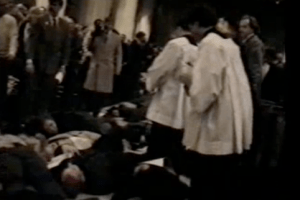
Jerry Kramer, another one of the early leaders of ACT UP, during one meeting asked half of those in the room to stand up as a way of making a point about the urgency of this issue. He said, “you will all be dead from AIDS in a year, what are you gonna do about it?”
This is the kind of passion and rage that people brought to the movement in ACT UP and it manifested itself in the following ways:
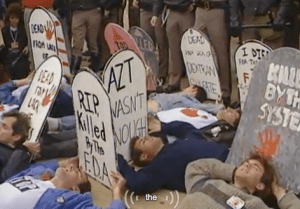
- Catholic Cardinal John O’Connor, was not only preaching against the gay community, he was on the Reagan appointed AIDS Commission and refused to acknowledge the crisis, which was taking the lives of thousands of people in New York City alone. In 1989, ACT UP members and the Women’s Health Action Network (WHAM!) held marches outside St. Patricks Cathedral in New York, once with a banner that read, “O’Connor Public Health Menace.” On one occasion the group did an action in the church during mass and held a die-in to dramatize the seriousness of AIDS. Some members yelled during the mass and said, “You are killing us, stop killing us, we’re not going to take it anymore.” Over 100 people were arrested for this action, known as the Stop the Church Campaign, which was later made into a 24 minute documentary.
- In March of 1987, 250 members of ACT UP protested in front of Wall Street to demand greater access to HIV/AIDS drugs and a more coordinated national policy to deal with the crisis. The group chose Wall Street to confront large drug companies that were more interested in making money that providing drugs to fight AIDS. Seventeen members of ACT UP were arrested at this action.
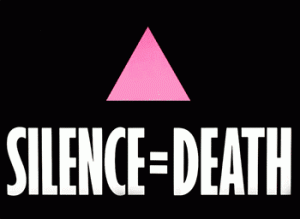
- In April of 1987, ACT UP held an action at the main post office on the last day to file income tax returns. The group knew that the news media always reports on late filers and would have to report on their action, plus the group began its Silence = Death campaign, with the now infamous logo.
- In 1988, members of ACT Up took action against Cosmopolitan Magazine, because it had published misleading and harmful information about AIDS and sex. About 150 people protested outside the Hearst building, which is the parent company of Cosmo. People chanted, “Say no to Cosmo,” and ACT UP had a film team there to document the action and produce a new video for this campaign.
- When the US War in the Gulf began in 1991, ACT UP took the opportunity to draw the connections between military spending and lack of funds for AIDS. One action involved getting into the studio of CBS and disrupting a live broadcast, where Dan Rather was reading the news. The very next day ACT UP members went to the Grand Central Terminal in New York and released banners that said, “Money for AIDS, not for war.” These actions were part of what ACT UP called Days of Desperation.
In essence, what ACT UP accomplished was to have a profound and lasting impact on HIV/AIDS, not just from the greater awareness their actions brought, but because they challenge systems of power that perpetuated violence, suffering and social exclusion against those who were and are HIV positive.
ACT UP did not play nice, they did not ask for marginal reforms, they did not create public/private partnerships and they didn’t rely on either the government or the so-called free market to solve the problem.
What we can learn from ACT UP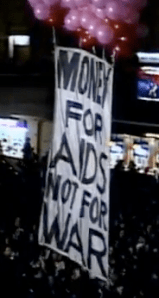
There were and still are numerous chapters of ACT UP all across the country, with sister organizations around the world that continue to fight against institutional violence, oppression and homophobia.
This fight continues today, despite the gains made by grassroots activism to address the class, gender and class disparities within HIV/AIDS. Corporations are motivated by profits rather than people, AIDS still disproportionately impacts poor communities, the LGBTQ community, communities of color and immigrant populations and the lack of adequate funding for resources is still a major part of the fight.
What we can learn from ACT UP about how we organize today is important. First, we have to take bold action, the kind of action that will challenge power systems in whatever form they take. We cannot allow government agencies, pharmaceutical companies, trade policies and religious institutions to prevent anyone from having access to HIV/AIDS testing & medication.
Second, our demands should not just be for access, it is about justice and part of that fight for justice today is to radically change social structures and power dynamics that perpetuate the spread of such diseases – classism, racism, patriarchy, homophobia, transphobia, heterosexism and imperialism.
Third, ACT UP understood the importance of an intersectional analysis, which is why they did not shy away from making the demand of money for AIDS, not for war. As of today, roughly $212 million has left Grand Rapids to fund the US occupation of Afghanistan. Imagine if just 1% of that much money, $2.1 million, was available to groups like The Red Project. Imagine what kind of work they could accomplish if money was never an issue. The Obama administration, like all previous administrations always puts its priority in military spending and not human rights issues like HIV/AIDS.
Fourth, we have to target those structures, which benefit from the current systems of oppression. Pharmaceutical companies still profit while people unnecessarily die. Governments still deny or avoid making HIV/AIDS a priority, within a larger context of public health justice. Religious institutions still marginalize and promote hate around the issue of HIV/AIDS. Commercial media still misinforms or minimally informs on the larger social and historical context of HIV/AIDS.
Lastly, we need to learn from ACT UP, in terms of their ability to a have creative and impacting media strategy. We must avoid doing things that are media friendly, instead do things that 1) provoke the media, and 2) we need to make more of our own media that both documents actions and challenges power. We must not be content to just make media that is symbolic, rather media that makes those in power feel terribly uncomfortable.
Films About ACT UP in West Michigan
In the next week, we highly recommend that people in West Michigan attend one of the screenings of two separate documentaries that deal with the history of ACT UP. The LGBT Resource Center at GVSU will be screening the film How to Survive A Plague, on Monday, December 3 at noon on the Allendale Campus (Grand River Room – Kirkhof Center) and at 6:00PM at the downtown campus (Loosemore auditorium). UICA will be screening the film United in Anger, on Wednesday, December 5 at 7:00PM.
Holland’s Power Plant still being debated
This article was written by Nicole Berens-Capizzi.
Holland City Council held its regular weekly meeting on Wednesday, November 28. At this meeting they discussed a variety of topics, including the 114 MW natural gas power plant being considered to power the city. In the days leading up to the meeting, the public was under the impression that Holland City Council would vote on the Baseload Generation Staff Recommendation. On November 12, Holland Board of Public Works (HBPW) approved the staff recommendation to build the natural gas power plant. Based on how the process had played out thus far, residents have expected city council would also approve this plan. In spite of this, Mayor Kurt Dykstra officially announced to the media that a decision on the issue wouldn’t be likely at this meeting. 
During the pre-council meeting the general manager of HBPW, Dave Koster, briefly discussed the plan. He said that HBPW had approved the plan and are “looking for council to follow suit”. Not long after this discussion, the mayor announced that this issue would be taken off the agenda for the night, but city council would likely vote on the issue the following Wednesday, December 5. Mayor Dykstra also announced that following the city council meeting would be a study session regarding the board’s recommendation. This concerned many at the meeting because the decision to omit this issue from the agenda while holding a separate study session after the council meeting was never announced to the public prior to the pre-council meeting. Because the study session is supposed to be open to the public it would have made sense to announce this decision prior to the meeting, in the name of transparency. This decision was also problematic because the study session wouldn’t begin until later in the evening after much of the public had already left for the night.
Members of the public who wanted to comment on the recommendation were encouraged to do so either when item twelve on the agenda was addressed, or during the study session after the council meeting. Once city council reached item twelve, three members of the public decided to speak out against the proposed 114 MW natural gas power plant.
Susan Harley, the Michigan Policy Director for Clean Water Action, stated for the record that since the study session is distinct from the city council meeting, an announcement should have been made about the study session at least eighteen hours in advance to comply with the Open Meetings Act. She expressed concern not only about the fact that city council hadn’t decided to move completely away from coal, but also the environmental impacts of fracking. She stated that HBPW didn’t include concerns about fracking throughout their decision making process because they felt this issue was out of their hands, but considering there may be more regulations on fracking in the near future, this is something they should take into consideration. Overall, she said it’s the wrong time to make a decision on natural gas.
Carol from the Holland Area League of Women Voters, like Susan, also expressed concern about the fact that the city is still planning on keeping the James DeYoung coal-fired power plant running. She spoke on behalf of LWV when stating that she is very concerned about climate change and believes Holland can be a leader in a cleaner energy future, should they decide to move toward a sustainable energy policy.
Jan O’Connell, the Energy Issues Organizer for the Michigan Chapter of the Sierra Club, said that “HBPW’s recommendation and vote is putting the cart before the horse in setting up and recommending a plan to build a large, 114 MW natural gas plant without fully factoring in and maximizing energy efficiency as well as renewable energy”. She also expressed concern about the fluctuating price of natural gas and the city locking itself into one particular source of energy when it might not be financially sustainable in the future.
The study session regarding HBPW’s recommendation to move forward with the natural gas plant began at approximately 9:30pm. Unfortunately, much of the public had left by this time. Dave Koster of HBPW began the presentation by reiterating the idea that the public has had many opportunities to give input, though the public hasn’t felt very included in the process. (A previous article explores this more in-depth.) He went on to summarize HBPW’s proposal to “pursue combined-cycle technology in a 2 x 1 configuration approximately 114mw in size”. In the presentation, they also included the idea that a “7.5% more efficient cycle means less emissions, less fuel burned and therefore less cost per kWh”. Unfortunately, like many of the other arguments in favor of the natural gas power plant, this only looks at the bottom line and doesn’t take into consideration the impact that fracking for natural gas has on the environment.
Unlike the October 29 meeting, the public was given the opportunity to comment after the presentation by HBPW. Most of the meeting thus far had focused on the economics of HBPW’s recommendation, with a few comments on the environmental impact of this plan. The first person to comment during the study session, however, really brought the issue home. Unfortunately, I didn’t have the opportunity to follow up with her after the meeting since she left right after speaking. She said that if the city decides to go with natural gas, she hopes they continue researching other options, and she also asked HBPW if they knew who the provider of the natural gas would be. Mr. Koster stated that HBPW owns a natural gas pipeline in Overisel that is connected to an interstate pipeline and has multiple suppliers. After he said this, the concerned resident also expressed her fears about fracking. She said that many Allegan residents have received letters or solicitations to lease their property for fracking. In her words, this was “too close for comfort” given how unsafe fracking is and how they are exempt from regulations regarding clean air and water. She said fracking destroys communities, and that people are paid big money for leasing their land, but have to sign nondisclosure agreements in the process. “This imprisons people”, she said.
Mr. Koster stated that HBPW isn’t in the business of fracking or looking to get into the business, they just focus on what sources of energy are best for the city. He also encouraged her to look up a fact sheet from the Michigan DEQ that “dispels myths about fracking”, and he reassured her that the process is safe and has been going on in Michigan for years.
Monica Hallacy, a concerned Holland resident, commented on how new horizontal hydraulic fracturing is to the state and expressed similar concerns regarding the industry’s exemptions from basic regulations. She said that Holland wants to be a leader in clean energy.
I was the last person to comment during the study session. I said that while I understand HBPW isn’t in the business of fracking, it’s irresponsible to not consider the impact fracking has on the environment when making decisions about the overall environmental impact of a particular source of energy. I made the point that the DEQ and EPA are pro-industry, not community, and that the way to learn the truth about the impacts of fracking is to talk to those who live in communities where it’s taken place. I mentioned the increased rates of breast cancer among those living near frack sites, and also the impact consumption of contaminated water has on farmers (their animals in particular). After this comment, city council and HBPW moved on to a discussion of the proposal in general.
Even though no final decision was made on November 28, a few members of city council expressed various concerns about the board’s recommendation, including the possible location of the new natural gas power plant, as well as cautioning against relying strictly on one source of energy. City council seemed more divided on this issue than some of us previously believed.
Obama and GOP Play Tag Team on Entitlements
This article by Glen Ford is re-posted from Black Agenda Report.
It seems that every breathless moment of corporate media news is choreographed to convince Americans that austerity is as inevitable as tomorrow’s weather. The objective of this con game is to gut Social Security, Medicare and Medicaid. The two principle parties engaged in negotiations – the White House and congressional Republican leaders – are both agreed that entitlements must be put under the knife. The “grand bargain” that both Obama and the GOP seek has already been made, in principle. Austerity is the common language and goal of the talks, and nobody that counts in the discussions is defending entitlements.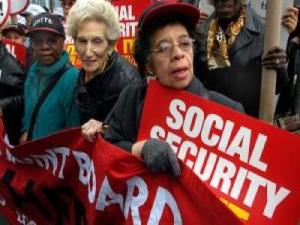
There is only one problem: the vast majority of Americans oppose cuts in Social Security, Medicare and Medicaid.
This is the great difficulty facing both Obama and the Republicans: the fact that the public favors the maintenance and even expansion of the meager U.S. social safety net. The disagreement, the great debate, is not between Republicans and the White House, who both agree on putting entitlements on the chopping block. The disagreement is between strong majorities of the American people, who want no tampering with the three entitlement programs, and Obama and his Republican friends, who are hell bent on so-called entitlement “reform.”
This is not a fight between the two parties; it is a choreographed beat-down of the American majority by corporate Democratic and Republican thugs, aided by shrieking corporate media banshees screaming, Watch out for the cliff, Watch out for the cliff!.
The “grand bargain” was struck back in the summer of 2011, when both sides agreed on roughly $4 trillion in cuts. The agreement only unraveled because a presidential election was drawing near, and the two parties needed to pretend that they were separated by vast political differences. Now that the election is over and the verdict is in, corporate Democrats and Republicans can abandon the pretense of a great ideological divide, and return to their shared mission of cutting entitlements. Both hide behind the phony “fiscal cliff” to convince the public that the pending theft of entitlements is an unstoppable act of nature, rather than a conspiracy of corporate henchmen, against the clear wishes of the majority of Americans.
Robert Reich, the liberal former Labor Secretary in President Bill Clinton’s administration, says that Obama is not behaving like a president who is serious about facing down the Republicans. If he were, Obama would let the Bush tax cuts die at the end of this year, and then have Democrats introduce new tax cuts for the middle class. The president could dare the Republicans to hold middle class to tax cuts hostage to cuts for the rich. In that kind of facedown, Obama would likely win.
But Obama is not trying to outmaneuver Republicans; he and the GOP have teamed up to stampede the public – the suckers in this game – into giving up their entitlements. As David Swanson puts it, we are not witnessing the making of a grand bargain, but a “grand catastrophe.”
Minneapolis Congressman Keith Ellison, the Black co-chairman of the Congressional Progressive Caucus, says he and the other 75 members “are not going to allow the most vulnerable Americans to shoulder the burden of this fiscal problem.” But the left wing of the Democratic Party can only stop the forces arrayed against entitlements by actively opposing their own president, who is playing austerity tag team with the Republicans. And the so-called progressives don’t have it in them.
What If America’s Leaders Actually Want Catastrophic Climate Change?
This article by Dave Lindorff is re-posted from Counter Punch. Editor’s note: What this writer is referring to in terms of the US government’s planning for climate catastrophe is what Christian Parenti explores in his book “Tropic of Chaos: Climate Change and the New Geography of Violence.”
What if the leaders of the United States — and by leaders I mean the generals in the Pentagon, the corporate executives of the country’s largest enterprises, and the top officials in government — have secretly concluded that while world-wide climate change is indeed going to be catastrophic, the US, or more broadly speaking, North America, is fortuitously situated to come out on top in the resulting global struggle for survival?
I’m not by nature a conspiracy theorist, but this horrifying thought came to me yesterday as I batted away yet another round of ignorant rants from people who insist against all logic that climate change is a gigantic fraud being perpetrated, variously, by the oil companies (who allegedly want to benefit from carbon credit trading), the scientific community (which allegedly is collectively selling out and participating in some world-wide system of omerta in order to get grants), or the world socialist conspiracy (which of course, is trying to destroy capitalism).
What prompted me to this speculation about an American conspiracy of inaction was the seemingly incomprehensible failure of the US — in the face of overwhelming evidence that the Earth is heating up at an accelerating rate, and that we are in danger of soon reaching a point of no return where the process feeds itself — to do anything to reduce either this country’s annual production of more atmospheric CO2, or to promote some broader international agreement to slow the production of greenhouse gases.
It seems insane that this nation’s leaders, corporate and political, would even now still be deliberately refusing to take action to protect the Earth, which of course they and their children and grandchildren will also have to live on, and yet almost to a one they are on the side of the deniers or the delayers. The business leaders for example overwhelmingly provided campaign funding to the Republicans — a party that makes jokes about global warming and openly urges more burning of coal.
Okay, a lot of Republicans are wacky believers in a 6000-year-old world where Adam and Eve hunted dinosaurs and god talked to Moses. But it seems equally or even more insane that people who clearly know better, like President Barack Obama, or most of the Democratic Party leadership in Congress, would resist even minimal efforts to limit greenhouse gas emissions, and would directly work to undermine international efforts at reaching a rigorous treaty on global reduction of carbon emissions.
Unless, that is, you consider that in a dog-eat-dog environment of nations struggling to survive in a world that, as the World Bank’s latest report predicts, could be 4°C hotter (7.2°F) by as early as 2060, with mass starvation in Africa, Asia and South America, flooding of critical river deltas and low-elevation population centers like Shanghai, Bangladesh, Holland, etc., and the loss of most of the world’s fish to an acidified ocean, the US could be sitting pretty, at least relatively speaking. Sure low-lying places like Cape Cod, the Outer Banks, the lower Florida peninsula, New Orleans, and the Rockaways and the Manhattan financial district would be gone, but given this nation’s current wealth and military power, its vast natural resources, and its widely varied climate zones, including Alaska, the U.S. could probably come out ahead in such a survival-of-the-fittest struggle.
Consider that perhaps the current breadbasket region of the midwest might become a dust-bowl. Okay, nasty, but the evidence so far suggests that at least for the next hundred years, all the melting of the Greenland ice sheet and other land ice in northern Canada, will be impacting the nation’s northeast by having all that new fresh water pushing the Gulf Stream out to sea (a Gulf Stream that we are told will also be weakening dramatically), actually making the northeast cooler and wetter during that period. That is to say, states from Ohio to Maine, and south to perhaps Virginia or North Carolina, could become better places to grow crops, at least until all the ice up north is gone. Arizona and Florida would be hell for retirees, but they could retire elsewhere. Deep wells could draw on prehistoric aquifers, as farmers in Texas and Oklahoma have done for years, which could compensate for epic climate-change-caused droughts. So what if this would destroy the aquifers eventually? Nobody thinks a century ahead anyhow.
Meanwhile, while the US would adapt fairly handily to the global catastrophe, most of the rest of the world would become a pure hell, with nations desperately battling nations over dwindling water supplies, and famine killing people not by the tens of thousands as today, but by the millions, or perhaps even billions. Think of China and India, our biggest competitors in global markets these days. With their relative poverty, their massive populations, mostly concentrated along low-lying coastal areas, they will be toast in a 4°C hotter world.
I’m sorry to say it, but I don’t have a hard time imagining most of our ruling elite looking at this scenario and thinking, “Hey! That could work out well for us! With huge oceans separating us from the desperate masses in Asia and Africa, and only a relatively small desert border to protect to our south, and with a small, weak and friendly nation to the north, we could come out of this with the world at our feet, ripe for the picking.” What’s a mass extinction event that wipes out half of all living species to such people? What’s it matter to them if the teeming oceans lose their food chain and become filled with nothing but jellyfish? What’s it matter of hundreds of millions of poor people starve to death, or if nations in Africa or Asia blow each other up? If they, the US and their companies, can come out of this rubble largely intact, and with the same elites still in charge, where’s the downside?
I haven’t looked closely at the science of this, but I think I’m correct in saying that the US is probably better situated than most other countries to survive a major global warming event. Of course, even in the US, climate change of this scale would be massively destructive and destabilizing, and would cause huge social and political upheaval. This may explain why we keep reading about the Department of Homeland Security ordering huge quantities of dumdum bullets (even for places like Social Security Administration field offices!) and building mass detention centers, or about Congress continuing to pass ever more intrusive and invasive police state-type legislation, while militarizing local police.
I’m not suggesting that these leaders would be contemplating just walling off the US, and allowing us all to continue on as the free society that we have grown used to over the last few hundred years, while the rest of the world goes through its death throes, horrendous and unacceptable as that would be. Rather, I’m speculating that the elites may be contemplating a way that they, the ruling class, not we as Americans, could, by doing nothing to stop climate change, come out on top as a result of it.
I realize this is conspiracy thinking, and that as such it is rather far-fetched, and yet what troubles me is that it’s hard to imagine a alternative explanation for the years of complete inaction on combating global warming, and the deliberate undermining of any sort of international accord which America has engaged in for the past decade.
Our leaders, political and corporate, may be puerile, egocentric greed-heads, but they are not stupid. They surely for the most part recognize that the Earth is heating up and heading at full speed towards ecological, social and political disaster. How else to explain, then, their astonishing unwillingness to take action?

