Grand Rapids pays someone to represent the City in Washington
This morning, MLive posted a story about what the City of Grand Rapids pays a lobbyist in DC. The article identifies Dykema Gossett PLLC as being the lobbying firm the city has used since 2006.
The cost to the City of Grand Rapids, and thus to taxpayers, is $5,250 per month, which comes to $63,000 a year.
The remainder of the brief article includes comments from a City staff member and First Ward Commissioner Dave Shaffer, both of which speak very highly of the lobbying firm. The article lists several projects, which had received federal funding because of the lobbying efforts of Dykema Gossett PLLC.
The article ends with the following comment:
“We believe that given the direction in Congress (with the ban on earmarks), it’s very important for us to have representation in D.C.” Alibasic said. “We’re going to be looking to really strengthen our grant opportunities through this contract.”
Such a statement is a reflection of how politics works in this country. If you pay someone to “represent” your interests, government works. Questioning the City staffer who made such a comment was not what the MLive reporter was interested in, even though asking for further clarification on what was meant by paying someone in DC to represent “us” really means.
The MLive story is also lacking on content about the lobbying firm itself, not even a link to the company’s site.
It would stand to reason that if taxpayers are coughing up $63,000 a year to this company, they should know something about the firm the City of Grand Rapids has hired.
Dykema Gossett has several offices in Michigan and across the country. They provide a number of services besides lobbying, such as legal work and consultation. The firm works in numerous fields of business, but represents three main industries – automotive, energy and the financial industry. A pretty corrupt trio.
According to the Center for Responsive Politics, Dykema Gossett didn’t spend much money during the last election cycle, with only two payments to candidates, both going to 2nd Congressional Candidate Bill Huizenga. However, employees of the firm made significant contributions to candidates, with a total of 337 separate donations, many of which were $1,000 or more. Here is a list of recipients of that money from Dykema Gossett.
Dykema has a pretty interesting client base, in addition to the City of Grand Rapids. Such a client list would make anyone with a conscience have serious reservations about doing business with a company that profits from the likes of Bank of America, Bayer Corporation, Compuware Corporation, eBay Inc., Ford Motor Company, General Motors, Honda North America, JPMorgan Chase, McDonald’s Corporation, Procter & Gamble, Sears Roebuck & Company, The Walt Disney Company, Verizon Wireless and Wal-Mart Stores, Inc.
It’s unfortunate that MLive did not bother to provide readers with any background information on the company that Grand Rapids taxpayers have given nearly $400,000 to since 2006.
Staggering Amount of Chemicals Entering Great Lakes—Do You Buy Products that Threaten Drinking Water?
This article by the Alliance for the Great Lakes is re-posted from Ecowatch.
The Great Lakes are home to 20 percent of the world’s surface freshwater and, increasingly, host to a worrisome class of chemical compounds known as contaminants of emerging concern.
Often originating from everyday products ranging from shampoos and pharmaceuticals to textiles and home furnishings, as well as from common agricultural practices around the Midwest, these compounds can have impacts on people and wildlife that are far from benign and are raising concerns about their effects on the body’s endocrine system—the driver of key functions such as growth and development, metabolism and reproduction.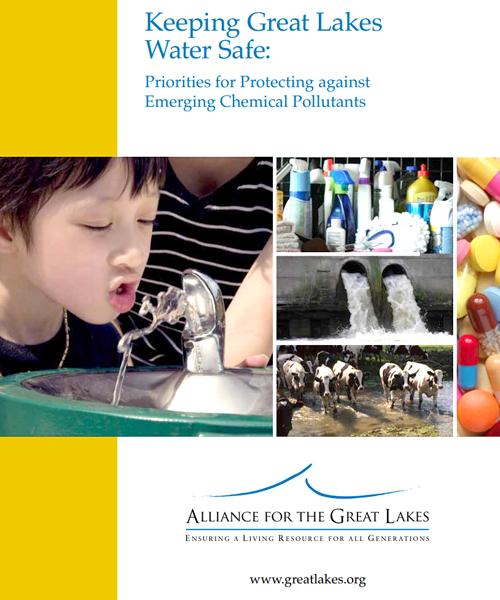
A report released today by the Alliance for the Great Lakes notes that since the production of synthetic chemicals took off after World War II, the waters of Lake Michigan—which take a century to refresh—have yet to see a complete turnover.
Halfway through this cycle, scientists are beginning to see alarming trends of an increasing multitude of chemicals found in the water. In southern Lake Michigan, one of the most urbanized and industrialized areas in the Great Lakes Basin and home to approximately a third of the Great Lakes population, these contaminants are a steady source of chemical exposure for aquatic species, and affect the quality of the waters we rely upon for drinking and look to for recreation.
“The number of chemicals entering the nation’s environment each year is staggering, as is the potential for them to degrade the water we drink and swim in,” says Alliance President and CEO Joel Brammeier. Upwards of 85,000 chemicals are in production and use in the U.S. today—more than 2,200 of them produced at a rate of 1 million-plus pounds a year. Beyond this, consumers can choose from more than 50,000 pharmaceutical products, and nearly 20,000 registered pesticide products have entered the market since registration began in 1947.
The report applies a published, peer-reviewed scientific framework to rank chemicals of highest concern found in national waters that are representative of those found in the Great Lakes. The methodology examines both surface water and treated drinking water—identifying the top 20 emerging contaminants for each based on occurrence, ecologic and human health impacts, and water treatment capabilities. The top-ranking chemicals include representatives from a broad range of categories: hormones, synthetic musks, antibiotics, pharmaceuticals, antimicrobials and preservatives, UV blockers, plasticizers, flame retardants and pesticides.
As the chemical presence around us expands, the potential for them to end up in the Great Lakes also grows—arriving there via atmospheric deposition, stormwater runoff and sewage overflows. Others are released into the Great Lakes at trace concentrations via treated wastewater discharges because conventional sewage treatment isn’t designed to remove them.
Lake Michigan’s surface waters are affected, with six of the top 20 chemicals detected—among them flame retardants, synthetic fragrances, bisphenol A (BPA), and a popular cholesterol-lowering drug—found in the open lake waters. Current data shows that, after processing in a treatment plant, drinking water drawn from Lake Michigan may not be significantly burdened with contaminants, with only one chemical—a flame retardant—detected of the top 20 identified in the report. The report cautions that the data collected thus far provides only a snapshot of what might be in the open waters of the Great Lakes, however, and doesn’t take into account the health risks that bioaccumulating chemicals in the water pose to people who eat Great Lakes fish. Also not known is the level of risk these trace levels of contaminants in the water actually pose for people and wildlife.
“With hundreds of mostly unregulated compounds detected in Great Lakes surface waters today, it’s critical to start identifying now those chemicals that pose the greatest threat to the health of the lakes, the wildlife and the 40 million people who depend on them for drinking water,” says Olga Lyandres, Alliance research manager and author of the report.
Some municipalities and public utilities already monitor or study emerging contaminants, among them Chicago, Milwaukee and the Central Lake County Joint Action Water Agency—which supplies drinking water to Lake Michigan communities in northern Illinois. But many smaller communities, such as Gary, Ind. and Racine, Wis., don’t monitor for them because of the absence of clear guidance on how to do so.
Although water treatment plays a key role in removing contaminants, the report emphasizes that water and wastewater utilities are not solely responsible for preventing and controlling contaminants in Great Lakes water. To that end, it calls for a comprehensive approach that involves not only technological solutions, but collaboration among utilities, regulatory agencies, public health officials, manufacturers and environmentalists to focus on pollution prevention.
“Together these entities must work to encourage policy, social and behavioral changes that propel businesses to evaluate chemicals before they enter the marketplace, and individuals to reduce their use of chemicals—thereby lessening the risks associated with the chemicals’ eventual release into the environment,” the report states. The report further calls for:
- Funding development of consistent, uniform regional monitoring standards.
- Encouraging the U.S. and Canada to draw on credible prioritization methods to set binational objectives for controlling high-priority Great Lakes contaminants, and to pursue these goals through domestic policy reforms.
- Reforming the 36-year-old federal Toxic Substances Control Act to feature a framework that places pollution prevention at the forefront of new chemical design and production.
CEO Evening News?
This article is re-posted from Fairness & Accuracy in Reporting.

The CBS Evening News has decided the best way to inform viewers about the impending “fiscal cliff” is to let corporate CEOs affiliated with the Fix the Debt campaign recommend cuts to Social Security and Medicare.
 On November 19, Goldman Sachs CEO Lloyd Blankfein was tapped for his apparent expertise in long-term budget forecasting. His message was simple: Benefit cuts are necessary. “The entitlements, and what people think that they’re going to get, because it’s not going to–they’re not going to get it,” he asserted.
Blankfein offered more specifics, explaining that
Social Security wasn’t devised to be a system that supported you for a 30-year retirement after a 25-year career. So there will be certain things that the retirement age has to be changed, maybe some of the benefits have to be affected, maybe some of the inflation adjustments have to be revised.
It’s hard to know what he’s talking about when he refers to a “25-year career.” Perhaps some Goldman Sachs employees retire in their early 40s, but most workers do not–and they certainly don’t get Social Security retirement benefits when they do so. But Blankfein derives a straightforward moral from this dubious talking point: These benefits must be cut “because we can’t afford them.”
The following night, anchor Scott Pelley had a new expert: Honeywell CEO David Cote, who warned that the country’s debt load meant that “we’ve got to do something.” Why should viewers care what Cote says about any of this? Pelley explained that he “knows about fixing finances. He pulled Honeywell out of a slump.”
Cote’s fix is to reduce tax deductions, since “there were like 169 different ones used in, I don’t know, 2008 or 2009, somewhere in there.” Like the other CBS CEO, Cote also wants benefit cuts: “The big nut is going to have to be Medicare/Medicaid.… At the end of the day, you can’t avoid the topic. Especially with the Baby Boomer generation retiring. It’s going to literally crush the system.”
On November 21, CBS Evening News was still on the case. The experts this time were, as anchor Jeff Glor put it, “two men who say they know how it should be done–if only Washington would listen.” The two are Erskine Bowles and Alan Simpson, who co-chaired a 2011 White House debt commission. The chairs issued a report, based on drastically shrinking the federal government, that was championed by many in the press (Extra!, 1/11), but failed to be approved by the full commission. Both are co-founders of the corporate-backed “Fix the Debt” campaign.
That was followed on the broadcast by another segment with Goldman Sachs’ Blankfein, who told anchor Scott Pelley:
Look, if we go over the fiscal cliff it will be very bad, hugely bad–hugely negative for the stock market, which is, you know, a source of people’s wealth, people will feel poor.
Of course, many people don’t consider the stock market a source of their own wealth. And 50 million Americans already “feel poor” because they are.
Blankfein added: “To me, whether the tax rate is 2 percent lower or higher or the cutoff age on some entitlement is one year less or more is secondary or tertiary to the fact that this country is focused on its future.”
A cut in Social Security or healthcare probably is “tertiary” to a guy who makes millions of dollars every year. Which makes his perspective a peculiar one to highlight twice in one week.
So what accounts for the urgent need to cut benefits?
The “fiscal cliff” is a scheduled set of tax increases and spending cuts that, if allowed to roll out over the course of 2013, would likely do considerable harm to the fragile economic recovery. It is not really a “cliff,” though; Congress and the White House could go over it on January 1 and still reach a subsequent deal in the days or weeks afterwards.
Some of those pushing the “cliff” crisis seem more interested in making some permanent cuts to programs like Social Security and Medicare–which would have far more serious consequences for Americans than the “fiscal cliff.” Among those advocates are the business interests behind the Simpson/Bowles Fix the Debt campaign. All of the CBS fiscal experts featured last week were affiliated with this group.
There are critics of this plan. The Institute for Policy Studies recently issued a report (11/13/12 ) explaining the corporate interests behind the debt campaign. Report co-author Sarah Anderson told Democracy Now! (11/13/12) that Fix the Debt is “really just a Trojan horse. They’re pushing for the same old tax breaks for corporations that they’ve been pushing for for about a decade.”
Instead of doing journalism to expose the interests behind this campaign, CBS is giving them a megaphone.
ACTION: Tell CBS Evening News that their discussion of the “fiscal cliff” should include experts who aren’t entitlement-busting CEOs.
CONTACT: CBS Evening News Phone: 212 975-3247 evening@cbsnews.com
AIDS and Activism Part II: Reagan, DeVos and the 1980s crisis
Since as early as 1981, AIDS was known to be a deadly disease. Even by 1983, the Centers for Disease Control (CDC) had begun a national hotline for AIDS.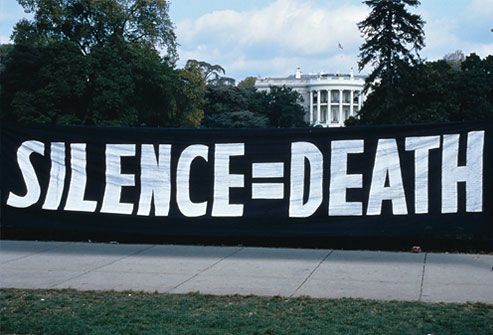
Cases of AIDS were being reported in almost every major city in the US beginning in 1982, but the national news media did not report on it until the following year. In fact, the New York Times did not make AIDS a front-page story until May 25, 1983.
This delayed reporting on AIDS by the New York Times becomes more striking, when one considers the following:
Similarly, the discovery of cyanide-laced Tylenol capsules in the Chicago area in October 1982 prompted a huge spate of press coverage. The New York Times covered the story every day of October, and then ran 23 more stories in November and December. In the end, seven people died from the capsules.
By contrast, The New York Times published only three stories on AIDS in 1981, and only three more in all of 1982, none of which were on page one. Yet by the time of the Tylenol poisonings, 260 Americans had died of AIDS, and 374 more had been diagnosed.
One person who was making AIDS a concern of reporting was Randy Shiltz, a journalist who was assigned to report on AIDS in San Francisco in 1982 for the San Francisco Chronicle. Shiltz was a member of the Gay community and had already written a powerful biography of slain Gay activist and San Francisco official, Harvey Milk.
Shiltz relied heavily on early HIV/AIDS activists like Bill Kraus and Cleve Jones for information and came to the realization that AIDS was a disease impacting thousands and it was a story that outside of the Gay community was either unknown or suppressed. Shiltz eventually wrote his book, And the Band Played On, which chronicled the first half of the 1980s and the AIDS epidemic. The book was published in 1987 and spent 5 weeks on the New York Times Best Sellers list.
By 1987, 20,000 had died from AIDS and despite the growing epidemic the federal government did not take any formal action until that year. Reagan did appoint the Presidential Commission on the Human Immunodeficiency Virus Epidemic in the summer of 1987; it was later renamed the Watkins Commission, after its chair.
With the appointment of this commission, Reagan was able to appease those who demanded a more sustained federal response to AIDS. He also answered the concerns of the New Right by appointing an AIDS commission that included few scientists who had participated in AIDS research and few physicians who had actually treated people with AIDS. In addition, the commission included outspoken opponents of AIDS education, such as New York Cardinal John O’Connor. O’Connor was not only opposed to AIDS education, he was openly hostile to the Gay community.
Religious Right leader Gary Bauer, who was in the Reagan administration in 1987, said of those appoint by the President:
…..the panel was designed to be ”a cross-section of thoughtful Americans” rather than another medical or scientific group that would duplicate dozens of previous efforts. ”We intentionally tried to get people from a wide variety of walks of life, and took the risk that there would be disagreements and fireworks,” Mr. Bauer said. He also called it ”a good group” to deal with such issues as insurance coverage and care for AIDS patients and said he doubted that quarantines, school policy or casual transmission would become a major focus.
The Religious Right was particularly incensed by the AIDS crisis and saw it as purely a result of immoral behavior, especially in the Gay community. Religious Right leaders at the time, such as Pat Robertson and Jerry Falwell, equated the deaths with the Gay community as retribution from God for their “sinful” lives. Falwell not only despised the Gay community, he despised the larger society which “tolerated” Gays. Falwell’s famous statement was:
“AIDS is not just God’s punishment for homosexuals, It is God’s punishment for a society that tolerates homosexuals.”
Rich DeVos and the AIDS Commission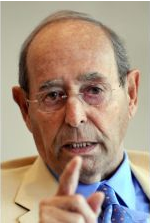
One of the people appointed to the 13-member AIDS Commission was Amway co-founder Rich DeVos. DeVos was chosen in part because he was one of the largest financial supporters of the Republican Party, but also because of his role in the Religious Right.
In an interview with MLive a few years ago, DeVos made some pretty revealing comments about his attitudes towards the Gay community while sitting on the AIDS Commission.
When HIV first came out, President Reagan formed a commission and I was honored to be on that commission. I listened to 300 witnesses tell us that it was every body else’s fault but their own. Nothing to do with their conduct, just that the government didn’t fix this disease. At the end of that I put in the document, it was the conclusion document from the commission, that actions have consequences and you are responsible for yours. AIDS is a disease people gain because of their actions. It wasn’t like cancer. We all made the exceptions for how you got it, by accident, that was all solved a long time ago. That’s when they started hanging me in effigy because I wasn’t sympathetic to all their requests for special treatment. Because at that time it was always someone else’s fault. I said, you are responsible for your actions too, you know. Conduct yourself properly, which is a pretty solid Christian principle.
Not only does DeVos show his homophobic bias, his comments demonstrate his ignorance of the issues surrounding HIV/AIDS. It was within this climate of homophobia and inaction on the part of the federal government that AIDS activism would take a new direction in 1987, with the creation of the AIDS Coalition to Unleash Power (ACT UP). We will explore the impact of ACT UP in Part III of this series.
Why is Obama Silent Over the New Congo War?
This article by Shamus Cooke is re-posted from Counter Punch.
The last Congo war that ended in 2003 killed 5.4 million people, the worst humanitarian disaster since World War II. The killing was directly enabled by international silence over the issue; the war was ignored and the causes obscured because governments were backing groups involved in the fighting. Now a new Congo war has begun and the silence is, again, deafening.
President Obama seems not to have noticed a new war has broken out in the war-scarred Congo; he appears blind to the refugee crisis and the war crimes committed by the invading M23 militia against the democratically elected government of the Democratic Republic of the Congo (DRC).
But appearances can be deceiving. The U.S. government has their bloody hands all over this conflict, just as they did during the last Congo war when Bill Clinton was President. President Obama’s inaction is a conscious act of encouragement for the invaders, just as Clinton’s was. Instead of Obama denouncing the invasion and the approaching overthrow of a democratically elected government, silence becomes a very powerful action of intentional complicity on the side of the invaders.
Why would Obama do this? The invaders are armed and financed by Rwanda, a “strong ally” and puppet of the United States. The United Nations released a report conclusively proving that the Rwandan government is backing the rebels, but the U.S. government and U.S. media cartoonishly pretend that the issue is debatable.
The last Congo War that killed 5.4 million people was also the result of the U.S.-backed invading armies of Rwanda and Uganda, as explained in the excellently researched book “Africa’s World War,” by French journalist Gerard Prunier.
In fact, many of the same Rwandan war criminals involved in the last Congo War, such as Bosco Ntaganda, are in charge of the M23 militia and wanted for war crimes by the U.N. international criminal court. The current Rwandan president, Paul Kagame, is a “good friend” of the U.S. government and one of the most notorious war criminals on the planet, due to his leading roles in the Rwandan genocide and consequent Congo War.
A group of Congolese and Rwandan activists have been demanding that Kagame be tried for his key role in the Rwandan genocide.
As Prunier’s book explains, the Rwandan genocide was sparked by Kagame’s invasion of Rwanda — from U.S. ally Uganda. After Kagame took power in post-genocide Rwanda, he then informed the U.S. — during a trip to Washington D.C. — that he would be invading the Congo. Prunier quotes Kagame in Africa’s World War:
“I delivered a veiled warning [to the U.S.]: the failure of the international community to take action [against the Congo] would mean that Rwanda would take action… But their [the Clinton Administration’s] response was really no response at all” (pg 68).
In international diplomacy speak, such a lack of response — to a threat of military invasion — acts as a glaring diplomatic green light.
The same blinding green light is now being offered by Obama to the exact same war criminals as they again invade the Congo.
But why again? The Democratic Republic of the Congo’s current President, Joseph Kabila, helped lead the military invasion during the last Congo war. As a good stooge, he delivered Congo’s immense mining and oil wealth to multi-national corporations. But then his puppet strings started to fray.
Kabila later distanced himself from U.S. puppets Rwanda and Uganda, not to mention the U.S. dominated International Monetary Fund (IMF) and World Bank. The IMF, for example, warned Kabila against a strategic infrastructural and development aid package with China, but Kabila shrugged them off. The Economist explains:
“…[The Congo] appears to have gained the upper hand in a row with foreign donors over a mining and infrastructure package worth $9 billion that was agreed a year ago with China. The IMF objected to it, on the ground that it would saddle Congo with a massive new debt, so [the IMF] is delaying forgiveness of most of the $10 billion-plus that Congo already owes.”
This act instantly transformed Kabila from an unreliable friend to an enemy. The U.S. and China have been madly scrambling for Africa’s immense wealth of raw materials, and Kabila’s new alliance with China was too much for the U.S. to bear.
Kabila further inflamed his former allies by demanding that the international corporations exploiting the Congo’s precious metals have their super-profit contracts re-negotiated, so that the country might actually receive some benefit from its riches.
The Democratic Republic of the Congo is home to 80 percent of the world’s cobalt, an extremely precious mineral needed to construct many modern technologies, including weaponry, cell phones, and computers. The DRC is possibly the most mineral/resource rich country in the world — overflowing with everything from diamonds to oil — though its people are among the world’s poorest, due to generations of corporate plunder of its wealth.
Now, a new war is underway and the U.N. is literally sitting on their hands. There are 17,500 U.N. peacekeepers in the DRC, not to mention U.S. Special Forces. The invading M23 militia has 3,000 fighters. What was the U.N.’s response to the invasion? The New York Times reports:
“United Nations officials have said that they did not have the numbers to beat back the rebels and that they were worried about collateral damage, but many Congolese have rendered their own verdict. On Wednesday, rioters in Bunia, north of Goma, ransacked the houses of United Nations’ personnel.”
If Obama and/or the U.N. made one public statement about militarily defending the elected Congolese government against invasion, the M23 militia would have never acted.
Human Rights Watch and other groups have correctly labeled the M23’s commanders as responsible for “ethnic massacres, recruitment of children, mass rape, killings, abductions and torture.”
But at the U.N. the Obama administration has been actively protecting this group. The New York Times continues:
“Some human rights groups say that Susan E. Rice, the American ambassador to the United Nations and a leading contender to be President Obama’s next secretary of state, has been far too soft on Rwanda, which is a close American ally and whose president, Paul Kagame, has known Ms. Rice for years. The activists have accused her of watering down language in a Security Council resolution that would have mentioned Rwanda’s links to the [M23] rebels and say she also tried to block the publication of part of a [U.N.] report that detailed Rwanda’s covert support for the M23.”
It’s likely that the Obama administration will jump into action as soon as his M23 allies complete their military objective of regime change, and re-open the Congo’s military wealth to U.S. corporations to profit from. There are currently talks occurring in U.S.-puppet Uganda between the M23 and the Congo government. It is unlikely that these talks will produce much of a result unless Kabila stands down and allows the M23 and its Rwandan backers to take over the country. The M23 knows it’s in an excellent bargaining position, given the silence of the U.N. and the United States government.
If the war drags on, expect more international silence. Expect more massacres and ethnic cleansing too, and expect the still-recovering people of the Congo to be re-tossed into massive refugee camps where they can again expect militia-sponsored killings, rape, starvation, and the various barbarisms that have accompanied this especially brutal war, a brutality that grows most viciously in environments of silence.
The local group, Mutual Aid GR is hosting a meeting to discuss next steps in the local efforts to stop horizontal hydraulic fracking in West Michigan, which is one the rise, based on recent oil & mineral rights leasing data.

According to the Facebook event page, Mutual Aid GR states:
By now we know the devastating impact fracking has on water, air, health, and communities. We need to act fast to keep our state from becoming a clear-cut, polluted wasteland at the hands of the fracking industry.
In addition to fracking, we are also planning action around the tar sands pipeline that will soon cut through the state from two locations. Here is an article, including a map, with more details:
http://ecowatch.org/wp-content/uploads/2012/10/map.jpg
Joining us at this meeting will be members of Kent County Water Conservation. We will be discussing how to fight fracking in Kent County and across the state. In addition to this, we will discuss organizing actions around the proposed tar sands pipeline, setting up a teach-in for resisting fossil fuels, creating more of our own material, and other related topics.
Next Steps in resisting Fracking and Tars Sands in Michigan Meeting
Saturday, December 1
3:00 – 5:00PM
671 Davis, NW – lower level of the Steepletown Neighborhood Center
AIDS and Activism – Part I
This is the first in a series of postings that deal with the theme of AIDS and Activism. The first posting is the chapter – AIDS in the Gay Community in Grand Rapids – from the film, A People’s History of the LGBTQ Community in Grand Rapids.

In this segment of the film we discover that AIDS activism began in the early 80s and was primarily taken on by the gay community. Larry Abbott talks about how the first organizing took place, how much of their funding came from the gay community and its allies and how groups like the United Way would not fund AIDS work at that time.
In addition, the video has Rev. Bruce Roller talking about ministering to the people dying of AIDS and the difficulty in finding a funeral home that would take the bodies of those who died from AIDS.
Jan Koopman, former director of the AIDS Resource Center, talks about the work in the 90s and Jeanne Marshall talks about the first AIDS Walk in Grand Rapids. The video ends with Drew Stoppels talking about more recent organizing efforts around HIV/AIDS in Grand Rapids.
There is also footage of TV news stories on the AIDS Quilt in Grand Rapids and stories of some of those who had a quilt made in their honor.
10 Facts Retailers Don’t Want You to Know About Online Shopping
This article is re-posted from ZNet.
When the news covers Cyber Monday every year, the focus is on sales and consumer spending – not the real cost to the workers who deliver all of those orders. The whole system is built on unsafe, low-paying, temporary jobs. Workers in U.S. shipping centers and warehouses that fulfill online orders for major retailers like Amazon.com and Walmart are subject to dangerous, sweatshop-like working conditions. These workers are consistently asked to work at unreasonable and backbreaking speeds, but they endure the pain because they’re afraid of losing their jobs. Get the real deal on online shipping:
1. Backbreaking pace of work: Workers in shipping centers who fulfill online orders are asked to grab items for boxes at unsustainably high speeds. In many cases, workers are required to collect 1,200 items in a 10-hour shift, or one item every 30 seconds.i If employees can’t keep up, they are disciplined or fired.
2. Marathon walking: Workers have to continuously cross great distances inside the massive warehouses. “Pickers,” who locate and collect items for shipping, reportedly walk on average between 12ii and 15iii miles every shift. Despite some items being football fields apart iv, workers are expected to maintain the same frenzied pace.
3. Extreme temperatures: Temperatures in warehouses are often extreme – either way too hot (120 degrees!v) or too cold. The warehouses can become literal sweatshops. Rather than slow the pace of work or provide air conditioning, last year Amazon executives arranged for paramedics to wait in ambulances outside its warehouse in Allentown, Pennsylvania, to treat all of the workers suffering from dehydration or heat stress.vi
4. Physical injuries: With a frenzied work pace, repetitive heavy lifting, constant walking, and extreme temperatures, many workers report being injured on the job.viiviii ix Many workers last less than six months at the job because of the grueling physical demands.x
5. Contractor curtain: Sweatshop shipping is such a secret now because many online retailers have grown adept at distancing themselves from the problem by hiding behind a “contractor curtain.” Retailers use a dizzying number of contract and temporary firms to hire employees to fulfill their orders – removing themselves from the responsibility of maintaining safe conditions on the job.xi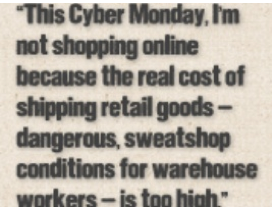
6. Expendable employment: Temporary employees at online warehouses lack job security because they are employed in an industry that thrives on disposable labor. New workers cost less than long-time employees, and often warehouses fire staff after only a few months. The high firing rate ensures no one knows how long his or her job will last.xii
7. Low wages: Temporary workers in warehouses on average make $3 less an hour than the permanent employees doing the same work.xiii Less than four percent of online warehouse workers in Illinois have health insurance. Sixty-two percent of these workers earn below the federal poverty line. More than one-third of them have to work a second job to pay the bills.xiv
8. Taxpayers forced to foot the bill: Without adequate wages and benefits, one in four workers requires government assistance, such as food stamps or welfare.xv As a result of online retailers not paying warehouse workers enough to make basic ends meet, taxpayers are forced to cover the difference.
9. No voice on the job: Today, workers face sizable obstacles and intimidation from their employer if they try to organize a union to improve working conditions on the job. Due to outdated labor law, temporary warehouse workers face the unrealistic challenge of organizing and overcoming resistance from both the retailer and the temp agency. Given the odds, temporary workers have little to no voice on the job and are extremely vulnerable to retaliation when they speak out.xvi
10. Wage theft: Many warehouse employees are paid on a “piece rate,” or paid per item rather than per hour. While the piece rate results in inconsistent paychecks for workers, it also leads to illegal wage theft as employers exploit workers, taxpayers, and competitors who play by the rules by paying less than minimum wage requirements, failing to pay workers proper overtime, and failing to pay adequate employment taxes. At a warehouse in Riverside, California, one employer racked up nearly half a million dollars in fines for failing to provide itemized wage statements to its employees.xvii
We can stop sweatshop shipping. Online retail is driven by customer demand for discount goods delivered within a day or two. We have to tell these retailers what we do want and will pay for: products from companies that deliver on good jobs by…
- Hiring enough workers to meet production demands and paying them fair wages and benefits.
- Ensuring working conditions are safe and reasonable.
- Taking responsibility as an employer by creating permanent jobs and hiring workers directly, so their employees have more rights, benefits, and security on the job.
This system won’t change until consumers stand up together and let online retailers know that we care more about how they treat their workers than the cheap discounts they’re offering.
This Cyber Monday, Say No to Sweatshop Shipping. Sign the pledge now > >
World AIDS Day 2012 events in Grand Rapids

There are several opportunities to learn about the issue of HIV/AIDS and what work is being done, both locally and nationally, at events in Grand Rapids beginning on December 1st.
World AIDS Day 2012 – The community to Reflect, React and Rejoices
Saturday, December 1
6:30PM
Fountain St. Church – 24 Fountain St., Grand Rapids
An evening of music and dance, along with information tables with resources available in West Michigan for HIV/AIDS. For more information go to http://www.facebook.com/events/546511018696839/.
World AIDS Day – featuring Jake Mossop
Saturday, December 1
8:00pm
Wealthy Theater 1130 Wealthy St. SE
The Grand Rapids Red Project is pleased to be welcoming Jake Mossop, from television’s “1 girl 5 gays,” to join us for an interactive discussion on the state of HIV/AIDS in the world today. For more information go to http://www.facebook.com/events/296663460443655/.
World AIDS Day at GVSU
Monday, December 3
Pew Campus:
noon: Todd Heywood — Criminalization of HIV/AIDS – 136E DeVos
2pm: Pam Lynch — Harm Reduction – 136E DeVos
6:00pm — How to Survive a Plague (film) – Loosemore Auditorium
Allendale campus:
noon: How to Survive a Plague (film) – Grand River Room – Kirkhof Center
All events are free and open to the public. For more information call 331-2530.
United in Anger – film
Wednesday, December 5
7:00PM
UICA – 2 West Fulton, Grand Rapids
Members free, non-members $5
GMOs in Mexico: A Crime Against Peasant And Indigenous Maize; A Crime Against Humanity
This article is based on a Media Release from Via Campesina.
In the next few days, the multinationals Monsanto, DuPont and Dow are expecting a positive response from the Mexican Government to sow 2.4 million hectares of GM maize in Mexico, a surface area equivalent to that of El Salvador. The situation is extremely alarming since Mexico is the world’s centre of maize diversity, with thousands of varieties in the fields of peasant and indigenous communities. Maize is currently one of the world’s three main food staples, so the contamination of Mexican maize by dangerous GMOs is a threat to the entire planet.
There are thousands of local varieties of maize in Mexico’s peasant communities, each one the product of different climates, soils, ecosystems and cultures. From Mexico, maize spread across the world, becoming one of the most important foodstuffs for many other peoples, especially in Southern Africa, Asia and all of Latin America. In recent decades, however, industry and the multinationals have also shown considerable interest in maize. They have developed hybrid varieties, dependent on pesticides and other inputs, which peasants must purchase. They have also developed GM maize varieties which today cover 51 million hectares across the globe.
“The situation is a matter of grave concern, since the Mexican Government is favouring the multinationals at the cost of peasant wellbeing and our health”, said Alberto Gomez, of Via Campesina Mexico. “For the past twenty years, the Mexican Government has been jeopardizing our food sovereignty by opening agriculture to free trade, flooding us with cheap, low quality maize and leaving thousands of peasants in poverty. Now they want to poison us with GM maize. We won’t allow it.”
Studies published recently in France show that GM maize could seriously damage health. These risks have not been properly assessed. In the French studies, rats which ate this maize suffered high incidences of cancer, with damage to their vital organs. In Mexico they want to sow, among others, the same variety of GM maize as that in the French studies, known as “NK 603”.
GM crops are, moreover, a violation of peasant rights. “All GM plants contaminate peasant crops, through genes patented by multinationals, and thus prevent peasants from using their own seeds. That is why in Europe we applied pressure to obtain laws which today ban GM plants from our fields and our food. In Europe and throughout the world we need to support the people of Mexico in their resistance to the multinationals. The wellbeing of everyone on the planet is at stake”, said Guy Kastler of Via Campesina France.
Via Campesina organizations throughout the world are united with Mexican civil society and men and women peasants, who oppose Monsanto’s demands and insist they be rejected. Organizations and citizens are encouraged to take action in their own countries to draw attention to the extremely irresponsible attitude of the Mexican Government. “We need to take action everywhere and denounce the fact that the attack on Mexican maize is an attack on all of humanity”, said Francisca Rodriguez of Via Campesina in Chile. “Native seeds are a treasure held by peasant and indigenous peoples. They are the only seeds which can feed the world in a healthy way, without the need for pesticides. They are the only ones whose diversity enables them to adapt to climate change. We cannot tolerate the loss of these seeds if they are contaminated by GM plants.”
Via Campesina calls upon its organizations to organize a major offensive and to remain alert. in the face of this offensive, we must mobilize in all countries: filing complaints at headquarters of the multinationals Monsanto, DuPont and Dow and with the governments that support them; filing complaints with bodies such as the FAO and the United Nations Convention on Biodiversity (CBD); pressuring Mexican embassies throughout the world; organizing demonstrations and other actions; disseminating the information through all possible media. The people and peasant communities of Mexico resist the multinationals. Reject this attack on life across the planet!
NO TO GM MAIZE! KEEP MONSANTO OUT!
GLOBALIZE STRUGGLE, GLOBALIZE HOPE!


