Restaurant Workers don’t Need Private Fundraisers, they need support to organize and build worker-led movements
 On Tuesday, September 12, Lilly Tomlin and Jane Fonda will be in Grand Rapids for a private fundraiser for the One Fair Wage campaign.
The One Fair Wage campaign is a project of the Restaurant Organizing Committee, which is based out of New York City.
The Restaurant Organizing Committee (ROC) is a movement that is made up of people who work in the restaurant sector – wait staff, people who bus tables and cooks. This 25,000 member movement is fighting for better working conditions, benefits and better wages all across the US.
I met several organizers with the ROC at the US Social Forum held in Detroit years ago and was immediately impressed with their understanding of the issues and their commitment to fighting with other restaurant workers who are some of the most exploited in the US.
The private fundraiser that features Tomlin and Fonda states the following:
Did you know that Michiganders who rely on tips only make $3.38/hour? We invite you to join us, along with Jane Fonda and Lily Tomlin, to raise the minimum wage and ensure that all all Michiganders have One Fair Wage.
This awful disparity in pay is in part because the larger trade unions did not fight to include restaurant workers and migrant farm labor into the national minimum wage battles of the 1930s and 40s. The Restaurant Organizing Committee is trying to change this dynamic and is part of a larger movement in the country to fight for a $15 an hour minimum wage for all workers.
However, a fundamental problem with the private event that is being hosted in Grand Rapids is that it is not being organized by those who work in the restaurant industry. In fact, not only is this private event not organized by restaurant workers, the cost of the private event is such that it excludes the very workers it seeks to support.
The minimum ticket fee to be able to come and hang out with the stars of the show, Grace and Frankie, is $250 per person. For those who contribute $500 – $1000 per ticket will be able to be part of a much smaller event with Fonda and Tomlin and even get their picture taken with the long-time TV and Hollywood stars.
Such events are terribly problematic. First, these kinds of private fundraisers offer people with disposable wealth the opportunity to contribute money that is often a way for those with economic privilege to feel like they are contributing to “the cause.”
Second, movements like the Restaurant Organizing Committee and the $15 an hour minimum wage campaigns are effective precisely because they are led by those who are most negatively impacted. Restaurant workers can relate to other people who work in that industry and build the kind of relationships necessary to build unions and movements that can make a real difference in people’s lives.
Lastly, private events like these completely miss the point about the value of building grassroots movements. If the people who attend this event were really interested in supporting the Restaurant Organizing Committee, they would use their wealth to pay restaurant workers to be able to organize their fellow workers. Aside from paying workers to organize, they could be giving money to cover the cost of child care or other daily expenses that restaurant workers are often unable to pay because they cannot afford basic necessities with a $3.38 an hour minimum wage.
Working class people don’t need sympathy, charity or handouts, they need allies that will support their organizing efforts on the terms of working class people.
GR Bus Driver’s Union confronts Mayor Bliss during Labor Day walk
Earlier today, members of the Grand Rapids Amalgamated Transit Union (ATU) and supporters, gathered near the Ah Nab Awen Park in downtown Grand Rapids. Several hundred people were getting ready to participate in the annual Mayor’s Labor Day Walk with the ATU members wanting to make a statement about the failure of Mayor Rosalynn Bliss to honor the bus driver’s union contract.

Just last week, the ATU protested at The Rapid Board meeting, where an ATU member was arrested, while Mayor Bliss and other board members voted to give The Rapid CEO a raise.
ATU members and supporters led the walk and while crossing the Grand River on Bridge St, labor activists stopped moving and forced walkers, including Mayor Bliss, to go around them.

 Forcing people to walk around them, the labor activists then were able to surround the Mayor, continuing to engage her about her union busting tactics. By the time the Labor Day walk arrived at the corner of Bridge and Front Street, the Mayor was so rattled by the presence of labor activists and their supporters, she stopped walking and waiting for GRPD officers to escort her away from those protesting.
ATU members and supporters stayed at the corner of Bridge and Front Street, where they engaged other people who were participating in the Mayor’s Labor Day Walk. Some people were clearly upset with what the labor activists were doing and didn’t understand why they were protesting the Grand Rapids Mayor. This writer overheard one person say that this was an inappropriate action for the activists to take. One activist responded by saying, “What don’t you understand? This is a labor protest on Labor Day!”
Here is some video of the ATU members and supporters confronting the Mayor on the corner of Bridge and Front Street.
 After about 15 minutes, the Grand Rapids Mayor finally decided to give up and walk back to where the Labor Day walk began, instead of continue on the route that her supporters had taken.
Clearly, this was a victory for the ATU members and their supporters. The Mayor of Grand Rapids will not soon forget (as she walks away in the photo to the right) this display of labor solidarity, but it might take the proposed boycott of the Transit Millage this November to get the Mayor to actually agree to renegotiate the contract with the Grand Rapids Amalgamated Transit Union.
Hate Groups, Hate Mapping and Grand Rapids
 Two weeks ago, WOOD TV 8 provided airtime for a West Michigan white supremacist group and then failed to adequately question them on their philosophy and practice.
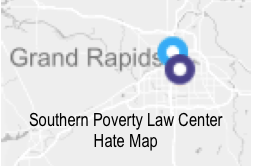
The WOOD TV 8 story cited the Southern Poverty Law Center Hate Map, which listed the white supremacy group as one of three “hate groups” in the area. The other two groups given the “hate” designation by the SPLC are Act for America and the Grand Rapids chapter of the Nation of Islam.
Act for America is a national group, but we could not find any solid evidence that the Grand Rapids chapter still exists. The hyperlink on the side-panel of the SPLC Hate Map is even a dead link. The only real piece of info we could find online about the GR chapter of Act for America is from 2008 and identifies Mark Lee as the contact person.
The third group, the Nation of Islam, hardly seems like it deserves the designation as a hate group. The Nation of Islam in Grand Rapids, like most chapters, has worship services, distributes the Nation newspaper, hosts study groups and also is involved in various charitable activities. Whatever one thinks about the theological views of the Nation of islam, they have never engaged in acts of violence or terror against anybody in Grand Rapids to my knowledge. Therefore, the SPLC inclusion of the Nation of Islam in Grand Rapids on their hate map seems rather dangerous and problematic.
It is dangerous to include the Nation of Islam in Grand Rapids on the Hate Map because it could make them the target of state surveillance, state repression or white vigilante violence. It is problematic to have the Nation of Islam in Grand Rapids on the list, because there is simply no evidence that they promote or practice hate.
The Southern Poverty Law Center does not provide a very well thought out rational for what lands groups on the Hate Map. Here is what the SPLC says about the Hate Map:
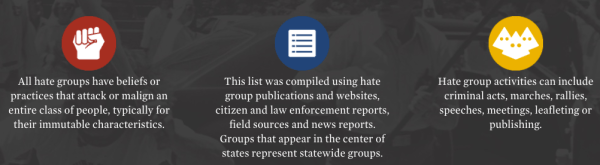
Each of the three brief explanations for the Hate Map are vague and rather limiting. The focus of the Hate Map is on groups that also tend to not have a great deal of power and are often seen as extremist groups. In the above description of Hate Groups on the map it states that the list was compiled in part by “law enforcement reports.” Let’s stop right there. Think about the amount of harm that police officers, ICE agents, etc cause people, particularly communities of color. Think about the very function of cops, which neighborhoods they spend the majority of their time in, who they stop, who they harass and who they arrest, detain and deport. I don’t really care if we call it hate or not, the fact remains that the GRPD causes way more harm to people than does Act for American GR or the small group of white supremacists known as the Gallows Tree Wotansvolk Alliance. This should not come as a surprise since they have one-third of the city’s budget at their disposal and they are better armed. So why isn’t the GRPD on the SPLC Hate Map?
But let’s not stop there. What about a group like the Acton Institute? Here is a group which promotes outright imperialism, white supremacy and Islamaphobia. The Acton Institute has nothing but contempt for the poor and promotes policies that dismantles any real safety net. Hell, even one of their board members is part of an organization that is undermining progressive politics in Latin America.
Then there are groups like the West Michigan Policy Forum, which has won tax breaks for the rich, passed a Right to Work law in Michigan, undermined public sector pensions and is in favor of redirecting more public money into private hands. Sounds like hate to me.
Grand Rapids is home to numerous churches, which are overtly anti-LGBTQ. The SPLC says that, “hate groups have beliefs or practices that attack or malign an entire class of people.” Seems like faith institutions, which are anti-LGBTQ fit this definition of hate.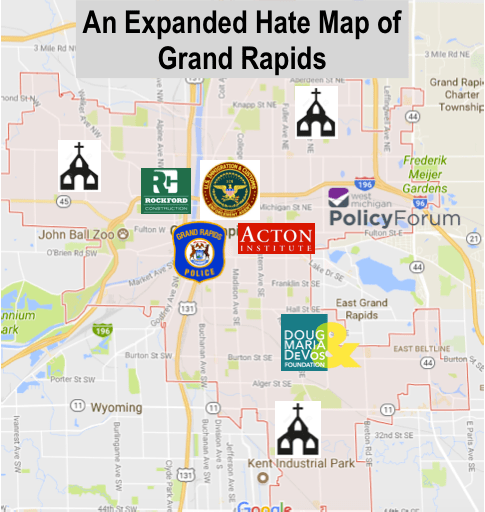
Faith institutions also invest a ton of money into not allowing women to have control over their own reproduction. Many faith institutions also promote patriarchy and work to undermine many feminist gains that have been made in recent decades. How is this not hate?
Then there is the DeVos family and all their foundations. Each of their family foundations funds groups which promote taking away a public safety net and putting more public money into the private sector. The Doug and Maria DeVos Foundation, along with other DeVos foundations have provided funding to anti-LGBT groups over the years. The DeVos family has even spent millions to defeat LGBT marriage equality in several states over the years.
What about the Immigration Customs Enforcement officers in Grand Rapids. One of the main functions is to tear families apart, by arresting, detaining and deporting people simply because they are undocumented. Seems to me that entities that want to destroy families are engaged in hate.
What about all the development corporations and businesses that are gentrifying Grand Rapids at an outrageous pace? These developers are displacing families, destroying homes and existing neighborhoods, all in the name of making more money. How is this not hate?
In other words, one major problem with the Southern Poverty Law Center and its hate map is that is too narrowly defines hate and leaves out the organizations/groups that do the most harm in this community.
(Editor’s note: of course this map could contain a whole lot more groups that engage in hate and harm. We did not address ablism, anti-semitism, settler colonialism or a whole range of other forms of harm and hate that could be added. We invite others to add to this map and share it with others.)
Walmart ad is both insulting and a lie
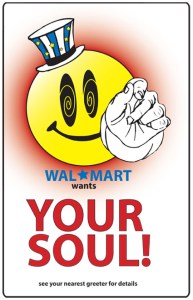 There is a new Walmart ad that has been running on TV in recent weeks, an ad that is identified as “many chairs, one table.”
In this new minute-long Walmart video ad, we see a montage of people, each of them grabbing a distinctly different chair. At one point music begins in the ad, which is a 1967 hit song from the band The Youngbloods, Get Together.
The chorus line for the Youngbloods song is, “come on people now, smile on your brother. Everybody get together, try to love one another right now.” We see a diverse group of people gathering their chairs and eventually they all end up at a large table outside, sharing food and enjoying this beautiful communal gathering.
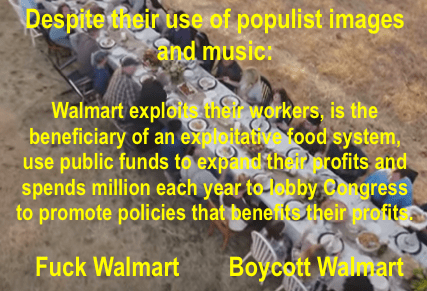
It’s bad enough for Walmart to use this popular culture song from the 60s, but it is even more offensive that this corporation would use a community food sharing image, considering how Walmart is fundamentally about the business of exploitation.
Here are just a few examples of how Walmart takes advantage of people and communities:
- Wal-Mart is the wealthiest company in the world with over $14 billion in profits last year alone. The company makes that kind of an annual profit because it has destroyed many local businesses and pays its workers poverty level wages. In 2008, Wal-Mart CEO H. Lee Scott Jr. made a $29,682,000 salary, which is 1,314 times more than the salary of an average full-time Wal-Mart worker.
- If Wal-Mart paid its workers a livable wage they could seriously reduce the number of people needing.
- Wal-Mart gets millions in tax breaks every year from communities across the country when they broker deals to build new stores. In addition, Wal-Mart use state and federal tax loopholes to pay less in taxes and gets all kinds of subsidies from local communities where they build new stores.
- Wal-Mart is a company, like any other company, that is committed to maximizing their profits. You cannot simultaneously end hunger and make a profit. Besides not paying workers in the US a livable wage, Walmart profits off the misery of millions globally by selling products made in sweatshop conditions.
- Walmart’s board of directors is made up of a group of economic elites who are also committed to maximizing profits and maintaining inter-corporate relations, which allows them to be a united front against government and public scrutiny.
- Walmart is one of the largest food retailers in the world and a great deal of the food they sell uses exploited farmworker labor. While Walmart does not hire migrant farmworkers, they do benefit from the exploitative migrant labor used within the agricultural sector. This is exactly why the Grand Rapids Cosecha Movement is involved in a boycott campaign against Walmart, because the corporation profits from the current food system that is so dependent on the use of migrant farmworkers.
Walmart, like the economic system of capitalism, does not want people to “get together” or “love one another” now or anytime for that matter. Don’t believe the Walmart bullshit. Boycott Walmart!
MLive, NAFTA and Misinformation
On Sunday, Mlive ran an article on the North American Free Trade Agreement, known as NAFTA, entitled, What You Need to Know About NAFTA and its Impact on Michigan.
The article provides an oversimplified explanation of the trade agreement, that limits the perspectives shared, as well as providing unsubstantiated claims.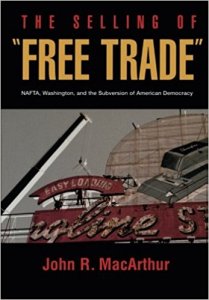
The MLive definition of NAFTA states:
The North American Free Trade Agreement deal either reduced or eliminated tariffs on products in many key industries and introduced sets of industrial, environmental, health and safety standards for the three participating countries to follow. (US, Canada & Mexico)
This is the official definition that governments and corporations have been putting forth since late 1993. However, the reality on the ground has been radically different. A good source for understanding how NAFTA came to be adopted by all three governments can be found in John MacArthur’s book, The Selling of “Free Trade”: NAFTA, Washington, and the Subversion of American Democracy. MacArthur makes it clear that NAFTA is a trade agreement that benefits the wealthy in all three countries and increases hardship for the poor and working class from each country. Another perspective not found in MLive, is that of the insurgent indigenous group in Chiapas, known as the Zapatistas. The Zapatistas refer to Mexico as, “a death sentence for the indigenous people of Mexico.”
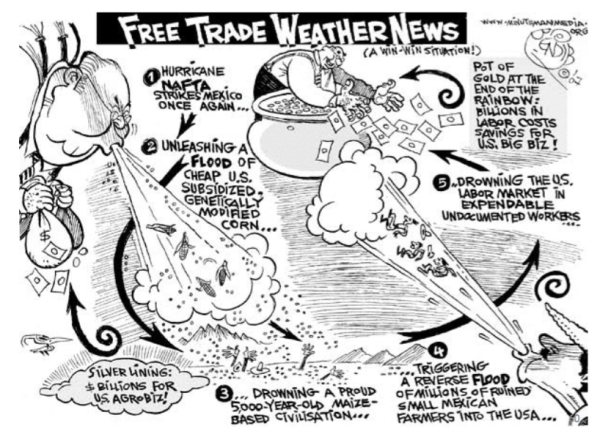
The reason why the Zapatistas have taken this view of NAFTA is based on their experience of how it has been devastating for those who live off the land. Because of the cheap, subsidized corn and other agricultural products that flooded the Mexican economy after NAFTA, millions of small farmers were forced off the land, unable to compete with the subsidized US food products.
The influx of subsidized food products from the US also increased the number of people who were forced to flee Mexico and come to the US, many of them undocumented immigrants. There is no acknowledgement of these dynamics in the MLive article and there are no Mexican farmer and immigrant perspectives on the trade agreement.
Corporate and government voices
The only perspectives we get from the MLive article are those who are elected officials and Michigan agri-business voices. There is one source from organized labor, but this is only in reference to President Trump playing golf instead of renegotiating NAFTA. Such a statement provides no real insight from the dozens of US labor groups that have been fighting against NAFTA from the very beginning.
For example, based on the Bureau of Labor data, Michigan has lost 196,730 manufacturing jobs during since NAFTA/WTO went into effect in 1994. This challenges the oversimplified statement in MLive, which says, “Many critics contend the deal has weakened the United States’ manufacturing industry by encouraging businesses to move operations to Mexico for cheaper labor, however.”
The MLive article also provides limited analysis of what it is the Trump administration is or is not doing around the renegotiation of NAFTA, nor does MLive provide a link to the actual working document that the Trump administration has put forth in regards to NAFTA. 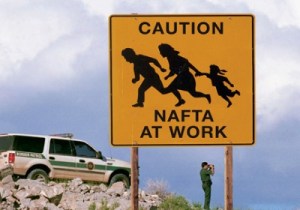
The MLive reporter also provides no sources outside of the administration, such as what non-partisan groups like Public Citizen, which has responded directly to the Trump administration document released in July:
“This document does not describe the promised transformation of NAFTA to prioritize working people that some voters were expecting based on President Trump’s campaign pledges.
More than 910,000 specific American jobs have been certified as lost to NAFTA under just one narrow program, but this document does not make clear whether NAFTA’s job offshoring incentives or its ban on Buy American procurement policy will be eliminated or labor or environmental standards better than the widely rejected one in the TPP will be added.
The document is quite vague so while negotiations can start in 30 days, it’s unclear what will be demanded on key issues, whether improvements for working people could be in the offing or whether the worst aspects of the TPP will be added making NAFTA yet more damaging for working people. The administration should follow the European Union’s practice and make public its actual proposals being shared with Mexico and Canada prior to talks starting.
The Trump administration has a very narrow pathway to both achieving the president’s campaign pledges on NAFTA and passing a new NAFTA deal. Achieving Trump’s campaign-promised NAFTA deficit-lowering and U.S. job creation goals will require changes to NAFTA that GOP congressional leaders and the corporate lobby oppose and about which this document remains vague. Even if a bloc of GOP rank and file members may support elimination of NAFTA’s investor offshoring incentives and Buy American ban, which are necessary to achieve Trump’s goals, a sizable bloc of Democratic votes will be needed to pass a new NAFTA of that sort. But GOP congressional leaders and the corporate lobby are demanding TPP elements be added to NAFTA and that will push away Democrats. Some aspects of that TPP agenda can be seen in today’s document because much of the text repeats the negotiating objectives of the 2015 Fast Track bill, which GOP leaders and the corporate lobby loved and most congressional Democrats, a sizable bloc of GOP congressional members and labor and civil society groups opposed.”
What we get instead from MLive is lazy journalism that tells us very little about NAFTA and often misleads readers as to what the actual impact has been on people who live in Michigan.
Members of the Grand Rapids Power Structure are major contributors to PACs for the 2018 Election
 According to some recent data from the Michigan Campaign Finance Network, there are several members of the Grand Rapids Power Structure who have contributed significantly to various Political Action Committees for the 2018 Election cycle.
The amount of money raised so far by the top 150 PACs in Michigan, is “the highest total posted by the top 150 PACs at this point in a two-year election cycle in at least a decade and could be the highest in state history, according to the Michigan Campaign Finance Network’s past tracking.”
Members of the Grand Rapids Power Structure are some of the larger contributors to these PACs. For instance, the House Republican Campaign Committee, which has raised more money to its PAC than all other PACs til now received contributions from:
- Nancy and John Kennedy, Autocam, $80,000
- Peter and Joan Secchia, of the company Sibsco
- J.C. Huizenga, Huizenga Group $30,000
- Michael Jandernoa, Perrigo, $20,000
Contributing to the Senate Republican Campaign Committee PAC from the Grand Rapids Power Structure were:
- J.C. Huizenga, Westwater Group, $30,000
- John Kennedy, Autocam, $20,000
- Michael Jandernoa, of the company Perrigo, $20,000
The Business Leaders for Michigan’s Super PAC received large contributions from:
- Michael Jandernoa, former CEO of Perriogo, $20,000
- Doug DeVos, president of Amway, $10,000
The Complete Michigan PAC (Sen. Mike Shirkey) received a contribution from:
- John Kennedy, the CEO of Autocam, $40,000
Members of the Grand Rapids Power Structure also contributed to PACs that are connected to members of the Michigan House and Senate. In the 73rd House District, Rep. Chris Afendoulis received funds from the Meijer PAC, $2,500 and the Kennedy family, Autocam $2,000.
The only other members of the Michigan House or Senate to receive PAC money so far for the 2018 election cycle were:
- 74th House District, Rep. Rob VerHeulen received $1,000 from the Meijer PAC
- 77th House District, Rep. Tommy Brann Received $500 from the Meijer PAC
- 28th Senate District, Sen. Peter MacGregor received $1,500 from the Meijer PAC
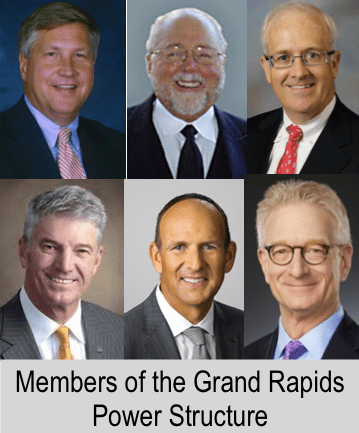 Lastly, it is important to note that these same members of the Grand Rapids Power Structure are also interconnected through the organizations and associations they are part of in West Michigan. It makes complete sense that many of these wealthy individuals are connected through organizations, since these very same entities are committed to furthering the very interests of these wealthy members of the Grand Rapids Power Structure.
Of the members of the Grand Rapids Power Structure mentioned above, many of them are connected through the following groups:
- West Michigan Policy Forum – John Kennedy, Doug DeVos, Michael Jandernoa, J.C. Huizenga, Peter Secchia and Meijer.
- The Right Place Inc. – John Kennedy and Hank Meijer
- Grand Action – Michael Jandernoa
- The Acton Institute – J.C. Huizenga and John Kennedy
- Van Andel Institute Board of Trustees – John Kennedy
- Spectrum Health Board of Trustees – Joan Secchia
- GVSU Board of Trustees – John Kennedy
- West Michigan United Way Board – Michael Jandernoa
More corporate welfare in Michigan for Agri-business companies while child poverty grows
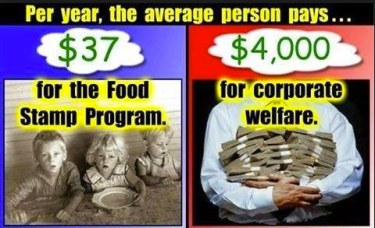 Earlier this week, MiBiz reported that the Michigan Department of Agriculture and Rural Development, in conjunction with the Michigan Economic Development Corp. will be giving out $4.7 millions to agri-business entities to expand their already large production projects.
This is not surprising considering the history of the Michigan Department of Agriculture and Rural Development (MDARD) and the Michigan Economic Development Corp. (MEDC). Both of these government run entities are essentially using taxpayer funds to give to agri-business companies, because this is the kind of work that both groups do. That is to say, both the MDARD and MEDC do not generally provide funding to small businesses or small sustainable farms.
Another corporate entity, the Michigan Agri-business Association has hundreds of members, but some of the largest members are a who’s who of toxic and destructive companies like Bayer, Dow Chemical, DuPont, Syngenta and Enbridge.
Most of the space provided to spokespersons in the MiBiz article is from these three agri-business entities.
The article does provide some commentary space to one of the companies benefiting from the taxpayer subsidies, the largest egg producer in Michigan, Herbruck’s Poultry Ranch.
Herbruck’s has been under a great deal of scrutiny for years because of its environmental record, since the company runs Controlled Animal Feeding Operations, known as CAFOs. You’ve probably see one of their larger facilities, which can be seen from highway 96 as you travel eat, right before the Ionia exit.
Herbruck’s is no stranger to living off of taxpayer money. The Environmental Working Group, which has a massive Farm Subsidy Data Base shows that Herbruck’s Poultry Ranch has received $430,864 between 1995 – 2014. You can search the data base yourself to see who else is receiving corporate welfare.
 One of the other agri-business entities receiving corporate welfare is Fairlife LLC, operating in Coopersville, Michigan. The company makes a milk drink and is actually a subsidiary of the largest beverage company on the planet, the Coca Cola Company.
Nice to know that we are all paying money to agri-business corporations so they can they can expand and make even more profits, while so many people are just trying to survive.
GRIID Fall 2017 Class: Learning from Social Movements in US and Grand Rapids History
 What can we learn from the history of social movements? What tactics and strategies have been effective in order for people to overcome systems of oppression?
This is the focus of the Fall 2017 GRIID class. Over an 8-week period, we will explore the power of social movement in US history, using the book, A People’s History of the United States by Howard Zinn. From Zinn’s book we will explore the abolition movement, the Black Freedom movement and the labor movement during the later part of the 19th century and early part of the 20th century. For those who don’t have a copy of Howard Zinn’s book, there is a PDF version online at this link.
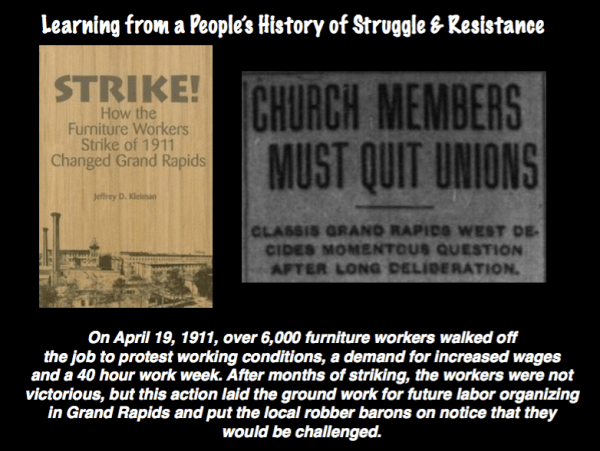
In addition, we will explore social movements in Grand Rapids history, focusing on the early labor movement and the civil rights movement. We will be reading a section from Jeffrey Kleiman’s book, Strike!: How the Furniture Workers Strike of 1911 Changed Grand Rapids and a chapter from Todd Robinson’s book, A City within a City: The Black Freedom Struggle in Grand Rapids, Michigan. In addition, we will be using some additional research done through the Grand Rapids People’s History Project. GRIID will provide a PDF version of the chapters we will be using for this class from the two books about Grand Rapids.
The class begins on Monday, September 25 and goes for 8 weeks ending on November 13. Class will meet from 6:30 – 8:30pm at take place at St. Andrew’s Episcopal Church 1025 3 Mile Rd NE, Grand Rapids, MI 49505 (lower level – enter off the parking lot) The class cost is $25, but we will not turn anyone away who is unable to pay. To sign up send an e-mail to jsmith@griid.org.
Is Fighting Fascism really an American Tradition?
 There have been a great deal of memes floating around on social media in the past week, many of them in response to the White Supremacist violence that took place in Charlottesville.
Many of these memes address white supremacy and fascism. However, as is the case with most memes, they tend to oversimplify reality and sometimes distort reality.
Take the meme here on the right. It says, Anti-Fascists disrupting a large gathering of white supremacists. The image clearly is from WWII, with the US military deploying troops, getting ready to do battle with Nazis. Now, it is possible that many US soldiers who were drafted into WWII, believed that they were fighting fascism, but that does not necessarily mean that the military and political leadership in the US was deeply committed to fighting fascists and disrupting white supremacy.
It is important for us to critically look at this history and investigate what exactly the US was committed to before, during and after WWII, particularly as it relates to fighting fascism.
Did the US Fight Fascism in Germany?
In Christopher Simpson’s little known book, The Splendid Blonde Beast: Money, Law and Genocide in the Twentieth Century, the author makes it clear that US financial institutions played a major role in rebuilding Germany after WWI. Entities like J.P. Morgan & Co., National City Bank, Brown Brothers, Lehman Brothers, Goldman Sachs and the Bankers Trust Company all provided significant loans and made major investments in the German economy.
Simpson also notes that there were several law firms that played a major role in facilitating the financial transactions that US banks made with Germany during the 1920s and 30s. One of the most notable law firms was Sullivan & Cromwell. Sullivan & Cromwell was a major player, not only with relations between the US government and the German government, the law firm dealt with numerous other governments the US had relations with, so much so, that Sullivan & Cromwell became known as the revolving door with the US State DePartment. Many of the Sullivan & Cromwell lawyers either transitioned into positions in the US State Department or began in the State Department and then entered the law firm.
Two of the most notable lawyers who got their start at Sullivan & Cromwell, were brothers Allen and John Foster Dulles. Throughout the 1920s and 30s, the Dulles brothers played a major role in building relationships with Nazi Germany and after WWII they were rewarded positions in the Eisenhower administrations as Secretary of State (John Foster Dulles) and the Director of the CIA (Allen Dulles).
The relationships that the Dulles brothers developed with Nazi Germany would pay off after WWII, since they would recruit hundreds of Nazi scientists, military leaders and intelligence agents to come work for the US. Christopher Simpson documents this history in his ground-breaking book, Blowback: The First Full Account of America’s Recruitment of Nazis, and its Disastrous Effect on Our Domestic and Foreign Policy. One of the highest ranking former Nazi Generals to be recruited by the CIA, was Reinhard Gehlen. Gehlen was recruited specifically because he was one of the Nazi Generals in charge of the Eastern Front and had a great deal of intelligence on the Soviet Union. You can read all the details about this dynamic in Mary Ellen Reese’s book, General Reinhard Gehlen: The CIA Connection.
Doing Business with Fascists instead of fighting them
Another major reason to be critical of the claim that the US was committed to fighting fascists during WWII was based on the fact that many major US corporations were operating factories in Nazi Germany or manufacturing products to sell to Nazi Germany. One such company was IBM, which contracted with Nazi Germany to develop a punchcard system that was used to track Jews and other prisoners in concentration camps.
Edwin Black (who appeared in the video clip above), in his book the, Nazi Nexus: America’s Corporate Connections to Hitler’s Holocaust, cites a 1945 US Army report, which called the Ford Motor Company, “the arsenal of Nazism” with the full consent of the automotive company based in Dearborn, Michigan.
The Ford Motor Company operated factories throughout Germany during WWII, for both automobile manufacturing and for the production of munitions for the Nazi army. (Nazi Nexus) In addition, the Ford Motor company was manufacturing vehicles that were used by the Nazi military up until at least 1944, mostly at their facilities in Detroit/Dearborn. This dynamic is also well documented in Charles Higham’s important book, Trading with the Enemy: The Nazi-American Money Plot 1933 – 1949.
Fighting Fascism means fighting White Supremacy
A third important dynamic that we need to come to terms with is that the US government was not really interested in what was happening to the Jews in Nazi Germany. The US had its own brand of anti-Semitism that was growing during the 1930s. This anti-Semitism impacted policy at the highest level, especially when it came to how the US government responded to the Jews who were attempting to flee Nazi Germany.
The US government ultimately denied entry to Jews we were fleeing Nazi Germany. The US literally turned away a ship of 900 German Jews in the late 1930s and shortly afterward, it rejected a proposal to allow 20,000 Jewish children to come to the US for safety.
In David Wyman’s book, The Abandonment of the Jews: America and the Holocaust 1941 – 1945, the author makes it clear that the US did very little to actually prevent what Nazi Germany was doing to the Jews. In addition to not taking in Jews who had already fled Nazi Germany, the US did not intervene directly to put a stop to the death camps. US knowledge of the concentration camps was made clear by at least 1942, yet there was no strong effort to bomb the rail lines leading into the camps, the very same rail lines that were used to bring millions of Jews to work or be exterminated in camps all over Germany and German occupied territory. This failure on the part of the US political and military leadership to prevent the deaths of millions of Jews is well documented in Raul Hilberg’s book, Perpetrators, Victims and Bystanders: The Jewish Catastrophe 1933 – 1945. Many US troops were certainly appalled to learn what was happening in the German concentration camps near the end of the war, but dismantling those camps was never a priority of the US political and military establishment.
A few other important points to raise in regards to the question of whether or not Americans have a strong history of fighting fascism are as follows: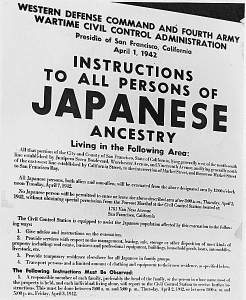
- After the Fascists were defeated in Germany, Italy and France, the US military often suppressed the anti-fascist forces in those countries and replaced them with the fascist collaborators that the resistance forces were attempting to defeat. Part of the reason the US military was ordered to restore power to fascist collaborators was because they did not want the resistance forces to take power, since the resistance forces were often made up of communists, socialists or anarchists.
- While the US did round up roughly 11,000 German Americans during WWII and put them in internment camps, that number pales in comparison to the 120,000 Japanese Americans that were forces into internment camps. This disparity reflected to racial politics of the US government, which was much more interested in punishing people of Japanese descent than German descent.

- Cherokee scholar Ward Churchill, in his book, A Little Matter of Genocide: Holocaust Denial in the Americas 1492 to the Present, refers to the Nazi concept of Lebensraum, which means living space. Churchill argues that the forces removal of Native nations in the US is what influenced Hitler in his adopt his racial policies towards Jews that ultimately led to their extermination.
- After WWII, the US initiated the Marshall Plan as a form of economic recovery for Germany. However, as Michael Zezima, author of the book, Saving Private Power: The Hidden History of the Good War, notes, the Marshall Plan was really a massive subsidy to US corporations and former Nazi companies, so that they could continue to expand their influence in Europe.
While a great deal more can be said to challenge the claim that the US has a strong tradition of fighting fascists, this brief summary should be enough to get you to question this claim.
However, one should follow up with the books that are cited in this post and we certainly encourage you to do your own investigation into this matter.
If you wanted an actual example from this time period where Americans really fought against fascism, check out the Abraham Lincoln Brigade.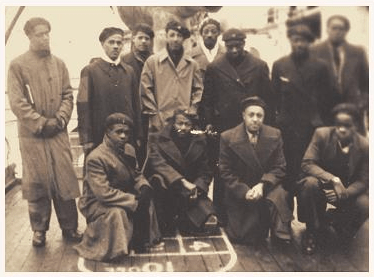
The Abraham Lincoln Brigade were some 2,800 US volunteers that participated in fighting against the fascist forces during the Spanish Civil War (1936 – 1939). These men and women were part of an effort that included forty thousand other men and women from 52 countries that fought against fascism in Spain. You can see from the photo here, that many African Americans were part of the effort to fight fascists in Spain in the late 1930s. This is the history we need to reclaim. This is the history we need to teach.
The honest Legacy of Congressman Vern Ehlers
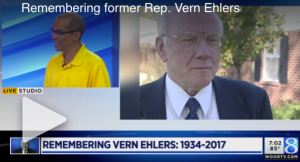 On Tuesday, former US Congressman Vern Ehlers passed away at the age of 83.
In the past few days there has been a number of news stories reflecting on the life of the former Congressman, with virtually every story communicating nothing but respect and admiration for Vern Ehlers.
One article on MLive just listed the comments from local politicians, both current and former, such as Senator Debbie Stabenow, Rep. Bill Huizenga, current Secretary of Education Betsy DeVos and Grand Rapids Mayor Rosalynn Bliss.
A WOOD TV 8 story provides significant time to Ehler’s former press secretary Chris Barbee, but also included commentary from additional politicians like Rep. Justin Amash, Gov. Rick Snyder and Rep. Fred Upton.
An earlier story on MLive provided some background on Ehlers’ political career from Kent County Commissioner to Congressman. In addition, some of the news coverage highlighted certain policies that the former Congressman had “championed,” such as Great Lakes Restoration and STEM Education.
Some of the themes that are reflected in the news coverage of Ehlers’ passing is that he was, “respected on both sides of the aisle,” that he had a great sense of humor and served the 3rd Congressional District well. Some of the reporting talked about his Christian faith and several respondents said that “we needed more politicians like Vern.”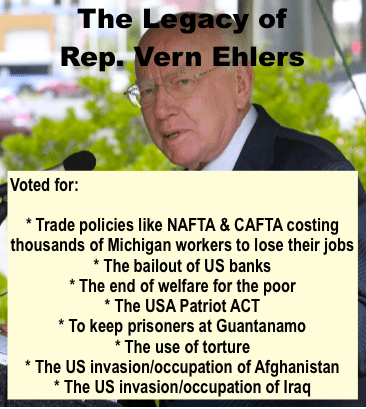
It is always interesting to observe how the news media deals with the death of a politician, regardless of party affiliation. Congressmen Ehlers, like Congressman Paul Henry (whom Ehlers replaced) are almost canonized in the news coverage without any critical perspective on what these politicians stood for, not what their track record looked like.
Congressman Ehlers took over for Paul Henry as the Representative for the 3rd Congressional district in 1993, when Henry was diagnosed with a brain tumor. This means that Ehlers was Congressman during the Clinton administration, the Bush administration and the first 2 years of the Obama administration. Ehlers left office in January of 2011.
From 1993 through 2011, anyone in Congress would have had to deal with major policies that impacted millions in the US and millions more worldwide. Former Congressman Vern Ehlers voted on trade policies, domestic economic policies, war and military budgets and the aftermath of September 11, 2001 terrorist attacks in the US.
I was personally involved in numerous campaigns to challenge and confront Congressman Ehlers during his time in Congress and was even arrested on a few occasions at his office in the Grand Rapids Federal Building.
Ehlers, like most politicians, practiced business as usual politics. On the economic front, Ehlers consistently voted to continue massive corporate subsidies that were in the billions, while millions of families were struggling to make ends meet. Ehlers voted for the Clinton administration’s policy to end welfare as we know it and he voted for the massive bailout of banks after the economic collapse of 2007 – 2008.
These policies expanded the gap between rich and poor in the US and had devastating consequences particularly on women and communities of color.
Congressman Ehlers voted in favor of the North American Free Trade Agreement (NAFTA) and the Central American Free Trade Agreement (CAFTA). These trade policies had devastating effects on US workers and resulted in the elimination of thousands of manufacturing jobs being lost in Michigan alone.
After the September 11, 2001 attacks, Ehlers voted for the Patriot Act and everyone of the subsequent policies after that to renew or expand domestic US government surveillance programs. The Patriot Act targeted the Arab American and Muslim American communities and should be seen as what it is, a racist policy.
Congressman Ehlers voted to in support of the US military assault and then subsequent military occupation of Afghanistan in 2001. Ehlers also voted for the US invasion and occupation of Iraq in 2003 and continued to voted in favor of military spending in Iraq, the use of private contractors and the use of torture by US military personnel in Iraq.
In March of 2007, several hundred people went to the home of Vern Ehlers to protest his ongoing support of the US occupation of Iraq, as you can see in this video:
Again, in 2008, Ehlers was confronted about his support for the US occupation of Iraq, when he was attending an event at the Women’s City Club in Grand Rapids:
Additionally, in the early months of the US military occupation of Iraq in 2003, members of the People’s Alliance for Justice and Change organized the Trial of Vern Ehlers as a dramatic depiction of the then documented US war crimes being perpetrated in Iraq, which Congressman Ehlers supported. You can read the transcript of the trial here or watch a video version of the trial.
So, despite the glowing news coverage of the passing of this former US Congressmen, some of us will remember him as a supporter of economic policies that supported the rich, devastating trade policies, US militarism, war crimes and torture. But hey, he was respected on both sides of the political aisle.

