Celebrating the Real Dr. Martin Luther King Jr
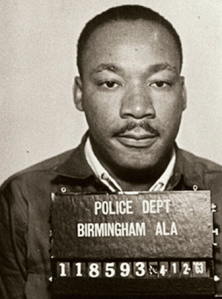 As we celebrate one of the great leaders in the Black Freedom Struggle, it is important that we familiarize ourselves with the real Dr. King and not the one that is promoted in commercial media or by organizations that have their own agendas.
Like most people, Dr. King was not a static person and was not part of a static movement. He evolved over time and continued to sharpen his own view of the world as he moved beyond a civil rights view to a more global liberationist view. Dr. Martin Luther King Jr. also matured in his use of tactics and strategizing when dealing with systems of oppression.
What follows are resources that we encourage people to investigate, so as to drawn your own conclusions about who Dr. King was, what he preached and practiced before he was assassinated nearly 50 years ago.
One good sources is The King Center Archive, which can be found online at http://www.thekingcenter.org/archive. The archive contains nearly 1 million documents associated with the life of Dr. King.
 Another great source is a collections of King’s writings published in 1963 called, Why We Can’t Wait. This collection of writings includes his famous Letter from a Birmingham Jail.
 Of course, there is the I have a Dream Speech, which give delivered in Washington, DC in 1963 at one of the largest civil rights demonstrations in US history. Some great sources to accompany that speech are Gary Younge’s book, The Speech: The Story Behind Dr. Martin Luther King Jr.’s Dream and Nobody Turn Me Around: A People’s History of the 1963 March on Washington, by Charles Euchner.
It is also important to know that Dr. King did not limit himself to challenging institutionalized racism, he also spoke out and organized around economic exploitation. Michael Honey’s book, All Labor Has Dignity, is a collection of writings and speeches that Dr. King gave that challenged economic injustice and well as demonstrating his relationship to organized labor groups in the US.
 In a Single Garment of Destiny: A Global Vision of Justice, edited by Lewis Baldwin, you will find an amazing collection of writings and speeches by Dr. King that not only explored the issue of global poverty, but makes clear the tremendous understanding Dr. King had of US foreign policy and global solidarity. Included in this collection is King’s famous speech, Beyond Vietnam, which contains not only his denunciation of the US as the “Greatest purveyor of Violence in the world today,” it contains Kings naming the Evil Triplets of Racism, Militarism and Capitalism as the greatest threats to humanity.
 As King’s vision of liberation became more radical, he began to name systems of oppression and to call out the unjust US war in Vietnam and the violence perpetrated against the black community in the US. In a little know book entitled, The Trumpet of Conscience, there are 5 lectures that King delivered on the Canadian Broadcasting System in 1967. These are some of the most powerful articulations of King’s vision and makes clear why he was such a threat to those in power.
 The further radicalization of King is also capture well in another collection of King’s work, edited by Dr. Cornel West, entitled, The Radical King.
One of the last campaigns that Dr. King was involved in was The Poor People’s Campaign, which began in the summer of 1968, months after he was assassinated. This campaign was originally designed to have thousands of people set up a tent city in Washington DC until their demands were met around racial and economic justice, what King called a Bill of Rights for the Disadvantaged.
During the same time, the Memphis sanitation workers were organizing a strike for better wages and working conditions, Dr. King went to Memphis to support the strike and lend his solidarity to their struggle. The sanitation worker’s strike and King’s visit is well documented in the book, Going Down Jericho Road: The Memphis Strike, Martin Luther King’s Last Campaign, by Michael Honey.
 Memphis is where King was assassinated, on April 4 of 1968. King’s assassination is the subject of two important books. One book is Michael Eric Dyson’s book April 4, 1968: Martin Luther King Jr’s Death and How It Changed America. A second book, written by William Pepper, explores who was actually involved in King’s assassination and what role local, state and federal authorities played in the shooting of Dr. King. Pepper’s book is entitled, An Act of State: The Execution of Martin Luther King.
 It is also important to understand that the FBI had been monitoring Dr. King’s activities for years, making threats against him and wire tapping his phones. One book, which documents the FBI monitoring of King (with actual documents), is the book by Michael Friedly and David Gallen, Martin Luther King Jr: The FBI File.
There are other important scholarly works on the message and person of Dr. King. Three books in particular are worth mentioning. The first is by John Ansbro, entitled, Martin  Luther King Jr.: The Making of a Mind. The second scholarly book is by Michael Eric Dyson, entitled, I May Not Get There With You: The True Martin Luther King Jr. Lastly, no investigation of Dr. King is completed without the great Black Theologian James Cone’s book, Martin and Malcolm and America: A Dream or a Nightmare.
In addition to these books, speeches and essays by and about Dr. King, there are some great films about King and this time period. The PBS series Eyes on the Prize, provides  wonderful visual documentation of the black liberation movement and Dr. King. However, a film that deals more directly to the message and person of Dr. King is Citizen King, which deals particularly with the last few years of his life, his vision and the state repression against him and his family.
All of these resources are important, especially if we want to not let government, non-profit or political groups hijack the message and witness of this deeply passionate man.
Countries that Trump calls Shitholes are violent, poverty stricken countries because of over a century of US Policy
President Trump is creating a stir again over his recent comments about immigrants that are coming from “shithole” countries, like Haiti and countries in Africa.
Numerous commentators are responding to the racist nature of such comments and for good reason. However, there is a completely different component here that most media sources are missing and that is the fact that many of the countries that Trump is referring to have refugees/immigrants coming to the US because of US imperialism and European colonialism.
Let’s start with a look at Haiti.
Haiti became independent in 1804, after a revolution led by Black people.The US hated this fact and has been punishing Haiti ever since. Abraham Lincoln proposed to send all the black slaves to Haiti as a White Supremacist solution and since the early 20th century the US has pretty much run the small Caribbean nation.
From 1914 to 1934, the US Marines occupied Haiti in order to stop numerous rebellions. In addition, during this time the US essentially re-wrote the Haiti Constitution to favor longterm US financial interests. ( See Paul Farmer’s, The Uses of Haiti) Since the late 1950s, the US supported the dictatorships of Papa Doc and Baby Doc Duvalier. The Duvalier dictatorship was a brutal dictatorship using state terrorism that was enforced by the government’s death squads known as the Ton Ton Macutes.
Then in 1990, the Haitian people elected a Catholic priest by the name of Jean-Bertrand Aristide, who was a proponent of Liberation Theology. Aristide was overthrown in a US-back Military Coup in 1991 and took exile in the US. The Clinton administration then got Aristide to adopt World Bank/IMF Structural Adjustment Policies, and in turn the US administration agreed restore Aristide to power.
Aristide was elected again and then over thrown by another US backed military coup and spent 7 years in exile, all of which is well documented in the film Aristide and the Endless Revolution.
If we wanted to look at US interventions in Africa over the last 50 years, here is a sampling of how the US has helped to create violence and poverty in that continent:
- US involvement in the assassination of President Lumumba in the Congo in 1961.
- US Support for the South African Apartheid government that last for decades and right up until the end
- CIA involvement in Angola that led to a bloody civil war.
- US support of dictatorship in Somalia in the 1990, which led to a failed US intervention during the Clinton administration.
- US support for the brutal dictatorship of Idi Amin in Uganda in the 1970s.
- US support for the brutal dictatorship of Mobutu in Zaire (now the the Congo) for roughly 30 years.
- Egypt was in the top 5 in US military aid for over 25 years.
- US antagonism of Libya for several decades, leading to the US-back coup in 2011.
- 1998 bombing of a pharmaceutical plant in Sudan, which led to the deaths of thousands, since this pharmaceutical plant provided 50% of the medicines in the Sudan.

It is understandable that people are outraged by the recent comments by President Trump, but he is simply reflecting a long standing US position on Haiti and the continent of Africa.
If you want to explore this history more, participate in the GRIID class, Investigating US Foreign Policy from 1898 to the Present, which begins on Monday, January 29.
 Reading the business press can be difficult at times, but for those who are engaged in grassroots organizing, it is important for us to monitor such news sources. It’s important because those who have economic and political power are often more candid with what they think in the business press than in the more mainstream commercial media.
In addition, the business press also is pretty up front about their bias, even allegiance, to those who wield tremendous economic and often political power. This was demonstrated recently in the Grand Rapids Business Journal, with their announcement of the 2017 Newsmakers of the Year awards event, scheduled for January 31st at the Frederick Meijer Gardens.
The list of nominees reads like a who’s who of the Grand Rapids power structure, with mostly familiar names, to those who follow power dynamics in West Michigan.
There are 16 separate categories, with 3 nominations in each category. However, it is interesting to see how deeply certain people, families and companies are represented in the nominations.
The family/business with the most mentions are of course the DeVos Family. Dick DeVos is a nominee for Economic Development and his wife Betsy DeVos is a nominee for Education. In addition to that power couple, Dan DeVos is a nominee for Sports (ownership of the Grand Rapids Griffins) and Daryn Kuipers is a nominee in the Beverage category because he works for Boxed Water. Boxed Water is part of the DeVos owned Windquest Group Core Companies.
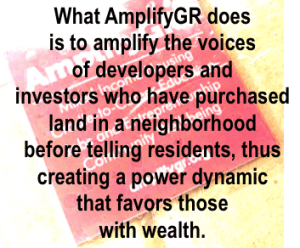
Of course, the DeVos connection doesn’t end there. In the category of Non-Profit newsmakers, AmplifyGR is nominated. AmplifyGR is funded by the Doug and Maria DeVos Foundation and was created for the purpose of getting the family into the development business, along with AmplifyGR’s partner Rockford Construction. Which brings us to another connection, since Rockford Construction is nominated for two categories – Construction and Sustainability.
Being nominated by the Grand Rapids Business Journal as a 2017 Newsmaker, of course is an endorsement that what these individuals or companies were doing in the community over the past twelve months. We take a much different view of these nominees, so we’d like to offer our own awards for each of the people named above.
Daryn Kuipers/Boxed Water wins the We’re Profiting Off of the Sale of Water Award.
AmplifyGR, along with Rockford Construction, wins the Gentrifier of the Year Award.
However, since Rockford Construction was also nominated for the Sustainability of the Year Award, we’d like to give them the – We Had to Destroy the Neighborhood in order to make it Sustainable Award.
Dan DeVos, owner of the Grand Rapids Griffins, wins the We Own Everything Else, Why Not the Sports Teams Award.
Since Dick DeVos was nominated for the Economic Development category, he wins the How to Use Public Money for Private Profit Award.
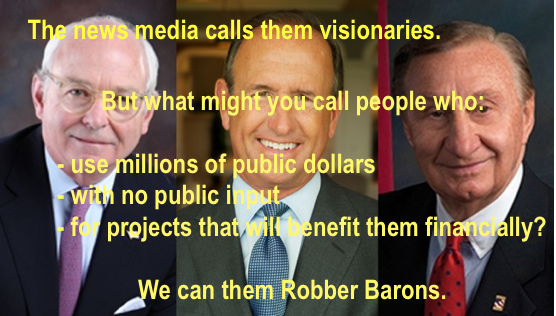
Lastly, since the Grand Rapids Business Journal nominated Betsy DeVos for an Education award (even though she is the only person nominated who is not working in Grand Rapids), we give her the How to Dismantle Public Education Award.

The War on Immigrants continues to escalate: Temporary Protected Status of 200,000 Salvadoran immigrants has been revoke by the US Government
 Approximately 200,000 Salvadorans, many of whom have resided in the United States since becoming eligible for Temporary Protected Status (TPS) in 2001, will have until September 2019 to either willingly leave the United States, obtain U.S.legal permanent residency by some other means, or else face deportation.
“What these long-term residents of the United States needed is a pathway to citizenship. Instead, under Trump, they will be forced to turn their lives upside down and drag their children back to one of the most violent countries in the world,” said a spokesperson from the Washington Office on Latin America (WOLA).
The Trump administration previously ended TPS for Haitians and Nicaraguans in November 2017, affecting about 50,000 Haitians and some 2,500 Nicaraguans. A decision on the 61,000 Honduran recipients of TPS is expected before May 4, 2018.
Salvadoran officials, including President Salvador Sánchez Cerén, appealed to DHS Secretary Kirstjen Nielsen as recently as last week not to go through with the decision, arguing that it would wreak havoc on El Salvador’s economy. The tiny Central American nation relies heavily on remittance payments sent from Salvadorans living in the U.S. to their family members back home.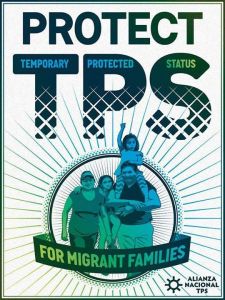
TPS is a program that has allowed administrations to extend temporary residency to foreign nationals on U.S. soil at a time when a profound disaster—natural or political—strikes in their home countries. Originally, close to 300,000 Salvadorans in the United States were vetted and granted TPS after a killer earthquake rocked the small Central American country in 2001, as the Center for Public Integrity explained in a recent story. Congress created TPS as part of the Immigration Act of 1990.
Kent County is home to several thousand Salvadorans, which means that families will be torn apart or face the difficult task of returning to a country that is extremely violent and where more than half the population lives in poverty.
The announcement to end TPS for Salvadorans from the Trump administration is part of a long line of policies that have been devastating for Salvadorans. The US has been a supporter of the wealthiest families, many of which own coffee plantations, for the better part of a century.
In 1932, the US backed the Salvadoran military, which slaughtered an estimated 10,000 coffee workers in one day, because they dared to organize against the harsh working conditions and poverty wages. This event is known in El Salvador as La Matanza – The Massacre.
From the late 1970s through the early 1990s, the US supported the death squad government of El Salvador, which killed about 80,000 of its own people in a brutal counter-insurgency war. During the peak of those years, the US government was providing $1 million a day to the government of El Salvador to suppress their own people. In 1980, Salvadoran Archbishop Oscar Romero wrote to then President Jimmy Carter and asked him to stop sending money for weapons. Weeks later, the Archbishop was shot dead by Salvadoran soldiers while saying mass in San Salvador.
Because of the government repression, thousands pf Salvadorans fled their country to come to the US, but were often denied asylum. In 1984, the US Sanctuary Movement was born and faith-based groups and other organizations were taking people in who were fleeing repression in El Salvador and Guatemala.
During the 1990s, and especially after the 1994 Peace Accords, El Salvador was subjected to Structural Adjustment Programs by the World Bank/IMF loans, which meant that the government had to privatize many formerly public services and reduce spending on social services. It was during this time that the level of state corruption and street level violence increased, violence which continues til today.
This is the legacy of US policy with El Salvador and the decision to end TPS for Salvadorans living in the US, who now have to leave within the next 18 months, is just the most recent repressive policy the US has imposed on the Salvadoran people.
This decision to take away TPS from Salvadorans living in the US is just another aspect of the growing war against immigrants. It is time that we increased our level of resistance to such policies and consider offering sanctuary to those who are being forced to leave, much like the resistance and sanctuary work being done in the 1980s in Grand Rapids.
100 Ideas, White Supremacy, Entrepreneurs and Income Inequality
 Try to imagine if you can, what Grand Rapids might look like if no one lived in poverty. Imagine if just those who were African American, disproportionately did not live in poverty. Can you even imagine that?
Some will say that African Americans have had every opportunity to get out of poverty and that there is no reason why a high number of blacks in this city should live in poverty.
Those who are quick to say this fail to acknowledge the history of White Supremacy in the US. They fail to acknowledge that slavery meant that black people earned no money and were not allowed to acquire assets, while white people profited significantly off of slavery.
Those who fail to acknowledge the history of White Supremacy fail to take into account the theft of black owned land, the constant terrorism of armed white people, whether it is the KKK or the local police department. Failure to acknowledge the history of White Supremacy means failure to talk about the history  of lynching, segregation, financial red lining, that black people have disproportionately made lower wages than white people, mass incarceration, white flight, gentrification, urban renewal and the defunding of the public sector, which has disproportionate impacted the black community more than any other.
People could read about how the economic system of capitalism doesn’t serve most people, but has particularly impacted the black community, as the great historian Manning Marable documents in his book, How Capitalism Underdeveloped Black America.
Along comes Start Garden, which says it wants to give away $1,000 to 100 people for new business ideas in the coming weeks. In July, Start Garden judges (whoever they might be) will have complete say in determining what lucky 10 people will then each get $20,000 to start a new business initiative.
The funds for this new project are coming from the banks and other financial institutions listed below, with the intent of creating,”10 new sustainable ideas in our Grand Rapids business district,” says, Jorge Gonzalez of Start Garden. Gonzalez went on to say, based on an MLive article, “That means wealth creation.”

Gonzalez’s co-worker in this project, Darrel Ross explained the thinking behind the initiative, when he said, “The solution to poverty is income, and the best way to generate income is through entrepreneurship.” Such a statement not only fails to acknowledge the history of White Supremacy, it fails to take into account how the system of capitalism works.
Capitalism, particularly Neo-Liberal Capitalism, functions best when there are a small percentage of the population keeping most of the wealth, while the masses are living in poverty or just a pay check away from falling into poverty. In fact, the founder of Start Garden, Rick DeVos, and the entire DeVos Family, has been deeply committed to the accumulation of wealth for themselves and influencing public policy to do things like – defund the public sector, eliminate unions, provide tax breaks and major subsidies to corporations, undermine public education and give the super rich unlimited ability to buy elections at the federal and state level.
Yet, somehow those who currently run Start Garden want people to believe that creating more entrepreneurs is the best way to generate income. Now, this might help a few people get out of poverty, but it is not sustainable and it again fails to acknowledge history and the complex nature of systems of oppression that make it extremely difficult for black and brown communities to experience economic justice.

Real economic justice looks more like what the Movement for Black Lives (MBL) is proposing.
First, the MBL is calling for massive Reparations for the wealth extracted from our communities through environmental racism, slavery, food apartheid, housing discrimination and racialized capitalism in the form of corporate and government reparations focused on healing ongoing physical and mental trauma, and ensuring our access and control of food sources, housing and land. 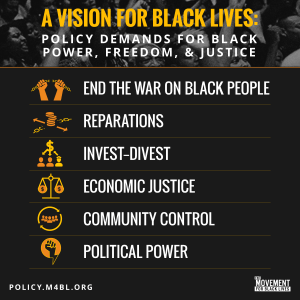
Second, MBL is calling for an Invest-Divest strategy, which says, We demand investments in the education, health and safety of Black people, instead of investments in the criminalizing, caging, and harming of Black people. We want investments in Black communities, determined by Black communities, and divestment from exploitative forces including prisons, fossil fuels, police, surveillance and exploitative corporations.
Third, they are calling for Economic Justice, where they say, We demand economic justice for all and a reconstruction of the economy to ensure Black communities have collective ownership, not merely access.
Each of these strategies and demands comes with lots of details on how the black community can get out of poverty, all of which can be found at this link https://policy.m4bl.org/.
The local news reported that there was a large audience for the kick-off of the 100 Ideas Start Garden Project. This is no surprise, given that 100 people will likely get $1,000 for just pitching a one-minute idea. However, such entrepreneurial ventures will only end up benefitting a small number of people, which will ignore thousands in poverty and perpetuate individualism, rather than promote how we can collectively fight poverty, income inequality and imagine other community-based forms of collective liberation.
From Organizing a Poor People’s Campaign to hosting a Corporate Breakfast: The Uses and Abuses of Dr. King’s Legacy
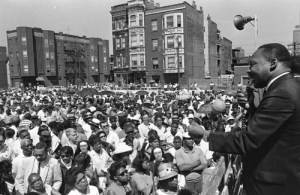 This year will mark the 50th anniversary of the assassination of Dr. Martin Luther King Jr. And this year, like most years since the federal government began to celebrate the Black Freedom Fighter’s birthday, Dr. King’s legacy will be miss used, appropriated and whitewashed by all sorts of entities and systems of oppression.
Federal, State and Local governments will misrepresent King’s legacy with calls for diversity and unity, when in fact Dr. King was so much more than that. If one looks at his evolution, from civil rights leaders to the black liberation struggle, it is clear that King had changed from the days of calling for integration to embracing a more prophetic role in calling out the violence and structural racism that was (and is) so woven into US society.
In his 1967 speech, Which Way Its Soul Shall Go, Dr. King didn’t mince words about racism in America, when he said:
“I am sorry to have to say that the vast majority of white Americans are racists, either consciously or unconsciously.”
Dr. King began to see in the years just before he was assassinated that racism wasn’t just a problem in the deep south. After 1965, when he moved his operations to the north and opened an office in Chicago, he began to deepen his critique of racism and white supremacy. Dr. King also began to expand on his use of tactics and strategies to challenge what he would refer to as the Evil Triplets of American society – Racism, Militarism and Capitalism.
During the 1966 Chicago urban campaign, Dr. King stated:
“We’ll use something that avoids violence, but becomes becomes militant and extreme enough to disrupt the flow of the city. I know it will be rough on them when they have to get 200 people off the Dan Ryan expressway, but the only thing I can tell them, which do you prefer, this or a riot.”
In 1967, in his Beyond Vietnam speech, Dr. King referred to the US as the, “greatest purveyor of violence in the world today.” King’s stance against the Vietnam war was even criticized in civil rights circles as being a divisive issue.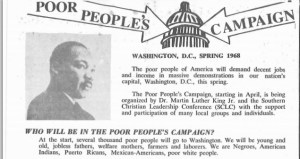
Besides racism and militarism, King began to also critically examine the economic system of capitalism. This was especially the case after 1965, where King became more strident in his denunciation of economic exploitation and began to demand massive reparations for black America, in what he called a “Bill of Rights for the Disadvantaged, our veterans of the long siege of denial.” This call for reparations is what motivated his involvement in the last campaign he organized, the Poor People’s Campaign.
The Poor People’s Campaign was not only based on the idea of massive reparations, but on King’s sharp critique of economic exploitation, which he named as capitalism. Here is what Dr. King had to say:

Considering all of what Dr. King had to say about racism, militarism and capitalism, it was rather disappointing to see that the Grand Rapids Urban League would be hosting their 18th Annual Dr. Martin Luther King Jr. Corporate Breakfast. 
How is it, that anyone could use the name of Dr. King and then add, Corporate Breakfast. How does one engage in this kind of cognitive dissonance? Do people really believe that Dr. King would want to be associated with corporations?
The main sponsors of the Corporate Breakfast that is meant to honor the man who challenged capitalism are, Steelcase, Spectrum Health/Priority Health, Chemical Bank, Mercantile Bank, Fifth Third Bank and Comerica Bank. Then there is the cost of the tables to purchase. A Platinum Sponsorship can get you a table of 30 for a mere $10,000, Gold Sponsorship will pay for 20 people with a price tag of $5,000, Silver Sponsorship $2,500, Bronze Sponsorship $1,250 and Angel Sponsorship $1,000.
I’m not sure how one gets from denouncing capitalism, calling for massive reparations and organizing a poor people’s campaign, to hosting a corporate breakfast.
 It is easy to present Democrats and Republicans as polar opposites, always waring with each other. However, the Blue State/Red State dichotomy is often an illusion framed around certain social issues.
When it comes to US foreign policy and the defense of capitalism, then we can easily see bipartisan consensus. For most of US history, especially once wars are started, it is rare to find members of Congress who take a stand against US militarism. This bipartisan consensus is often framed as “support for the troops,” but a closer look will demonstrate that both the Republicans and Democrats are deeply committed to US wars abroad, which leads to a consensus on the Defense budget, which leads to bringing money to states that have a stake in weapons contracts or domestic military bases.
This bipartisan consensus was on display just before the holidays, when Michigan Senators Gary Peters and Debbie Stabenow, along with the entire Michigan Congressional Delegation, was lobbying for Fort Custer Training Center to become a missile-defense site.
Fort Custer is located between Kalamazoo and Battle Creek, which would mean that as a missile defense site, it would be near two major metropolitan areas.
The Michigan Senators and the entire Congressional Delegation from Michigan submitted a letter to Lieutenant General Samuel A. Greaves, who is the director of the Missile Defense Agency, stating:
“North Korea poses an increasingly substantial threat to our homeland, culminating in the recent launch of a new intercontinental ballistic missile that flew higher and longer than previous launches,” wrote the Senators and Representatives. “Fort Custer benefits from excellent existing infrastructure, including efficient access to two major interstate highways and a nearby 10,000-foot runway. The fields at Fort Custer are shovel ready and it is our understanding the CIS can be constructed at the lowest cost with the least environmental impact.”

This bipartisan consensus demonstrates the commitment that Republicans and Democrats have to US militarism – because the US will not tolerate most countries having nuclear capability; and it demonstrates a bipartisan commitment to capitalism – in that more taxpayer funds will come to Michigan for this missile defense program, which translates into more money for private weapons contractors, along with capital that will be injected into the communities in and around Kalamazoo and Battle Creek.
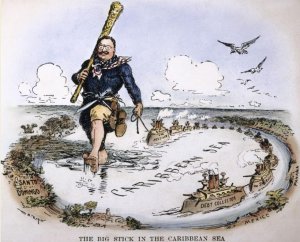 This 8-week class will investigate and analyze US foreign policy from what is normally referred to as the Spanish American War through the current policy under the Trump administration.
It is impossible to investigate more than a century of US foreign policy in 8 weeks. However, we will look at US Foreign Policy through various themes, such as chronological, geographical, the use of US soldiers, economic warfare, the use of proxy forces, weapons sales and diplomatic coercion. In addition, we will look at the human and ecological impact of US foreign policy.
There are no books assigned for this class, but we will use chapters from a variety of books, online sources that provide historical analysis, online sources that track certain aspects of US foreign policy, online sources that focus on specific regions or countries, declassified US government documents and current news & analysis of US foreign policy. In addition, we will use clips from various documentaries on US foreign policy and provide a bibliography for further investigation.
The GRIID class will be held on Monday nights beginning on Monday, January 29th and ending on Monday, March 19. The class runs two hours, from 6:30pm til 8:30pm. The GRIID class will be held at Plymouth United Church of Christ, located at 4010 Kalamazoo Ave SE, Grand Rapids, MI 49508.
The cost of the class is a suggested donation of $25 for the whole 8 weeks, but no one will be turned away because of the cost. For those interested in attending this class, send an e-mail to jsmith@griid.org.
With the Zapatistas on New Years Eve
 In honor of the 24th anniversary of the Ejercito Zapatista Liberacion Nacional (EZLN) uprising in Chiapas, Mexico.
The video below is from New Years Eve of 2000, when I was doing some accompaniment work in Chiapas, with the Zapatistas community in Oventic.
This footage demonstrates the power of direct action, showing indigenous communities converging on a Mexican military base with the intent of occupying that base until the soldiers agreed to leave……and they did!
The second part of the video is a short speech (more like a poem), that was given by Commandate David at midnight, during the EZLN annual celebration of their uprising, which began in 1994, the year that NAFTA was implemented.
This video is a clip from a longer documentary produced in 2006, entitled, Reversing the Missionary Position: Learning Solidarity on Mayan Time, which can be viewed at this link. I also wrote a book, which accompanies the documentary, entitled, Sembramos, Comemos, Sembramos: Learning Solidarity on Mayan Time, which is based on the solidarity work I have done in Central America and Mexico, along with my experiences working with refugees from Meso-America during the 1980s through 2006.
The Best of GRIID 2017: Exposing systems of power and reporting on movements of resistance
It is always difficult to try to limit the amount of stories you want to highlight in an end of the year summary of local news.
There have certainly been numerous stories that have developed in the past year, but in many ways these stories are symptomatic of larger, more systemic problems that certain sectors of the West Michigan community has to deal with all the time.
 While we can acknowledge that there is maybe a new awareness around deeply entrenched issues like White Supremacy with the Trump administration, these issues are not new.
One thing we try to do here at GRIID, is to expose the systems of power and oppression in West Michigan, while at the same time shed light on the grassroots resistance and social movements that are opposing these systems. So here are some of the main stories/issues we have written about in 2017.
AmplifyGR
While attending a housing meeting in late May, I was made aware of the group AmplifyGR. Within 10 minutes of hearing about this new non-profit, I was able to discover that it was a front group for the DeVos Family. Since the initial Part I and Part II stories, we were able to investigate some larger aspects of the AmplifyGR group, including the amount of money spent in purchasing the land in the southeast part of GR, along with how much money the DeVos Family Foundations have spent in the targeted neighborhood. We also have documented the push back from the community to AmplifyGR in both the June and July meetings.

Movimiento Cosecha GR
One of the amazing developments in the past year has been the creation of the local chapter of the national group known as Movimiento Cosecha. Cosecha GR came on the scene in February, with its first major action in February, drawing attention to US immigration policy, with over a thousand people marching in the streets.
Cosecha GR continued its organizing work with other marches and an action at the local ICE office where three people were arrested to expose the bankrupt immigration policies of this country.
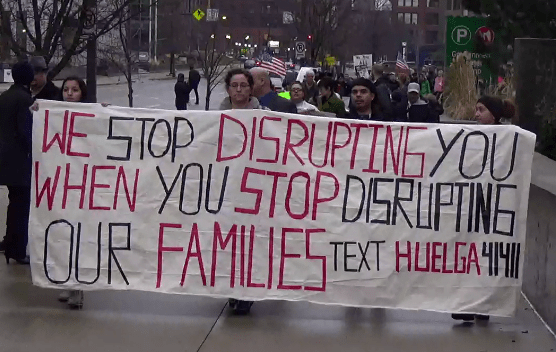
One focus of Cosecha GR has been to use boycotts to address systemic problems around immigration, by making it clear that without immigrants the US economy would come to a stop. The boycott campaign saw several thousand people marching and refusing to buy anything on May 1st, an action at Walmart that exposed the wages of migrant workers and the current Turkey Boycott Campaign.
White Supremacy in GR
White Supremacy in Grand Rapids may not seem so evident to people with racial privilege, but for communities of color – Native, Black, Latinix and other communities, White Supremacy is the norm.
Part of the problem is how we talk about White Supremacy, often limiting our understanding to just looking at hate groups like the KKK, without looking deeper at how White Supremacy functions in this community.
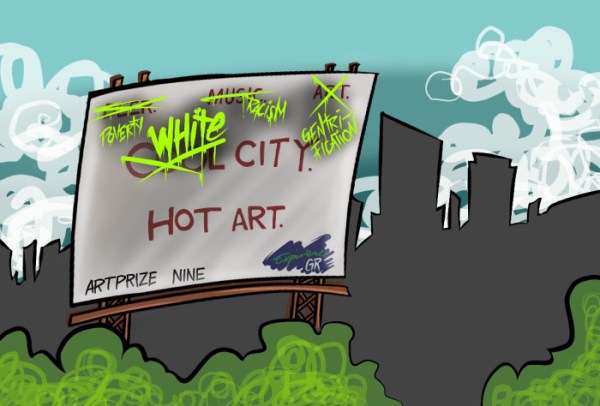
One can see White Supremacy as part of the current housing crisis and how Grand Rapids has become so gentrified in many neighborhoods.
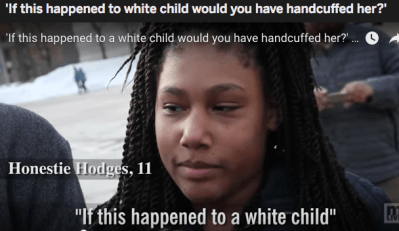 The other area where White Supremacy has been getting more and more attention is with the function and practice of the GRPD. There was the incident where the GRPD had stopped several young African American kids at gunpoint in April of 2017. In May, members of the Black community were calling for a State of Emergency, even though city officials were not taking them seriously. Just a few weeks ago, the GRPD once again demonstrated how they deal with communities of color, when they handcuffed at gunpoint an 11 year old black girl.
In addition, while we have been writing about ArtPrize since its beginning, we wrote a story this year making the point that what ArtPrize ultimately promotes is Whiteness.
Airport protests
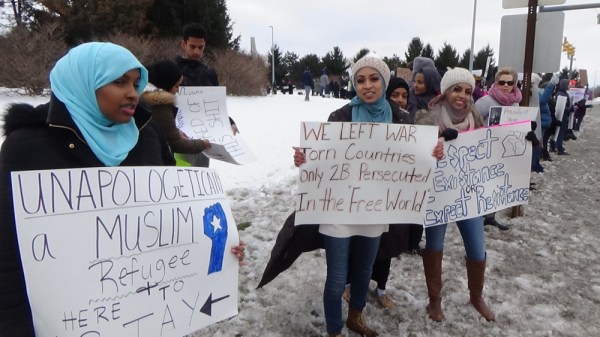
Earlier in the year, we saw millions of people participate in protests against the so-called Muslim ban, where the Trump administration was attempting to implement a travel ban for people from several Muslim dominated countries. People in Grand Rapids quickly organized similar protests at the Kent County Airport, with an initial action in late January, followed by another one in early February.
Betsy DeVos Watch and Resistance
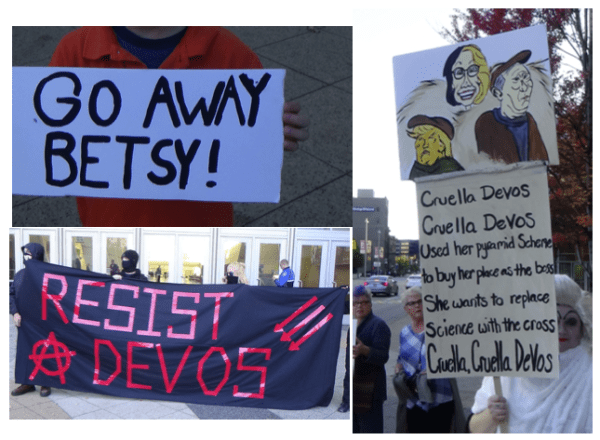
This year saw the appointment of Betsy DeVos as the Secretary of Education and because of that we created a new section on our blog, the Betsy DeVos Watch section. We regularly critique what policies the Secretary of Education has been promoting, along with documenting the number of actions against Betsy DeVos no matter what state she travels in.
The protests that have greeted Betsy DeVos have also happened in Grand Rapids, with at least three separate actions taking place when she has visited GRCC in August, the MSU ribbon cutting ceremony in September and her keynote address at the Acton Institute’s annual gathering in October.
ATU/Cosecha GR Solidarity
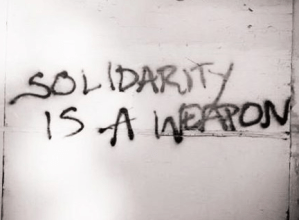 Another inspiring story from 2017, has been the ongoing relationship between members of the Grand Rapids Bus Driver’s Union (ATU) and Cosecha GR. This ongoing relationship has led to numerous solidarity actions, like the effort to collaborate on the campaign to support ATU workers during contract negotiations and an effort to change Grand Rapids city policy, which would prevent city workers from asking the immigration status of people.
While both campaigns were unsuccessful, it has been clear that the victory is in the mutual solidarity that has developed in the past year, which made clear the point that immigration issues are labor issues and labor issues are immigration issues.
The Most Powerful Family in West Michigan
Lastly, since we have been monitoring the activity of the various members of the DeVos Family, we finally decided it was important to put together a collection of articles and archives covering several decades that investigates the power and influence of the DeVos Family. This collection looks at some of the history of the family, their role in West Michigan politics, the various family foundations, how the DeVos Family uses their wealth to influence elections and legislation, local news coverage of the family, ArtPrize and articles on Betsy DeVos since she became the Secretary of Education. You can download the 350-page DeVos Family Reader by going to this link.

