Protestors confront Betsy DeVos during her visit to GRCC
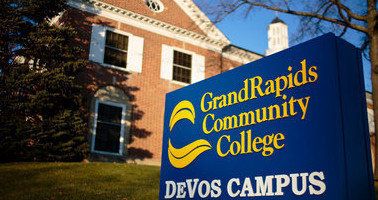 Yesterday, about 40 people showed up to the Grand Rapids Community College to confront Secretary of Education Betsy DeVos as she toured a few buildings on campus.
The DeVos family has contributed significantly to GRCC over the years, which resulted in the former Davenport College on Fulton St. being named the DeVos Campus.
MLive had reported less than 24 hours ago that DeVos would be making a stop in Grand Rapids, thus making it difficult for people to turn out on short notice. 
DeVos was in Grand Rapids earlier that morning and visited with students at the Van Andel Education Institute, which is not a public education facility. It was a strategic move on the part of the Education Secretary to not announce her visit to the Van Andel Education Institute.
People involved in organizing today’s action began meeting near the GRCC campus at 12:30 and were under surveillance by the GRCC campus security and the GRPD, which had officers in cars all over the campus.
Once it was determined which building Betsy DeVos would be entering, those protesting lined up along Ransom Street in front of the GRCC campus. You can see people in the pictures that were there to confront DeVos and you can see law enforcement people waiting inside the parking ramp.
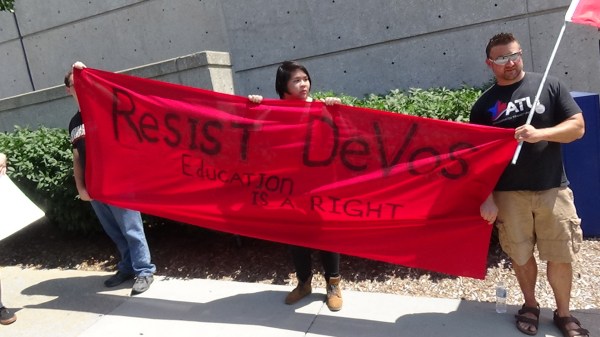

DeVos showed up in a white SUV with tinted windows, followed by another vehicle, also with tinted windows, before anyone realized it was her.
However, those who organized the protest were undeterred and went up to the campus and inside the building hoping to confront the Secretary of Education while touring the building. People were met by campus security who told them they would be arrested if they moved beyond a certain point, as you can see in the video here.

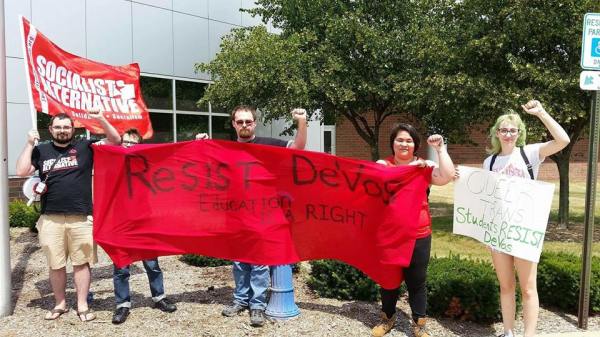
People with the group Socialist Alternative, then decided to go to the Godfrey St. campus of GRCC, since DeVos was headed there next. The group held the same large banner and was told by the GRPD that they could be on the property before DeVos’ vehicle showed up.
However, when the vehicle transporting Betsy DeVos showed up, people tried to block the entrance to the campus. The cops threatened to arrest them and those protesting did move, but not fast enough for the cops, since one of the people attempted to block the entrance was pushed and shoved.
Alex Kelley contributed to this article.
Johnson Center report on philanthropy fails to challenge the dominant narrative about wealth
 The Johnson Center at GVSU, recently came out with a report on philanthropic giving in two communities. The report, Understanding Philanthropic Character of Communities, looks at philanthropic giving in Kalamazoo and Grand Rapids.
The report is rather academic and vague. More importantly, the report reflects the dominant narrative about foundations and philanthropy, which is to say they celebrate philanthropic giving without any critical analysis of what foundations represent.
My take on the role and functions of philanthropy are informed in part by several books which challenge the dominant narrative: The Revolution Will Not Be Funded: Beyond the Non-Profit Industrial Complex, by INCITE; Foundations and Public Policy: The Mask of Pluralism, by Joan Roelofs; and Under the Mask of Philanthropy, by Michael Barker. In addition, my own experience working within the non-profit industrial complex has informed me on how foundation funding impacts whats happens and what doesn’t happen in this community.
Philanthropy in GR: What Does Happen
According to the report by the Johnson Center, the bulk of the philanthropy in Kent County (for 2012) came from private foundations, not community foundations, as in seen in the graphic below.
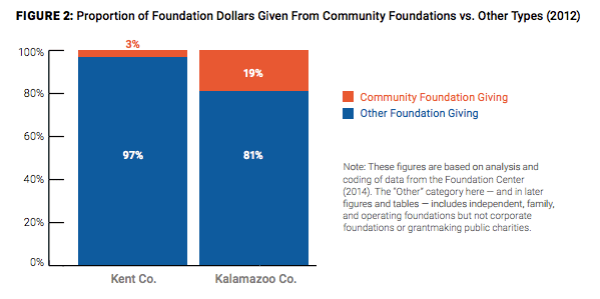
The private foundations cited in the report are listed here on the right.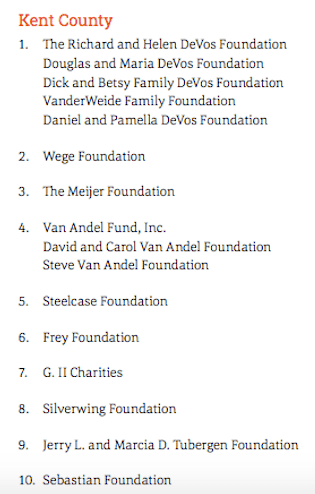
Most of these foundations, dominated by the DeVos family, are also part of the West MI Power structure. These families, besides having foundations, have tremendous economic and political power in the area and are known to influence local and state policy through their political contributions. Their political contributions are not factored into the Johnson Center report, which makes the report incomplete, since you cannot ignore the political contributions.
First, in the case of the DeVos family, their political contributions are much larger than the philanthropic dollars they give out on an annual basis.
Second, a great deal of money contributed by the DeVos family, and to a lesser degree other foundations on the list, provide significant amounts of funding to groups that promote policy that dismantles various forms of social welfare, such as public funding for schools, pensions and services which the state previously provided. Therefore, when foundations give money to non-profits, this money then seeks to fill a gap that they created through their influence in the policy arena. For instance, since public education spending has been reduced in Michigan for more than two decades or diverted to charter schools, the DeVos family can contribute significantly to private education programs like Potter’s House or Believe 2 Become, which is a way to introduce faith-based/entrepreneurial education into the Grand Rapids Public Schools. The result is that foundations, like the various DeVos foundations are often seen as very generous with the money, when in fact they use their wealth to create a social crisis and then fill the void with funding that they can control the outcomes with.
At the end of the Johnson Center report there are three areas of investigation on philanthropic giving: art, downtown development and education. We have already addressed the educational component to some degree, so lets look at arts and downtown development.
In regards to Kent County, the only philanthropy discussed in the Johnson Center Report is ArtPrize. The report states:
For all the controversy ArtPrize has engendered — whether over the quality of art selected through public voting, the “popularity contest” aspect of the public awards, the political activities of the DeVos family, or the rejection of specific works of art — ArtPrize is an undeniable success.
Calling it a success is not a very objective term, since the report never provides any clarity on how ArtPrize as been an undeniable success. Do they mean for the public, for the downtown businesses or the artists?
The other area the report looks at is on downtown development. You can see from this graphic here, how much foundation money and how much public money was put into various projects. It is important to note that these are projects initiated by Grand Action, which was created by Dick DeVos and other members of the local power structure, as a means to generate more revenue for their downtown assets – hotels, bars, restaurants and private parking lots.

Challenging the dominant narrative about foundations and philanthropic contributions
As was mentioned earlier, a critical view of foundations and philanthropic contributions is important, especially if we want to challenge the dominant narratives of class privilege.
There are five major critiques to this dominant narrative:
- Foundations are a way of creating tax havens for those with high levels of wealth and only a small percentage of the money in foundations actually is spent.
- Foundations are great PR for the capitalist class. Foundation giving distracts the public by getting us to praise those with wealth for their generosity, instead of critically examining how those who have foundations “made” their wealth.
- Foundations also engage in forms of population management. Charitable contributions are often a way to put the attention on those who are experiencing poverty, instead of those who created poverty and social inequality. Plus there is the added benefit of making people feel ashamed of being the recipient of charity, instead of realizing their collective potential to organize as a social movement.
- Foundations have directly influenced the culture of non-profits in three important ways. First, there are always conditions, limitations and pre-determined outcomes for foundation giving. Second, foundation giving almost always makes it so that you cannot participate in work that seeks to transform society or to get at the root of systemic problems. Third, non-profits most often follow a corporate model that is both hierarchical and with boards of directors, which are often times made up of people who are in positions of power.
- Lastly, foundation giving limits our ability to be imaginative about how to collectively work for change.
A few weeks back a local DJ with 95.7FM, posted a piece entitled, 10 Reasons NOT to Move to Grand Rapids. 
The posting got lots of attention and was the latest in a series of “lists” that Grand Rapids loves to boast about. Of course, the post from Jojo Girard was really a list of the 10 reasons why people should want to move to Grand Rapids. The post had the usual cool city reasons, like beer, art, entertainment, great neighborhoods and the ever popular number one reason…….The People Seem to Be Happy All the Time.
Now, I realize that 95.7FM, like all commercial media, relies heavily on advertising dollars. Therefore, local radio stations certainly don’t want to spend much time talking about difficult issues in Grand Rapids, issues like racism, poverty, gentrification, the local power structure and spiritual violence. Advertisers like what the refer to as, a good consuming climate. Happy and superficial chatter on local media creates a fabulous consuming climate and it doesn’t alienate the business community.
In an attempt to respond to the superficiality of the 95.7FM post, I present the 5 Reasons why the 10 Reasons NOT to Move to Grand Rapids list is really Bullshit.
#1 – The 10 reasons list is Bullshit, because white people just don’t have to confront the ugly realities that communities of color do on a daily basis in Grand Rapids. White people can avoid having to deal with the structural racism that exists. White people don’t have to worry about being pulled over by cops the way black people do. White people don’t have to think about the fact that there are large sectors of the Grand Rapids community that live in constant fear of law enforcement agencies because of their status as immigrants. White People can go to the events in downtown, frequent a brewery or go to a Griffin’s hockey game because these places and events are almost always designed to cater to the needs of white people. Whether it is music, art, theater, sporting events or public spectacles like ArtPrize, white people don’t have to worry about not enjoying themselves, because all of the events are primarily for their benefit. This might be a reason why they seem so happy all the time.
#2 – Grand Rapids has the biggest wealth gap in the state of Michigan. There are over 600 millionaires in Kent County, yet there are thousands of people who live in poverty. Those who find the 10 reasons NOT to move to GR list so appealing is because they don’t have to think about all those individuals and families who are living in poverty. And even if they do think of those who live in poverty, they often believe that it is simply because of a lack of opportunity, that those who live in poverty simply aren’t applying themselves enough or because it is God’s will. The people who feel blessed to live in Grand Rapids don’t have to deal with those who live in poverty, at least not on a regular basis. All the new coffee shops, market-rate housing, clothing boutiques and entrepreneurs, indeed make Grand Rapids feel as if everyone is so happy all the time.
#3 – A fairly recent study states that in Michigan, you need to make $15.16 to afford rent. The 10 Reasons NOT to Move to Grand Rapids boasts that the choice of great neighborhoods to live in is too long. One of the neighborhoods they mention is the Belknap neighborhood, which has seen lots of new development in the past year. Of course, this new development has meant that numerous low-income residents have been displaced to make room for GVSU expansion and $300,000 condos. This gentrification and displacement is happening in numerous parts of the city, with developers receiving huge tax breaks at the public’s expense. To not acknowledge that there is a major housing crisis in the City of Grand Rapids only demonstrates race and class privilege.
#4 – A real reason to not move to Grand Rapids is because the people who run this city are vicious and narcissistic. We all know who these people are, since they have their names adorning buildings all over the place. The people who run this city, also use their wealth to influence policy at the state and local level to make sure that it will benefit their interests. The types of policy they push through often hurt working class people. Then these same people use their foundations to donate money to social service agencies to demonstrate how benevolent they are. The people who run this city also despise equality of any kind – racial, economic or LGBTQ equality. These people impose their will and their values on the rest of the community and then expect us all to bow down and treat them as great leaders and philanthropists.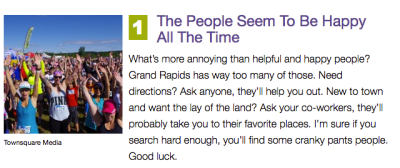
#5 – The 10 reasons NOT to move to GR list includes all the great Mexican restaurants to chose from. This statement is in many ways a reflection of cultural appropriation. People love Mexican food, but couldn’t give a damn about Mexican people, especially the ones who work in kitchens or pick the food we eat for really shitty wages. This is so very much Grand Rapids, where we think we are so diverse, yet we do whatever we can to make sure that everyone who isn’t white, doesn’t have any power. Sure, there are a few Latino individuals who the power structure allows to make it, but most Latinos or people who are not white will never really be valued and treated with respect in this city, as long as we continue to practice managerial racism.
There are so many other reasons why this list of 10 reasons to move to Grand Rapids are bullshit? If you have some additional reasons you’d like to share, we’d love to hear them.
There were two things that were incredible about tonight’s community meeting hosted by AmplifyGR.
First, almost everyone of the the people who spoke during the roughly 80-minute public comment time, were critical of what AmplifyGR was doing, skeptical of the process or outright opposed to what AmplifyGR has in mind to do.
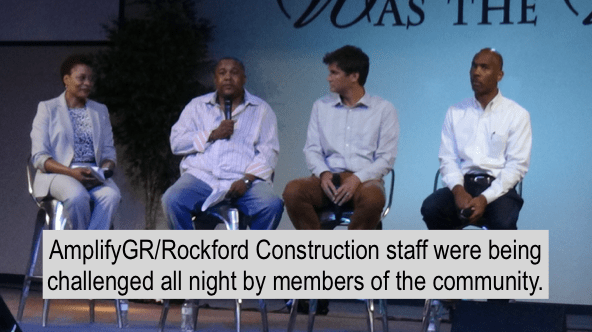
From the very get go, people were not mincing words about what they felt about AmplifyGR, Rockford Construction and the DeVos family. Community Activist LaDonna Norman told the AmplifyGR people sitting up front, “stop making our community look stupid.” Norman was referring to what AmplifyGR was doing and acting like they had nothing but good intentions. LaDonna then went on to name what was happening and that the whole thing was essentially, “DeVos owned. Everyone involved is bought and paid for by the DeVos Family.”
The facilitator then asked the audience how many people agreed with this sentiment. Lots of people clapped or shouted out. When the facilitator asked how many people did not share Norman’s perspective, there were only a few who spoke up. However, what was interesting is that the facilitator then said, that the response was evenly split. This kind of denial or attempt to control the narrative was thick throughout the night.
Another African American woman says she is currently homeless. She used to pay $500 a month for a 3 bedroom place to rent. Now she can’t find the same thing for less than $1,000 and actually is is 3 times the cost for what she used to find. She wants to stay in this community, in this neighborhood. She asks AmplifyGR if they are going to have real affordable housing that does not have all these restrictions.
Then there was a question about supporting existing black owned businesses in the neighborhood and how people did not want to see another Starbucks come in. AmplifyGR’s response was to focus on providing entrepreneurial support through Start Garden, which is yet another DeVos run entity.
Tempest Warfield, an afro-Latina, just made it plain when she given the chance to speak. She spoke passionately and called out who is running this process. She said that a lot of what this boils down to is race and class. “People want to just stay in their homes, but people are feeling bullied by the wealthiest family in the area. People want to keep their homes and leave a legacy for their kids. We do have purpose here, even if it doesn’t look like it to the DeVos family.” John Ippel, from AmplifyGR, responded by saying he gets it. Tempest came right back and said, “be careful about practicing white savior politics.”
Other people were asking about AmplifyGR’s commitment to elevating civil rights or asking would the new development cause zoning changes or property taxes to rise. The AmplifyGR folks didn’t directly answer those concerns, but the community made sure they answered, after several people shouted, “you didn’t answer the question.”
Allison Colberg, with the Micah Center, said there is a huge fundamental problem with the story that is being told. AmplifyGR is framing thing whole effort as “the AmplifyGR area,” when in fact it is not there area. Alllison provides a sharp analysis of what is going on through a White Supremacy lens – that the making of policy and other forms of systemic racism took wealth from black people. “The community should be in charge. We broke and it is based on a history. So put some duct tape on it and just listen.”
There were several other critical and challenging comments made by people throughout the rest of the evening, some from using the microphone, while others just shouted it out from their seats. Then Ken Miguel-Cipriano made an interesting statement that was also in the form of a question. He asked if the majority of people in the community were opposed to what AmplifyGR wanted to do, would they honor that is close up shop? Ken then said, “how about if 70% of the people opposed it?”
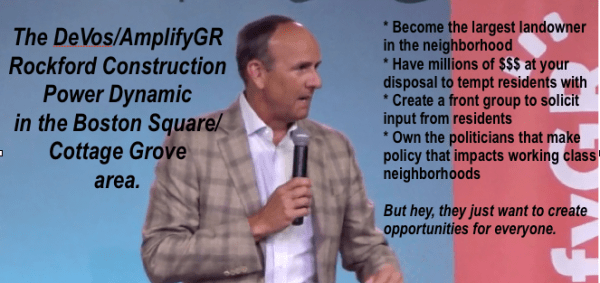
This brings us to the second incredible thing that was said during the meeting. The Executive Director of AmplifyGR, John Ippel responded by saying, “even if 70% of the community opposed this, we would just have to get back up and move forward and do it better.” You could heard several people in the audience gasp in horror and the level of arrogance they heard coming from the AmplifyGR person.
This sentiment from AmplifyGR, was affirmed at the end, when the facilitator ask the three men seated on stage what their take-aways were from tonight. Each of them responded by saying that they were looking forward to more community engagement and working with neighbors. It is as if they didn’t care that there was significant opposition at this second community forum.
Afterwards, there were lots of small conversations taking place and the ones this writer overheard reflected both the level of community opposition to the AmplifyGR project, as well as being shocked by the level of arrogance displayed.
This is far from being a done deal. The next meeting is September 7. We’ll keep you posted.
City of Grand Rapids hires PR firm with a long history of involvement with GOP politics
 Yesterday, in an article on MLive, it was announced that the City of Grand Rapids has hired the PR firm of Truscott Rossman to assist them with developing a better communications strategy.
The City will spend $60,000 of taxpayer money for a 1-year contract with the largest PR firm in the state, Truscott Rossman. One of the reasons for bringing in the PR firm, according to the Mayor, was to help them develop a more comprehensive communications plan.
The MLive article gives an additional reason for bringing in Truscott Rossman:
“The city still has a $5,000 outstanding bill with Truscott Rossman from April, when the city hired them for emergency communications assistance. Guitar, the city’s spokesman, was on vacation when a video was released of police stopping five unarmed black youths at gunpoint as they were investigating the report of a gun, Guitar said.
The video and incident garnered national attention, and the city reached out to the public relations firm for help.”
In the PR world, this is a way of saying the PR firm was brought in to do damage control, especially since the video was a political embarrassment to the city.
The PR firm was started by John Truscott in 2001. Before that, Truscott was the Communications Director and Press Secretary for Governor John Engler. After the John Truscott Group was formed, they began working closely with numerous GOP campaigns in Michigan, most notably former Rep. Pete Hoekstra and the failed gubernatorial campaign of Dick DeVos in 2006.
The Truscott Group continued to be involved in various political campaigns. John Truscott was George W. Bush’s spokesperson in Michigan during the 2000 election and he was also part of the recount team in Florida. In addition, Truscott is the former chair of the Lansing Regional Chamber of Commerce.
In 2011, the John Truscott Group and Kelly Rossman-McKinney were the number 1 & 2 PR firms in the state. The decision was made that same year to create one powerhouse PR firm, now known as Truscott Rossman. Truscott Rossman now claims to be a bi-partisan PR firm, since Rossman used to work closely with Democrats. However, in 2013, the political consulting resource, Campaigns & Elections, named Truscott a top Republican Party influencer in Michigan.
One of the services that the PR firm offers is their annual Michigan Legislators’ Guide to Lobbyists and Reporters. The Truscott Rossman Guide is highly valued by politicians, reporters and lobbyists alike.
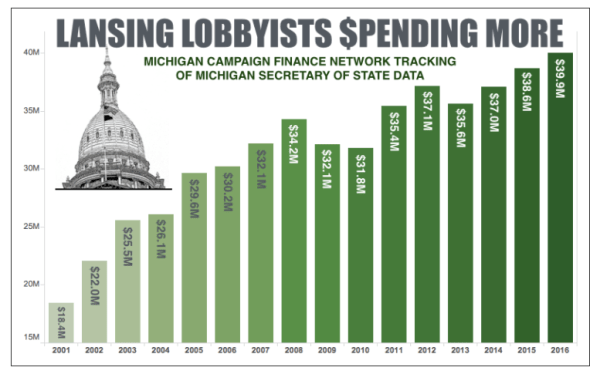
The Lobbying Guide has definitely had an impact. The Michigan Campaign Finance Network reported that it was a record year for lobbyist spending in Michigan for 2016, with $39.9 million being spent by corporations and other associations working to influence state legislators.
People would do well to be skeptical of the City’s contract with Truscott Rossman. One important book the takes a critical look at the PR industry is, Toxic Sludge is Good For You: Lies, Damn Lies and the Public Relations Industry. The authors of this book assert, that the PR industry “poisons the American democratic process by the nation’s professional spin doctors and exposes the bare-knuckled, invisible hand guiding and shaping public opinions.”
Edward Bernays, seen as the Grandfather of PR, was fond of saying this:
“The conscious and intelligent manipulation of the organized habits and opinions of the masses is an important element in democratic society. Those who manipulate this unseen mechanism of society constitute an invisible government which is the true ruling power of our country.”
We all should be wary of any part of the Public Relations industry, particularly one with a long history of working on behalf of some of the most powerful people in Michigan.
MI Senator Gary Peters is one of the co-sponsors of the bi-partisan bill to criminalize the BDS movement in the US
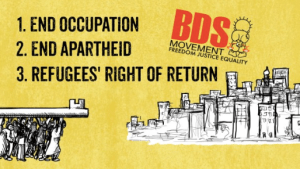 Since 2005, the Palestinian-led Boycott, Divestment & Sanctions (BDS) movement has been growing and making significant progress in the effort to end the Israeli occupation.
The BDS movement, which is modeled on the South African Anti-Apartheid movement, has been under attack since it began. However, there have been an increase in the number of tactics that governments are using to suppress this movement, particularly governments that support the Israeli occupation.
The British government has attacked the BDS movement and now the US government wants to criminalize the movement.
According to a recent article by investigative journalist Glenn Greenwald:
“a group of 43 senators — 29 Republicans and 14 Democrats — wants to implement a law that would make it a felony for Americans to support the international boycott against Israel, which was launched in protest of that country’s decades-old occupation of Palestine. The two primary sponsors of the bill are Democrat Ben Cardin of Maryland and Republican Rob Portman of Ohio. Perhaps the most shocking aspect is the punishment: Anyone guilty of violating the prohibitions will face a minimum civil penalty of $250,000 and a maximum criminal penalty of $1 million and 20 years in prison.”
The Israel Anti-Boycott Act (S. 720) was introduced a few months ago and was drafted with input from the American Israel Public Affairs Committee (AIPAC).
The ACLU last week sent a letter to the Senators who co-sponsored this legislation stating, “We urge you to refrain from co-sponsoring the legislation because it would punish individuals for no reason other than their political beliefs.” 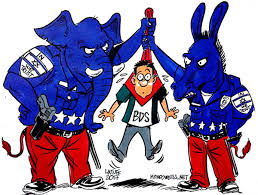
One of the Senators that the ACLU sent the letter to was Michigan Senator Gary Peters. This comes as no surprise considering that Senator Peters is following the same level of allegiance that his predecessor, Senator Carl Levin, had towards Israel. Senator Peters has been a top 20 recipient of Israeli Lobby money since taking over for Senator Levin.
The House version of the bill, H.R. 167, has nine cosponsors from Michigan alone, including Rep. Bill Huizenga from Holland.
This piece of legislation represents the most recent example of the complete, bipartisan support of Israel and the demonization of any challenge to that support.
 Yesterday, the City of Grand Rapids, along with other elected officials, hosted an event to show off some of the newest buses that are powered from natural gas.
The event to celebrate the new natural gas powered buses was held at the 6th Street Bridge Park and was meant to highlight the so-called sustainable efforts of the ITP bus system. Local elected officials spoke and ice cream was served.
However, there was one thing that the elected officials and those in attendance didn’t anticipate. They didn’t anticipate that members of the local ATU bus driver’s union would be there to disrupt their celebration.
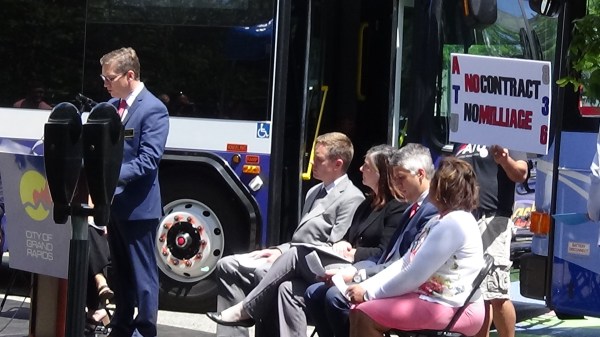
When a fourth elected official began speaking, several people with a banner walk in front of him, standing between the podium and the crowd. Using a bullhorn they made statements, which you can see in the video below.
The rest of the formal ITP event was cut short, since it was clear that the bus driver’s union and their supporters were not going to let up on disrupting the event.
Afterwards, we interviewed several members of the Grand Rapids chapter of the Amalgamated Transit Union, sharing their thoughts on the failure of The Rapid board to sign a contract and how this was impacting union members.
J20 Week of Solidarity: Trump Inauguration Resisters, including 3 from Grand Rapids, could face 75-year prison sentences
 Many people are familiar with the large march that took place in Washington, DC on the weekend of President Trump’s inauguration. Hundreds of people from Grand Rapids made that trek to collectively protest the 45th president.
There was also a protest on the day of the actual inauguration, January 20th, where over 200 people were arrested for attempting to disrupt the swearing in of Donald Trump. What people are less familiar with is the fact that most of those arrested during the January 20th protest are now facing up to 75 years in prison……..for protesting.
The online resource Defend J20 Resistance, provides some useful information on how such repression can happen:
The prosecution’s case rests on a broad interpretation of the Federal Riot Statute, which could make a participant in a political rally guilty for any property damage that takes place during that time. A superceding indictment added additional charges of urging to riot, conspiracy to riot, individualized property damage, and for over half the group, assaulting an officer or resisting arrest. These additional charges were given with no new group evidence or individual particulars.
The DC Attorney’s Office is trying to set a repressive precedent for political expression under the administration of Donald Trump with Attorney General Jeff Sessions. It is incumbent upon anyone who values dissent to stand in solidarity with the defendents in this case. This case in many way ressembles the 800 water protectors in the midst of Grand Jury processes in North Dakota, and other individual resisters arrested throughout the country.

Week of Solidarity
Those who were arrested, their supporters and hundreds of grassroots organizations are calling for July 20 – 27 as a week of solidarity. People are encouraged to investigate what type of state-sponsored repression we all could face, by reading some of the following articles:
Tilted Scales: The Criminal Legal System for Radicals
Repress This!: Way to Be Your Own Anti-Repression Committee
The Other Side of COIN: Counter-Insurgency and Community Policing
Join the Resistance: Ideas for Fighting Trump and Becoming Ungovernable
In addition, people are encouraged to distribute and use some of the following posters for wheatpasting:
‘Week of Action‘ Posters
‘Solidarity With J-20 Arrestees‘ Poster
‘Uncompromising Solidarity with Rebels Facing Repression‘ Poster
In addition, people could organize their own events to raise funds for those facing state repression from the January 20 action in DC. There are also lots of places that people can send money right now to support those facing up to 75 years in prison. Just click on this link, but a great way to show solidarity would be to support the folks from Grand Rapids who were arrested at the J20 protests. Just go to the West Michigan J20 Support Fund.
Lastly, check out this great video from sub media at the link below, which provides excellent analysis and context for responding to state repression.
 Last Thursday, US Secretary of Education Betsy DeVos spoke at American Legislative Exchange Council’s (ALEC) annual meeting in Denver. MLive, like many other media sources chose to focus on how DeVos responded to those who were protesting the ALEC conference, with the MLive headline reading as, DeVos calls out protesters as ‘defenders of status quo’ at conservative political conference.
The MLive article primarily cites DeVos, but does give a few sentences to State Superintendent from Michigan. There is no one who was part of the protests who were quoted in the article, despite the fact that they were the subject of the headline.
You can watch the entire speech to the American Legislative Exchange Council, a video that was taken by a TV station in Denver.
The MLive reporter did not verify any of the claims made by Secretary DeVos or provide any information about the mission and work of the American Legislative Exchange Council.
ALEC is one of the largest corporate lobbying forces in the US, representing the interests of hundreds of companies, many of which are Fortune 500 companies. ALEC lobbies at the federal and state level to push for policies that will be beneficial to its members. 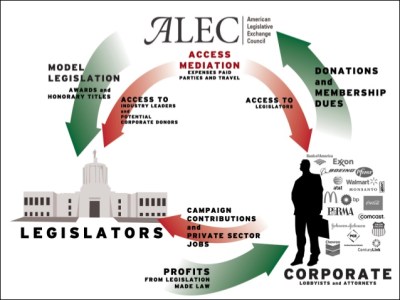
ALEC also consists of numerous think tank and non-profit organizations, like the Mackinac Center for Public Policy.
The group that has done more to expose ALEC in recent years is the Center for Media & Democracy (CMD), a group which hosts the important resource known as SourceWatch. The CMD’s data-base on ALEC is extensive and is updated on a regular basis.
One of more intriguing things that DeVos said in her speech, was to give praise to ALEC for the work they do, particularly at the state level.
“You have led the way in helping states across the nation craft innovative solutions to today’s problems: in healthcare, taxes, regulations, entitlements, and importantly, education.”
This statement by DeVos is true, but the MLive reporter doesn’t bother to verify it or provide examples of what the Secretary of Education means by help states craft solutions, which is code for crafting policy.
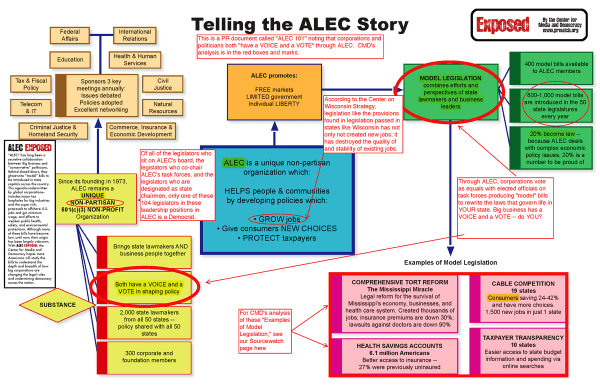
A recent example in Michigan where ALEC-connected organization collaborated to get policy adopted into law, was the attack on teacher pensions. This would be easy to verify, since ALEC has branches in all 50 states and separate websites for those states, such as the Michigan site, which has as its most recent posting a piece praising the attack on teacher pensions.
Another important aspect of the Michigan attack on teacher pensions, was the fact that one of the major groups lobbying for the new law on teacher pensions is the West Michigan Policy Forum. The West Michigan Policy Forum, which includes several members of the DeVos Family, is made up of members from the West MI power structure that also has provided substantial political contributions to the Michigan legislators that pushed the new teacher pension laws.
A recent Facebook post by the West Michigan Policy Forum underscores the excitement they feel over getting the policy they paid for.
The West Michigan Policy Forum (WMPF) sent out a statewide letter today applauding Governor Rick Snyder and lawmakers for their success in making critical changes needed to address the drastically underfunded teacher pension fund. The letter followed the Governor’s signing SB 401 into law today.
The law will:
–Place all new school staff hired after Feb. 1, 2018, into a 401 (k)-style retirement savings account – empowering new teachers by giving portability to their benefits and ensuring their retirement is pre-funded;
–Offer a newly designed hybrid plan for teachers who prefer this alternative;
–Help stabilize $29 billion in previously unfunded retirement promises, which has been draining money away from classroom funding;
–Limit risk and increases stability for school districts and kids in the future.
“The state’s lawmakers collaborated on addressing Michigan’s unfunded liabilities in a way that reduces tax payers’ risks well into the future,” says John Kennedy, chairman, West Michigan Policy Forum. “This allows school districts to keep recruiting great teachers and ensure that the state keeps its promises to current teachers and retirees.”
The WMPF letter says the innovative leadership that the team of elected officials displayed shows a true commitment to a long-term vision for our state.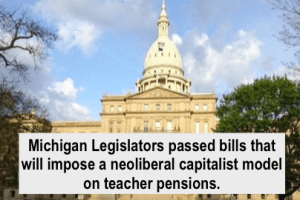
In the letter sent to more than 1,500 business and community leaders throughout Michigan, the WMPF specifically called out the leadership of Senator Phil Pavlov R- St. Clair; Representative Thomas Albert, R-Lowell, Senate Majority Leader Arlan Meekhof, R-West Olive, and Speaker of the House Tom Leonard, R-DeWitt.
Reforming Michigan’s unfunded liabilities will continue to be a top priority for WMPF as other public pensions and retiree healthcare benefits will be addressed. During the 2016 WMPF bi-annual conference, a report and full review of the dangers of unfunded retirement promises and the looming problems in MI’s local governments were presented.
Kennedy says WMPF members believe Michigan will be a model for the nation as it continues the hard work of addressing these crucial issues. He says, “By enacting these changes into law, Michigan legislators have offered more certainty today that Michigan will remain a good place to create jobs and raise their families.”
The MLive article completed missed the boat on being able to connect the Betsy DeVos speech at the ALEC conference in Denver last week, to how ALEC works at the state level, to how other members of the DeVos Family play a role in helping to craft state policy.
AmplifyGR to host second community meeting on July 27
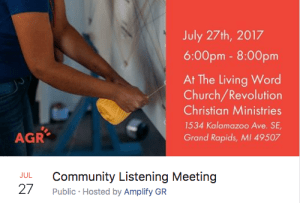 The DeVos-funded, Rockford Construction partnered group, AmplifyGR, announced yesterday that they will be hosting a second “community listening meeting” on Thursday, July 27 at the same location as the first meeting. The doors open at 5:30pm, with the meeting beginning at 6pm,
We reported on the first meeting, a meeting that received a fair amount of push-back from the community. We were all told at that meeting that they would find a larger venue to host the second meeting and that they would be adding new information to the AmplifyGR site. Instead, the meeting is being held at the same location and the only thing that AmplifyGR has added to their website was the maps of the two locations in which they are targeting.

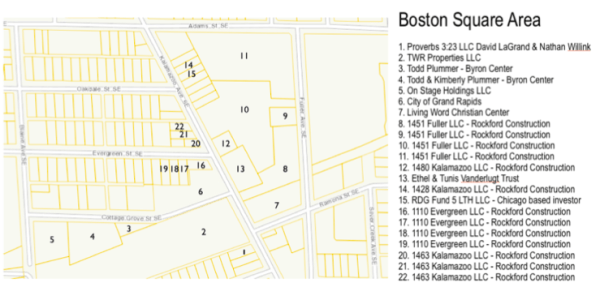
These maps, unfortunately do not provide very clear details on the actual properties that have been purchased by Rockford Construction, unlike the maps we have provided in pervious postings (shown below) and the MLive article, which provides pictures of the properties they have purchased.
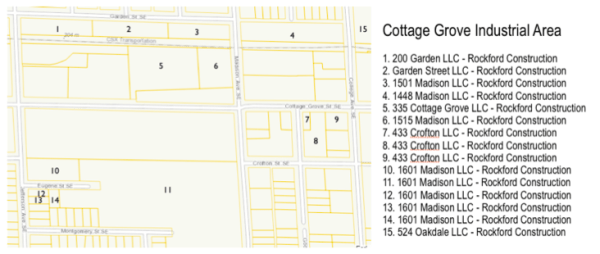
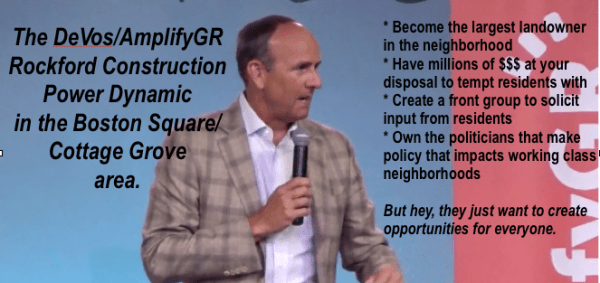
Since the first meeting, we have also written two additional articles based on comments that Doug DeVos made at the first meeting. The first article was a response to the notion that what AmplifyGR wants to do is to provide opportunities to people in the Boston Square area. We challenge that notion by making the point that since DeVos has so much political and economic power, it makes it extremely difficult for people to be treated as equals at the table.
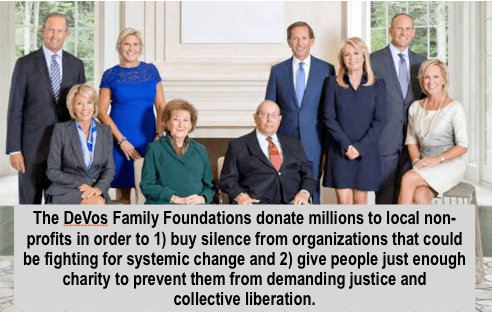
The second article was a response to the claim that DeVos gave when he said that they have already invested a great deal into the southeast part of Grand Rapids, where AmplifyGR is operating. Upon investigating that claim we discovered that there were numerous non-profits that have received financial support from one of the many DeVos family foundations. We ask those groups if they had a position on AmpligyGR’s plans and what kind of influence the DeVos family had in the work they do, since they have received funding from them.
 Grand Rapids Institute for Information Democracy