Statement from Commissioner Talen affirms his complicity in ICE violence and his unwillingness to take action to End the Contract
 On Tuesday, Kent County Commission Jim Talen issued a statement on why he will not support the call from Movimiento Cosecha GR and GR Rapid Response to ICE for the County of Kent to End their contract with Immigration and Customs Enforcement (ICE).
This statement not only further demonstrates Commissioner Talen’s unwillingness to do something that comes from the affected community (immigrant community), it makes it clear that he will not take action as an elected member of the county commission to concretely reduce the harm being done to the immigrant community through the actions of ICE and local law enforcement agencies that cooperate with ICE.
In the second paragraph of the statement, Commissioner Talen admits that there is harm being done to immigrant families, but lays the blame solely at the feet of federal and state government. It is true that the bulk of the violence done by ICE against the immigrant community is because of federal policy, however, ICE would have a much more difficult time terrorizing the immigrant community if they did not have the cooperation of private corporations (who makes money providing specific services for ICE) or local governments that have contracts/agreements with ICE to either provide jail beds for those detained by ICE or the cooperation of local law enforcement agencies. The Kent County government has a contract through the Sheriff’s Department to provide beds at the Kent County Jail for those ICE choses to put a hold on, plus the Kent County Sheriff’s Department has made it clear that they will cooperate fully with Immigration and Customs Enforcement.
In March of this year, Kent County Sheriff Larry Stelma, signed onto a letter crafted by the National Sheriff’s Association, which makes it clear that this association embraces the same anti-immigrant position as the Trump administration. Here is just a sample of that letter and the hyper-nationalistic language it contains:
Congress must act to pass legislation to secure our borders through enforcing immigration laws, tightening border security, support the replacement and upgrades to current barriers and fencing and construction of barriers along the U.S. and Mexico international boundary as requested by those areas where it is needed, suspending and/or monitoring the issuance of visas to any place where adequate vetting cannot occur, end criminal cooperation and shelter in cities, counties, and states, and have zero tolerance and increased repercussions for criminal aliens.
Commissioner Talen then goes on in his statement to say that what the End the Contract campaign is proposing should be, “vetted by people who have expertise in all the potential implications.” What Commissioner Talen is saying is that the affected community, the immigrant community being targeted by ICE, does not have enough expertise in understanding their own oppression. Such a statement by Commissioner Talen is dismissive of the lived experience of the immigrant community, a community that lives in constant fear of what ICE agents will do to their families, their parents, their spouses and what long-term effects it will have on the children.
Commissioner Talen then goes on to suggest that signing onto the statement put forth by Movimiento Cosecha GR and GR Rapid Response to ICE, will not help the cause (reducing the trauma to Kent County residents.) He then cites three excerpts from the End the Contract statement, which he says are problematic for him. It is worth including all three of his responses to these three points.
“….will immediately release a statement denouncing ICE….” I don’t know a lot about ICE and I have concerns about how the agency is doing its work under the direction of the current administration. I’m willing to denounce some of the specific current actions of ICE that are hurting families but I don’t know enough about it’s broader roles to denounce it overall. I suspect that there may be some important roles for it to play in immigration and customs enforcement.
“….submit a motion to end the contract….to all agendas….until the motion passes.” Although the County Commission does not have the power to end the contract, it could approve a resolution asking the Sheriff (who does have the power) to end the contract. In my experience, repeatedly submitting a motion is not a very effective way to get nine of my colleagues (a majority) to vote favorably on a motion. It would probably have the opposite effect. My experience suggests that I need to be able to provide good evidence in civil conversation with my colleagues to bring them over to my side and I am willing to commit to that.
“….will do everything in our power, including withholding county monies for the Kent County Sheriff’s Department budget and refusing approval of budgets, to end this contract.” The County Commission cannot withhold funding for a particular portion of the Sheriff’s budget. I don’t feel that it would be responsible for me to refuse approval of the entire Sheriff’s Department budget. The Sheriff plays an important role in ensuring the safety of our community.
 To the first point, it is clear that Commissioner Talen doesn’t know a great deal about ICE, yet he believes ICE must provide some important roles. It is not a a surprise that the current immigration justice movement, made up of immigrant communities, other communities of color, religious communities and other allies, all are calling for the abolishment of ICE.
ICE was created in 2003 as part of the U.S. government’s response to 9/11 that included mass surveillance, racial profiling, and militarism. As part of the Department of Homeland Security, ICE is positioned to treat immigrants as a security threat—not as people who are part of our communities. ICE only benefits the current systems of power and oppression and that is why Movimiento Cosecha GR and GR Rapid Response to ICE are calling for its abolishment.
The second point that Commissioner Talen communicates is that the County Commission does not have the power to end the contract. We disagree with that belief, in part because the commissioners voted to adopt a contract with ICE in 2012, plus the commissioners, like any organized body can pressure the Sheriff’s office to end the contract through a variety of tactics, specifically through the budget.
This brings us to Commissioner Talen’s third point, where he believes that the commission, cannot withhold funding for a particular portion of the Sheriff’s budget. Again, Commissioner Talen demonstrates his unwillingness to push the issue and use a tactic which could be rather effective. Talen qualifies his position in this third point by stating, The Sheriff plays an important role in ensuring the safety of our community. We would ask, whose community? The affected community, the immigrant community doesn’t feel safe because of the actions of the Sheriff’s Department.
In addition, this also speaks to the commissioners belief that law enforcement agencies primary function is to keep the community safe. There is a growing body of work which suggests otherwise. I challenge Commissioner Talen to read Alex Vitale’s book The End of Policing or Kristian Williams book, Our Enemies in Blue. In Vitale’s book he states:
Well-trained police following proper procedure are still going to be arresting people for mostly low-level offenses, and the burden will continue to fall primarily on communities of color because that is how the system is designed to operate – not because of the biases or misunderstandings of officers.
Why else is the county jail made up disproportionately of black or latino/latinx members of the community?
At the end of his statement, Commissioner Talen says, “I am committed to finding ways to reduce and hopefully eliminate the trauma being experienced by many in our community.” If this was true, then the commissioner would do what the immigrant community is asking him to do…….end the county’s contract with ICE. If he is unwilling to do this, then he is actually complicit in the violence that ICE commits against the immigrant community in Kent County.
Who the wealthiest in West Michigan are giving their money to for State races in West MI
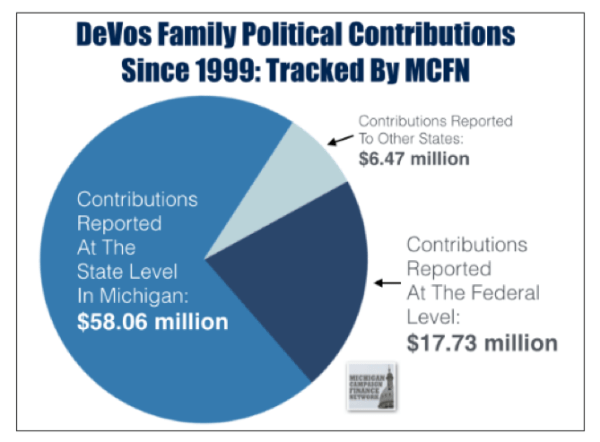
As we have documented in our series on the Grand Rapids Power Structure, the DeVos Family and other members of the local elite, strategically contribute to political campaigns throughout the state, but particularly to races in West Michigan.

Let’s look at which candidates for state office in West Michigan that the Grand Rapids Power Structure is contributing to.
State Senate Races
28th Senate District – Peter MacGregor: DeVos family, Amway $25,000; Michael Jandernoa, 42 North Partners, $10,000; John Kennedy, Autocam Medical, $10,000; Van Andel family, Amway, $5,000; Mark Meijer $2,500, Mark Murray, Meijer, $2,500; Peter Secchia $2,500
29th Senate District – Chris Afendoulis: John Kennedy, Autocam, $4,000; Steve Van Andel, Amway, $2,000; Cheri DeVos $2,000; Maria DeVos $2,000; J.C. Huizenga $2,000; Mark Murray $2,000; Michael Jandernoa $2,000; Matthew Hayworth $2,000; Richard DeVos Sr. $2,000; Dan DeVos $2,000; Peter Secchia $2,000; Richard DeVos Jr. $2,000; Doug DeVos $2,000
30th Senate District – Daniela Garcia: John Kennedy, Autocam, $10,000; Jack DeWitt, Request Foods, $2,500, Grand Rapids Area Chamber PAC $500; Meijer PAC $500
34th Senate District – Holly Hughes: DeVos family, Amway, $12,000; Secchia family, Universal Forest Products, $4,000
State House Races
72nd House District – Steven Johnson: Meijer PAC $500
73rd House District – Lynn Afendoulis: DeVos family, DP Fox Ventures, $2,000; Mark Murray, Meijer, $1,000; Joan Secchia $1,000
77th House District – Tommy Brann: Grand Rapids Area Chamber of Commerce $650; Meijer PAC $500
86th House District – Thomas Albert: John Kennedy, Autocam, $10,000; Michael Janderoa $1,000; Matthew Haworth $1,000; Peter Secchia $1,000; Meijer PAC $1,000
89th House District – Jim Lilly: Meijer PAC $1,000; J.C. Huizenga $1,000
Sources used:
 Last week, hundreds of high school students from around the country attend a conference in Washington, DC, hosted by the ultra-conservative group Turning Point USA.
From the Turning Point USA website:
Turning Point USA’s mission is to educate students about the importance of fiscal responsibility, free markets, and limited government. Through non-partisan debate, dialogue, and discussion, Turning Point USA believes that every young person can be enlightened to true free market values.
Therefore, it stands to reason that those invited to speak at this high school summit, were those who also embraced the mission of the organization, such as Attorney General Jeff Sessions, Senator Orin Hatch, Senator Rick Santorum, billionaires Peter Thiel, Mark Cuban and Secretary of Education, Betsy DeVos.
DeVos spoke to the gathering of conservative high school students on Wednesday, July 25. In her prepared remarks, DeVos addressed several issues. DeVos began by speaking about the Parkland, Florida school shooting, stating that President Trump has taken swift action to respond to this kind of violence, by appointing a Federal Commission on School Safety, which has no real experience in this area, but reassuring the crowd that whatever schools do to respond to violence is really up to states and school districts.
DeVos used her states rights mantra on school safety to then talk about applying the same principle to all aspects of education. DeVos clearly panders to an audience of young people who embrace her philosophy of freedom or more specifically, freedom to chose.
The Secretary of Education then goes on to make the following statement:
There’s one thing for sure: you’ll enter an economy that’s the strongest it’s been in years! After the historic Tax Cut and Jobs Act, confidence is at a new high and unemployment – in nearly every sector – is at a new low. Nearly 3 million jobs have been created since President Trump took office, and Americans are more hopeful about their futures!
Of course, Secretary DeVos provided no evidence to support any of these claims, the claim about the economy in general, the claim about the Tax Cut and Jobs Act (which really benefits the wealthy) or the claim about job creation. Of course, Secretary DeVos doesn’t have to verify these claims, because if people like her just say it, they must be true.
Betsy DeVos also made the following claim in her speech:
So, let’s conclude by returning to the idea that made this country great: freedom! You’re blessed to live in the most free and most prosperous country in the history of human civilization. Most free and most prosperous. That’s no accident. You cannot have one without the other.
Again, no substantiation of such a claim is necessary. In fact, that the US is the most free and prosperous nation in the history of the world is just a truism. It just is. And to question such a claim, borders on treason and heresy.

The high schools students who attended to the Turning Point USA summit certainly believe this truism, that the US is the greatest country in history. In fact, it is a fundamental belief that isn’t just embraced by conservatives, but by many liberals as well. In fact, those who are the beneficiaries of this freedom and prosperity, people like the DeVos Family, are well aware of the fact that the prosperity of the US really means the prosperity of the few, act the expense of the many. The lie of wealth accumulation is that anyone can do it. However, the reality is that those who are part of the billionaire class, like the DeVos Family, are well aware of the fact that their wealth is predicated on the poverty and exploitation of others.
This was really the message that Secretary of Education, Betsy DeVos, was delivering to the 800 students gathered last week in the nation’s capitol…….if you believe in capitalism, then you can do whatever you want with your life. To hell with the masses of people who will suffer while you make millions.
Kent County Sheriff Stelma is either stupid or in denial about intimidation being un-American
 Last Thursday, MLive ran an article about an action that took place at Kent County Commissioner Saalfeld’s house because of his refusal to end the contract that the county has with Immigration and Customs Enforcement.
In that MLive article, Kent County Sheriff, Larry Stelma, was quoted as saying:
“Trying to intimidate anyone just isn’t the American way.”
Now, it is important to state up front, as someone who was part of that action at Commissioner Saalfelds house, that it was designed to expose him for the harm he is complicit in, specifically the harm done by ICE agents to immigrant families in West Michigan. There was no intimidation tactics, since people came to his house to ask him to commit to ending the contract the county has with ICE and to let his neighbors know what his position was on the matter.
Having said that, it is astounding that someone like Sheriff Stelma can make such a statement. Does he really believe what he said or is he in deep denial about what America is all about? Do people like the Sheriff simply internalize the values of the system or is what he said simply what he was coached to say, since it is meant to put attention back on those protesting Commissioner Saalfeld and away from the county’s complicity in the harm being done by ICE. Either way, let’s take a moment to unpack the comment from Sheriff Stelma about intimidation being un-American.
Putting aside what most of us learned in civics class or US history from grade school all the way through college, what can we say about intimidation in US history? One need look no further than two of the fundamental pillars of what the US was founded on – Genocide and Slavery.
The US history of Settler Colonialism was predicated on intimidation. Indigenous communities and nations were intimidated by US militia and the US military to vacate their lands or suffer the consequences. This was the practice from the very beginning of US Settler Colonialism, from the 17th century all the way up to the present, as is well documented in books like, An Indigenous People’s History of the US, by Roxanne Dunbar Ortiz.
The legalized slavery that the US utilized throughout the country and particularly in the South, was also based on the use of intimidation. Africans were sold into slavery and the threat of violence was constantly asserted once Africans were property. If you don’t work fast enough, if you don’t obey the master or if you look at the master’s wife a certain way, were all means of intimidation in order to keep those in slavery compliant and submissive.
In fact, the whole history of White Supremacy in the US is based on intimidation. Even after chattel slavery was outlawed, the US legal system found ways to use intimidation as a means of keeping African Americans as second class citizens, whether it was through the use of Jim Crow laws, terrorist groups like the KKK or legalized segregation which constantly used intimidation as a tactic. If you drink from this fountain or use this bathroom or if you don’t sit at the back of the bus, there will be consequences. This normalized use of intimidation can still be seen through the War on Drugs, mass incarceration, where the black community is under a constant state of intimidation by the systems of power and privilege that dominate the US.
How about the economic system of capitalism? If you don’t perform at a certain pace or constantly produce more or if you want to organize your fellow workers, there is always the use of intimidation by the capitalist class. You can lose your job, you can lose your benefits or you can lose your pension if you do not comply with your employer.
Here’s another one, US foreign policy. If we think for a moment about the history of US foreign policy, we can easily see that the US has been intimidating countries for two centuries. Being the most militarized country on the planet, intimidation comes easy. If your country wants to question the US, you will be intimidated at United Nations gatherings. If you side with an opponent of the US, the US will impose sanctions on you. If you dare to develop your own nuclear capability, the US will intimidate you into submission or they will bomb the hell out of you.
 Hell, if one wanted to look at the use of intimidation as a tactic in the US, one need look no further than the very profession that Sheriff Stelma is a part of. All law enforcement agencies use intimidation as a means to keep people from doing things that cops don’t want them to do.
How many of us have the experience of being pulled over by the cops and not feel intimidated? This is especially true in communities of color, based on the history of police abuse in those communities.
This brings us back to the issue of why people were confronting Commissioner Saalfeld in the first place, which led to Stelma’s comment about intimidation being un-American. The very function of Immigration and Customs Enforcement (ICE) is to intimidate immigrant communities. Immigrant communities live in absolute fear of what ICE and other law enforcement agencies could do to them, whether they are going to the grocery store, picking their children up from school, driving to work or simply relaxing in their homes.
The very fact that Sheriff Larry Stelma can make such a claim about intimidation demonstrates he is either really, really stupid, oblivious to US history or he is in deep denial about what his Sheriff’s Department is primarily about.
Some observations on the End the Contract action at the Kent County Commission meeting
Yesterday, roughly 50 people organized around the End the Contract campaign, went a second time to the Kent County Commission meeting to demand an end to the contract the county has with Immigration and Customs Enforcement.

It is always a good indication of how effective social movements are, when systems of power respond with ridiculous tactics. In the picture above you can see that Kent County officials moved the podium to the center of the room and then added those retractable barriers to both sides, with signs on either side saying, “Staff Only Beyond This Point.”
This was no doubt in response to the fact that at the June 28th County Commission meeting, we took over the semi-circle space where the county’s logo is displayed on the carpeting.
The people who came to demand an end to the contract with ICE, brought signs to display, many of which had images of the commissioners themselves, challenging them to think about their complicity in the harm being done to the immigrant community by ICE agents.

After the formalities at the beginning of the commission meeting (which included the Pledge of Allegiance and a Christian prayer – I don’t know how they can continue to get away with that shit) the agenda did include an annual report from the Kent County Land Bank, which lasted about 15 minutes. However, several commissioners asked questions of the land bank representatives that took an additional 20 minutes, which to many in the room seemed like a stalling tactic just before the public comment period.
Once people were finally given the opportunity to speak, an estimated 20 people got up and used the 3 minutes to address the commission on why they should end the county’s contract with ICE. Gema Lowe with Movimiento Cosecha GR spoke first. Gema keep the focus on ending the contract and the harm being done to the immigrant community and then presented the commissioners with a list of over 1,600 names of people who have already signed the End the Contract petition, in the form of a scroll.
 There were several other immigrants who got up to speak about the harm they have witnessed because of ICE violence, to members of their family and the immigrant community as a whole. Other people addressed the commissioners as parents, speaking about the unimaginable fear they would have if they were being separated from their children.
There were also people involved from GR Rapid Response to ICE who spoke about the weekly calls they receive from immigrants who have had a family member taken by ICE and the impact it has had on their families.
One person got up and used most of their time to play an audio recording of the children being taken from their families at the border and put into cages.
Another immigrant spoke about how his father had fled Guatemala during the civil war and came to the US to give his family a better chance. This immigrant spoke about the difficult choices his father had to make and the difficult circumstances that immigrant families are faced with because of the terror inflicted by ICE.
Then Kent County Commissioner Robert Womack came to the podium and made it clear that as a black man, he could no longer sit idly by and do nothing when other communities of color were being targeted by state repression. Commissioner Womack then sign the oversized End the Contract document that organizers brought to the meeting, shown here. You can see Commissioner Womack’s signature at the bottom, with a smaller signature signed by Commissioner Betsy Melton (she signed it later – after the formal meeting was completed).

After the public comment period, those demanding an end the to contract began chanting and some sat on the floor to further demonstrate their opposition to the county’s complicity in ICE violence.
The organizers were then asked to end the disruption of the meeting by Commissioner Womack, who said that they needed by 15 minutes to complete the meeting and then commissioners could address the ICE contract issue directly. Organizers agreed to stop disrupting and listen to what the commissioners had to say.
Of the commissioners who spoke, most of them either deflected the attention away from their responsibility in ICE violence or they said that it warranted further discussion. One Commissioner even admitted that he didn’t even know that the county had a contract with ICE.
Other commissioners used the time to speak about how great the Sheriff’s Department was and how they support the “Rule of Law,” which was just another way of saying they supported the county’s contract with ICE. Another commissioner used the opportunity to try to shame protestors because of their disrupting tactics, stating that such tactics, “didn’t help their cause.”
After the meeting was adjourned, there were several small conversations with some of the commissioners and at one point Commissioner Betsy Melton also signed the End the Contract statement. Unfortunately, only 2 of the 19 commissioners were willing to make a commitment to end the county’s contract with ICE, while most either avoided the issue entirely or in the case of one commissioner, they chose to continue to say that only the Sheriff’s Department could do anything about it.
One thing was clear…….those who are involved in the End the Contract campaign would be coming back and continuing to organize until the Kent County contract with ICE was terminated.

Last night, roughly 40 people showed up at Kent County Commissioner Jim Saalfeld’s house to pressure him to end the County’s contract with Immigration and Customs Enforcement (ICE).

Organized by Movimiento Cosecha GR and GR Rapid Response to ICE, this action was in part a response to Commissioner Saalfeld’s decision to limit public comment at the June 28th Commission meeting, his claim that someone pushed another speaker (which was completely false) and because he decided to end the meeting by walking out and cutting the microphone during the June 28th meeting of the County Commissioners.
People marched about 2 blocks to Saalfeld’s house and then one of the organizers read some oversized documents that were being presented to the Chairman of the Kent County Commission.
The first document that was read out loud, was a statement of intent that the group was wanting Saalfeld to sign. That statement read as follows:
I, James Saalfeld, do hereby declare that ICE (Immigration and Customs Enforcement) is no longer welcome in Kent County, and that the Kent County Sheriff’s Department is no longer authorized to work with ICE or to remain in contractual agreements with ICE.

- will immediately release a statement denouncing ICE and declaring my intent to end the contract.
- will submit a motion to end the contract to the next Commission Meeting Agenda and to all agendas following that until the motion passes.
- will do everything in my power, including withholding county monies for the Kent County Sheriff’s budget and refusing approval of future budgets, to end this contract.
Commissioner Saalfeld was either not at home or refused to come to the door to talk with people about the ICE contract. The document was then duct taped to his front door, as you can see in the photo above.
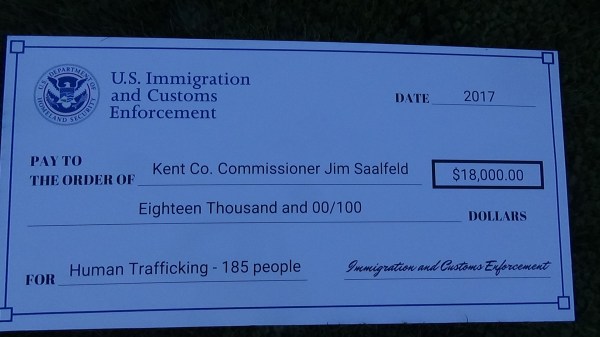
In addition, people brought an oversized check to the protest, a check which shows how much money Kent County made in 2017 for trafficking immigrants that had a hold put on them by ICE.
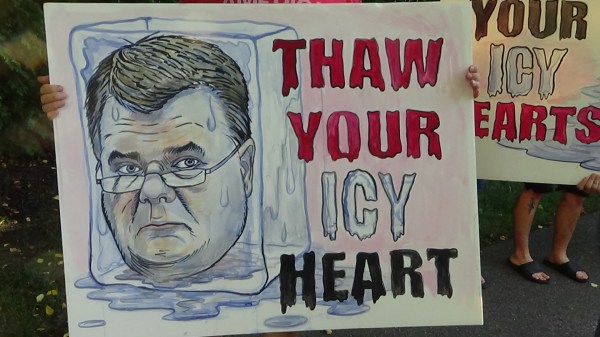
In addition to the document and the oversized check, people brought signs, some of which were like yards sign that were added to the front lawn of Commissioner Saalfeld’s home. These signs reflected the reality of what Commissioner Saalfeld and his fellow commissioners are unwilling to do, which is to end the county’s contract with ICE.

Those who organized the action also had flyers that were distributed in the neighborhood. These flyers provided basic information about the county’s contract with ICE and why it was important that the contract be ended. Several neighbors did step out of their homes to see what was happening and one neighbor came over to complain that the noise those protesting were making had interrupted his pool party.
Eventually the Kent County Sheriff’s Department showed up, but they didn’t really do anything to stop the action. There were 5 Sheriff’s Department cruisers there at one point, but despite their presence, they did nothing to stop people from standing in front of Saalfeld’s house or dancing to music that was amplified during the protest.


The protest outside of Commissioner Saalfeld’s home lasted about 1 hour, but those who participated were reminded that the next morning people were going to the July 26th Kent County Commission meeting to once again address to commissioners and demand that they take action to end the county’s contract with ICE.
Lastly, people were invited to attend the next End the Contract meeting, which will be held on Monday, July 30th, with details at this link.
Liberals, Conservatives and the defense of ICE violence
The issue of immigrants and immigration policy have been a rather contentious issue for most of US history. However, the recent actions by the Trump administration to separate immigrant families, especially at the border, has put Immigration and Customs Enforcement (ICE) front and center.
There has been a great deal of organizing in response to ICE in the past 12 months, around the country and in the Grand Rapids area. Locally, the GR Rapid Response to ICE group has been hosting monthly trainings designed to mobilize people to prevent ICE from arresting, detaining or deporting people, along with a wide variety of direct support to immigrants who have been impacted by ICE.
In addition, there is a recent campaign to get Kent County to end their contract with ICE, a contract they have had since 2012. There have been demonstrations at the June County Commission meeting, along with an action at the July 4th parade in East Grand Rapids, plus a petition campaign to end the contract.
With all of the attention centered around the harm that is being done through ICE, it is no surprise that there are lots of sectors publicly defending ICE, both liberal and conservative sectors. Let’s take a look at two examples, one from a conservative think tank and another from a liberal politician.
A Conservative Defense of ICE
The first example comes from the Acton Institute, which posted an article about ICE last week, entitled, The Left’s populist pushback.
The article, written by a third year university student, not only makes a weak argument about the “populist” response to ICE repression, the article demonstrates the author’s lack of understanding about what ICE does and how it impacts the immigrant community.
First, the Acton writer seems to think that the push to abolish ICE is being led by the group Democratic Socialist of America (DSA). While DSA chapters around the country have been active in actions against ICE, they are not the sole entity behind the growing movement. All across the US, there are anarchist groups, socialists, DSA groups, immigrant-led groups, religious groups and numerous autonomous groups that are not attached to any one political philosophy, which are organizing to resist ICE repression.
Second, the Acton article is rather vague when it comes to anything critical of ICE policies and practices. Nowhere in the article does it mention any hard facts about how ICE has been arresting and detaining immigrants, often followed by their deportation. The actual harm done to individuals and families has been devastation, such as the report released by the ACLU in May of 2018, documenting widespread abuse of immigrant children in detention.
Third, the Acton Institute article calls upon its readers to “respect the rule of law” and that if there are abuses being committed by ICE, then there are proper ways to go about making changes to the law.
Lastly, while the Acton article doesn’t overtly defend Immigrations and Customs Enforcement, it does endorse the administration’s criminalization of immigrants and compels its readers to trust that the rule of law will serve the greater good.
A Liberal Defense of ICE
The second response is written by Kent County Commissioner Jim Talen, which you can read at this link. Talen, who is a Democratic Commissioner, is responding specifically to the End the Contract camapign that Movimiento Cosecha GR and GR Rapid Response to ICE have initiated. Talen writes:
The Sheriff has assured me and others of several policies related to how they handle immigration-related issues:
• The Sheriff currently only holds individuals for ICE for whom there is a warrant for a criminal offense. The Sheriff does not hold people who have been detained by ICE for only an immigration violation.
• When someone is arrested for a criminal offense and booked at the jail, their information, including fingerprints and citizenship, is entered (by law) into a national database that is accessible to all law enforcement agencies in the U.S., including ICE. The Sheriff does not specifically notify ICE of a person’s immigration status but ICE is able to see who is at the jail and request that the person be held for up to 72 hours.
• Kent County Sheriff’s Deputies do not arrest or detain people solely for immigration violations.
Such assurances from the Sheriff are bogus and misleading. First, if a local law enforcement agency stops someone for a faulty brake light and then discovers that the person has no drivers license, they can be arrested and taken to the Kent County Jail, where ICE has the option of putting a hold on them. For Commissioner Talen, this is a criminal offense. The reality is that this is simply a policy matter in Michigan, which currently does not allow those who are undocumented to obtain a drivers license, even though that was previously the case. People should not seen as criminal simply because state or federal policy is outdated and unjust.
Second, by stating that the Sheriff’s Deputies do not arrest or detain people because of their immigration status is just a way of avoiding the point I just made about people being stopped and then arrested because they are driving without a license.
Third, we know, based on the study done about racial profiling in Grand Rapids, that law enforcement disproportionately stops black and latino/latinx motorists. This type of racial profiling, does not explicitly target people because of their immigration status, but it doesn’t matter, since those drivers who cannot obtain a drivers license are at greater risk of being pulled over by cops. The fact that cops or deputies don’t asked their immigration status is irrelevant, since their arrest put them in contact with ICE. Therefore, people’s immigration status DOES become the issue.
Commissioner Talen then goes on to say this:
A benefit to County taxpayers from having the contract is that it protects the County in the event of a lawsuit by having the Department of Justice defend it. There are a pair of existing lawsuits against Kent and Allegan Counties for detaining undocumented persons. I have been told that Allegan County, which does not have a contract with ICE, has spent over $100,000 on its defense so far while Kent County has been defended by the DOJ and has not incurred significant local cost.
Really, the fiscal argument? people should be allowed to sue if the justice system does not serve them. More importantly, the argument here omits a major fiscal reality. The people who are picked up by ICE or end up in detention because ICE put a hold on them while in the Kent County Jail, are costing immigrant families hundreds of thousands of dollars.
Those who are put into detention by ICE are often the primary income earners, so immigrant families are suffering because they no longer have income and must rely on charity or alternative means of support. If the people who are being detained by ICE are eligible for bond, then families must come up with $5,000 – $7,000 for bond. This puts an even greater financial burden on immigrant families, many of whom are already burdened by the cost of living in this community. The fact that Commissioner Talen argues that this saves taxpayers money is also not true, since the immigrant community, even those who are undocumented, pay taxes in Kent County.
In the end, Commissioner Talen fails to acknowledge the harm and trauma being done to the immigrant community, he justifies and supports the county’s contract with ICE and he fails to acknowledge the campaign to end the contract with ICE. The best he can come up with is, “This is a complex and ongoing issue of significant importance to our community.”
As the old labor song asks, “which side are you on?” In the case of Commissioner Talen and the Acton Institute, both are on the side of oppression and state violence.
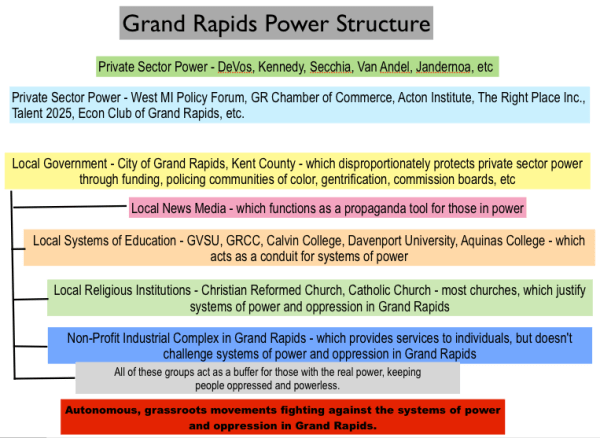
Graphic by Jason Flannery
A visual depiction of the Grand Rapids Power Structure




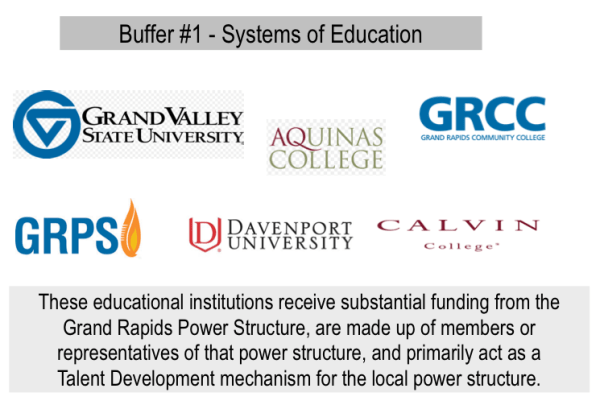

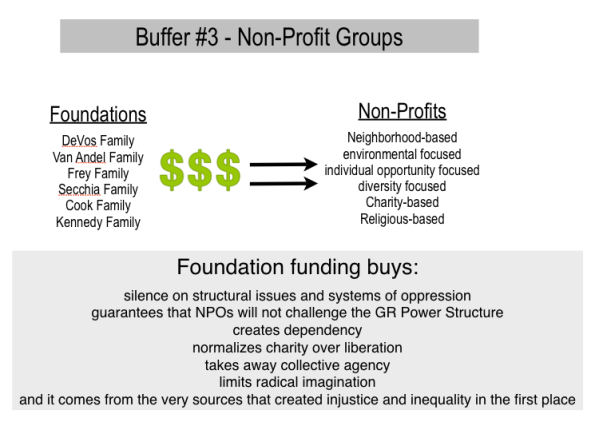
Grand Rapids Power Structure is bringing Jeb Bush to town for bi-annual policy conference in September
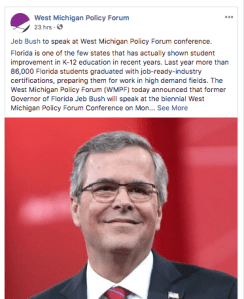 The West Michigan Policy Forum is one of the key groups in the area that makes up the Grand Rapids Power Structure, as we documented in Part IV in our recent series.
The West Michigan Policy Forum (WMPF) is an outgrowth of the Grand Rapids Chamber of Commerce. Founded in 2008, the WMPF has had a tremendous influence on state policy in Michigan. Several of the key members are part of the Grand Rapids Power Structure and have advocated numerous policies that have been adopted at the state level, such as cuts to business taxes, making Michigan a Right to Work state and eliminating public sector pensions.
For their bi-annual conference this coming September, it would appear that the focus of the conference and the policies they want to see adopted in the state are directed at undermining public education and creating a larger “talent” pool. To assist them in crafting policies that would help the WMPF achieve their goals, they are bringing former Florida Governor Jeb Bush as one of the keynote speakers in September. Here is how the WMPF announced Bush’s visit as a speaker in September:
Florida is one of the few states that has actually shown student improvement in K-12 education in recent years. Last year more than 86,000 Florida students graduated with job-ready-industry certifications, preparing them for work in high demand fields. The West Michigan Policy Forum (WMPF) today announced that former Governor of Florida Jeb Bush will speak at the biennial West Michigan Policy Forum Conference on Monday, September 24 at the Amway Grand Plaza Hotel.
During his eight years as governor, Bush introduced a suite of education reforms called “The Florida A+ Plan for Education.” The reforms included bringing transparency and accountability through specific school measurements that parents could understand. Schools in Florida are now graded A-F tied to student performance.
Bush will help headline a series of discussions and policy initiatives during the WMPF tied to improving Michigan’s ability to grow, attract and retain talent.
There has been plenty of documentation on how Bush undermined public education in Florida and adopted the very “education reform” policies that Betsy DeVos and the national organizations she has been involved in, have been promoting for the past two decades.
In 2015, an article on Alternet reflected the Bush war on Education and the ACLU chapter of Florida in 2015, also provided a substantial critique of Bush’s education policy.
A reporter for the Miami Herald noted in 2015, that Jeb Bush “dumbed down Florida’s schools and even the Jeff Bezos’-owned Washington Post has acknowledged just this year that the Trump administration’s education platform is essentially the same as what Jeb Bush adopted in Florida.
In addition, to the general undermining of public education policy that Jeb Bush will discuss while at the West Michigan Policy Forum in September, he will address, “improving Michigan’s ability to grow, attract and retain talent.”
This push for students to be developed as “talent” has been the focus of numerous groups in Grand Rapids, such as Believe 2 Become, which produced a major report on the theme in 2017, entitled, Workforce Opportunity in West Michigan:Connecting a Qualified Workforce to High-Growth Opportunities.
The group Talent 2025, has also been promoting the general idea of students as talent, with an emphasis on the collaboration between the business community and educators. In fact, Talent 2025, has developed a short list of next steps in order to reduced the gap between school completion and career readiness, as you can see here on the right.
As we have done in previous years, GRIID plans to attending the 2018 West Michigan Policy Forum conference and reporting on what the organization will make as their focus for the coming year.
Increased surveillance and and intelligence gathering are tactics the GRPD is using to “win over the community”
The Grand Rapids Police Department has been reeling for over a year now, because of public outrage over numerous incidents where cops pulled guns on black youth. These incidents have highlighted how local police departments deal with public resistance to their treatment of communities of color.
In addition to the numerous incidents of GRPD violence against black youth, there was also the report that came out last year about how the GRPD engages in racial profiling of black and latino/latinx motorists. All of this has resulted in the black and immigrant communities protesting the policies and practices of the GRPD, especially at City Commission meetings and community forums.
 On the defensive, the GRPD has been working hard to: 1) find ways to ease community concerns about their actual role (protecting power and maintaining business as usual), and 2) engage in a variety of tactics to convince the public that the police department really does care about the community.
In recent weeks, the GRPD has been hosting programs and begun a series of tactics to try to win public confidence and to get the public to assist the police in monitoring behavior, primarily in communities of color.
In late June, the GRPD began hosting a series of forums, that were organized by a paid contractor to attempt to build trust between the community and the GRPD. Policing at the Speed of Trust is what these forums have been called, where participants have a 1 on 1 session with a member of the GRPD, “where attention is directed toward objectives instead of suspicion about others’ intentions, according to a City of Grand Rapids announcement.
The entity that the City of Grand Rapids contracted with to conducted these Speed of Trust sessions with the GRPD is Franklin Covey, a corporation that works in 150 countries around the world and with most of the companies listed in Fortune 500. Franklin Covey also works with local municipalities, specifically with Government/Law Enforcement.
There is no mention on the City of Grand Rapids announcement about how much they spent to contract with Franklin Covey and the decision to host forums that has people pair up with cops is brilliant, since it gets people to think about cops as individuals instead of as a structure that uses force to control people.
Another recent initiative from the GRPD is their Gun Violence Door Hanger Initiative. This project is designed to have police officers hang information in English and Spanish, information that lets people know how to contact the police or Silent Observer. The door hangers have been used in neighborhoods where recent gun violence has occurred, with the hope that residents will assist the GRPD in sharing information about potential suspects. The Director of Silent Observer stated, “These door hangers remind residents that in order to help police stop, solves and prevent crime, they need to share what they know with police or Silent Observer and can do so in the privacy of their own home.” Such programs are a form of what police historian Kristian Williams calls counter-insurgency.
“Pacification is best thought of as a massively enhanced version of the community policing technique that emerged in the 1970s. Community policing is centered on a broad concept of problem solving by law enforcement officers working in an area that is well-defined and limited in scale, with sensitivity to geographic, ethnic, and other boundaries. Patrol officers form a bond of trust with local residents, who get to know them as more than a uniform. The police work with local groups, businesses, churches, and the like to address the concerns and problems of the neighborhood. Pacification is simply an expansion of this concept to include greater development and security assistance.”
Having the public channel information to the police is a form of counterinsurgency that helps the police target communities that are heavily policed and to gather information about dissidents or potential dissidents that question the legitimacy of community policing.
One addition program that the GRPD is promoting is the Voluntary Camera Registration Program. This program, “allows residents and business owners to let the police department know that they have a camera on their property. These camera locations will be added to a database only accessible to law enforcement. Having a database with known locations of surveillance cameras will make it quicker for law enforcement to obtain video footage that may help to solve a crime.” In other words, the GRPD wants to increase their ability to monitor the public without their knowledge of this type of surveillance.
Of course, all of this costs money, but nowhere on the City’s website can we easily find out how much the taxpayers are spending to implement such programs.
If the City of Grand Rapids really want to build trust between the GRPD and the community, then the GRPD needs to stop using a disproportionate amount of violence in the black and immigrant communities, stop using intimidation tactics, harassment and the increased levels of surveillance of people who are speaking out against police abuse. I for one don’t think that is what the City of Grand Rapids will do, since the GRPD’s function is to spend the bulk of their efforts and resources to police the black and immigrant neighborhoods and to protect the system of power and privilege that exists in this city.

