DeVos Family is largest political donors in 6 of the 14 Congressional races in Michigan
 There are still nearly 4 months before the November 2018 elections. This means that the campaigns will get uglier over the coming months and the amount of money contributed and spent will be astronomical.
However, let us be clear that the majority of money that has been contributed and will be contributed in the remaining months of the 2018 election cycle, is money that comes from the wealthiest families and industries. This is the case all over the country.
Right here in Michigan, we can see that the money coming in for the 14 separate Congressional races is also coming from the wealthiest families. If we are looking at the wealthiest families in West Michigan, then we need look no further than the DeVos Family, which has been the largest political contributor in Michigan for years.
Of the 14 Congressional races the DeVos Family is a major contributor in 6 of those races. There are some races that will not be close and some races that will certainly go Democratic (and have for years), so the DeVos Family strategically spends their money on races that are likely to result in a won for the candidates they are backing.
What follows is data from the Michigan Campaign Finance Network, specifically for the six Congressional districts that the DeVos Family is making major contributions:
- 2nd Congressional District Bill Huizenga DeVos Family Contribution $13,500
- 3rd Congressional District Justin Amash DeVos Family Contribution $13,500
- 4th Congressional District John Moolenaar DeVos Family Contribution $13,500
- 6th Congressional District Fred Upton DeVos Family Contribution $27,000
- 10th Congressional District Paul Mitchell DeVos Family Contribution $13,500
- 11th Congressional District Klint Kesto DeVos Family Contribution $5,400
Total DeVos Family Contributions in the Michigan Congressional Races: $77,400
Someone recently asked me why I have it in for the DeVos Family. Any family that can buy elections, but political access and impose public policy on society that fits their ideological worldview should be exposed and resisted, not matter who they are. It just happens that the DeVos Family is at the top of the list from West Michigan. GRIID will continue to expose them and work with anyone who wants to resist their oppressive politics.

 On Friday, MLive reported that there is a group that is legally challenging the Michigan Ballot Initiative for an increase in the state’s minimum wage.
MLive reported that the group Michigan Opportunity, is asking the Michigan Court of Appeals to not allow the One Fair Wage campaign initiative to be on the ballot this fall. The One Fair Wage campaign is calling for a $12 an hour minimum wage in Michigan.
The MLive article states:
“We firmly believe that the Michigan One Fair Wage petition, financed almost exclusively by out-of-state interests, has willfully violated Michigan’s Constitution and … election law to achieve the special interest ends of their financiers,” Michigan Opportunity committee spokesman Justin Winslow said in the release.
The MLive article also cites someone with the One Fair Wage campaign:
“Michigan One Fair Wage will be intervening in the lawsuit to defend the petition and will be responding to the challenges filed with the Board of Canvassers,” said Mark Brewer, legal counsel to the Michigan One Fair Wage.
The MLive article doesn’t provide any background for either Justin Winslow, the group Michigan Opportunity or Mark Brewer.
According to the campaign finance requirements, which you can find on the Michigan Secretary of State office, the group Michigan Opportunity received $100,000 from the Michigan Restaurant Association in April to fund their effort to defeat the One Fair Wage campaign. The MLive article does say that Michigan Opportunity, is “an opposition group with ties to the Michigan Restaurant Association.”

However, upon further investigation, saying Michigan Opportunity has ties to the Michigan Restaurant Association is somewhat misleading. MLive does quote Justin Winslow from the Michigan Opportunity group, but fails to mention that he is also the President of the Michigan Restaurant Association and has been since 2015.
Prior to that position, it is important to note that Winslow has served as, “chief of staff for Sen. John Pappageorge, R-Troy, leading appropriations and legislative strategy. He also served as legislative director for Sen. Tony Stamas, R-Midland, and director of external affairs for Sen. Shirley Johnson, R-Troy.”
On the other side, it should be noted that Mark Brewer, the person cited in the MLive article, as legal counsel to the One Fair Wage campaign, is the former head of the Michigan Democratic Party. As with so many of the ballot initiatives, they are highly partisan.
Lastly, it should be noted that there has been a national campaign to make $15 an hour the federal minimum wage. The current minimum wage in Michigan makes it impossible for most people making minimum wage to afford housing with the current market rate for housing.
Grand Rapids Power Structure: Part X – Movements for Reform or Movements for Collective Liberation?
 Over the past few months we have been investigating the Grand Rapids Power Structure, beginning with a discussion about its framework in Part I; the most powerful family in Grand Rapids, the DeVos Family, in Part II and in Part III we looked at other members of the most powerful members of the private sector. In Part IV, we looked at the private sector organizations that have power and which individuals sit on the boards of those organizations.
Five weeks ago, we looked at the next level of the Grand Rapids Power Structure, the local government, in Part V, and four weeks ago we investigated the role and function of the media, within Grand Rapids and how it serves power in Part VI.
Three weeks we began to look at how various institutions act as a buffer for systems of power against systemic change, first looking at institutions of higher learning in Part VII and in Part VIII we looked at how Religious Institutions act as a buffer against systemic change in Grand Rapids.
Last week, we looked at how Non-Profits play a role in acting as a buffer for systems of power and against systemic change, in Part IX.
Today, in Part X, we will look at which groups are working to just reform the current system of power in Grand Rapids and which are working to dismantle it and create new, autonomous forms of self-governance and collective liberation.
Reformism in Grand Rapids
There is a whole litany of groups working on issues from a reformist perspective in Grand Rapids. Many of these groups are advocating for electoral reform or supporting particular politics through the electoral process. While I think that voting can be a useful tactic in bringing about some form of social change, historically it has not created the kind of changes necessary for systemic and structural transformation.
And yet, we see a number of groups mobilized around elections and voting in Grand Rapids, those endorsing ballot initiatives, those endorsing individual candidates and those adopting what are often referred to as progressive political values. And while individuals within those groups may have a deeper critique of the Grand Rapids Power Structure, most of these groups will spend a great deal of energy and resources that will NOT, in any significant way, challenge the current system of power in this area.
Voting can be seen as a form of hard reduction, but it is often not a source of transformative justice or collective liberation. This should be clear in West Michigan, considering how much influence that the Grand Rapids Power Structure has on influencing public policy and buying candidates in Parts II, III and IV. It is not really possible to compete with organized money, unless you have organized people who are willing to take risks and engage in transformative politics.
Last week, we discussed the limitations of the non-profit sector, with their reliance on foundation funding, often foundations run by those within the Grand Rapids Power Structure, plus their are the limitations of what non-profits can do politically. Grand Rapids has hundreds of non-profits, even those that claim to engage in grassroots justice work. However, those non-profits still operate within a reformist framework and do not threaten the current power structure in Grand Rapids.
Then there are groups that exit, which are not non-profits, yet often act like one. These groups engage in reformist politics, by attempting to work within the boundaries, which the system of power has determined to be legitimate and respectable.
Take for instance, the group GR Homes for All. This is a group that adopts the principle that having a home is a right and not just for those who can afford one. However, the politics of the group, which is primarily led by those who have secure housing, works around the margins to make change. GR Homes for All, recently got the Grand Rapids City Commission to adopt a rental application fee process, which doesn’t punish those applying to rent in the Grand Rapids market. This is beneficial for those who rent, but it doesn’t challenge the sector that has the real power in the housing market, namely landlords, property management companies and the real estate industry in Grand Rapids. Until the housing justice movement is led by those who are most vulnerable, those who are being priced out of the housing market and those who are most impacted by gentrification, then any efforts the group engages in will not result in challenging those with the most power.
Another example of a group involved in a more reformist approach to critical issues is the Grand Rapids Water Protectors. This group, in many ways, grew out of the movement working in solidarity with the indigenous struggle at Standing Rock in 2016 & 2017. It was rooted in the idea that all water is sacred and that anything – oil pipelines, fracking – that was a threat to water should be resisted.
The Grand Rapids Water Protectors does do some good educational work around water issues and is involved in the campaign to shut down Line 5, the Enbridge Oil Pipeline, that runs through Michigan. However, the group does not advocate for direct action to shut down Line 5 and hasn’t really engaged in other forms of resistance in the Grand Rapids area, especially the kind of resistance that would threaten the local power structure. Like many of these groups, the Grand Rapids Water Protectors has the potential to use direct action and transformative politics as a means to achieve its goals, but that has not been the case so far.
Movements that Challenge Power in Grand Rapids
Grand Rapids does have a rich history of people and movements being involved in direct action, the kind of action that challenges power. There are the examples of the 1911 Furniture Workers Strike, the Socialists who resisted during WWI in Grand Rapids, the Central American Solidarity Movement, the South African Anti-Apartheid Movement to the various forms of black resistance to White Supremacy over the years, as has been documented in Todd Robinson’s book, A City Within a City.
There have also been movements that challenged US imperialism during the Vietnam War and the US wars in Iraq and Afghanistan, along with anarchist and autonomous environmental groups in recent decades in Grand Rapids. And while these movements come and go, they have offered a glimpse of the potential for lasting resistance and a challenge to reformism in the area. Even though these movements didn’t “win,” they were a real threat to the business as usual approach to politics and they engaged in direct action as the primary tactic used in their varying strategies.
However, the most substantial resistance to power in Grand Rapids in recent decades has been from communities of color. The indigenous community, the black community and the latino/latinx communities come to mind, in terms of those who have posed the largest threat to the system of power in Grand Rapids.
In the 1960s and 1970s, the black community, which challenged forced busing, fought to maintain their own community schools and those who resisted police brutality, housing injustice and unemployment are a few examples of the kind of resistance that was threatening to the Grand Rapids Power Structure.
Maybe one of the best examples of a group/movement that not only challenges the existing power structure in Grand Rapids, but engages in transformative politics that seeks to achieve collective liberation, is Movimiento Cosecha GR.
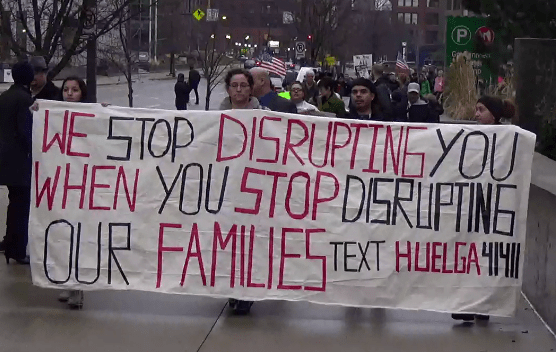
Movimiento Cosecha GR is a chapter of a national immigrant-led movement that seeks to win respect, dignity and permanent protection for all immigrants. Movimiento Cosecha GR is not a non-profit and it does not seek to reform immigration policy, rather they work to create justice for the immigrant community.
Cosecha GR has its own power analysis, which it often presents during trainings and introductions for people who come to their meetings. Cosecha GR’s theory of change evolved out of the efforts to reform immigration policy since the 1980s, where politicians and political parties kept using immigrants and the Latino/Latinx community in order to get votes, while never transforming immigration policy.
One example that Movimiento Cosecha GR gives was in 2005-2006, when legislation was put forward by Congressman Sensenbrenner that would further criminalize those that were undocumented and anyone who would assist them. This proposed legislation was was met by massive mobilizations across the country from the Latino/Latinx community. In Grand Rapids, some 10,000 people marched in the streets to protest the proposed legislation. Then the Democratic Party was able to convince the immigrant community to support Barack Obama in the 2008 election, with the promise that comprehensive immigration reform would occur.
The Latino/Latinx community voted big for the Democrats, yet no real movement was happening around immigration. Instead, the immigrant community began to take matters into their own hands, particularly young immigrants to forced the Obama administration to adopt a policy for undocumented youth, who are generally referred to as Dreamers. Not satisfied with the some political promises, these same immigrant youth then began to demand protection for their parents and extended family members, since they too deserved to stay in this country. This is the context in which Movimiento Cosecha was born, out of a political struggle that realized the immigrant demands were not going to be met until they began to force politicians to meet their demands. It’s what Cosecha GR refers to as, “we don’t dance with politicians”……..meaning we don’t play the cozying up to politicians in order to ask for political favors.
Therefore, Movimiento Cosecha GR uses popular education and direct action tactics to mobilize immigrants and allies to win dignity, respect and permanent protection for all immigrants. They use short term and long term campaigns, such as boycotts, strikes, marches and other forms of direct action to achieve their goals.
What the group in Grand Rapids has done in the past 18 months has been impressive, in terms of how many people have been mobilized, how many actions they have engaged in and how it has received attention from the local power structure. The local law enforcement agencies, particularly the GRPD, have responded with increased monitoring, the targeting of some organizers, intimidation and an attempt to control the larger mobilizations over the past 18 months.
Movimiento Cosecha GR has engaged thousands of people through the boycotts and strike they have organized during May Day, with workers refusing to go to work and families keeping their kids out of school, to the Wal-Mart boycott and the Turkey boycott last year.
Current Movimiento Cosecha GR is involved in a statewide campaign to get drivers licenses for all and the end the contract that Kent County has with ICE. The action that Movimiento Cosecha GR organized (along with GR Rapid Response to ICE) on June 28th, was a clear demonstration of their effectiveness and how the system of power feels threatened by what they are doing.
Movimiento Cosecha GR also practices transformative politics and collective liberation because they; 1) are a movement led by immigrants, 2) they utilize direct action as the primary strategy for change, and 3) they don’t cozy up to politicians or dance with political parties, instead they force systems of power to accept their demands. If we are to challenge the Grand Rapids Power Structure, this is the kinds of transformative politics we need to engage in. We all can learn from Movimiento Cosecha GR.
It is no secret that in West Michigan, christian missionary work is just like breathing air. We don’t think about it, it is just part of the dominant cultural reality.
In fact, Grand Rapids was built upon the work of christian missionaries, which were part of the settler colonial project to remove or assimilate indigenous communities living along the Grand River.
With some 800 churches in Grand Rapids, and hundreds more in surrounding communities, christian mission work still dominates the local landscape. Some christian groups do mission work in urban core areas, others go to impoverished areas around the country, while others make it a point to leave the US and spread the “good news” about their religion……..and how wonderful American and Americans are.

In fact, christian missions is just an extension of christian hegemony, which is the theme of an important book by Paul Kivel, entitled, Living in the Shadow of the Cross. The Christian Hegemony Project defines christian hegemony as:
The everyday, pervasive, deep-seated, and institutionalized dominance of Christian institutions, Christian values, Christian leaders, and Christians as a group.
One recent example of christian hegemony was a story that was reported on WOOD TV 8 a few days ago, about some christian missionaries who just got back from Haiti, after fleeing violence. The channel 8 story frames the issue as the missionaries got out safely, despite the dangerous situation they were in. WOOD TV 8 reported:
Roads were also blocked around the resort in Carries where the Lowell missionaries were staying. The group was ready to head home Sunday, but hunkered down in its secure hotel after the airport about an hour away closed.
Channel 8 mentioned that the christian missionaries were from a church in Lowell (Impact Church), who were partnering with a group in Grand Rapids called Starfysh. Impact Church is a Wesleyan Church and Starfysh appears to be non-denominational.
What is instructive about the channel 8 story is that they never question why people from Lowell are in Haiti, not do they question what they are actually doing with the people of Haiti. Christian mission work is so normal that the news media doesn’t need to ask these basic questions, because, of course the mission groups are there to “do good.”
The group Starfysh does make it a point to say on their website that they are non-political. “We do not take positions on Haitian politics nor do we attempt to influence political discourse.” The fact is, the organization’s very presence in Haiti is political, whether they like it or not, and they are operating in a long standing tradition of US policy that has been essentially punishing Haiti ever since they won independence in the early part of the 19th Century. We pointed this dynamic out in a short video in 2010, after a Bush/Clinton ad was being used to collect money after the 2010 earthquake.
By not questioning the motives of the christian mission group, channel 8 is essentially normalizing white saviorism, making the presence of white christians from Lowell in Haiti, like it was just another day in the life of white christians.
We can not accept, nor assume, that white christian missionaries are ever involved in anything that is in the best interest of the people they claim to be helping. It is urgent that we come to terms with this reality and begin to provide a different narrative around the role of christian hegemony and white saviorism.
On June 22nd, we reported that the US House of Representatives had passed a version of the 2018 Farm Bill, which punished those who are food insecure, by requiring them to work a certain amount of hours per month in order to receive food assistance.
 Recently, the Senate passed a similar version of the Farm Bill, that not only continues to subsidize agribusiness, the Senate version also requires those on food assistance to work.
Michigan Senator Debbie Stabenow, the Ranking Member of the U.S. Senate Committee on Agriculture, Nutrition, & Forestry, led the charge to pass a bi-partisan bill. The announcement on Senator Stabenow’s website suggests that the 2018 Farm Bill is great for Michigan farmers and great for Michigan’s economy.
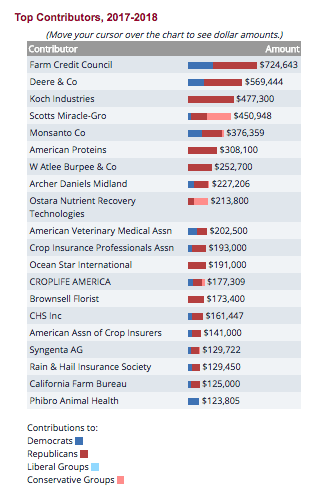
The reality is that the bill is great for agribusiness in Michigan. Those who stood with Stabenow in Michigan at a recent press conference, are entities within the agribusiness sector, such as the individual large-scale farms, the Michigan Vegetable Council and the Michigan Rural Water Association. At the federal level, you can see in the chart on the right, the agribusiness corporations that have contributed the most in the past year to lobbying Congress to pass the Farm Bill.
Most of these businesses and farm associations and their members are recipients of massive taxpayer subsidies and most of them grow mono-crops on a large scale. Small farmers and farmers that practice sustainability benefit at all from the US Farm Bill.
The Senate version of the Farm Bill may not be as harsh on food assistance recipients, but it will still require people to find jobs, go to job training and participate in a monitoring program in order the continue receiving food assistance.
According to Food and Water Watch, the Senate Bill is not as punitive as the House version, but it still it still perpetuates an unjust and unsustainable food system. They state in a recent post that there are two areas that really need improvement:
• Commodity Crops – The Senate bill maintains the approach of the last farm bill when it comes to commodity crops like corn, soy and wheat by emphasizing subsidized crop insurance as the primary farm safety net. Missing is any discussion of the real reforms we need, including restoring grain reserve programs that could be used to provide stability for farmers and rein in overproduction of these commodity crops that end up as cheap feed for factory farms.
• Factory Farms – For several Farm Bill cycles, large-scale factory farm operations have been eligible to receive hundreds of thousands of dollars from a program called the Environmental Quality Incentives Program (EQIP) to subsidize equipment or facilities to manage the massive amounts of manure they generate. By allowing factory farms to use taxpayer dollars to subsidize their manure management, EQIP funds have helped corporate agribusiness consolidate the livestock industry. The Senate bill would continue to allow this practice, as well as increase the size of loans to farms that the USDA will guarantee. These guaranteed loans serve as another subsidy to factory farms, which can convince banks to lend them money to expand or build new facilities, with taxpayers taking all the risk.

However, the group Food First, says that the Farm Bill not only needs improvement, it does nothing to promote farm justice. In a recent statement, Food First wrote:
Every 4-5 years, the U.S. Farm Bill bounces back and forth between the House and Senate chambers of the U.S. legislature as progressive NGOs engage in lobbying efforts to support social programs like the Supplemental Nutritional Assistance Program (SNAP), Beginning Farmer and Rancher Program, the Conservation title, and now, the Farm Stress program.
None of these issues—important as they are to millions of people—address the crisis of U.S. agriculture. None break the agrifood monopolies’ stranglehold on our farmers, farmworkers, food workers, and consumers, or the negative impact the Farm Bill has on the global food system. None call for parity, the foundation for an equitable farm and food policy. What is missing, according to the authors of this Backgrounder, is farm justice.
The document that Food First is referring to, can be found at this link.
 Yesterday, I was invited to present on media literacy with a group of students who were working on a project about restorative justice through the Restorative Justice Coalition of West Michigan.
The students had a goal of making video(s) about how restorative justice works and its importance.
The 2 hours I spent with students was delightful, in that these were students who were inquisitive and had lots of opinions about media. I began the session with a media literacy exercise that is in 2 parts. The first part had 9 Marvel movie characters that the students needed to identify. The second part was a picture of the 9 US  Supreme Court Justices, even though one of them was dead and one of them justice announced they were retiring from the bench.
The exercise was meant for students to talk about why they were able to identify the Marvel characters and not the Supreme Court Justices. One students stated that he recognized the Marvel characters because they do have a moral compass and can teach people about self sacrifice. This student also stated that the Supreme Court Justices make decisions without public input, so since this student had no agency in determining how the justices would decide, he had little interest in who they were. It was a most excellent observation about the limitations of our political system.
We then looked at some basic principles of media literacy and talked about how all media is constructed, the cumulative effect of media consumption, how everyone navigates media images & messages differently, gender representation, body image and how advertisers develop brand loyalty.
 We then began to talk about and look at examples of racial representation in the media – news stories, films, advertisements, video games and various online sources. It became clear to the students that communities of color were being stereotyped in media, with unfair representation, with an overt emphasis on the criminalization of being black in the US.
The criminalization of black and brown people in media, both entertainment and news media, is one of the manifestations of White Supremacy in our society. The negative representations of people of color normalizes the biased perceptions that white society has about black and brown bodies and solidifies their belief that punitive actions must be taken against these communities in order the keep them safe. The media’s role in fostering a fear-based reaction from white people is then reflected in the types of policies that are passed, especially when it comes to policing and the prison industrial complex.
One way that this all plays out in society is through the so-called War on Drugs. The War on Drugs is understood within the black community as a war on their community. We discussed a statistic from  the group Critical Resistance, which does prison abolition work, that demonstrates how the criminal justice system is so bias against black people when it comes to the issue of illegal drugs. This one sentence (seen here to the right) got a strong reaction from students, with some of them calling this an outrageous.
This same sentence and the statistics it contained also demonstrated to the students that the criminal justice system was not interested in anything remotely like restorative justice. In fact, one student named exactly what the statistic demonstrated, which was that the criminal justice system was punitive.
The 2 hour session concluded with us looking at some possible video messages that the students could produce in the next few days. We talked about the War on Drugs, policing in the black community, the City of Grand Rapids budget for the police, racial profiling by the cops and the current Kent County contract with Immigration and Customs Enforcement (ICE), all of which were punitive measures by systems of power.
Grand Rapids Power Structure: Part IX – Non-Profit Organizations as Buffers against systemic change
 Over the past few months we have been investigating the Grand Rapids Power Structure, beginning with a discussion about its framework in Part I; the most powerful family in Grand Rapids, the DeVos Family, in Part II and in Part III we looked at other members of the most powerful members of the private sector. In Part IV, we looked at the private sector organizations that have power and which individuals sit on the boards of those organizations.
Four weeks ago, we looked at the next level of the Grand Rapids Power Structure, the local government, in Part V, and three weeks ago we investigated the role and function of the media, within Grand Rapids and how it serves power in Part VI.
Two weeks we began to look at how various institutions act as a buffer for systems of power against systemic change, first looking at institutions of higher learning in Part VII and in Part VIII we looked at how Religious Institutions act as a buffer against systemic change in Grand Rapids.
Today, we will look at how Non-Profits play a role in acting as a buffer for systems of power and against systemic change.
First, it is useful to state upfront that when critiquing non-profits, we are not saying that they do no good. There is no simple good/bad binaries when looking at non-profits. Instead, we need to think about how they function within a system, since non-profits rely heavily on outside funding sources, primarily from private foundations, which are essentially tax-havens for rich people who want to influence public policy. Therefore, it is more useful to think of non-profit organizations as being part of a system, which many have identified as the Non-Profit Industrial Complex.
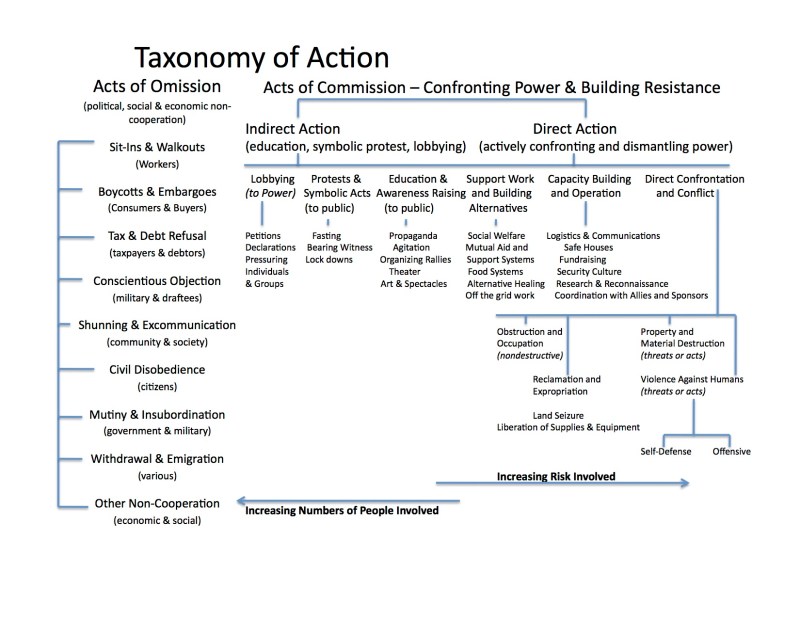
The Non-Profit Industrial Complex is a relationship between the Private Power, the State, foundations, the non-profit/NGO, social service agencies and sometimes social justice organizations. These relationships often result in the surveillance, control, derailment, and everyday management of political movements. The feminist group INCITE!, has identified the following ways in which non-profits function as it relates to private and state power.
- Monitor and control social justice movements;
- Divert public monies into private hands through foundations;
- Manage and control dissent in order to make the world safe for capitalism;
- Redirect activist energies into career-based modes of organizing instead of mass-based organizing capable of actually transforming society;
- Allow corporations to mask their exploitative and colonial work practices through “philanthropic” work;
- Encourage social movements to model themselves after capitalist structures rather than to challenge them.
 In looking at non-profits in Grand Rapids and their relationship to private power, it is easy to see that these organizations rely heavily on the very foundations run by the wealthiest families who make up the Grand Rapids Power Structure. The DeVos Family foundations, the Van Andel Foundation, the Secchia Foundation, the Cook Foundation, the Frey Foundation and the John & Nancy Kennedy Foundation. These foundations channel millions of dollars to local non-profits, which results in; 1) the non-profits will not speak out about the power these families have in influencing public policy, and 2) the non-profits will not look at the root causes of the issues they are organized to respond to. In fact, the members of the Grand Rapids Power Structure, through their efforts to influence public policy, are part of the root cause of the issues that non-profits are responding to.
For instance, look at the issue of poverty and economic inequality. Those in the sector of private power, spend a great deal of money to influence public policy to dismantle unions, end pensions & benefits, reduce public spending for social services and reap the benefits of taxpayer subsidies when they “develop” a new project. These dynamics are major contributors to lower wages, less of a safety net for people who are struggling economically, reducing or eliminating health benefits, plus an increase in housing costs that thousands in Grand Rapids can no longer afford. These same private sector individuals and families, then turn around and contribute funds to local non-profits to provide some services to the very people they have been undermining, except with non-profits they are encouraged to only look at the individual behavior of those experiencing poverty – managing their money better, getting more job training, starting their own business, etc., instead of developing a critique of how these systems function to oppress and exploit them in the first place.
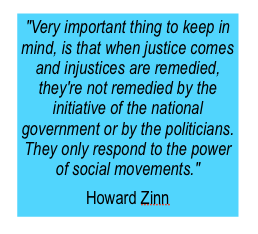
This is fundamentally the difference between non-profit organizations and social movements. Non-profits put bandaids on social problems and never really challenge the systems of power and oppression that cause the problems in the first place. Social Movements, on the other hand, seek to build the capacity of people to take power back into their own hands, to dismantle the systems of power and oppression that caused the injustices and to engage in collective, radical imagination to create a better world.
People can go to www.guidestar.org to look up the 990s that foundations must submit to find out which non-profits are recipients of their funding. Below is a sampling from a 2016 990 of the Doug and Maria DeVos Foundation. This sampling demonstrates that foundations from wealthy people are both designed to fund directly projects that these members of the power structure have helped to create (Grand Rapids Initiative for Leaders) and those which they know will not challenge their power (Grand Rapids Urban League or Hispanic Center of Western Michigan).

Other ways to secure the buffer role of non-profits is to have representatives of the Grand Rapids Power Structure sit on the board of directors of these organizations. For instance, the board of directors for the Hispanic Center of Western Michigan or Kids Food Basket, both have representatives of the local power structure. These relationships will guarantee that those non-profits will not do anything to threaten the system of power that exists. Again, they can provide some important relief to people who are suffering, but they offer no long-term solutions that ultimately challenges the systems and structures which caused the harm in the first place.
 Take, for example, the difference in how a non-profit like the Hispanic Center of Western Michigan engages the Latino/Latinx community compared to Movimiento Cosecha.
The Hispanic Center offers programs and services that will benefit individuals or families. These services and programs do provide relief to people who are struggling financially, who need translation services or who are working to gain certain legal status. The Hispanic Center has professional staff to assist these individuals and families to achieve certain goals and they rely heavily on grant money, which is provided by foundations. The Hispanic Center does not address the root causes of the problems that people who utilize their services are dealing with.
In contrast, Movimiento Cosecha GR is a social movement that has a much broader goal of winning dignity, respect and permanent protection for all immigrants. This movement utilizes trained organizers who will then train other people in the same skills. Those involved with Movimiento Cosecha GR are not paid and the fundraising they do is grassroots that relies on general community members to contribute. Cosecha GR has a power analysis and a theory of change to help them achieve their goals, along with the use of tactics and strategies that not only challenges the systems of power and oppression, they provide people with an opportunity to engage in collective liberation. Movimiento Cosecha GR is a horizontal organizations, where no one person is in charge and they do not have a board of directors to answer to. Cosecha GR is committed to addressing the root causes of the current immigration crisis in order to achieve immigrant justice.
In Part X of this series we will look at some of the organizations and movements in Grand Rapids that have the potential to achieve transformative justice, along with some ideas of how we dismantle the Grand Rapids Power Structure and create grassroots, autonomous movements for radical change.
Candidates, endorsements and Social Movements
 Last week I received a rather strange Facebook message, one that included a request.
I will not name the person who sent me the message, but for me it is an instructive commentary on electoral politics and social movements.
The message I received is the following:
Not sure I have your nerve, when it comes to civil disobedience (I did see you sitting down last week, right?) but I need folks like you to ‘like’ my campaign page and keep aspiring electeds close to the human costs of bad policy.
First, the candidate in question is not someone I have a relationship with. I only know them because of their involvement in the community, but we do not travel in the same circles.
Second, I was taken back right away when they said, “Not sure I have your nerve, when it comes to civil disobedience.” Since I have no relationship with this individual, it was rather puzzling to me that they were not sure if I was indeed one of the 7 people arrested on June 28th for engaging in civil disobedience against Kent County’s contract with Immigration and Customs Enforcement (ICE).
Third, in my mind I thought to myself, why would you not have the nerve to engage in civil disobedience. This person is a white male, with some class privilege, so why not be willing to risk arrest in order to draw attention to the fact that ICE is currently terrorizing immigrant families in Kent County? The risk to white men with class privilege, is not much of a risk to engage in civil disobedience. Those of us arrested only spent 6 hours in the Kent County Jail, since we had people bond us out, who also waited for us with refreshments and rides. It was more of an inconvenience, but not much of a risk, especially since it was only a misdemeanor charge.
For me, someone running for office would gain all kinds of credibility by joining in the struggle for immigrant justice and be willing to get arrested in order to resist the state repression being carried out by ICE in Kent County.
Civil disobedience has a long history, with millions participating in such as of resistance, whether it is for immigrant justice, anti-war resistance, worker justice, gender justice or engaging in actions against institutional racism and white supremacy. In fact, every major social movement in US history has used civil disobedience and civil resistance as a tactic to achieve their strategic goals. Using civil disobedience and civil resistance was integral in the abolitionist movement, the labor movement, the suffrage movement, the Civil Rights Movement, the Disability Justice movement, the farmworker movement, the environmental justice movement and many other social movements in the past of the present. More importantly, I would argue that civil resistance and civil disobedience as a strategy has been historically more effective than voting in terms of gaining the demands that these movement sought to win. This is essentially the theme of Howard Zinn’s book, A People’s History of the United States and it is a theme in numerous other books on US history, such as Frances Fox Piven’s and Richard Cloward’s book, Poor People’s Movements: Why They Succeed, How They Fail.
Remember that this candidate expressed that they were not willing to participate in civil resistance, and yet they wanted my support. The candidate went on to say, but I need folks like you to ‘like’ my campaign page. To this request, I simply ask, why? Why does this candidate need me to like their Facebook page? How will that further the cause of justice for immigrants and why are they unwilling to reciprocate any support for the cause to which I chose to get arrested for?
Political Endorsements are Backward
It is standard practice for people who run for office to seek endorsements from individuals and organizations that operate outside of the 501c3 world. Virtually everyone does it, from those running for local office all the way up to those seeking a seat in the federal government. But let me suggest that the notion of political endorsement is backward.
What if individuals and organizations got candidates to endorse their political vision? In fact, as a strategy, it would be even more effective, if groups of people and autonomous groups would come together to create a platform that candidates would endorse. Imagine of individuals and organizations would say, we will not vote for you unless you embrace this vision:
- Single Payer Health Care
- Free College Education for anyone
- An end to US Imperialism and a significant reduction to the US military budget
- An end to Corporate Welfare
- A Living Wage – $20 an hour as the new minimum wage
- Abolish ICE and the Prison Industrial Complex
- A 90% reduction of carbon emissions by 2050
- An End to Institutionalized Racism and White Supremacy
- Food Justice
- Permanent Protect for all Immigrants
- Safe, Affordable Housing for All
This list could be longer, but the point here is, when are we going to start creating a platform and a vision for what we want instead of just continuing to give our vote away to candidates who have rather vague commitments to progressive politics? If they want our votes, then the should have to earn them by standing for what it is that we collectively want to see happen in the world. Of course, maybe a system of representative democracy is not really suited to bring about the kind of radical, transformative politics we need.
Let us all develop the nerve to engage in civil resistance, since the future depends on our collective ability to take risks.
Betsy DeVos Watch: A Corporate Education Appointment and Students as Workforce Development
 In April, we reported on the Department of Education adding another anti-civil rights lawyer, Carlos G. Muñiz. In late June, Secretary of Education, Betsy DeVos, announced yet another confirmation to the Department of Education, Frank Brogan.
Brogan has served in several different educational capacities and will serve as Assistant Secretary of Elementary and Secondary Education. Brogan is the former President of Florida Atlantic University and was later Lt. Governor of Florida in Jeb Bush’s administration. The last position that Brogan held was Chancellor of the Pennsylvania State System of Higher Education.
During Brogan’s tenure in Florida he supported redirecting public money to private schools and the downsizing of educators within the public school system. As the Washington Post reported recently, Brogan was part of Jeb Bush’, “corporate school reform movement that sought to operate public schools as if they were for-profit businesses.” Thus, adding Brogan to the Department of Education is consistent with the education privatization model that Betsy DeVos has been pushing since she became Secretary of Education in 2017.
Students as Workforce Talent
One of the trends in the attack on public education is recent decades has been the way that the business community has framed the role of students. Students are no longer thought of as developing critical thinking skills or as being engaged in the humanities, students are now seen as talent. For the business community, they see students primarily as future employees and they want students to have the skills needed in order to join the workforce.
In West Michigan, this narrative about students is embraced by the leading CEOs in the area, through a group known as Talent 2025. Talent 2025 is one of the organizations that is part of the Grand Rapids Power Structure.
Betsy DeVos has been promoting student development as talent development for the business community long before she became Secretary of Education. So, it’s no surprise that the Secretary of Education would attend and speak at the annual conference for SkillsUSA.
SkillsUSA is a national organization that promotes a relationship between students, teachers and businesses for the purpose of developing future employees. SkillsUSA has numerous corporate partners, such as 3M, General Electric, Lowes, Snap-On and State Farm.
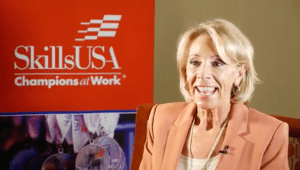 Betsy DeVos spoke at the SkillsUSA annual conference and competition in late June. In her speech at SkillsUSA, DeVos uses this opportunity to not only talk about career development, the Secretary of Education also used this platform as an opportunity to talk about the “need” to fill jobs in the manufacturing sector.
In her speech, Secretary DeVos stated:
We’re fundamentally reevaluating what we do and how we do it. Washington’s bloated bureaucracies do not meet the needs of our global economy and labor market, and they create artificial barriers between education and workforce programs.
This statement makes it clear that what Betsy DeVos is ultimately interested in, as far as students are concerned, is the expansion of US markets. More specifically, the expansion of US markets, through the eyes of Betsy DeVos, really means increased corporate profits. This ethos of education as profit making was underscored by last week’s announcement that the Trump Administration wants to merge the US Department of Education with the Department of Labor.
 There are many things that we are taught to believe about the United States of America. We grew up reciting the Pledge of Allegiance without understanding or critically investigating the words. We are taught to blindly accept that the Founding Fathers were great defenders of liberty, without knowing that many of the signers of the Declaration of Independence were slave owners.
However, we can fight back against the nationalistic tendencies that most of us are raised with and we can begin to seek out deeper truths about the US. The great abolitionist Frederick Douglass said this about the Fourth Of July, in a speech he gave in 1852:
“What, to the American slave, is your 4th of July? I answer; a day that reveals to him, more than all other days in the year, the gross injustice and cruelty to which he is the constant victim. To him, your celebration is a sham; your boasted liberty, an unholy license; your national greatness, swelling vanity; your sounds of rejoicing are empty and heartless; your denunciation of tyrants, brass fronted impudence; your shouts of liberty and equality, hollow mockery; your prayers and hymns, your sermons and thanksgivings, with all your religious parade and solemnity, are, to Him, mere bombast, fraud, deception, impiety, and hypocrisy — a thin veil to cover up crimes which would disgrace a nation of savages.There is not a nation on the earth guilty of practices more shocking and bloody than are the people of the United States, at this very hour.”
The contradiction of the 4th of July is evident to people who dare to look closely at the history of the United States. Indeed, the contradictions are self-evident even today. While many people across the country gathered yesterday for a cook out, witnessed the spectacle of fireworks or attended one of the many parades that took place in West Michigan, there were people who were unwilling to accept the dominant narrative about the 4th of July.
About 50 people participated in an action yesterday organized through Movimiento Cosecha GR. The action took place in East Grand Rapids during the 4th of July parade that made its way on Wealthy Street for just a few blocks in downtown East Grand Rapids.

Movimiento Cosecha GR set up for mock cages of detained children and families, like what we have been seeing near the US/Mexican border in recent weeks. In additions to the mock detention cages, there were several banners that were held on both sides of the street, calling for an end of the contract that the government of Kent County currently has with Immigration and Customs Enforcement (ICE). 
The action yesterday, is a follow up to the larger action that took place last Thursday, where some 200 people came to the Kent County Commission meeting to demand that the county end their contract with ICE.
In addition to the mock cages and banners, people were chanting “End the Contract,” especially when politicians and candidates were walking past the crowd. As is the case for most fourth of July parades, the bulk of those participating in the parade were candidates or people currently holding office. Rep. Justin Amash walked in the parade, as did Winnie Brinks, who is running for a State Senate seat in Michigan. There were also current Kent County Board Commissioners, specifically Phil Skaggs and Robert Womack. Those taking part in the action were sending a loud message to both of these commissioners to End the Contract, as not one single Kent County Commissioner has come out against the contract since the commissioners were confronted at the June 28th meeting.
The only movement on the issue of the county’s contract with ICE, was a Facebook posting proposal from Commissioner Jim Talen on June 28, who stated:
At the end of today’s meeting, my colleague Dave Bulkowski and I both asked Chair Saalfeld to consider appointing a task force to take a look at what can be done to address the concerns that were shared.
Many have responded to this proposal to have a task force with swift criticism that it is only a way to distract or re-direct the people from demanding an end to the contract that Kent County has with ICE.

We know that ICE is arresting and detaining immigrants on a weekly basis in Kent County. ICE is separating families and terrorizing the immigrant community, which is exactly what the County Commissioners were told during the June 28th meeting.
Back to yesterday’s parade.
On a few occasions, those who participated in the action also sang songs. One song, a old labor song, included the lyrics, “which side are you on.” One strategy that Movimiento Cosecha uses is the strategy of polarization. Movimiento Cosecha will take a public stand on immigration, like the County’s contract with ICE, and see how the public responds to the issue. The public will be polarized to either join Movimiento Cosecha in their call for an end to the contract with ICE or they will reject it and side with those who support oppression.
The whole point of the action yesterday, was to polarize people and see which side they are on with this issue. In addition, to the mock cages, the banners, the chanting and songs, there were people conducting interviews with those attending the parade, asking them what they thought about the issue of freedom on the 4th of July, while children and families are being detained by ICE at the border and in Kent County.
Lastly, people were handing out information about upcoming meetings and actions related to the Kent County contract with ICE. Activist were also asking people to sign a petition, demanding that Kent County end their contract with Immigration and Customs Enforcement, which you can sign here.
In addition to signing the petition, Cosecha GR and GR Rapid Response to ICE are inviting people to take part in several upcoming events and actions that challenge the legitimacy of ICE in Kent Count.
Movimiento Cosecha GR has an Ally Training on Monday, July 9th and GR Rapid Response to ICE has their next monthly training on Thursday, July 19th. There is also a Facebook group called, End the Contract, which people are encouraged to join and get regular updates on this campaign.

