GRPD’s recent detaining of black youth was just following procedure and it was racist
 In late August, the GRPD received a call stating there were black youth with a gun seen in the area of Alto Avenue and Griggs Street SE. Several blocks later the GRPD stopped three black youth, at gunpoint, then handcuffed them and put them into a police cruiser. It was then determined that none of the black youth stopped had a gun and they were no longer suspects.
This incident took place just a few days after GRPD officers surround the house of a Latino family, detained and handcuffed the father for an hour, even though it was eventually determined he did nothing wrong.
On August 30th, Grand Rapids Police Chief David Rahinsky responded to questions from local media about the police stopping at gunpoint 3 black youth in the southeast part of Grand Rapids. You can watch the video of the news conference with Rahinsky by going to the GRPD’s Facebook page pasting for August 31st at 2:38PM.
The video doesn’t reveal a great deal, but it does demonstrate that Rahinsky has received a great deal of training in how to deal with the media. Rahinsky was questioned about racial profiling and the mother’s reaction to the way her son was treated. Chief Rahinsky kept referring to the mother’s response as “emotional” and that once she sees the video the cops have, she will better understand what happened.
Like so many people in positions of power, Rahinsky is dismissive of the mother’s reaction to the way her son was treated and labeling it as “emotional” is patronizing and arrogant.
In the press conference, Rahinsky essentially defends what his officers did in this situation and says that it follows the GRPD’s Youth Interactions Policy. Looking at the policy, it seems like the GRPD officers did act accordingly. In fact, I would say that based on the history of policing in the US and how policing actually functions, that Rahinsky is right to support how his officers responded to this incident.
Now, don’t get me wrong, I am not agreeing with how the youth were treated by the GRPD. I loathe and detest the kind of harm and trauma that people in this community experience at the hands of the GRPD on a regular basis, particularly people of color. However, let’s be honest about the behavior of the GRPD in this case, as they did follow procedure. But just because someone follows procedure, doesn’t make it right.
The GRPD officers were doing what they are supposed to do, because this is exactly what police departments do. Alex Vitale, in his important book, The End of Policing, states:
“Well-trained police following proper procedure are still going to be arresting people for mostly low-level offenses, and the burden will continue to fall primarily on communities of color because that is how the system is designed to operate – not because of the biases or misunderstandings of officers.”
The GRPD apprehension of the black youth in the southeast part of Grand Rapids because they fit the description of someone who had a gun, is what they do. The police behavior is the norm and it is normalized because it is based on a long-standing historical practice of white supremacy, which means that communities of color are more heavily policed than other communities.
What we need to do is stop being surprised when this kind of harm by the police is done to people from black and brown communities. We need to organize and resist this kind of state violence, but we need to stop believing that their actions are abnormal. The hyper-policing of black and brown communities is the norm, because this is the function of state violence within the framework of white supremacy.
The power and potential of organized Immigrant Labor: Labor Day Part III
In Part I of this series we looked at the growing wealth gap in the US and in Michigan, along with how communities of color disproportionately are impacted by poverty.
In Part II, we looked at how most major organized labor groups have hitched their cart to the Democratic Party, which has led them to a decline in membership and why they need a new strategy.
In today’s post, we want to look at the power that immigrant labor has and why it is important for those of us who have privilege in this society to support the organizing efforts of immigrant labor.
In the 1960s and 70s, the United Farm Workers (UFW) demonstrated to the American people that when organized, migrant labor and immigrant labor has tremendous power. Led by people like Dolores Huerta and Cesar Chavez, the UFW brought the big agriculture to its knees with their grape and lettuce boycotts.
This type of organized labor power is still being demonstrated today, with groups like the Coalition of Immokalee Workers (CIW). The CIW is not only exposing the exploitative nature of agribusiness, they are showing how migrant and immigrant workers have tremendous power to make change.
Immigrant labor, whether it is in the fields, in the restaurants or other service industries,when organized, has the capacity to bring the country to a stand still. Think about it. Immigrant labor is what give us our food……they pick our fruits and vegetables, the work in the slaughterhouses and they are the fastest growing sector of restaurant kitchen and wait staff.
At the same time, the working conditions of immigrant labor in the food sector, along with the disgustingly low wages, means that agribusiness and the restaurant sector is able to make huge profits. When these workers are organized, like the CIW, they are able to demonstrate the power that immigrant labor has.
In West Michigan, the capacity of immigrant labor is one of the largest in the nation, after California and Florida. There is a large concentration of immigrant/migrant farm workers in West Michigan. The unfortunate reality is that this labor force is not organized and there is no effort on the part of the mainstream unions to provide support for these workers to organize themselves so that they can demonstrate their power.
Imagine for a moment, if the mainstream unions in West Michigan gave the same amount of money they contribute to the Democratic Party every election cycle and instead re-directed those funds to immigrant laborers. Imagine what would happen if these workers who pick, prepare and serve our food in West Michigan had their own union. Imagine how the both white conservatives and white liberals would react. Would people who don’t do this kind of back breaking work, offer their support for such a union?
What would happen during ArtPrize, if those who picked, prepared and serve food would all of a sudden go on strike? What if those who went on strike would also refuse to clean the hotel rooms and change the linen for all those tourists who are coming to look at art in the coming weeks? What would people do if they couldn’t drink craft beer, because those who harvest the hops in Michigan and beyond, all of a sudden went on strike demanding better wages and working conditions?
If those who work in these sectors went on strike, it would cause the economy to come to a halt AND it would demonstrate the power that immigrant labor has in this community and across the country. Just imagine the possibilities.

Once you are done imagining the possibilities, then do something about it. First, you could support the efforts of Movimiento Cosecha GR, which is always working with immigrant labor in West Michigan and every year is calling for a general strike around May Day. Second, if you are part of a union, propose that the labor union you have a membership in, provide financial and technical support to immigrant laborers who want to organize where they work. Lastly, get your church, your faith community, your neighbors, your co-workers or any other group of people that is not self-absorbed to educate themselves on how dependent we all are on immigrant/migrant labor in the US.
Workers and unions need a new strategy: Labor Day Part II
In Part I of this series, we looked at the growing wealth gap in the US and in Michigan, along with the data around poverty, especially within communities of color. In today’s post, we want to take a critical look at campaign financing that comes from organized labor and what that means in terms of advancing the struggle for worker rights and worker justice.
 Labor unions were formed with the primary objective of defending workers rights, pushing for worker demands and to create workplace democracy. There have been some unions in the history of the US, particularly the IWW, that was fundamentally against capitalism, but still fought for workers rights and workplace democracy. However, most unions have not made the abolition of capitalism a goal, instead they have focused on worker conditions, wages and workplace democracy.
Organized labor unions have fought and won the 8 hour work day, workers compensation, workplace safety, better wages, pensions, improved workplace environment and the abolition of child labor. These were all victories that workers fought for, since they were never a gift from bosses, corporations or members of the capitalist class. For an important overview of this history, see From the Folks Who Brought You the Weekend, by Priscilla Murolo and A.B. Chitty.
However, since the end of WWII, labor union have been losing ground on numerous fronts. The number of workers in the US that are part of a labor union has steadily declined since the 1950s. The Taft-Hartley Act of 1947 was a major blow to workers, since it attempted to make strikes, particularly wildcat strikes illegal.
The de-industrialization in the US, also weakened worker unions, as did the rise of globalization, which included trade agreements that fundamentally undermined unions and workers rights in general. However, a major factor in the weakening of organized labor has been its decision to attach itself to the Democratic Party, especially i the past 50 years. Now, before people dismiss this point, I ask you to think about 2 things. First, how much money have unions and their members dished out in recent decades to support Democrats, and second, how has that money resulted in worker justice and increased workplace democracy?
Unions and the Financial backing of the Democratic Party
If we look at the data provided by the Center for Responsive Politics, we can see what the major unions have contributed to the Democratic Party since 1990. Lets take a look at four examples, especially four of the major labor unions in the US; the United Auto Workers, the AFL-CIO, the National Education Association and the American Federation of State, County and Municipal Employees.
Since 1990, the UAW has contributed nearly $55 million to Democrats and spent another $40 million to lobby members of Congress.
The AFL-CIO has contributed just shy of $66 million to Democrats and spent another $91 million lobbying Congress.
AFSCME has contributed $116 million to mostly Democrats and another $47 million to lobby Congress.
The National Education Association has contributed $128 million to Democrats and another $53 million on lobbying Congress.
This means that these four major unions combined have spent $365 million to influence elections and another $231 million to lobbying those already elected. What this says is that these four unions have used $596 million of their members money to try to influence election and policy at the federal level since 1990.
In Michigan, the trend is not much different. If you look at the data provided by the Michigan Campaign Finance Network (MCFN) for all the state races in the 2018 election, you will see that the Democratic candidates have received hundreds of thousands from various labor unions within the past 18 months and will continue to receive thousands more before the November election. In addition, some of the largest Political Action Committees in the state are labor unions, which you can also see from the MCFN.
A more specific example of how unions have spent money during an election cycle, was in 2012, when unions spent $21.9 million to pass Proposal 2. The business community however, spent $25.9 million to defeat the measure, which it did. Just after the November election in 2012, there was a major rally held in Lansing, where some 10,000 workers and allies came to protest the austerity measures being passed by the state, particularly making Michigan a Right to Work state. Unfortunately, instead of occupying the capitol building or shutting down Lansing, most of the rally organizers proposed that they get their people elected in 2014……….which didn’t happen.
What have unions and workers won with millions going to the Democrats?
It will be argued that if unions did not support Democrats with millions during elections in recent decades that the GOP would have pass even more draconian laws to further weaken labor laws and give private capital even greater power. This may be true to some extent, but what such an argument doesn’t take into account, is the fact that in the heyday of the labor movement – late 19th Century through 1945 – is that workers won a great deal without primarily aligning themselves with the Democrats. In fact, what labor historians have made clear is that the labor movement, by engaging in massive organizing efforts and using direct action were the reasons why they won so many labor disputes.
In more recent decades, say during the years that the 8 years of the Clinton administration and the 8 years of the Obama administration, we need to ask what major labor victories took place? My read on those years was that there were no major labor victories, but there was a steady decline of union membership and numerous set backs for working people. Think of the number of trade agreements that were enacted since 1992, when NAFTA went into effect. The massive WTO protest in Seattle took place in 1999, while Clinton was in the White House.
During the Obama years, the only significant thing that organized labor asked from the Obama administration was to not sign on to more trade policies like the TPP and to pass the Employee Free Choice Act (EFCA). The TPP did not pass, despite the Obama administration’s support of it and the EFCA never got any traction. Again, unions may argue that if they had not financially backed Democrats then workers would have lost more ground.
Time for a new Labor Movement/Labor Strategy?
Ok, so lets say that organized labor decides to stop funding the Democratic Party and instead focuses on movement building. Union members could still vote for Democrats if they chose, but they could be part of a new labor movement that would not be beholden to political parties and could actually affect change.
There are already some signs to workers and unions pushing for more transformative justice. There is the $15 an hour movement, the numerous teacher strikes across the country and there are efforts to organize workers from corporations like Amazon. However, these efforts are often unconnected and they are not primarily focused on workplace democracy.
First, what if organized labor used the funding that they would have put towards elections and use it for paying people to organize shops and other work places? Not only would this scare the shit out of the capitalist class, it would give more workers an opportunity to be part of a union that actually fought for them. This kind of union organizing should also take place outside of specialized work and organize migrant labor, service sectors, restaurant workers and the unemployed.
Second, workers could engage in wildcat strikes, walkouts or other forms of direct action that would force companies to the table. In demonstrating their power, workers could negotiate wages, benefits and workplace dynamics that would result in victories. As individual shops and work places win labor battles, these same unions could join other labor struggles and support workers who were fighting get get a union and all the possibilities that come with being organized.
Third, unions could re-direct the money that they were spending for elections and lobbying to provide mutual aid to families that are experiencing poverty, facing foreclosure or any other economic hardships, including the corporate-driven health care costs. Not only would this kind of mutual aid help build relationships with working class people, it could result in an increase in union membership.
Fourth, what is the labor movement began to develop their own independent media. The commercial media will not represent the collective struggles of workers, in large part because they are dependent on advertising dollars from the very entities that exploit workers. We used to have a lively labor press in the US, but so little of that exists now. We need an independent media that tells the stories of the people whom the commercial media ignores. With an independent media, more people will have access to information that the commercial media marginalizes or represses. I’m not talking about just online media, I’m talking about labor-based press, a newspaper that is run by and for workers. Such a tool and other forms of media are weapons we need in the war of propaganda that the capitalist press is winning.
These proposals are not necessarily new, since much of what we have been talking about has been done before, with a great deal of success. However, we do need to do some things differently from what organized labor has done in the past.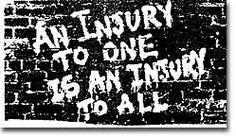
Fifth, the worker-led movement needs to also connect to other movements around fighting white supremacy, patriarchy, ablism, homophobia, transphobia and fighting for food justice, immigrant justice and climate justice. Class issues can bring us together, but only if we do not make class the center of all justice struggles. The new work-led movement needs to be intersectional and transformative and not settle for just fighting against capitalism, but creating new economic systems that are democratic, local and multifaceted. We can take a cue from the wobblies who believed that, “An injury to one is an injury to all.”
Inequality in Michigan is business as usual: Labor Day Part I
As we approach Labor Day 2018, it is always important for us to pause for a moment and look at the realities of the economy in Michigan.
We constantly hear in the commercial news media, from the business press and from politicians that the economy is doing well and has recovered from the 2007-2008 crash. We are also reminded by the capitalist class in West Michigan that the economy is strong and that those with tremendous wealth are working to make the economy even stronger.
However, the question we should always ask is for whom is the economy strong……..who benefits? In 2016, we reported that Grand Rapids had the largest wealth gap of any city in Michigan. It that report we documented that there were 600 millionaires in Kent County alone. The one percent class continues to grow daily, with the wealth gap growing at an unprecedented level. The new graphic below, shows by state, how much money one needs to make to be part of the one percent class.
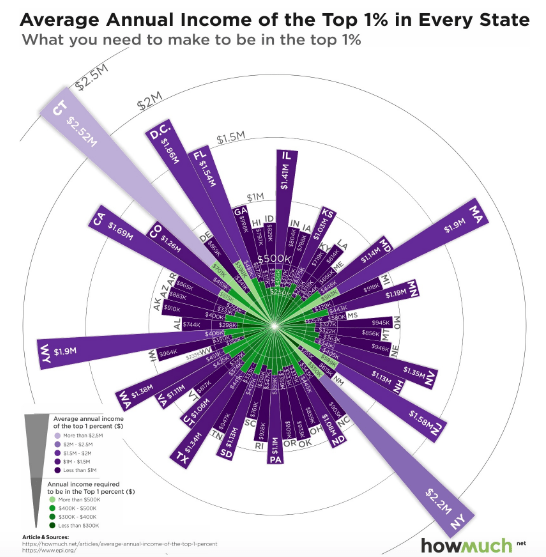
In Michigan, according to this data/graph, you need earn $918,000 to be part of the one percent class. In West Michigan, we know the names of some of these one percenters, like DeVos, Van Andel, Secchia, Jandernoa, Kennedy, Hunting, etc, which also happens to be the class of people who spend a great deal of their time working to influence public policy, through groups like the West Michigan Policy Forum.
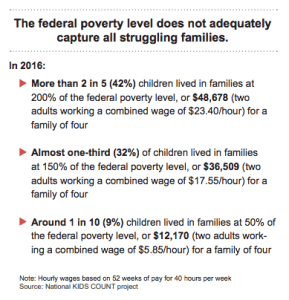 In contrast, there are huge sectors of the population across the state and right here in West Michigan, who are struggling to stay alive. According to a new report from Prosperity Now, 29.2% of Michigan households live in poverty and 49.4% of renters in Michigan are cost burdened.
The national trend isn’t much better. According to the Kids Count national data, as you can see in the graphic here on the right, millions of families are experiencing poverty while the wealth gap continues to grow.
This dynamic of family and child poverty disproportionately impacts communities of color, with African American, Native American and Latino/Latinx communities suffering the worst of the wealth gap. The data below comes from the 2018 Kids Count report.
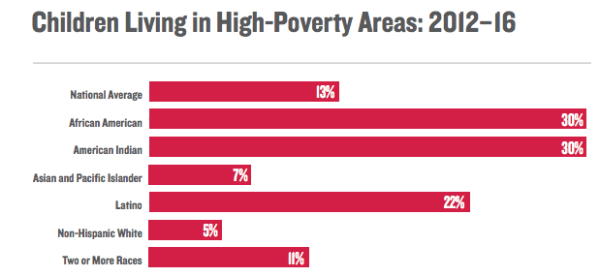
 In Michigan, the data for children living in poverty, especially children from communities of color, demonstrates the deep racism and white supremacy that permeates the structural realities for millions across the state. (see graphic on the right)
This data is disturbing, but we have to come to terms with the fact that it is the result of how policy works and how it benefits the one percenters in this state. This wealth gap, with so few having so much, with so many having so little, is by design.
Those who craft policy, who contribute the most to political campaigns and who are part of the one percent class, benefit from the poverty of families and children, especially families and children from communities of color.
There are the occasional news reports about this kind of poverty and the structural racism that is part of it, but those few stories are drowned out by the constant celebration of new market rate housing developments, the new breweries, the new restaurants, the ongoing development stories and the stories about the benevolence of the one percent class “who give us so much.”
Make no mistake about it, there is a class war going on and the one percent class, the business class, the capitalist class is winning……………but it doesn’t have to remain that way. In Part II of our Labor Day series, we’ll look at the status of unions in Michigan and how we need to imagine a different strategy for working class families.
 A new zine, created by one of the arrestees, is a great introduction to issues like civil disobedience, immigrant solidarity and the campaign to end the contract that Kent County has with ICE.
 The 23-page zine also has great visuals that walks people through every step of an action that took place on June 28th of this year, when 7 people engaged in civil disobedience to shed light on the current contract that Kent County has with Immigration and Customs Enforcement (ICE).
This One Small Thing looks at the action, the groups involved, the arrest  process, being booked into the Kent County Jail, the jail food, the legally required phone call, the visit with the nurse and the bonding out process, along with the amazing support that was offered to those who chose to participate in the direct action.
You can download the entire zine at this link and we encourage people to share it as the campaign to End the Contract is still happening, with an action coming up on September 13th.
2018 West Michigan Policy Forum Conference seeks to develop a strategy to further undermine public education and labor unions
 We are only one month away from the 2018 gathering of the state’s most powerful people, at what is called the West Michigan Policy Forum Conference.
On September 24th, the West Michigan Policy Forum will hold its bi-annual conference to determine and work on policy that benefits the interests of the state’s capitalist class. According to the promotional narrative for the conference, the West Michigan Policy Forum states that it will, “set an aggressive 2018-19 state policy agenda to keep Michigan moving in the right direction.”
The focus for this year’s conference will be on workforce development and talent development. Both of these terms are simply code for how to transform educational systems in to creating obedient workers that will benefit the business community.
The current Chairman of the West Michigan Policy Forum (WMPF), John Kennedy (also CEO of Autocam), recently wrote an op-ed for the Detroit News about the upcoming WMPF. In that op-ed, Kennedy writes:
“As business leaders, it’s our responsibility to help Michigan keep its position as a welcoming home for both companies and employees. We need to ensure that our children have access to excellent education and that our families have the quality of life they deserve.”
However, we have heard these claims before. In that same op-ed, Kennedy makes it clear what happens at these conferences and what they have achieved in the past 10 years – killing the Michigan Business Tax, the personal property tax, making Michigan a Right to Work State and pushing through legislation to take away pensions for teachers and other workers in the public sector.
The conference this year, like all previous gatherings, is to create an agenda for how to change state policy. Look at the line up of speakers that the 2018 conference will feature:
- Tawni Hunt Ferrarini – The Hammond Institute for Free Enterprise at Lindenwood University on Understanding our State’s Fiscal Health
- Tony Seba, Stanford University
- Doug DeVos – Re-think” Talent and Education
- Arthur Brooks, American Enterprise Institute on Back to Work” – Moving People Back to Work: Why Work Matters
- Dr. Edward Montgomery, Western Michigan University on Michigan Investment vs. Results in K-12 Education
- John Kennedy, CEO Autocam Medical on Increasing Michigan’s Prepared Workforce of the Future
- Jeb Bush, former Governor of Florida on Florida’s Education Story: A-F Policy for School Buildings
- Dr. Steven Perry – An avid promoter of charter schools, Dr. Perry has been criticized for his aggressive anti-teachers union stance. And last year, the educator was accused of perpetuating “respectability politics” for suggesting dreadlocks and afros did not promote an “aesthetics to success.”
For those who care about public education and labor unions, the strategies that this conference will be developing are vitally important to us to understand. Not only is it vital for us to understand what the business class is up to when it comes to education and labor, we need to resist it and make sure that their plans are defeated.
Three families from West Michigan are in the top 15 across the state for election contributions
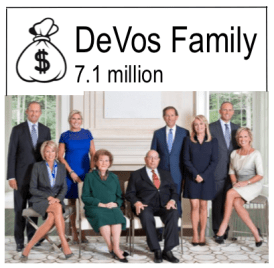 More campaign finance data is being tallied in Michigan and we now know which wealthy families are contributing more money to influence the upcoming November election.
The Michigan Campaign Finance Network lists the top 15 families in Michigan that have contributed the most to the current election cycle. Topping the list was failed Democratic Gubernatorial candidate Shri Thanedar, who contributed $10.7 million.
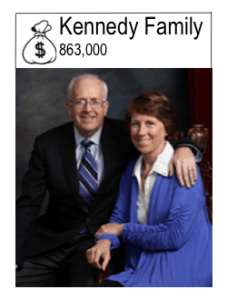 Coming in a close second was the DeVos Family, spending $7.1 million in the current election cycle. Interestingly enough, the DeVos Family was not the only member of the West Michigan capitalist class in the top 15 in the state of Michigan. Coming in 10th place is the Kennedy Family, which contributed $863,000, followed by the Jandernoa Family coming in 15th place, with a total of $592,000 in contributions to influence the November election.
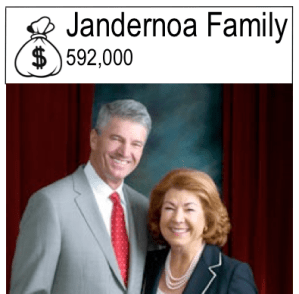 In our recent series on the Grand Rapids Power Structure, we looked closely at the DeVos Family in Part II of the series, and in Part III we looked at other members of this elitist group, which included John Kennedy and Michael Jandernoa.
It is no surprise that DeVos, Kennedy and Jandernoa are involved in many of the same organizations in West Michigan that also work hard to influence state and local policy, such as the West Michigan Policy Forum, the Right Place Inc, the Acton Institute, Talent 2025 and Business Leaders for Michigan.
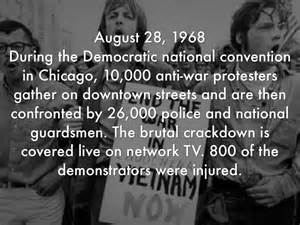 1968 was a year that saw the assassination of Martin Luther King Jr and Presidential hopeful Bobby Kennedy. However, 1968 also saw revolution happening on a global scale, with insurgent movements challenging oppressive governments.
In the US, the anti-war movement was just getting started in its opposition to the Vietnam war. People were refusing induction, US troops were going AWOL and starting their own newspapers that exposed US imperialism. US soldiers returning from the war in Vietnam had energized the anti-war movement, so much so that the movement began to challenge those in power.
Anti-war organizers then came to the 1968 Democratic National Convention in Chicago, attempting to push the party to adopt an anti-war stance as it related to Vietnam and the rest of Southeast Asia.
Chicago Mayor Richard Daley wasn’t having any of it, calling on the police to crack down on anyone who intended to disturb the convention. With TV news crews broadcasting live, the whole nation witnessed a Democratic Mayor order the police to beat anti-war protestors at the Democratic National Convention.
Such a display of utter contempt for popular protest by the Democratic Party led many people in the movement to abandon the belief that electoral politics was a mechanism for real change. Of course the Democratic Party lost the Presidential election to the Republican candidate Richard M. Nixon and Congress (still controlled by the Democrats) continued to vote for massive military expenditures for Vietnam, sending tens of thousands of US soldiers to die and more than a million Vietnamese civilians.
The belief that change outside of electoral politics increased after the 1968 elections on numerous fronts. The black liberation movement also didn’t put faith into electoral politics and militant organizations sprung up all over the country. There was the Black Panther Party for Self-Defense, which not only believed in self-defense, they also practiced radical mutual aid by implementing breakfast programs and drug rehabilitation programs throughout the country. This same type of organizing led to groups like the American Indian Movement, the Chicano Liberation Movement, the Young Lords and other identify-based groups to take matters into their own hands instead of trusting the government.
At the same time the LGBT movement had also become more militant with the 1969 Stonewall Riot and the formation of groups like the Gay Liberation Front. The various strains of the US feminist movement also began generating more attention with their actions around sexism, gender inequality and reproductive justice. We often forget that the US Supreme Court ruled in favor of reproductive rights for women in 1973, even though the President was Richard M. Nixon.
The labor movement also took to more militant tactics by using wildcat strikes, organizing against speedups, with major victories in the coal mines, the agricultural sector, the automobile industry and at the post office. In fact, with these labor victories it was the peak period for real wages, which have been steadily declining for decades, along with union membership.
All of this direct action and all of this organizing was being done primarily outside of electoral politics and it was working.
Lessons for Today
- Political and social movements can and should exist outside of electoral politics.
- Electoral politics might complement the work being done by movement organizing, but it can never replace it. When voting is a tactic, it can be an effective tool. When voting is a strategy it is the death of social movements.
- The social movements of the late 60s and early 70s were movements NOT non-profits. Social movements work on the root causes of injustice. Non-profits provide services to individuals who are facing a crisis. It’s no surprise that the rise of non-profits began just after the radical movements of the late 60s and early 70s.
- Considering how much more money is being injected into electoral politics today (Billions) think of how that kind of money could support local and national movements. What if Unions gave the same kind of money to families living in poverty as they do to candidates? Not only would financial support for people likely result in an increase in union memberships, it would assist in building a larger base of support to engage in direct action to unionize places of employment all across the country.
- Social and political movements should remain autonomous from political parties. Social and political movements that are tied to political parties end up having little say in party politics and their issues are often ignored by political parties because, “we have to focus on getting our people elected first.”
- If social and political movements practiced a more intersectional analysis, it would allow them to see how their issues are interconnected and give them greater opportunity to collaborate on actions. The current abolish ICE/immigrant justice movement and the abolish prisons movement are essentially working towards the same goals and if their collective analysis saw how immigrant detention facilities and prisons were the same or how cops and ICE officials were essentially the same, they would be more likely to support each others struggle. We are seeing some of this now with the National Prison strike and the Abolish ICE movements. This is largely because these movements are being led by those most impacted, those who are currently prisoners and the immigrant communities.
- Autonomous and independent social movements that engaged in direct action and demonstrated their power would ultimately force political parties to ask what they can do for these respective movements. Right now social movements are constantly being shamed by political parties to support their candidates and turn out their people to vote. If social movements were autonomous and demonstrated their power, political parties would be forced to seek out movements for their marching orders. Of course, if social movements were strong enough, we wouldn’t need political parties as we could eventually transform communities that no longer need representation or political parties which have made it clear that they only serve their own interests.
Yesterday, after those involved with the End the Contract campaign had left the Kent County Commission meeting, Commissioner Antor spent over six minutes defending the county’s contract with ICE by using the same narrative that the current administration does.
Commissioner Antor also said several other things in his attempt to “set the record straight,” comments which we want to deconstruct. However, we are posting the video here so that people can draw their own conclusions based on the comments of Commissioner Antor.
One of the main themes of Commissioner Antor’s comments was that ICE was not arrested people just because they are “illegal aliens” ( he actually referred to undocumented immigrants as illegal aliens), but because they were dangerous people. The claim that undocumented immigrants are dangerous – murderers, rapists, etc – was a narrative that Donald Trump used during his 2016 campaign for President and it has been a narrative that he has continued to use within the past few months.
The number often cited by the current administration is that undocumented immigrants have killed 63,000 people since September 11, 2001. There are numerous media sources that have refuted this claim, beginning with Snopes.com, which dismantled this claim this past June.
If you are suspect of Snopes.com, then we only need to turn to more mainstream sources such as the New York Times, the Washington Post or National Public Radio, all of which has fact checked the claim that undocumented immigrants are dangerous murderers. The NPR story is particularly compelling, since they cite four separate studies to refute the meta-narrative that undocumented immigrants are dangerous criminals.
It was interesting that the only sources that Commissioner Antor cited were Immigration and Customs Enforcement and the Sheriff’s office. Antor cites these sources as if they are unbiased and factual, because of course law enforcement agencies would not lie or mislead the public. Or would they?
Earlier this year, the International Human Rights Clinic (based in Chicago) obtained through the Freedom of Information Act some 4,600 pages of documents from the Department of Homeland Security, demonstrating widespread abuse of immigrant children who were in detention.
In April of this year, the investigative online journal, The Intercept, discovered that there were over 1,200 of sexual abuse of immigrants in US detention, mostly at the hands of ICE officers. The Intercept also found that even though over 1200 complaints were filed that only 43 were investigated.
This counter narrative confirms the information that those involved with GR Rapid Response to ICE have been sharing about the weekly calls they receive from immigrant families that have been impacted by ICE arrests and detentions. What GR Rapid Response to ICE has been hearing is that most people are being picked up by ICE for minor infractions, not for “dangerous” criminal behavior.
Another point that Commissioner Antor made in his remarks was that the number of ICE arrests that required beds at the Kent County Jail was trending down. What those of us in the End the Contract campaign have been saying over and over again is that even one family that is being terrorized by ICE is too many in Kent County.
Commissioner Antor then makes a comment about how the ICE arrests and deportations did not begin under the current administration, but with the Obama administration and why were those protesting not acknowledging this. First, ICE arrests and detentions began during the George W. Bush administration, when ICE was created. Second, the End the Contract protests have always acknowledged that ICE arrests, detentions and deportation under the Obama administration were unjust. In fact, if the commissioners ever bothered to ask or look into Movimiento Cosecha they would realize that this movement began by Latino/Latinx youth who forced the Obama administration to adopt DACA. However, those same youth that gave birth to Movimiento Cosecha also then wanted protections for their parents and other family members who were facing deportation, so the truth is that resisting the ICE and anti-immigration policies of the Obama administration is what brought about the movement.
In addition, the fact that the current End the Contract campaign is only now challenging the County about their ICE contract, is because the campaign only found out nine months ago that Kent County even had a contract with ICE. What really pisses off Commissioner Antor, the other commissioners and the Sheriff’s Department is that fact that Movimiento Cosecha GR and GR Rapid Response to ICE has made the county’s contract with ICE public.
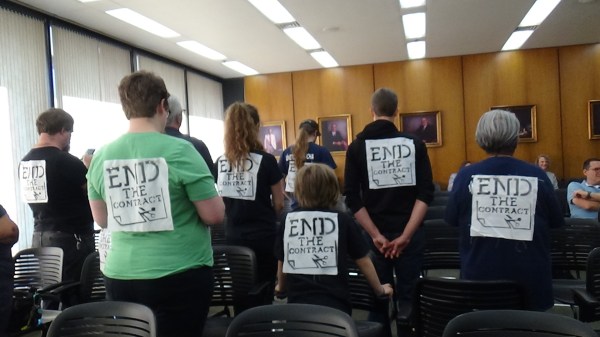
Lastly, Commissioner Antor accused those involved in the protests at the Kent County Commission meetings over the last 2 months of being “uncivil,” even though at yesterday’s meeting people stood silently while the commission meeting continued. The counter narrative is that people involved in this campaign have engaged in CIVIL disobedience and CIVIL resistance precisely because of the fact that families right here in Kent County are being separated by ICE, which includes the complicity of the County because of their contract to allow ICE to hold immigrants at the Kent County Jail. Commissioner Antor is upset that people are challenging him and his fellow commissioners. The commissioners are bothered by the fact that people from their community are engaging them in ways that are outside of their comfort zone, which has become so apparent from the very beginning of the campaign.
At the first meeting, Chairman Saalfeld ended the meeting and he and most of the other commissioners walked out so that they didn’t have to listen to the testimony from the people most affected by ICE violence. Then the county put up barriers to separate themselves from the public and now funnel people through a narrow area to where public comment takes place. This all happens during meetings that take place at 8:30am on a Thursday morning, which makes it impossible for most people who work first shift or have children, to even attend a county commission meeting to talk about issues they care so deeply about. At the August 6th meeting that Movimiento Cosecha GR and GR Rapid Response to ICE had with county officials, these issues were brought up and the only response that was given was, “this is the way they have always done it.” Well maybe it is time for Kent County to do things differently, to practice democracy more authentically, and more importantly, to actually listen to members of the immigrant community and their allies who want them to end their contract with ICE immediately!
This morning about 15 people went to the Kent County Commission meeting to once again demand an end to the contract the county has with Immigration and Customs Enforcement (ICE).
The group reading the following statement in English and in Spanish during the public comment and afterwards, everyone stood up and turned their backs to the commission, each wearing an End the Contract patch.
“It has been two months since we began our campaign to End the Contract that Kent County has with ICE.
During those two months we have come to every County Commission meeting to demand an end to the contract, we have circulated a petition with over 1,700 signatures, we have demonstrated during the 4th of July celebrations, we have visited to home of the Kent County Commission Chairman, we have held a rally at the Kent County Jail and we have meet with County administrators, commissioners and members of the Sheriff’s Department.
 The answer we keep getting from county officials is that they will not end to contract with ICE. The Sheriff’s Department tell’s us that they are obligated by law to do so, yet numerous cities and county governments across the country have ended their contract with ICE. County Commissioners have told us that they do not have the power, which we completely disagree with.
In addition, county officials have completely dismissed the lived experience of the immigrant community, which is being terrorized by ICE. County officials have heard directly from the immigrant community about how they are being harmed by ICE violence and they have been presented with information about the weekly calls that GR Rapid Response receives from the immigrant community that has been targeted by ICE.
Therefore, let us make it clear to everyone, that we will continue this fight to end the contract, we will continue to speak out against the harm that ICE is doing in our community, we will continue to support the families that are being separated by ICE and we will continue to attend county commission meetings until the contract is terminated and the county is no longer complicit in the violence against the immigrant community that is being done by ICE.”
What was ironic is that there were several items on the Kent County Commission agenda devoted to adding cops to communities within the county, adding school cops in several communities and then discussing (in closed session) police labor council agreement. The commission could talk about more policing and contracts, but said nothing about the ICE contract.
During the second Public Comment period, Gema Lowe (with Movimiento Cosecha GR) spoke and demanded that the ICE contract be put on the next agenda, which is September 13. Gema was surrounded by other people who are part of the End the Contract campaign and after she spoke the entire group left.
The whole point of the tactic today was to make it clear that, even though the End the Contract campaign has asked to be put on the agenda over the last two months, the County Commissioners have repeated ignore them and to dismiss the stories that the immigrant community has been sharing directly or stories that have been told by allies every time the campaign has interacted with county officials.

