 During the State of the Union address, President Trump addressed some of his administration’s plans for dealing with immigration. However, like all politicians, we should not take what they say to heart, rather, we need to look more closely at the details of any policy.
The details of the new administration’s immigration policy were released on January 25 and can be found in a document entitled, White House Framework on Immigration Reform & Border Security.
There are four segments within this policy, including Border Security, DACA Legalization, Protecting the Nuclear Family and Eliminate Lottery and Repurpose Visas. The section on Border Security is the longest and is prefaced with the following statement:
The Department of Homeland Security must have the tools to deter illegal immigration; the ability to remove individuals who illegally enter the United States; and the vital authorities necessary to protect national security.
This statement is then followed by these 9 tools:
- $25 billion trust fund for the border wall system, ports of entry/exit, and northern border improvements and enhancements.
- Close crippling personnel deficiencies by appropriating additional funds to hire new DHS personnel, ICE attorneys, immigration judges, prosecutors and other law enforcement professionals.
- Hiring and pay reforms to ensure the recruitment and retention of critically-needed personnel.
- Deter illegal entry by ending dangerous statutorily-imposed catch-and-release and by closing legal loopholes that have eroded our ability to secure the immigration system and protect public safety.
- Ensure the detention and removal of criminal aliens, gang members, violent offenders, and aggravated felons.
- Ensure the prompt removal of illegal border-crossers regardless of country of origin.
- Deter visa overstays with efficient removal.
- Ensure synthetic drugs (fentanyl) are prevented from entering the country.
- Institute immigration court reforms to improve efficiency and prevent fraud and abuse.
Everyone of these tools are designed to not only strengthen border security, they are designed to target undocumented immigrants and to expedite the process of arresting, detaining and deporting undocumented immigrants. In addition, the language used, particularly in points 5 and 8, emphasizes a very negative image of who immigrants are. This language essentially criminalizes immigrants and is part of the government effort to make undocumented immigrants seem as though they are all violent criminals.
 Many of the other points listed in the White House document on immigration talk about adding more immigration judges, more ICE officers and attorneys. These measures are only designed to further target undocumented immigrants and speed up the process of arresting, detaining and deporting people.
The only point that identifies a dollar amount ($25 billion) has to do with the border wall system and ports of entry. Two things are important to note here. First, there already exists roughly 700 miles of border wall and fencing along the US/Mexican border. Much of the existing wall and fencing was built and expanded during the Clinton administration in the 90s. Secondly, walls and barriers of any kind don’t ultimately work as a deterrent to immigration.
The other three areas – DACA Legalization, Protecting the Nuclear Family and Eliminate Lottery and Repurpose Visas – all are framed in a negative way, further criminalizing immigration and making it almost impossible for people to achieve permanent resident status.
What Would Immigration Justice Look Like?
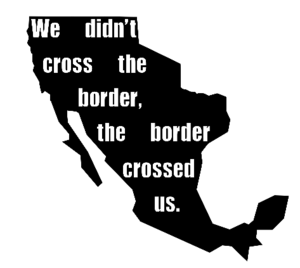 Immigration Justice can never be achieved unless we acknowledge that immigration justice is intertwined with economic & trade policies, militarism, white supremacy and colonialism. In oder to achieve immigration justice we have to work on dismantling white supremacy, colonialism, militarism and economic/trade policies that are rooted in capitalism.There is the common phrased used by immigrants, particularly Mexican immigrants, that says, “we didn’t cross the border, the border crossed us.”
In fact, the very notion of borders is a nation state creation that is ultimately rooted in imperialist expansion. Mexicans would say that a third of the continental US used to be their land and indigenous communities would argue that is was all their land before the European conquest began more than 500 years ago. Thus, the statement, “we didn’t cross the border, the border crossed us,” is not some facetious notion, it is rooted in the historical reality of US imperialist expansion.
 Immigration justice would acknowledge that people fleeing their home countries often do so out of economic desperation. This economic desperation is connected to the following dynamics; inequality in their country of origin; World Bank and IMF policies that force austerity measures on countries in the global south; capitalist expansion into new markets, which often undermines localized economies; and trade policies that are by their very design, meant to benefit large corporations, often displacing people because they can no longer make a living off the land they once owned. The North American Free Trade Agreement is a good example, which has displaced millions from Mexico.
 Immigration Justice would also require the US to stop providing weapons to countries like Mexico, Guatemala and Honduras that are used to suppress the populations of those countries; stop providing military advisors and training and stop US military intervention. All these forms of militarism contribute to the displacement of people who often end up coming to the US out of fear for their very lives. A great analysis of US militarism in Mexico is explored in Dawn Paley’s marvelous book, Drug War Capitalism.
Immigration Justice also would encompass things like: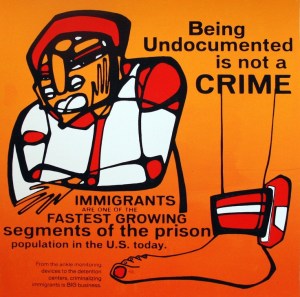
- Ending the policy of targeting, detaining and deporting immigrants just because they are undocumented.
- Dismantling the massive detention centers in the US, which are part of the large prison industrial complex.
- The recognition that if the 11 million undocumented immigrants were all detained or deported, that the US economy would collapse.
The Immigration Justice Movement is growing and challenging policy around DACA, TPS (Temporary Protected Status), and the overall unjust and repressive practice of ICE raids and arrests that create tremendous fear in the immigrant community.
 The Immigration Justice Movement is primarily being led by the immigrant community and is no longer asking for reform, but demanding long term solutions. As the Movimiento Cosecha says, “Make no mistake, our movement is stronger than ever. We have structures, strategy, strength, support, and spirit of resilience that it’s rooted in the sentiment of our community so that we will win permanent protection, dignity and respect for ALL immigrants!”
However, this movement also need allies and collaborators – those of us with privilege. We need to stand in solidarity with immigrants, educate ourselves about this struggle, provide support and mutual aid to the immigration justice movement, take risks, offer sanctuary and work to prevent the violence and harm that the state – through the courts, ICE, border patrol, local police, detention centers – does to immigrants.
What is Amplify GR up to these days?
 Is has been 4 months since AmplifyGR made the announcement that they canceled all of the previously scheduled meetings with the community on their development plans for the Boston Square and Cottage Grove neighborhoods.
AmplifyGR staff person Willie Patterson, made a video announcement that was posted on October 12. In that message, AmplifyGR acknowledges that the community has raised several concerns about the process AmplifyGR was engaged in, which led to the cancelation of the meetings. Of the three community Forums that AmplifyGR did host, there was significant pushback from the community and those in attendance.
However, AmplifyGR is merely adjusting their plans for the re-development of parts of southeast Grand Rapids. In an AmplifyGR blog post from August 22, they state, “Still, those of us on the front lines agree: If going slower is the price of getting this right… of NOT repeating the mistakes of the past… it’s worth it. You’re worth it. Our community is worth it. And our commitment and passion to achieving the above priorities has never been greater.”
The above statement is a clear indication that AmplifyGR plans to move forward with their development projects, they just want to get more feedback from the community. In fact, it seems as though, based on some of their Facebook posts, that the DeVos-created entity is meeting with people, just in a less public fashion. In other words, AmplifyGR is moving forward with their development plans for southeast Grand Rapids, outside of the public arena, where they have been challenged on their lack of transparency and intent from the very start. AmplifyGR wants to avoid the kind of pushback they have been experiencing, especially when the community has a chance to speak their mind in a public forum and even interrupt the organization’s plans, as we saw during the last public meeting AmplifyGR held in September.
 I have also looked at the Southtown Corridor Improvement District minutes over the past six months and there is no new evidence that AmplifyGR has been either attending or having input on those meetings. I looked at those minutes, because it was at minutes from January of 2017 that I first learned of the AmplifyGR plans to re-develop parts of southeast Grand Rapids.
In addition, I have looked through the GR Planning Commission documents and meeting minutes and have found no evidence of AmplifyGR activities there.
So, what has the DeVos-created entity, AmplifyGR, been up to is recent months? The last blog post on their website is from August of 2017. However, their Facebook page has been posting information since the announcement of the public meeting cancellations.
AmplifyGR hosted a Coffee with the Cops function, has promoted community turkey give away during the holidays, job fairs and they have posted several announcements about other DeVos Family funded projects, such as Spring GR and the DeVos created entity Start Garden. In fact, Start Garden’s 100 Ideas entrepreneurial project is the now the cover page for AmplifyGR. DeVos money looking out for DeVos money.

Ag Secretary in West MI talks to farmers, says poor people receiving food assistance better not get used to their “lifestyle”
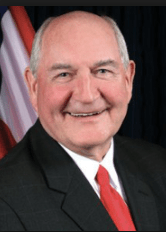 Last Thursday, Secretary of Agriculture Sonny Perdue, visited Robinette Orchards in Grand Rapids Township and spoke with farmers and farm lobbyists, according to an article on MLive.
Perdue had a particular message to people who received federal food assistance:
“For able-bodied adults without dependents who have taken this program as a lifestyle and are not looking for work, we want to send a message to them,”
Perdue was basically saying to a crowd of people who receive massive federal subsidies through the Farm Bill, that people who benefit from federal food assistance programs that they are screwed.
 Such contempt for poor people is not new, since the 2014 Farm Bill cut $8.6 billion for food assistance. However, we can ascertain from the Ag Secretary’s remarks that further cuts to federal food assistance are likely to happen.
The irony of such comments from Perdue, especially considering the US Farm Bill is a nothing short of massive corporate welfare for agri-business (large farmers who generally grow mono-crops). While Governor of Georgia, Sonny Perdue himself made sure that some of the largest Georgia corporate farmers benefited from an earlier version of the Farm Bill.
Also ironic is the fact that Michigan farmers have received over $5 billion in subsidies over the past 20 years, according to the Environmental Working Group data base. Apple growers, like Robinettes, have been the beneficiaries of over $27 million is federal subsidies over the past two decades.
One question that was posed to Perdue, while he was in Grand Rapids Township, had to do with the shortage of migrant farm workers, which those in the agribusiness sector rely on. There is no response from Perdue in the MLive article, to the question about migrant labor, but based on his track record as Governor of Georgia, we could draw some conclusions.
In 2006, Perdue said:
“It is simply unacceptable for people to sneak into this country illegally on Thursday, obtain a government-issued ID on Friday, head for the welfare office on Monday and cast a vote on Tuesday.”
Perdue signed into law several measures that would crackdown on undocumented immigrants, while he was Governor of Georgia.


Synder Front Group runs another Super Bowl Ad extolling the economic comeback of Michigan
This is the third time that Governor Rick Snyder and the 501c4 group, Making Government Accountable, has run an ad during the Super Bowl during the 8 years he has been in office.
The ad, like all political ads, engages in populous and vague rhetoric, like, “Our government is now fiscally responsible” and “Everywhere, a renewed sense of confidence and pride.”
 The video also makes the claim that over 500,000 new jobs have been created in Michigan, but never qualifies what kind of jobs, the wages those jobs pay and whether they are full-time or part time. This is the nature of political ads.
The ad also makes the claim, “Detroit has become the most remarkable comeback city in the country.” Again, no need to substantiate such claims. If you say it, it must be true.
 The images the ad uses about Detroit are those of downtown, with high rise buildings and sports arenas (which were subsidized by taxpayers). What the ad doesn’t show is the growing gap between the wealthy and those in poverty, the gentrification of Detroit or the fact that the city continues to shut off water to thousands of people who are struggling to survive.
The ad doesn’t really talk about the rest of the state, but we know that the ad ran in the Detroit, Flint, Traverse City and Grand Rapids TV markets. According to the Detroit News, the ad ran on WOOD TV8, just prior to the Super Bowl game, at the cost of $12,000.
We found out about the ad from a Facebook post on the West Michigan Policy Forum page. The West Michigan Policy Forum agrees with the ads 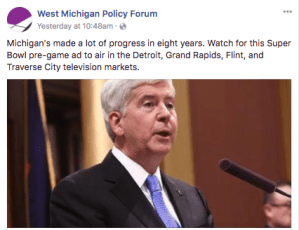 message, as the members of the WMPF are amongst the primary beneficiaries of the “economic comeback” of Michigan. What the WMPF members mean by “economic comeback” is more profits for their companies, more government program cuts, taking away public sector union pensions, making Michigan a Right to Work state and eliminating the Michigan Business Tax.
No surprise then that several members of the leadership team at the West Michigan Policy Forum, John Kennedy, Michael Jandernoa, Doug DeVos, Meijer Family, Steve Van Andel, J. C. Huizenga, Matthew Haworth and the companies they represent, have been substantial contributors to Gov. Snyder since he was first elected.
West Michigan Elite amongst the largest contributors to the 2018 Election in the State
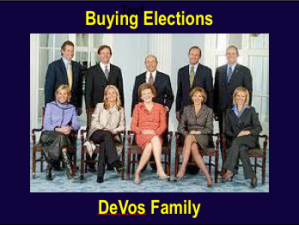 The Michigan Campaign Finance Network is already making it clear that the 2018 Elections in Michigan will be one of the most expensive in state history.
In the 2018 Election we will see contributions from numerous sectors, including Political Action Committees (PACs), Caucus Committees, Super PACs, outside funding and an increase in individual candidate contributions.
One area, Caucus Committees, not only demonstrates the outrageous amounts of money that have already been raised in Michigan, the data also shows that West Michigan elites are amongst the top contributors to purchasing 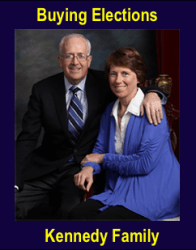 the 2018 elections.
According to the data collected by the Michigan Campaign Finance Network, the top two contributors to the Senate Republican Campaign Committee are listed as:
- DeVos Family, Windquest Group and RDV Corp, $240,000
- Kennedy family, Autocam, $60,000
This amount of money is just what was raised in 2017 and we can expect even higher numbers for 2018.
In the House Republican Campaign Committee, the top three contributors are from West Michigan:
 DeVos Family, Windquest Group and RDV Corp, $240,000
- Nancy and John Kennedy, Autocam, $80,000
- Secchia family, Sibsco, $80,000
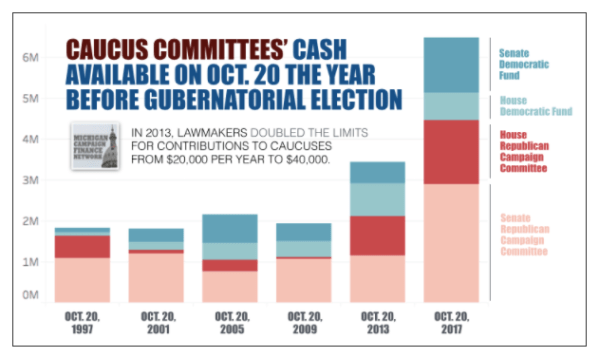
The Republicans have raised significantly larger amounts than the Democrats to date for the 2018 Election and that typically translates in to the GOP continuing to dominate state politics. You can see from the chart below, that the Michigan Republicans have raised in the House and Senate Caucus Committees more than double what the Democrats have raised.
We don’t have to have a City Manager form of government in Grand Rapids, we didn’t before
 On Tuesday, we posted an article that provided an alternative view of the 8 years that Greg Sundstrom has served as City Manager of Grand Rapids. At the end of that article, we wrote:
we are not asking the question of why we even need a City Manager. The City Manager position in Grand Rapids is a non-elected position, yet this person has more power than anyone else in the City. If the City really wanted community engagement, they would really look at other forms of governance, where all residents had a say, where neighborhoods had more autonomy and where the city budget was determined by the public and not the City Managers office.
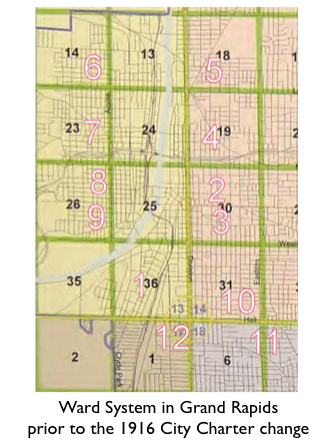
One thing that we did not mention in the Tuesday article, is that Grand Rapids used to have a different form of government. In the early part of the 20th century, Grand Rapids did not have a City Manager, instead the city was led by a strong Mayor, with a 12 ward system.
What this 12 ward system provided, was greater representation from both the working class residents of Grand Rapids and more ethnic diversity, at least diversity in terms of the various Euro-Americans that lived in the City – German, Polish, Dutch, Italian and Lithuanian.
This 12 ward system changed in 1916, when a new City Charter was proposed to reduced the 12 ward system with a 3 ward system and a strong Mayor form of government to a City Manager form of government.
This charter change was an effort put forth by the business community as a direct response to the 1911 furniture workers strike. The furniture workers strike demonstrated to the business community that working people had too much say in local electoral politics.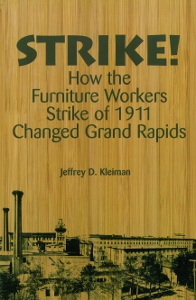
In August of 1916, voters went to the polls to determine the future political structure of Grand Rapids. The new Charter won by a small margin of 7,693 votes in favor to 6,012 votes in opposition. According to Jeffrey Kleiman’s book, Strike: How the Furniture Workers Strike of 1911 Changed Grand Rapids, the wards that voted overwhelmingly in favor of the Charter change were made up of the city’s elite.
The Second, Third and Tenth wards provided enthusiastic support for the proposed changes. Here lived the industrialists, lawyers, and bankers who formed the leadership of the Furniture Manufacturers Association, and the Association of Commerce. These men shared social and business connections through Kent Country Club and the Peninsular Club, and many were members of Fountain Street Baptist Church.
During another period of turmoil in Grand Rapids, there were attempts to change the City Charter back to a larger ward system and eliminate the City Manager for of government. In the later 1960s, just after the July 1967 race riot in Grand Rapids, there were both internal and external efforts to change the form of government.
In October, 1967, just a little over two months after the riot, there was a call for an investigation by Mayor Sonneveldt to look into the possibility of eliminating the City Manager form of government.

The question of shifting to a new form of government, by eliminating the City Manager position, was again debated in the Grand Rapids Press in November of 1967 and again in 1969, with the research commission that Sonneveldt requested 2 years earlier, but this time they were calling for a return to a 12 ward system and limiting the powers of the City Manager.
There have been other times in Grand Rapids history where efforts were put forth to restructure the number of wards the city would have or to eliminate the City Manager form of government.
Therefore, it is not unreasonable to consider such a change right now, especially considering how much power the City Manager has in a non-elected position. And, like in 1967, Grand Rapids is again faced with serious racial and economic disparities. A new form of governance, especially one that truly gave all residents a say what form of government or governance they want. We can certainly learn from the past about what to do in the present that might effect our collective futures.
To view the GR Press articles on the various local governance proposals between 1967 – 1970, click here.
GR Press Editorial on the GRPD and community relations is the same old establishment mantra
On Sunday, the Grand Rapids Press Editorial Board posted an editorial entitled, City leaders should expedite healing police, minority relations.
The editorial is a well intentioned piece, with lots of the usual calls for improving the relationship between the communities of color and the GRPD. However, the editorial ultimately falls into the same trap and all well intentioned proposals.
The editorial is both naive and it fails to acknowledge how power functions. The editorial is naive, because it believes that the GRPD can rebuild trust with communities of color, but more importantly, the editorial staff fail to understand that the very function of the GRPD is not to protect communities of color. The GRPD’s function is to actually police neighborhoods of color, which is to say they are there to manage the activities in communities of color, which ultimately protects the centers of power, which benefit from White Supremacy.
In the very first sentence, the editorial staff shows its bias by using the term citizens of color. One would think that with all the recent attention around immigration policy, ICE raids and the fear that many in the immigrant community have towards cops, that the editorial board would know better than to use the term citizen.
Legally, those who are undocumented in this community, are not seen as residents. Instead, those who are undocumented are seen, especially by law enforcement agencies, as criminals who just happen to reside here.
However, the editorial primarily focuses on what the cops have done that impacts the black community, citing the incident with the 11 year old girl who was handcuffed at gunpoint and the 4 black boys who were profiled by the cops last March.
The editorial then states, “In both circumstances, the officers followed policy and procedure, and the children were innocent.” This statement is true. The GRPD was following procedure. This is how they treat suspects, regardless of the age of said suspects.
Then the editorial demonstrates a major fallacy about police, when it states:
And the police should be able to do their jobs — protecting the public — without feeling like they are the enemy because of the misconduct of some bad actors.
This statement contradicts the earlier statement about following procedure. There are not a few bad apples or bad actors in the police department, the police conduct within communities of color is a matter of policy. Why do you think that the GRPD spends more time actually patrolling neighborhoods of color, particularly low income neighborhoods of color, than they do in more affluence, white neighborhoods? In the first two chapters of Alex Vitale’s new book, The End of Policing, he makes clear that the police primarily do not exist to protect the public, particularly residents of color.
Vitale states in his book, Well-trained police following proper procedure are still going to be arresting people for mostly low-level offenses, and the burden will continue to fall primarily on communities of color because that is how the system is designed to operate – not because of the biases or misunderstandings of officers.
The GRPD disproportionately spends more time in neighborhoods of color because it is by design.
 The rest of the editorial talks about how the GRPD needs to spend more money to rebuild trust in neighborhoods of color, add more higher ranking officers and promote cultural competency amongst the rank and file cops. Again, as the research of Vitale and others has shown, these tactics are ineffective and are merely designed to make us believe that the police department really wants to be our friend.
The editorial ends by saying, This simmering trust issue requires deliberate and consistent attention from city commissioners to prevent this situation from escalating into a full-blown crisis.
For people who are members of communities of color, it is already a full-blown crisis. In fact, back in May, leaders in the black community were demanding that the Grand Rapids City Commission call for a State of Emergency. That demand was not taken seriously.
I agree that there is a state of emergency for the black community, in regards to police violence and harassment. Add to that the levels of poverty, discrimination and the effects of gentrification has had on the black community, one can see why they are calling for a state of emergency.
In early July of 1967, just two weeks before the riot in Grand Rapids, the head of the Grand Rapids Urban League, Paul I Phillips, communicated to Mayor Sonneveldt, the City Manager and the Grand Rapids Chief of Police that according to the national Urban League office, Grand Rapids was on a “dangerous list” of cities with racial tensions. Despite the comments from the Urban League, Mayor Sonneveldt, the City Manager and the Chief of Police “positively denied that riots were possible in the city.
The City of Grand Rapids needs to learn from history or it is doomed to repeat it.
An Alternative view of what has happened in Grand Rapids during the 8 years that Greg Sundstrom has been City Manager
 Last week, MLive ran a story that sort of summarized the 8 and a half years that Greg Sundstrom served as the City Manager of Grand Rapids.
The article, in many ways is an overview of his tenure as City Manager, but it’s also sort of a puff piece, considering the accolades that Sundstrom is given from other city officials. In fact, city officials are the only sources cited in the article, meaning that no one from the community was asked what they thought about Sundstrom’s tenure as City Manager.
The article does acknowledge some “difficulties” that Sundstrom has faced, including the budget, race relations and police violence, but those issues are glossed over.
In many ways, the headline sets the tone for the story, From millions in deficit to cash in the bank: Greg Sundstrom’s Grand Rapids turnaround. This headline, is misleading, since it doesn’t acknowledge what the city had to do in order to be “fiscally sound.” The MLive piece does state about half way through the article that some 500 city employees were laid off and that contracts with the police, fire and other city staff were re-negotiated to cut benefits and restructure retirement plans. In other words, Sundstrom was responsible for applying deep austerity measures to the City of Grand Rapids, as part of the larger Neoliberal economic measures imposed by local and state governments that has been happening for several decades now. However, how would this article have read had their been comments from some of the 500 city employees that were laid off?
Part of the reason why Grand Rapids, like many municipalities, was facing a deficit, was the unjust way in which the State of Michigan dealt with revenue sharing. Grand Rapids was not getting back from the state what it should have received in revenue sharing. Instead, when Rick Snyder became Governor, there was a further shift to adopting austerity measures and Snyder made it a point to come to Grand Rapids in March of 2011, to use the City as a model for how to downsize local government.
Towards the entire of the MLive article, Sundstrom acknowledges the issue of poverty in Grand Rapids, but then quickly is quoted as saying that Grand Rapids is, “exploding’ with prosperity.” At the very end the of the article, Sundstrom then says, “I just think 10 years from now whoever’s going to be sitting in this chair is going to be sitting as the city manager of the coolest city in the country.”
 As a counter to the MLive puff piece, we’d like to list some of the major shifts that have occurred in the past 8 and a half years, while Greg Sundstrom has been the City Manager of Grand Rapids.
- Sundstrom oversaw the massive Neoliberal Economic plan for Grand Rapids, with the layoffs of hundreds of City employees, cuts to health benefits and retirement plans.
- Sundstrom was City Manager during a period where the number of people living in poverty grew in Grand Rapids, with roughly one quarter of the population living in poverty and more than 30% of the Black and Latinix communities living in poverty.
- During Sundstrom’t tenure as City Manager, the city has undergone gentrification in many neighborhoods, displacing hundreds of families, while giving developers millions in tax breaks.
- Sundstrom ignored the struggles of union workers who lost wages and benefits over the past eight years, including the Rapid Bus Drivers Union, the local ATU.
- Activists supporting the bus drivers union were harassed and intimidated by the GRPD because they stood in solidarity with the ATU.
- With Sundstrom’s approval, the City of Grand Rapids has given at least $725,000 of taxpayers money to a DeVos entity to manage Smart Zones in the city.
- Sundstrom would not support Grand Rapids becoming a Sanctuary City and was silent when City Commissioners voted to NOT include the GRPD in the City’s policy of never asking residents about their immigration status.
- After the Ferguson uprising, the City of Grand Rapids adopted mild reformist policies for the GRPD, but has continued to defend the police abuse of and the targeting of communities of color in Grand Rapids – including the treatment of African American youth.
- Sundstrom has continued to maintain a full third of the City’s budget to be allocated for the GRPD, despite calls from the community for greater transparency, more accountability and a shift to other forms of community safety practices.
- Another traffic study was conducted in Grand Rapids, a study which concluded that black residents are disproportionately targeted and profile by the GRPD – even though the black community had been saying for years that this was their lived experience.
City Manager and the Future of Grand Rapids Politics
Next week, there will be a community forum held at the Wealthy Theater to allow residents to give input on who will be the next City Manager. The event is billed as a community engagement effort.
I’m all in favor of community engagement, but the problem with how it is often done in Grand Rapids, is that the public is often only asked to give input on decisions that those in power have already made or public input is limited to a framework that is too narrow.
For example, we are not asking the question of why we even need a City Manager. The City Manager position in Grand Rapids is a non-elected position, yet this person has more power than anyone else in the City. If the City really wanted community engagement, they would really look at other forms of governance, where all residents had a say, where neighborhoods had more autonomy and where the city budget was determined by the public and not the City Managers office.
There are all kinds of possibilities for the future of how City politics could happen in Grand Rapids. Unfortunately, city leaders seemed to be content for maintaining a business as usual approach that leaves decision-making power in the hands of a small group of people.
Betsy DeVos Watch: Fake Sympathy from DeVos on MSU victims, while undermining the existing Title IX protections against sexual assault
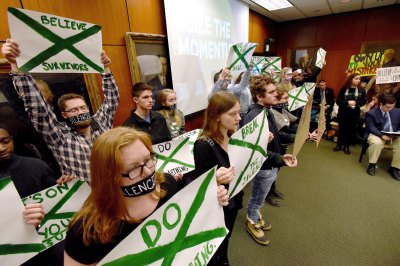 After dozens of testimonies and a trial that lasted several weeks, USA Gymnastics and Michigan State University doctor Larry Nassar was finally sentenced and will most likely spend the rest of his life in prison.
However, there is growing scrutiny of what MSU officials and anyone in a position of power at MSU, who could have done something, and didn’t. Those who did nothing or worse, enabled the abuse, include campus police, MSU officials and possibly the MSU football and basketball programs.
According to a recent investigation by ESPN’s Outside the Lines, it seems pretty clear that the complicity in allowing abusers to either get away with violence or to be let off the hook with minor consequences.
According to the ESPN report:
Over the past three years, MSU has three times fought in court — unsuccessfully — to withhold names of athletes in campus police records. The school also has deleted so much information from some incident reports that they were nearly unreadable. In circumstances in which administrators have commissioned internal examinations to review how they have handled certain sexual violence complaints, officials have been selective in releasing information publicly. In one case, a university-hired outside investigator claimed to have not even generated a written report at the conclusion of his work. And attorneys who have represented accusers and the accused agree on this: University officials have not always been transparent, and often put the school’s reputation above the need to give fair treatment to those reporting sexual violence and to the alleged perpetrators.
This ESPN report makes it clear, that while Nassar’s crimes have been uncovered, the football and basketball programs have not been properly investigated and held accountable. This, no doubt, is in part due to the fact that MSU football and basketball bring a lot of money to the campus and to East Lansing. Anytime big money is involved, those who stand to gain from the profitable football and basketball programs will do whatever is necessary to silence any criticism, even if it means silencing the victims of sexual assault.
Betsy DeVos and Fake Sympathies
On Friday, January 26, Secretary of Education, Betsy DeVos, released the following statement in light of the verdict against Nassar.
“My heart breaks for the survivors of Larry Nassar’s disgusting crimes. What happened at Michigan State is abhorrent. It cannot ever happen again — there or anywhere. Students must be safe and protected on our nation’s campuses. The Department is investigating this matter and will hold MSU accountable for any violations of federal law.”
Now, I can’t claim to know if Betsy DeVos actually feels sorry for the victims of Larry Nassar or not. What I do know, is that she has spent a great deal of time during her first year in the Trump administration to weaken and attack Title IX protections around sexual assault. Therefore, it is hard for me to take seriously the sincerity of Betsy DeVos’ claim that she thinks that what happened at MSU should not happen on any campus ever again. It is what we might name as, good old fashioned hypocrisy.
Last July, we reported on the groups working with Secretary DeVos to weaken Title IX. We noted that groups like National Coalition for Men, an anti-feminist organization, was working with DeVos to undermine Title IX.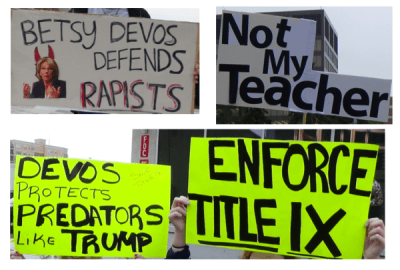
Another group invited by Secretary DeVos to the Title IX listening session was Stop Abusive and Violent Environments (Save). SAVE is another anti-feminist organization that believes that campuses are experiencing “rape culture hysteria.”
According to a recent article on Slate.com, “The Southern Poverty Law Center has identified SAVE, which opposes rules that prevent defense attorneys from entering evidence of a survivor’s sexual history in a rape trial, as a planet in the “manosphere” of misogynist online forums. SAVE lobbies against domestic violence protections, claims that the “leading reason” for abuse is “female initiation of partner violence,” and calls falsely accused perpetrators the “true victims of abuse.”
Now, having Title IX protections in place, doesn’t mean that a campus will comply with those regulations. Again, the ESPN article is important as is states:
On Thursday, Outside the Lines reported that MSU officials in 2014 did not notify federal officials that the university had dual Title IX and campus police investigations of Nassar underway, even though federal investigators were on campus that year scrutinizing how MSU dealt with sexual assault allegations. The Outside the Lines report also found that MSU administrators still have not provided to federal officials all documents related to the Nassar allegations.
The interesting thing about Secretary DeVos’ actions against Title IX and the MSU revelations, is that just two days after DeVos was in Grand Rapids to be part of the celebration of the new MSU building in downtown – a celebration that involved DeVos having informal conversation with MSU President Lou Anna Simon – is when DeVos weakened Title IX protections for sexual assault, as was reported by Diana Moskovitz.
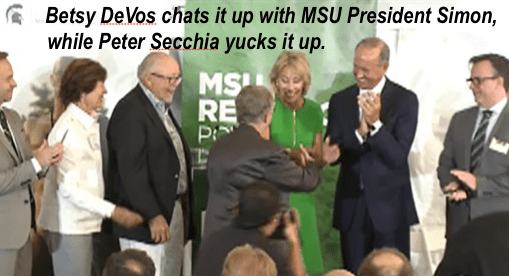
In addition, there was a protest organized by MSU students and faculty the day she visited Grand Rapids for the MSU ribbon-cutting ceremony on September 20th. You can see from the signs above that much of the focus of the protest was related to her undermining of Title IX protections.
Two weeks after Betsy DeVos and Lou Anna Simon met in Grand Rapids, MSU asked to have Title IX federal monitoring come to an end. In this instance, both the President of MSU and Betsy DeVos are complicit in the sexual assault crimes committed on MSU’s campus. How many more victims of sexual assault must come forth before we take their pain seriously?
 Grand Rapids Institute for Information Democracy