Learning Disability Justice: A Personal Story
 I just finished reading an amazing book entitled, Care Work: Dreaming Disability Justice, by Leah Lakshimi Piepzna-Samarasinha.
The book is written by someone from the disability community, specifically about the kind of work that the disability community does for each other. The analysis that is provided throughout the book is open surpassed by the powerful stories of how people in the disability community to the work of caring for each other.
Care Work is also a statement that counters the dominate ableist narrative about how able-bodied people are the ones who care for those with disabilities. The book is inspiring and at the same time it challenged my own ableist views and even my own experiences as a child, in my family and my organizing work.
I didn’t see myself as someone with a disability
For me, one aspect of how normalized the ableist narrative is, was how I identified myself as a kid growing up in Pennsylvania. I grew up in a hyper-patriarchal family, where my father dictated everything in the family. We had a family business and from a very early age I was required to assist my father with delivering milk to people’s homes. In addition, our family was extremely into sports and my older brother and I were expected to participated in playing football, baseball and basketball. If we didn’t play or didn’t play well, it was a sign of weakness.
It was in this context that at the age of 8, I was diagnosed with having what we were told at the time, “crocked legs.” When I put my legs together, my feet would be about 4 inches apart, and when I ran my knees would hit each other, often becoming raw and sometimes bleeding.
This diagnosis ended up with me going to see a specialist in Elizabethtown, PA. The specialist worked out of a place called, The Cripple Children’s Hospital. This specialist determined that the problem was my feet, so for several years I was forced to wear “corrective shoes,” do exercises every night and eventually I had to wear these corrective shoes that had cables attached to them leading to a belt that I had to wear around my waist. I even had to wear these shoes with cables to bed every night.
For the next four years I was forced to wear these corrective shoes with cables and had to endure constant teasing from my classmates at school and even from my brother and father who saw my condition as a sign of weakness.
At the age of 12 I went to see another specialist who said that wearing these shoes and doing the exercises I had done for four years were all for nothing. The problem was not my feet, but my knees. Within six months it was determined that I was to have surgery, where three large staples were inserted into the insides of each knee and left there for a year. After surgery, I spent 3 weeks at the Cripple Children’s Hospital and was in a ward with 25 other kids, all of which had conditions that were worse than mine.
All of this was happening during my years of puberty, which exacerbated my insecurity and awkwardness. I couldn’t play sports for the year that the staples were in my knees, which gave me a sense of shame because of the pressure in my family to be physical and play sports.
Having staples in my knees for a year “worked” and End finished off my High School years play ball and working full time for the family, before I eventually left town and came to Michigan.
My Younger Brother was disabled
I had two bothers growing up and my younger brother contracted spinal meningitis as an infant, which resulted in serious brain damage that has affected his entire life.
My parents were told early on that they could not care for a child with my brother’s condition. When my brother was 8 he was placed in an institution in Butler, Pennsylvania, about a 3 hour drive from where we lived at the time. This meant that we would only visit him once a month, since growing up in a working class family limited our ability to afford the cost and the time to see him.
However, after three years, my brother was moved to an institution that was closer to home, only a 60 minute driver. My brother was at this second institution for only one year, because every time we would go visit, my mother would discover that he was wearing other people’s clothing or he was missing a tooth and staff had no idea that this was happening.
My parents made the decision to bring him home and my mother made the commitment to be his primary care giver. However, my mother had no formal training and often projected he worldview onto my brother. My father was so much worse. My father would be embarrassed by my brother if we were ever in public, he rarely did any care giving and he often used verbal violence and at times physical violence against my brother. My father was a bastard.
Growing up with a brother with the kind of disability he had, certainly impacted how I saw myself in the world and it did teach me how the world sees those with disabilities…….as disposable people.
However, it wasn’t until I moved out of my parents house and became an adult that my own experiences have forced me to learn more and to move closer to what disability justice is.
Participating in Care Work
Over the years I have worked as a direct care giver to people with varying disabilities and with several different agencies. I have always valued this work and found it meaningful, although many of the people I have worked with were not committed to having a relationship with the people that they worked for and the agencies I have worked for often valued profits over people. More over, the biggest problem that I have encountered in doing this work is those doing the work often see themselves as the savior of the people they were working with.
This White Savior politics, particularly in West Michigan where I have done this care work, was often run by Christian organizations. These religious organizations would normalize certain behaviors for the population they were “serving”, with things like having people go to jobs, go to church and embrace a culture of pity. There certainly were people who developed relationships with the people they worked with and tended to treat people better, with more humanity. Unfortunately, there was little opportunity to learn about disability justice or to practice it. There was no real intellectual challenge to the ableist practices and no space for exploring or even being exposed to disability justice for those of us who worked in these spaces. However, there were plenty of examples of how those in the disability community practiced care work with each other. This practice, within the disability community, was often seen as cute and not as an opportunity to learn from the community these organizations claimed to be serving.
Trying to Learn Disability Justice
Over the years as I have been involved in organizing work, I have been challenged by and mentored by people who are part of the Disability Justice movement. Those of us who are organizers and who do not see ourselves as part of the disability community, need to organize in such a way that makes what we do accessible to all bodies. We must stop being part of ableist supremacy and be in solidarity with those whom the dominant culture sees as disposable or a burden. We must see that the Disability Justice Movement is essential in the struggle for collective liberation.
I am grateful for those who remind me, inform me, challenge me and make me accountable for the work I do in this community and to make sure that it is always responsive to the desires of those who have been a challenging inspiration.

False Solutions in the New Gilded Age: Jeff Bezos just gave the Grand Rapids Community Rebuilders $5 million, which is what he make in 30 minutes
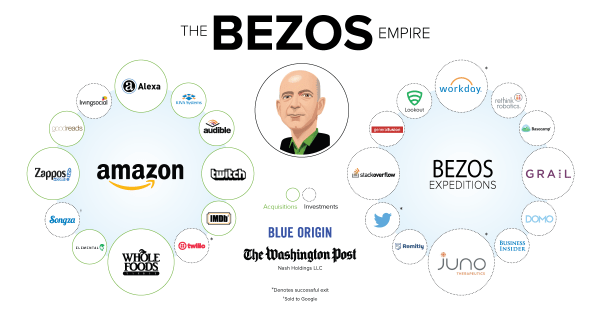
 On Tuesday, I received a Media Advisory from the Grand Rapids-based group Community Rebuilders. The Media Advisory stated that the organization had received a $5 million donation from the Bezos Day One Fund, which is the charitable wing of the wealthiest man on the planet, Jeff Bezos.
$5 million dollars is a great deal of money and it will certainly contribute to the work of Community Rebuilders. The Media Advisory also quoted the Executive Director of Community Rebuilders, Vera Beech, who stated:
“Community Rebuilders is a hard-working organization, and we’re not afraid to take risks to support families experiencing homelessness. This grant will allow us to do so on an even bigger scale to more quickly reach our community’s goal of eliminating homelessness in Kent County.”
Now, I’m not questioning the success stories that Community Rebuilders has, in terms of actually helping people transition from being homeless to living in a home that they can afford. What I am questioning is the goal of Community Rebuilders, which is to eliminate homelessness in Kent County.
People who experience homelessness end up in that predicament for numerous reasons, such as people dealing with addiction, people struggling with mental health, people losing their jobs, health care costs, etc. However, we also know that there is no real reason for people to actually be homeless, since homelessness is really a byproduct of capitalism.
The economic system of capitalism is designed to make a small number of people disgustingly rich and the rest of the population at varying levels of economic insecurity. For example, the wealthiest man on the planet right now, Jeff Bezos, is estimated to be worth about $132 Billion as of May 1, 2018. Now, $132 Billion is so big that most of us can’t even wrap our heads around what that means, plus Bezos wealth was a mere $99 Billion on January 1, 2018. This means that Bezos’ wealthy increased by $33 Billion in 120 days.
The Independent news entity, Democracy Now!, broke down what Bezos’ wealth expansion means during that 120 period. “If you divide that difference by the 120 days in that period, you find that he made $275 million a day. Divide that by 24 hours in a day to get about $11.5 million per hour, the equivalent of roughly $191,000 per minute or — the clincher — $3,182 every second.”
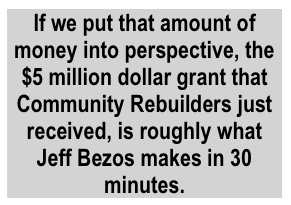
If we put that amount of money into perspective, the $5 million dollar grant that Community Rebuilders just received is roughly what Jeff Bezos made from January 1st to May 1st in 30 minutes.
Gilded Giving
People might remember from US History classes that the later part of the 19th Century was referred to as the Gilded Age, since there was a massive separation between the grotesquely rich and everyone else. It could be argued that we live in another Gilded Age, with the less than 1% of the population controlling most of the wealth.
The Institute for Policy Studies just released a new report that also speaks to the problem of living in another Gilded Age. Their report, Gilded Giving 2018: Top-Heavy Philanthropy and Its Risks to the Independent Sector, investigates the problem of society’s reliance on the charity of the wealthiest people. The report states:
Our charitable sector is currently experiencing a transition from broad-based support across a wide range of donors to top-heavy philanthropy increasingly dominated by a small number of very wealthy individuals and foundations. This has significant implications for the practice of fundraising, the role of the independent nonprofit sector, and the health of our larger democratic civil society.
This brings us back to the $5 million that Community Rebuilders received from the Bezos Foundation. The problem with accepting the fact that people like Jeff Bezos are allowed to make $11.5 million dollars in an hour, while a large percent of the population is one paycheck away from losing everything and record numbers experiencing poverty, is that it prevents us from questioning how so few can be so wealthy, while so many are so poor.
Relying on the handout of the super rich is a false solution
The reality is that Community Rebuilders can never end homelessness in Kent County. Relying on the charity of people like Jeff Bezos is a false solution. As long as our society accepts the current wealth gap, which allows Jeff Bezos to control the amount of wealth that he does, then we can never end homelessness, poverty or any other major social inequality.
Lastly, I would argue that as long as the economic system of capitalism remains, we will continued to see the non-profit world rely on the donations of the wealthiest people on the planet. And as long as we rely of the “charity” of the wealthiest people on the planet we will never allow ourselves to see the inherent contradiction in an economic system that is designed to reward so few, while so many suffer unnecessarily.
Dark Money: DeVos family supports Michigan State Senator who has introduced a bill to conceal nonprofit donors
 Another election cycle has passed us and one of the most instructive aspects of the 2018 election cycle was how much money was contributed to elect politicians and support ballot initiatives.
According to the Michigan Campaign Finance Network, the 2018 election was the most expensive in state history, with $291.1 million in contributions for the ballot initiatives and the state’s races for governor, attorney general, secretary of state, Michigan Senate, Michigan House, Michigan Supreme Court, U.S. Senate and U.S. House. These numbers will go up, once all of the contributions have been tailed, which will easily push the amount contributed over $300 million.
In addition, Michigan also set a record for the amount of money raised by Political Action Committees (PACs). Again, the Michigan Campaign Finance Network put PAC money raised in 2018 at $80 million (for the top 150 PACs).
We have reported in the past about how the DeVos family paid for legislation that allowed PACs to double the amount of money they could raised for candidates.
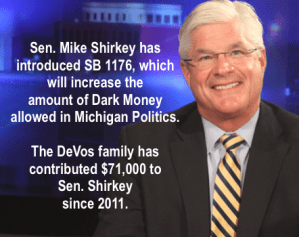
Now, new legislation has been introduced that would effectively ban any state or local public agency from requesting information about supporters of nonprofit organizations, including nonprofit groups that spend money to influence voters in the weeks before an election. On November 8, Republican State Senator Mike Shirkey introduced SB 1176.
SB 1176 does not have any co-signers as of yet and according to the State’s Legislature page the bill has been referred to the Michigan Competitiveness Committee.
The Michigan Competitiveness Committee is chaired by Rep. Mike Shirkey and four other State Senators: Jim Stamas (34th District), David Robertson (14th District), John Proos (21st District) and Rebekah Warren (18th District). All of them are Republicans, except for Warren.
In looking at who have been some of the major campaign contributors during their time as a state lawmaker, one name is pretty consistent. The DeVos family has contributed $71,000 to Rep. Shirkey since 2011.
In addition, the DeVos family has contributed the following amount since 2011 to two of the other three Republican Senators, who also sit on the Michigan Competitiveness Committee:
Sen. John Proos – $9000 from the DeVos family
Sen. David Robertson – $7000 rom the DeVos family
Of course there is nothing new about the fact that the DeVos family contributes significantly to Republican candidates. However, what is important is which candidates they contribute to, which committees they sit on and which candidates either propose legislation or sign onto legislation that will ultimately benefit the DeVos family. The DeVos family is very strategic and contributes money to politicians that will ultimately embrace their financial and ideological agenda, like Sen. Mike Shirkey.

Patriarchy Pushes Back: DeVos-led Education Department provides more protections for those accused of sexual assault with Title IX revisions
 We have seen the power of the MeToo Movement in recent years, with more and more women finding the courage and the support to confront and name their abusers.
However, so many of society’s institutions still operate within a framework of patriarchy, where the normalization of male dominance reigns supreme. We see this within religious institutions, the legal system, the military industrial complex and the entertainment industrial complex.
The most recent institutional push back against feminism is the US Department of Education’s revision of Title IX. According to a November 16 Press Release:
“Throughout this process, my focus was, is, and always will be on ensuring that every student can learn in a safe and nurturing environment,” said U.S. Secretary of Education Betsy DeVos. “That starts with having clear policies and fair processes that every student can rely on. Every survivor of sexual violence must be taken seriously, and every student accused of sexual misconduct must know that guilt is not predetermined. We can, and must, condemn sexual violence and punish those who perpetrate it, while ensuring a fair grievance process. Those are not mutually exclusive ideas. They are the very essence of how Americans understand justice to function.”
A Washington Post article published last Friday, says that Secretary of Education Betsy DeVos sees the new Title IX revisions as a balancing of the rights of sexual assault survivors and those who are accused of sexual assault.
As we have reported in previous Betsy DeVos Watch articles, the Education Secretary has been providing significant input from anti-feminist organizations across the country, in what DeVos was calling Title IX “listening session.” These groups have providing DeVos with a framework to influence the Title IX revisions, a framework that is essentially anti-feminist and one that embraces patriarchal values.
For instance, the group The National Coalition for Men, has an insidious video on their homepage, which asks the question, Is Feminism a Hate Group?
Another group, the Foundation for Individual Rights in Education (FIRE), which believes that college campuses have an inherently “liberal bias,” released a statement on Friday in response to the new Title IX guidelines. FIRE states:
The proposed regulations are a marked improvement over the previous guidance in a number of important ways.
By taking the rights of both complainants and accused students seriously, these proposed regulations make important strides toward ensuring that complaints of sexual misconduct will be neither ignored nor prejudged.
The proposed regulations define sexual harassment in accordance with established Supreme Court precedent, eliminating the confusion that has led institutions nationwide to adopt overly broad definitions of sexual harassment that threaten student and faculty speech.
The anti-feminist group Stop Abusive and Violent Environments (SAVE) wrote about the new Title IX ruling, “The rules come after years of rising pressure on universities to better respond to allegations of sexual assault and other misconduct. They land at a time when the #MeToo movement brought increased public scrutiny and accountability to harassment and assault. This proposal, by contrast, pushes the pendulum in the reverse direction.”
SAVE works closely with the Center for Prosecutor Integrity, which makes the defense of those accused of sexual assault their primary focus.
 Another group that has had Betsy DeVos’ ear in the process of rewriting Title IX is the Coalition to End Domestic Violence. This group has also pushed back against the “feminist bias” on campuses, believes in the “preservation of family” (which is code for the preservation of Patriarchy) and promotes the notion that there are too many false allegations against men accused of sexual assault.
Lastly, the group Families Advocating for Campus Equality (founded by parents of students accused of sexual assault), which has yet to post a response to the new Title IX guidelines, does feature an article on their main page with the following headline: Finally Powerful Women are speaking up for the Rights of Men. That headline sums up the essence of the push back from Patriarchy to feminism and the recent MeToo Movement.
To view a 1 page summary of the Department of Education’s new Title IX guidelines, click here.
To review the proposed Title IX rule’s section-by-section summary, click here.
To read the entire Title IX document changes, go here.
Demonstration outside Blue Cross/Blue Shield office in downtown GR prompted because of Gov. Elect Whitmer’s appointment to Transition Team
 (The following article was written by Alex Kelley. Photos are also credited to Alex Kelley.)
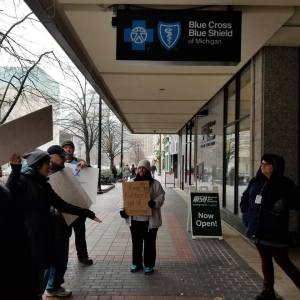
On Thursday, around 15 people from Our Revolution Grand Rapids, the Grand Rapids chapter of Democratic Socialists of America, and the general public showed up to protest and flyer at the Blue Cross Blue Shield office in downtown Grand Rapids in protest of Gretchen Whitmer’s appointment of Blue Cross Blue Shield CEO Daniel Loepp.
As often happens in Grand Rapids, the Grand Rapids Police Department was quick to perform their role of defending private property over peoples’ rights. A police captain came and spoke with the group within seconds of folks arriving. They asked the usual questions about what the plan was/whether we were planning on marching or disrupting etc, and gave the usual spiel about the BCBS office being private property and BCBS having the right to  ask us to leave if we went inside. What was instructive but not particularly surprising in context of GRPD attempted surveillance of other organizations like Movimiento Cosecha GR was that GRPD had been monitoring the public Facebook event, as confirmed by the police captain. After the conversation with the captain the police limited their involvement to circling the block with 3 cruisers, one unmarked, throughout the hour and a half folks were there
The protesters handed out a flyer with the following text:
We demand Governor-elect Gretchen Whitmer remove from her transition team Daniel Loepp, Blue Cross Blue Shield President/CEO.
We die or go deeply into debt because we are denied or cannot afford the insurance provided by companies like Blue Cross Blue Shield of Michigan. His addition was a betrayal to her voters
and the activists who worked tirelessly to put her in office. We ask that Whitmer consider what is
more important; our healthcare needs or the needs of Blue Cross Blue Shield.
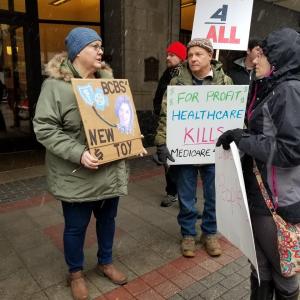 Our main concern is the level of influence Daniel Loepp will have behind the scenes of the Whitmer transition. Loepp being on Whitmer’s transition team gives the health insurance industry a dangerous level of influence in the governor’s office. Loepp and Blue Cross Blue Shield have given campaign funding to both Democrats and Republicans to protect their interests. While Whitmer rejected all criticisms that she was in the pocket of insurance companies, the decision to add Loepp to the transition team where he can represent the interests of Blue Cross Blue Shield is corrupt business as usual
Both we and our employers have seen higher premiums, making health care less affordable and accessible every day. We face routine denials for life-saving medication like insulin as well as life-saving procedures. We constantly find ourselves at the mercy of opaque network practices. Even with BCBS insurance, inflated deductibles make regular visits to the doctor f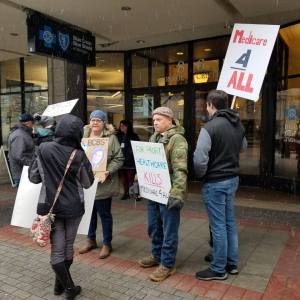 or check-ups or work release notes an impossibility. Over 600,000 Michiganders are still without coverage. Dan Loepp oversees a company that makes its money by denying Michiganders vital services.
“Dan Loepp is on Gretchen Whitmer’s transfer team to protect Blue Cross Blue Shield, not the hundreds of thousands of uninsured and underinsured Michiganders this campaign was elected to fight for. If the Whitmer administration wants to prove their independence from big insurance industry donors, they should remove Dan Loepp, and fight for the 85% of Democrats and 52%
of Republicans who now support Medicare for All.” – William Toms, Michigan for Single Payer Healthcare.
 The flyer also contained this petition calling on Whitmer to remove Loepp from the transition team.
Many people were receptive to both this demand and the demand for Medicare for All, with the notable exception of many of the folks coming in and out of the BCBS office. Some of the protest organizers main talking points were that Whitmer’s appointment of Loepp shows she’s beholden to the interests of the health insurance industry over fixing healthcare for ordinary people, that BCBS pays Loepp $13 million while 600,000 folks in Michigan don’t have healthcare, and that even when folks do have care, it is inadequate and overpriced.
Governor Elect Whitmer’s Transition Team: Who’s In, Who’s not
 The day after Gretchen Whitmer was announced the winner of the Governor’s race in Michigan, the Governor-Elect released the names of the people who will be part of her transition team.
One person on that transition team has received a great deal of attention, the CEO of Blue Cross/Blue Shield (BCBS), Daniel J. Loepp. Loepp’s appointment to Whitmer’s transition team not only was reported in news outlets around the state, it garnered an article on the independent news site, The Intercept.
One of the reasons why Loepp’s appoint is so controversial, is that BCBS contributed $144,000 to her election campaign. In addition, having BCBS on Whitmer’s transition team, will certainly be the end of any possibility of a statewide single-payer health care system being introduced in Michigan. Whitmer has already gone from talking about a more progressive health care system to now using the term affordable, which essentially means that single-payer or Medicare for All will not be what the Governor Elect will advocate for.
Who else is on the Transition Team?
Besides the CEO of BCBS, there are 10 other members of Whitmer’s Transition Team. Let’s take a look at who they are.
Dr. Mona Hanna-Attisha – An associate professor at MSU and director of the MSU and Hurley Children’s Hospital Pediatric Public Health Initiative, a model program mitigating the impact of the Flint water crisis.
Barbara McQuade – A professor at University of Michigan School of Law, Professor McQuade served as the U.S attorney for the Eastern District of Michigan from 2010-2017.
Dennis Archer – Mayor of Detroit from 1994-2001. While Archer was Mayor of Detroit he oversaw major downtown development projects, projects which initiated a great deal of the gentrification of Detroit and opened the door for business owners like Dan Gilbert to buy up lots of property in the city, which has lead to a widening of the gap between those living in poverty and the 1 percent.
Kate Pew Wolters – Chair of the Steelcase Foundation and a Grand Valley State University Trustee, Ms. Wolters is also president family’s foundation and is involved with the Progressive Women’s Alliance of West Michigan. Wolters is part of the power structure in Grand Rapids; was involved with the now defunct One Kent Coalition – which sought to restructure and consolidate the government for the Greater Grand Rapids area; and while she was board chair at the Grand Rapids Art Museum, she was tasked with telling Dennis Komac, then the Director of the Art Museum that he had to stop being involved with the LGBT book store Son’s & Daughters or he would be fired from his job at the Art Museum. Komac refused to disassociate himself with the bookstore and was fired – as is documented in the film, A People’s History of the Grand Rapids LGBTQ Community.
Mike Prusi – Former Michigan Senate Minority Leader, who also served three terms in the House of Representatives. Prusi is from the UP and served as president of USW Local 4950.
Joe Schwarz, M.D. – Former Republican Congressman for Michigan’s 7th District and a practicing physician. Dr. Schwarz also serves on the board of directors of “Voters Not Politicians.”
Allan Gilmour – Retired Vice Chairman of Ford Motor Company.
Dug Song – Co-Founder of Ann Arbor-based internet security provider Duo Security.
Gary Torgow – Chairman of Chemical Financial Corporation, the holding company of the largest bank headquartered in Michigan,
Portia Roberson – CEO of Focus: HOPE, a non-profit community organization that was one response to the 1967 riot in Detroit. The Board of Directors and Advisors of Focus: HOPE is made up primarily of representatives of corporations. https://www.focushope.edu/about-focus-hope/#staff
Thus, it seems that there are 5 members of Whitmer’s Transition Team that come from the corporate world, 3 former politicians, 2 lawyers, 1 doctor and 1 non-profit director.

Who’s Not on Whitmer’s Transition Team?
One glaring omission from Whitmer’s Transition Team is organized labor. This is significant in many ways, especially since organized labor contributed to her election campaign. http://mcfn.org/followthemoney2018#Governor Organized labor contributed hundreds of thousands of dollars, yet they don’t have a seat on the Governor-Elect’s Transition Team. Organized labor should be there to fight to restore pensions for public sector employees and teachers, remove Michigan’s Right to Work policy, fight to get a livable wage for Michigan’s workers and reduced the power that corporations like Nestle has over State government. Organized labor has to stop supporting Democrats, unless there are clear benefits for working class people, as we noted in Part II of our Labor Day articles.
There is no overt representation of anyone from the Environmental Justice movement that is part of Whitmer’s Transition Team. Having someone from the Environmental Justice Movement could lead to reversing the state’s water give-away to Nestle, lead to an end to Line 5, bring about some immediate outcomes to the Flint & Detroit water crisis and the development of clean and efficient mass transit.
There is no one on Whitmer’s Transit Team that is part of the racial justice movement. Having someone from the racial justice movement would send a strong message to the state that police violence against black and brown communities would no longer be tolerated, that funding for communities of color would increase dramatically, that ICE violence against the immigrant community would no longer have the support of the Governor’s office and that the newly proposed private immigrant detention facility in Ionia would be canceled.
There is no overt representation on the Governor-Elect’s Transition Team from the LGBTQ community. Having LGBTQ representation would send a strong message to the people of Michigan that unlike Schuette’s anti-LGBTQ stance, the new Governor would take the offensive in promoting LGBTQ policies like adding LGBTQ protections to the Elliot-Larson anti-discrimination laws and provide greater protections for members of the trans and gender non-conforming community.
There is no representation from the Housing Justice or anti-gentrification organizations across the state. Having someone from this sector on the Transition Team would send a strong message to developers, landlords and property management companies that rental costs should be reduced to a truly affordable level. Someone from this sector would also mean that there could be an end to Emergency Management policies and give greater control to neighborhoods and communities that are constantly be taken over by or threatened with gentrification.
There is no representation from the Public Education community on Whitmer’s Transition Team. Having a strong public education advocate could lead to Lansing defending public school teachers, challenging Charter School expansion, not allowing public money to support Charter or private schools and a commitment to greater funding opportunities of public education, especially if it levels the playing field for school districts that are primarily made up of students of color.
This brief list of who is not on the Governor-Elect’s Transition Team is meant to get us all to stop just being happy that there isn’t a Republican Governor and to get us to engage in radical imagination about what could happen and what needs to happen if we want social justice to be achieved. Having said all this, I am not surprised that Whitmer’s Transition Team does not include people from social movements. Elections rarely include the vision of social movements, which is why social movements should always be autonomous from electoral politics, allowing them to challenge governments to adopt policies that promote greater economic, social and racial justice.
Senator Stabenow wants Michiganders to make the weapons used by US military and sold to foreign governments
Michigan Senator Debbie Stabenow’s office has recently released a new report, Make It American.
The report is designed to change the Buy American legislation loopholes, which allows US government agencies to purchase goods manufactured in other countries. Senator Stabenow’s report is designed to get rid of these loopholes and provide greater opportunities for Michigan manufacturers to get those government contracts in the future.
Not surprising the largest area of government agency use of contractors outside of the US is the Department of Defense, using $84 billion of US taxpayer money to have military equipment made by contractors from around the globe.

Senator Stabenow’s pitch in this report is to close these loopholes, so that Americans, and especially those living in Michigan, get the jobs in the manufacturing industry. Sounds about right. Every politician runs on the idea that they will create jobs. Jobs, like crime and education, are main pillars in any campaign strategy. However, to emphasize the importance of the report, Senator Stabenow’s homepage (as of this writing), has a picture of her with the CEO of R.A. Miller Industries (RAMI), a Grand Haven-based manufacturer of high-tech products for our military.

There are some major issues that the report misses, issues that virtually all politicians don’t want to talk about, so let’s unpack the contradictions of capitalism and militarism that are at the heart of this new report from Senator Stabenow.
Americans should build the weapons and other tools used by the US military. It is fairly well known that the US economy was at its peak during WWII, since everything from the steel industry, transportation and technology industries were geared towards making items used by the US military. This was really the birth of the US Military Industrial Complex, that Eisenhower warned the people about just as he was leaving office.
However, since the Military Industrial Complex is part of the system of capitalism, weapons manufacturers and other industrialists, their allegiance is determined more by profits than patriotism. With the US government and specifically the Department of Defense, they too operate within a capitalist framework, thus they will seek out manufacturing contracts that are lower, thus their allegiance often is swayed by capitalism and not by patriotism.
Americans pay for the US Military Industrial Complex. No where in Senator Stabenow’s report is there any discussion of how US taxpayers fundamentally subsidizes the US Military Industrial Complex, as is well documented by the National Priorities Project. US taxpayer pay for war and militarism, regardless of who actually makes the weapons.
Even if Americans make the weapons, a large percent of the weapons are being sold to foreign government. US weapons sales and military aid has always been astronomical. In fact, the US has been the largest global weapons trafficker for decades and the amount of military that the US provides is greater than the combined total of most countries that provide military aid abroad, as can be seen in the chart below. In addition, US weapons sales are being used by foreign governments to engage in warfare and oppression, with Israel and Saudi Arabia as just two examples.

Capitalists don’t like to be regulated. Capitalist, especially global capitalists don’t like to be regulated. However, in the case of the Defense Industry, they are happy to get government contracts, which are essentially a subsidy from taxpayers and sometimes referred to as a form of State Capitalism. Senator Stabenow will have a nearly impossible time trying to get the loopholes closed with the current Buy American legislation. However, I suspect that this was not really her goal. The Senator’s goal was really about demonstrating to the public and military contractors (mostly military contractors) that she cares about Michigan’s economy, since the report was released just weeks before the November election.
Lastly, it is worth noting that like all US politicians at the federal level, Senator Stabenow has a commitment to neoliberal capitalism and US Imperialism. More profits for weapons profiteers and more weapons for the larger global US imperial project.
Diversity of Tactics, Movement Building and the campaign to End the ICE contract with Kent County
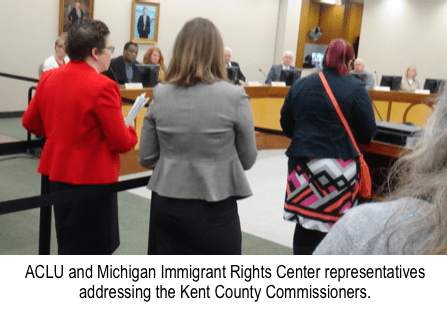
As we reported, last Thursday, representatives from the ACLU and the Michigan Immigrant Rights Center (MIRC) presented both legal and personal reasons why Kent County officials should take a stand and end their contract with Immigration and Customs Enforcement (ICE).
There were several members of Movimiento Cosecha GR, which spoke during public comment, like they have for months, since the campaign to end the contract began in June. The first person to speak from the ACLU/MIRC was a member of the affected community and followed the same type of message that Cosecha GR members have used…….she spoke about the actual harm being done to her family members by ICE violence.
The story from this woman was powerful and it was important that the lawyers from the ACLU and MIRC began with this testimony, which continued to center the voices and lived experiences of the immigrant community.
A lawyer from MIRC spoke next and provided important legal arguments for why Kent County did NOT need to comply or cooperate with ICE agents in Kent County, which you can read about in more detail at this link.
The closing comments were made by a lawyer from the ACLU, who also made some legal arguments. However, what Miriam Aukerman (ACLU) made clear in her comments that what was important is that the County needed to act now, especially since the community has been asking them to end the contract since June. Aukerman made it clear that it is unconscionable that the County has failed to act after the affected community has been using their voices and sharing their lived experiences. The ACLU lawyer made it clear that the County needed to introduce and pass a resolution to demand that the Kent County Sheriff end their contract with ICE.
What the lawyers had to say were nothing but complementary to what Movimiento Cosecha GR and GR Rapid Response to ICE have been saying for months. In fact, even though County Administrators and County Commissioners have viewed the End the Contract efforts with distain, primarily because of the tactics that have been used, the ACLU/MIRC call to End the Contract should be viewed as the an affirmation of what has happened over the past 5 months.
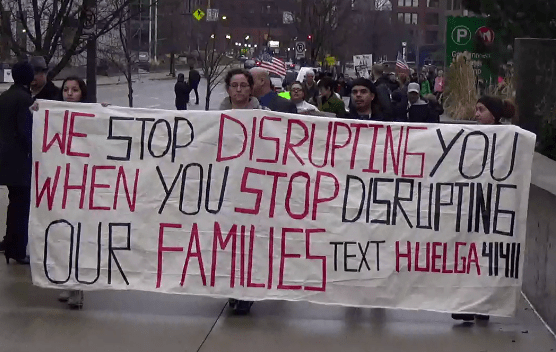
In addition, the ACLU/MIRC call for an End to the Contract also spoke to the diversity of tactics that are necessary in movement building. While the county officials may dislike the disruptive tactics, what Movimiento Cosecha GR and GR Rapid Response to ICE organizing effort has demonstrated is that this insurgent social movement (movement from below) is consistent with previous movements, like the Civil Rights Movement.
The Civil Rights Movement used education, legal means and a whole lot of direct action to force politicians to adopt policies that were based on equality and freedom. The Civil Rights Movement, like all social movements, engaged in direct action tactics that disrupted “business as usual” social norms. Whether that meant a sit in, boycotting a business, shutting down street traffic or disrupting bureaucratic proceedings that the public has no say in and is designed to protect systems of power and privilege, the tactics that have been employed by Movimiento Cosecha GR, GR Rapids Response to ICE, the ACLU and MIRC are all necessary in the fight to resist ICE violence in Kent County.
Documents from FOIA request about Kent County ICE Contract reveal several important points
 (A special thanks to Amy Carpenter for submitting a Freedom of Information Act request to obtain the documents pertaining to the Kent County ICE Contract.)
Recently, someone working with Movimiento Cosecha GR and GR Rapid Response to ICE requested that the county release documents regarding the Sheriff’s Department contract with ICE, beginning with the lead up to the June 28th action at the Kent County Commission meeting, all the way up to the County segregating the public to a different room during their regular meeting schedule.
The documentation includes a great deal of repetitive content, since the e-mails include certain threads between county commissioners and county administration staff. However, there are several things that are instructive when reading the FOIA requested documents.
First, it is instructive that county officials (referring to staff, commissioners and Sheriff’s Dept.) began by stating that the ICE contract is a federal matter and that there is nothing they can do about it. From there, the language changed to “it is the Sheriff’s Department that has the contract,” and eventually the demand to end the ICE contract “will not achieve what your group wants to do.” There was clearly an evolution to how county officials responded to the demands to end the ICE contract.
Second, it was clear from numerous exchanges between county officials that they were clearly monitoring Movimiento Cosecha GR, GR Rapid Response to ICE and GRIID articles about the campaign to end the contract. On a June 14 communication between County Administrator Britt and Commissioner Saalfeld, Britt states, “It is strictly a Sheriff policy issue but it’s germane to the County Board because we are the funding unit that equips him with the jail. However, we can stop anyone from using public comment to politicize an issue.” Numerous commissioners have denied any relationship between the county budget and the ICE contract, even though it seems that Britt makes that point pretty clear. It’s also interesting how he is suggesting that they want to “stop anyone from using public comment to politicize an issue.” What else could public comment about the ICE contract be other than political?
County Administrator Britt does send out a message (June 29) just after the June 28 County Commission meeting, with a message that was vetted through corporate counsel, about what happened at the June 28 meeting. The meeting was ended “to ensure the safety of all individuals in the room.” This is ridiculous, since no one who came to that meeting was a threat to anyones safety. The only threat came from armed officers who threatened to remove people from the room.
In preparation for the July County Commission meeting, county officials wanted to make it clear that they were going to include some new protocols in response to the June 28 meeting, by dictating and controlling how public comment would go and how the physical space would be organized, as you can see from their comments below.

On pages 45 – 48 of the FOIA documents, regarding the August 23rd Commission meeting, county officials provide justification for their suspension of the meeting and moving it to another building.
On page 55 of the FOIA documents, we see that a staff person with Michigan Senator Gary Peters was at the July Kent County Commission meeting. It was agreed that Chairperson Saalfeld would not introduce the staffer with Sen. Peters, rather he just wanted to listen and observe. There was no further information or correspondence with Sen. Peters’ office in the FOIA documents.
On page 64, one County administrator states, “The County and its Commissioners remaining willing to discuss the issues and the limited ability of the County to influence the federal immigration law, but the recent vandalism and trespassing at the County Board Chair’s home and further disruption at the today’s meeting did not foster collaboration or cooperation.” There was no vandalism at Chairman Saalfeld’s home, just numerous signs left challenging him to end the contract with ICE. If there was vandalism or trespassing the police would have arrested people, but no one was arrested despite significant police presence. In regards to the disruption at the July County Board meeting, the groups that have organized these actions have made it very clear that until the county ends their complicity with ICE violence, there will be disruptions at the meetings, because the mild inconvenience of meetings being disrupted is nothing compared to how the lives of immigrants are being disrupted every day in this community.
This sentiment from county administrators is continued on page 65 when they state, “If they want to solely protest without listening and dialoguing it will be a disappointment.” Well, representatives from Movimiento Cosecha GR and GR Rapid Response to ICE did meet with County officials at a separate gathering in early August, but despite the information shared about the ongoing violence being done to the immigrant community, the County officials present refused to even discuss any possibility of ending the contract with ICE.
On page 68, Commissioner Antor writes to County Administrators about his frustration with “protestors” and suggests that the county no longer allow signs in the commission meetings or bullhorns and any disruptive behavior. He also states that the county should put out a statement on the FACTS about the ICE contract to “dispel all the hyperbole and misinformation.” This same commissioner was recorded at a later meeting engaging in his own propaganda that was merely parroting the Trump administration positions on immigration.
On page 70 we finally learn about the fact that some county officials were setting up a separate meeting that did not include those organizing the end the contract campaign, where the sheriff and undersheriff were present.
Beginning on page 75, we see the first information about the decision of the County Board Chair to suspend the September 13th meeting because of the People’s Commission that was held in the commission chambers. On page 77, the FOIA documents show that the county once again was monitoring the campaign’s Facebook page and quoting it at length.
On page 81, Chairman Saalfeld makes his feelings known in a short rant about those involved with the End the Contract campaign:
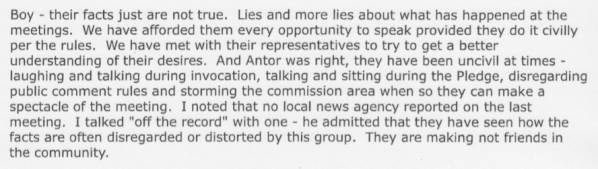
Interesting that he notes that he spoke with a news person off the record about how facts are distorted, which is interesting considering that the local news has continued to report on the campaign to end the ICE contract and has even provided information that challenges the County’s ongoing lack of taking people seriously.
On pages 89 – 90, there is correspondence from a resident in Ada that said they were praying for the county commissioners and Saalfeld said to let her know that “their prayers are greatly appreciated.”
On page 97 there is an e-mail from Comm. Bulkowski asking if there has been any discussion about setting up a meeting between “the Sheriff and the Hispanic community.“ He then goes on to say, “I tam pretty confident that the few people who disrupt our meetings don’t represent the wider Hispanic community.” Then on page 104, Comm. Bulkowski goes on to say more about wanting to meet with the “Hispanic Community” and that groups like the Hispanic Chamber and the Hispanic Center should be invited to talk about these matters. This is further indication that the commissioners are dismissive of those involved with Movimiento Cosecha GR and the affected community that has continued to share their stories about the pain suffered by ICE violence.
Beginning with page 115 and continuing for several pages there is the county’s response/PR damage control in regards to their decision to not allow the public in the Commission chambers during the 2nd September meeting.
On Page 121, Comm. Saalfeld commends County Administrator Britt for his interview on WKTV and then states that the others interviewed indicates both some inaccurate facts and some things that are not understood. We of course have a much different perspective on the interviews.
 On page 128, Comm. Saalfeld sent another e-mail to County Administrator Britt, with a link to a GRIID article about the No Business With ICE Day action and the following comment.
“Maybe time to engage the GRPD.”
Saalfeld no doubt makes this comment because in the GRIID article cited and many of others, there has been a huge GRPD presence at anti-ICE actions. Since the Kent County Sheriff has stated repeatedly that they will not arrest people during County Commission meetings that Saalfeld wants to enlist the GRPD to deal with those who disrupt the commission meetings.
While the documents based on the FOIA request don’t necessarily reveal anything significant, they are instructive as far as how the county views those involved in the end the contract campaign and how the disruptions have made some of them very uncomfortable moving forward.
Lawyers present case that Kent County doesn’t need to comply with ICE, yet majority of the Commissioners fail to take action
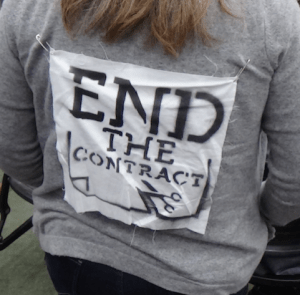 Yesterday, about 25 people working on the End the ICE contract with the Kent County Sheriff’s Department attended the morning meeting of the Kent County Commission.
Only a few of the organizers with Movimiento Cosecha GR and GR Rapid Response to ICE spoke about the contract during public comment. However, there were several representatives from the Western Michigan branch of the ACLU and MIRC (Michigan Immigrant Rights Center) who presented together, making it clear that Kent County was not legally obligated to comply with ICE, nor to continue the contract.
The legal arguments for why Kent County doesn’t have to comply with ICE was laid out in a letter sent to then Sheriff Stelma in late September, a letter you can read here.
In addition to their legal case, representatives from the ACLU and MIRC told the Kent County Commissioners and administrators that they have been circulating a letter in the community with clear demands about ending the contract with ICE and making Kent County a more welcoming community for immigrants. You can read and sign on to the letter here, and here are the list of demands presented in the letter:
We call on you, the County Commissioners, to pass a welcoming resolution for Kent County that does the following:
1. Proclaims that Kent County is a county that welcomes immigrants;
2. Calls on the Sheriff to end the contract with ICE and its voluntary and harmful practice of aiding ICE’s deportation efforts;
3. Prohibits any county funds from being used for federal immigration enforcement efforts; and
4. Commits to engage the community on other steps the county can take to make Kent County a more welcoming county.
The letter has been signed by community stakeholders including Justice for Our Neighbors, the Hispanic Center of West Michigan, the Micah Center, Treetops Collective, Dominican Sisters of Grand Rapids, Christian Reformed Church Office of Social Justice, Joy Like a River United Church of Christ, Grand Rapids Rapid Response, and the West Michigan Coalition for Immigration Reform.
At the end of the meeting, just before the commissioners adjourned, there were a few responses directed at the issue of the ICE contract. Comm. Melton spoke with some urgency about the need to do something, especially since the community has been coming before this commission for more than four months now.
Commissioner Talen made reference to the 2019 County Budget that was discussed earlier and he said he was struck by the language in the section of the budget about public safety (Sheriff’s Department and Jail) that the county should protect people, especially the most vulnerable. He then made the connection between the most vulnerable and the families impacted by ICE violence, but never agreed to take action or to honor the demands laid out by the ACLU, MIRC, Movimiento Cosecha GR or GR Rapid Response to ICE.
 Commissioner Bulkowski then said what he and some others have been saying since June, which was that they need to go through the process of investigating the matter and establish a Task Force. This is problematic on several levels. First, suggesting that the county establish a Task Force completed dismisses the lived experiences of the immigrant community, which has been communicating with them since June about the harm that their families are enduring because of ICE. Second, establishing a Task Force minimizes the organized efforts of Movimiento Cosecha GR, GR Rapid Response to ICE, the ACLU and MIRC, which has been calling for an end to the ICE contract since June. All of these groups have done their due diligence, by taking testimony from hundreds of people impacted by ICE violence, documenting it, providing legal support for the families, mutual aid support and publicizing the ICE violence for the past 2 years. In addition, Chairperson Saalfeld said he was hesitant to establish a Task Force, since the Commissioners can’t dictate policy matters to the Sheriff’s Department. Saalfeld made these comments just minutes after the ACLU and MIRC made it clear that the county is under no legal obligation to comply with ICE.
Commissioner Womack was the last to respond to this issue, by stating that he was going to commit to writing up a draft of a Kent County Commission Resolution to call on the Sheriff’s Department to end the contract. It seems that the only person to hear what people have been saying for months and willing to take action, is the only commissioner of color.

