How about we work on collective liberation: On why we should not be seduced by electoral politics
 Ok, so it’s two days after the election and lots of people are feeling good about the outcome. This euphoria is understandable, especially since the Trump administration took over the White House and began making the already white supremacist political culture in the US an even greater nightmare for communities of color.
I get why people turned out in large numbers on Tuesday and voted to reject the reactionary far right agenda. I also get that people voted overwhelmingly for Democrats. However, let us be clear that the vote yesterday was primarily about doing what some refer to has a form of “harm reduction.” Personally, I think the term is problematic, but I get that people want to believe that their participation in voting might be a way to slow down the harm that is being done to so many in the current systems of oppression – capitalism, white supremacy, patriarchy, settler colonialism, etc. That being said, it doesn’t STOP THE HARM BEING DONE. Harm is still being done and we all know which communities of people who were experiencing the greatest amount of harm are and who will continue to experience harm tomorrow – black Americans and other communities of color, immigrants, the disability community, the LGBTQ community (especially trans and queer people of color) and people who are experiencing the brutality of poverty.
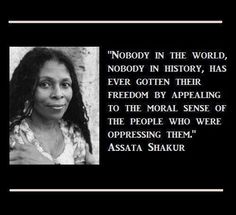
Voting as a form of harm reduction should also tells us that the system of voting is not really designed to challenge systems of power and oppression, rather it just trying to keep it from totally destroying us. Sheldon Wolin, in his important book Democracy Inc: Managed Democracy and the Spector of Inverted Totalitarianism, makes it clear that the form of representative democracy that exists in the US is a form of managed democracy (sort of like managerial racism). Those who have the real power, will only tolerate small changes from civil society. Wolin also points out that those in power have only become more entrenched in recent decades, with even more influence over the electoral system in the US. This is exactly why a great deal of people in the US do not participate in the process. In 1956, the great African American scholar W.E.B. Du Bois wrote, “I believe that democracy has so far disappeared in the United States and that no two evils exist. There is but one evil party with two names, and it will be elected despite all I can do or say.”
 I add this comment from Du Bois not to say that people shouldn’t vote, rather to make the point that voting is but one tactic to use to work towards collective liberation. However, voting within the current system that is used in the US will never bring about collective liberation, which is why those in power allow it to continue. For instance, think about the three state ballots proposals that passed in Michigan. While they all generated a fair amount of positive attention in liberal/progressive circles, Props 2 & 3 are merely tweaks to the existing electoral system and in fact just provides more legitimacy to the system of managerial democracy. Proposal 1, which will legalize the sale of marijuana in Michigan, will be a very small step in reducing the harm done by the War on Drugs, especially against communities of color. However, as legal and anti-racist scholar Michelle Alexander points out, “Here are White Men poised to run big Marijuana businesses, dreaming of cashing in big. Big money, big business and selling weed, after 40 years of locking up impoverished black kids for selling weed. Their families and futures destroyed. Now White men are planning on getting rich doing precisely the same thing.” The poor black and brown people who are in for drug possession will not likely be pardoned, nor will they be reimbursed for loss of wages, jobs, housing, etc. Also, within the system of capitalism, who do you think will be the primary beneficiaries of marijuana sales?
However, the most important point I want to make here is that while voting can be a tactic for harm reduction, it does not get us to collective liberation. If we want collective liberation and especially the liberation of black, brown and indigenous people, those who identify as trans and queer, immigrants, those experiencing poverty and those suffering the brunt of US imperialism, then we need to ask ourselves…….how do we make this kind of collective liberation possible?
Think about it. Today, and yes, even after the newly elected people take office, what will we have in the US?
- We still have land that was stolen by a system of settler colonialism from hundreds of Native nations.
- We still have a country where most of the taxes are used for the Military Industrial Complex to expand US imperialism, with the US being the largest weapons trafficker in the world.
- We still have a country where black people are murdered by cops at an alarming rate, with disproportionately high levels of poverty and millions of black people in the Prison Industrial Complex.
- We still don’t have anything remotely close to Climate Justice. In fact, we still have a capitalist system which doesn’t give a shit about the ongoing ecological destruction that is taking place on a global scale.
- We still have the system of patriarchy in place, where women are sexually assaulted at astronomical rates and a rape culture that permeates virtually every aspect of this society.
- We still have a heterosexist system that rewards cisgendered people and punishes trans, queer and gender non-conforming people.
- We still have a system of capitalism, which brutalizes workers and redirects more public money into the private sector.
- We still have a system where undocumented immigrants are criminalized and being rounded up by ICE every day to be sent to detention facilities, often leading to deportation.
- We still have a health care system that is driven by private corporations, which have no regard for the well being of most people.
I could go on about the kind of system we have, but the point here would be that this system has been around since the US was founded, regardless of who sits in the White House or who controls Congress.
 I know there are plenty of people who think that voting for Democrats is enough to change the system, but voting for Democrats will not end or even challenge the the systems of oppression listed above. For example, in the first few years of the Clinton Administration and the first few years of the Obama administration, when Democrats controlled the White House and Congress, the structural and systemic oppression of people and the planet continued. Democrats controlling the White House and Congress did not result in a major systemic changes or dismantling of systems of oppression. This is not to say that the Bush II administration and the current Trump administration has pushed legislative politics further to the right, to expand the control of systems of power and oppression, but the point here is that Democrats in power do not push legislative politics in ways that challenge systems of power and oppression, social movements do.
 Of course, what I am saying is that while voting may have been a form of harm reduction, it will not get us to collective liberation. If we want to work for collective liberation then we will need to be involved in mass movements. Mass movements not only have the power to challenge the systems of power and oppression that run the country, they have the power to create safe spaces, to center the lives and voices of the most vulnerable, movements can allow us to engage in radical imagination and provide opportunities to create new, independent and autonomous ways of organizing.
What I want to encourage people to do is to vote for and to chose to be part of social movements that are fighting for justice and collective liberation. If it isn’t clear to people what those movements look like, I would suggest the following:
- Black Lives Matter and other black-led movements for liberation that are challenging the system of White Supremacy.
- Indigenous movements, like we saw at Standing Rock that are now being replicated all over Turtle Island, movements which are challenging the system of Settler Colonialism.
- Movimiento Cosecha, Mijente and other immigrant led and immigrant justice movements
- Queer and Trans liberation movements, like Pink and Black or the Silvia Rivera Law Project.
- Disability Justice movements, especially those that operate outside of the non-profit system.
- Food Justice movements, especially those that renounce food charity and corporate agribusiness, like Via Campesina.
- Climate Justice movements, especially those that do not believe that capitalism and sustainability are compatible, like Idol No More.
- Tenant Rights and housing justice movements that are led by those experiencing gentrification and skyrocketing housing costs, like the Right to the City movement.
- Anti-imperialist movements like the Zapatistas, the Palestinian BDS movement and other insurgent movements fighting against US imperialism.
Educate yourself. Be part of movement building work. Fight to dismantle systems of oppression. Work towards Collective Liberation. Vote for social movements, with your energy, your ideas, your creativity, your passion, your imagination and your resources. Don’t be seduced by the limitations of electoral politics and embrace the power of collective liberation.
White House releases a report on the evils of Socialism and of course the Acton Institute praises it
 A week ago, the White House released a report entitled, The Opportunity Costs of Socialism.
The 72 page report was put together by the White House group known as the Council of Economic Advisors (CEA). The CEA was founded in 1946, during the Truman administration and conducts research for the White House on economic policy.
The CEA is made up of individuals who all have a history of defending the economic system of capitalism, beginning with the Chairman, Kevin Hassett. Hassett, a former consultant for the US Treasury Department, spent numerous years as an economist for the American Enterprise Institute, an influential right wing think tank.
On Friday, the Grand Rapids-based think tank, the Acton Institute, posted an article summarizing the White House report and essentially affirming its analysis. The Acton Institute’s support of the report is no surprise considering that the organization is an apologist for free market policies.
The article has one accompanying photo, which shows people at a rally in the US, holding signs saying Medicare for All. In the White House report and the Acton Institute article, the idea of Medicare for All is considered scandalous, since it would prevent private corporations the right to sell people insurance. The White House report does not provide an assessment of the current health care system in the US, other than to suggest that it is less of a tax burden than single payer health care policies that other countries have adopted. The report also fails to mention that there are millions of Americans who support policies like Medicare for All.

The report is riddled with flaws, but perhaps the largest one is the role that the US has played in attempting to undermine countries which have adopted socialist policies. The White House report attempts to critique the economic policies of China, the former Soviet Union, Cuba and Venezuela.
The report offers no comparison on the differences in China or Russia today, which have essentially adopted state-sponsored capitalism, to the socialist policies that both countries previously held. More importantly, in the case of Cuba and Venezuela, the report omits the fact that the US government has actively tried to undermine undermine Cube since 1959, using a variety of tactics or what Noam Chomsky refers to as decades of political terror and economic warfare.
In the case of Venezuela, the US during the years that Hugo Chavez was in power and up to the present, has also actively attempted to undermine the country by isolating Venezuela, punishing countries that have positive relations with them, using economic leverage and undermining the political process through organizations such as the National Endowment for Democracy. Eva Golinger’s book, The Chavez Code: Cracking US Intervention in Venezuela, provides excellent analysis on how the US has worked to undermine Venezuela.
The White House report on socialism hasn’t received much attention in the mainstream commercial media or even in more independent media sources. This is understandable, considering everything else that has been happening in recent weeks, but the failure of news agencies to cover the findings of the report is indicative of the news media’s tendency to focus on the person of Donald Trump, rather than the policies of the current administration.
West MI Policy Forum speaker advocates for a neoliberal economic agenda: More privatization, undermining of unions and dismantling public education
 Last Monday, the West Michigan Policy Forum posted the mot recent information about the content of the September conference. This post featured a link to another interview by Comcast Newsmakers, with Professor Tawni Hunt Ferrarini, who’s talk at the WMPF Summit focused on what she calls Understanding Michigan’s Fiscal Health.
You can watch her entire lecture at this link, but we also found the powerpoint presentation that she gave from her own personal website.
The lecture and accompanying slides are not terribly interesting. Ferrarini serves as a faculty scholar for the Mackinac Center for Public Policy, a right wing think tank that has been around for three decades and has received millions of dollars in contributions from the Grand Rapids Power Structure, specifically the DeVos Family.
The first 19 pages of her presentation makes it sound as if during the Granholm administration the state’s economy failed, while under the Snyder administration, Michigan’s economy has thrived. I would argue that under both administrations the economy primary benefited those who were well off, but that benefit has excelled under Snyder’s tenure as governor of Michigan.
The presentation because a bit more interesting around slide 20, when the Mackinac Center professor makes it clear what still needs to happen to make the state’s economy truly benefit the capitalist class. Ferrarini identifies four major fiscal challenges for the state, which underscores exactly why the West Michigan Policy Forum invited her to present in September.
- Unfunded Liabilities
- Transportation (roads)
- Tax Credits
- Education
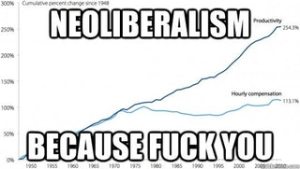 These four challenges are the main current pillars of the neoliberal economic policy makers around the world, but especially in the US and Europe. Each of these four are part of the larger neoliberal policy framework that transfers massive amounts of public funding the the private sector, also known as austerity measures. In an excellent article over 20 years ago, Elizabeth Martinez and Arnoldo Garcia identify neoliberalism as consisting of 5 main points:
- The Rule of the Market
- Cutting Public Expenditure for Social Services
- Deregulation
- Privatization
- Eliminating the concept of the Public Good and replacing it with individual responsibility
In Professor Ferrarini’s presentation, she advocates for similar points, which she identifies as challenges, meaning they need to be improved on or they still need to be implemented.
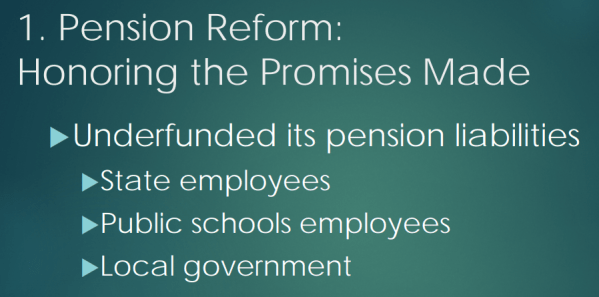
In slide #22, we can see that Ferrarini wants to see pensions that were won and fought for by unions to be replaced with market-based 401k plans. She also promotes attacking pension at the state & local government level, along with public sector educators.
In the second major policy challenge of transportation/roads, Dr. Ferrarini essentially just cites a Mackinac Center report called Roads in Michigan.
In the third challenge of tax credits, which does remove some tax credits to certain industries, but does nothing to adequately tax the larger private sector, which would result in billions of tax dollars that could provide a substantial safety net in Michigan.

The fourth and final challenge is education. This was a major focus of the West Michigan Policy Forum in September, where essentially the main thrust of the speakers, like Jeb Bush, was to adopt the same kinds of education policies that Betsy DeVos is now promoting in Washington.
What should be clear to anyone who has read any of the article we have written about the 2018 West Michigan Policy Forum or previous forums, is that these gatherings are critical to promoting and adopting the far right neoliberal economic and social agenda. Why the work of the West Michigan Policy Forum does not garner much attention from the progressive, liberal or lefts sectors is baffling to this writer, since what the WMPF advocates for at the state level in terms of policy, should be resisted by great urgency.
Nothing but contempt for the anti-fascist movement ANTIFA: Conservatives and Liberals agree
In an article posted on the Acton Institute’s webpage on October 22nd, the Rev. Ben Johnson entitles his article, The spiritual core of political hate.
The photo that accompanies the article shows cops attempting to stop or block protestors, some of which are holding antifa flags, as you can see from the screen-saved image here.

The content of the article isn’t terribly interesting or well thought out, but one thing is clear, that the only example that Rev. Johnson provides of political hate, is antifa.
First, Johnson refers to an interview that NBC had conducted with Professor Mark Bray about antifa. Bray, who has written an excellent book that traces the history of anti-fascist resistance, entitled, Antifa: The Anti-Fascist Handbook, was quoted in Johnson’s article as saying, “I wouldn’t characterize my political perspective as being ‘violent protests’ so much as community self-defense.”
Right after this quote from Bray, Rev. Johnson adds his own sentence in parenthesis, saying, (Of course, “violent protests” is not a political perspective, since it lacks any intellectual substance.) This is the first clear indication that Rev. Johnson has nothing but contempt for anti-fascist resistance, since he denigrates communities engaging in self-defense as lacking intellectual substance.
Secondly, Johnson further’s his contempt for antifa, in this paragraph:
Over the last year, extremists have reversed the 1964 Civil Rights law by chasing people (including some minorities) out of public accommodations. Public figures who do not share the demonstrators’ commitment to the expropriation and redistribution of wealth, within and between societies, find themselves targeted by menacing protests that threaten to spill over into physical violence.
Johnson is clearly referring to organized resistance to white supremacists who are attempting to speak on campuses or other venues and are met with significant opposition. The communities that are opposing the white supremacists are saying that hate speech is not free speech and providing these white supremacists with a platform to proclaim their hatred of jewish people, communities of color, immigrants and those who identify as LGBTQ has consequences and should not be tolerated.
At the very end of the article, Rev. Johnson cites the keynote speaker at this year’s Acton Institute annual dinner, the Rev. Timothy Keller who says, “Is there a solution” to the problems created by modern identity? “Yes,” he said. “It’s the Christian Gospel.” Rev. Keller, it should be noted, not only embraces the neoliberal free market views of the Acton Institute, he doesn’t believe that women or those who identify as LGBTQ should be allowed to be leaders in the Christian community.
Many people might suggest that an Acton Institute writer equating political hate with antifa is to be expected. While I don’t disagree with the notion, I still believe that it is important to not only acknowledge this reality, but believe it is equally important to understand why those on the right, religious or otherwise, hold these kind of views against anti-fascist resistance.
 However, it may not be as evident to those who identify as liberals and progressives that there is also a significant amount of contempt directed at antifa by liberal and progressive organizations.
Take for instance this recent meme that was posted on various social media sources by the group known as Occupy Democrats. The text reads, This is American terrorist Cesar Sayoc, who tried to commit mass murder by sending 12 bombs to Trump critics. He wasn’t radicalized by ISIS. He wasn’t radicalized by Antifa. He was radicalized by Donald Trump.
Now, I get the intention of this meme, but it is highly problematic. First, the Occupy Democrats meme essentially equates ISIS and antifa, which is utterly ridiculous. Second, this meme also equates the violent behavior of Cesar Sayoc, who attempted to murder Trump critics, with antifa activists who have organized in recent years to prevent white supremacists from coming into their communities to promote hate and violence against vulnerable populations.
This meme, while condemning the actions of a Trump supporter, also demonstrates contempt for anti-fascist organizing being done by antifa. In addition, it demonstrates that Occupy Democrats, (which was created during the Occupy movement as an attempt to co-opt the message and energy of that movement by the Democratic Party) also holds the organized resistance work of antifa in contempt and would rather distance themselves from real anti-fascist organizing than be associated with it.
Follow the Money: Kent County Commission Candidate Campaign Finances

Large bills fanned out and held in hand
Considering how much attention we have been giving to the Kent County Commission because of the Sheriff Department’s contract with ICE, we thought it would be worth looking at the campaign finance records for all of the incumbents and the challengers in the upcoming November election.
What follows is a list of the candidates by district, with the amount of money they have, plus some of the larger donors for each candidate. To look up the information yourself, just go to the Kent County Clerk page, under the election section and then click on the button for Campaign Finances.
There are definitely names (individuals and organizations) of those who are part of the Grand Rapids Power Structure, who have contributed to several candidates listed below.
District #1
Theodore Vonk (R) Nothing filed for this cycle
Deborah Havens (D) Total – $7373; Major contributions – $1683 Deb Havens, $200 David Harrison
District #2
Tom Antor (R) Total – $3100; Major contributions – $500 MAC PAC, $350 Grand Rapids Chamber PAC, $250 Peter Secchia
Jeremiah Anway (D) $0
District #3
Roger Morgan (R) Nothing filed for this cycle
District #4
Diane Jones (R) Total – $24,290; Major contributions – Realtors Political Action Committee of Michigan $500, Grand Rapids Chamber PAC $250
Kari Smith (D) Total – $300
District #5
Mandy Bolter (R) Total – $7,790; Major contributions – Garcia Majority Fund $500, David Bilardello $500, David Hibma $500, Realtors PAC $500, Steve Van Andel $500, David Mehney $500, MAC PAC $500.
Neville Mark (D) $0
District #6
Stan Stek (R) Total – $1447; Major contributions – Stan Stek $697, Michigan Association of Realtors $500, Grand Rapids Chamber of Commerce $250
Pam DeGryse Total – $0
District #7
Stan Ponstein (R) Total – $2752; Major contributions – Stan Ponstein $577, Peter Secchia $500, Friends of West Michigan Business $250
Mike Johnson Total – $557
District #8
Harold Voorhees (R) Total – $2500; Major contributions – Harold Voorhees $1000, Dan Hibma $500, Rusty Richter $500, Dave Dishaw $500
District #9
Matt Kallman (R) Total – Matt & Jennifer Kallman loaned $2500
Bob Smith (D) Total – $2408; Major contributions – Bob Smith $1791
District #10
Emily Brieve (R) Total $2385; Major contributions – Dan Hibma $250, Ross Post $250
District #11
Jim Saalfeld (R) Total $32,346; Major contributions – Commercial Alliance of Realtors $500, Grand Rapids Chamber of Commerce PAC $350
August Treu (D) Total – $3532
District #12
Jill Martinez (R) Total – $4205; Major contributions – Kent County Republican Committee $2500, Peter Secchia $1000,
Monica Sparks (D) Total – $2825; Major contributions – Equity PAC $1000, Raquel Salas $500, Grand Rapids Chamber PAC $350, Natalie Garcia $250, Bob Goodrich $200
Charlotte Aikens (G) $0
District #13
Jessica Ann Tyson (R) Total – $5925; Major contributions – Kent County Republican Committee $2500, Realtors PAC of Michigan $1500, Peter Secchia $1000, Grand Rapids Chamber PAC $350
Betsy Melton (D) Total – $2000; Major contributions – Betsy Melton $2000
District #14
Kyle Brethauer (R) $0
Carol Hennessy (D) Total – $3937; Major contributions – Grand Rapids Fire Fighters Union $1000, West Michigan Plumbers and Fitters $500, Grand Rapids Area Chamber of Commerce $250
District #15
Joel Townsend (R) $0
Jim Talen (D) Total – $1050; Major contributions – Friends of West Michigan Business $250, Jonathan and Leslie Anderson $200, Bob Goodrich $200
District #16
Jenna Vandekamp (R) $0
Dave Bulkowski (D) Total – $4207; Major contributions – Grand Rapids Chamber PAC $250, John Van Fossen $250, Bob Goodrich $200
District #17
Courtney Panter (R) $0
Robert Womack (D) $0
District #18
Dan Koorndyk (R) Total – $13,950; Major contributions – Realtors Political Action Committee of Michigan $2000, Peter Secchia $1000, Steven Baldwin $1000, John Bales $1000, Susan Hascall $1000, Dan Hibma $1000, Hildenbrand Leadership Fund $500, MAC Pac $500
Stephen Wooden (D) Total – $27,325; Major contributions – Stephen Wooden $1000, Steve Pestka $1000, Equity PAC $1000, Cary Fleisher $1000, Adelyn Wooden $500, Fred Wooden $500, John Hunting $500, West Michigan Plumbers, Fitters and Service Trades Local Union $500, Elizabeth Welch $500, Sam Singh $500, Sandra Rempel $500, Bob Goodrich $250, Tamara Vandenberg $250
District #19
Laurel Abraham (R) Total – $10,734; Major contributions – Kent County Republican Committee $5000, Peter Secchia $1000, Alan Abraham $1000, Terri Land $500, La Buckley $500, Tracy Knapp $500
Phil Skaggs (D) Total – $28,741; Major contributions – Phil Skaggs $9735, Grand Rapids Fire Fighters Union PAC $1500, Bob Goodrich $650, Grand Rapids Police Officers Association PAC $500, Elizabeth Welch $500, John Hunting $500, Michigan Laborers Political League PAC $250
Kent County Candidates at Latino Community Coalition forum are asked about ICE Contract
 The Latino Coalition hosted a community forum last night at Lee High School, where candidates from several districts in the urban core of Grand Rapids, the ones with larger Latino/Latinx population resides.
They invited a total of ten candidates, but only six of them showed up. Four of the candidates were incumbents and 2 were challengers. There was also a low community turnout, with an estimated 25 people in attendance.
The Latino Coalition has been hosting similar candidate forums in recent years in order to provide greater opportunity for Latino/Latinx residents to be informed about candidate positions and to press candidates on issues that are of greater importance to the Latino/Latinx community.
There were several questions posed to the candidates, but what this writer was most interested in had to do with how they felt about the contract that the Sheriff’s Department has with ICE. What follows is a summary of what was said.
Mike Johnson who is running to be on the Kent County Commission said the contract should end now. Robert Womack said the contract should end immediately because this is what the community has asked of the commission. Womack also said that the county has millions of dollars in surplus and can afford to lose whatever money the jail gets from the current ICE contract. Commissioner Womack also said that the county does a terrible job when it comes to how they interact with minority communities.
The other person who is running to be elected for the first time, Joel Townsend, said he was not in favor of ending the contract, although he suspects that the county does not have to legal cooperate with ICE.
All the other current County Commissioners – Bulkowski, Talen and Hennessy, all said that they would not sign the commitment to end the contract that has been presented to them by Movimiento Cosecha GR, but that they would be willing to work with the community to end the contract. None of the commissioners were very clear about how they would help to end the contract, but they all made a point to say that it was complicated.
What does seems clear is that the want to set up a task force to look into the matter before taking any action. This is what those who have been involved with the campaign to end the contract with ICE have heard since the very first meeting in late June, yet no task force has been established and none of the commissioners provided a timeline for when that might even begin.
One commissioner said that ending the contract was symbolic and that it wouldn’t do what people were asking for. We have heard this over and over again and the response from Movimiento Cosecha GR and the GR Rapid Response to ICE has been, “we know that ending the contract will not stop ICE from taking members of the immigrant community. However, it will send a strong message to ICE and the affected community that the county will not be complicit with ICE repression. In addition, it will go a long way to improving the County’s relationship with the immigrant community, which right now is based on a lack of trust.”
In addition, Movimiento Cosecha GR and GR Rapid Response to ICE has made it clear for over a month now that what they were demanding has expanding to more than just ending the contract with ICE. Since the September 13 County Commission meeting, this is what they are demanding:
- Ending the Contract with ICE
- Pass a resolution that says the County will not use any of their resources to support ICE, which includes ending the holds that ICE requests.
- Make the County a Sanctuary for all immigrants, just like Ann Arbor and Detroit have done.
- Support the work of GR Rapid Response to ICE, who gets calls every week from families – you can help them to interrupt ICE and to support families who have been harmed by ICE.
- Pass another resolution to support state legislation that would allow drivers licenses for all.
To watch the video of the Latino Community Coalition candidate forum, go to their Facebook page and in the videos section the forum is the fist one you can click on. The question about the ICE contract begins about 28 minutes into the forum.
DeVos Philanthropy is once again unchallenged by MLive
On Friday, MLive published a brief article about how the DeVos family was 25th on the Forbes list of top 50 givers in the US.
The article doesn’t provide much information other than to say:
 The West Michigan family, who made their billions through Amway, made notable gifts last year to Spectrum Health Foundation, Frederik Meijer Gardens, Heart of West Michigan United Way, West Michigan Center for Arts and Technology and the National Constitution Center.
While it is true that the DeVos family contributed to the above organizations, they gave a whole lot more to several other entities, specifically to religious institutions and right wing policy groups.
The MLive article fails to mention the millions the family has contributed to Hope College, Calvin College, the Haggai Institute, the Luis Palau Association and numerous other conservative religious entities. When it comes to far right policy groups, the DeVos family has contributed millions to groups like the American Enterprise Institute, the Heritage Foundation, the Mackinac Center for Public Policy, the Acton Institute, the Alliance for School Choice and the Great Lakes Education Foundation.
Omitting information on some of these entities is significant, because it makes us all think that what the DeVos family contributes to are just nice charities. The reality is that this family has contributed millions of dollars to conservative religious groups that have very strong positions on reproductive rights, LGBT issues and the normalization of patriarchy. In addition, the policy groups and think tanks collectively take strong positions in favor of privatizing education, dismantling public sector unions, deregulating the economy, pushing Right to Work policies and getting local and state governments to adopt economic austerity measures that gravely effects working class people and communities of color.
The MLive article also doesn’t talk about how the foundations that wealthy families set up are a way of 1) hiding some of their money so it cannot be taxed; 2) to act as a kind of PR front to distract people from thinking about how they have made their money, and 3) how foundations have been used as a way to manage the non-profit sector, which disproportionately relies on foundation grants.
It is also important to note that the DeVos Family contributes more to influence government policy in Michigan more than any other family in the state, based on documentation from the Michigan Campaign Finance Network. The kinds of policies they have been promoting, both through their family campaign finances and groups like the West Michigan Policy Forum have resulted in making Michigan a Right to Work state, attacking teacher and other public sector pensions, denying same sex parents from adopting from the largest adoption agencies in the state, changing the tax system to benefit the wealthiest and changing state law to allow larger campaign contributions.
All of these policies have caused a tremendous amount of harm and negatively impacts the most marginalized communities in the area. The DeVos Family then provides substantial grant funding through their numerous family foundations, funding that is often used by non-profits to respond to the harm the DeVos Family has caused. The difference is that the funds used within the non-profit sector are based on conditions, which allows the DeVos Family to engage in a form of social engineering and population management.
In addition, the non-profits that are receiving funds from the DeVos Family Foundations are then put in a position so as to never criticize the family’s political funding. This means that in addition to engaging in population management, non-profit/social service organizations are also managed for fear of losing their funding. Therefore, the DeVos Family philanthropy plays a significant role in the two pronged strategy of ideological warfare they engage in through their wealth. (See Part I and Part II of an article that further explores this dynamic.)
MLive once again demonstrates their unwillingness to question or challenge the dominant narrative about the DeVos family, a narrative that is essentially created by them, which is then repeated by the commercial media. This was the case with the recent death of Rich DeVos and has been for decades in West Michigan.
Last month, the West Michigan Policy Forum held their big policy conference in Grand Rapids, a conference that I was denied access to, even though I have covered all their previous conferences.
The primary focus of the West Michigan Policy Forum’s conference this year was on education and talent creation. One of their main speakers was former Florida Governor Jeb Bush, who’s comments we provided a critique of.
Another speaker was Arthur Brooks, President of the American Enterprise Institute (AEI), one of the most influential far right think tanks in the country. The speech by Brooks is still not available, but while he was in Grand Rapids, he did a short interview with Comcast’s show, Newmakers, which you can view here. 
The Comcast show host sets up the show by asking the question, Socialism vs Capitalism – why are young people turning towards the former? It’s an interesting and an important question that AEI President Arthur Brooks doesn’t answer.
However, before Brooks gets a chance to ask the question, he is asked about the American Enterprise Institute. Brooks claims the organization is, “about expanding freedom, liberty and free enterprise, particularly for people who are at the margins.” Based on this statement, AEI is deeply committed to working with communities of color, immigrants, the LGBTQ community and people experiencing poverty……those on the margins, right. Not hardly. AEI has been a think tank for corporate capitalism, which is why they are a member of the American Legislative Exchange Council (ALEC). AEI has fought against increasing wages, fought against any real kind of economic regulation, has defended big tobacco, defended environmental polluters and was deeply involved the US invasion/occupation of Iraq beginning in 2003.
Brooks then attempts to address why young people are attracted to Socialism. He says that the economic crash of 2007-2008 probably had an impact on young people who viewed the economy as being bleak. Brooks then says this always happens when capitalism takes a down turn, but people should remember that only capitalism can actually rescue the billions of poor people in the world. Of course Brooks ignores the massive US government bailout of Wall Street in 2008, which saved Capitalism.
The show’s host the asks Brooks what he would say students at a college campus about economics. Brooks says that in recent decades some 2 billion people have been pulled out of poverty because of free trade policies, globalization, property rights and the culture of free enterprise. Brooks offers no evidence and the show’s host doesn’t ask for any.
The show’s host then talks about the role of electoral politics in all of this and about how Liberals and Conservatives need work together. Brooks says he has a new book coming out about this very topic. The President of AEI says that there is a small group of people who are getting rich off of telling people they need to hate people they disagree with. His forthcoming book is, Love Your Enemies: How Decent People Can Save America from Our Culture of Contempt. You just couldn’t make this shit up.
The American Enterprise Institute has nothing but contempt for the poor and has demonstrated during its history that their allegiance is to those in the Capitalist class. This is exactly why the DeVos family has contribute millions to AEI over the years and it is exactly why the West Michigan Policy Forum brought him to Grand Rapids for their conference.
 In January of 1992, just days before the cease-fire in El Salvador, I was sitting in the Central Plaza watching the crowds of people with my traveling partners. We noticed a large crowd in the center listening to a man speaking in English who was accompanied by a translator. I decided to walk over to investigate what was going on when I realized that the man speaking was a preacher from the US. No sooner did I realize this that I turned around and rejoined my friends shaking my head in disgust.
When the crowd finally dispersed I noticed that the street preacher was headed in our direction. Right away he began to speak to us in English and inquired about our being in El Salvador. We told him we were tourists because one never knows when there are people listening in on your conversations. Before we could say any more this guy began asking us if we had “come to know the Lord.” We all said no, much to his disappointment, but we were curious enough to know what he was doing here. He said “to spread the Gospel and to win souls for Christ.” We asked him if he was doing anything for these people in the way of food, housing, jobs, ect. He told us no and that those things were not relevant as long as people saved their souls.
At that point I remember telling him that he was no different than the long line of Christians who had come here to impose their will on these people. I said if you wanted to preach religion, maybe he might want to follow the model of the late Archbishop Oscar Romero. Looking at me with a confused expression, our missionary friend simply said, “Who was he?”
The above was taken from my book, Sembramos, Comemos, Sembramos: Learning Solidarity on Mayan Time. That book is about how the people of Central America and Chiapas, Mexico had transformed my life and helped me to come to the realization that real solidarity takes place when we accompany people who are fighting for liberation from oppression.
I also shared this story about the US missionary in El Salvador, because it demonstrates how arrogant and clueless most people in the US are when it comes to the life and commitment of the late Archbishop of El Salvador, Oscar Romero. In El Salvador, people affectionately referred to Romero as Monsenor, because Romero had demonstrated his commitment to the people of El Salvador towards the end of his life. And Romero had primarily demonstrated his commitment to the people because he accompanied them in their struggle, walking with them and making the church in El Salvador their church of the poor and oppressed.
Before Romero was chosen as the new Archbishop of El Salvador, he was a quiet and conservative bishop. Romero was even a member of the Opus Dei, a movement within the Catholic Church that began in Spain in the early part of the 20th century and supported the dictatorship of Franco.
 However, Romero was a close friend of Fr. Rutillio Grande, a priest in one of El Salvador’s rural communities. Grande was a proponent of Liberation Theology and when he was assassinated for serving the poor and challenging the wealthy oligarchy in El Salvador, Romero began to see the light. This moment of transformation is what Jesuit scholar Jon Sobrino called “Rutillio’s Miracle,” because it was the catalyst that transformed Romero into the Voice of the Voiceless.
Quickly Romero began to not only speak out on behalf of the poor, he began acting in such a way that soon thousands of Salvadorans would come to call him simply “Monsenor.” Romero turned the facilities at the cathedral into a space for people to come for relief, food and medical assistance. Romero also began hearing the stories of countless Salvadorans who told him how their family members were disappeared, tortured and killed.
Romero then began to challenge the power structure in El Salvador, mostly through his Sunday sermons and his weekly radio broadcast. Romero understood all to well that the poverty and violence that people endured was because of the unjust economic power that the country’s wealthy possessed.
Romero also understood that the political violence that was terrorizing the country’s poor and working class people was a direct result of US military aid to El Salvador. Five weeks before Romero was assassinated he wrote a letter to then US President Jimmy Carter. He asked Carter that if the US really wanted to support justice in El Salvador that the US should stop sending weapons to his country and that the US should not directly intervene in any way into the political, economic, military or diplomatic affairs of El Salvador.
Noam Chomsky writes in the book Manufacturing Consent, that after Romero sent the letter to Carter, the Carter administration put pressure on the Vatican to try and curb the activities of the archbishop. The Vatican did not try to silence Romero for his critique of US imperialism, but they also did nothing to challenge the Salvadoran military to cease their threats against Romero and other religious workers in the tiny Central American country. This fact alone, makes you wonder, why is the Vatican now canonizing Romero as a Saint, when they were complicit in many ways in the US-back counterinsurgency campaign that resulted in tens of thousands of deaths in the 1980s?
How Romero Transformed my life
In March of 1980, when Oscar Romero was assassinated, I was completely oblivious to what was happening in El Salvador. However, within a few short years, my world was opened to the realities of US-sponsored terrorism in Central America.
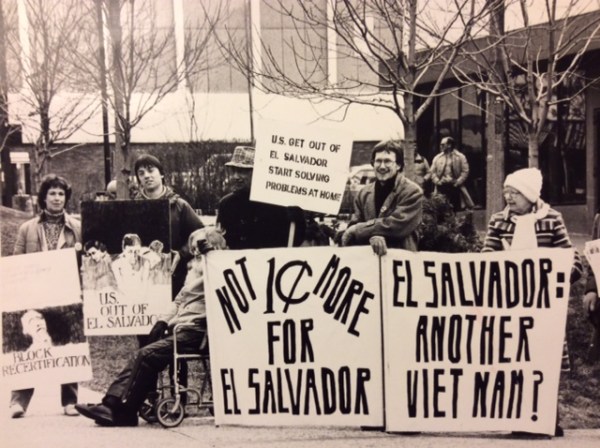
When I first moved to Grand Rapids in 1982, I quickly came in contact with folks who were doing weekly vigils for Central America on the Monroe Mall. The picture shown above, was part of that ongoing consciousness raising work around Central America when the US was supporting counter-insurgency wars in El Salvador and Guatemala, the Contra War in Nicaragua and had turned Honduras into a massive US military base.
When I was in the seminary in 1983/84 and studying at Aquinas College, a student group that I was part of continued to hold vigils, hand out literature and invite speakers to campus. We hosted a Salvadoran labor organizer who had survived a bombing of her labor hall earlier that year.
After I had left the seminary and helped to found the Koinonia House, we continued organizing around Central American solidarity issues, but it never felt like it was enough. Then in 1986, our community house on LaGrave, decided to take the next step and declare ourselves a sanctuary for Central American political refugees. It was this decision that led me down the path of living and working in Central America, making 13 trips between 1988 and 2006, doing primarily accompaniment work.
According to Staughton Lynd’s book, Accompanying: Pathways to Social Change, Salvadoran Archbishop was the first person to use the term accompaniment. Romero practiced accompaniment in two important ways.
First, the Salvadoran Archbishop practiced accompaniment by speaking out against injustice. Romero spoke out against the injustice in El Salvador, because that is what the people told him to do. Romero did this in his sermons, in his letters and on his radio show.
In his Third Pastoral Letter as Archbishop, Romero stated, “The most acute form in which violence appears in Latin America, is structural, or institutionalized violence, in which the socioeconomic and political structures operate to the benefit of a minority with the result that the majority of people are deprived of the necessities of life.” This is why in the same pastoral letter, Romero denounces Capitalism.
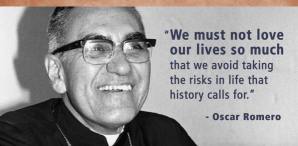
However, the second and most important form of accompaniment that Romero practiced, was walking with the people. Romero made it a point to visit communities all over El Salvador, to listen to them and to learn from them in their struggle.
This was the most important lesson I learned from Romero. I learned to walking with people, to listen and to accompany them even if it meant putting my life at risk.
When I was in El Salvador during the cease fire in 1992, the women from the grassroots organization COMADRES (an organization founded as a result of the assassination of Archbishop Romero), had invited us to stay at their offices, because it would help keep them safe. What these Salvadoran women meant was that the presence of gringos would provide them with some extra space to do what they needed to do and maybe it would mean they would be able to stay alive for another day.
COMADRES, like so many other Salvadoran groups were constantly receiving death threats and having members of their organization disappear or end up murdered by the Salvadoran army. The four of us who stayed at their office were honored that they would ask us to have a presence with them and we delighted in the opportunity to sleep on the floor.

Because the cease fire had begun, there was a massive demonstration planned a few days later in San Salvador, where hundreds of thousands of people who converge on the capitol and celebrate the end of the counter-insurgency war that Romero and so many others fought against. Again, the women at COMADRES asked us to accompany them in the march and to even make our own banner expressing our solidarity with the Salvadoran people.
 The march and celebration was amazing and lasted all day, all night and into the following morning. It is hard for those of us who have not grown up in a war torn country to understand the emotional and psychological relief that people were experiencing during the celebration that took place right next to the Cathedral that Romero had preached at while he was the Archbishop.
I’m still not sure how I feel about the Vatican’s decision to canonize Monsenor Romero, since for me and for most Salvadorans, Romero did not need to be validated by the Catholic hierarchy. Romero found his validation in the work of accompaniment. We shouldn’t need to feel validated by awards or recognition, rather our validation should come from those we accompany on the road to collective liberation. Viva Monsenor Romero!
Proposal for new immigration detention facility in Ionia indicates an increase in ICE activity in Michigan
 Several Michigan news sources are reporting that the Deerfield Correctional Facility, a former state prison in Ionia, could be the site of a new privately run detention facility for immigrants.
So far, only the Immigration Centers of America (ICA) has applied to purchase the former prison, which closed in 2009. According to the Detroit Free Press, the state has not signed off on the deal yet, although it is important to note that the former chief of staff to Gov. Rick Snyder who is now a lobbyist working for the detention center company, Dennis Muchmore.
The Detroit Free Press article also states that the federal government is also waiting to find out if the facility will be able to hold between 500 – 600 immigrant detainees at any given time. The article also quotes the CEO of Immigration Centers of America, Russell Harper, as stating:
The Deerfield site will become a major employer and taxpayer instead of an abandoned correctional facility.
Of course the CEO of a corporation that makes money from detaining people would argue that this would be good for the city of Ionia, as is indicated by featuring the economic impact for local economies on their website. (seen in the graphic below) This is what those who are part of the Prison/detention Industrial Complex always argue, that prisons, jails and detention facilities are good business and will create jobs. Ionia has a long history of hosting a prison, which makes the likelihood that the city would agree to the new immigrant detention facility, almost a sure thing.

Richard Kessler, an immigration lawyer based in Grand Rapids said this news signals, “the continued criminalization and detention of people who only have non-violent offenses. It is also problematic that this is a for profit endeavor. It is upsetting and frustrating, this trend of for profit detention facilities that is happening across the country and it is my experience that the private facilities tend to treat people worse than state run facilities. If this detention facility comes to pass it will likely lead to an increase in detention of immigrants in Michigan and ultimately, it will hurt more families within the immigrant community.”
Immigration Centers of America
Immigration Centers of America was founded in 2008 and provides detention and transportation services for the US Department of Homeland Security. Their Farmville Detention Facility in Virginia, is often cited as a shinning example of the kind of services they offer to Homeland Security.
According to the Center for Responsive Politics, ICA spent around $50,000 on lobbying in 2011, which makes sense, since that is the year they first began to operate the Farmville Detention Facility.
 What this proposed Immigration Detention facility could mean for Michigan
This news that Ionia could be an immigrant detention facility for between 500-600 immigrants is deeply disturbing news. What those of us who work with the immigrant community and and for immigrant justice need to consider are the following:
- The new ICA facility will further criminalize immigrants
- It will lead to an increased level of fear within the immigrant community
- It will result in an escalation of family separation within the immigrant community
- It signals a deeper relationship between the state and private power
- It affirms the Trump administration’s desire to increase ICE agents and ICE activity in Michigan
For those who are committed to the fight for immigrant justice, the proposed privately run immigrant detention facility means we have our work cut out for us and will make 34 ICE detention facilities in Michigan, based on the data from the Dept. of Homeland Security that you can see in the map shown here on the right. La Lucha Sigue!!

