Appointments, Inaugural contributions and buying influence in the Whitmer Administration
 In November, we posted a story looking at Gov. Whitmer’s transition team and noted that they were primarily made up of people from the business sector and those who reflected a “business as usual” approach to policy.
Governor Whitmer has not yet filled all the appointments for her cabinet in state government as of this writing, but there has been some appointments that have raised concerns already, with the appointment of a lobbyist to be legislative director and a former charter school advocate to be the senior advisor for the Michigan Prosperity position. Doug Ross is the appointment for the Michigan Prosperity position and according to an recent article, his role will be to “improve workforce talent and educational attainment and further overall economic development outcomes.” On the education front, this description sounds similar to what Education Secretary Betsy DeVos is proposing – education as workforce talent development.
In addition, there are other signs early on in the Whitmer administration would should also raise concerns for those hoping for more progressive policies coming out of Lansing.
First, the Michigan Campaign Finance Network (MCFN), recently posted information about who the large financial backers of Governor Whitmer’s inauguration ceremony. The large contributions that the MCFN documents range from $100,000 contributors to $10,000. What follows is a list within each contribution level that people need to pay attention to:
$100,000 Contributors – Blue Cross/Blue Shield, DTE Energy, Consumers Energy, PharmaSCript of Michigan, Governmental Consultant Services Inc., Muchmore Harrington Smalley & Associates and Public Affairs Associates, with the last three all being lobbyists.
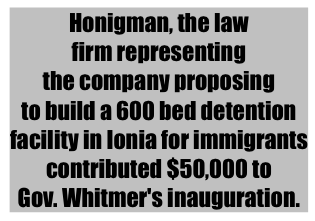
$50,000 Contributors – Chemical Bank, Delta Dentral, Honigman (law first representing ICA proposal to build a 600 bed ICE detention facility in Ionia), Ilitch Holdings, Inc.; Kandler Reed Khoury & Muchmore; Karoub Associates, McAlvey Merchant & Associates; Meijer, Inc.; Michigan Credit Union League & Affiliates; Michigan Legislative Consultants; Michigan Realtors and Quicken Loans and the Family of Companies.
$25,000 Contributors – AECOM; Boji Group; Business Leaders of Michigan; Citizens Insurance; Clark Hill; Comcast; Dewpoint; Ford Motor Company; HNTB Corporation; Huntington Bank; ITC: a Fortis Company; LeadingAge Michigan; Magna International; Michigan Association of Broadcasters-Michigan Public Broadcasting; Michigan Association of CPAs; Michigan Beer & Wine Wholesalers Association; Michigan Health & Hospital Association; Michigan Paving & Materials and Stoneco of Michigan; National Association of Theater Owners of Michigan; Pfizer; UnitedHealth Group; and Weedmaps.
$10,000 Contributors – Ascend Michigan; Atheneum Hotel; Auto Dealers of Michigan,; Butzel Long; Capitol Relations/Meridian Health Plan A Wellcare Company; Centene; Christman Company; Cinnaire; Coca-Cola Company Michigan; Dean Transportation; Deloitte; Delta Air Lines, Inc.; Detroit Medical Center; Dickinson Wright PLLC; DLZ Michigan, Inc.; Eidex; Ernst and Young; FCA US; Fritz Enterprises Inc. & Huron Valley Steel Corporation; HTC Global Services; General Motors; IGT Global Solutions Corporation; Jackson National Life Insurance Company; Kalitta Air; Karmanos Cancer Institute; The Kroger Co. of Michigan; Kyyba; LightSpeed Communications; Meredith Corporation; Michigan Corrections Organization; Michigan Funeral Directors Association; Michigan Interactive, An NIC Company; Michigan Restaurant & Lodging Association; Michigan State Medical Society; Microsoft; Midland Cogeneration Venture; Midwest Independent Retailers Association; Miller Canfield; Netlogx; Penske Corporation; PhRMA; Priority Health; RNDC of Michigan; Shelborne Development; Sun Valley Foods; Small Business Association of Michigan; Switch; TILT Holdings; TransCanada; Uniprop; and Verizon.
Now, I left out unions, a few environmental organizations and Planned Parenthood, but compared to the number of private sector contributors listed above, their numbers were small in comparison. One could say at this point that making contributions of between $10,000 and $100,000 to Governor Whitmer;s inauguration ceremony is all about buying access. This is the standard thinking with political contributions in general. However, what we need to ask ourselves here is what else are large contributors expecting?
For example, the AFL-CIO contributed $10,000, but are they expecting that workers rights, workplace democracy, wages, benefits, etc will improve under Governor Whitmer or are they just hoping that things will not get worse than they already are for working class people? Honigman law firm, which contributed $50,000, might be expecting the State of Michigan to endorse the proposed ICE detention facility in Ionia (run by ICA). One could argue that other contributors from the private sector are not just buying access, but expectations that the Whitmer administration will be friendly to business interests throughout the state.
Additionally, there was an event on February 13th in Grand Rapids that should also raise serious questions for people hoping for progressive policies changes in Lansing under Governor Whitmer. The Right Place Inc., which is part of the Grand Rapids Power Structure, hosted a breakfast with the new Governor, which included 400 members of the business community. Check out the photos from The Right Place Inc. from the Investor Breakfast with Gov. Whitmer.
Now, do people think that there was much discussion about progressive policy proposals at this breakfast or did the business community of West Michigan leave the event feeling confident that their interests would not be threatened under Governor Whitmer’s leadership? The fact that this was the first public appearance after the State of the State address should indeed raise serious questions for people who are hoping for Michigan to adopt more progressive policies, policies that are based on racial justice, gender equity, strong environmental protections, an expansion of workers rights, a restoration of teacher pensions, countering the attacks against public education, reducing the privatization of public services, ending the war on immigrants, putting a stop to Line 5 and making Flint’s fight for clean water and environmental justice a top priority?
This writer is not waiting to see if these things will happen because of state government. Instead, I believe that for these kinds of policies and practices to be adopted we need to put our collective hopes into the collective efforts of various social movements across the state.
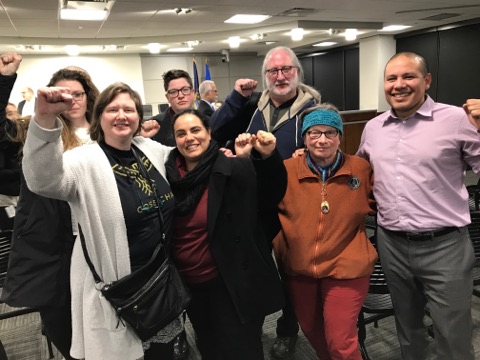
Movimiento Cosecha GR and GR Rapid Response to ICE make demands at the City Commission meeting
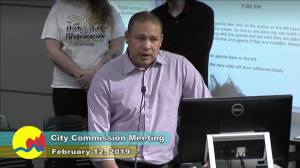 Last night, members of Movimiento Cosecha GR and GR Rapid Response to ICE addressed the Grand Rapids City Commission meeting about the GRPD’s involvement with Immigration and Customs Enforcement (ICE).
A few weeks ago, the ACLU and the Michigan Immigrant Rights Center (MIRC) sent a letter to the Grand Rapids City Commission and the GRPD about the police department’s involvement in the arrest and detention of Jilmar Ramos-Gomez. Gomez, a former US Marine, was arrested by the GRPD, which then turned him over to ICE. This was the specific issue that immigrant justice activists addressed during the commission meeting.
There were seven people from Movimiento Cosecha GR and GR Rapid Response to ICE that addressed the commissioners during public comment. They addressed several issues related to the GRPD and Immigration and Customs Enforcement (ICE) and made the following demands:
- No cooperation between GRPD and ICE
- No City resources should be used to support ICE violence against the immigrant community
- The City Commission should endorse the Drivers License for All campaign being organized by Movimiento Cosecha
- The GRPD should stop harassing and intimidating those involved in trying to prevent ICE violence against the immigrant community.
Some of those who spoke talked about the trauma that immigrants experience because of ICE arrests or being in detention, along with how children are impacted by witnessing the arrest of a parent. One social worker for GRPS also addressed the constant fear that the immigrant community lives in because of ICE harassment, intimidation and violence.
The Drivers License for All campaign was addressed in part because of the fact that based on a recent study, we know the GRPD engages in racial profiling and because immigrants who do not have a US drivers license often end up in ICE custody even if they were only originally charged with driving without a license.
Sergio Reyes with Movimiento Cosecha GR spoke specifically about a recent incident where he and his wife were pulled over by the GRPD for no clear reason. When the cops made him get out of the car they said he smelled like pot, even though Reyes was not smoking. In addition, the police questioned his wife separately who later told her husband that the police said, “if he is a citizen he has nothing to worry about.” This point underscored the issue of the GRPD asking the immigration status of people, even though it is not their job to enforce immigration policy.
Members of Movimiento Cosecha GR and GR Rapid Response to ICE addressed members of the Grand Rapids City Commission just weeks after they successfully got the Kent County Sheriff’s Department to end ICE holds because of their seven month campaign against the contract between the county and ICE.
The Time I confronted Rich DeVos on being a billionaire
 A new report was just released showing that the richest 0.00025 percent of the American population now owns more wealth than the 150 million adults in the bottom 60 percent.
The report comes from the National Bureau of Economic Research and was authored by Gabriel Zucman.
The wealth gap in the US has been growing in recent decades and the top 400 richest people, those featured in the annual Forbes 400 report, are continuing to amass disgustingly large amounts of wealth. There are over 500 billionaires in the US alone and several of them live in West Michigan, including the Meijer and DeVos families.
I have written a great deal about the wealth of these two families, particularly the DeVos family. However, I have never shared a story about the time that I confront Rich DeVos about his wealth at a book signing in 2004.
The Grand Rapids Press had run an article about DeVos’ new book entitled, How to Be Like Rich DeVos: Succeeding with Integrity in Business and Life. The article that the Press ran had a picture of Michael Jordan, Mother Theresa and Jesus, but the picture of DeVos was larger than the rest of them. The article also mentioned that DeVos would be at a book signing at Schuler Books on 28th Street, so some of us decided to go.
When we arrived at the bookstore, people had already lined up to get a copy of the book signed by the Amway co-founder. A friend of mine and I decided to grab other books to get signed. My friend grabbed the book Robbing Us Blind: The Return of the Bush Gang and the Robbing of America and I grabbed a leather-bound copy of the King James Bible.
We decided to stand in line by not right next to each other, so as not give ourselves away since people may have recognized us. My friend greeted DeVos first, who was puzzled by the book title that my friend wanted him to sign. DeVos said, “yeah, I guess some people can be too greedy,” and signed the book anyway. We later auctioned the book off for a fundraiser.
When I finally got to the table, I hand DeVos the bible I had brought up and he said, “You want me to sign your bible,” and I said, “sure, why not.” He began to sign it and I said I saw the article in the GR Press that had you picture, along with Jesus, Michael Jordan and Mother Theresa. I ask him, “how did you feel about having a larger picture than Jesus?” DeVos said, “I did think it was a little strange, but it was out of my hands.” He went back to signing the bible and then I asked him, “So, what do you think about that gospel quote, which says that it is harder for a man to get into the Kingdom of Heaven than it is for a camel to go through an eye of a needle.” DeVos was getting ready to respond, when his body guard, a rather large man, grabbed my arm and said, “that’s enough,” and pulled me away from the table.
Those who are billionaires are engaging in unjust and criminal behavior, especially while so many are suffering from lack of healthy food, health care, housing and other basic human rights. For more on the history and politics of the DeVos Family, see our DeVos Family Reader.
 On Friday, MLive reported that Gov. Whitmer was looking at changes around the work requirements for those receiving Medicaid.
“Michigan expanded its Medicaid program under the federal Affordable Care Act. A new Michigan law requires able-bodied Healthy Michigan Medicaid recipients to work an average of 20 hours of work per week, or 80 hours per month. Recipients need to comply with this for at least nine months per year, starting in 2020, with some exemptions.”
Governor Gretchen Whitmer wants to convince the Michigan legislature that requiring people on Medicaid may not be necessary and that most states don’t require it under the Affordable Care Act.
This decision on the part of Governor Whitmer comes just days before the kickoff to the national campaign known as Medicare for All. There are grassroots groups all over the country that will be hosting “barnstorms” this week, an effort that is being coordinated by National Nurses United (NNU). You may recall that National Nurses United was pushing for a Single Payer Health Care System when Obama ran in the 2008 election. Obama the candidate had voiced support for a Single Payer System, but once he became president, his advisors thought that pushing for a Single Payer System would be too much.
However, the reality is that based on most polling, at least two-thirds of Americans favor a Single Payer System or Medicare for All. According to a recent article on Common Dreams, over 30 million Americans are uninsured and two-thirds of personal bankruptcies are caused by medical bills. Millions of people across the country are having to chose between heating their homes, buying groceries or paying for health care.
In Grand Rapids, there will be a meeting on Medicare for All, on Wednesday, February 13, from 6:30pm – 8pm at CWA Union Hall, located at 3281 Kentland Court SE in Grand Rapids. The Facebook event states in the description:
Over 70% of Americans want #MedicareForAll, but politicians won’t pass this bill without public pressure. Find out how you can mobilize your community to win #MedicareForAll. Put #PeopleOverProfit, and cover everyone regardless of income or health condition. EVERYBODY IN. NOBODY OUT.
This type of organizing is in sharp contrast to what elected officials like Gov. Whitmer are doing, which only protects the existing health care system. If people want to have just policies like Medicare for All, then they should rely on grassroots efforts and social movements, not on the empty promises of elected officials.
Betsy DeVos Watch: Cheerleading for Trump and School Choice
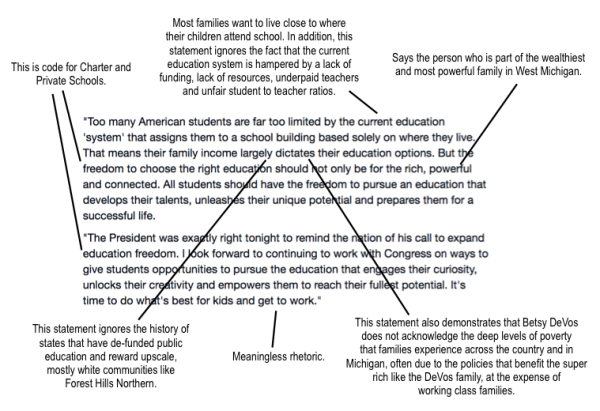
 After the State of the Union address on Tuesday, Secretary of Education Betsy DeVos took the opportunity to thank President Trump for his comments about “education freedom” and her own call for expanding School Choice in a statement released the same day.
We decided this would be a useful opportunity to do a simply deconstruction of what Betsy DeVos had to say, which you will find here below.
Consumers Energy Super Bowl message was a shallow PR stunt designed to distract us from all the money the company makes from dirty energy
 On Super Bowl Sunday, viewers in the Lower peninsula of Michigan saw a 90 second message from the CEO of Consumers Energy, Patti Poppe. The message was both an apology and a thank you to businesses and residents of Michigan, since the company asked people to turn their thermostat down.
Such a statement from the CEO of Consumers Energy should be seen as a shallow PR move, especially considering what Consumers Energy represents. Consumers Energy is a company that has been profiting off of the public for decades, while manufacturing energy that has caused a great deal of harm to public health, to environmental devastation and to climate change.
While Consumers Energy likes to show that they have a diversified energy portfolio, the company has primarily manufactured energy through coal, which has been one of the worst forms of energy that humans have ever used.
However, the company takes no responsibility for their role in destroying the environment, harming human health and adding to the climate change crisis. In fact, Consumers Energy now likes to talk about how they are a responsible corporation that embraces the Triple Bottom Line – People, Profit and Planet.
This was Patti Poppe’s message to those who gathered at the Econ Club of Grand Rapids in December. Local talking head Rick Albin did a short interview with Poppe before her Econ Club talk, where Albin said, “you are always looking at what is best for Michigan.” This type of uncritical thinking is what we are used to with the news media in West Michigan. Of course, the CEO of Consumers Energy would not be challenged at the Econ Club lecture, because the people who attend such functions share the ideological principles that Patti Poppe does, which of course is that Capitalism is Wonderful.
The Consumers Energy CEO commercial during the Super Bowl did generate a fair amount of Michigan news coverage, but it focused on what Patti Poppe had to say and less about the company. Sure, there was some criticism around residents having to turn down their thermostats, but the criticism was limited and narrow in scope.
According to Salary.com:
As President and CEO, CMS and Consumers at CMS ENERGY CORP, Patricia K. Poppe made $6,862,295 in total compensation. Of this total $1,100,000 was received as a salary, $1,144,000 was received as a bonus, $0 was received in stock options, $4,263,888 was awarded as stock and $354,407 came from other types of compensation. This information is according to proxy statements filed for the 2017 fiscal year.
Imagine if people knew that the person who asked us to turn down our thermostats makes nearly $7 million a year.
Another relevant question for the news media to ask would be how much the company spends on lobbying and political contributions. According to the Michigan Campaign Finance Network Consumers Energy spent the following amounts on lobbying in Michigan during the past four years.
2015 $311,117
2016 $230,820
2017 $225,651
2018 $129,314 (for January – July)
At the federal level, Consumers Energy has spent $4,119.558 on political contributions since 1990 and $23,073,752 on lobbying since 1998, according to OpenSecrets.org.
There was going to be a ballot initiative in 2018 for Michigan that was energy related, but Consumers Energy and DTE Energy struck a deal with the ballot organizers in the Spring of 2018 to keep the issue off the ballot. The deal would require both Consumers Energy and DTE Energy to commit to relying on 25 percent renewable energy by the year 2030. While some may see this as a positive step, it is grossly inadequate levels for renewable energy use, especially considering what the global climate scientific community has been saying. For instance, the US Global Change Research Program, which published its Fourth National Climate Assessment, makes the following statement in their summary of findings:
Communities, governments, and businesses are working to reduce risks from and costs associated with climate change by taking action to lower greenhouse gas emissions and implement adaptation strategies. While mitigation and adaptation efforts have expanded substantially in the last four years, they do not yet approach the scale considered necessary to avoid substantial damages to the economy, environment, and human health over the coming decades.
In 2012, there was another ballot initiative called 25 by 25, which was calling for 25% renewable energy production in Michigan by 2025. Consumers Energy spent money to defeat the ballot initiative.
Therefore, it seems pretty clear to this writer, that the message from the CEO of Consumers Energy was a shallow PR stunt designed to get the media and the pubic to focus on turning down our thermostats instead of critically assessing what the real function of Consumers Energy is……to make as much money as possible while harming human health, destroying ecosystems and making climate change inevitable.
Group that spent the most to oppose Voters Not Politicians ballot initiative is run by a DeVos operative
 As the dust settles on the 2018 election, data continues to come out about which groups funded what ballot proposals.
The Michigan Campaign Finance Network does an amazing job of following the money in Michigan electoral politics and their most recent article has some interesting analysis about who was behind the 2018 Michigan Ballot initiatives.
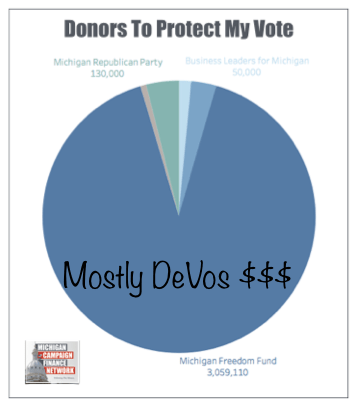
What I found most interesting is that the group that spent the most money opposing the Voters Not Politicians ballot initiative, was the Michigan Freedom Fund. The entity created by the Michigan Freedom Fund, designed to defeat Voters Not Politicians, was Protect My Vote.
You can see from the graphic here that the Michigan Freedom Fund was the largest contributor to this effort. The President of the Michigan Freedom Fund is Greg McNeilly, who also happens to be the Chief Operating Officer of the Windquest Group. The Windquest Group is one of the DeVos family’s business entities.
McNeilly, while he ran Dick DeVos’ failed gubernatorial run in 2006, once boasted how political donations are the most protected form of speech:
“Political speech is the most protected form of speech, and we need more people participating at higher levels. We should applaud anyone who is leading on that dimension and try to encourage greater participation in our great American experiment.”
Such a statement reflects McNeilly’s allegiance to the DeVos family fortune.
However, the main issue her, with the new data from the Michigan Campaign Finance Network, is that the group that spent the most money to defeat Voters Not Politicians was a group that was essentially created by DeVos family money and is run by their most trusted political operative, Greg McNeilly. This is just the most recent example of how DeVos money infects electoral politics and promotes anti-union, anti-abortion, anti-LGBTQ and pro-business policies in the state. Remember that, the next time you are tempted to think that the DeVos family does so much good for West Michigan.
Systems of Oppression, the GRPD and Celebrating Black History Month
 Systems of oppression and power always make it a point to appropriate the images and messages of revolutionary politics. Corporations, political parties and other structures that have power over people often claim to celebrate Dr. Martin Luther King Jr. and Black History Month.
Such appropriation is often seductive and subtle, but it is appropriation none the less.
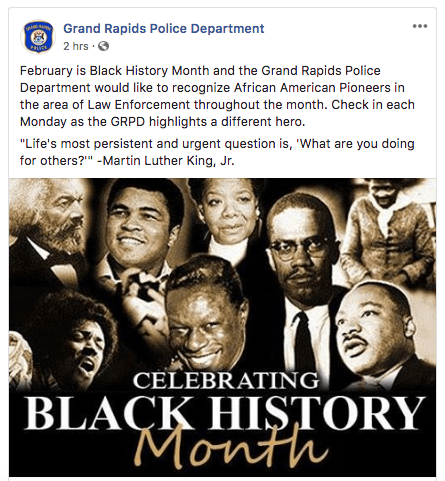
Then there are entities like the Grand Rapids Police Department, which are not so subtle, which also claim to celebrate Black History Month. On February 1st, the GRPD posted the following text and image on the Facebook page – here on the right.
There are just so many things that are fundamentally wrong with the GRPD claiming to celebrate Black History Month. Such a claim is insulting and offensive. The text says they want to, “recognize African American Pioneers in the area of Law Enforcement throughout the month.”
It’s as if Black History Month can be reduced to celebrating anything as long as it involves African Americans. Well, lets take a closer look at the significance of the GRPD claiming to celebrate Black History Month.
First, the text also includes a rather innocuous quote from Dr. Martin Luther King Jr. Systems of power and oppression have their own agenda and will use people like Dr. King to support their agenda. Quoting Dr. King doesn’t mean much these days, especially since those who often engage in oppression are the first to quote the civil rights leader.
If we look at the totality of Dr. King’s life and work, we clearly see that he was in favor of challenging systems of oppression and power and that includes police departments. It is insulting and offensive for the GRPD to quote Dr. King when we know that for decades the police intimidated, harassed, infiltrated, arrested, beat and even killed those involved in the Black Freedom Struggle.
Then there is the image that the GRPD uses, an image which includes a few Black entertainers, but mostly Black people who have been at the forefront in the fight for justice and liberation.
There are two people from the 19th century abolitionist movement, Harriet Tubman and Frederick Douglass. Both Tubman and Douglass were targeted by police, security agents and other enforcement entities of the state. In fact, those who were involved in the Underground railroad were seen as an enemy of the state.
Then you have the images of Dr. King and Malcolm X. Both of these men were part of the larger Black Freedom Struggle and both of them were personally harassed, wiretapped, targeted and arrested by law enforcement. Both of these men were assassinated and while we can debate who specifically pulled the triggers in the killing of Malcolm and Martin, it is clear that local law enforcement and the FBI were either involved or complicit in their deaths.
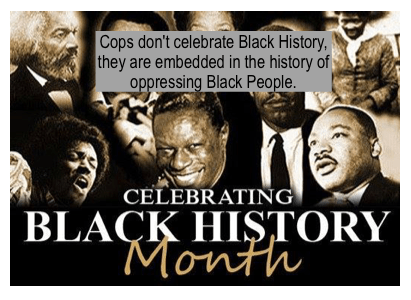 The image of Muhammad Ali might seems rather innocuous, since many saw him as merely an athlete. However, Ali, apart from his involvement in the Nation of Islam, was a draft resister and a dedicated activist/organizer against the US war in Vietnam. Ali refused his induction into the US military and was promptly arrested by cops for doing so. In addition, while Ali was stripped of his boxing title, he spent the better part of two years traveling around the US, speaking at college campuses, churches and civic institutions against the US war in Vietnam. He did this all under the watchful eye of the FBI and local law enforcement, since anyone involved in such activities was considered an enemy of the state.
Then there is the reality of politics and oppression in Grand Rapids. The GRPD excessively patrols in Black neighborhoods and disproportionately monitors and arrests Black people in this community. We are all familiar with the more high profile cases in recent years, but we may not be as familiar with the daily activity of the GRPD to harass and intimidate the Black community.
The fact that the GRPD wants to highlight “African American Pioneers in the area of Law Enforcement,” just underscores how insulting their celebration of Black History Month is. Having African American cops intimidating, harassing and arresting Black people doesn’t make it any less oppressive than having White cops do it. All cops serve the interests of the state, which ultimately means it serves the interests of those with power.
The Acton Institute invites AmplifyGR to talk about what they are doing in Grand Rapids and there is no mention of who created the non-profit
 On January 24, the far right think tank, the Acton Institute, hosted a presentation by Ashanti Bryant, the education project manager for AmplifyGR.
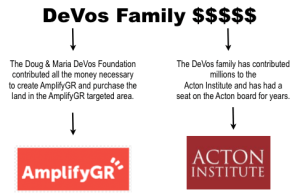
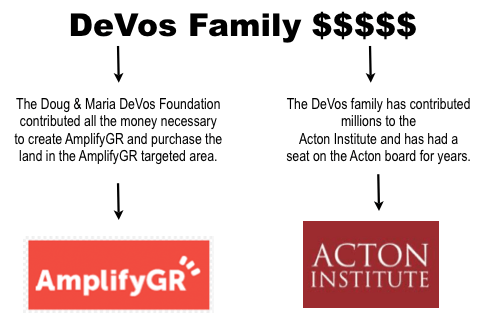
Bryant’s presentation lasted only 30 minutes, which was followed by a Q & A session. However, throughout the entire event, whether it was the introduction give by an Acton representative, the presentation or the Q & A, not one word was mentioned about how AmplifyGR came about two years ago. To some this might not seem like a strange thing, but consider the following. The DeVos family has contributed millions of dollars to the Acton Institute over the past 25 years and Betsy DeVos sat on their board of directors at one time, along with her mother Elsa Prince. Betsy’s son, Rick DeVos, now sits on the Acton board. With all of the connections to the DeVos family, it would seem that at an Acton Institute event, there would be some mention of the connection between the most powerful family in West Michigan and AmplifyGR. Unfortunately, the connection was not made.
You can watch the presentation by Ashanti Bryant at this link, but it wasn’t very compelling, especially since he basically read a powerpoint presentation. However, I watched the presentation and found it instructive enough to share some analysis of what Bryant had to say. Before doing so, it is important to point out that Ashanti Bryant’s background in education is as follows. Bryant used to be a principal at Grand Rapids Christian Schools and he has been a consultant to both private and charter schools.
Purpose Built Communities
Ashanti’s presentation centered around Purpose Built Communities, the model that AmplifyGR has been pushing since its creation 2 years ago. The AmplifyGR Education Director began by quoting Dr. Martin Luther King Jr, offering up two quotes that were both fairly innocuous.
Bryant then talked about concentrated poverty, plus gave national and regional statistics. He also spoke about the history of racial segregation in housing and education and cited Richard Rotherstein’s book, The Color of Law.
The AmplifyGR Education Director then talked about the 49507 zip code in Grand Rapids and referenced Todd Robison’s book, A City within a City: The Black Freedom Struggle in Grand Rapids, Michigan. Up to this point, the information that Bryant shared was solid and relied on great sources, but then came the punch line. There was no call for racial justice, for an end to White Supremacy or for reparations for the African American community in Grand Rapids. Instead, Bryant suggested that the way to overcome all of this historical racism in Grand Rapids was what AmplifyGR was promoting, the Purpose Built Communities model.
However, unlike the Purpose Built Communities model that has been used around the country, with an emphasis on housing, education and wellness, AmplifyGR has added a fourth component, what they call jobs and entrepreneurialism. Within this model, Bryant said that there needs to be a backbone organization, an organization that can act as an anchor for the implementation of the Purpose Built Communities model. You guessed it, AmplifyGR is the backbone organization in this case.
In many ways the Q & A portion of the presentation was the most revealing. A white guy told a story about a wealthy person wanting to move back into an area of Detroit that had suffered from disinvestment and then said that this guy was being accused of gentrification. Bryant’s response to this comment was, “We at AmplifyGR avoid using the word gentrification. We believe in a diversity of incomes living together, but we prefer to call it investing in the community.”
In response to the question about job and business creation, Bryant said that AmplifyGR plans to bring 1,000 new jobs to the area. As of today, there are 4 new businesses and 100 new jobs created, according to Bryant, but he never qualified how well those jobs paid.
The only education question that was asked had to do with whether or not AmplifyGR was pushing Charter Schools as an education solution. Bryant said that in their model, they partner with three education centers, with Heritage Academies, GRPS and Hope Academy. Both Heritage Academies and Hope Academy are Charter Schools and the GRPS is Charter School friendly.
Bryant was then asked how AmplifyGR did community engagement. He said they started out doing town hall meetings, but then said he would not recommend doing town hall meetings, since he just provided people with an opportunity to vent frustrations. Bryant said they now host resident meetings, which are small and allows AmplifyGR the opportunity to focus on the Purpose Built Communities model. Of course Bryant would say don’t do town hall meetings, because AmplifyGR was called out repeatedly during the three town hall meeting that were held in the summer of 2017.
The last question had to do with how AmplifyGR was utilizing the private sector for their work. Bryant mentioned that Rockford Construction was involved early on. Unfortunately, Bryant failed to mention that Rockford Construction had purchased dozens of properties in the Boston Square and Cottage Grove areas in 2017, spending millions without resident input.
So, you have an AmplifyGR presentation at an Acton Institute event and there is no discussion about the millions of dollars that the DeVos family has contributed to the Acton Institute, not the fact that the DeVos family created AmplifyGR and bankrolled the purchase of dozens of properties in the AmplifyGR target area, without resident input. But that’s ok, because they are in that neighborhood to “help.”
 On Tuesday, the Senate voted on S.1 also known as the Strengthening America’s Security in the Middle East Act of 2019.
Like a great deal of legislation, S. 1 contains several items in it, including Title IV – Combating BDS Act of 2019. The bill specifically states:
Nonpreemption of measures by State and local governments to divest from entities that engage in certain boycott, divestment, or sanctions activities targeting Israel or persons doing business in Israel or Israeli-controlled territories.
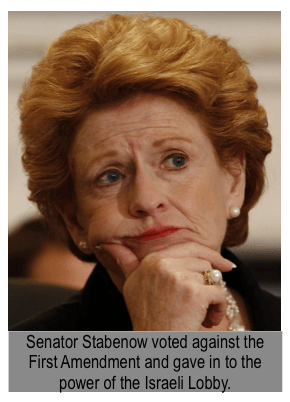
The bill was introduced by Senator Marco Rubio and it passed by a margin of 76 – 22. Michigan Senator Gary Peters voted against the bill, but Senator Debbie Stabenow voted for it.
The 76 Senators that voted for the bill, essentially bowed to pressure from AIPAC and Christians United For Israel (CUFI).
The ACLU has taken a public position on this matter, not because it has anything to do with Israel, but because of the anti-free speech nature of the bill. The ACLU has stated:
The bill at issue here, S. 1, would not criminalize boycotts of Israel on its own, although Congress has attempted to do that as well. Instead, it would encourage states to create laws that violate the First Amendment. These state laws would require government contractors — including teachers, lawyers, speech pathologists, newspapers and journalists, and even students who want to judge high school debate tournaments — to certify that they are not participating in such boycotts. In other words, they would make people choose between their livelihood and their First Amendment rights. In cases going back to the McCarthy era — when the government required employees to swear that they were not members of the Communist Party or engaged in “subversive” advocacy — the Supreme Court has made clear that the government cannot impose such a choice on its citizens.
The First Amendment dangers posed by these anti-boycott laws are even greater because their sponsors have made it crystal clear that they are designed to silence a particular viewpoint that is critical of Israeli and U.S. policy. As the name declares, the Combating BDS Act and the state anti-boycott laws it seeks to entrench are explicitly directed at a particular political viewpoint critical of Israeli government policies as well as U.S. support for those policies. This violates the core principle of the First Amendment — that the government cannot dictate to its citizens which causes they can and can’t support.
Beyond the defense of the First Amendment, what Senator Stabenow and the other 75 Senators who voted for S.1 essentially voted against the rights of Palestinians and their fight against Israeli Apartheid. For more information on the BDS campaign, check out the BDS Movement site here.

