Unfunded liabilities, austerity measures and neo-liberal economic plans: What the West Michigan Policy Forum wants to do to public sector employees
 On Monday, the West Michigan Policy Forum posted on their Facebook page an article by the Michigan-based news source Bridge.
The Facebook post included the text you can see here on the right, which affirms the West Michigan Policy Forum’s position that public sector health care benefits and pension are an “unfunded” and should be done away with.
The West Michigan Policy Forum (WMPF) has made the elimination of public sector employee benefits and pensions a priority since 2017. The WMPF, along with other neo-liberal capitalist groups succeeded in eliminating public teacher pensions in 2017 and made it the focus of their bi-annual conference this past fall, when hundreds of their members met in Grand Rapids.
The Bridge article is entitled, A $18B debt is coming due, and it’s haunting small town Michigan. The premise of the article is that with the cost of public employee health care benefits and pensions, in communities all across the state have less money, “for everything that makes a city livable, from police and fire protection to parks and recreation and roads.”
The Bridge reporter makes the assumption that money cannot be generated or diverted from other sources and that things like police budgets are absolutely necessary. For example, in Grand Rapids, the Police Department uses up one third of the current city budget and one could certainly argue that their behavior in recent years has been highly questionable at keeping the most vulnerable communities safe. Another way that Grand Rapids could save a great deal of money would be to reduce or eliminate subsidies to developers who primarily build high cost housing that benefits the professional class.
This is a major flaw in the article, since it assumes that everything that municipalities spend their money on currently is absolutely necessary. The article also ignores the fact that revenue sharing from the state has been significantly reduced or eliminated in some cases and is tied to communities adopting more strict austerity measures.
So, the question is, why should public sector employees have to give up their current health care benefits and pensions, when many of them have dedicated decades to the service of their community and have always expected that these benefits would be in place for them when they retire?
 What the West Michigan Policy Forum is pushing for and what some municipalities have already adopted is to shift the burden on to the workers, reduced health care benefits, make public sector employees pay for a larger amount of the health care and to shift any pension plans to the speculative market in the form of a 401k. In this scenario, we would be leaving people’s health care and pensions to a volatile market. In addition, this push to relieve municipalities from the responsibility of paying for their employee benefits and pensions, in reality is just another attack on public sector unions. This has been the plan of the American Legislative Exchange Council and the State Policy Network at the national level, along with groups like the West Michigan Policy Forum at the state level.
Lastly, it must be pointed out that many of the members of the West Michigan Policy Forum contributed collectively nearly $17 million in the last election cycle to fund candidates who support these kinds of austerity measures that also undermine public sector unions.
Community groups confront GR City Commission over GRPD’s role in ICE violence, call for cop to be fired!
 About 40 members of the public, including representatives from Movimiento Cosecha GR and GR Rapid Response to ICE showed up to the Grand Rapids City Commission meeting last night, in part as a response to the newly released documents that were obtained from the GRPD by the ACLU and the Michigan Immigrant Rights Center (MIRC).
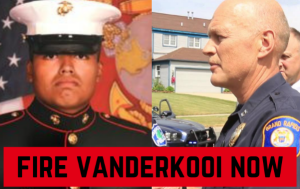
The documents provide conclusive evidence that Jilmar Ramos-Gomez was racially profiled. In addition, the documents show that the GRPD officer who contacted ICE was not even on the job, instead he saw a news story and contacted ICE.
Movimiento Cosecha GR and GR Rapid Response to ICE were calling for Captain Curt VanderKooi, a member of the GRPD, to be fired from the police department because of the racist action he took in collaboration with ICE. The two groups even have an online petition campaign to pressure the city to fire VanderKooi.
However, in preparation of the public outcry, the City Manager invited the act-Police Chief to get up and speak, or rather to read a statement, which basically justified the GRPD’s role in contacting ICE, leading to the arrest and detention of Jilamr Ramos-Gomez.
The acting-Police Chief then read an apology from Captain Curt VanderKooi, who claims he regrets using the language that he did.
This was a complete PR stunt on the part of the City of Grand Rapids, in an attempt to head-off the public outrage that was evident, even while the acting-Police Chief was reading the canned statement.
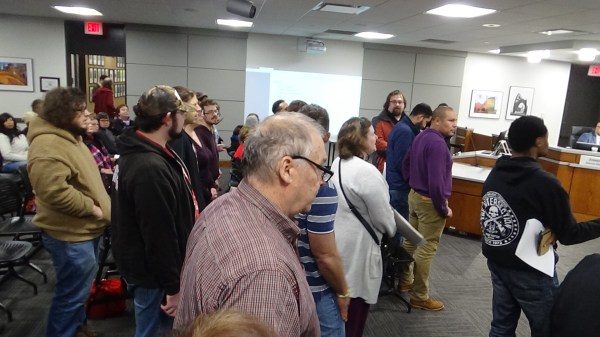
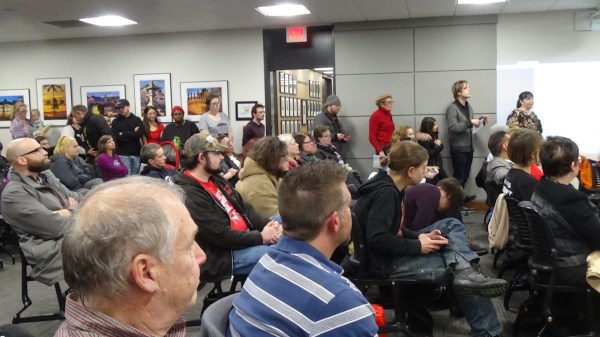
Amy Carpenter, with Movimiento Cosecha GR, then came forward and asked, since the acting-Police Chief was given an opportunity to address the issue of GRPD’s complicity with ICE to do harm to Jilmar Ramos-Gomez. The Mayor said no, so members of Movimiento Cosecha GR and GR Rapid Response to ICE stood up and began chanting “Cops and ICE go hand in hand” and “Let us speak.” There was some back and forth between the Mayor and the public about how unfair it was to allow the acting-Police Chief to speak on the issue that dozens from the public came to address. It seemed unfair and unjust to those who were in attendance, since allowing the acting-Police Chief to speak set the tone for the entire evening.
Once it came time for public comment,virtually everyone got up to speak about the treatment of Jilmar Ramos-Gomez and the GRPD’s involvement with Immigration and Customs Enforcement.
Several people got up and demanded that Captain VanderKooi should be fired, that the City should not use one cent of resources to support ICE and to support the Driver’s License Campaign being organized by Movimiento Cosecha GR.
Mary Alice Williams, a former City Commissioner, also spoke and said that she stands with the immigrant community and to say that Captain VanderKooi is not a racist just because of the language that he used, but more importantly because of the fact that he called ICE about Jilmar Ramos-Gomez, which was nothing short of racial profiling.
Deirdre Cunningham said that they suffer from PTSD and yet they were never arrested because of the color of their skin. They also called for the the firing of Curt VanderKooi.
Lindsay Rosa, a local social worker, who spoke to how Captian Curt VanderKooi has a history of this kind of racist behavior and has profiled many immigrants in the past. Rosa shared several stories about how VanderKooi has treated many immigrants that she has directly worked with.
Jose Flores, a current GRPS School Board member, spoke out against racial profiling and police abuse and demanded that the City do better to serve the public. Flores confronted the City Manager and demanded that the city either suspend or dismiss Captain VanderKooi.
Phillip Snyder said that whatever we say it doesn’t matter, since the City Commissioners are only concerned about not upsetting the Grand Rapids Chamber of Commerce and other members of the Grand Rapids Power Structure. He not only demanded that Captain VanderKooi be fired, but that the City of Grand Rapids should become a Sanctuary City.
Alex Kelly addressed the issue of police harassment and threat of violence during Movimiento Cosecha GR marches and other actions. Kelly made it clear that the GRPD, often with involvement with the Sheriff’s Department, serves only to intimidate and threaten members of the immigrant community and their allies.
Hillary Scholten, a lawyer with MIRC, also spoke and addressed how the acting-Police Chief’s comments at the beginning of the meeting were selective and inaccurate. She was followed by two lawyers from the ACLU, one asking, “what does it take for the GRPD to hold their officers accountable.”
Miriam Aukerman, also with the ACLU, said that the behavior of the GRPD was both unfair and a form of racial profiling. Miriam then went on to dismantle the claims that the GRPD officer acted in an effort to stop terrorism. She ended by saying, “that the time is past for pious words, we need real action.”
A little girl got up and said that Captain VanderKooi got her friend deported and that he should be fired.
Someone from the group Equity PAC spoke about the internal affairs review and how the GRPD found there was “nothing wrong” with what happened to Jilmar Ramos-Gomez. He said that he stands with Movimiento Cosecha GR and that the city needs to be accountable for what the GRPD is doing.
There were also several members of the African American community who stood in solidarity with Movimiento Cosecha GRa and called for the termination of Captain Curt VanderKooi.
One young Latino man got up to speak and pulled out his phone, then said he was calling ICE on one of the City Commissioners, because she didn’t look white. He ended by says that the GRPD collaboration with ICE is just sick.
Lorena Aguayo-Marquez, also with Movimiento Cosecha GR, said that it was a joke for the police to investigate themselves in regard to the case of Jilmar Ramos-Gomez. “I don’t want to have to carry a passport in my own community and I don’t want to live in fear of police and ICE violence.”
Amy Carpenter, with Movimiento Cosecha GR and GR Rapid Response to ICE, then read a resolution that both groups were demanding that the city adopt as a clear action they can take. The resolution is included below.
At this moment several dozen members and supporters of Movimiento Cosecha GR and GR Rapid Response to ICE stood up and moved to the front and once again began chanting, “Cops and ICE go hand in hand.” This went on for several minutes, until the Mayor hit the gavel and ended the meeting.
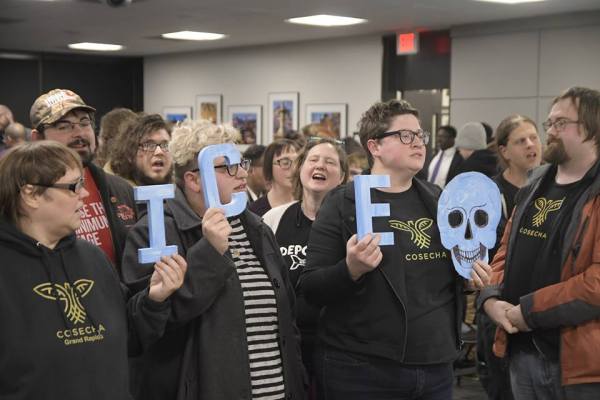
(Photo credit to John Rothwell)
Resolution
We, the undersigned elected city commissioners, do hereby recognize our responsibility to our immigrant neighbors.
Whereas –
• Municipalities all over the country are ending their contracts with ICE (Immigration and Customs Enforcement) because of public outcry over the terror and violence wrought by ICE;
• Our immigrant neighbors, who are an important part of the social, cultural, and economic fabric of our city, are living under the threat of terror and violence from ICE;
• Families are being separated in our city of Grand Rapids with the involvement of the Grand Rapids Police Department;
• and whereas we as commissioners have a responsibility to provide moral leadership in Grand Rapids as our duty to the electorate;
We do hereby resolve the following:
• We will end all GRPD cooperation with ICE;
• We will not allow for any city resources to be used for the purposes of ICE’s work or to detain our immigrant neighbors based on their immigration status;
• We publicly support the Driver’s Licenses for All campaign and call for the State of Michigan to make driver’s licenses available for under-documented immigrants again.
From food insecurity to food justice: An uncomfortable conversation for ending hunger and poverty in West Michigan
 “The major problems confronting activists committed to food justice revolve around mass incarceration, labor exploitation, and immigration.”
The quote above comes from the recent book, Food Justice Now: Deepening the Roots of Social Struggle, by Joshua Sbicca. Sbicca challenges those of us who claim to be about the work of Food Justice, by forcing us to step outside of the silo of food insecurity and to look at how larger systems of oppression are the real cause of hunger and food insecurity.
The problem, too often with people who grapple with food insecurity issues, is that we try to approach the issue by first thinking about the current food system and where we can make adjustments within that system to address things like access to food, hunger, food waste, etc. However, taking such an approach often results in a continuation of that same food system, with some mild reforms.
For example, take the recent issue of snow days and food insecurity. MLive ran an article entitled, The dark side of snow days: Food insecurity. The article focused on how many children would not be able to get the food provided to them by the group Kids Food Basket (KFB), because there was no school. The issue was also highlighted in a recent column by Kids Food Basket CEO Bridget Clark Whitney, where she talks about how the community came together to make sure that during the snow days that children were still able to access the food that KFB provides on a daily basis. Indeed, it is phenomenal how so many people stepped up to make up the food bags, those who transported the food, the coordination and all the community partners that were involved to pull it all off.
However, even when we see these acts of charity taking place on a regular basis, I am left feeling uneasy about how we are address the issue of child hunger. Considering all the effort that is put into what KFB does – the fundraising, recruiting volunteers, the partnerships with schools and putting together the 8,000 sack lunches that KFB puts together on a daily basis. This is a tremendous amount of work and coordination. But if we step back from all this effort, we are still left with the hard reality that 25% of the children living in West Michigan live in poverty. This means that the food charity work that KFB is engaged in is a growth industry, but it also means that it is ultimately a false solution.
Now, don’t get me wrong, I’m glad that 8,000 children receive sack lunches on a daily basis, but this shouldn’t be the end goal. The end goal should be to eliminate poverty. Now, eliminating poverty is no easy solution and in order to do so, we need to understand the reasons why there is so much poverty in West Michigan.
Poverty in West Michigan is the result of numerous systems of power and oppression. Poverty exists because people do not earn a livable wage. Imagine if the children whom KFB serves lived in homes that were receiving a living wage. However, we know it is not just about people receiving a just wage/living wage, we know that communities of color have higher rates of poverty. In this instance we need to acknowledge that the system of White Supremacy also contributes to perpetuate poverty by privileging white people at the expense of communities of color.
Lack of a living wage and White Supremacy are still not enough to understand poverty. Let’s say that a family member ends up in the Prison Industrial Complex, which means that a primary income earner is now in jail or prison. How do families survive this dynamic and still make ends meet. How do families navigate the trauma of having a parent in jail/prison and still function in an economic system that is based on exploitation?
What about housing issues? West Michigan is in the midst of a housing boom, but that doesn’t mean that everyone benefits. There are thousands of families in the area that cannot afford the current rental rates and are unable to buy a home, especially with increased property values.
On top of all of this, you also have a political and economic class in West Michigan that not only has tremendous wealth, but they collectively work to pass legislation that make life for working class and communities of color rather difficult.
We know that is 2016, Grand Rapids had the largest wealth gap in the state of Michigan. We also know that there are over 600 millionaires living in Kent County at the same time that 1 in 5 children are living in poverty. These disparities are not a coincidence, rather the are directly related to each other. You can not have a small minority of people making so much, without the exploitation of the many.
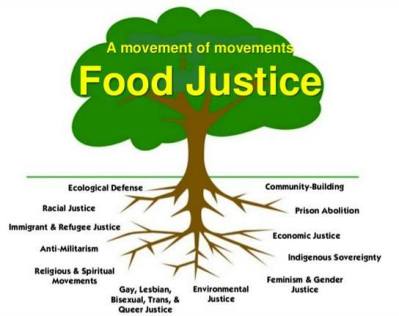 This brings us back to Kids Food Basket and the issue of food insecurity. How do we honestly address the issue outside of the food insecurity silo? What the author of Food Justice Now is suggesting is that instead of making food the focus of our conversation, that we shift it our focus to include a more comprehensive approach to addressing other forms of injustice and systems of power and oppression.
If the goal of any group is to eliminate hunger or poverty, what might they do in the short-term and the long-term. Here are some proposals.
Short-term Goals
While still engaging in food charity work, organizations need to adopt policies or points of unity that acknowledge that there are numerous systems of oppression at work that results in poverty and hunger. What if the mission statements from food charity and food justice organizations acknowledged that until we end White Supremacy, the economic system of Capitalism, mass incarceration, colonialism, patriarchy and other systems of oppression, we will continue to have poverty and hunger.
Next we need to make it clear that in order to end poverty and hunger, we need to support things like, the right of workers to form unions, a living wage for workers, an end to structural and systemic racism, equal pay for women, and an end to the commodification of housing, food and health care. What if groups addressing food insecurity were proposing things like community budgeting, a redirection of government spending on militarism and policing and put that money into the hands of communities to meet basic needs like housing, health care, education and good nutrition. A great example of groups that address these issues is the Movement for Black Lives, which has a very clear vision and platform for how to achieve justice for the black community, including an invest-divest policy and community control.
We could also look at the plan developed by the Black Panther Party for Self-Defense, a 10 point program, which does include food justice within a larger framework and vision.
Long-term Goals
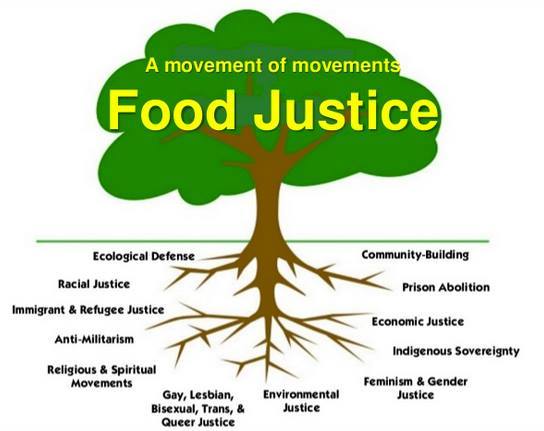 Once we have more comprehensively accepted what it will take to end poverty and hunger, we then need to work on dismantling the systems of oppression and power that are the root causes. Of course, no one individual or organization can do this. We need to form coalitions and build movements that address these issues and begin to dismantle them.
What if a group like Kids Food Basket were to work with Movimiento Cosecha GR and various labor groups to demand a minimum of $15 an hour for all workers in Kent County. This would not only provide more livable wages for families, but it would radically increase the wages of immigrant workers who do most of the food related work in this community – as migrant farm workers and restaurant workers.
What if Food Charity and Food Justice groups challenged the massive wealth gap in Kent County and called for a redistribution of wealth from the 600 millionaires that made their wealth off the backs of poor and working class people.
What if Food Charity and Food Justice groups worked with a coalition of other groups to call for massive reparations owed to the Black, Latinx and Indigenous communities in Kent County?
What if Food Charity and Food Justice groups called for a massive reduction in military spending and redirected that money for food and health care for everyone in Kent County?
If the goal of any organization that deals with food insecurity is to end food insecurity, hunger and poverty, then these are the kinds of things we will need to work on if we really want to end hunger and poverty. If not, then we will continue to do the same things we are doing now, which might make people feel good about themselves, but it will not do a damn thing to actually end hunger and poverty in our community.
Lastly, I want to say that I write these words with a recognition that I too am complicit in the ongoing hunger and poverty of people if I am not working on dismantling the systems of power and oppression that are the root causes. I am not blaming people or organizations, rather I want to challenge all of us to honestly grapple with what it is that we need to do to realistically end hunger and poverty.
9 of the top 30 political donors in the state are from West MI, but the DeVos family is number one on the list
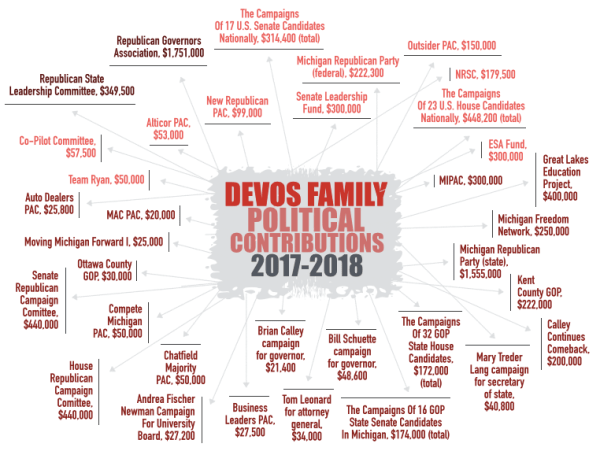
 With all of the data from the 2017-2018 election cycle now in, we can finally see who the big money contributors were. Many of the names on the list are familiar to most, especially if you in West Michigan.
In fact, according to a recent post from the Michigan Campaign Finance Network, 9 out of the top 30 donors during the last election cycle are from West Michigan.
- DeVos family $11.3 million
- Kennedy family $1.1 million
- Haworth family $915,000
- Van Andel family $885,000
- Jandernoa family $795,000
- J.C. Huizenga $762,000
- Secchia family $573,000
- Meijer family $567,000
- Terri Lynn Land & Dan Hibma $450,000
Many of the people on this list from West Michigan are also part of the Grand Rapids Power Structure, in part, because of their own personal wealth, but also because of the organizations they belong to, organizations which often further their wealth and power.
Of course, the DeVos family is at the top of this list and has been for years in terms of political contributions from people residing in Michigan. The graph below, provides details of some of the larger contributions that the DeVos family made during the most recent election cycle, with a breakdown funding at the federal and stat level. Two of the larger PACs the DeVos family contributed were the Great Lakes Education Project (which Betsy DeVos founded) and the Michigan Freedom Network, which is run by DeVos political operative Greg McNeilly.
One can search on the database provided by the Michigan Campaign Finance Network, under the heading Follow the Money.
Fulfilling the DeVos Agenda
However, while it is important to look at which candidates/politicians the DeVos family contributed to, it is equally important to look at how they voted. This is important, since the way that the politicians (who received funding from the DeVos family) have voted is completely in step with the ideological values of the most powerful family in West Michigan.
We know that the DeVos family supports charter schools and private schools over public education. We know that the Michigan legislators who have received funding from the DeVos family have voted for directing taxpayer money to charter schools, passed legislation to shift public school teacher pensions away from traditional pension funding to a 401K system.
We know that the DeVos family despises organized labor, so their funded politicians have voted to make Michigan a Right to Work state, have taken away benefits from public sector employees and have undermined unions across the state. In contrast, DeVos funded politicians have voted over and over again for policies that are beneficial to the business community, especially large companies that transfers more public money into the private sector.
We also know that the DeVos family funded politicians have voted to legally allow adoption agencies to prohibit same-sex partners from adopting, plus the same politicians passed legislation to allow for increased campaign contributions to candidates running for office in Michigan.
Lastly, it is important to mention that DeVos-backed candidates have been in favor of the Enbridge’s Line 5, which puts the Great Lakes at risk of contamination AND DeVos funded candidates have been absolutely complicit in the racist and ecological disaster that is occurring in Flint.
All of this is what DeVos political money buys in Michigan. So the next time you all want to celebrate ArtPrize, Start Garden, Boxed Water, AmplifyGR or any other aspect of the DeVos empire, remember what this family really represents.
Local News Coverage of the Press Conference held Friday on recent ICE arrest and detention of Brandon Reyes
 On Friday, a Press Conference was held in the law offices of immigration attorney Richard Kessler, the lawyer representing Brandon Reyes and his mother, two of the most recent victims of ICE violence in West Michigan.
Those who spoke during the Press Conference were Richard Kessler, Gema Lowe (Movimiento Cosecha GR), Kathleen Underwood (Michigan United) and two of Brandon’s relatives who talked about the impact his and his mother’s arrest has had on the family.
The local news media present during the Press Conference were MLive, WZZM 13, Michigan Radio and El Vocero Hispano. As of this writing, only stories from MLive and WZZM 13 have been posted on their websites.
In addition, one thing we would encourage people to do is look at the entire press conference that was video taped by GR Rapid Response to ICE, at this link. It is always useful to compare what was actually said in its entirety and then compare it to the constructed news story.
We begin with the story posted on MLive and written by reporter Justin Hicks, with the headline One-time ‘Dreamer’ detained by ICE in Grand Rapids.
The article begins with some basics on what happen to Brandon Reyes and his mother on Tuesday, February 19. However, the article early on cites an ICE official, thus leading with law enforcement as the primary voice, even though the Press Conference was called by those who support Reyes.
The article then shifts to talking about a drinking while under the influence charge that Reyes had last year, a charge which he plead guilty to and had been fulfilling the consequences of that action. The MLive article spent three paragraphs on the alcohol-related charge.
Then the article does provide some background on Reyes, followed by the first comments made by those who called the press conference. Gema Lowe, with Movimiento Cosehca GR was quoted as saying, “It is inhumane for ICE to target and kidnap beloved members of our community when they are just trying to go to work, live their regular lives, and support their families.”
During the Q & A period of the Press Conference, Lowe was asked to clarify what she meant by ICE violence, which she did, as is reflected in the MLive article. However, what is interesting is that the reported appeared to have interpreted Lowe’s comment to mean that some sort of physical violence had been done. In other words, this reporter from MLive would not consider the arrest and detention by ICE as violence, despite the economic hardship and trauma that it causes for individuals and families.
The comments by Lowe were followed by other people who spoke at the Press Conference, first by Kathleen Underwood who has Brandon as a student at GVSU and worked with him in a volunteer capacity with Michigan United. Reyes’ cousins, Nelly Gudino and Ana Ramirez, then spoke with specifics about how the arrest of Brandon and his mother impacted their family.
The MLive article then quotes immigration lawyer Richard Kessler, who said, “2019 has been the “darkest hour” of his 38 years as an immigration lawyer.” This was an important comment made by Kessler, but it should be stated that this was the very first thing said during the Press Conference and would have provided a much different framing of the story, had MLive led with this comment.
From there the MLive article cites other ICE officials about the arrests that they make, stating:
“ICE deportation officers carry out targeted enforcement operations every day in western Michigan and locations around the country as part of the agency’s ongoing efforts to protect the nation, uphold public safety, and protect the integrity of our immigration laws and border controls.”
Unfortunately, the MLive reporter did not question or verify the claims made by the ICE official about how these arrests “protect the nation, uphold public safety, and protect the integrity of our immigration laws and border controls.” By not questioning or verify the claims made by ICE, it is simply reported as fact.
WZZM 13 Coverage
The online post from WZZM 13 is headlined, One-time ‘Dreamer’ detained by ICE in Grand Rapids. The channel 13 story begins with the focus and intent of the Press Conference, which was people in the community were calling for the release of Brandon Reyes and his mother from ICE. This was in sharp contrast to how MLive frame the issue at the beginning.
 The WZZM 13 story also makes it clear early on that the arrest of Reyes and his mother was one of 40 to 60 arrests that ICE has made in the past few days, in what are called by ICE “fugitive operations.”
The article then goes on to say that the Trump administration has engaged in efforts to eliminate DACA, a program that has allowed Reyes to remain in the country.
The article continues by talking about his driving while under the influence charge from last year, but finishes with mention of a petition that Movimiento Cosecha GR put together calling for a judge to allow Brandon and his mother to be released on bond and to rejoin their family.
These two stories as reported by local English language news media, provides a clear example of how media is constructed and why we cannot rely on commercial journalism to provide the public with complete coverage of crucial issues that affect our community, such as ICE violence against the immigrant community.
Will Capitalism Save communities of color? Start Garden and the deception of wealth creation
 “A true revolution of values will soon cause us to question the fairness and justice of many of our past and present policies. On the one hand, we are called to play the Good Samaritan on life’s roadside, but that will be only an initial act. One day we must come to see that the whole Jericho Road must be transformed so that men and women will not be constantly beaten and robbed as they make their journey on life’s highway. True compassion is more than flinging a coin to a beggar. It comes to see that an edifice which produces beggars needs restructuring.”
Martin Luther King Jr. – from his Beyond Vietnam speech – April 4, 1967
Capitalism, and its current form of Neoliberal Capitalism, is very seductive. It offers promises of personal wealth and freedom from poverty, yet too often it has failed people miserably, especially in communities of color. However, despite this well documented history, such as in Manning Marable’s important scholarly work, How Capitalism Underdeveloped Black America, members of the capitalist class continue to promote “economic opportunities” for communities of color.
Take the example of Start Garden, their recent comments in the business press and the beginning of their second straight year of the 100 Ideas project. In a recent article from MiBiz, Co-Director of Start Garden, Paul Moore said:
“What the data is pointing to is we’re going to need to do a better job at creating on-ramps for women and minorities, and if we’re not doing that with any intentionality, there’s no reason we should expect to see anything change.”
What Moore and Start Garden believes is that if you can just offer more women and people from communities of color business opportunities, then they will have the same opportunities that men and white people have had. But this is a lie and has been so, since capitalism is by its very nature predatory and benefits only a small sector of the population. Charlene Caruthers, in her book Unapologetic: A Black, Queer, and Feminist Mandate for Radical Movements, makes this observation:
Capitalism with Black in front of it won’t liberate our people. Capitalism is by definition tied to the subjugation of African-descended people. Our collective liberation will not come from models that rely on individual or small group wealth building.
However, this is exactly what Start Garden is doing – attempting to convince some people from communities of color that they can make it individually or create small pockets of wealth. And in many ways it makes sense. To criticize people of color for wanting to build wealth through capitalist means is just another way to practice white supremacy. What I am interested in doing is to challenge entities like Start Garden, which are funded by members of the billionaire class (the DeVos family), and the larger community about the very nature of these types of neoliberal capitalist projects.

Start Garden’s 100 Ideas project is a great example of how we can all be fooled into thinking about wealth and economics. They invite people to submit ideas and for that they will pay you just to submit an idea. However, if there are ideas that they really like, they will reward you with more money. However, as always with venture capitalists, the get to keep some of the profits you make, especially if your new business project does well.
But here is the thing. Start Garden was made possible by DeVos money, which as we know was built on the Amway pyramid scheme. The DeVos family became billionaires by convincing people that they could get rich by selling their products. It works, for a small percentage of people. There are a few who have benefited from this pyramid scheme, but most people are unable to live well, because that is the nature of capitalism…….the few benefit at the expense of the majority.
On top of the fact that DeVos wealth was created through a pyramid scheme, they have also spent decades and millions of dollars to support the Republican agenda of attacking workers, undermining unions, making Michigan a Right to Work state and pushing policies that transfers public money into the private sector.
This is all context. Then, Start Garden steps in and says, we want to help you potentially funding your ideas. The problem with the is that the DeVos family has spent decades promoting policies that have negatively impacted communities of color and now they want to offer “opportunities.” On top of all of that, Start Garden takes no risk, while presenting themselves as providing opportunities, whereby they can profit off of the creative imagination and labor of other people.

One additional fallacy about the lie of Start Garden’s entrepreneurial project and its attempt to create opportunities for people of color is that no where in their vision or philosophy do they acknowledge the history of how white supremacy and structural racism have devastated communities of color, nor do they advocate this the system of white supremacy should be dismantled.
If we look at the Black Radical tradition, we can see that there is a fundamentally different approach to how to work for collective liberation. Zoe Samudzi and William Anderson, in the powerful book, As Black As Resistance: Finding the Conditions for Liberation, make this observation:
Our movements and our work need to avoid neoliberal enticements to corporatize or commoditize or otherwise become caught in the gears of capitalist accommodationism.
Towards the end of his life, Malcolm X also understood that capitalism could never be a solution to the liberation of his people. Malcolm said, “Most of the countries that were colonial powers were capitalist countries and the last bulwark of capitalism today is America and it’s impossible for a white person today to believe in capitalism and not believe in racism. You can’t have capitalism without racism.”
Malcolm X inspired black people to form the Black Panther Party for Self Defense. The Black Panther’s, in their creation of the 10 Point Program identified capitalism as one of the problems. In point #3 they state:
WE WANT AN END TO THE ROBBERY BY THE CAPITALISTS OF OUR BLACK AND OPPRESSED COMMUNITIES. We believe that this racist government has robbed us and now we are demanding the overdue debt of forty acres and two mules. Forty acres and two mules were promised 100 years ago as restitution for slave labor and mass murder of Black people. We will accept the payment in currency which will be distributed to our many communities. The American racist has taken part in the slaughter of our fifty million Black people. Therefore, we feel this is a modest demand that we make.
There is a certain insidiousness about what Start Garden is promoting and their deliberate targeting of communities of color. Whatever people from those communities chose to do with what the Start Garden’s of the world are offering is their choice, but for those of us who are white and claim to be progressive or in favor of dismantling the system of white supremacy, we should not be seduced by what the DeVos-funded Start Garden project is offering.
People, Profits and the Grand Rapids Whitewater Project
 There has been recent news coverage about the Grand Rapids Whitewater project, primarily around new funding efforts and the naming of a new CEO.
MiBiz ran an article on February 8 noting that $4.4 million in new funds have been pledged for the project, with $1.4 million coming from Kent County, $2 million from the state of Michigan and $1 million coming from the Cook Foundation. The Cook Foundation, interestingly enough, has a history of funding right wing Christian organizations over the years and Peter Cook (along with Rich DeVos) threatened to withdraw million for the GVSU health building on the corner of Michigan and Lafayette in 1995 after it was discovered that the university had made a promise to faculty and staff to grant domestic partner benefits. Peter Cook and Rich DeVos opposed domestic partner benefits.
This project is also seen as another public-private partnership, which essentially means that public money will be transferred to the private sector, with little or not say from the public.
Also noted in the MiBiz article was the naming of Steve Heacock as the new CEO of Grand Rapids Whitewater. MiBiz provided adequate information on Heacock stating:
Heacock formerly worked as chief administrative officer of Van Andel Institute and previously was a partner in law firm Warner Norcross + Judd LLP. He also has been involved in the Grand Rapids-Kent County Convention/Arena Authority and Grand Action and was a former chair of the Kent County Board of Commissioners.
Steve Heacock is the perfect choice to led Grand Rapids Whitewater, since Heacock is a political insider who has served the interests of the Grand Rapids Power Structure for decades. Such interests have primarily been economic interests, which is the primary focus of the river restoration project. The 2014 report put together by the Anderson Economic Group on behalf of Grand Rapids Whitewater, makes it clear that economic development is the main goal of the group.
The economic development aspect of the river restoration project will mean more businesses along the river, businesses that will primarily benefit the professional class, along with new entertainment venues and of course increased tourism. Such economic incentives are consistent with the history of who has benefited from the use and abuse of the river. At the peak of the furniture baron era, massive profits were being made by the captain of industry, while at the same time the pollution and contamination of the river was being committed by industrial capitalism.
The MiBiz article also states that the river restoration project is being dubbed the “River for All” project. Since this project is primarily an economic development tool, working class and poor people are not likely to be flocking to the restored river. This will not be due to signs posted saying, poor people not welcomed. However, the reality is that working class and poor people have less leisure time than those who are well off and while working class people enjoy the river for picnics they will not be the ones lining up to use kayaks or spend money at the new restaurant and entertainment venues that will pop up along the river.
Socialism is great, when it’s for the private sector: More Corporate Welfare in Michigan
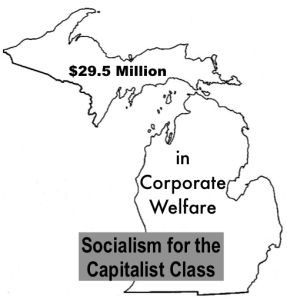 Just over a week ago, MLive ran a story entitled, West Michigan businesses get $9.9M from state for employee training. The article states:
The Going PRO Talent Fund, formerly the Skilled Trades Training Fund, awarded $9,940,010 in grants to 261 West Michigan businesses, large and small, in a variety of industries to provide industry-recognized, transferable skilled trades training that employees may not have gotten otherwise.
The article goes on to say:
“As Michigan works to close its talent gap, programs like the Going PRO Talent Fund provide resources for employers and their employees to keep up with an ever-changing, high-tech global economy,” said Jeremy Hendges, Talent and Economic Development chief of staff. “This fund is part of Michigan’s comprehensive approach to ensuring it can compete in the global race for the most and best talent while ensuring our companies can continue to invest in homegrown talent.”
Jeremy Hendges, who is quoted in the article. recently wrote an opinion piece for the Detroit News, referring to this project, where the state gives millions to the private sector, as Michigan’s Marshall Plan.
Hendges has previously worked has the Legislative Director in both the Michigan Senate and the Michigan House of Representatives, which means he could work his connections to get legislative approval for this massive “grant program.” Well, at least that is what Hendges and MLive refer to it as, a grant program. The reality is that this project is nothing more than corporate welfare or socialism for the private sector.
While the capitalist class is pulling their hair out over recent suggestions that the rich out to be taxed way more than they are now, those in the private sector are claiming that taxing the rich would be socialism. However, when taxpayer money goes to the private sector, now they conveniently call it a grant or talent development.
Socialism for the Capitalist Class
While the MLive article focuses on corporate subsidies given under this program in West Michigan, across the state, the amount of public money given to the business community for “talent development” was a total of $29,458,110.00. You can view all the businesses which benefited from the massive corporate welfare scheme, by going to this link.
Some of the larger recipients in West Michigan, were: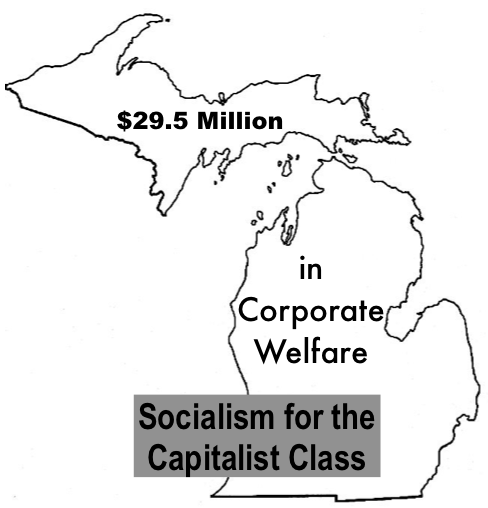
Gordon Food Service in Wyoming: $211,305
Michigan Turkey Producers in Grand Rapids: $113,699
Autocam Medical, LLC in Kentwood: $93,000
Herman Miller, Inc in Zeeland: $289,345
Herbruck Poultry Ranch, Inc in Saranac: $214,800
What is interesting is that each of these companies are run by people who are part of groups like the West Michigan Policy Forum or are directly involved with the Acton Institute, entities which promote the privatization of public services and seek to dismantle public sector employee benefits and pensions. How ironic that they have no problem holding their hands out to take public money that will primarily benefit their bottom line.
Trump’s Wall, Border Security and the need for strategic responses that lead to immigrant justice
 For months now there have been threats from the Trump administration about wanting to build a wall along the border of Mexico and the US.
It has been since he was a candidate, that Donald Trump wanted to build a permanent wall along the border, something that appealed to his voting base. The issue of the wall has become even more contentious, especially after the government shutdown earlier this year.
On Thursday, Congress voted to pass legislation that would provide $1.375 billion for 55 miles of fencing in Southern Texas and would increase Immigration and Customs Enforcement’s (ICE) budget by hundreds of millions of dollars. This legislation passed in the Senate 823- 16, with wide bi-partisan support. Both Michigan Senators, Debbie Stabenow and Gary Peters voted for this legislation. In the House a version of the bill passed 300 – 128.
The New York Times also reported that:
The agreement, tucked into a $49 billion bill funding the Department of Homeland Security, includes restrictions on where fencing can be built in the Rio Grande Valley and what can be used to build it. Only “existing technologies” are allowed, effectively prohibiting a concrete structure or any new prototypes that administration officials might try to put into place. Communities and towns along the border will also be able to weigh in on the location and design of the fencing.
Democrats have been using the language of “Border Security” during their tactical disagreement with President Trump and leading members of the GOP.
This decision by the Democrats has been seen by many immigrant justice groups across the country as a complete betrayal of what needs to happen around larger immigration issues and policies.
Being strategic amidst Trump’s threats
The legislation that came out of Congress on Thursday was not enough to satisfy the Trump administration and he has been threatening to declare a state of emergency and shut down the government again.
While these threats are fundamentally wrong and will only do more harm to immigrant communities, it is important that we think strategically about how to move forward on the wall, border security and ICE violence.
There have already been calls for demonstrations, specifically around Trump’s threat of a national emergency until he gets his border wall. Some of these actions are being organized by MoveOn.org across the country, with one scheduled for West Michigan today.
The MoveOn.org message for today’s protest is as follows:
Protest Trump’s Attack on the Constitution to Declare Fake Emergency. NO HATE NO WALL NO RACISM NO ATTACK ON DEMOCRACY Trump wants to Steal Billions $ of tax payers dolllars needed for national disasters and misuse and insult our military for his racist unnecessary wall. Protest this Gross Abuse of Power on Presidents Day Monday at 5:30 p.m.
Part of the problem with this kind of language is that it only blames the Trump administration, while ignoring the bi-partisan reality of funding for border security and ICE. More importantly, the language doesn’t center the ongoing harm being done to immigrant communities.
 In contrast, there are other actions being planned around the country, actions that are primarily being organized by communities of color and those most directly impacted by current immigration policies. This groups states, “We refuse to choose between Trump’s openly racist wall and the Democrats’ implicitly racist “smart border.” The differences between Trump’s border wall and a soft-power smart wall are minor variations on the same deadly theme. We will block the border wall. We choose another way: freedom of movement, solidarity, and mutual aid.”
In addition, the groups organizing these more strategic actions are also calling for the following:
- We call for a “Block the Wall” mobilization on February 19 and 20 against the border wall and against the state of emergency. We can march, take over public space, and organize sick-outs in the nation’s capital. We can block every ICE detention center, field office, and ICE contractor around the country with the occupation of the public space around the facilities. Each of these offices are maintained by working class people in support staff, couriers, cleaning crews, tech services, and social workers. We invite all of these workers to call in sick and join the occupations on the sidewalks and streets.
- We call for the organization of mutual aid to support the federal workers and subcontractors who remain uncompensated for 34 days of unpaid labor, and to support those who rely on government assistance. We call for cooperation to pool and distribute resources immediately to ease the daily struggles of those most affected. We commit to taking care of one another as the state gambles with the lives of millions.
- We call for direct support for migrants and border struggles. There are multiple initiatives already demonstrating hospitality to migrants and physically defying the border that separates the United States from Mexico, from autonomous kitchens in Tijuana to indigenous-led anti-border camps in Texas. We will build the capacity to undermine the border, welcome refugees, and demonstrate that free movement can be beautiful, safe, and beneficial for all—so long as the police and la migra stay out of the way.
This kind of vision and strategy is critical if we are to work towards immigrant justice.
Things you can do to effectively support immigrant justice
- Build relationships with the immigrant community, relationships built on solidarity and mutual aid and NOT on White Saviorism.
- We need to center the voices and lived experience of immigrants while fighting state violence violence being done by policy makers, ICE agents or local law enforcement that is complicity with ICE.
- We need to support immigrant-led movements that are working for immigrant justice, movements like Movimiento Cosecha GR and national.
- We need to directly confront systems of oppression that are targeting the immigrant community – ICE, local cops and state or private detention centers that are complicit in the ICE matrix. In Kent County, this would mean supporting GR Rapid Response to ICE.
- We need to make the link between various systems of oppression, particularly where immigrant justice fits in. For example, US trade policies, the US funding of the so-called drug war in Mexico/Central America and climate change are all reasons that are contributing to people from that region coming to the US. Therefore, Capitalism, climate change, White Supremacy and other systems of oppression are the root of the immigration crisis. We need to work on dismantling these systems.
Statewide campaign against detention centers in Michigan to host first public meeting in Ionia this Saturday
 Since last October, it has been known that the private company Immigration Centers of America (ICA) has been proposing a 600 bed immigration detention center in Ionia.
In early January, ICA presented for the first time in front of the Ionia City Commission and one week later a new statewide coalition began meeting to fight the proposed detention center.
Since then, those who have been meeting in Lansing have met several other times and even participated in an action to confront the law firm that is representing ICE, Honigman.
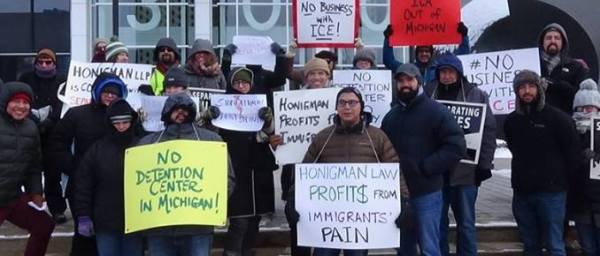
Now, the statewide coalition is hosting a meeting this Saturday in Ionia for those who want to get involved in the campaign. Below is a flyer for the event, which you can share and invite others who want to be involved in the effort to stop the for profit detention center in Ionia and throughout the state.
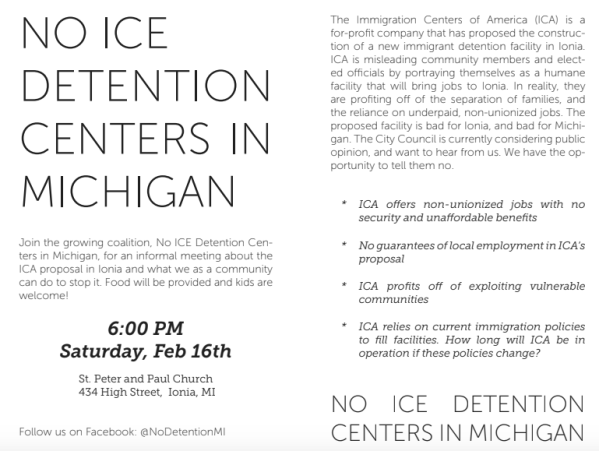
Recently, people from Ionia and around the state spoke during an Ionia City Council meeting, expressing their opposition to the proposed immigration detention facility and will no doubt be doing more of that in the coming weeks and months. For more information on the statewide No Detention Centers in Michigan campaign, go to their Facebook page at this link https://www.facebook.com/NoDetentionMI/

