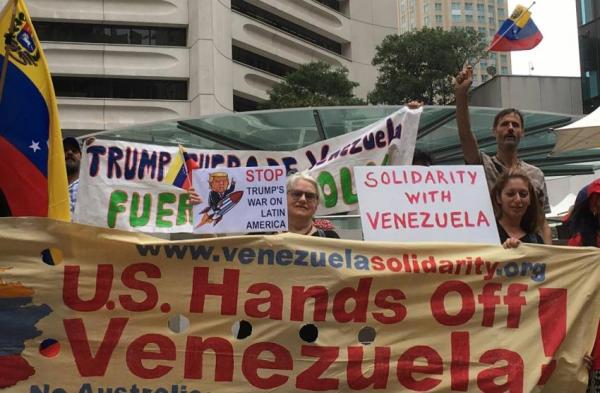
 The Trump administration is calling for a coup in Venezuela. US policy towards Venezuela has going supporting both a hard and soft coup in that country since Hugo Chavez became president in 1999.
In 2002, there was a coup attempt that was supported by the US, an attempt that failed. The 2002 coup is well documented in the film, The Revolution Will Not Be Televised. With the current coup attempt, the US is calling for the overthrow of President Maduro to be replaced by opposition leader Juan Guaidó.
US foreign policy towards Venezuela has been to undermine the Bolivarian Revolution that began with Chavez, but continues to be embodied by civil society in Venezuela. This US effort to thwart and independent and autonomous Venezuela began with President Clinton and continued with Bush, Obama and now President Trump.
We thought it was important to provide some solid analysis/links for what is happening right now in Venezuela, some online resources that have provide excellent information on US/Venezuelan relations in recent decades and a few book titles that provide important historical information specific to US foreign policy and Venezuela.
There has been some really good independent reporting on the US coup in Venezuela. First, The Intercept provides a great podcast on the coup, with several long-time observers of US foreign policy in the region.
The Real News Network also has two good video news analysis pieces on the US coup in Venezuela, one with the editor of the online resource Venezuela Analysis https://venezuelanalysis.com/ and a second video featuring a historian on US/Venezuelan relations.
The Washington Office on Latin America has an excellent FAQ on the current situation in Venezuela and CounterPunch has a solid analysis piece that was posted yesterday, entitled, Trump’s Coup in Venezuela: The Full Story
Democracy Now also did interviews yesterday with long-time journalist and Latin America affairs expert Allan Nairn. Two weeks ago, the media watchdog group, Fairness & Accuracy in Reporting did an interview with Alexander Main, who is the director of international policy at the Center for Economic and Policy Research.
Then there is an excellent article in The Nation by Greg Grandin, who has written several books on US foreign policy in Latin America. Grandin responds to a propaganda piece that recently appeared in the New York Times.
Another piece we want to mention is also from CounterPunch and provides an interesting piece on how some of the Democratic Presidential hopefuls have responded to the US coup in Venezuela.
 For an excellent online resource on Venezuela, we recommend the site https://venezuelanalysis.com/, which has been tracking US efforts to undermine that country since 2003.
Lastly, here are a few book titles that we recommend if you want to big picture on US foreign policy in Venezuela and Venezuelan politics.
The Chavez Code: Cracking US Intervention in Venezuela, by Eva Golinger
Bush Versus Chávez: Washington’s War on Venezuela, by Eva Golinger
Venezuela: What Everyone Needs to Know, by Miguel Tinker Salas
We Created Chávez: A People’s History of the Venezuelan Revolution, by George Ciccariello-Maher
Belknap Neighborhood continues to feel the effects of gentrification
 The Belknap neighborhood is no stranger to outside interests with money coming into that northeast side area and wanting to change the makeup of that community.
In the 1990s, there was a major push on the part of Spectrum Health to transform the area to what is now know as the Medical Mile.
Just a few years ago, when GVSU announced it wanted to expand their presence near their Michigan Street facility, the most recent wave of gentrification hit the area.
In the Spring of 2016, the Grand Rapids City Commission approved a major condo project, in what was to be known as the Coit Square Project. The site If the River Swells, provided an important analysis of the Coit Square Project, primarily through a class lens.
Then in the Fall of 2016, the physical changes to the neighborhood could be seen with the demolition of some 20 homes in order to make way for the new GVSU building. We took pictures of the demolition at the time and raised questions about the demolition as a form of displacement.
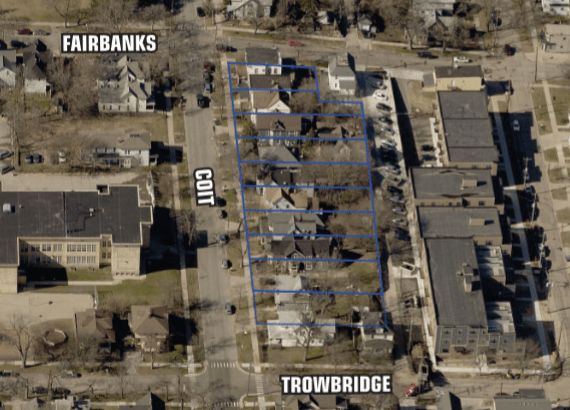
The neighborhood continues to be a target for gentrification, with the most recent example being a project that would demolish nearly another dozen homes. According to Grand Rapids Planning Commission documents from January 10, 2019, the east side of Coit NE, between Fairbanks and Trowbridge, would be leveled for a new housing development project (highlighted here in blue).
This new project is being proposed by RJM Properties, which had begun a project in 2014 known as the Clancy Street Lofts and is now billed as the “Gateway to Belknap Apartments. These apartments run between $1,000 – $2,500 a month.
The new RJM Properties project would include 43 – 50 housing units for sale, as is indicated in the Planning Commission document here:

The units will cost $169,900 – $329,900 for 1 and 2 bedroom units; the 3 bedroom units will have a base price of $499,900. So these new units will run between $175,000 to more than a half a million, which clearly means that there target demographic for these housing units as the professional and business class. However, in the GR Planning Commission documents it does state that RJM Properties, “is actively working to devise a plan that would help make it possible for us to allocate 2 units for affordable low-income ownerships.”
While some will applaud this new project as further evidence that Grand Rapids is a thriving city, it is for this writer a clear indication that Grand Rapids continues to be a city that celebrates wealth at the expense of poor and working class residents.
Movements and Moments: How we are winning the Fight Against the ICE in Kent County Part II
Last week, we posted Part I of this story, providing an analysis of what Movimiento Cosecha GR and GR Rapid Response to ICE has been doing to fight the presence of ICE in Kent County.
In Part I, we focused primarily on the campaign to end the contract between the Kent County Sheriff’s Department and ICE. We framed the fight as taking advantage of moments to build the anti-ICE movement, specifically by bookending the national outrage over immigrant children in cages in June of 2018 and the decision by the Kent County Sheriff’s Department to change their policy on holding people at the jail for ICE.

Last Thursday, Movimiento Cosecha GR and GR Rapid Response to ICE declared that the change in policy by the Kent County Sheriff’s Department, wherein, they would require a judicial warrant in order to hold people in the jail for ICE. This effectively made the contract meaningless, since it gutted the essence of the contract between ICE and Kent County.
What we wanted to reflect on today is what happened at the Kent County Commission meeting last Thursday and why we should never rely on systems of power to initiate the kind of change we are calling for……..collective liberation.
“Silence is the Voice of Complicity” Dr. Martin Luther King Jr.
Roughly 20 people who have been involved in the effort to end the contract between ICE and Kent County, attended the Kent County Commission meeting last Thursday to provide one last opportunity for commissioners to publicly declare that they supported an end to the contract with ICE.
However, before public comment was provided, the Kent County Sheriff did speak to why she made the decision to require ICE to provide a judicial warrant if they wanted the county to hold people. This outcome, as we noted last week, is the direct result of 7 months of constant pressure being applied by Movimiento Cosecha GR and GR Rapid Response to ICE to the Kent County government, using a variety of tactics, culminating in the national news coverage of the ICE detention of a US citizen and former Marine.
Movimiento Cosecha GR and GR Rapid Response to ICE wanted to provide the commissioners and the county administrators one last opportunity to save face and to publicly declare their support for a formal end to the contract with ICE. Several members of both groups spoke during public comment and they brought with them a copy of an oversized resolution that they could sign and thus, publicly declare a call for the formal end to the contract.
The commissioners were invited to sign the document. There was nothing but silence from that elected body. There are several things I want to look at based on the reaction from the commissioners.
First, those of us who were involved in this campaign to end the contract have been coming to the commission meetings since June of 2018. We have shared with them dozens of specific examples of how immigrant families have been separated because of ICE actions in Kent County and we discussed the trauma that this harm has inflicted. More importantly, there have been numerous immigrants, some who have been impacted by ICE violence, who spoke directly to the Kent County Commissioners, yet the commission failed to act.
Second, after last Thursday’s Kent County Commission meeting, one commissioner did approach members of Movimiento Cosecha GR and GR Rapid Response, but not on the matter of signing the letter or thanking the groups for the dedication and commitment to fighting this injustice. Instead, the county commissioner scolded the group for not standing during the prayer and the pledge of allegiance, which happens at the beginning of every commission meeting. At one point, this commissioner even referred to this behavior as that of a rebellious teenager. This was just another example of West Michigan Nice and White Privilege. Those of us who do not stand during the prayer or the pledge of allegiance do so out of a deep conviction, not because of some adolescent rebellion. Christian prayers should NEVER accompany government functions, since it is a clear violation of the separation between church and state. In addition, not standing for the pledge of allegiance is related to not wanting to follow blind nationalism, not wanting pledge to the same state, which condones the violence and harm done to the immigrant community by ICE. Standing or not standing for ceremonial formalities is irrelevant. The County Commission claims they represent the people and their concerns, but it seems that this only happens when they determine that those concerns are worthy of their time.
The third, and final point, I want to make here about what happened at the Kent County Commission meeting last Thursday, is that it further demonstrated why our collective theory of change puts faith in the power of people/social movements and not in systems of power like the Kent County Commission. We won without their approval or their commitment to reducing harm against the immigrant community. We won because of the collective efforts and commitment by a social movement that doesn’t rely on systems of power, but on the radical imagination of people, the demonstration of solidarity with the immigrant community and the revolutionary love that we have with each other.
The Fight Against ICE continues…….
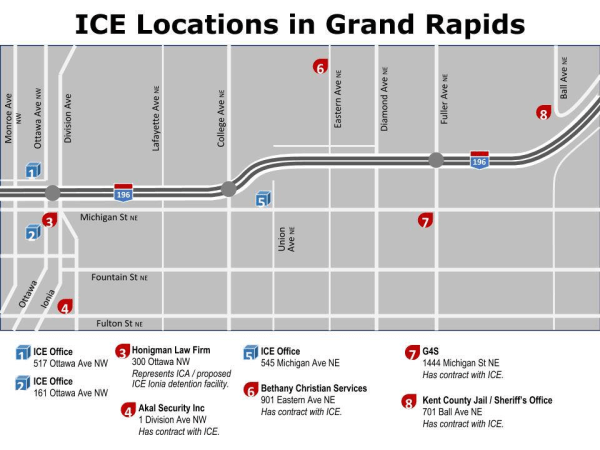
While we took a moment to celebrate the end of the contract between ICE and Kent County, we know that the struggle continues. ICE is deeply embedded in our community and we plan to fight them until they leave the county. You can see from the map below, the various ways that ICE operates in Kent County, where their offices are, which companies have contracts with them and other relationships.
Just last Saturday, some 30 people braved the cold weather to publicly denounce the law firm (Honigman LLC), which is representing Immigration Centers of America, the for profit private company that builds detention facilities across the county for ICE. This effort kicked off a new statewide campaign to prevent the construction of a new ICE detention facility in Ionia. We invite you to join us in this ongoing fight against ICE in Kent County. Just go to the Movimiento Cosecha GR and the GR Rapid Response to ICE Facebook pages to get information about upcoming actions and how to get involved.
La Lucha Sigue!!!
Offering up students to the Captains of Industry: Betsy DeVos, Talent Pipelines and the Neoliberal model of education
Public education historians have always recognized that schools in the US were designed in part as a mechanism to socialize children to follow orders and have the necessary skills to function as workers. (See a well researched history of public education in the US, by teacher and researcher John Taylor Gatto, The Underground History of American Education, Volume I: An Intimate Investigation Into the Prison of Modern Schooling.)
However, in recent decades there has been an increasing desire upon the part the capitalist class to push education systems to create a more deliberate talent pipeline. Translated, this simply means that the business community wants education systems to provide them with more influence and more access to schools in order to groom the future workforce.
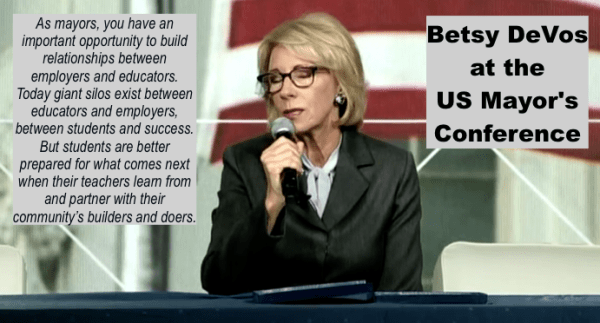
This message is exactly what Betsy DeVos delivered at the 87th annual Mayor’s Conference last week, held in Washington, DC. You can read her speech by going to this link, but what follows are the most relevant quotes related to the theme that DeVos addressed.
First, DeVos promotes the link between the neoliberal capitalist economy and education:
Despite a booming economy with record-low unemployment, employer after employer reports that they cannot find enough qualified people to hire. I’m sure you’ve heard the same. There is a disconnect between education and the economy, just as there is often a disconnect between a child and the school they’re assigned to.
Second, DeVos enrolls mayors from across the country to assist the business community by pushing the talent pipeline mantra:
As mayors, you have an important opportunity to build relationships between employers and educators. Today giant silos exist between educators and employers, between students and success. But students are better prepared for what comes next when their teachers learn from and partner with their community’s builders and doers.
Third, DeVos provides examples of where these business/education partnerships already exist, when she says:
At Harper College outside Chicago, I was impressed by the non-traditional apprenticeships, like ones in banking, insurance, and supply-chain management. These kinds of apprenticeships are common in other parts of the world, but aren’t yet here. They need to be.
Then there’s Mercedes and BFGoodrich which partner with Shelton State Community College in Tuscaloosa, Alabama, to offer students excellent opportunities to upskill in their current profession or start a new one. Employers and educators working hand-in-hand to develop stronger community – in every sense of the word.
These examples are encouraging. Students need more of them. Many more! Employers need them, as do educators. Most importantly, your communities need them.
Of course, this is nothing new coming from Betsy DeVos. For the past 20 years, she and other members of the DeVos family have been pushing for a great role for the business community to play in public education. This philosophy of creating a talent pipeline from schools to businesses was a cornerstone in the DeVos creation of the Great Lakes Education Project, which was designed to influence education policy in Michigan. DeVos has also been part of the creation of other regional organizations across the country that have also sought to influence both state and federal education policy, as we documented when Trump nominated her as Secretary of Education.
We have also reported on these dynamic in West Michigan, both within the Grand Rapids Public Schools and the business-dominated groups that are seeking to create a larger, more institutional talent pipeline in the area. Groups like Believe 2 Become, Talent 2025 and the West Michigan Policy Forum.
In 2017, a report was produced locally, Workforce Opportunity in West Michigan:Connecting a Qualified Workforce to High-Growth Opportunities, which demonstrates that the local power structure sees students primarily as workers they can make money off of.
The contemporary business community uses terms like talent management and workforce development, but these are essentially modern terms for what 19th century writers would refer to as wage slaves.
Look at these comments from Business Leaders and you can see how they view students:
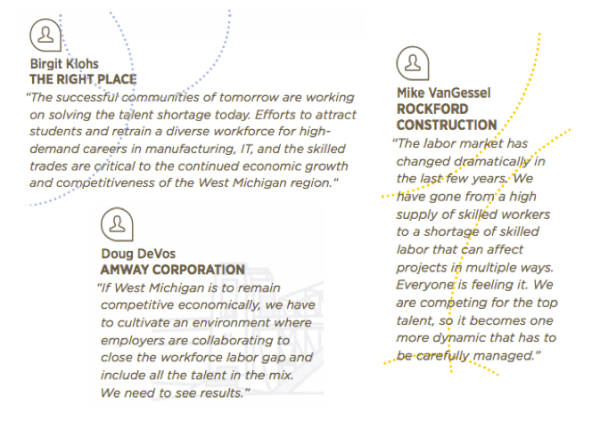
Each of these members of the capitalist class make it clear that the function of education is to prepare people to be good and obedient workers.
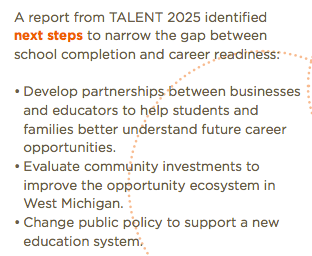 The talent management group Talent 2025 has identified these three goals (on the right) for West Michigan, if the economy is to grow.
These goals are instructive, since they make it clear that education should serve business interests, corporate funding should drive greater economic opportunities and the education system should change, meaning it should become more privatized to serve business needs.
It is crucial that we all not buy into the Orwellian use of language and promote talent creation, talent management or workforce development. This language is simply meant to deceive us into believing the lies of an economic system that only benefits a small percentage of people, like the DeVos family and other members of the capitalist class.
ACLU and MIRC confront ICE and the GRPD on their arrest and detention of former Marine and Citizen
As we reported, last week Kent County made national news over the arrest and detention of Jilmar Ramos-Gomez, a former US soldier and citizen.
Shortly after this incident, the Grand Rapids Police Department issued a statement, a statement which angered many people. Here is that statement from the GRPD:
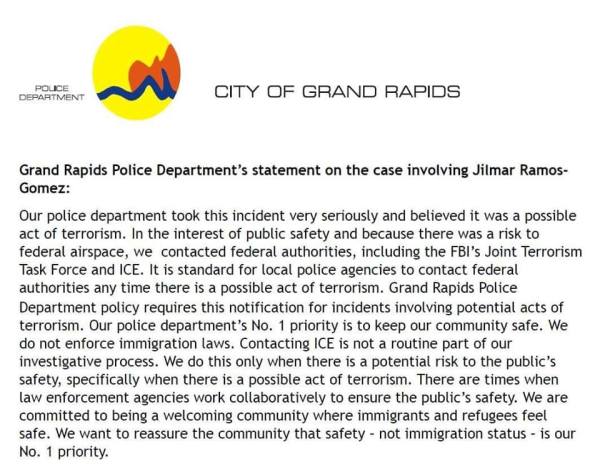
In addition, an unnamed ICE official also made a statement, which was equally appalling in the detention of Jilmar Ramos-Gomez.
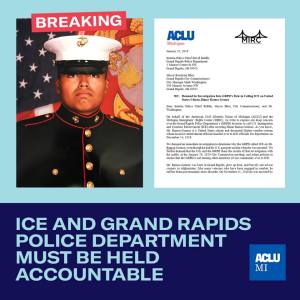 Now the ALCU and the Michigan Immigrant Rights Center (MIRC) has sent letters to ICE and the GRPD challenging them on the arrest and detention of the former Marine, in an attempt to get some answers and to call them out publicly for their inexcusable behavior.
The letter sent to the GRPD and to Mayor Bliss reads in part:
The GRPD’s evasive public statement raises more questions than it answers. The GRPD asserted that because the incident for which Mr. Ramos-Gomez was arrested involved federal airspace, the GRPD contacted federal authorities. We appreciate that there are situations where it is appropriate to coordinate with relevant federal law enforcement agencies. But why did the GRPD contact ICE? ICE is the federal agency responsible for immigration enforcement, and the GRPD had Mr. Ramos-Gomez’s U.S. passport, license, military ID, and U.S. Marine Corps tags. What made the GRPD think that Mr. Ramos-Gomez was illegally present in the United States? Would the GRPD have called ICE if Mr. Ramos-Gomez were white and his name was John Smith? How many times does the GRPD call ICE on members of our community and how many of them are people of color? Former GRPD Chief David Rahinsky has publicly represented that GRPD is not concerned with immigration status and does not target immigrants.1 But that was not true in Mr. Ramos-Gomez’s case. And we, along with many members of the community, believe it is frequently not true in other cases. We demand an explanation as to why the actual practice of the GRPD here diverged from its public statements. We also demand transparency about GRPD’s actual practices with respect to ICE, including public disclosure of data on the number and nature of GRPD-ICE interactions.
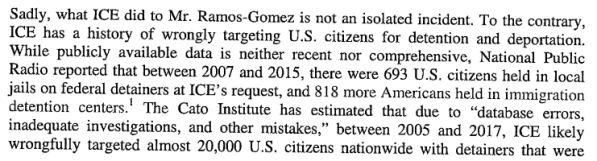
The letter that the ACLU and MIRC sent to ICE also is demanding an investigation as well as greater transparency in cases related to West Michigan. Here are some excerpts from that letter:


All of this, of course, comes on the heels of the decision made by the Kent County Sheriff’s Department to change their policy on ICE holds, where they will now require ICE to obtain a judicial warrant in order for the Kent County Jail to hold people who are in their custody.
All of this further demonstrates the power of the grassroots effort led by Movimiento Cosecha GR and GR Rapid Response to ICE since June of 2018, when these two groups demanded that Kent Count end their contract with ICE.
Centering White Voices Again: White Supremacy, Settler Colonialism and the fallout of white catholic boys disrespecting Indigenous people
 What happened last weekend in Washington, DC, where white catholic school boys disrespected indigenous people was appalling and painful to see all over social media. In fact, most of what I have seen on my Facebook feed has been reactions to this incident.
The overwhelming response to this incident has been completely understandable. It was an act of disrespect, it was an act of ignorance and it was a manifestation of white supremacy.
However, most of the responses that I have seen still ends up centering white voices at the expense of Indigenous voices. In addition, the centering of white voices also distracted us from asking what it was that Indigenous people were doing in Washington, DC and what was the purpose of their march.
The #IndigenousPeoplesMarch was calling attention to the injustices faced by Native communities, including:
• The epidemic of missing and murdered Indigenous women
• An “environmental holocaust” on Indigenous lands
• Voter suppression
Police brutality
This information and this narrative has been largely ignored by most media and white liberals who are incensed at the smug stare down that the white catholic school boys engaged in directed at Nathan Phillips.
 Now, there has been some examples of indigenous voices being heard as a result of the white catholic maga hat wearing boys being disrespectful narrative. Here is a powerful observation from Nathan Phillips that was on CNN.
When they said, “Let’s go hit the drum, let’s go sing, let’s reclaim our space here” because this was the Indigenous Peoples March rally, and when these two groups came together and started that and I was witnessing as it escalated from just two small groups, then the other one just went back and got more people, went back and got more people, went back and got more people until there were over 100 people, maybe 200 young men there facing down what? Four individuals? Why did they need 200 people there other than it’s hate and racism? They had their target. They had their prey. And so I wish somebody would’ve been able to stand in front of the 7th Cavalry and my relatives at Wounded Knee. I wish somebody would’ve stood there and said, “No, you can’t do this.”
Nathan Phillips was calling out and naming what white people have been doing to indigenous people for hundreds of years. White people, through of system of white supremacy, have been killing indigenous people and taking their land. In addition, white christians have been using spiritual violence against indigenous people, forcing them to convert and then taking their children and putting them in boarding schools so they can, “kill the Indian and save the man.”
Another message that has been effectively drowned out, since our focus has been on the behavior of white boys, is to not have to deal with how some of the indigenous people responded to chants from the white catholic school boys, who said, “Build the Wall.” One powerful response was, “We don’t build walls on Native land.”
Kade Ferris, an anthropologist, blogger and enrolled citizen of the Turtle Mountain Band of Chippewa in Belcourt, North Dakota, provided some important context to this issue. She said:
“Throughout history, indigenous people — including those in what is now Mexico and central America — moved freely across the land in search of greater opportunities. They knew where they could and couldn’t go and where they belonged. Borders were meaningless and were a concept that was imposed by the forces of colonialism … they are and always have been a way to try to control people.”
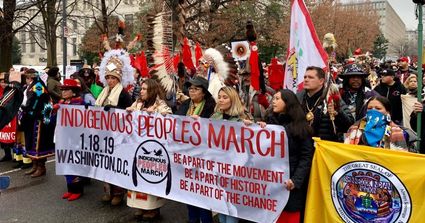 These two examples, both of which center the voices of indigenous people, completely reframes the narrative away from the offensive behavior of some white catholic school boys, (which was disgusting) and forces us to have to come to terms with our own complicity in the historic and contemporary ways in which white people have treated indigenous people for centuries.
While it is important to disapprove of the actions of the white catholic school boys, it is much more important to support indigenous people and the demands that they brought to the march in DC. These demands were not directed at white catholic school boys, they were demands directed at a political and economic system that is rooted in white supremacy and settler colonialism. If we claim to be in solidarity with indigenous people, then it is our task to dismantle white supremacy and settler colonialism, a task much more difficult than expressing outrage over the spectacle that the news media has amplified.
 (Editor’s note: I am a member of both Movimiento Cosecha GR and GR Rapid Response to ICE.)
Last week, Kent County made national news with the revelation that a man born in the US, who later served in the US military in Afghanistan, was detained by Immigration and Customs Enforcement (ICE).
Shortly after this news went national, the Kent County Sheriff held a press conference, stating that the Sheriff’s Department, “will no longer honor federal immigration holds without an arrest warrant signed by a judge.”
Without a doubt, this is a significant win for the movement to pressure Kent County to End their Contract with ICE, in a campaign that began in June of 2018. After 6 months, it is worth taking a step back and reflecting on how we got to this moment.
Movements and Moments in the Fight Against ICE
We (whenever I say we, I am referring to Movimiento Cosecha GR and GR Rapid Response to ICE) first began planning to take action to end the contract, a contract that the Kent County Sheriff’s Department has had since 2012, in the Spring of 2018. In March of 2018, no one was talking about the contract with Kent County, but when we first decided to make it a public issue last June, we could not have picked a better time.
Just weeks before we planned to go to the County Commission with our demands to end the contract, the issue of immigrant family separation and putting children in cages at detentions centers near the US/Mexican border was front page news. We seized this political moment, to not only draw attention to the fact that immigrant families were being separated right here in Kent County, but that the contract between ICE and the Kent County Sheriff’s Department was contributing to this harm.
Since late June of 2018, we have engaged in some two dozen actions to draw attention to ICE in Kent County. We have attended numerous Kent County Commission meetings, produced all kinds of media coverage and made our own media. We have conducted informational sessions on ICE and provided all kinds of educational resources to people in the community. Because of our organizing, thousands of people in the area now know about ICE and the contract with the county.
We have all sat in dozens of meetings in the past year, planning and strategizing over this issue. We have conducted trainings, collected signatures, raised funds for immigrant families, provides legal support and other forms of mutual aid.
In addition, we have worked with the ACLU and MIRC, several churches and a few non-profits, all of which have contributed to the effort to end the contract. I share all of this to say that, if it wasn’t for all of this effort, all of this energy and all of this commitment, the Sheriff’s Department would not have made the policy change they did last week. The Kent County Sheriff’s Department only acted because of the cumulative efforts we have engaged in over the past year.
This is the power of social movements. Social movements often do work that goes unrecognized, work that seems like it is getting no where, but then you have moments like last week and all of a sudden change can occur. In June we seized the moment when children in cages were headline news and last week, we seized the moment when a military veteran was detained by ICE. All of that happened because of the dedicated work being out into this campaign, by both Movimiento Cosecha GR and GR Rapid Response to ICE.
Two weeks ago, when some of us were interviewed by MLive, after we attended a January 3rd County Commission meeting, the MLive reporter stated that it didn’t seem like we were making any progress with the County Commission. It’s because people often only see progress as something that those with power can make happen. The power of social movements demonstrates just the opposite. Social movements show that ordinary people can not only affect change, but pull back the curtain on how the power to change things is exists with movements not the political establishment.
 We have also been hearing and reading that several other members of the County Commission are now calling for an end to the contract with ICE. We believe that these politicians didn’t come to this conclusion on their own, but because they have been pressured into making a decision that grew out of the will of the people.
When we first came to the Kent County Commission meeting in late June of 2018, we were dismissed and our demands were not taken seriously. We were told by Kent County Commissioners and administrators that this is a federal issue and that they could do nothing about immigration. We then heard from County officials that their hands were tied and that they were legally obligated to comply with federal agencies like ICE. The narrative with those in the County has changed little by little over the past several months and now some are calling for an end to the contract with ICE.
This is the power of radical imagination, which says that we don’t have to settle for mild reforms or political window dressing. The power of social movements has always demonstrated that through direct action we can achieve anything we set our collective minds to. And if we are honest about the history of the US, then we will eventually come to the conclusion that whatever gains we have made, whatever rights we have won, whatever institutional forms of oppression have been defeated, it has always been because of the power of social movements.
However, this fight is not over, so please join us this Thursday, January 24th at 8:30am and come to the Kent County Commission meeting to demand an end to the contract with ICE. In addition, join our larger work to provide support to immigrant families who have been impacted by ICE and to participate in the larger goal of abolishing ICE in Kent County.
La Lucha Sigue!
Like some demonic, destructive suction tube: Martin Luther King Jr and US militarism Part III
 In Part I, we looked at Dr. King’s Beyond Vietnam speech, to demonstrate that the civil rights leaders was deeply critical of US militarism. We also look at the ways in which US militarism was impacting the world from the time of his speech in 1967, to the present, looking at what each administration was doing in terms of militarism.
In Part II, explored the organized resistance movements against US militarism, since Dr. King’s 1967 Beyond Vietnam speech. In particular, we looked at how that organized resistance to US militarism manifested itself in Grand Rapids and when it took place, which should illuminate the contradictions of when anti-militarism organizing occurred.
In Part III, we want to propose a way to envision resisting US militarism in the future that is intersectional and embraces Dr. King’s notion of redirecting resources from militarism to “programs of social uplift.”
US Militarism impacts everything
One thing that has often been missing from organized resistance to US militarism is a recognition that it impacts everything. Think about it. US militarism is a manifestation of White Supremacy, since it primarily is used against people of color and relies disproportionately on communities of color as soldiers. US militarism abroad is primarily waged against people in Latin America, Asia, Middle Eastern countries and African nations. On the domestic front, black and brown communities are targeted by military recruiters through programs like JROTC and because of the fact that we have an economic draft. An economic draft means that higher percentages of communities of color experience poverty and are therefore more susceptible to joining the military because of a lack of job or higher education opportunities.
US militarism impacts the environment. US military bases generate a tremendous amount of waste and impact eco-systems wherever they exist. US militarism relies on massive amounts of fossil fuels, thus contributing to climate change on a global scale. US militarism in the form of weaponry is a massive destructive force, such that, in addition to killing people, it kills animals, plant life, birds, aquatic life and destroys entire eco-systems because of its destructive nature.
US militarism is also a manifestation of patriarchy. As feminist researcher Cynthis Enloe has documented, wherever a US military base exists, women around the world are used by US soldiers as sex objects, many of whom are forced into sex trafficking.
Another way that US militarism impacts everything is the amount of weaponry that wounds people, thus creating large numbers of people with disabilities. In countries like Vietnam, there are still place were US mines are either killing people or causing them to lose limbs or eyesight or hearing.
US militarism also promotes heterosexism, contributes to agribusiness, is often a form of spiritual violence, since it is endorsed and even promoted by Christianity. In other words, US militarism impacts everything.
So, if we recognize that US militarism impacts everything, then we should also recognize that war and militarism are not just a moral issue, but one that should involved organized resistance by any and all social movements.
If you are part of an environmental group, you should ask yourself if that have as part of their mission to oppose US militarism? If your organization is a feminist organization, does it have as part of its mission the end to US militarism? If you are part of a group that works on anti-racism, then it would follow that resisting US militarism should be part of the platform. Again, the point should be clear, that no matter what issues we work on, part of it should be to oppose US militarism.
A great example of groups that are not explicitly anti-US militarism is the environmental justice movement. This movement has 17 principles and number 15 is, “Environmental Justice opposes military occupation, repression and exploitation of lands, peoples and cultures, and other life forms.”
These principles of Environmental Justice are rooted in an intersectional analysis, which should govern our own collective work and movements.
How do we move forward?
Recognizing that resisting US militarism should become part of our collective work, while important to acknowledge, is not that practical for people who are most affected by systems of power and oppression. Communities of color, immigrants, queer and disabled people have more immediate and urgent matters to deal with just to survive in this harsh world.
Then there is the reality that of those of us who carry more privilege wanting to see marginalized communities “get involved” in anti-militarism work. This is not only a matter of white, male privilege, it fails to acknowledge that asking marginalized people to join anti-militarism movements is NOT what we should be doing. In fact, the question for those of us who carry a great deal of privilege should ask is, how can we be an ally/accomplice in the struggles of oppressed communities?
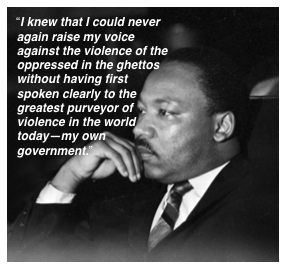
Now, if those communities want our solidarity, then we need to avoid white saviorism and practice an ethos of accompaniment and radical solidarity. Second, in our work as allies/accomplices, we will realize that those who are most marginalized have always thought about and resisted US militarism, even if we are not aware of it. But here is the thing, if we stand with those most marginalized by systems of oppression, it provides a cushion for those communities, along with emotional and physical space, to then devote more energy to fighting systems of oppression. Dr. King recognized this dynamic and stated in his Beyond Vietnam speech that, “I knew that I could never again raise my voice against the violence of the oppressed in the ghettos without having first spoken clearly to the greatest purveyor of violence in the world today—my own government.”
In fact, there are numerous examples of communities of color resisting US militarism, even being out front in that resistance. We often recognize US soldiers returning from Vietnam to become part of the anti-war movement, but we generally think of white soldiers. However, there were many black, latinx and native soldiers who returned to be part of the anti-war movement and to start other insurgent movements.
 For example, some of the early members of the Black Panther Party for Self Defense were former GIs and realized that the police in the US were just a domestic manifestation of US militarism. Robert Williams, who was in the Korean War, joined the NAACP and then organized his community to take up arms for self defense, a decade before the Panthers came on the scene. In addition, many of the hundreds of members of the Deacons of Defense were also former GIs and completely recognized that fighting white supremacy in the US WAS a form of fighting US militarism.
Many of those involved in the Chicano movement, the Brown Berets and the American Indian Movement, were also former GIs, who also used their experience within US imperialism to organize within their own communities against the various ways that US militarism manifests itself across the country. In fact, their efforts to fight colonialism and settler colonialism in what we refer to as the US, was and is a form of resistance to US militarism.
Those of us who are part of the white community tend to see anti-militarism work as opposing specific wars that occur on foreign soil, when in fact US militarism is everywhere and has been and continues to be resisted by marginalized communities. We just don’t see it. So you see, for those of us who identify as white need to continue to learn from communities of color, to do the work of resisting our own role in white supremacy and to learn from the radical history that we celebrate today with Dr. King’s birthday.
Grand Rapids is a city made up of all kinds of people. Yet, the only people who really seem to matter are those that already have power and wealth.
For example, there was a recent article on Inc. entitled, Why Grand Rapids is one of the Fastest Growing Cities in America and a Hotbed for Entrepreneurs.
However, unlike most stories that praise Grand Rapids, this one was written by someone who lives here. Jeff Barrett, CEO of Barrett Digital and the creator of Status Creative, the guy who (with Rob Bliss) created the awful GR Lipdub in 2011, writes about how great Grand Rapids is and gives us three reasons why.
First, Barrett tells us that Grand Rapids tackles big ideas. By big ideas he doesn’t mean how to confront climate change or how to improve public health or how to end poverty. The Big Ideas he is referring to are embodied in two companies – Steelcase and Founders Brewing. Steelcase tackled the big idea of evolving into a business that does consulting and makes office furniture. And the craft company Founders just surpassed Bell in terms of production. Wow, these really aren’t big ideas, they are just examples of businesses making more profits.
Second, Barrett tells us that Grand Rapids isn’t afraid to fail. To prove it, the PR guru refers to what cool stuff the DeVos family is up to (Amway is a client of Barrett’s), how Grand Rapids is becoming a fabulous tourist destination, how the Right Place Inc. is creating more public/private business projects and how the Grand Rapids Chamber of Commerce looks like a Capital One Cafe. Damn, now these really aren’t big ideas, these are just a way to acknowledge that the Grand Rapids Power Structure is continuing to kickass at the expense of thousands of residents who are struggling to survive.
Third, Barrett tells us that Generations of philanthropists continue to elevate this city. Of course, by philanthropists, Barrett means DeVos and Secchia, which are the only two philanthropists he cites, along with Spectrum Health, which is essentially another DeVos project.
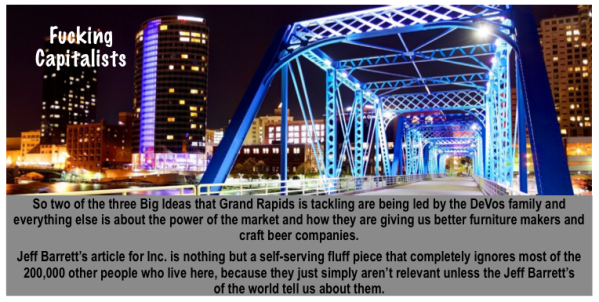
So two of the three Big Ideas that Grand Rapids is tackling are being led by the DeVos family and everything else is about the power of the market and how they are giving us better furniture makers and craft beer companies.
Jeff Barrett’s article for Inc. is nothing but a self-serving fluff piece that completely ignores most of the 200,000 other people who live here, because they just simply aren’t relevant unless the Jeff Barrett’s of the world tell us about them.
Despite GRPS claims that they are not partnering with Homeland Security, Immigrant Justice groups question the real purpose of the proposed academy
 Yesterday, MLive posted a story about immigrant justice groups challenging the Grand Rapids Public Schools about a new proposed school career program.
This action was organized by members of Movimiento Cosecha GR and GR Rapid Response to ICE, because of information from a January 5th MLive article which stated that GRPS would be offering new education/career programs and one of them would be called the Academy of Public Safety, Homeland Security and Cybersecurity.
Yesterday, the immigrant justice groups held a press conference outside of City High School on Plainfield, since there was an event planned for that location by GRPS, which was then cancelled due to weather. However, Movimiento Cosecha GR and GR Rapid Response to ICE still help a press conference. The groups had intended to hand out information to parents, some of which the January 15 MLive article included. However, it is important to include the full statement, which says:
To the GRPS School Board, Superintendent, and Administration:
In MLive articles dated on August 22, 2018 and January 5, 2019, it was revealed that GRPS is planning an Academy of Public Safety, Homeland Security and Cybersecurity among six employment-based academies at Ottawa Hills High School. Many are hearing about this for the first time.
We in the immigrant community who have trusted GRPS daily with our children are shocked and devastated that the school district is planning this academy. In working with Movimiento Cosecha GR and the immigrant community at large, you’ve made it appear that you are on our side. In fact, on September 5, 2017, the GRPS Board of Education introduced a resolution calling on the U.S. Congress to immediately act to restore the DACA program. Superintendent Teresa Weatherall Neal was quoted on WZZM 13 saying, “It isn’t just about removing one person, you will affect an entire community when that happens….These are our neighbors. These are people in our community. And we can’t say that this is okay — we cannot believe this is okay.”
Yet with this action of creating an academy to funnel neighborhood children into jobs that are designed to terrorize, kidnap, and harm our family members, you are showing that you are clearly not on our side and you are not on our children’s side.
Local law enforcement is also complicit with ICE and the Department of Homeland Security, as evidenced by the Kent County Sheriff’s contract with ICE.
We stand with all communities of color who have been harmed by over-policing of our communities and police violence against children like the Michigan 5 and Honestie Hodges.
As the parents and students of your school district:
- We want you to immediately dismantle all plans to open this Academy of Public Safety, Homeland Security, and Cybersecurity.
- We also demand that the GRPS Board of Education make a public statement calling for the End of the Contract between Kent County and ICE.
We need to see action on both these demands by the February 4 board meeting.
We would remind you that we expect better from the school system that we support with our taxes and our engagement. We expect a true community-based education where our children can explore ways to learn and live together that are truly just: ways that are cooperative and that focus on restorative justice. Our children could learn how to organize for movements like our own. What we cannot have is our tax dollars going to support an institution that is complicit with ICE, an agency that terrorizes and separates our families. We will not stand for it and neither will our children.
In response, the Grand Rapids Public Schools Communication Director, John Helmholt stated in the MLive article, the academy has ‘’absolutely nothing to do with ICE nor the U.S. Department of Homeland Security. The district has not, does not, and is not planning to have a partnership with the U.S. Department of Homeland Security.’’
This statement from Helmholt was gleamed from a larger statement that he sent to parents, a statement worth reading here:
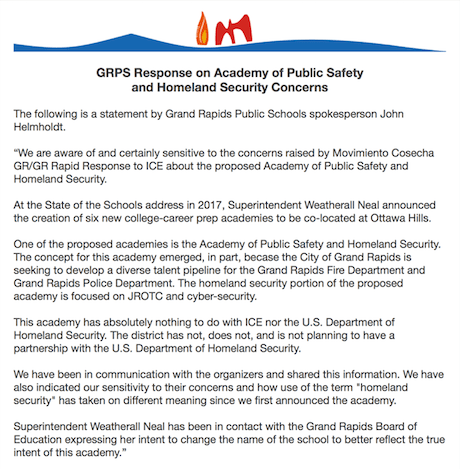
The letter from GRPS states, “The district has not, does not, and is not planning to have partnership with the US Department of Homeland Security.” If this is true, then this should be clarified further by talking with the community about what exactly this Academy of Public Safety, Homeland Security and Cybersecurity will actually offer students.
Also, the statement says that the purpose of this academy was to “develop a diverse talent pipeline for the Grand Rapids Fire Department and the Grand Rapids Police Department. The homeland security portion of the proposed academy is focused on JROTC and cyber-security.
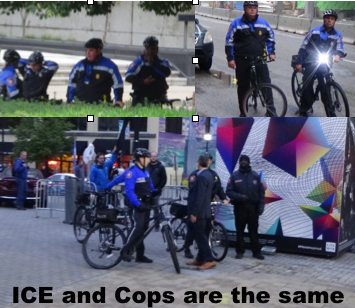 Since when do public schools create programs especially designed to encourage students to become police officers? Being a law enforcement officer in this community also means that they cooperate and therefore are complicity with ICE arresting and detaining immigrants. This means that encouraging students to be cops is like saying that you can have a job that would likely result in you being part of arresting and detaining members of your own immigrant community.
It should also be stated that JROTC is proven to be a program that primarily targets black and latinx students from urban areas, in what the counter-recruitment community identifies as an economic draft. The military representatives that run JROTC make all kinds of promises to participants about economic incentives, but rarely talk about how they might be involved in oppressing communities of color around the world, often in countries where their parents originally came from.
Therefore, even if the Department of Homeland Security will not be involved in the new academy (which is still in question), it appears that the academy will be directing students to career opportunities that will likely result in their participation in the repression of their own communities.
Movimiento Cosecha GR and GR Rapid Response to ICE has invited the community, particularly the affected community, to come to an information session to be held at the Hispanic Center, on Wednesday, January 23rd, beginning at 6pm.

