Facilitating the Good Food Workshop: What happens when you challenge the West MI Nice culture
 Yesterday, I was asked by the good folks at Access of West Michigan to facilitate part of a workshop that was meant to take a deeper look at the problems those who are involved responding to food insecurity have to come to terms with. In many ways, the facilitation was really about challenging the participant’s understanding of systems of oppression, but it was also about challenging what many in this area refer to as West Michigan Nice.
Two of the organizers with Access of West Michigan did a great job of looking at the history of food charity and how this response to food insecurity is completely inadequate. They also talked about the organization’s history and how Access of West Michigan has moved from a food charity to a food justice/food sovereignty model. The framing that these two presenters provided was a great way for me to transition to talking about Systems of Oppression and Structural Inequality.
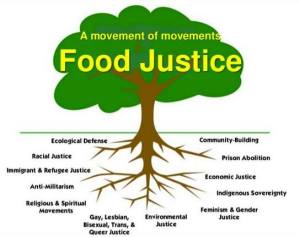
I began with the slide above, to make the point that to achieve food justice, we must include all of the other aspects of movement building that are seen here as the roots or the foundation of the work to achieve food justice.
I also let people know that some of the content from my session was based on the recent book by Joshua Sbicca, Food Justice Now: Deepening the Roots of Social Struggle. One thing that Sbicca states early on is that, “ The current development of food justice should reflect the environmental justice movement’s insistence that environmental inequalities are not ultimately about the environment but about how structural inequalities harm people as they relate to the environment.”
In terms of food insecurity, the question is not that there isn’t enough food that is available to people, but there are systems of oppression that prevent people from eating healthy.
The Systems of Oppression that we touched (there are many more) were:
- White Supremacy
- Patriarchy
- Economic exploitation/Capitalism
- Heterosexism
- Ablism
- Anthropocentrism
I asked people to try to define each of these terms, but the other interesting thing about this list is that some people did not see Capitalism as a System of Oppression. Some said that it merely needed to be tweaked so that more people could have “opportunities.” This is a common response and completely understandable, since most people are not even aware of other economic models. What was also interesting is that since I said Capitalism was a system of oppression, people wanted me to give them an alternative. My response was, it didn’t really matter what I thought. Instead, I suggested that it is a questions best put to people, especially those most negatively impacted by Capitalism, to answer.
Next, I moved to a discussion of concrete manifestation of these Systems of Oppression, which I named as Structural Inequalities, listed here:
- Prison Industrial Complex
- Wealth Gap
- Institutionalized Racism
- Institutionalized Sexism
- Institutionalized homophobia and Transphobia
- State Violence against communities of color
- Corporate Power’s influence in the democracy
- Health Care system run by Insurance Companies and the
- Pharmaceutical Industry
- Energy Industry control over the energy we consume
There was less resistance to this list and I asked people to provide examples of what these Structural Inequalities looked like and how it affected people. There was no shortage of responses.
From there, we then talk about the importance of learning from social movements, particularly those that were led by communities of color. We briefly touched on the Poor People’s Campaign, the Farmworker Movement, the Black Panther Party for Self-Defense and the Movement for Black Lives.
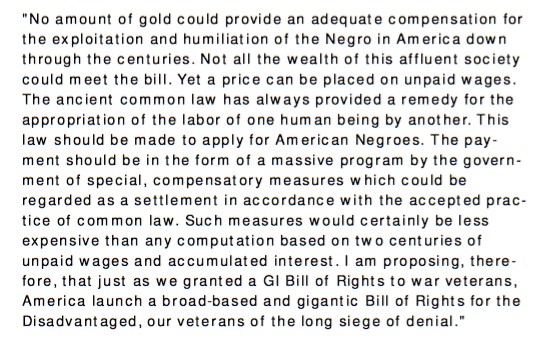
The Poor People’s Campaign, which grew out of the Civil Right Movement was demanding and end to poverty, decent housing and good jobs, particularly for the Black community. Dr. King used the idea that those in power could pay for the historic injustices that Black people have endure, what King called a promissory note, which is reflected in the vision Dr. King provides below.
The US Farmworker Movement, from the United Farm Workers to the Coalition of Immoklee Workers have fought and are fighting for the right to organize, better wages and working conditions, plus they have exposed a major injustice in the food system, the economic exploitation of the current agribusiness model.
Next we looked at the Black Panther Party for Self-Defense. We talked about two things when it came to the Black Panthers. First, we discussed the radically imaginative vision expressed in their 10 Point Program, plus we talked about all of the amazing projects they created such as the Breakfast program and the drug rehabilitation programs.
 Lastly, we touched on the amazing work of the Movement for Black Lives. Here were look at just one aspect of their incredible platform, specifically the Invest-Divest portion of the platform.
We then shifted gears to talk about some conceptual principles developed by Kirsten Valentine Cadieux and Rachel Slocum, listed here.
- Acknowledging and confronting historical, collective social trauma and persistent race, gender, and class inequalities.
- Designing exchange mechanisms that build communal reliance and control.
- Creating innovative ways to control, use, share, own, manage, and conceive of land, and ecologies in general, that place them outside the speculative market and the rationale of extraction.
- Pursuing labor relations that guarantee a minimum income and are neither alienating nor dependent on (unpaid) social reproduction by women.
Before getting to the group work of the workshop, I also talked about the importance of practicing Radical Imagination. Some aspects of Radical Imagination are:
Radical Imagination should take us from sympathy to solidarity.
- The Radical Imagination is “radical” not because of the answers it provides or the tactics it suggests, but because of the causes it seeks to understand.
- The Radical Imagination is not just about thinking different, it is about acting differently.
One additional way of framing Radical Imagination was this:
Radical imagination is re-envisioning your existence on this land without the inherited privileges of conquest and empire. It is accepting the fact of a meaningful prior Indigenous presence, and taking action to support struggles not only of social and economic justice, but political justice for Indigenous nations as well.
At this point we began to do group work that was not centered around food, but around issues that were confronting people, who are also food insecure. We had groups use radical imagination to come up with ways to dismantle the current Housing/Gentrification system, the for profit Health Care system, the unjust immigration system and the system of mass incarceration. However, before we broke into groups, we collectively discussed ways to dismantled poverty in Kent County.
I’m not going to share all of the ideas that people came up with, but I did want to say that there were a few take aways for me in doing this exercise. First, people really struggled to come up with ideas that operated outside of so-called free market system. This is understandable, considering how our expose to other models is limited. Secondly, when give the opportunity, people did exercise Radical Imagination that concluded that these systems could be abolished, because the participants could identify specific roots causes of mass incarceration and the other forms of structural inequality that we discussed.
The groups then did some reporting back, with brief discussion. I ended my portion of the workshop by making the point that, since everyone in the room was working to fight hunger and food insecurity, that our ultimate goal should be to put ourselves out of a job. What I meant by that is that if we really want to end hunger and food insecurity, then what we currently do – food pantries and other forms of food triage – would eventually not be needed. However, we all could end up doing something else, in terms of being part of community-based organizing, but that should really be determined by the people most impacted from Structural Inequalities and not those who have privilege.
The workshop ended with a panel consisting of people who are work in spaces that are addressing food insecurity. What I walked away with from the panelists were a few things. First, I heard that there needs to be more intentionality with regards to supporting and developing leadership that comes out of communities of color. The participants at this workshop were overwhelmingly White.
Second, instead of organizations “serving” the needs of the community, they need to ask those in affected communities what kind of support they need, but also what their larger vision of social transformation might be that would go way beyond whatever programs social service organizations can provide. Lastly, there were some practices that the organizations that the panelists were apart of that were moving in the right direction. For instance, at UCOM, one thing they have been doing is not requiring people to provide too much personal information, like social security numbers, since a majority of the people who access their resources are from the immigrant community. This shift in procedure was specifically to minimize the ability of ICE to gather more information on the immigrant community.
There wasn’t much time for a Q & A session with the panelists, but one question that did come up was, “What do we do next?” This is a common question that people, especially White people ask. The thing about this question is that it often means that people are looking for a quick fix to problems. The problem with asking the question, especially in this context is, that it means that people can easily avoid having to sit with the hard work of grappling with how Systems of Oppression and Structural Inequalities impact people. We all need to do more examination of how we participate in this kind of structural violence, own it and then maybe we can get to work on finding solutions.
The person who asked the question works at a church which provides meals to hundreds of people on a daily basis. This kind of triage work in important, in that it can have a positive impact on those who can access these meals. However, this is just a form of food insecurity triage, but it is not a solution. I responded by saying that, this is why we need to learn from the history of social movements. For example, the Black Panther Party for Self Defense used their breakfast program not only as a matter of feeding people in their community, but it also served to build trust. More importantly, it was one action that the Black Panthers took within a larger strategic plan that had a clear political vision within their 10 Point Program.
The Black Panther Party for Self Defense was not running a breakfast program as a form of charity, rather it was part of a larger community-based platform that was about greater community empowerment, political autonomy and the ability to fight the systems of oppression that are clearly laid out in their 10 Point Program. Unfortunately, most of the food charity programs in West Michigan are paternalistic and have no strategic purpose that could challenge the Systems of Oppression and Structural Inequalities that make up West Michigan Nice.
ACLU and the Michigan Immigrant Rights Center File an appeal with the City of Grand Rapids over Jilmar Ramos-Gomez case
 On Wednesday, the ALCU and the Michigan Immigrants Rights Center filed an appeal to the City of Grand Rapids, specifically to the Grand Rapids Civilian Appeal Board.
The letter begins by stating:
Dear Civilian Appeal Board:
We write to appeal the decision of the Grand Rapids Police Department’s Internal Affairs Unit regarding the complaint we filed on behalf of Jilmar Ramos Gomez. We ask that the Civilian Appeals Board (CAB) conduct a comprehensive review of the interactions between the Grand Rapids Police Department (GRPD) and U.S. Immigration and Customs Enforcement (ICE) regarding Mr. Ramos-Gomez, and require further investigation as needed by the Labor Relations Board. Because the evidence available clearly shows that Captain Curt VanderKooi racially profiled Mr. Ramos-Gomez and discriminated against him based on his race and disability, we also specifically request that the CAB overturn the finding of Internal Affairs exonerating Captain VanderKooi of violating the Impartial Policing Policy, and review the adequacy of the investigation into his use of derogatory and demeaning language, which resulted in mere coaching.
There are some new aspects to this most recent letter and the documents contained within it. First, the letter requests the following from the Civilian Appeal Board:
- Reverse the IAU’s exoneration of Captain VanderKooi and find that he violated the Impartial Policing Policy
- Review the adequacy of the investigation into the sustained charge of Discourtesy Review Captain VanderKooi’s actions to determine whether other policies were violated
- Review the actions of all other GRPD officers involved in this incident; and
- Review the broader policy issues this incident raises
 Second, the ACLU and MIRC are appealing the findings of the GRPD’s Internal Affairs Unit for two reasons:
First, the investigation was incomplete in that it focused solely on Captain VanderKooi and did not look at whether other GRPD employees violated the impartial policing policy, such as Officer Adam Baylis, who failed to report Captain VanderKooi’s biased comments and turned a blind eye to ICE’s planned detention and deportation of a U.S. citizen. The investigation also failed to look at the inadequate and non-existent policies and procedures of the GRPD regarding ICE collaboration or treatment of individuals with mental illness, or our respected marine veterans.
Second, the finding of the Internal Affairs that Captain VanderKooi did not violate the GRPD’s Impartial Policing Policy should be overturned because the evidence already in the record clearly establishes that he engaged in racial profiling and disability-based discrimination by intentionally contacting ICE based on Mr. Ramos-Gomez’ Latino heritage and by mocking Mr. RamosGomez for his mental disability.
This new appeal from the ACLU and MIRC is significant for several reasons. First, because it challenges the authority of the Internal Affairs Unit, which is essentially cops investigating cops. Second, it expands the claims of bias beyond just race to now include disability bias. Lastly, the new appeal calls for changes to the Civilian Appeal Board Procedures. This last point is important because the Civilian Appeal Board does not have any real teeth and can only make recommendations. What the ACLU and MIRC are requesting would allow for more evidence in each case, along with public comment.
All of this is vital in the process of trying to make the GRPD more accountable to the community and to minimize the harm done to people, particularly to communities of color, which have been impacted by police bias and police violence.
Again, to read the entire letter, with all of the background information, click here.
 Foundations have to submit 990 statements annually, in order to avoid scrutiny from the federal government. Because of the paperwork that is involved and the documentation that recipients of foundation money must submit, the government provides two years for foundation 990 reporting. This means that foundations are only now submitting their 990 forms from 2017.
Over the next several weeks, as foundations make their 2017 990s available, I will be providing a summary and analysis of foundation giving for 2017 from members of the Grand Rapids Power Structure. We begin with the Richard & Helen DeVos Foundation.
As we have documented in the past, the Richard & Helen DeVos Foundation is one of the largest in the area. According to Guidestar.org, the Richard & Helen DeVos Foundation reported Gross Receipts at $48,711,749 and Assets at $14,017,852. To see the full 990 file for 2017, go to this link https://griid.org/wp-content/uploads/2019/03/richard-helen-devos-foundation-2017.pdf.
990 documents have payments to entities that occur during the year and a separate section for future payments. We will include the total from both as it applies.
The largest recipients of contributions from the Richard & Helen DeVos Foundation tend to fall into the category of educational institutions.
- Aquinas College $3,000,000
- Calvin College $1,020,000
- Davenport University $1,525,000
- Grand Rapids Christian Schools $500,000
- Grand Valley State University $5,040,000
- King’s College $8,400,000
- Kuyper College $2,000,000
- Lee University $1,900,000
- Michigan State University $2,600,000
- Potter’s House $325,000
- Rehoboth Christian School Association $1,000,000
- South Christian High School $1,500,000
- Western Theological Seminary $1,450,000
- Zuni Christian School Mission $1,050,000
This level of contributions to schools serves two purposes. First, it underscores the value that the DeVos Family puts on private religious education, specifically religious education that embraces a similar worldview of the DeVos Family. Second, in the instances where they contribute to public schools, here the seek to have influence on the policies of those schools, such as GVSU, which we have documented. https://griid.org/2018/09/13/gvsu-canonizes-rich-devos-but-some-students-push-back/
The next large category that the Richard & Helen DeVos Foundation contributed were churches or organizations that identify as Christian. We only include those which are $50,000 or more for 2017.
- Alliance for Children Everywhere $450,000
- Back to God Ministries International $50,000
- Bethany Christian Services $500,000
- Central Presbyterian Church $500,000
- Christian Leaders NFP $300,000
- Christian Reformed Church in North America $300,000
- Christian Schools International $50,000
- David’s House Ministries $500,000
- DeVos Urban Leadership Initiative $100,000
- Evangelism Explosion III International Inc. $250,000
- First Christian Reformed Church $50,000
- Focus on the Family $50,000
- Guiding Light Ministries $75,000
- Holland Home $60,000
- Holland Senior Citizen Center Inc. $500,000
- Hope Network $100,000
- ICCF $75,000
- International AID Inc. $95,000
- Keystone Community Church $300,000
- LaGrave Avenue CRC $1,100,000
- Luis Palau Association $670,000
- Madison Square CRC $430,000
- Mel Trotter Ministries $50,000
- Nueva Esperanza $50,000
- Partners Worldwide $1,500,000
- Pillar Church $1,100,000
- Pine Rest $1,875,000
- Pregnancy Resource Center $50,000
- Prison Fellowship Ministries $600,000
- Right to Life of Michigan $150,000
- The General Synod of the Christian Reformed Church in America $100,000
- Words of Hope Inc. $50,000
- World Renew $625,000
- Youth for Christ USA Inc. $50,000
Funding to these faith-based entities clearly fits into the DeVos agenda, since they are also Christians, particularly Christians that do not threaten systems of power and fall on the conservative side of Christianity.
A third category that the Richard & Helen DeVos Foundation has contributed to would be the Think Tank/political advocacy sector. Again, we only include those who received $50,000 of more.
- Acton Institute $125,000
- Alliance Defending Freedom $50,000
- American Enterprise Institute $150,000
- Heritage Foundation $250,000
- Mackinac Center $115,000
- National Constitution Center $2,050,000
- National Review Institute $75,000
These Think Tanks and advocacy groups play a vital role in promoting the Right Wing political agenda that the DeVos family has been promoting for the past 5 decades. These groups collectively support a neo-liberal economic agenda, privatization of public services, the privatization of education, an attack on unions and worker benefits/pensions, the subsidization of the business class and US interventionist and imperialist policies.
In addition, the Think Tank/Advocacy groups work compliments the direct political funding that the DeVos family gives to state and federal candidates, such as the $11.3 million they gave in the last election cycle. In fact, the Think Tank/Advocacy groups often write the policy positions that the politicians will introduce, such as the Right to Work policy that the Mackinac Center crafted, which was pushed by DeVos funded state policy makers.
A fourth group that the Richard & Helen DeVos Foundation made contributions to were social service agencies, mostly in West Michigan. The benefit of providing groups like the Baxter Community Center with funding is that it ends up making social problems the fault of individuals and not structural injustice. Indeed, these social service agencies do not advocate for policy change or structural transformation, rather they provide assistance to individuals and families who are “in need.”
A fifth and final category of groups receiving funding from the Richard & Helen DeVos Foundation are cultural groups like the Grand Rapids Art Museum, the St. Cecilia Music Society and ArtPrize. Contributing to to these groups provides great PR value, thus suppressing or re-directing any criticism of the overtly far right policy objectives of the DeVos Family.
We feel that is is vital to scrutinize the contributions from the Richard & Helen DeVos Foundation and to see them as a form of strategic funding for the short and long-time objectives the family has been promoting for decades.
 Next Week, the GVSU Hauenstein Center is hosting a lecture by former US General Wesley Clark.
In the GVSU promotional material I received in the mail, it states that Clark was a valedictorian at West Point and later a Rhodes Scholar. In addition, the GVSU mailer says that Clark was a 4 star general for 38 years in the US military serving as the Supreme Allied Commander with NATO and helped to write and negotiate portions of the 1995 Dayton Peace Agreement.
This all sounds rather impressive, well, it’s impressive if you think that the US military is a humanitarian force. While Clark was the Supreme Allied Commander with NATO, he was responsible for the US?NATO bombing in Kosovo, which knowingly resulted in civilian deaths, actions that are considered in the World Court as war crimes. For those who would like a source on Wesley Clark’s involvement with war crimes in Kosovo, I would encourage you to read Noam Chomsky’s book, The New Military Humanism: Lessons from Kosovo or check out this interview with Chomsky discussing the same topic.
What is even more absurd than GVSU bringing former General Wesley Clark – a war criminal – to campus, is the topic that he plans to present. Again, according to the Hauenstein Center’s promotional material, Gen. Clark will present on the challenges of overcoming polarization in America. This lecture is part of the Hauenstein Center’s Common Ground Initiative.
So, GVSU is bringing a known war criminal to speak to the public and students about how the US can overcome the polarization that exists in the US. Interesting. First, how can someone who spent 38 years in the US military, who was directly involved in the bombing of civilians in Kosovo and who legitimizes the history of US military intervention all around the world, how can this person lecture us about how to overcome the current polarization in America?
Secondly, what is it about people who think we need to overcome polarization? I mean, I get it that people want to generally get along with others and the whole unity thing. It is interesting to me that quiet often when something tragic happens, people say that the most important thing for us to do now is to come together and show unity. Why?
For example, when the police kill another black person, people will often say that we need to come together as a community or a nation and demonstrate our unity. Not only do I find such a notion somewhat ridiculous, it dismisses the fact that the nation or the community is already polarized and it will remain so until we confront major systems of oppression.
Black people are killed by police because we have a system of white supremacy that infiltrates every institution. One could also argue that cops killing black people is also because of the economic systems of capitalism, hetero-sexism and patriarchy. Again, the country and our community is already deeply polarized and that is not going to change unless we dismantle these systems of oppression.
Look at the example of gun violence in the US. Last year, after the Parkland School shooting, people kept saying we need to come together as a county to make sure this doesn’t happen again. But here’s the ting……..there are a ton of businesses that manufacture guns who don’t care that those guns will be used to kill people. There are gun lobbyists who give lots of money to politicians to make sure that guns are not regulated too much. Then there are jails/prisons that employee a lot of people who get paid to house those with gun-related charges, along with “security” companies that make all kinds of gadgets to monitor the public, which also profits from a society that is deeply polarized.
Lastly, I’m not really interested in trying to figure out how we can be less polarized as a nation or a country. There will always be people and institutions that profit from the oppression and exploitation of other people. I’m more interested in being part of organizing people who will confront the systems of power and oppression that are the root causes of people not being able to live in peace. Instead of calls for a vague notion of unity, I’d rather have people who are willing to fight against oppression no matter what the risks are.
As we noted in our most recent post, there has been some pushback from the Grand Rapids Police Officers Association and retired GRPD officers on the decision to suspend with pay, Captain Curt VanderKooi over his racist profiling of Jilmar Ramos-Gomez.
At last night’s Grand Rapids City Commission meeting, this was the focus of most of the public comment, just like it was last week. People can watch/listen to those comments themselves, which begin around 37 minutes into the video provided by the city.
After watching the City Commission meeting, it seemed clear to this writer that the local news coverage of last night’s meeting demonstrated a bias in favor of the police and those supporting the police. What follows is a deconstruction of that news coverage.
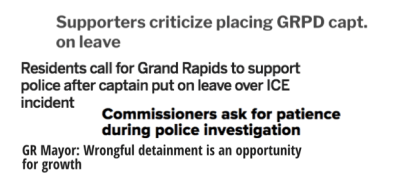
The headline of the MLive article demonstrates a bias in favor of those who offered support for the GRPD during the public comment, Residents call for Grand Rapids to support police after captain put on leave over ICE incident.
After looking at the video of the commission meeting, I counted 10 people who spoke in support of the police and Captain VanderKooi and 10 people who were critical of the GRPD and VanderKooi, some calling for him to be fired. Thus, the headline should have read, Residents who spoke during the City Commission were divided over the suspension of Captain VanderKooi.
The first sentence in the MLive continues to demonstrates the pro-police bias, by stating:
A week after protesters shut down a city commission meeting demanding a police captain be fired, police supporters called on commissioners Tuesday to back the captain and offer greater support to the police department.
 The MLive article cites two people who spoke in support of the GRPD and Captain VanderKooi, one (Johnny Brann) who said they will be starting a new group called, Voice of the Badge. No one who was opposed to police misconduct was cited in the story, which only said, that several protestors turned out Tuesday calling for VanderKooi to be fired. IN fact, if you listen to the public comment from those who opposed the racial profiling by VanderKooi of Ramon-Gomez, they had a great deal more to say than just calling for him to be fired.
Besides the biased demonstrated in the MLive article, the rest of the article simply was re-hashing the arrest of Ramos-Gomez and everything that happened afterwards.
The WOOD TV8 story was equally problematic, with how the reporter framed the story and the text version online, which ran the headline, Supporters criticize placing GRPD capt. on leave. The Wood TV 8 story begins with a comparison of how the previous city commission meeting was “interrupted by protestors,” to some context on why people were outraged over the GRPD’s role in assisting ICE. The channel 8 reported went on to say that while there were still calls for VanderKooi to be fired, the majority of those who spoke were critical of the suspension of Captain VanderKooi. Again, if one watches the public comment period from last night, this simply isn’t true. There were three pro-police voices and one critical of VanderKooi in the channel 8 story that aired last night.
The WZZM 13 story was much shorter and post this headline on their website, Commissioners ask for patience during police investigation. The channel 13 story included one pro-police voice and one who was critical of Capatin VanderKooi. However, like the headline of this story, the focus was primarily on what some City Commissioners had to say, citing two of them in the story.
The WXMI 17 story wasn’t much better, only citing one person who supported VanderKooi and Mayor Bliss. The online headline for Fox 17 was, GR Mayor: Wrongful detainment is an opportunity for growth.
The only other coverage of the city commission meeting last night was WOOD radio, which just re-posted the story from WOOD TV 8.
In addition to the pro-police bias in the local news coverage, none of the local news media chose to respond to the claims that the Grand Rapids City government is anti-police, a comment heard from several people during the meeting. There are ways to verify those claims. First, all of the current commissioners and the Mayor supported the last city budget, which allots a full one-third of the budget to the GRPD. Second, besides the GRPD itself, there is the Grand Rapids Police Officers Association, which always defends the GRPD and there is a group called Friends of GR Cops, which also support the Grand Rapids Police Department.
Now Johnny Brann and others want to create yet another group to support the police, the Voice of the Badge. As of this writing there is no online presence for this group. Also, with the news coverage of this issue in recent days, the local news media could be added to the “support the police” category.
Amidst ICE and Police violence against the immigrant community, most local news media centers the perspectives of cops
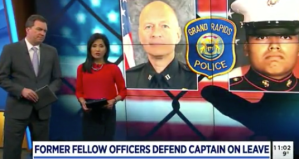 The news media continues to report on the incident involving the former Marine and US citizen, Jilamr Ramos-Gomez, and the role that the GRPD played in alerting Immigration and Customs Enforcement (ICE) of Ramos-Gomez’s arrest.
Much of the news coverage has been generated because of the work that has been done by the ACLU, the Michigan Immigrant Rights Center, Movimiento Cosecha GR and GR Rapid Response to ICE. This coverage escalated last week when these groups confronted the Grand Rapids City Commission on the racist, profiling actions taken by Captain Curt VanderKooi.
There have been several news stories since then that have centered around the reaction from the several Grand Rapids Police Officers, some retired and some with the police union.
On March 1st, MLive and other news agencies reported on a press conference hold by the police union who not only claimed that the suspension of officer VanderKooi was the city “cowering to mob rule,” but that the city put a stop to the GRPD’s efforts to arrest organizers of the May 1, 2018 march organized by Movimiento Cosecha.
Another example is a story that originally ran on WOOD TV8 on Monday night, where two retired GRPD officers added their voices in defense of the now suspended Captain Curt VanderKooi. One of those retired officers even went as far as to say that VanderKooi was not a racist and was in fact, “a role model for officers.”
What is glaringly absent from these most recent news stories are the perspectives of those who are organizing against ICE/Police violence against the immigrant community and the voices of immigrants themselves.
WOOD TV 8 even begins their story with the statement that “they reached out to two long-time officers” who worked with VanderKooi for a long time, thus making it clear that this perspective was sought out. However, there is no counter-balance to the story, since no one from the community who has been challenging the police/ICE collaboration was sought out.
It is important to note at this point that police officers are valorized in this society. This valorization takes place, in part, because numerous institutions make the claim that cops protect the rest of us at great risk. However, the news media and entertainment media also frame the function of law enforcement as necessary and benevolent. Therefore, it is not surprising that the voices of cops and ex-cops are centered over and above members of community that live in constant fear of law enforcement and those who are organizing to expose the collaboration between ICE and local cops.
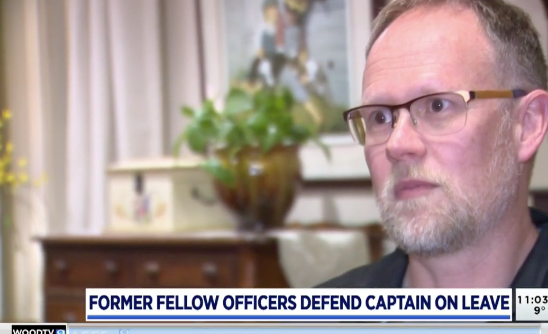
What is even more interesting is that one of the retired cops who was interviewed in the WOOD TV8 story, Mark Mathis, is also still a member of the Grand Rapids Police Officers Association. He posted this statement about the WOOD TV 8 story on the police union’s Facebook page, a statement, which we are posting in full to demonstrate how the police union thinks about what happened with the arrest of Ramos-Gomez and the subsequent suspension of VanderKooi.
My thanks to Leon Hendrix for reaching out to get additional perspectives.
The News 8 version is my short take on the incident. Here is the longer one:
The real problem is that Special Interest groups and the City Government have joined forces. This incident is a vehicle being used to wall the GRPD off from it’s Federal law enforcement partners.
Captain Vanderkooi is happily being thrown under the bus to accomplish these goals.
First, his action that night was completely appropriate.
This incident involved a suspect setting fire at the biggest hospital in Grand Rapids. He burned a keypad, created lots of smoke, and caused alarms to go off. This was near lots of oxygen tanks and patients. He then tried to gain access to the helipad. This wasn’t a small event at the hospital.
Captain Vanderkooi is the head of the Detective Unit. While at home GRPD commanders get “shift summaries”. He would have been given the basics of the incident and the arrested person’s name.
Because of politics the City has already chosen to wall off street officers from the ability to contact some Federal partners. Captain Vanderkooi was the DESIGNATED person at the PD to make these contacts.
Does anyone think that arson at a major hospital combined with trespassing at an aviation facility isn’t a concern in 2019? Anyone?
Investigators are paid to investigate. Captain Vanderkooi is one of the best. The goal of any investigation is to gather information so that the puzzle pieces can be complete when it’s time to solve the mystery.
ICE doesn’t just deal with illegal aliens… they track all movement in and out of the country. My name is in their database. I just got back from Mexico and ICE both ran my information and added it to the database. It’s a huge lie that the ICE database is simply used by racist cops that hate Hispanic people.
The GRPD should have absolutely checked with our Federal partners to see if they could add any clarity to what was being investigated. Due to City rules Vanderkooi was the designated person to do it.
ICE’s database returned a response that caused ICE concern. ICE came down to talk to the arsonist — who promptly told them he was a Foreign National with bad intent.
Local charges were bumped down and ICE took custody of the guy. Turns out he lied. He was a citizen. ICE was provided proof of that and released him.
This has nothing to do with CVK’s appropriate contact with Federal partners. This has nothing to do with the needed ability to work together in the future.
No investigatory database is inherently evil. Information is good and contributes mightily to community safety.
No one would complain about any other database used in the investigation. No one would care if this guy was Bosnian. The faux outrage only exists to accomplish much larger goals.
Captain Vanderkooi, as the head of the DB, would see reports that have perhaps 20,000 Hispanic surnames over the course of a year. He contacts ICE a handful of times annually. Evidence of profiling or racism? Hardly.
The current victim is Vanderkooi. The next casualty is anyone at the PD that does anything this group doesn’t like. The ultimate victim will be community safety.
At the end of the day do we want our officers to cooperate with KCSD? With the State? With other States? With our Federal Partners?
Or is the real goal to have GRPD operate on a sanctuary island where 20 radical protestors call the investigatory shots?
I sure don’t… and anyone with the ability to reason should be very concerned.
News 8 link below in the first comment. Post has been made public…
Sorry to inconvenience you: Disruption, tactics and the power of Direct Action in Grand Rapids
 At the beginning of the Zapatista Revolution in San Cristobal de Las Casa, Chiapas, Mexico on December 31st, 1993:
Tourist – “We have tickets to go whitewater rafting.”
Sub-Comandante Marcos – “Sorry to inconvenience you, but this is a revolution.”
Last week, members of Movimiento Cosecha GR and GR Rapid Response to ICE disrupted the Grand Rapids City Commission by chanting, “Cops and ICE go hand in hand.”
This disruption resulted in the Mayor of Grand Rapids deciding to end the commission meeting, when those involved in the disruption refused to stop.To those who observed this action, it was clear that there were some people who came to speak to the commission during the public comment period, but were unable to do so because the meeting was adjourned.
There are some who might say that the disruption was rude and disrespectful, but to those who believe in the power of Direct Action and the tactic of disruption, it was clear that the action was effective.
Direct action means that people take collective action to change their circumstances, without handing our power over to someone else to do it, such as a boss or a politician. Direct Action is a broad strategy use by those involved in social movements to demand and simultaneously achieve the kind of changes that movements want.
Now, I doubt that anyone involved in the disruption at last Tuesday’s Grand Rapids City Commission took delight in preventing people from speaking during the public comment period. However, the use of the tactic of disruption was meant to do two things. First, it was meant to send a message to everyone present that the racial profiling that Captain VanderKooi engaged in was unacceptable. Secondly, disrupting the Grand Rapids City Commission was a tactical decision to disrupt business as usual, to say that we will not allow bureaucratic proceedings continue while the GRPD, and their cooperation with ICE, does harm to immigrants in this community.
The result of the tactic of disruption in this case was effective. First, it resulted in demonstrating the power of collective action to shut down the meeting. Second, it sent a clear message about why people were shutting down the meeting. Lastly, it resulting in generating a great deal of news coverage and larger community conversation around the issue of police racial profiling and ICE violence in our community.
Those who also took part in the Direct Action at City Hall last week, using the tactic of disruption were also well aware of the fact that their collective action was based on the example of numerous social movements that have existing throughout history and throughout the world. What follows are just a few examples of the use of direct action and the tactic of disruption from various historic social movements. These were not only effective tactics, but were necessary for achieving fundamental change in the face of repressive policies and systems of oppression.
 The Montgomery Bus Boycott – African American activists refusing to move to the back of the bus was a tactic of disruption that definitely inconvenienced white passengers and cost the bus company money, but it eventually led to allowing African American bus riders to sit wherever they wanted to.
- ACT Up Against AIDS – ACT Up would regularly use disruption as a tactic. In 1989, 5000 people went into the St. Patrick’s Cathedral in New York City to disrupt mass to draw attention to the Catholic Church’s silence on the AIDS crisis in and their stance on abortion. They handed out condoms during the mass and literature on safe sex.
- Chicago Freedom Movement – In 1966, Dr. King and thousands of other civil rights activists organized non-permitted marches in Chicago with the goal of ending slums. This movement shut down streets, which disrupted traffic, they marched in all white neighborhoods and they march to Real Estate offices to protest housing discrimination. They used the tactic of disruption to bring attention to the issue and to win some housing for poor people.
- United Farm Worker Grape Boycott – Beginning in 1965, the United Farm Workers joined the Agricultural Workers Organizing Committee (led by Filipino labor organizers) to boycott grapes. They used the tactics of marches, fasting and disrupting business as usual at grocery stores that sold grapes grown in California. This campaign got international attention and it eventually did win better pay and the fight against the use of pesticides that farm workers were exposed to.
- 2001 Protest against the FTAA in Quebec – In the spring of 2001, tens of thousands of protestors came to Quebec City, Canada to protest the Free Trade Area of the Americas (FTAA). The FTAA was a proposed trade policy, like NAFTA, for the entire Western Hemisphere. Protestors caused so much disruption to the FTAA proceedings, which resulted in police using a tons of tear gas. The tear gas got into the ventilation system of the convention center where government leaders were meetings, so much so that they had to delay the meeting. The FTAA was eventually defeated because wherever the heads of state met, they were confronted by thousands of protestors.
- 2017 Protests Against the Trump Administration Muslim Ban – In airports across the US, hundreds of thousands of protestors shut down business as usual, sometimes delaying flights, to protest the “Muslin Ban.” This protest even took place at the Kent County Airport, where hundreds of people flooded the airport and disrupted passengers and airline companies.
These are just a handful of examples of how Direct Action in the form of disruption can be a powerful tactic to stop business as usual, bring attention to a critical issue and win real change that is because of the collective action of movements, instead of simply appealing to politicians.
It was in this tradition, that people chose to disrupt the Grand Rapids City Commission last Tuesday.
 Last Thursday, Secretary of Education, Betsy DeVos, along with U.S. Sen. Ted Cruz (R-TX) and U.S. Rep. Bradley Byrne (R-AL), announced a new federal program called the Education Freedom Scholarship in a speech she delivered.
According to DeVos, “The policy will make a historic investment in America’s students, injecting up to $5 billion yearly into locally controlled scholarship programs that empower students to choose the learning environment and style that best meets their unique needs.”
In addition, DeVos wrote an opinion piece for USA Today, as another way of promoting this new plan to push an education agenda that she has been backing for the past 20 years.
More importantly, the Secretary of Education and her department have created a stand alone website, specifically dedicated to the Education Freedom Scholarships. The site provides several fact sheets with the intent of trying to dismiss any criticism of the policy. In the speech DeVos gave on February 28th, she made it a point to say, “So, you’ll hear that our proposal is an attack on public education. But beware: that’s fake news!”

Even if Betsy DeVos uses the Fake News ploy, we should not be fooled by what this policy will do to further erode public education across the country. It should be noted that these kind of tax credit scholarship programs are already used in 18 states to provide students with the opportunity to attend schools other than their nearest public school. These programs allow people and corporations to donate to a designated scholarship granting organization (SGO) and be reimbursed in the form of a tax credit. With the DeVos plan, states would designate the eligible SGOs, but the federal government would fund the tax credit reimbursement, up to $5 billion total.
Betsy DeVos has been directly involved in getting these tax credit scholarship programs in the states in the graphic above, through a network of organizations that mirror groups in Michigan like the Great Lakes Education Project and the Mackinac Center for Public Policy. Across the country, the State Policy Network, which brings together groups that primarily push for policy changes at the state level.

For years, the State Policy Network think tanks have join ALEC in pushing a broad education agenda to privatize public schools, including pushing for-profit online schools, for-profit and other charter schools, using taxpayer dollars for vouchers to for-profit schools, and even so-called “parent triggers” to allow a group of parents to close a public school for current and future students, and turn the school into a charter school or require a voucher system that takes away from traditional public schools.
In the graphic below, you can see some of the think thanks that the State Policy Network partners with the push these so-called School Choice policies.

Again, it is important that we recognize that what the new Education Freedom Scholarships policy would do is not totally new, but it would mean that there would be matching federal funds for states which would want to adopt the “school choice” plan being pushed by Betsy DeVos.
The encouraging news is that teachers, students, parents and communities are mobilizing across the country as a counter to the privatization/charter school push, with teacher strikes that have mostly resulted in victories for public education. These campaigns must be supported by a broad sector of the population and by other movements for social justice, especially since the future of public education is connected to so many efforts to bring about greater equality, justice and freedom.
Kent County’s ICE Hold Policy, the White House and the Sheriff Department’s quick dismissal of any Sanctuary claims
 The Kent County Sheriff’s Department continues to be in the news. This time Immigration and Customs Enforcement (ICE) and the White House are both accusing the Kent County Sheriff’s Department of releasing “criminal aliens” in recent weeks.
According to an ICE Press Release dated February 28:
Deportation officers with U.S. Immigration and Customs Enforcement’s (ICE) Enforcement and Removal Operations (ERO) have arrested three criminal aliens in western Michigan over the last several weeks after they were released from Kent County Sheriff’s custody with an active immigration detainer in place.
“The release of criminal aliens back on west Michigan streets continues to pose a serious threat to our communities,” said Rebecca Adducci, ERO field office director for Detroit, which covers the two-state region of Michigan and Ohio. “ICE remains committed to arresting and removing criminal aliens in the interest of public safety and national security, despite local decisions to not honor detainers and jeopardize the safety of its citizens.”
This statement was shared by the White House as well, according to an MLive story that was originally posted on March 1. The statement s from ICE and the White House are related to the case of former US Marine Jilmar Ramos-Gomez. The fallout of the Ramos-Gomez case forced the Kent County Sheriff’s Department to alter their policy around ICE holds, where they now require a judicial warrant to hold immigrants in the Kent County Jail for ICE.
However, while ICE seems to be calling out the Kent County Sheriff’s Department, immigration lawyers and lawyers with the ALCU and the Michigan Immigrant Rights Center have communicated to Movimiento Cosecha GR and GR Rapid Response to ICE that Kent County seems to still be cooperating with ICE in ways that conflict with the new judicial warrant requirement policy. A group of lawyers will be meeting with County officials this coming week to find out exactly what is happening.
The other issue that was raised in the MLive article and the ICE Press Release has to do with the issue of Sanctuary Policies. The ICE Press Release states:
Sanctuary Policies Put Public Safety at Risk
- These dangerous policies leave ICE with no choice but to increase enforcement in neighborhoods and workplaces to locate and arrest these persons while they are at-large—
- increasing the likelihood that other individuals previously not targeted for arrest will be taken into ICE custody.
- It is safer for everyone if we take custody of an alien in the controlled environment of another law enforcement agency as opposed to visiting an alien’s residence, place of work, or other public area. Arresting a criminal in the safety, security, and privacy of a jail is always the best option.
- When law enforcement agencies don’t honor ICE detainers, these individuals, who often have significant criminal histories, are released onto the street, presenting a potential public safety threat. When ICE Fugitive Operations officers have to go out into the community to proactively locate these criminal aliens, regardless of the precautions they take, it needlessly puts our personnel and potentially innocent bystanders in harm’s way.
- Moreover, tracking down our priority fugitives is highly resource intensive. It’s not uncommon for our criminal alien targets to utilize multiple aliases and provide authorities with false addresses. Many do not have a stable place of employment.
These claims by ICE are ill-informed and the Trump administration has made it clear since they took office that communities which declare themselves as Sanctuary Cities will be punished. To be clear, Sanctuary Cities is merely a decision by local municipalities to say that they will not cooperate with ICE agents to apprehend undocumented immigrants, since it is not their role to enforce federal immigration policy.
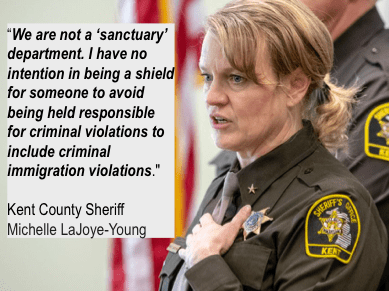
Kent County Sheriff LaJoye-Young took issue with ICE calling the County’s policy a “Sanctuary Policy.” IN the MLive article, the Kent County Sheriff is quoted as saying:
“We are not a ‘sanctuary’ department. I have no intention in being a shield for someone to avoid being held responsible for criminal violations to include criminal immigration violations.”
To this writer, such a statement by the Kent County Sheriff, continues to reflect that they will continue to cooperate with ICE and that those who are undocumented are considered criminal. The fact that Sheriff LaJoye-Young was so quick to dismiss any accusations that the County is a Sanctuary demonstrates that she will cooperate with federal authorities when it comes to those who are undocumented. This reality is affirmed by the fact that in the past few weeks GR Rapid Response to ICE has been overwhelmed with new cases of ICE arrests, detentions and even a few likely deportations.
Grand Rapids Police Union goes on the defensive, attempts to present City officials as cowering to immigration protestors
 In a clear attempt to divert attention from the racist practices of cops like Curt VanderKooi, the Grand Rapids Police Officer’s Association held a press conference yesterday to claim that Grand Rapids City officials are cowering to the will of immigration protestors.
The Grand Rapids Police Officer’s Association first criticized the GRPD’s decision to put Captain Curt VanderKooi on administrative leave, but spent most of the press conference time criticizing city officials for not allowing the GRPD to arrest people who did not obey the police during the May 1, 2018 march organized by Movimiento Cosecha GR, according to a story by WOOD TV8.
According to a prepared statement used during yesterday’s press conference, the Grand Rapids Police Officer’s Association (GRPOA) stated:
Furthermore, it has become perfectly clear to all members of the Grand Rapids Police Command Officers Association that over the past two years the elected officials and appointed leadership within the City of Grand Rapids will dismiss any actions by members of the Grand Rapids Police Department that are in compliance with established laws, policies, and recognized best practices in law enforcement and will instead cower to any “mob rule” behavior of any organizations that raise vocal opposition.
More importantly, the GRPOA is making the ridiculous claim that Grand Rapids City officials are in collusion with Movimiento Cosecha.
As an example of this reality, we were previously made aware of the collusion between our elected and appointed officials and several of the groups currently calling for the termination of Captain VanderKooi. On May 1, 2018, during a large protest, leaders of Movimiento Cosecha GR intentionally overran a police position for the second year in a row. Warrants were sought, sworn to, and issued by a judge for the arrests of two individuals. Shortly thereafter, the Acting City Manager and the Mayor became involved and the warrants were squashed. There is no clearer example that our city leadership would rather appease these groups who intentionally violate the law to purposely disrupt businesses and residents in Grand Rapids while endangering the lives of our officers, the general public, and their own protestors. Having known about this obstruction of justice, of which the current City Manager has also been notified, we are only left to believe that support for our personnel while acting with great restraint and being overrun by law breaking individuals does not and will not exist.
This is a rather outlandish claim on the part of the GRPOA, for several reasons. First, as someone who has been directly involved in the work of Movimiento Cosecha GR and GR Rapid Response to ICE, there is no collusion between these groups and the City. On the contrary. When these groups pressured the city in October of 2017, to adopt what were called the Equal Service Policy, the city altered the language of this policy at the eleventh hour to exclude the GRPD from the policy.
Second, it has been our experience over the past two years that the GRPD has been closely monitoring the actions of Movimiento Cosecha GR and GR Rapid Response to ICE. Whenever there is an announced action on social media, the GRPD sends numerous officers to harass and threaten members of these two groups who have made in clear in word and practice that their efforts are non-violent.
Third, in terms of the actions of the May 1, 2018 march, where the GRPOA claims that people overran a police position, the GRPOA omits some of the facts. While it is true that the march did not follow the GRPD-determined route, it is also true that the GRPD and Kent County Sheriff’s Department presence during the May 1, 2018 march was the real threat. Their use of horses was threatening and in several instances put those marching non-violently at risk. GRPD officers in cruisers have also demonstrated a lack of concern for people non-violently protesting by hitting them with their cruisers or threatening to run people over if they were not compliant.
Lastly, the GRPD has demonstrated over the past two years that they have been both cooperating with ICE, thus leading to the separation of families and the GRPD has been racially profiling motorists, which also has led to immigrants ending up in ICE custody because they do not have driver’s licenses, which the state of Michigan denies them.
GRPD protects the status quo
Towards the end of the GRPOA statement yesterday, they claimed there group, “is hopeful that the silent majority of residents who support the daily efforts of the Grand Rapids Police Department to keep them safe will communicate their support to our elected officials and our city management.”
I have no doubt that there are plenty of people who support the daily efforts of the GRPD, but those efforts are primarily meant to defend and protect the status quo. Whenever, residents stand up and challenge systems of power and oppression in this community, the GRPD is always there to defend those systems of power and oppression. Not surprisingly, this is the history of policing in the US. Any time social movements have sought to challenge power – the abolitionists, the labor movement, the suffrage movement, the civil rights movement, the farmworkers movement, the various anti-war movements, the LGBTQ movements, etc – the police have always been there to protect power and privilege.
I am not at all surprised by the statement from the Grand Rapids Police Officers Association. I am also not surprised that they attempted to get arrest warrants for people who were not compliant during the May 1, 2018 march. What I think is important for those who are involved in the current immigrant justice movement, is that we need to be extra vigilant of the oppressive nature of any law enforcement agency and we need to pay extra attention to how vulnerable the immigrant community is in this political moment.

