Michigan Governor’s race ads are being paid for by corporate money, on both sides
 With the primaries behind us in Michigan, campaign money will to more focused up until the November election.
The Michigan Campaign Finance Network (MCFN) recently released data on entities contributing to the Republican Governor’s Association (RGA) and the Democratic Governor’s Association (DGA), in terms of who is financing paid ads for the Governor’s race in Michigan between Bill Schuette and Gretchen Whitmer.
The DGA and the RGA are 527 organizations that disclose their donors on a quarterly basis through the Internal Revenue Service. Both groups raise money from across the country, including from some donors based in Michigan.
MCFN examined the top donors to each group from the start of 2017 through the end of June 2018 to see which donors listing Michigan addresses have given the most. Here’s what we found.
Top Michigan-Based Donors To RGA
1. DeVos family, Amway, $375,000
2. McKinley Associates, Ann Arbor, $200,000
3. Michigan Chamber, $100,000
4. ITC Holdings, $101,800
5. DTE Energy, $100,000
6. Edward Levy, Edward C. Levy Co., $75,000
7. J.C. Huizenga, Huizenga Group, $75,000
Top Michigan-Based Donors To DGA
1. Greenleaf Trust, Kalamazoo, $350,000
2. General Motors, $240,000
3. Fiat, $50,000
4. Dow International Finance, Midland, $45,000 (Dow gave $50,000 to the RGA)
5. Richard Schiffrin, Grant Eisenhofer, Farmington Hills, $25,000
6. Ford, $25,000
7. ITC Holdings, $25,000
For people in Michigan who are familiar with the big campaign donors, it’s no surprise to see names like DeVos, the Chamber of Commerce and JC Huizenga. What people may not be used to seeing are the list of entities contributing to the Democrats in this case, such as GM, Fiat, Dow, Ford, ITC Holdings and the Stryker Corporation connected Greenleaf Trust.
This raises questions, such as why would the major auto manufacturers, DOW and the other corporate entities be backing the Democratic candidate for Governor? What would these same corporations want in return, since no corporation or member of the capitalist class contributes to political campaigns without expecting something in return.
For those who are not blinded by partisanship, they would be aware of the fact that corporate America has been backing both major parties for decades now. If one does any kind of a search on opensecrets.org, one can clearly see that most major industry sectors contribute to both Republicans and Democrats. For example, look at what the Insurance Industry has contributed to both parties in the past year and the past 2 decades. Another example would be the pharmaceutical industry, which also spreads their money to both parties.
The bottom line is that if we are going to be informed about where we put our energies in terms of social change, whether it be movement building or voting, we need to always follow the money before making decisions.
A more honest obituary for Richard DeVos Sr.
 A few days have passed since the death of Richard DeVos Sr., yet the accolades continue to flow, especially from members of the capitalist class and organizations which he supported with his money.
One example of an organization that has made a public statement after the death of DeVos is the Acton Institute. The Acton founder, Rev. Robert Sirico stated, “Rich DeVos never shrank from the conviction that the roots of liberty and the morally-charged life are to be found in the eternal truths of the Judeo-Christian tradition.”
Now, I’m not really interested in making any kind of determination about what the “eternal truths” of the Judeo-Christian tradition are, since that same tradition has been used to justify, slavery, genocide, the subjugation of women, the theft of land, homophobia, white supremacy and the unbridled accumulation of wealth. These justifications have not been made by some marginal group of people, but by the leadership in most of the mainstream Christian denominations for most of its history.
What I am interested in discerning is a response to the claims made by the media, particularly the West Michigan media, about the life of Richard DeVos, especially after he and Jay Van Andel founded Amway. What follows is a look at how Rich DeVos used his wealth, power and privilege to expand his own personal wealth, the impose his own ideological worldview on the public and to go to great lengths to support organizations which shared his ideological worldview, especially those organizations which sought to dismantle anything that is part of the public sector, attack organized labor, undermine public education and cause harm to the most vulnerable members of society – communities of color and the LGBTQ community.
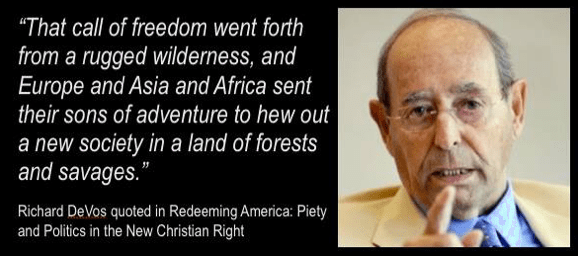
When Rich DeVos and Jay Van Andel founded the Amway corporation, they did so by embracing some of the most deeply entrenched lies about this country. Rich DeVos has written numerous books that promote his values. In his book Believe, DeVos, in talking about freedom, states, “that call of freedom went forth from a rugged wilderness, and Europe and Asia and Africa sent their sons of adventure to hew out a new society in a land of forests and savages.”
An early critique of Amway and their ideological stance came from a student at Calvin College in 1971, who wrote:
The most important issue in maintaining a wealthy economy is maintaining the control of the raw materials needed by American industries to keep producing the finished products. The United States simply does not have the raw materials to maintain its wealthy economy. Almost every significant raw industrial resource that American industries use is imported from poverty-stricken Third World countries in African, South America and Asia. Thus, the American Way has a vested interest in maintaining control over the countries from which the resources come. The continuation might be maintained by sheer economic brute force, by political manipulation or rewarding governments which are friendly to us, by CIA-inspired coups who are not cooperative with us or by wars to “maintain freedom” and to “prevent the spread of communism.”
Another early public challenge of the power and influence of Rich DeVos came from a Grand Valley State College student in 1977, when DeVos was a member of the Board of Control (similar to a Board of Trustees). The student called into questions DeVos and his unwillingness to allow students to have a say in school policy.
This example from GVSC continued right up until his death, since DeVos has contributed millions of dollars to the school, often with strings attached. Many people who attended William James and Thomas Jefferson Colleges before the school became GVSU, has stated that Rich DeVos lobbied heavily for the school to shed its counter-cultural history and adopt a more market-based school with an emphasis on business.
In 1994, when faculty and staff at GVSU were meeting with then President Lubbers over the university’s willingness to offer domestic partner benefits, word got out that this was going to happen. At the time GVSU was raising money for a proposed health education building on Michigan St and Peter Cook and Rich DeVos had pledged millions. Once DeVos and Cook found out about the proposal by GVSU to offer domestic partner benefits, they threatened to withdraw their financial support if the university would support a domestic partner benefits policy. GVSU acquiesced to the wish of DeVos and Cook. For further reading on Rich DeVos and GVSU check out What’s in a Name: A Popular Guide to Wealth & Influence at GVSU and our film A People’s History of the LGBTQ Community in Grand Rapids.
Anti-LGBT Legacy of Rich DeVos
The example from GVSU of DeVos threatening to withhold money from the university if they provided domestic partner benefits is just one example of Rich DeVos’ legacy of supporting anti-LGBT campaigns and organizations.
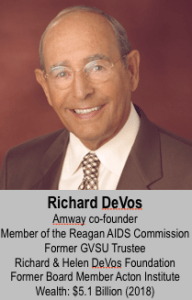 For decades, through his foundation, Rich DeVos funded anti-LGBT groups and Christian organizations that had adopted a homophobic and transphobic position, like the Family Research Council, Focus on the Family, the Coral Ridge Presbyterian Church and the National Organization for Marriage. These organizations identified themselves as pro-family, but what they really were promoting was a hetero-normative, patriarchal family structure, which was never tolerant of people who identified as gay, lesbian, bi-sexual, transgender or queer. Rich DeVos contributed millions to these entities, in part, because they were anti-LGBT.
Other more specific examples of DeVos and his anti-LGBT stance came in the late 1980s when he was appointed to President Reagan’s AIDS Commission. HIV/AIDS had been devastating the LGBT community for years before the federal government created this and the LGBT community was demanding that the federal government take action.
With the appointment of this commission, Reagan was able to appease those who demanded a more sustained federal response to AIDS. He also answered the concerns of the New Right by appointing an AIDS commission that included few scientists who had participated in AIDS research and few physicians who had actually treated people with AIDS. In addition, the commission included outspoken opponents of AIDS education, such as New York Cardinal John O’Connor. O’Connor was not only opposed to AIDS education, he was openly hostile to the Gay community.
Another openly hostile opponent of the LGBT community was Rich DeVos, who was also on Reagan’s AIDS Commission. In an interview with MLive a few years ago, DeVos made some pretty revealing comments about his attitudes towards the Gay community while sitting on the AIDS Commission.
When HIV first came out, President Reagan formed a commission and I was honored to be on that commission. I listened to 300 witnesses tell us that it was every body else’s fault but their own. Nothing to do with their conduct, just that the government didn’t fix this disease. At the end of that I put in the document, it was the conclusion document from the commission, that actions have consequences and you are responsible for yours. AIDS is a disease people gain because of their actions. It wasn’t like cancer. We all made the exceptions for how you got it, by accident, that was all solved a long time ago. That’s when they started hanging me in effigy because I wasn’t sympathetic to all their requests for special treatment. Because at that time it was always someone else’s fault. I said, you are responsible for your actions too, you know. Conduct yourself properly, which is a pretty solid Christian principle.
Not only does DeVos show his homophobic bias, his comments demonstrate his ignorance of the issues surrounding HIV/AIDS.
On the issue of same sex marriage, DeVos was also an active opponent, providing at least $20,000 to fight the ballot initiative in Michigan in 2004 and another $100,000 for the ballot initiative in Florida in 2008.
Some people have claimed that in his later years, Rich DeVos had a change of heart, as was demonstrated by his family’s donation to the families of the victims of the Pulse nightclub shooting in Florida. While it is true that the family made such a donation, there was no acknowledgement that DeVos had funded the anti-LGBT marriage proposal in 2008 and that he had given millions of dollars to John Kennedy’s Coral Ridge Presbyterian Church for decades, a church that is based in Florida and preached on the evils of “homosexuality” for decades, thus cultivating a climate of hate directed at the LGBT community.
Funding Right Wing Organizations that do harm
Beyond identity politics, Rich DeVos was also a champion of funding what are often referred to as conservative groups. However, such a label is not adequate, since many of the groups that DeVos funded were ideologically motivated and embraced far-right policy positions and above all a neo-liberal capitalist framework.
I wrote about the funding of these organizations in 1998, in an article entitled, Giving til it hurts others. Rich DeVos continued to give to some of these same entities right up until his death, groups like the American Enterprise Institute, the Heritage Foundation, the Free Congress Foundation, the Mackinac Center for Public Policy, the Acton Institute and a whole range of groups that sought to undermine social welfare policies, re-direct public funds to the private sector, an attack on labor unions, the privatization of education and the re-regulation of environmental laws and the financial sector.
The Heritage Foundation, for example, was a major architect of the Reagan administration’s policies to downsize government and to attempt to undermine social welfare policies.
Closer to home, DeVos has supported the Acton Institute, the Grand Rapids Chamber of Commerce and the West Michigan Policy Forum, all of which support the same neo-liberal capitalist platform we mentioned above. What is important to note about these groups and the funding they have received from Rich DeVos, is that all of these groups are working towards a radical reconstruction of government and society, one that is based on market principles. These groups all are involved in provided research and documentation that supports their ideological positions, that are them used to influence policy makers at the local, state and federal level.
Rich DeVos bought a lot of political influence
In addition to funding organizations that fit in the ideological framework of DeVos, he made it a point to buy as much political influence as possible. Depending on the source, some claim that Rich DeVos contributed roughly $200 million to candidates or incumbents since the early 1970s. According to opensecrets.org, DeVos had already contributed more than $1 million in the current election cycle.
Rich DeVos has contributed to the Republican Party at the federal and state level, plus he has contributed to specific candidates running for federal, state and local office from Michigan and in other states. DeVos has also contributed to support or oppose ballot initiatives in Michigan and throughout the country as well.
The amount of money that Rich DeVos has contributed to buy political influence is staggering, but it is also important to note that his contributions directly influence policy. Lets look at a few examples from recent years.
In June of 2014, Governor Snyder signed into law HB 4052, a law that takes away local control. Why is this relevant, because powerful entities like the DeVos family do not want local communities adopting policies like a living wage, regulations against wage theft or adopting anti-discrimination ordinances that would include or add anti-discrimination protections for the LGBT community.
HB 4052 was introduced by Rep. Earl Poleski (R) and then went to the Committee on Commerce & Trade, which is chaired by Joseph Graves (R). Graves received $9,000 from the DeVos family for his re-election bid in 2014, along with several other members of the Committee on Commerce and Trade. This committee recommended that HB 4052 be adopted and then it was put before the Michigan Senate. The Michigan Senate sent the bill to the Competitiveness Committee chaired by Mike Shirkey (R). Rep. Shirkey received $4,500 from the DeVos family for his re-election bid in 2014, as did several other members of this committee.
A second example would be a bill that was also signed into law the summer of 2014, HB 4188. This legislation, often framed as a religious freedom bill, would allow adoption agencies in Michigan the ability to deny LGBT couples/partners/families from adopting.
HB 4188 was introduced by Rep. Andrea LaFontaine (R). Rep. LaFontaine received $8,100 in campaign contribution in 2014 from the DeVos family. Many of the cosponsors of this bill were also recipients of DeVos family funding.
A third example would be legislation that was passed in September of 2017, legislation that is sort of a Citizens United for Michigan, allowing for greater amounts of money to be contributed during elections. We documented that in the Michigan Senate, most of those who voted for the legislation had received money from DeVos.
The “benevolence” of Rich DeVos
One additional major claim that has been made in recent days is how benevolent Rich DeVos has been and how much money his foundation has contributed to charitable causes.
First, it is important to note that no matter what year one looks at the 990s from the Richard and Helen DeVos Foundation, most of the larger donations are going to entities like the megachurch Willow Creek Community Church, the Haggai Institute, the American Enterprise Institute or Americans for Prosperity. Giving millions to groups like these is not charity, it is the funding of ideologically-driven groups that try to influence public policy or are engaged in work that does actual harm to people.
Second, the money that Rich DeVos has contributed to more traditional charity groups or service organizations, goes specifically to those organizations because they do not address root causes of problems or take a systemic approach to dealing with social ills. The non-profits that DeVos has contributed money to provide services to individuals who are looking for assistance in some way, but Rich DeVos never gave money to groups that were focused on challenging systems of oppression or those who encourage direct action to fight injustice. Contributions to non-profits helps to create a buffer between those in the capitalist class and those who could potentially be organized to challenge the wealth of the capitalist class, as we documented in our recent series on the Grand Rapids Power Structure. Obviously, a great deal more could be said about Rich DeVos and his wealth, power and influence. However, this article should provide you with ample evidence to counter the narrative from the commercial media since his death last week.
If you want to read more about Rich DeVos and his family, check out our DeVos Family Reader entitled, We’re Rich and We Do What We Want.
The Canonization of Rich DeVos: Even in death the news media acts as stenographers to power
 It has begun. With Thursday morning’s announcement of Richard DeVos Sr.’s death, the news media has already begun to canonize the billionaire co-founder of Amway.
This treatment of DeVos was expected, since for years the news media, particularly the West Michigan news media, has acted as stenographers to the most powerful family in the area.
The narrative that the news media has crafted around Rich DeVos and his family has been decades in the making, as we have documented over the years. The narrative that has been created is similar to what Sarah Schulman calls the “gentrification of the mind” or what the great revolutionary thinker Franz Fanon referred to as the “colonization of the mind.”
This colonizing of our minds, in the case of the Rich DeVos, has much to do with how we are taught about the capitalist myth of the self-made man. We are taught very early that people like Rich DeVos made their money without anyone’s help. In addition, the news media in West Michigan has been telling us since the 1970s that Grand Rapids would not be what it is if it weren’t for Rich DeVos. This cumulative impact of a specific narrative is important for our understanding of how so many people have embraced this belief and why it is so important to think about the narrative that the news media has created about Rich DeVos.
Stenographers to Power
There have been numerous stories in the national news media, including the New York Times and the Washington Post.
However, it is more relevant to focus on the West Michigan media, since they have had a more intimate relationship with the DeVos family and have been reporting on the family for decades.
One thing that I found instructive, was just how quickly the Grand Rapids-based news media had constructed a narrative about Rich DeVos. The MLive story was posted at 11:00am on Thursday, just a few hours after it was announced that DeVos died. Not only was it instructive to see how quickly the local news media crafted these stories, it was also instructive about how much media has been crafted in such a short time. This not only includes a written narrative, but dozens of photos and video. Now, it is certainly possible that the local news media already had something created in anticipation of his death and some might say that is just journalism being prepared. However, it doesn’t take into account the consistency in the narrative about Rich DeVos. It’s as if the news media talked to each other and agreed that they were all going to do nothing but celebrate the Amway co-founder in whatever stories they produced.
All of the local news outlets have put forth a similar narrative about Rich DeVos, whether we are talking about MLive, WOOD TV 8, WZZM 13 or WXMI 17. Here is a list of themes constructed by the news media about Rich DeVos
- He was a successful businessman.
- He made his own wealth.
- He and his family are generous contributors to charity.
- Rich DeVos revitalized downtown Grand Rapids.
- He was a major contributor to the Republican Party and other conservative causes.
- Rich DeVos helped GVSU move from a college to a university.
- He became a sports owner in the 90s by purchasing the Orlando Magic basketball team.
- He was a motivational speaker.
Now, there were a few references in the local news coverage that made it seems as if the coverage was balanced. Amway business practices were discussed in terms of the claims of the Canadian government that the company engaged in fraud, but this was settled and Amway agreed to pay a fine. However, those who have challenged the narrative about Amway have not limited their criticism to just the Canadian incident, they have looked at the business structure and the corporate culture as well. For a further investigation of this, please see the book Amway: the cult of free enterprise, by Stephen Butterfield.
There was also some reference to DeVos being on President Reagan’s AIDS Task Force in the 1987. However, this reference on MLive just mentioned that activists protested this appointment and then quoted DeVos saying, “That was probably one of the most difficult years of my life. It was the first time I began to not sleep at night. It wasn’t so much the criticism. It was the enormity of the problem and the people who were suffering with it. I think it raised my sensitivity. I became far less critical.”
Apart from these few mild criticisms, the rest has all been media pundits and other influential people gushing about what a great man Rich DeVos was. WOOD TV 8 political reporter Rick Albin kept talking about how DeVos remade the city of Grand Rapids and they kept showing a clip of DeVos saying that this was his town……without any irony on their part.
Then there was Catherine Behrendt with WZZM 13, who also spoke about DeVos. Behrendt spoke of him as if he was a saint and then did a walk down memory lane with some video footage of her and Rich in his home showing her pictures and allowing her to be there while he was exercising on the treadmill.
However, maybe the most disgusting display of stenography by the local news media was not only their reading of the DeVos family statement, but the inclusion of several tweets from grandson and founder of ArtPrize, Rick DeVos. And it is important to note that the TV stations in particular did not just read these tweets at one point in their coverage, they kept going back to tweets from Rick DeVos throughout their coverage.
One other demonstration of the news media’s complicity in canonizing Rich DeVos, is the fact that WOOD TV 8, at the bottom of their main story on DeVos, included a link to an RDV Corp website that tells the story of Rich DeVos.
On Monday, we will provide a counter-narrative to the life of Rich DeVos in an article we are tentatively calling, An Honest Obituary for Rich DeVos. In the meantime, check out our DeVos Family Reader entitled, We’re Rich and We Do What We Want if you want information that is not filtered by the commercial media.
Grand Rapids CityFest 2018: The perfect religious event that provides cover for wealth, power and privilege
 Over the past few months there has been a tremendous amount of marketing being done for the Grand Rapids 2018 CityFest.
There are billboards on all the highways running through the city, yard signs, radio advertising and tons of online promotions for the event that will take place this weekend.
When I went into my local Lake Michigan Credit Union this week, there was a stack of promotional tickets by the coffee for CityFest as well. These tickets featured musical guests, a Family Fun Zone, FMX Demos and featured speakers Luis and Andrew Palau.
So what is CityFest, who are entities backing it financially and why is important for people to pay attention to what this event means for West Michigan?
Financial backing for CityFest
There are numerous entities backing the 2018 CityFest, including businesses, Christian radio stations and Christian schools like Calvin College, Cornerstone College and Spring Arbor University. However, the two entities backing this religious gathering that should grab our attention are the Acton Institute and the Doug & Maria DeVos Foundation.
Many of the sponsors who are backing CityFest are clearly known for their support and promotion of conservative religious values, but having the Acton Institute and the DeVos family involved raises even more questions about what the real purpose of such an event is.
CityFest 2018
According to its own promotional material, CityFest is:
a major region-wide campaign focused on serving the region and proclaiming a message of hope. And it all culminates on September 8-9 as we celebrate with great music and Good News at Ah-Nab-Awen Park. Produced by the Luis Palau Association, this event is in partnership with hundreds of local churches, businesses, and non-profits.
CityFest is not your typical religious revival, but it does have all the trappings of the traditional come to Jesus events. CityFest is a hip, contemporary tent revival that seeks to be a family-friendly event, combining sports and music as a pretext to bring people to hear main message from the Palau family.
In addition, CityFest includes what is called the One West Michigan message. Check out this video for the One West Michigan effort.
So, One West Michigan wants to mobilize people to do charity work around affordable housing, racial equity and education. While this is what they call their focus areas, in looking at the three areas and what they are advocating, it is clear that what the One West Michigan effort and CityFest is all about is getting people to do charity work, which is to say don’t question the system.
Much of what the One West Michigan project seeks to accomplish is to channel people into doing religious work, mostly through non-profits. In the area of housing, they direct people towards the Inner City Christian Federation, but they don’t raise questions about why so many people can’t afford the skyrocketing costs of housing. The affordable housing section states: Safe, stable, and affordable housing is crucial for families working their way out of poverty. People are not working their way out of poverty, people are experiencing poverty based on an economic system that rewards greed and excess.
The Racial Equity section, use the same old West Michigan Nice rhetoric, such as the need to provide more opportunities for people. There is no analysis of systemic or structural racism and a deep history of white supremacy in West Michigan.
In the area of Education, the One West Michigan entity wants to insert more Christianity into schools, get pastors to partner with principals and to direct people to groups like National Heritage Academies, a national for profit Charter School organization run by J. C. Huizenga.
This brings us to the features speakers, Luis and Andrew Palau. Next to Billy Graham, Luis Palau is possibly the most globally known evangelist today. Latin America is his area of high notoriety, but in the past 2 decades he has made significant inroads in the US, Europe and even the former Soviet Union. So why would Christians in West Michigan, an area that is staunchly Christian/conservative, bring this Oregon based evangelist to town?
Palau is “clean” by certain evangelistic standards. He has no publicly known past sexual blemishes, nor has he been investigated for fraud or tax evasion. Palau even states that he is disgusted with the type of TV evangelists that have given his work a black-eye. Palau is an evangelist in the traditional Christian bible believing sense. He believes that accepting Jesus as your personal savior is paramount, but he also believes in capitalism and nurturing political connections when serves his purposes. Thus, more than anything, Palau affirmed the status quo attitudes of many West Michigan residents, especially in business and political circles.
Palau and his activities have been reported in dozens of article in Christianity Today during the past 40 years. During that time Palau was in Somoza’s Nicaragua, where, unlike the community of Solentiname, a Nicaraguan Christian based community under persecution, he was welcome with open arms. In 1977, Palau was greeted and accompanied on his crusade by Colombian president Alfonso Michelsen, not particularly known for being a human rights advocate. Also in the 70’s Palau visited Bolivia with the help of an organization known as Food For the Hungry (FFH). According to Sara Diamond’s book Spiritual Warfare, FFH “argues that poverty is rooted in individuals’ belief systems and by extension, in cultures supposedly conducive to underdevelopment and poverty.” (Diamond pg 226) The founder of FFH, Larry Ward, was also with Palau on that trip. Ward, a former overseas director of World Vision “was known to have a close relationship with South Vietnamese and US military leaders.” In 1982, Palau brought his crusade to Paraguay, under the brutal dictatorship of Alfredo Stoessner. According to recently released documents there was massive execution of civilians during Stoessner’s reign. (see Covert Action Quarterly, Fall 1994). Stroessner’s government gave Palau his approval to distribute 100,000 bibles and study courses to children nationwide.
After the fall of the Berlin Wall, Palau was crusading in the Soviet Union. In 1989, Palau was said to have brought the first open-air evangelism of its kind. The Christianity Today article quoted Kent Hill as a Soviet specialist who was pleased with the outcome of Palau’s crusade. Kent Hill is with IRD, who I mentioned earlier. In 1992, Palau was in Mexico and was given the title “Distinguished Visitor” by Mexican neoliberal president Carlos Salinas. In Mexico that title has previously been given only to the Catholic Pope and the Dali Lama.
Probably the most revealing article was a May, 1983 interview that Chritianity Today did with Palau. In my mind it clarifies the theology and politics of this crusader. Palau had just returned from Guatemala when this interview was conducted. Christianity Today asked Palau “How much control does President Rios Montt have of the army? (Palau) To turn a nation around as he has, knowing Latin Americans and how independent we are, that has got to be the helping hand of God. Generally, it appears he’s given the right instructions urging the people to do the right thing, and putting it on the basis of righteousness. In the first weeks in office he said, ‘I will not lie, I do not cheat, and I do not abuse my powers.’” For anybody who knows anything about the history of Guatemala this statement is utterly false.
Efrain Rios Montt became president in 1982 via a military coup. During his 18 months in power Montt presided over a genocidal campaign waged against the Indigenous and poor of that country. Americas Watch documented the atrocities in which women were frequently raped and children were bayoneted to death or smashed against rocks. Even one of Montt’s supporters in the church El Verbo said, “The Army doesn’t massacre the Indians. It massacres demons, and the Indians are demon possessed; they are communists.” (Diamond pg. 166)
Some of Palau’s connections have also helped to further these repressive policies in Guatemala and elsewhere. Frequently, when Palau travels he is accompanied by a representative from Bible Literature International (BLI). In the early 1980’s BLI helped to distribute hundreds of thousands of bibles to army personnel and civil patrol units in Guatemala, for what was known as “Operation Whole Armor”, another counterinsurgency tactic developed by Rios Montt. BLI, which began in 1923, has been distributing bibles and bible literature throughout the globe as an attack communism, most notably in Guatemala, Honduras and El Salvador. In El Salvador they are said to have sent bibles to everyone in the Salvadoran telephone directory. As former president of Overseas Crusades, one of the largest US-based missionary organizations, Palau was able to utilize their connections as well. According to Sara Diamond, Overseas Crusades “said that at one time virtually all of its personnel were being debriefed by the CIA. Debriefings included questions by the CIA on the internal politics of remote Third World regions and detailed questions on Indigenous religious and political leaders.” (Spiritual Warfare pg. 207) So much for being a clean evangelist.
On the 100th anniversary of Protestantism in Guatemala (1982), Montt invited as the main speaker Luis Palau, who predicted that Guatemala would be the first majority Protestant country in Latin America. In many ways that was not just a prediction, but a promise. More than any other Latin American country Palau and his ministry team works diligently to spread their message in Guatemala. Guatemala is the distribution center for Palau’s radio and TV shows in Latin America. At least 17 radio stations and one TV station runs Palau’s message within the country. Palau also has a newspaper column in one of Guatemala’s largest dailies La Prensa Libre, where it is published twice a week. Palau also publishes 2 magazines Cruzada and Continente Nuevo. This all has a tremendous impact on the rise of evangelical and Pentecostal churches in Guatemala. Some estimates say that 35-40% of the population is now Protestant. Many analysts attribute this rise to what is referred to as salvation theology, a theology that focuses on personal salvation and hopes for a better life in the next world. In many ways much of Guatemala is ripe for this type of theology. In a country that has one of the worst human rights records in the Western Hemisphere this type of theology has a certain emotional and psychological appeal. As a way of dealing with the incredible pain and suffering that so many Guatemalans have endured, it is quite understandable that huge numbers of people would embrace this pie in the sky world-view. But lets not kid ourselves about the role that the US funded Guatemalan military has in helping this process along.
During the scorched-earth campaign under the regime of Rios Montt many “model villages” were set up as an attempt to pacify the areas that had been traditionally more sympathetic to the guerrilla movement. Many of the Palau-type evangelicals were invited in to help pacify the people, often using USAID food to win them over, in what Montt called his “Beans and Guns” program.
All of this is to say that Luis and Andrew Palau fit the message and mission of the those who have the real power in West Michigan. As father and son, the Palau’s can deliver a message of prosperity that not only masks the systems of oppression at play in West Michigan, it provides additional cover for the Grand Rapids Power Structure to make sure that their power is not scrutinized, allowing them to continue to expand their wealth and influence throughout the community. CityFest 2018 allows them another great opportunity to do just that.
GRPD’s recent detaining of black youth was just following procedure and it was racist
 In late August, the GRPD received a call stating there were black youth with a gun seen in the area of Alto Avenue and Griggs Street SE. Several blocks later the GRPD stopped three black youth, at gunpoint, then handcuffed them and put them into a police cruiser. It was then determined that none of the black youth stopped had a gun and they were no longer suspects.
This incident took place just a few days after GRPD officers surround the house of a Latino family, detained and handcuffed the father for an hour, even though it was eventually determined he did nothing wrong.
On August 30th, Grand Rapids Police Chief David Rahinsky responded to questions from local media about the police stopping at gunpoint 3 black youth in the southeast part of Grand Rapids. You can watch the video of the news conference with Rahinsky by going to the GRPD’s Facebook page pasting for August 31st at 2:38PM.
The video doesn’t reveal a great deal, but it does demonstrate that Rahinsky has received a great deal of training in how to deal with the media. Rahinsky was questioned about racial profiling and the mother’s reaction to the way her son was treated. Chief Rahinsky kept referring to the mother’s response as “emotional” and that once she sees the video the cops have, she will better understand what happened.
Like so many people in positions of power, Rahinsky is dismissive of the mother’s reaction to the way her son was treated and labeling it as “emotional” is patronizing and arrogant.
In the press conference, Rahinsky essentially defends what his officers did in this situation and says that it follows the GRPD’s Youth Interactions Policy. Looking at the policy, it seems like the GRPD officers did act accordingly. In fact, I would say that based on the history of policing in the US and how policing actually functions, that Rahinsky is right to support how his officers responded to this incident.
Now, don’t get me wrong, I am not agreeing with how the youth were treated by the GRPD. I loathe and detest the kind of harm and trauma that people in this community experience at the hands of the GRPD on a regular basis, particularly people of color. However, let’s be honest about the behavior of the GRPD in this case, as they did follow procedure. But just because someone follows procedure, doesn’t make it right.
The GRPD officers were doing what they are supposed to do, because this is exactly what police departments do. Alex Vitale, in his important book, The End of Policing, states:
“Well-trained police following proper procedure are still going to be arresting people for mostly low-level offenses, and the burden will continue to fall primarily on communities of color because that is how the system is designed to operate – not because of the biases or misunderstandings of officers.”
The GRPD apprehension of the black youth in the southeast part of Grand Rapids because they fit the description of someone who had a gun, is what they do. The police behavior is the norm and it is normalized because it is based on a long-standing historical practice of white supremacy, which means that communities of color are more heavily policed than other communities.
What we need to do is stop being surprised when this kind of harm by the police is done to people from black and brown communities. We need to organize and resist this kind of state violence, but we need to stop believing that their actions are abnormal. The hyper-policing of black and brown communities is the norm, because this is the function of state violence within the framework of white supremacy.
The power and potential of organized Immigrant Labor: Labor Day Part III
In Part I of this series we looked at the growing wealth gap in the US and in Michigan, along with how communities of color disproportionately are impacted by poverty.
In Part II, we looked at how most major organized labor groups have hitched their cart to the Democratic Party, which has led them to a decline in membership and why they need a new strategy.
In today’s post, we want to look at the power that immigrant labor has and why it is important for those of us who have privilege in this society to support the organizing efforts of immigrant labor.
In the 1960s and 70s, the United Farm Workers (UFW) demonstrated to the American people that when organized, migrant labor and immigrant labor has tremendous power. Led by people like Dolores Huerta and Cesar Chavez, the UFW brought the big agriculture to its knees with their grape and lettuce boycotts.
This type of organized labor power is still being demonstrated today, with groups like the Coalition of Immokalee Workers (CIW). The CIW is not only exposing the exploitative nature of agribusiness, they are showing how migrant and immigrant workers have tremendous power to make change.
Immigrant labor, whether it is in the fields, in the restaurants or other service industries,when organized, has the capacity to bring the country to a stand still. Think about it. Immigrant labor is what give us our food……they pick our fruits and vegetables, the work in the slaughterhouses and they are the fastest growing sector of restaurant kitchen and wait staff.
At the same time, the working conditions of immigrant labor in the food sector, along with the disgustingly low wages, means that agribusiness and the restaurant sector is able to make huge profits. When these workers are organized, like the CIW, they are able to demonstrate the power that immigrant labor has.
In West Michigan, the capacity of immigrant labor is one of the largest in the nation, after California and Florida. There is a large concentration of immigrant/migrant farm workers in West Michigan. The unfortunate reality is that this labor force is not organized and there is no effort on the part of the mainstream unions to provide support for these workers to organize themselves so that they can demonstrate their power.
Imagine for a moment, if the mainstream unions in West Michigan gave the same amount of money they contribute to the Democratic Party every election cycle and instead re-directed those funds to immigrant laborers. Imagine what would happen if these workers who pick, prepare and serve our food in West Michigan had their own union. Imagine how the both white conservatives and white liberals would react. Would people who don’t do this kind of back breaking work, offer their support for such a union?
What would happen during ArtPrize, if those who picked, prepared and serve food would all of a sudden go on strike? What if those who went on strike would also refuse to clean the hotel rooms and change the linen for all those tourists who are coming to look at art in the coming weeks? What would people do if they couldn’t drink craft beer, because those who harvest the hops in Michigan and beyond, all of a sudden went on strike demanding better wages and working conditions?
If those who work in these sectors went on strike, it would cause the economy to come to a halt AND it would demonstrate the power that immigrant labor has in this community and across the country. Just imagine the possibilities.

Once you are done imagining the possibilities, then do something about it. First, you could support the efforts of Movimiento Cosecha GR, which is always working with immigrant labor in West Michigan and every year is calling for a general strike around May Day. Second, if you are part of a union, propose that the labor union you have a membership in, provide financial and technical support to immigrant laborers who want to organize where they work. Lastly, get your church, your faith community, your neighbors, your co-workers or any other group of people that is not self-absorbed to educate themselves on how dependent we all are on immigrant/migrant labor in the US.
Workers and unions need a new strategy: Labor Day Part II
In Part I of this series, we looked at the growing wealth gap in the US and in Michigan, along with the data around poverty, especially within communities of color. In today’s post, we want to take a critical look at campaign financing that comes from organized labor and what that means in terms of advancing the struggle for worker rights and worker justice.
 Labor unions were formed with the primary objective of defending workers rights, pushing for worker demands and to create workplace democracy. There have been some unions in the history of the US, particularly the IWW, that was fundamentally against capitalism, but still fought for workers rights and workplace democracy. However, most unions have not made the abolition of capitalism a goal, instead they have focused on worker conditions, wages and workplace democracy.
Organized labor unions have fought and won the 8 hour work day, workers compensation, workplace safety, better wages, pensions, improved workplace environment and the abolition of child labor. These were all victories that workers fought for, since they were never a gift from bosses, corporations or members of the capitalist class. For an important overview of this history, see From the Folks Who Brought You the Weekend, by Priscilla Murolo and A.B. Chitty.
However, since the end of WWII, labor union have been losing ground on numerous fronts. The number of workers in the US that are part of a labor union has steadily declined since the 1950s. The Taft-Hartley Act of 1947 was a major blow to workers, since it attempted to make strikes, particularly wildcat strikes illegal.
The de-industrialization in the US, also weakened worker unions, as did the rise of globalization, which included trade agreements that fundamentally undermined unions and workers rights in general. However, a major factor in the weakening of organized labor has been its decision to attach itself to the Democratic Party, especially i the past 50 years. Now, before people dismiss this point, I ask you to think about 2 things. First, how much money have unions and their members dished out in recent decades to support Democrats, and second, how has that money resulted in worker justice and increased workplace democracy?
Unions and the Financial backing of the Democratic Party
If we look at the data provided by the Center for Responsive Politics, we can see what the major unions have contributed to the Democratic Party since 1990. Lets take a look at four examples, especially four of the major labor unions in the US; the United Auto Workers, the AFL-CIO, the National Education Association and the American Federation of State, County and Municipal Employees.
Since 1990, the UAW has contributed nearly $55 million to Democrats and spent another $40 million to lobby members of Congress.
The AFL-CIO has contributed just shy of $66 million to Democrats and spent another $91 million lobbying Congress.
AFSCME has contributed $116 million to mostly Democrats and another $47 million to lobby Congress.
The National Education Association has contributed $128 million to Democrats and another $53 million on lobbying Congress.
This means that these four major unions combined have spent $365 million to influence elections and another $231 million to lobbying those already elected. What this says is that these four unions have used $596 million of their members money to try to influence election and policy at the federal level since 1990.
In Michigan, the trend is not much different. If you look at the data provided by the Michigan Campaign Finance Network (MCFN) for all the state races in the 2018 election, you will see that the Democratic candidates have received hundreds of thousands from various labor unions within the past 18 months and will continue to receive thousands more before the November election. In addition, some of the largest Political Action Committees in the state are labor unions, which you can also see from the MCFN.
A more specific example of how unions have spent money during an election cycle, was in 2012, when unions spent $21.9 million to pass Proposal 2. The business community however, spent $25.9 million to defeat the measure, which it did. Just after the November election in 2012, there was a major rally held in Lansing, where some 10,000 workers and allies came to protest the austerity measures being passed by the state, particularly making Michigan a Right to Work state. Unfortunately, instead of occupying the capitol building or shutting down Lansing, most of the rally organizers proposed that they get their people elected in 2014……….which didn’t happen.
What have unions and workers won with millions going to the Democrats?
It will be argued that if unions did not support Democrats with millions during elections in recent decades that the GOP would have pass even more draconian laws to further weaken labor laws and give private capital even greater power. This may be true to some extent, but what such an argument doesn’t take into account, is the fact that in the heyday of the labor movement – late 19th Century through 1945 – is that workers won a great deal without primarily aligning themselves with the Democrats. In fact, what labor historians have made clear is that the labor movement, by engaging in massive organizing efforts and using direct action were the reasons why they won so many labor disputes.
In more recent decades, say during the years that the 8 years of the Clinton administration and the 8 years of the Obama administration, we need to ask what major labor victories took place? My read on those years was that there were no major labor victories, but there was a steady decline of union membership and numerous set backs for working people. Think of the number of trade agreements that were enacted since 1992, when NAFTA went into effect. The massive WTO protest in Seattle took place in 1999, while Clinton was in the White House.
During the Obama years, the only significant thing that organized labor asked from the Obama administration was to not sign on to more trade policies like the TPP and to pass the Employee Free Choice Act (EFCA). The TPP did not pass, despite the Obama administration’s support of it and the EFCA never got any traction. Again, unions may argue that if they had not financially backed Democrats then workers would have lost more ground.
Time for a new Labor Movement/Labor Strategy?
Ok, so lets say that organized labor decides to stop funding the Democratic Party and instead focuses on movement building. Union members could still vote for Democrats if they chose, but they could be part of a new labor movement that would not be beholden to political parties and could actually affect change.
There are already some signs to workers and unions pushing for more transformative justice. There is the $15 an hour movement, the numerous teacher strikes across the country and there are efforts to organize workers from corporations like Amazon. However, these efforts are often unconnected and they are not primarily focused on workplace democracy.
First, what if organized labor used the funding that they would have put towards elections and use it for paying people to organize shops and other work places? Not only would this scare the shit out of the capitalist class, it would give more workers an opportunity to be part of a union that actually fought for them. This kind of union organizing should also take place outside of specialized work and organize migrant labor, service sectors, restaurant workers and the unemployed.
Second, workers could engage in wildcat strikes, walkouts or other forms of direct action that would force companies to the table. In demonstrating their power, workers could negotiate wages, benefits and workplace dynamics that would result in victories. As individual shops and work places win labor battles, these same unions could join other labor struggles and support workers who were fighting get get a union and all the possibilities that come with being organized.
Third, unions could re-direct the money that they were spending for elections and lobbying to provide mutual aid to families that are experiencing poverty, facing foreclosure or any other economic hardships, including the corporate-driven health care costs. Not only would this kind of mutual aid help build relationships with working class people, it could result in an increase in union membership.
Fourth, what is the labor movement began to develop their own independent media. The commercial media will not represent the collective struggles of workers, in large part because they are dependent on advertising dollars from the very entities that exploit workers. We used to have a lively labor press in the US, but so little of that exists now. We need an independent media that tells the stories of the people whom the commercial media ignores. With an independent media, more people will have access to information that the commercial media marginalizes or represses. I’m not talking about just online media, I’m talking about labor-based press, a newspaper that is run by and for workers. Such a tool and other forms of media are weapons we need in the war of propaganda that the capitalist press is winning.
These proposals are not necessarily new, since much of what we have been talking about has been done before, with a great deal of success. However, we do need to do some things differently from what organized labor has done in the past.
Fifth, the worker-led movement needs to also connect to other movements around fighting white supremacy, patriarchy, ablism, homophobia, transphobia and fighting for food justice, immigrant justice and climate justice. Class issues can bring us together, but only if we do not make class the center of all justice struggles. The new work-led movement needs to be intersectional and transformative and not settle for just fighting against capitalism, but creating new economic systems that are democratic, local and multifaceted. We can take a cue from the wobblies who believed that, “An injury to one is an injury to all.”
Inequality in Michigan is business as usual: Labor Day Part I
As we approach Labor Day 2018, it is always important for us to pause for a moment and look at the realities of the economy in Michigan.
We constantly hear in the commercial news media, from the business press and from politicians that the economy is doing well and has recovered from the 2007-2008 crash. We are also reminded by the capitalist class in West Michigan that the economy is strong and that those with tremendous wealth are working to make the economy even stronger.
However, the question we should always ask is for whom is the economy strong……..who benefits? In 2016, we reported that Grand Rapids had the largest wealth gap of any city in Michigan. It that report we documented that there were 600 millionaires in Kent County alone. The one percent class continues to grow daily, with the wealth gap growing at an unprecedented level. The new graphic below, shows by state, how much money one needs to make to be part of the one percent class.
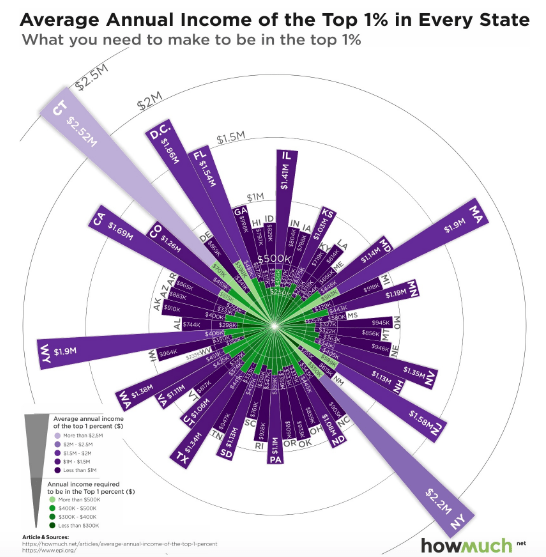
In Michigan, according to this data/graph, you need earn $918,000 to be part of the one percent class. In West Michigan, we know the names of some of these one percenters, like DeVos, Van Andel, Secchia, Jandernoa, Kennedy, Hunting, etc, which also happens to be the class of people who spend a great deal of their time working to influence public policy, through groups like the West Michigan Policy Forum.
 In contrast, there are huge sectors of the population across the state and right here in West Michigan, who are struggling to stay alive. According to a new report from Prosperity Now, 29.2% of Michigan households live in poverty and 49.4% of renters in Michigan are cost burdened.
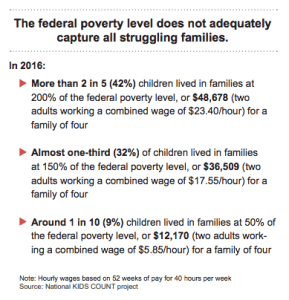
The national trend isn’t much better. According to the Kids Count national data, as you can see in the graphic here on the right, millions of families are experiencing poverty while the wealth gap continues to grow.
This dynamic of family and child poverty disproportionately impacts communities of color, with African American, Native American and Latino/Latinx communities suffering the worst of the wealth gap. The data below comes from the 2018 Kids Count report.
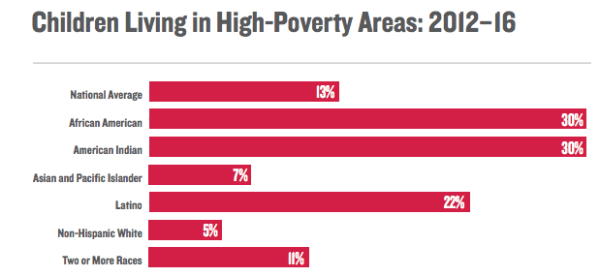
 In Michigan, the data for children living in poverty, especially children from communities of color, demonstrates the deep racism and white supremacy that permeates the structural realities for millions across the state. (see graphic on the right)
This data is disturbing, but we have to come to terms with the fact that it is the result of how policy works and how it benefits the one percenters in this state. This wealth gap, with so few having so much, with so many having so little, is by design.
Those who craft policy, who contribute the most to political campaigns and who are part of the one percent class, benefit from the poverty of families and children, especially families and children from communities of color.
There are the occasional news reports about this kind of poverty and the structural racism that is part of it, but those few stories are drowned out by the constant celebration of new market rate housing developments, the new breweries, the new restaurants, the ongoing development stories and the stories about the benevolence of the one percent class “who give us so much.”
Make no mistake about it, there is a class war going on and the one percent class, the business class, the capitalist class is winning……………but it doesn’t have to remain that way. In Part II of our Labor Day series, we’ll look at the status of unions in Michigan and how we need to imagine a different strategy for working class families.
 A new zine, created by one of the arrestees, is a great introduction to issues like civil disobedience, immigrant solidarity and the campaign to end the contract that Kent County has with ICE.
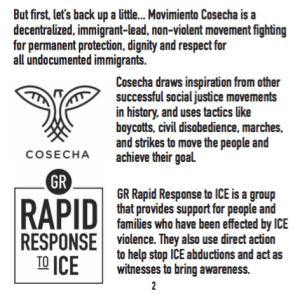 The 23-page zine also has great visuals that walks people through every step of an action that took place on June 28th of this year, when 7 people engaged in civil disobedience to shed light on the current contract that Kent County has with Immigration and Customs Enforcement (ICE).
This One Small Thing looks at the action, the groups involved, the arrest  process, being booked into the Kent County Jail, the jail food, the legally required phone call, the visit with the nurse and the bonding out process, along with the amazing support that was offered to those who chose to participate in the direct action.
You can download the entire zine at this link and we encourage people to share it as the campaign to End the Contract is still happening, with an action coming up on September 13th.
2018 West Michigan Policy Forum Conference seeks to develop a strategy to further undermine public education and labor unions
 We are only one month away from the 2018 gathering of the state’s most powerful people, at what is called the West Michigan Policy Forum Conference.
On September 24th, the West Michigan Policy Forum will hold its bi-annual conference to determine and work on policy that benefits the interests of the state’s capitalist class. According to the promotional narrative for the conference, the West Michigan Policy Forum states that it will, “set an aggressive 2018-19 state policy agenda to keep Michigan moving in the right direction.”
The focus for this year’s conference will be on workforce development and talent development. Both of these terms are simply code for how to transform educational systems in to creating obedient workers that will benefit the business community.
The current Chairman of the West Michigan Policy Forum (WMPF), John Kennedy (also CEO of Autocam), recently wrote an op-ed for the Detroit News about the upcoming WMPF. In that op-ed, Kennedy writes:
“As business leaders, it’s our responsibility to help Michigan keep its position as a welcoming home for both companies and employees. We need to ensure that our children have access to excellent education and that our families have the quality of life they deserve.”
However, we have heard these claims before. In that same op-ed, Kennedy makes it clear what happens at these conferences and what they have achieved in the past 10 years – killing the Michigan Business Tax, the personal property tax, making Michigan a Right to Work State and pushing through legislation to take away pensions for teachers and other workers in the public sector.
The conference this year, like all previous gatherings, is to create an agenda for how to change state policy. Look at the line up of speakers that the 2018 conference will feature:
- Tawni Hunt Ferrarini – The Hammond Institute for Free Enterprise at Lindenwood University on Understanding our State’s Fiscal Health
- Tony Seba, Stanford University
- Doug DeVos – Re-think” Talent and Education
- Arthur Brooks, American Enterprise Institute on Back to Work” – Moving People Back to Work: Why Work Matters
- Dr. Edward Montgomery, Western Michigan University on Michigan Investment vs. Results in K-12 Education
- John Kennedy, CEO Autocam Medical on Increasing Michigan’s Prepared Workforce of the Future
- Jeb Bush, former Governor of Florida on Florida’s Education Story: A-F Policy for School Buildings
- Dr. Steven Perry – An avid promoter of charter schools, Dr. Perry has been criticized for his aggressive anti-teachers union stance. And last year, the educator was accused of perpetuating “respectability politics” for suggesting dreadlocks and afros did not promote an “aesthetics to success.”
For those who care about public education and labor unions, the strategies that this conference will be developing are vitally important to us to understand. Not only is it vital for us to understand what the business class is up to when it comes to education and labor, we need to resist it and make sure that their plans are defeated.
 Grand Rapids Institute for Information Democracy