Three families from West Michigan are in the top 15 across the state for election contributions
 More campaign finance data is being tallied in Michigan and we now know which wealthy families are contributing more money to influence the upcoming November election.
The Michigan Campaign Finance Network lists the top 15 families in Michigan that have contributed the most to the current election cycle. Topping the list was failed Democratic Gubernatorial candidate Shri Thanedar, who contributed $10.7 million.
 Coming in a close second was the DeVos Family, spending $7.1 million in the current election cycle. Interestingly enough, the DeVos Family was not the only member of the West Michigan capitalist class in the top 15 in the state of Michigan. Coming in 10th place is the Kennedy Family, which contributed $863,000, followed by the Jandernoa Family coming in 15th place, with a total of $592,000 in contributions to influence the November election.
 In our recent series on the Grand Rapids Power Structure, we looked closely at the DeVos Family in Part II of the series, and in Part III we looked at other members of this elitist group, which included John Kennedy and Michael Jandernoa.
It is no surprise that DeVos, Kennedy and Jandernoa are involved in many of the same organizations in West Michigan that also work hard to influence state and local policy, such as the West Michigan Policy Forum, the Right Place Inc, the Acton Institute, Talent 2025 and Business Leaders for Michigan.
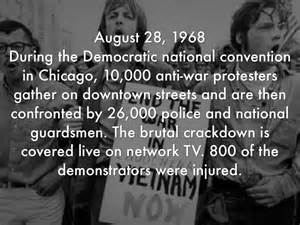 1968 was a year that saw the assassination of Martin Luther King Jr and Presidential hopeful Bobby Kennedy. However, 1968 also saw revolution happening on a global scale, with insurgent movements challenging oppressive governments.
In the US, the anti-war movement was just getting started in its opposition to the Vietnam war. People were refusing induction, US troops were going AWOL and starting their own newspapers that exposed US imperialism. US soldiers returning from the war in Vietnam had energized the anti-war movement, so much so that the movement began to challenge those in power.
Anti-war organizers then came to the 1968 Democratic National Convention in Chicago, attempting to push the party to adopt an anti-war stance as it related to Vietnam and the rest of Southeast Asia.
Chicago Mayor Richard Daley wasn’t having any of it, calling on the police to crack down on anyone who intended to disturb the convention. With TV news crews broadcasting live, the whole nation witnessed a Democratic Mayor order the police to beat anti-war protestors at the Democratic National Convention.
Such a display of utter contempt for popular protest by the Democratic Party led many people in the movement to abandon the belief that electoral politics was a mechanism for real change. Of course the Democratic Party lost the Presidential election to the Republican candidate Richard M. Nixon and Congress (still controlled by the Democrats) continued to vote for massive military expenditures for Vietnam, sending tens of thousands of US soldiers to die and more than a million Vietnamese civilians.
The belief that change outside of electoral politics increased after the 1968 elections on numerous fronts. The black liberation movement also didn’t put faith into electoral politics and militant organizations sprung up all over the country. There was the Black Panther Party for Self-Defense, which not only believed in self-defense, they also practiced radical mutual aid by implementing breakfast programs and drug rehabilitation programs throughout the country. This same type of organizing led to groups like the American Indian Movement, the Chicano Liberation Movement, the Young Lords and other identify-based groups to take matters into their own hands instead of trusting the government.
At the same time the LGBT movement had also become more militant with the 1969 Stonewall Riot and the formation of groups like the Gay Liberation Front. The various strains of the US feminist movement also began generating more attention with their actions around sexism, gender inequality and reproductive justice. We often forget that the US Supreme Court ruled in favor of reproductive rights for women in 1973, even though the President was Richard M. Nixon.
The labor movement also took to more militant tactics by using wildcat strikes, organizing against speedups, with major victories in the coal mines, the agricultural sector, the automobile industry and at the post office. In fact, with these labor victories it was the peak period for real wages, which have been steadily declining for decades, along with union membership.
All of this direct action and all of this organizing was being done primarily outside of electoral politics and it was working.
Lessons for Today
- Political and social movements can and should exist outside of electoral politics.
- Electoral politics might complement the work being done by movement organizing, but it can never replace it. When voting is a tactic, it can be an effective tool. When voting is a strategy it is the death of social movements.
- The social movements of the late 60s and early 70s were movements NOT non-profits. Social movements work on the root causes of injustice. Non-profits provide services to individuals who are facing a crisis. It’s no surprise that the rise of non-profits began just after the radical movements of the late 60s and early 70s.
- Considering how much more money is being injected into electoral politics today (Billions) think of how that kind of money could support local and national movements. What if Unions gave the same kind of money to families living in poverty as they do to candidates? Not only would financial support for people likely result in an increase in union memberships, it would assist in building a larger base of support to engage in direct action to unionize places of employment all across the country.
- Social and political movements should remain autonomous from political parties. Social and political movements that are tied to political parties end up having little say in party politics and their issues are often ignored by political parties because, “we have to focus on getting our people elected first.”
- If social and political movements practiced a more intersectional analysis, it would allow them to see how their issues are interconnected and give them greater opportunity to collaborate on actions. The current abolish ICE/immigrant justice movement and the abolish prisons movement are essentially working towards the same goals and if their collective analysis saw how immigrant detention facilities and prisons were the same or how cops and ICE officials were essentially the same, they would be more likely to support each others struggle. We are seeing some of this now with the National Prison strike and the Abolish ICE movements. This is largely because these movements are being led by those most impacted, those who are currently prisoners and the immigrant communities.
- Autonomous and independent social movements that engaged in direct action and demonstrated their power would ultimately force political parties to ask what they can do for these respective movements. Right now social movements are constantly being shamed by political parties to support their candidates and turn out their people to vote. If social movements were autonomous and demonstrated their power, political parties would be forced to seek out movements for their marching orders. Of course, if social movements were strong enough, we wouldn’t need political parties as we could eventually transform communities that no longer need representation or political parties which have made it clear that they only serve their own interests.
Yesterday, after those involved with the End the Contract campaign had left the Kent County Commission meeting, Commissioner Antor spent over six minutes defending the county’s contract with ICE by using the same narrative that the current administration does.
Commissioner Antor also said several other things in his attempt to “set the record straight,” comments which we want to deconstruct. However, we are posting the video here so that people can draw their own conclusions based on the comments of Commissioner Antor.
One of the main themes of Commissioner Antor’s comments was that ICE was not arrested people just because they are “illegal aliens” ( he actually referred to undocumented immigrants as illegal aliens), but because they were dangerous people. The claim that undocumented immigrants are dangerous – murderers, rapists, etc – was a narrative that Donald Trump used during his 2016 campaign for President and it has been a narrative that he has continued to use within the past few months.
The number often cited by the current administration is that undocumented immigrants have killed 63,000 people since September 11, 2001. There are numerous media sources that have refuted this claim, beginning with Snopes.com, which dismantled this claim this past June.
If you are suspect of Snopes.com, then we only need to turn to more mainstream sources such as the New York Times, the Washington Post or National Public Radio, all of which has fact checked the claim that undocumented immigrants are dangerous murderers. The NPR story is particularly compelling, since they cite four separate studies to refute the meta-narrative that undocumented immigrants are dangerous criminals.
It was interesting that the only sources that Commissioner Antor cited were Immigration and Customs Enforcement and the Sheriff’s office. Antor cites these sources as if they are unbiased and factual, because of course law enforcement agencies would not lie or mislead the public. Or would they?
Earlier this year, the International Human Rights Clinic (based in Chicago) obtained through the Freedom of Information Act some 4,600 pages of documents from the Department of Homeland Security, demonstrating widespread abuse of immigrant children who were in detention.
In April of this year, the investigative online journal, The Intercept, discovered that there were over 1,200 of sexual abuse of immigrants in US detention, mostly at the hands of ICE officers. The Intercept also found that even though over 1200 complaints were filed that only 43 were investigated.
This counter narrative confirms the information that those involved with GR Rapid Response to ICE have been sharing about the weekly calls they receive from immigrant families that have been impacted by ICE arrests and detentions. What GR Rapid Response to ICE has been hearing is that most people are being picked up by ICE for minor infractions, not for “dangerous” criminal behavior.
Another point that Commissioner Antor made in his remarks was that the number of ICE arrests that required beds at the Kent County Jail was trending down. What those of us in the End the Contract campaign have been saying over and over again is that even one family that is being terrorized by ICE is too many in Kent County.
Commissioner Antor then makes a comment about how the ICE arrests and deportations did not begin under the current administration, but with the Obama administration and why were those protesting not acknowledging this. First, ICE arrests and detentions began during the George W. Bush administration, when ICE was created. Second, the End the Contract protests have always acknowledged that ICE arrests, detentions and deportation under the Obama administration were unjust. In fact, if the commissioners ever bothered to ask or look into Movimiento Cosecha they would realize that this movement began by Latino/Latinx youth who forced the Obama administration to adopt DACA. However, those same youth that gave birth to Movimiento Cosecha also then wanted protections for their parents and other family members who were facing deportation, so the truth is that resisting the ICE and anti-immigration policies of the Obama administration is what brought about the movement.
In addition, the fact that the current End the Contract campaign is only now challenging the County about their ICE contract, is because the campaign only found out nine months ago that Kent County even had a contract with ICE. What really pisses off Commissioner Antor, the other commissioners and the Sheriff’s Department is that fact that Movimiento Cosecha GR and GR Rapid Response to ICE has made the county’s contract with ICE public.
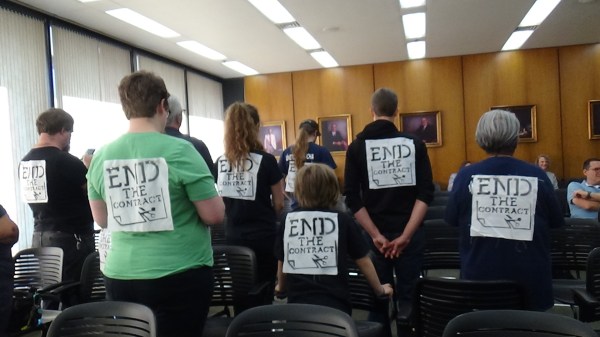
Lastly, Commissioner Antor accused those involved in the protests at the Kent County Commission meetings over the last 2 months of being “uncivil,” even though at yesterday’s meeting people stood silently while the commission meeting continued. The counter narrative is that people involved in this campaign have engaged in CIVIL disobedience and CIVIL resistance precisely because of the fact that families right here in Kent County are being separated by ICE, which includes the complicity of the County because of their contract to allow ICE to hold immigrants at the Kent County Jail. Commissioner Antor is upset that people are challenging him and his fellow commissioners. The commissioners are bothered by the fact that people from their community are engaging them in ways that are outside of their comfort zone, which has become so apparent from the very beginning of the campaign.
At the first meeting, Chairman Saalfeld ended the meeting and he and most of the other commissioners walked out so that they didn’t have to listen to the testimony from the people most affected by ICE violence. Then the county put up barriers to separate themselves from the public and now funnel people through a narrow area to where public comment takes place. This all happens during meetings that take place at 8:30am on a Thursday morning, which makes it impossible for most people who work first shift or have children, to even attend a county commission meeting to talk about issues they care so deeply about. At the August 6th meeting that Movimiento Cosecha GR and GR Rapid Response to ICE had with county officials, these issues were brought up and the only response that was given was, “this is the way they have always done it.” Well maybe it is time for Kent County to do things differently, to practice democracy more authentically, and more importantly, to actually listen to members of the immigrant community and their allies who want them to end their contract with ICE immediately!
This morning about 15 people went to the Kent County Commission meeting to once again demand an end to the contract the county has with Immigration and Customs Enforcement (ICE).
The group reading the following statement in English and in Spanish during the public comment and afterwards, everyone stood up and turned their backs to the commission, each wearing an End the Contract patch.
“It has been two months since we began our campaign to End the Contract that Kent County has with ICE.
During those two months we have come to every County Commission meeting to demand an end to the contract, we have circulated a petition with over 1,700 signatures, we have demonstrated during the 4th of July celebrations, we have visited to home of the Kent County Commission Chairman, we have held a rally at the Kent County Jail and we have meet with County administrators, commissioners and members of the Sheriff’s Department.
 The answer we keep getting from county officials is that they will not end to contract with ICE. The Sheriff’s Department tell’s us that they are obligated by law to do so, yet numerous cities and county governments across the country have ended their contract with ICE. County Commissioners have told us that they do not have the power, which we completely disagree with.
In addition, county officials have completely dismissed the lived experience of the immigrant community, which is being terrorized by ICE. County officials have heard directly from the immigrant community about how they are being harmed by ICE violence and they have been presented with information about the weekly calls that GR Rapid Response receives from the immigrant community that has been targeted by ICE.
Therefore, let us make it clear to everyone, that we will continue this fight to end the contract, we will continue to speak out against the harm that ICE is doing in our community, we will continue to support the families that are being separated by ICE and we will continue to attend county commission meetings until the contract is terminated and the county is no longer complicit in the violence against the immigrant community that is being done by ICE.”
What was ironic is that there were several items on the Kent County Commission agenda devoted to adding cops to communities within the county, adding school cops in several communities and then discussing (in closed session) police labor council agreement. The commission could talk about more policing and contracts, but said nothing about the ICE contract.
During the second Public Comment period, Gema Lowe (with Movimiento Cosecha GR) spoke and demanded that the ICE contract be put on the next agenda, which is September 13. Gema was surrounded by other people who are part of the End the Contract campaign and after she spoke the entire group left.
The whole point of the tactic today was to make it clear that, even though the End the Contract campaign has asked to be put on the agenda over the last two months, the County Commissioners have repeated ignore them and to dismiss the stories that the immigrant community has been sharing directly or stories that have been told by allies every time the campaign has interacted with county officials.
(This report comes to us from GR Rapid Response to ICE, which interviewed family members who were traumatized by the GRPD.)
 We got a call today that a Latino man in our community had been targeted and threatened by the Grand Rapids Police Department for allegedly stealing a vehicle. The family called GR Rapid Response to ICE team for support because they were worried that as he is Latino, that he would be potentially falsely charged, detained or event deported.
The following is a series of events beginning in the early hours on the morning of August 22nd.
At approximately 1:30 am in the morning the Grand Rapids Police surrounded the family’s house, and over a loud speaker, demanded that an alleged suspect they were chasing, come out of their house.
Most of the family was asleep inside, but the man’s wife came out with nothing to fear and hoping to help clear up any confusion, to a barrage of police vehicles and officers demanding that everyone come out of the house. She was pulled aside, searched and questioned about her and her partner’s potential involvement with a stolen vehicle that the police chased near to their home. She counted about ten GRPD vehicles on the street.
Then her partner, their small child and other guests were all removed from the house and questioned about their involvement with this stolen vehicle as well.
The police then handcuffed and placed her partner in the backseat of a police cruiser and read him Miranda rights. He was questioned and held in the back of the cruiser for nearly an hour while the police ran his name and his ID through the police database.
They accused him of lying about his whereabouts, and claimed they had personally seen him drive the vehicle, park and exit the stolen vehicle, and run into the family’s home through the back door. They accused him of being out of breath from running.
He “fit the description” of the suspect, except for his clothing, which the police claimed personally witnessing him change through a window in the home.
All false accusations.
The police then claimed that his and her stories didn’t match up and that made the police even more suspicious.
While the family were being questioned outside, several Grand Rapids Police Officers then entered the home, with the sleeping children still inside, to search for anyone else, and for any evidence.
None was found, of course, and police released him and removed the handcuffs.
Before he and the family were allowed to go back into the home, the police officers told him that they were now going to collect fingerprints from the stolen vehicle and come back and arrest him for stealing it.
After the interrogation, body searches, false accusations and holding, the family attempted to comfort their traumatized child who witnessed his father being held in the back of a police car, his mother searched, and his home invaded with his siblings inside.
As far as they could determine, no other people in their neighborhood were treated in this way, and they couldn’t understand why the police would lie and accuse him of committing a crime when he did absolutely nothing wrong.
Once all safely indoors, the family then contacted GR Rapid Response to ICE, a lawyer, and family members for support. He requested that we write this report so that others know about this profiling and mistreatment by the Grand Rapids Police Department.
His wife took photos of his wrists where the handcuffs had been put on too tightly. He also noted that his shoulder was hurt during the detainment and due to a previous collar bone injury he was experiencing physical pain today.
They also expressed that they were worried about leaving their home for fear of being targeted and falsely accused of committing this crime. They also expressed that they were worried about their child’s mental health after witnessing the event. Members of GR Rapid Response to ICE reached out for professional support for the child’s mental health and offered sanctuary as an option as well.
The most disturbing factor is his realization was that the Grand Rapids Police Department lied about seeing him personally commit a crime that he did not commit, and that they could potentially lie again, collaborate with ICE to falsely detain him, and potentially take him away from his family and life here in Grand Rapids.
Many people in West Michigan live in fear of being accused of committing a crime when they have done absolutely nothing wrong. Many immigrants and Latinx folks worry that their families will be torn apart because they are perceived as a danger to society.
A fundraiser may be posted shortly for this effected family’s legal fees should ICE or the GRPD place charges against him.
The most recent data is now available for election contributions in the 2017-2018 election cycle.
There numerous sources available to find this data, such as the Michigan Secretary of State, the Michigan Campaign Finance Network and the Center for Responsive Politics.
On the Center for Responsive Politics site, you can also search by zip code and see who is contributing the most to elections in your area. For example, the 49503 zip code, which includes downtown Grand Rapids, contributes more money than any other zip code in the city. And the large amount of money coming from the 49503 zip code is almost exclusively because of the DeVos Family.
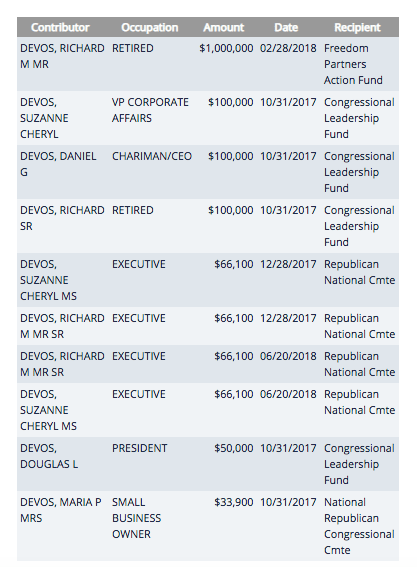
The DeVos Family owns homes all around the country, but they use their downtown Grand Rapids address as the address for political contributions, according to the Federal Election Commission.
The graphic below is a listing of the 10 contributions from the 49503 zip code and not surprising, all of them are from the DeVos Family.
In this next graphic, you can see who the family is making political contributions to.
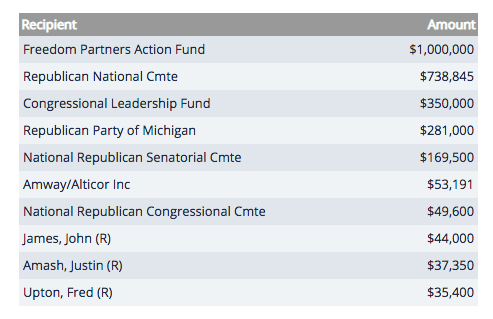
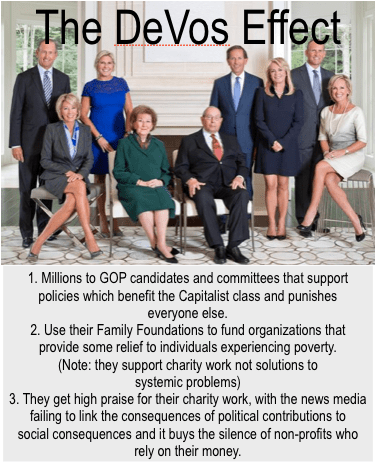 Considering what we know about the policies and practices of the Republican Party, the amount of money that the DeVos contributes is exactly why we cannot be seduced by any of their other projects like Start Garden, ArtPrize, AmplifyGR or what their foundations give money to. The amount of harm the DeVos Family contributes to through their support of the GOP creates the poverty and social conditions, which often results in people seeking out social services by organizations that many of the DeVos Foundations fund. This dynamic creates a perfect circle, where the DeVos Family political influence leads to a greater wealth gap divide, which leads to non-profits requesting grant money from the family foundations, which generates lots of great PR for the family and it buys the silence of organizations that claim to be part of the solution.
I once worked for a priest who abused children: Sexual Assault and the Pennsylvania Report on abuse by Catholic Priests
A new report was published recently that documents the systemic abuses by Catholic priests in the state of Pennsylvania.
Last week Democracy Now devoted two segments to this issue, with one segment looking at information about 300 priests abuses over 1,000 children and the Catholic Church covered it up. The second segment interviewed someone who was a survivor of abuse and a former priest who left and is now works for an organization that provides support to the victims of predatory clergy.
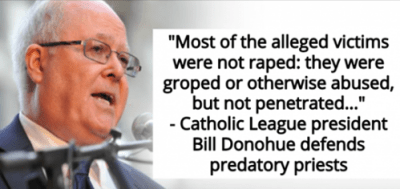 The second segment from Democracy now referred to the Catholic Church as a “criminal enterprise,” because of how they have tried to cover up and suppress that the abuse had been occurred. Considering the evidence, it doesn’t seem unreasonable at all to refer to the church’s role in the cover-up of the abuse by the priests as a criminal enterprise. What else do you call an institution that sanctions abuse and then tries to cover it up?
What is equally alarming are some of the responses to the new evidence of priests abusing children and the church hierarchy covering it up. A few days ago the president of the Catholic League made a statement in response to the claim that the priests raped these children.
This is an obscene lie. Most of the alleged victims were not raped: they were groped or otherwise abused, but not penetrated, which is what the word “rape” means.
Such a statement not only reflects how institutions consistently defend violence, it demonstrates a complete lack of empathy for the victims and the trauma they are experiencing and will experience for the rest of their lives.
This sort of sentiment from leaders in the Catholic Church is not unusual. In 2015, a New York Catholic Bishop claimed that the priests who have engaged in abuse of children can’t take all the blame. Bishop Robert Cunningham of the diocese of Syracuse, NY, stated that the “age of reason in the Catholic church is seven, so those boys are culpable for their actions.”
The recent reporting on the new evidence that the Catholic Church has once again attempted to cover up the abuse and harm committed by priests against children has led me to reflect a bit about my own experience working in the Catholic Church.
I once worked for a priest who abused children
I came to Grand Rapids in 1982, because I was offered a job as a youth minister at St. James Catholic Church. At the time, I had just returned from working as a teacher in a small school in Puerto Rico and wasn’t sure where I would land, so I took the offer from a priest to come to Grand Rapids.
The priest at St. James who invited me to work there was Fr. Charles Antekeier. Antekeier was a rather conservative priest who was part of the Catholic Charismatic movement, which adopted some fundamentalists religious views, but maintained a deep commitment to Rome and the church hierarchy.
I loved the work with the youth, both at the grade school and through the congregation, but I soon realized that Fr. Antekeier was a rather rigid leader and would not tolerate anyone who questioned him. A friend of mine at the time, who was head of the Peace & Justice committee at the church had organized an event to hear from two local priests who had just come back from Nicaragua to talk about the role that some catholic priests were playing in the revolution there. Fr. Antekeier was not pleased by this event and made it a point to invite Nicaraguans to speak at a mass the following week. However, the Nicaraguans he invited were part of the Word of God community in Ann Arbor, which was a reactionary group that supported the Nicaraguan dictatorship that had been overthrown in 1979.
I was then told by Fr. Antekeier that I needed to go to Ann Arbor and spend a week at the Word of God community, so I could be presented the real truth about what was happening there. I refused, saying that I already had work commitments with the youth of the church. Fr. Antekeier then told me to pack my stuff and leave that same day, as I was fired from my job.
In 2015, Fr. Charles Antekeier was permanently removed from doing any ministry work, since it was revealed that while he was pastor of St. James Church, he abused youth in the parish in the early 1980s. I remember seeing a news story about this and then read the formal statement from the Grand Rapids Catholic Diocese.
I was not surprised by this revelation, since I always had a suspicion about Antekeier’s relationship to the families at St. James, especially since his authority could not be questioned. However, I do struggle with the fact that this priest was probably abusing children while I was working at the church and I had no idea it was taking place.
There have been several other Catholic priests in Grand Rapids who have also been accused of abuse, some who were sued and others who have had legal action taken against them. However, the primary response by the Catholic Church is to reassign them to another parish, to place them in jobs that minimize public interaction or to allow them to live out their lives without any real consequences.
 The other day, I re-watched the film Spotlight, which dramatizes the Catholic Church cover-up of priest abuses in Boston over several decades. In one scene in the movie, Micheal Keaton’s character is having a drink with a guy who is a lawyer that works for the Catholic Church. The lawyer is trying to pressure Keaton’s character to stop the investigation by the Boston Globe and Keaton’s character then says, “this is how it happens isn’t it. A guy leans on a guy and suddenly the whole town just looks the other way.”
We can’t continue to look the other way. We have to stand up, speak out and do whatever it takes to not allow this kind of harm, this kind of abuse, this kind of violence to continue. As Dr. King once said, “Silence is the voice of complicity.”
Movimiento Cosecha GR and GR Rapid Response to ICE held a rally at the Kent County Jail yesterday, in their continued effort to get the county to end their contract with Immigration and Customs Enforcement (ICE).

Unlike all of the previous actions for the End the Contract campaign, there was limited commercial media coverage for this action. There were two Spanish language news entities present, but only one mainstream daily news outlet, WXMI Fox 17.
There are actually two versions of the WXMI 17 story, one that is written online and one that aired during the 10pm newscast on Saturday, August 18th, both of which can be viewed at this link.
 The written version of the Fox 17 story, provides some background on the campaign, making mention of the June 28th action at the Kent County Commission meeting, followed by a brief explanation of the relationship between the Kent County Jail and ICE.
The written story from Fox 17 then cites two people with Movimiento Cosecha, both of which talk about how this is a human rights issue and how many undocumented immigrants end up in the jail because of a drivers license violation, which then allows ICE to put a hold on those individuals.
The article ends with some data provided by rally organizers about the amount of money the county makes per undocumented immigrant that ICE has a hold on. The article does cite one source from the Kent County Sheriff’s Department, but never identifies who it is.
The story that aired on Fox 17 last night is somewhat different. First, the news reader provides a different frame for the rally than the written version. The broadcast version does include comments from two different Cosecha GR members, but it is worth mentioning that the second source cited was interviewed on Friday at a different location, which is different from what the written version communicates.
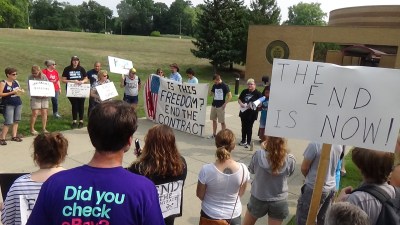 Third, the unnamed Sheriff’s Department officials state that the contract with ICE “reimburses” the jail for housing undocumented immigrants for ICE and that they “cannot break the contract, because they are simply following the law.”
A major difference in the broadcast version was that they interviewed Monica Sparks, who is running as a Democrat for Kent County Commissioner this November. Sparks said that the county should let the federal government deal with this matter and that other cities have ended their contracts with ICE in recent months, although the reporter did not verify that claim.
This was unfortunate that the Fox 17 reporter did not mention that there was someone from Kalamazoo Cosecha who talked about the fact that the County Commissioner there recently passed a resolution prohibiting the county from using any of its resources to support ICE. In fact, the resolution was read to the people gather at the rally.
Monica Sparks running for office has generated some controversy, since some people have claimed she used to be a Republican delegate, has been endorsed by Right to Life and coached four teens who organized a rally in 2016 in downtown Grand Rapids, a rally which featured the Grand Rapids Chief of Police. Black Lives Matter GR had written a statement saying they would not endorse this event, because the GRPD was provided a platform to speak and instead protested Chief Rahinsky when he spoke.
What you wouldn’t know about the rally from Fox 17
- There were several speakers from the immigrant community, which shared stories of the fear that they live under because of ICE being in Kent County. Not reporting on how the affected community is impacted by ICE violence means that people reading or watch the Fox 17 story were denied the opportunity to put a human face on this injustice.
- A school social worker talked about how ICE repression in the area is tearing apart immigrant families.
- Someone from GR Rapid Response talked about the work they do providing support to immigrant families who have been impacted by ICE arrests.
- Another person talk about an upcoming national prison strike and how the abolish ICE movement is directly connected to the abolish prisons movement, especially since more people have become aware of the conditions within ICE detention facilities and the abuses against immigrants by detention workers/guards.
- There was also information shared about numerous ways that people could be involved in the End the Contract campaign, along with being invited to support the work of Movimiento Cosecha GR and GR Rapid Response to ICE.
In the end, the story by WXMI 17 did not really further the public understanding of why the Kent County contract with ICE should be ended and why so many people are participating in the campaign.
There is a movement in Kent County to end the contract that the County has with Immigration and Customs Enforcement (ICE).
Beginning in late June, this new movement (which was initiated by Movimiento Cosecha GR and GR Rapid Response to ICE) began by mobilizing nearly 200 people to attend a Kent County Commission meeting to demand an end to the contract, which we reported on.

The initial action made it clear to the organizers of this campaign that county officials – administrators, the Sheriff’s Department and County Commissioners – were in no way interested in ending the contract with ICE. Since then, several commissioners have made public statements about how they have no power to end the contract and that the Sheriff’s Department holds all of the power.
The End the Contract campaign doesn’t believe that to be true and has pressured the commission to take a public stand against the contract and to use their authority over the budget to pressure the Sheriff’s Department to end the contract. So far, none of them have publicly agreed to do so.
The campaign is organized around the belief that real power resides in social movements and not with elected officials. We have seen in recent weeks the news media, elected officials and those who work for political parties express a contrary view. These sectors believe that they have the real power and the only way for the public to make progress is by getting “the right people” elected so that change can happen. However, this view of power and history is not supported by the history of social movements. From the Abolition movement to the Labor movement, the Civil Rights Movement to the Environmental Justice movement, change happens when people are organized to make the change that is necessary. Those in power never freely promote social justice. In fact, any change that might happen legislatively, has only ever come when social movements are strong enough to force elected officials to enact policy that the public wants.
This is the case with the End the Contract campaign, which seeks to mobilize enough people to ultimately pressure county officials to terminate their contract with ICE. In fact, this is what we are witnessing all around the country, where municipalities are ending their contract with ICE.
Even our neighbors in Kalamazoo County, the movement there recently made it possible for the local commissioners to pass a resolution stating in part:

In Kent County the elected officials continue to say that the only the Sheriff’s Department can make such a decision. Interestingly enough, Sheriff Stelma announced last week that he was retiring. In a recent MLive article, Stelma claims it has nothing to do with the protests against the ICE contract, yet it seems hard to believe that the End the Contract campaign had no influence on his decision.
Stelma made some ridiculous comments the previous week, in response to protestors showing up at the home of County Commission Chair Saalfeld’s home, claiming that intimidation isn’t very American.
Sheriff Stelma has been in a defensive posture since the county has had a contract with ICE, beginning in 2012. Here is a video clip, where one of the County Commissioners challenges Stelma over the use of beds by ICE at the county jail.
In addition, Sheriff Stelma (near the end of this video clip) states that the 3 day hold that ICE puts on being being held in the Kent County Jail is a “good” thing, because it gives families three days to be near the person who is being incarcerated at the county jail. Only someone who has the kind of privilege that Stelma has, could see this as something the county is doing that is a benefit to the families experiencing ICE repression.
In addition to attending county commission meetings, the End the Contract campaign has been involved in engaging the public in varying capacities, such as an action at the Fourth of July Parade, being at festivals and utilizing various forms of social media to invite people to be part of this fight to End the Contract.
People are encouraged to stay informed about the End the Contract campaign, by going to the Facebook page and to attend future actions, like the one being organized this Saturday at the Kent County Jail. The campaign is hosting an End the Contract with ICE Rally at the Kent County Jail. The rally will begin with a short march and then include speakers, music and more information about how to be involved in the campaign.
It is through this kind of actions and this campaign that the County will end their contract with ICE. This movement not only has made it a public issue, it will create enough pressure that county officials will have no choice but to respond to the will of the people and End the Contract.
 Grand Rapids Institute for Information Democracy